


1 Chronicles 19:4
- וַיִּקַּחvai·yi·Kachand he tookH3947Conj-w ¦ V-Qal-ConsecImperf-3msVerb Qal Consecutive Imperfect 3rd Singular Masculineוַandיִּקַּחhe took
- חָנוּןcha·NunHanunH2586N-proper-mNoun Proper Masculine
- אֶת'et<obj.>H853DirObjMParticle Object Indicator
- עַבְדֵי'av·Dei[the] servants ofH5650N-mpcNoun Plural Masculine Construct
- דָוִידda·VidDavidH1732N-proper-mNoun Proper Masculine
- וַיְגַלְּחֵםvay·ga·le·Chemand he shaved themH1548Conj-w ¦ V-Piel-ConsecImperf-3ms ¦ 3mpVerb Piel Consecutive Imperfect 3rd Singular Masculineוַandיְגַלְּחֵhe shavedםthem
- וַיִּכְרֹתvai·yikh·Rotand he cut offH3772Conj-w ¦ V-Qal-ConsecImperf-3msVerb Qal Consecutive Imperfect 3rd Singular Masculineוַandיִּכְרֹתhe cut off
- אֶת'et<obj.>H853DirObjMParticle Object Indicator
- מַדְוֵיהֶםmad·vei·Hemtheir robesH4063N-mpc ¦ 3mpNoun Plural Masculine Constructמַדְוֵיrobesהֶםtheir
- בַּחֵצִיba·Che·tziin the middleH2677Prep-b ¦ N-msNoun Singular Masculine Absoluteבַּin theחֵצִיmiddle
- עַד'adtoH5704PrepPreposition
- הַמִּפְשָׂעָהha·mif·sa·'Ahthe buttock[s]H4667Art ¦ N-fsNoun Singular Feminine Absoluteהַtheמִּפְשָׂעָהbuttock[s]
- וַיְשַׁלְּחֵםVay·sha·le·Chemand he sent away themH7971Conj-w ¦ V-Piel-ConsecImperf-3ms ¦ 3mpVerb Piel Consecutive Imperfect 3rd Singular Masculineוַandיְשַׁלְּחֵhe sent awayםthem
English is a literal word-by-word gloss of the Hebrew, not the KJV's wording. Why?
This is the original text the KJV's translators worked from — each Hebrew word with its own literal English meaning in this verse, prepared by scholars at Tyndale House, Cambridge. The KJV translates whole sentences, not word by word, so its wording differs: one Hebrew word can become several English words, and the KJV may choose “the LORD” where the gloss reads “Yahweh”. Both are faithful — they answer different questions. For the KJV's own rendering, switch to the KJV text.
Details
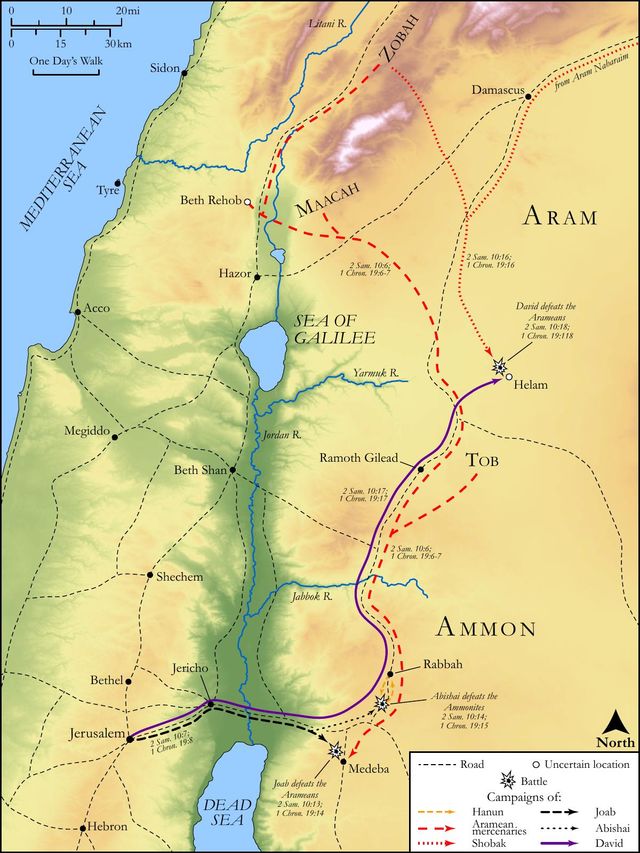
See on the biblical-era map
Study this verse
Public-domain commentary
Matthew Henry
From his Commentary on the Whole Bible. Henry comments on passages, not single verses — this entry covers 1 Chronicles 19:1–5.
Let us here observe, 1. That is becomes good people to be neighbourly, and especially to be grateful. David will pay respect to Hanun because he is his neighbour; and religion teaches us to be civil and obliging to all, to honour all men, and to be ready to do all offices of kindness to those we live among; nor must difference in religion be any obstruction to this. But, besides this, David remembered the kindness which his father showed to him. Those that have received kindness must return it as they have ability and opportunity: those that have received it from the parents must return it to the children when they are gone. 2. That, as saith the proverb of the ancients, Wickedness proceedeth from the wicked, Sa1 24:13. The vile person will speak villany, and the instruments of the churl will be evil, to destroy those with lying words that speak right, Isa 32:6, Isa 32:7. Those that are base, and design ill themselves, are apt to be jealous and to suspect ill of others without cause. Hanun's servant suggested that David's ambassadors came as spies, as if so great and mighty a man as David needed to do so mean a thing (if he had any design upon the Ammonites, he could effect it by open force, and had no occasion for any fraudulent practices), or as if a man of such virtue and honour would do so base a thing. Yet Hanun hearkened to the suggestion, and, against the law of nations, treated David's ambassadors villainously. 3. Masters ought to protect their servants, and with the greatest tenderness to concern themselves for them if they come by any loss or damage in their service. David did so for his ambassadors, Ch1 19:5. Christ will do so for his ministers; and let all masters thus give unto their servants that which is just and equal.
Continue studying 1 Chronicles 19:4 across the web’s major study libraries — every link below opens this exact verse, chapter, or book on the destination site.
Read & Compare
 BibleGatewayThis verse in more than 200 translations and 70 languages.
 Bible.comThe YouVersion reader — hundreds of translations, reading plans, and highlights.
 ESV.orgCrossway's official English Standard Version reader.
 NET BibleThe NET translation with 60,000+ translators' notes on every rendering decision.
 STEP BibleTyndale House's free study tool — original text, vocabulary, and scholarly resources.
 BibliaLogos Bible Software's free web reader.
 USCCBThe New American Bible (Revised Edition) with the U.S. bishops' study notes.
Commentaries
 BibleHub CommentariesDozens of classic commentaries on this verse, gathered on one page.
 StudyLightMore than 100 commentary sets — the largest collection on the web.
 BibleRefPlain-English commentary on what this verse means, verse by verse.
 Enduring WordDavid Guzik's free commentary on this chapter, widely used by Bible teachers.
 Bible Study ToolsVerse commentary alongside Greek and Hebrew study aids.
Original Language & Research
- BibleHub InterlinearThe verse word by word — original language, transliteration, and English.
- BibleHub LexiconEvery word's original-language definition and Strong's entry.
 Blue Letter BibleDeep-study tools — Strong's numbers, concordance, and word studies.
 SefariaThe Hebrew text with Rashi and centuries of Jewish commentary.
Sermons, Hymns & Audio


TrulyRandomVerse is not affiliated with these sites and doesn’t control their content. They’re linked because they’re genuinely useful.
Summary
1 Chronicles 19:4 describes the egregious and deliberate humiliation inflicted by Hanun, the king of Ammon, upon David's diplomatic envoys. This act, involving the shaving of half their beards and the cutting of their garments to expose their nakedness, was a profound breach of ancient Near Eastern diplomatic protocol and a direct, calculated insult to King David himself, serving as the immediate catalyst for a major war between Israel and Ammon.
Context
ShowHideLiterary Context
This verse is situated within the broader narrative of King David's reign in 1 Chronicles, specifically detailing his foreign relations. Chapter 19 opens with David's compassionate gesture of sending messengers to console Hanun, the new Ammonite king, after the death of his father, Nahash. This act of goodwill, likely intended to honor a past alliance or kindness, is tragically and deliberately misconstrued by Hanun and his suspicious advisors. Verse 4 graphically details the shocking and provocative actions taken by Hanun against these envoys, which directly precedes the escalation to full-scale war, as described in the subsequent verses of 1 Chronicles 19. The parallel account in 2 Samuel 10:4 underscores the historical significance and consistent portrayal of this pivotal event across the biblical narratives.
Historical & Cultural Context
In the ancient Near East, diplomatic envoys were typically considered inviolable, and their treatment directly reflected on the sending monarch. Hanun's actions were a maximal insult. Beards were potent symbols of a man's dignity, honor, wisdom, and maturity; their removal, especially half of one's beard, was an act of extreme public disgrace, often associated with mourning, slavery, or deep humiliation. Similarly, garments were not merely clothing but signified social status, identity, and personal modesty. To cut them in such a way as to expose one's "buttocks" (Hebrew miphsâʻâh, referring to the crotch or private parts) was an act of utter public shaming and degradation, designed to render the individuals contemptible and mock their masculinity. Hanun's actions were a calculated political move, perhaps born of paranoia or arrogance, designed to provoke a strong reaction and demonstrate defiance of established diplomatic norms, effectively declaring war without uttering a single word.
Key Themes
ShowHideThis pivotal verse contributes significantly to several overarching themes within 1 Chronicles and the broader Deuteronomistic History. Firstly, it highlights the fragility of peace and the destructive power of mistrust. David's initial overture of kindness is met with suspicion and hostility, demonstrating how easily good intentions can be misinterpreted, leading to catastrophic outcomes. Secondly, it underscores the importance of honor and dignity in ancient society; the profound insult to David's envoys was an insult to David himself, demanding a response to uphold the honor of the kingdom and its sovereign. This theme is further explored in David's subsequent actions to defend his reputation and his people, as seen in 1 Chronicles 19:6-7. Finally, it emphasizes the consequences of poor counsel, as Hanun's rash decision, based on the paranoid advice of his officials, directly precipitates a major regional conflict, underscoring the critical need for wise discernment in leadership, a theme echoed in wisdom literature like Proverbs 15:22.
Exposition and Analysis
ShowHideKey Word Analysis
ShowHideThis primitive root (H1548) properly means "to be bald" or, causatively, "to shave." Figuratively, it can mean "to lay waste." In this context, it refers to the deliberate act of removing the envoys' beards. In the ancient Near East, a man's beard was a profound symbol of his honor, status, and masculinity. To shave it, especially partially, was an act of extreme public humiliation and disgrace, designed to strip a man of his dignity and render him an object of scorn.
This primitive root (H3772) means "to cut (off, down or asunder)." By implication, it can mean "to destroy or consume," and specifically, "to covenant" (originally by cutting flesh). Here, it describes the violent and precise mutilation of the envoys' garments. This was not an accidental tear but a deliberate act of severing their clothing in a specific, indecent manner, designed to expose their nakedness and amplify their shame.
From a root meaning "to stride" (H4667), this word is a euphemism for "the crotch" or "buttocks." The phrase "hard by their buttocks" indicates that the garments were cut so high as to expose the envoys' private parts or lower back. This was an act of ultimate public indecency and degradation, designed to strip the men of all modesty and render them utterly contemptible in the eyes of onlookers.
Verse Breakdown
ShowHide"Wherefore Hanun took David's servants,"
This opening clause establishes Hanun's direct agency and responsibility for the ensuing actions. The phrase highlights the abrupt shift from a diplomatic reception to a hostile seizure of David's official representatives. David's "servants" were not merely personal attendants but emissaries, making their mistreatment a direct affront to David's sovereignty and the honor of his kingdom.
"and shaved them,"
This describes the first of two deeply humiliating acts. The shaving, likely of half their beards (as implied by the parallel account in 2 Samuel 10:4), was a profound cultural insult. It stripped the men of a primary symbol of their masculinity, honor, and social standing, making them objects of scorn and public derision. This act alone was sufficient to provoke a severe response.
"and cut off their garments in the midst hard by their buttocks,"
This details the second, equally egregious act of public shaming. The deliberate cutting of their outer garments at a specific, highly indecent point was designed to expose their nakedness and private parts. This was an act of extreme degradation, intended to strip them of all modesty and dignity, turning them into a spectacle of shame and rendering them symbolically naked and vulnerable.
"and sent them away."
This final clause describes the completion of the humiliation and the calculated nature of Hanun's actions. After being subjected to such profound physical and psychological abuse, the envoys were not held captive or killed but were sent back to David in their disgraced state. This ensured that the full extent of the insult would be seen by David and his court, thereby provoking a direct and unavoidable confrontation.
Literary Devices
ShowHide1 Chronicles 19:4 employs several potent literary devices to convey the gravity of Hanun's actions and their profound impact. The description of the insult itself functions as a powerful Symbolism: the shaved beard symbolizes the stripping of honor, manhood, and social standing, while the cut garments symbolize the loss of dignity, modesty, and public respect. The entire scene is imbued with Hyperbole, where the extreme nature of the physical degradation underscores the immense psychological and social humiliation intended. This verse also serves as a crucial point of Foreshadowing, directly preceding and setting the stage for the intense military conflict that dominates the remainder of 1 Chronicles 19 and 1 Chronicles 20. The Parallelism with 2 Samuel 10:4 highlights the historical importance and consistent interpretation of this event across biblical narratives, reinforcing its significance as a turning point in Davidic foreign policy and a clear declaration of hostilities.
Theological and Thematic Connections
ShowHideThis incident serves as a stark reminder of the destructive power of suspicion, ungodly counsel, and the deliberate intent to humiliate. Hanun's actions, born of paranoia and bad advice from his officials, transformed a gesture of condolence into an act of war. The theological implication is clear: leaders, and indeed all individuals, must exercise profound discernment in receiving counsel and in their responses to perceived threats. Rash decisions, especially those rooted in a lack of trust, fear, and a desire to inflict shame, often lead to devastating and far-reaching consequences. David's subsequent military response, while leading to bloodshed, was also a necessary defense of his kingdom's honor and the dignity of his people, reflecting a king's responsibility to protect his subjects and maintain his realm's integrity against such egregious affronts.
Reflection and Application
ShowHideThe narrative of Hanun's egregious insult to David's envoys offers profound lessons for contemporary life, compelling us to consider the immense damage that can be wrought by suspicion, misjudgment, and the deliberate intent to humiliate. In our daily interactions, whether personal, professional, or even online, the temptation to react rashly to perceived slights or to act on unverified information can lead to irreparable harm and escalate conflicts unnecessarily. This passage challenges us to cultivate wisdom, seek sound counsel, and practice discernment before responding to challenging situations, especially when our pride or honor feels threatened. Furthermore, it highlights the importance of empathy and understanding, recognizing that our actions, even those born of fear or insecurity, can have far-reaching and destructive consequences for others. We are called to reflect: How do we respond when our dignity is challenged, or when others seek to shame us? Do we seek wisdom and reconciliation, or do we allow pride and anger to dictate our actions, perpetuating cycles of hurt and conflict?
Questions for Reflection
ShowHideFAQ
ShowHideWhy was shaving half a beard and cutting garments such a severe insult in ancient times?
ShowHideIn the ancient Near East, a man's beard was considered a profound symbol of his honor, maturity, wisdom, and virility. To shave it, especially only half of it, was an act of extreme public humiliation, akin to stripping a man of his identity and dignity. It was often associated with mourning, slavery, or deep disgrace. Similarly, clothing was not just for warmth or modesty; it signified social status, personal honor, and public decency. To cut someone's garments, particularly in a way that exposed their nakedness or private parts (as "hard by their buttocks" implies), was an act of extreme public shaming, designed to render the individual utterly contemptible and mock their masculinity. These actions collectively were a deliberate and maximal insult, intended to provoke a strong reaction and demonstrate utter contempt for David and his kingdom, as further detailed in 2 Samuel 10:5.
What was David's immediate response to this insult?
ShowHideDavid was deeply offended and concerned for his humiliated servants. Upon hearing of their plight, he sent messengers to meet them and instruct them to remain in Jericho until their beards had grown back, acknowledging their shame and providing a temporary refuge and a chance to recover their dignity. This practical and compassionate response is recorded in 1 Chronicles 19:5. However, the insult ultimately led to war. Recognizing that Hanun's actions were a direct act of war and a severe affront to his honor and kingdom, David mobilized his army under the command of Joab, leading to a major conflict with the Ammonites and their Syrian allies, as described in the subsequent verses of 1 Chronicles 19.
Christ-Centered Fulfillment
ShowHideWhile 1 Chronicles 19:4 details a profound act of human insult and the resulting earthly conflict, it subtly points to a deeper spiritual reality fulfilled in Christ. Hanun's act of stripping David's envoys of their dignity and exposing their shame foreshadows the ultimate humiliation and degradation endured by Jesus, the true King and perfect Ambassador of God. Christ, though innocent and the very embodiment of divine glory, willingly subjected Himself to unspeakable shame. He was stripped of His garments, mocked, beaten, and ultimately crucified naked before the world, as recounted in passages like Matthew 27:28-31 and John 19:23-24. Unlike David's envoys, who suffered for their earthly king, Jesus willingly endured this ultimate public disgrace not for His own honor, but to bear the shame of humanity's sin, becoming a spectacle of suffering so that we, who were once spiritually naked and exposed by our sin, might be clothed in His righteousness (2 Corinthians 5:21). His suffering, the ultimate act of humiliation, was the very means by which God's peace was established, transcending the cycles of human conflict and vengeance, offering reconciliation to those who were once enemies of God (Colossians 1:20).