


1 Chronicles 19:3
- וַיֹּאמְרוּvai·yo·me·Ruand they saidH559Conj-w ¦ V-Qal-ConsecImperf-3mpVerb Qal Consecutive Imperfect 3rd Plural Masculineוַandיֹּאמְרוּthey said
- שָׂרֵיsa·Rei[the] officials ofH8269N-mpcNoun Plural Masculine Construct
- בְנֵיve·nei[the] people ofH1121N-mpcNoun Plural Masculine Construct
- עַמּוֹןa·MonAmmonH5983N-proper-mNoun Proper Masculine
- לְחָנוּןle·cha·Nunto HanunH2586Prep-l ¦ N-proper-mNoun Proper MasculineלְtoחָנוּןHanun
- הַמְכַבֵּדham·kha·Bed¿ [is] honoringH3513Interrog ¦ V-Piel-Prtcpl-msVerb Piel Participle Singular Masculine Absoluteהַ¿מְכַבֵּד[is] honoring
- דָּוִידda·VidDavidH1732N-proper-mNoun Proper Masculine
- אֶת'et<obj.>H853DirObjMParticle Object Indicator
- אָבִיךָ'a·Vi·khayour fatherH1N-msc ¦ 2msNoun Singular Masculine Constructאָבִיfatherךָyour
- בְּעֵינֶיךָbe·'ei·Nei·khain your viewH5869Prep-b ¦ N-fdc ¦ 2msNoun Dual Feminine Constructבְּinעֵינֶיviewךָyour
- כִּיkiforH3588PrtParticle Conditional
- שָׁלַחsha·Lachhe has sentH7971V-Qal-Perf-3msVerb Qal Perfect 3rd Singular Masculine
- לְךָle·Khato youPrep-l ¦ 2msSuffix Personal 2nd Singular Masculineלְtoךָyou
- מְנַחֲמִיםme·na·cha·MimcomfortersH5162V-Piel-Prtcpl-mpVerb Piel Participle Plural Masculine Absolute
- הֲלֹאha·Lo'¿ notH3808Interrog ¦ NegParticle Negativeהֲ¿לֹאnot
- בַּעֲבוּרBa·'a·vurin orderH5668Prep-b ¦ N-msNoun Singular Masculine Absoluteבַּinעֲבוּרorder
- לַחְקֹרlach·Korto exploreH2713Prep-l ¦ V-Qal-InfVerb Qal Infinitive Constructלַtoחְקֹרexplore
- וְלַהֲפֹךְve·la·ha·Fokhand to overthrowH2015Conj-w ¦ Prep-l ¦ V-Qal-InfVerb Qal Infinitive Constructוְandלַtoהֲפֹךְoverthrow
- וּלְרַגֵּלu·le·ra·Geland to spy outH7270Conj-w ¦ Prep-l ¦ V-Piel-InfVerb Piel Infinitive Constructוּandלְtoרַגֵּלspy out
- הָאָרֶץha·'A·retzthe landH776Art ¦ N-fsNoun Singular Feminine Absoluteהָtheאָרֶץland
- בָּאוּBa·'uhave they comeH935V-Qal-Perf-3cpVerb Qal Perfect 3rd Plural common gender
- עֲבָדָיו'a·va·Davhis servantsH5650N-mpc ¦ 3msNoun Plural Masculine Constructעֲבָדָיservantsוhis
- אֵלֶיךָ'e·Lei·khato youH413Prep ¦ 2msPrepositionאֵלֶיtoךָyou
English is a literal word-by-word gloss of the Hebrew, not the KJV's wording. Why?
This is the original text the KJV's translators worked from — each Hebrew word with its own literal English meaning in this verse, prepared by scholars at Tyndale House, Cambridge. The KJV translates whole sentences, not word by word, so its wording differs: one Hebrew word can become several English words, and the KJV may choose “the LORD” where the gloss reads “Yahweh”. Both are faithful — they answer different questions. For the KJV's own rendering, switch to the KJV text.
Details
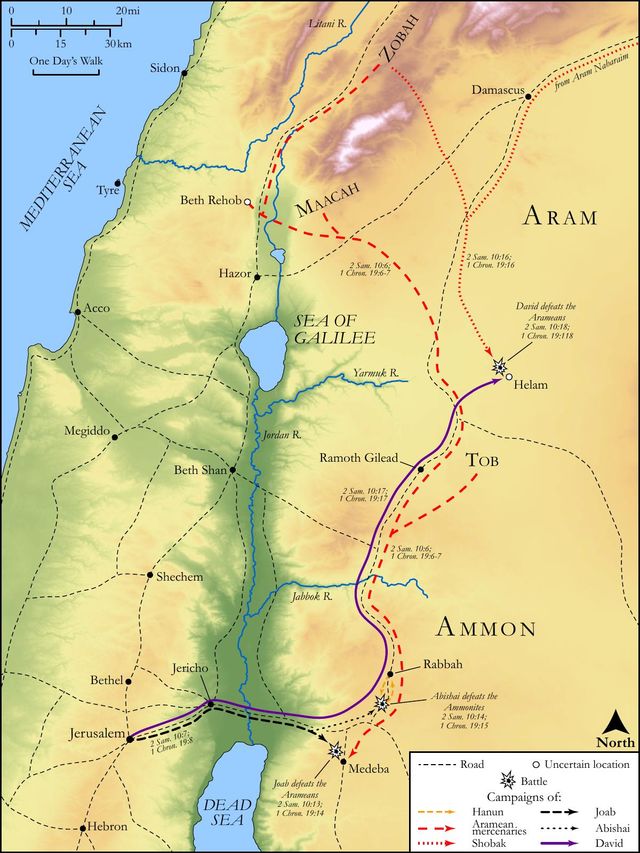
See on the biblical-era map
Study this verse
Public-domain commentary
Matthew Henry
From his Commentary on the Whole Bible. Henry comments on passages, not single verses — this entry covers 1 Chronicles 19:1–5.
Let us here observe, 1. That is becomes good people to be neighbourly, and especially to be grateful. David will pay respect to Hanun because he is his neighbour; and religion teaches us to be civil and obliging to all, to honour all men, and to be ready to do all offices of kindness to those we live among; nor must difference in religion be any obstruction to this. But, besides this, David remembered the kindness which his father showed to him. Those that have received kindness must return it as they have ability and opportunity: those that have received it from the parents must return it to the children when they are gone. 2. That, as saith the proverb of the ancients, Wickedness proceedeth from the wicked, Sa1 24:13. The vile person will speak villany, and the instruments of the churl will be evil, to destroy those with lying words that speak right, Isa 32:6, Isa 32:7. Those that are base, and design ill themselves, are apt to be jealous and to suspect ill of others without cause. Hanun's servant suggested that David's ambassadors came as spies, as if so great and mighty a man as David needed to do so mean a thing (if he had any design upon the Ammonites, he could effect it by open force, and had no occasion for any fraudulent practices), or as if a man of such virtue and honour would do so base a thing. Yet Hanun hearkened to the suggestion, and, against the law of nations, treated David's ambassadors villainously. 3. Masters ought to protect their servants, and with the greatest tenderness to concern themselves for them if they come by any loss or damage in their service. David did so for his ambassadors, Ch1 19:5. Christ will do so for his ministers; and let all masters thus give unto their servants that which is just and equal.
Continue studying 1 Chronicles 19:3 across the web’s major study libraries — every link below opens this exact verse, chapter, or book on the destination site.
Read & Compare
 BibleGatewayThis verse in more than 200 translations and 70 languages.
 Bible.comThe YouVersion reader — hundreds of translations, reading plans, and highlights.
 ESV.orgCrossway's official English Standard Version reader.
 NET BibleThe NET translation with 60,000+ translators' notes on every rendering decision.
 STEP BibleTyndale House's free study tool — original text, vocabulary, and scholarly resources.
 BibliaLogos Bible Software's free web reader.
 USCCBThe New American Bible (Revised Edition) with the U.S. bishops' study notes.
Commentaries
 BibleHub CommentariesDozens of classic commentaries on this verse, gathered on one page.
 StudyLightMore than 100 commentary sets — the largest collection on the web.
 BibleRefPlain-English commentary on what this verse means, verse by verse.
 Enduring WordDavid Guzik's free commentary on this chapter, widely used by Bible teachers.
 Bible Study ToolsVerse commentary alongside Greek and Hebrew study aids.
Original Language & Research
- BibleHub InterlinearThe verse word by word — original language, transliteration, and English.
- BibleHub LexiconEvery word's original-language definition and Strong's entry.
 Blue Letter BibleDeep-study tools — Strong's numbers, concordance, and word studies.
 SefariaThe Hebrew text with Rashi and centuries of Jewish commentary.
Sermons, Hymns & Audio


TrulyRandomVerse is not affiliated with these sites and doesn’t control their content. They’re linked because they’re genuinely useful.
Summary
1 Chronicles 19:3 is a pivotal moment that tragically transforms King David's sincere gesture of compassion into a catalyst for war. The Ammonite princes, driven by deep-seated suspicion and historical animosity, cunningly persuade their new king, Hanun, that David's envoys, sent to offer condolences for his father's death, are in fact clandestine spies dispatched to reconnoiter and undermine the Ammonite kingdom. This grave misinterpretation of benevolent intent, fueled by paranoia and poor counsel, leads Hanun to commit a profound insult against David's messengers, thereby igniting a devastating and avoidable conflict between Israel and Ammon.
Context
ShowHideLiterary Context
This verse stands as the dramatic turning point in the narrative of David's interaction with the Ammonites. It immediately follows David's genuine act of kindness in 1 Chronicles 19:2, where he sends messengers to console Hanun upon the death of his father, Nahash, remembering Nahash's past kindness to him. The princes' counsel in 1 Chronicles 19:3 directly contradicts David's stated benevolent purpose, setting the stage for Hanun's egregious insult to the envoys in 1 Chronicles 19:4-5. This act of dishonor directly precipitates the large-scale war detailed in 1 Chronicles 19:6-19, demonstrating a clear cause-and-effect relationship between flawed counsel and catastrophic outcomes. The Chronicler's account here closely parallels that found in 2 Samuel 10, underscoring the historical significance of this diplomatic failure.
Historical & Cultural Context
Ancient Near Eastern diplomacy was a complex and often precarious affair, heavily influenced by power dynamics, historical grievances, and pervasive distrust. The act of sending a delegation to a newly crowned monarch, while ostensibly a gesture of respect or condolence, could also be interpreted as a veiled attempt to assess a kingdom's strength, gauge its leadership, or even lay groundwork for future military action. The Ammonites, descendants of Lot, had a long-standing and often hostile relationship with Israel, marked by territorial disputes and military clashes (e.g., Judges 11). Given David's expanding empire and formidable military success, the Ammonite princes would have viewed any overture from him with intense suspicion, interpreting it through the lens of their historical animosity and geopolitical paranoia. Furthermore, the treatment of diplomatic envoys was sacrosanct; harming or dishonoring them was considered a direct insult to the sending king and a de facto declaration of war, a cultural norm that Hanun's subsequent actions would tragically violate.
Key Themes
ShowHideThis verse powerfully introduces several critical themes. Foremost is the peril of misinterpretation and unfounded suspicion. David's genuine act of compassion is tragically twisted by the Ammonite princes into a hostile reconnaissance mission, illustrating how deep-seated distrust can corrupt even the most sincere intentions. This highlights the crucial theme of discerning counsel; the princes' advice, rooted in fear and paranoia rather than truth, leads Hanun to make a catastrophic decision that brings war upon his people, serving as a stark warning against foolish or malicious guidance, echoing the wisdom found in Proverbs 11:14. The narrative also underscores the destructive consequences of unchecked mistrust and pride, demonstrating how a failure to extend grace or seek clarification can escalate minor misunderstandings into devastating conflicts, a lesson applicable not only to international relations but also to personal and communal dynamics. The entire account in 1 Chronicles 19 vividly portrays how human folly and suspicion can undermine peace and lead to widespread suffering.
Exposition and Analysis
ShowHideKey Word Analysis
ShowHideFrom the root H3513 (kâbad), this word means "to be heavy," and in a good sense, "to be numerous, rich, honorable; causatively, to make weighty, glorify, honor." The princes' rhetorical question, "Thinkest thou that David doth honour thy father...?" is deeply sarcastic and accusatory. They imply that David's actions are not for genuine honor or respect for Hanun's deceased father, but are a facade. They are challenging Hanun to see David's intentions as light, insincere, and ultimately dishonorable, rather than weighty and respectful.
Derived from H2015 (hâphak), meaning "to turn about or over; by implication, to change, overturn, return, pervert." In this context, it carries a strong connotation of subversion and destruction. The princes suggest David's goal is not merely to gather information but to actively destabilize, subvert, or conquer the Ammonite kingdom. This word evokes a fear of total disruption and subjugation, painting David's mission as inherently aggressive and aimed at the complete reversal of Ammonite sovereignty.
(râgal), this root specifically means "to reconnoiter, to be a tale-bearer (i.e., slander)." It is a technical military term for sending secret agents to gather intelligence on enemy forces or territory. By using this term, the princes directly accuse David's messengers of being hostile agents rather than diplomatic envoys. This accusation effectively frames David's entire action as an act of war, designed to gather intelligence for an impending invasion, thus justifying their own aggressive response.
Verse Breakdown
ShowHide"But the princes of the children of Ammon said to Hanun,"
This opening clause immediately shifts the narrative focus from David's benevolent intent to the internal deliberations within the Ammonite court. The "princes" (שָׂרֵי בְנֵי עַמּוֹן - sarei b'nei Ammon) are presented as key advisors to the new king, Hanun. Their collective voice and counsel will prove tragically influential, highlighting the profound impact of leadership's inner circle on national decisions.
"Thinkest thou that David doth honour thy father, that he hath sent comforters unto thee?"
This is a loaded rhetorical question, designed not to seek information but to plant seeds of doubt and suspicion in Hanun's mind. It challenges Hanun's initial perception of David's motives, implying that David's act of sending "comforters" (מְנַחֲמִים - menachamim, those who console) is disingenuous. The princes skillfully manipulate Hanun's perspective, suggesting David's seemingly honorable gesture is, in fact, a deceptive facade masking ulterior motives.
"are not his servants come unto thee for to search, and to overthrow, and to spy out the land?"
This is the core accusation, presented as another rhetorical question intended to elicit agreement and confirm their paranoid interpretation. The princes explicitly articulate their cynical view of David's true intentions, employing a series of three strong, militarily charged verbs: "search" (לַחְקֹר - lakhqor), "overthrow" (וּלְהָפְכָהּ - u'lehafkha), and "spy out" (וּלְרַגְּלָהּ - u'leraggelah). They assert that David's envoys are not diplomats but covert agents, their mission being hostile reconnaissance aimed at conquest. This reveals the deep-seated paranoia and distrust that characterizes the Ammonite leadership's view of Israel.
Literary Devices
ShowHideThe passage masterfully employs Dramatic Irony, as the audience is fully aware of David's sincere and compassionate intentions (as explicitly stated in 1 Chronicles 19:2), while Hanun and his advisors remain tragically ignorant, misinterpreting his actions through a lens of profound suspicion. This creates a palpable sense of tension and foreshadows the inevitable and devastating conflict. There is also a strong element of Foreshadowing, as the princes' paranoid accusations—that David's men have come "to search, and to overthrow, and to spy out the land"—ironically predict the very military actions that will ensue, albeit initiated by the Ammonites' own folly and David's subsequent retaliation. The passage also utilizes Contrast to highlight the stark difference between David's intended kindness and the Ammonite princes' malevolent interpretation, emphasizing the destructive power of mistrust and the tragic consequences of misguided counsel.
Theological and Thematic Connections
ShowHideThis verse serves as a profound theological commentary on the destructive nature of suspicion and the critical importance of wise counsel. It vividly illustrates how a lack of trust, fueled by fear and misinterpretation, can transform acts of genuine kindness into catalysts for conflict. The Ammonite princes' counsel, rooted in paranoia rather than truth, led Hanun to a decision that brought immense suffering upon his people. This narrative underscores the biblical principle that "where there is no counsel, the people fall; but in the multitude of counselors there is safety" (Proverbs 11:14). It challenges us to examine our own hearts for biases and predispositions that might lead us to misjudge others' motives, reminding us that a default posture of mistrust can be as destructive as outright hostility. The story is a cautionary tale about the spiritual and practical dangers of listening to voices that sow discord and suspicion, rather than those that promote peace and understanding.
Reflection and Application
ShowHideThe tragic misunderstanding in 1 Chronicles 19:3 offers timeless and potent lessons for our lives today. It compels us to reflect deeply on the lens through which we view the actions and intentions of others. Are we quick to assume the worst, projecting our own fears, insecurities, or past hurts onto seemingly innocent gestures? This narrative serves as a powerful reminder that suspicion, left unchecked, can poison relationships at every level—personal, communal, and even international. Just as Hanun suffered immense consequences from listening to ill-advised counsel, we too must exercise profound discernment in whom we listen to and what advice we internalize. We are called to cultivate a spirit of grace and to seek clarity before judgment, understanding that a willingness to believe the best, while not naive, often paves the way for peace, reconciliation, and flourishing relationships. This story challenges us to be proactive in building trust, to communicate transparently, and to be courageous enough to extend kindness, even when it might be misunderstood, trusting that genuine intentions will ultimately prevail or, at least, minimize unnecessary conflict.
Questions for Reflection
ShowHideFAQ
ShowHideWhy were the Ammonite princes so suspicious of David's intentions?
ShowHideThe Ammonite princes' profound suspicion stemmed from a confluence of factors: the long-standing historical animosity and rivalry between Israel and Ammon, the inherent paranoia prevalent in ancient Near Eastern diplomacy, and the undeniable reality of David's rapidly expanding regional power. They likely perceived David's condolences not as a sincere gesture of compassion, but as a cunning and deceptive ploy to gather vital intelligence for a future invasion. In a geopolitical landscape where alliances were constantly shifting and conquest was a common occurrence, any seemingly benevolent act from a powerful neighbor could easily be interpreted as a deceptive maneuver, especially given the deep-seated rivalry and distrust that had historically characterized the relationship between their peoples.
What was the historical relationship between David and Nahash, King of Ammon?
ShowHideThe relationship between David and Nahash, Hanun's father, was remarkably cordial, standing in stark contrast to the general animosity that existed between Israel and Ammon. 1 Chronicles 19:2 explicitly states that Nahash "showed kindness to me." The parallel account in 2 Samuel 10:2 corroborates this. While the biblical text does not elaborate on the specific acts of kindness, some traditions suggest Nahash may have offered David refuge or support during his difficult period of flight from King Saul. This past kindness is precisely the reason David felt compelled to send messengers to console Hanun, making the Ammonite princes' subsequent misinterpretation and Hanun's actions all the more tragic and ironic.
How did Hanun's decision based on this counsel impact the Ammonites?
ShowHideHanun's decision, tragically swayed by the princes' suspicious counsel, had catastrophic and devastating consequences for the Ammonite people. He committed an extreme act of public disgrace against David's messengers by shaving off half their beards and cutting off their garments in the middle, up to their buttocks (1 Chronicles 19:4). This was an unparalleled insult in ancient Near Eastern culture, tantamount to a direct declaration of war and a profound act of dishonor. David responded decisively by sending his formidable army, led by Joab, resulting in a major war where the Ammonites were decisively defeated, their cities besieged, and their land likely plundered (1 Chronicles 19:6-19). Hanun's folly, born of suspicion and poor counsel, led directly to the humiliation, devastation, and subjugation of his people.
Christ-Centered Fulfillment
ShowHideThe narrative of 1 Chronicles 19:3, with its tragic misinterpretation of benevolent intent and the subsequent eruption of conflict, powerfully foreshadows the world's reception of the ultimate King of Peace, Jesus Christ. Like David, who sent messengers with a sincere desire for comfort and reconciliation, Jesus came into a world steeped in suspicion, hostility, and spiritual blindness, bringing a message of profound peace, divine love, and eternal reconciliation. Yet, His true intentions were often tragically misunderstood, His divine mission twisted and maligned by those who viewed Him through a lens of worldly power, political threat, or religious dogma. The religious and political leaders of His day, much like the Ammonite princes, questioned His motives, implicitly asking, "Thinkest thou that He doth honor God, that He hath sent comforters unto thee?" They perceived His miracles as sorcery (Matthew 12:24), His teachings as blasphemy (Mark 2:7), and His claims as sedition against Caesar (John 19:12). They viewed His "servants"—His disciples and apostles—not as bearers of good news, but as agents sent "to search, and to overthrow, and to spy out" their established order, their power, and their cherished traditions. The world's ultimate rejection of Jesus, the true Lamb of God who takes away the sin of the world, and His message of grace culminated in His crucifixion, a profound act of misjudgment, hostility, and cosmic irony. However, unlike the earthly conflict in 1 Chronicles, Christ's suffering and death were not a defeat but the decisive, redemptive victory, fulfilling God's eternal plan and establishing a spiritual kingdom that is not of this world (John 18:36), a kingdom that ultimately overcomes all earthly suspicion and hostility through the power of divine love, truth, and resurrection.