


1 Chronicles 19:2
- וַיֹּאמֶרvai·Yo·merand he saidH559Conj-w ¦ V-Qal-ConsecImperf-3msVerb Qal Consecutive Imperfect 3rd Singular Masculineוַandיֹּאמֶרhe said
- דָּוִידda·VidDavidH1732N-proper-mNoun Proper Masculine
- אֶעֱשֶׂה'e·'e·sehI will doH6213V-Qal-Imperf-1csVerb Qal Imperfect 1st Singular common gender
- חֶסֶדChe·sedloyaltyH2617N-msNoun Singular Masculine Absolute
- עִם'imwithH5973PrepPreposition
- חָנוּןcha·NunHanunH2586N-proper-mNoun Proper Masculine
- בֶּןben[the] son ofH1121N-mscNoun Singular Masculine Construct
- נָחָשׁna·ChashNahashH5176N-proper-mNoun Proper Masculine
- כִּיkiforH3588PrtParticle Conditional
- עָשָׂה'a·Sahhe didH6213V-Qal-Perf-3msVerb Qal Perfect 3rd Singular Masculine
- אָבִיו'a·Vivhis fatherH1N-msc ¦ 3msNoun Singular Masculine Constructאָבִיfatherוhis
- עִמִּי'i·Miwith meH5973Prep ¦ 1csPrepositionעִמִּwithיme
- חֶסֶדChe·sedloyaltyH2617N-msNoun Singular Masculine Absolute
- וַיִּשְׁלַחvai·yish·Lachand he sentH7971Conj-w ¦ V-Qal-ConsecImperf-3msVerb Qal Consecutive Imperfect 3rd Singular Masculineוַandיִּשְׁלַחhe sent
- דָּוִידda·VidDavidH1732N-proper-mNoun Proper Masculine
- מַלְאָכִיםmal·'a·KhimmessengersH4397N-mpNoun Plural Masculine Absolute
- לְנַחֲמוֹle·na·cha·Moto comfort himH5162Prep-l ¦ V-Piel-Inf ¦ 3msVerb Piel Infinitive Constructלְtoנַחֲמcomfortוֹhim
- עַל'alonH5921PrepPreposition
- אָבִיו'a·Vivhis fatherH1N-msc ¦ 3msNoun Singular Masculine Constructאָבִיfatherוhis
- וַיָּבֹאוּvai·ya·vo·'Uand they cameH935Conj-w ¦ V-Qal-ConsecImperf-3mpVerb Qal Consecutive Imperfect 3rd Plural Masculineוַandיָּבֹאוּthey came
- עַבְדֵי'av·Dei[the] servants ofH5650N-mpcNoun Plural Masculine Construct
- דָוִידda·VidDavidH1732N-proper-mNoun Proper Masculine
- אֶל'elintoH413PrepPreposition
- אֶרֶץ'E·retz[the] land ofH776N-fscNoun Singular Feminine Construct
- בְּנֵיbe·nei[the] people ofH1121N-mpcNoun Plural Masculine Construct
- עַמּוֹןa·MonAmmonH5983N-proper-mNoun Proper Masculine
- אֶל'eltoH413PrepPreposition
- חָנוּןcha·NunHanunH2586N-proper-mNoun Proper Masculine
- לְנַחֲמוֹle·na·cha·Moto comfort himH5162Prep-l ¦ V-Piel-Inf ¦ 3msVerb Piel Infinitive Constructלְtoנַחֲמcomfortוֹhim
English is a literal word-by-word gloss of the Hebrew, not the KJV's wording. Why?
This is the original text the KJV's translators worked from — each Hebrew word with its own literal English meaning in this verse, prepared by scholars at Tyndale House, Cambridge. The KJV translates whole sentences, not word by word, so its wording differs: one Hebrew word can become several English words, and the KJV may choose “the LORD” where the gloss reads “Yahweh”. Both are faithful — they answer different questions. For the KJV's own rendering, switch to the KJV text.
Details
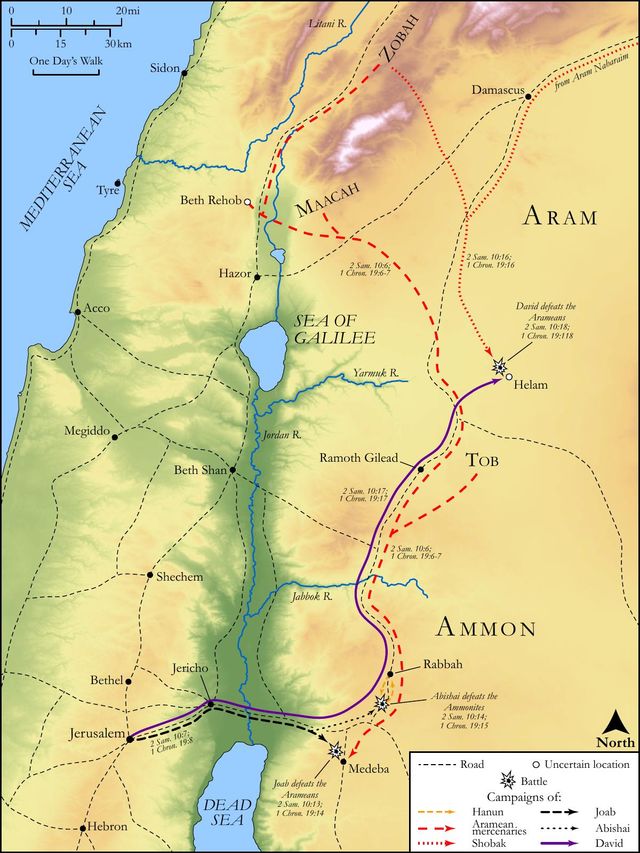
See on the biblical-era map
Study this verse
Public-domain commentary
Matthew Henry
From his Commentary on the Whole Bible. Henry comments on passages, not single verses — this entry covers 1 Chronicles 19:1–5.
Let us here observe, 1. That is becomes good people to be neighbourly, and especially to be grateful. David will pay respect to Hanun because he is his neighbour; and religion teaches us to be civil and obliging to all, to honour all men, and to be ready to do all offices of kindness to those we live among; nor must difference in religion be any obstruction to this. But, besides this, David remembered the kindness which his father showed to him. Those that have received kindness must return it as they have ability and opportunity: those that have received it from the parents must return it to the children when they are gone. 2. That, as saith the proverb of the ancients, Wickedness proceedeth from the wicked, Sa1 24:13. The vile person will speak villany, and the instruments of the churl will be evil, to destroy those with lying words that speak right, Isa 32:6, Isa 32:7. Those that are base, and design ill themselves, are apt to be jealous and to suspect ill of others without cause. Hanun's servant suggested that David's ambassadors came as spies, as if so great and mighty a man as David needed to do so mean a thing (if he had any design upon the Ammonites, he could effect it by open force, and had no occasion for any fraudulent practices), or as if a man of such virtue and honour would do so base a thing. Yet Hanun hearkened to the suggestion, and, against the law of nations, treated David's ambassadors villainously. 3. Masters ought to protect their servants, and with the greatest tenderness to concern themselves for them if they come by any loss or damage in their service. David did so for his ambassadors, Ch1 19:5. Christ will do so for his ministers; and let all masters thus give unto their servants that which is just and equal.
Continue studying 1 Chronicles 19:2 across the web’s major study libraries — every link below opens this exact verse, chapter, or book on the destination site.
Read & Compare
 BibleGatewayThis verse in more than 200 translations and 70 languages.
 Bible.comThe YouVersion reader — hundreds of translations, reading plans, and highlights.
 ESV.orgCrossway's official English Standard Version reader.
 NET BibleThe NET translation with 60,000+ translators' notes on every rendering decision.
 STEP BibleTyndale House's free study tool — original text, vocabulary, and scholarly resources.
 BibliaLogos Bible Software's free web reader.
 USCCBThe New American Bible (Revised Edition) with the U.S. bishops' study notes.
Commentaries
 BibleHub CommentariesDozens of classic commentaries on this verse, gathered on one page.
 StudyLightMore than 100 commentary sets — the largest collection on the web.
 BibleRefPlain-English commentary on what this verse means, verse by verse.
 Enduring WordDavid Guzik's free commentary on this chapter, widely used by Bible teachers.
 Bible Study ToolsVerse commentary alongside Greek and Hebrew study aids.
Original Language & Research
- BibleHub InterlinearThe verse word by word — original language, transliteration, and English.
- BibleHub LexiconEvery word's original-language definition and Strong's entry.
 Blue Letter BibleDeep-study tools — Strong's numbers, concordance, and word studies.
 SefariaThe Hebrew text with Rashi and centuries of Jewish commentary.
Sermons, Hymns & Audio


TrulyRandomVerse is not affiliated with these sites and doesn’t control their content. They’re linked because they’re genuinely useful.
Summary
King David, recalling a past act of kindness from Nahash, the deceased king of Ammon, dispatches a delegation of messengers to offer condolences and comfort to Nahash's son, Hanun, who has ascended to the Ammonite throne. This diplomatic overture underscores David's commitment to honoring past relationships and extending goodwill, even to a neighboring kingdom that had historically been antagonistic towards Israel.
Context
ShowHideLiterary Context
This account in 1 Chronicles 19:2 is a near-verbatim parallel to 2 Samuel 10:2. The Chronicler includes this narrative to highlight David's character and the unfolding of God's covenant with him. While 2 Samuel emphasizes the political and military consequences of Hanun's insult, Chronicles often focuses more on the moral and spiritual dimensions of events, showcasing David's righteous intentions. This verse sets the stage for a significant conflict between Israel and Ammon, triggered by Hanun's egregious misinterpretation of David's benevolent gesture. The subsequent chapters detail the ensuing war and its resolution, ultimately demonstrating God's faithfulness to David and Israel despite human folly.
Historical & Cultural Context
In the ancient Near East, the death of a monarch and the ascension of a new king often presented a critical moment for international relations. Sending condolences was a common diplomatic courtesy, signifying respect, acknowledging the new ruler's legitimacy, and often aiming to maintain or establish peaceful relations. Nahash, the father of Hanun, had been a long-standing enemy of Israel, notably besieging Jabesh-Gilead as seen in 1 Samuel 11:1. However, during David's fugitive years, Nahash appears to have shown him some unspecified kindness, perhaps offering refuge or support against Saul. David's act, therefore, was not merely protocol but a personal repayment of a past favor, demonstrating a king who valued loyalty and remembered benefactors, even former adversaries.
Key Themes
ShowHideThis verse introduces several important themes. Firstly, it highlights reciprocity and gratitude, as David explicitly states his motivation is to repay the kindness shown by Nahash. This underscores the biblical principle of remembering and honoring those who have been good to us, even across national or historical divides. Secondly, it showcases compassion and empathy, as David's primary aim is to "comfort" Hanun in his time of grief, demonstrating a king who is not solely focused on power but also on human relations and emotional support. Lastly, it serves as a diplomatic overture, an attempt to foster peaceful coexistence with a neighboring kingdom, reflecting David's strategic foresight in international affairs, even though this particular gesture was tragically misconstrued, leading to war, as detailed in the broader narrative of 1 Chronicles 19.
Exposition and Analysis
ShowHideKey Word Analysis
ShowHideThis multifaceted Hebrew term (H2617), often translated as "loving-kindness," "mercy," or "steadfast love," carries a rich theological weight. In this context, it denotes a deep sense of loyalty, faithfulness, and benevolent goodwill within a relationship, whether covenantal or personal. David's use of chêçêd here signifies his commitment to a past bond with Nahash, expressing a sincere desire to extend grace and honor that connection through his actions towards Hanun. It's more than mere politeness; it's an act rooted in a remembered obligation of loyalty and favor.
The verb nâcham (H5162) means "to sigh," "to be sorry," "to pity," or "to console." Here, it directly conveys David's empathetic intention to alleviate Hanun's sorrow over his father's death. It speaks to the human need for solace in grief and David's recognition of this need in a fellow ruler, despite the political implications. The repetition of "to comfort him" emphasizes the sincerity and primary purpose of David's mission, aiming to ease distress.
This word (H4397), often translated as "angels" in a divine context, simply means "messenger" or "envoy" in a human context. The sending of official messengers was a standard and highly significant act of diplomacy in the ancient world, representing the king's direct will and authority. The status and treatment of these messengers were paramount, as they embodied the king himself. David's choice to send such a delegation underscores the formal and serious nature of his intended act of goodwill.
Verse Breakdown
ShowHide"And David said, I will shew kindness unto Hanun the son of Nahash, because his father shewed kindness to me."
This opening clause reveals David's personal motivation and the principle of reciprocity. David's decision is not arbitrary but rooted in a past favor. The repetition of "kindness" (Hebrew, chêçêd) highlights the core of David's intention: to return a good deed. This demonstrates David's character as a king who remembers and values personal relationships, even with those who might otherwise be considered adversaries, setting a moral precedent for his reign.
"And David sent messengers to comfort him concerning his father."
This clause details the immediate action taken by David. The sending of official envoys was a formal diplomatic gesture, signifying the importance David placed on this act. The explicit purpose "to comfort him concerning his father" underscores the compassionate and empathetic nature of David's mission, focusing on Hanun's personal grief rather than any immediate political gain. This was an act of human solidarity in a time of loss, intended to convey genuine sympathy.
"So the servants of David came into the land of the children of Ammon to Hanun, to comfort him."
This final clause confirms the execution of David's command. The repetition of "to comfort him" from the previous clause reinforces the primary, stated objective of the mission, emphasizing David's benevolent intent. The arrival of David's "servants" (messengers) in Ammonite territory signifies the physical manifestation of David's goodwill, bringing his intentions directly to Hanun. This sets the stage for the tragic misinterpretation that follows, as Hanun's advisors would view this gesture with suspicion and hostility.
Literary Devices
ShowHideThe verse employs several literary devices that enrich its meaning. Repetition is prominent with the word "kindness" (Hebrew, chêçêd) appearing twice in David's declaration and "to comfort him" appearing twice in relation to the messengers' mission. This repetition emphasizes David's sincere motivation and the singular, benevolent purpose of his embassy. There is also a strong sense of Foreshadowing in this seemingly simple act of diplomacy. While David's intentions are pure, the reader, especially one familiar with the parallel account in 2 Samuel, knows that this gesture will be tragically misinterpreted by Hanun and his advisors, leading to war. This creates a dramatic Irony: an act intended to foster peace and goodwill ultimately ignites a major conflict, highlighting the unpredictable nature of human interactions and the potential for good intentions to be perverted by suspicion and pride.
Theological and Thematic Connections
ShowHideThis verse beautifully illustrates the biblical principle of remembering and reciprocating kindness, even when it extends beyond immediate alliances or past enmities. David's act of chêçêd towards Hanun, motivated by Nahash's prior kindness, reflects a divine characteristic. God Himself consistently demonstrates chêçêd towards His people, remembering His covenant and showing steadfast love despite their failings. David's action, though human, mirrors this divine attribute, showcasing a king whose heart, while flawed, often aligned with God's compassionate nature. It reminds believers that true generosity and empathy transcend tribal or national boundaries, urging us to extend grace and comfort to others, even those who may not be part of our immediate circle, just as Christ extended grace to all humanity.
Reflection and Application
ShowHideDavid's decision to extend kindness to Hanun, despite the historical animosity between Israel and Ammon, offers a profound lesson in intentional goodwill and the power of remembering past blessings. In a world often driven by suspicion and self-interest, David chose a path of generosity and empathy, seeking to comfort rather than conquer. This challenges us to consider how we respond to others, especially in moments of vulnerability or transition. Are we quick to remember past favors and extend compassion, or do we allow past grievances or potential future conflicts to dictate our interactions? This verse calls us to cultivate a heart of chêçêd, a steadfast love and loyalty that seeks to bless and comfort, even when the outcome is uncertain. It encourages us to be proactive in building bridges of peace and understanding, reflecting God's own character of grace and reconciliation.
Questions for Reflection
ShowHideFAQ
ShowHideWho was Nahash, and why was David indebted to him?
ShowHideNahash was the king of the Ammonites (H5983), a people often in conflict with Israel. He is famously known for besieging Jabesh-Gilead and threatening to gouge out the right eye of all its inhabitants (see 1 Samuel 11:1-2). However, during David's time as a fugitive from King Saul, Nahash appears to have shown David some unspecified kindness (H2617) or support. The exact nature of this "kindness" (Hebrew, chêçêd) is not detailed in Scripture, but it was significant enough for David to remember it years later, after he became king, and to feel obligated to reciprocate it to Nahash's son, Hanun. This suggests a personal favor or an alliance that offered David refuge or assistance during a vulnerable period in his life, highlighting David's character of remembering and honoring past benefactors.
Christ-Centered Fulfillment
ShowHideDavid's act of sending messengers to comfort Hanun, though ultimately leading to conflict due to human folly, beautifully foreshadows the ultimate act of divine chêçêd in Christ. David, a king, extended kindness to a grieving son, remembering a past favor. How much more did God, the King of all creation, extend His ultimate "kindness" and "comfort" to a grieving humanity, not based on any past favor from us, but on His own boundless love and covenant faithfulness! Jesus Christ is the supreme "messenger" (H4397) sent from God, not merely to offer condolences, but to bring true comfort and reconciliation to a world alienated by sin. Just as David's messengers were rejected and humiliated, so too was Christ, the Lamb of God, who takes away the sin of the world!, rejected and crucified by those He came to save. Yet, through His ultimate sacrifice and resurrection, He secured eternal peace and comfort for all who believe, fulfilling the deepest longing for reconciliation that David's initial gesture could only hint at. He is the Prince of Peace who offers a peace that surpasses understanding, even in the face of rejection, inviting all to receive His divine comfort and enter into His eternal kingdom, where true chêçêd reigns supreme (see John 14:27 and 2 Corinthians 1:3-4).