


1 Samuel 30:26
Bible text: King James Version (1769 Blayney text) · Public domain
Bible text: King James Version with Strong's numbers · Public domain
Bible text: Berean Standard Bible · Public domain
Bible text: American Standard Version (1901) · Public domain
Bible text: World English Bible, Messianic edition · Public domain
Bible text: Geneva Bible (1599) · Public domain
Bible text: Young's Literal Translation · Public domain
- וַיָּבֹאvai·ya·Vo'and he cameH935Conj-w ¦ V-Qal-ConsecImperf-3msVerb Qal Consecutive Imperfect 3rd Singular Masculineוַandיָּבֹאhe came
- דָוִדda·VidDavidH1732N-proper-mNoun Proper Masculine
- אֶל'eltoH413PrepPreposition
- צִקְלַגtzik·LagZiklagH6860N-properNoun Proper Location
- וַיְשַׁלַּחvay·sha·Lachand he sentH7971Conj-w ¦ V-Piel-ConsecImperf-3msVerb Piel Consecutive Imperfect 3rd Singular Masculineוַandיְשַׁלַּחhe sent
- מֵהַשָּׁלָלme·ha·sha·Lalsome of the bootyH7998Prep-m ¦ Art ¦ N-msNoun Singular Masculine Absoluteמֵsome ofהַtheשָּׁלָלbooty
- לְזִקְנֵיle·zik·Neito [the] elders ofH2205Prep-l ¦ Adj-mpcAdjective Plural Masculine Constructלְtoזִקְנֵי[the] elders of
- יְהוּדָהye·hu·DahJudahH3063N-properNoun Proper Location
- לְרֵעֵהוּle·re·'E·huto his friendH7453Prep-l ¦ N-mpc ¦ 3msNoun Plural Masculine Constructלְtoרֵעֵfriendהוּhis
- לֵאמֹרle·Mor<to> sayingH559Prep-l ¦ V-Qal-InfVerb Qal Infinitive Constructלֵ<to>אמֹרsaying
- הִנֵּהhi·Nehhere!H2009PrtParticle Interjection
- לָכֶםla·Khem[is] for <the> youPrep-l ¦ 2mpSuffix Personal 2nd Plural Masculineלָ[is] for <the>כֶםyou
- בְּרָכָהbe·ra·Khaha blessingH1293N-fsNoun Singular Feminine Absolute
- מִשְּׁלַלmi·she·Lalfrom [the] booty ofH7998Prep-m ¦ N-mscNoun Singular Masculine Constructמִfromשְּׁלַל[the] booty of
- אֹיְבֵי'o·ye·Vei[the] enemies ofH341V-Qal-Prtcpl-mpVerb Qal Participle Plural Masculine Construct
- יְהוָהYah·wehYahwehH3068N-properNoun Proper Title
English is a literal word-by-word gloss of the Hebrew, not the KJV's wording. Why?
This is the original text the KJV's translators worked from — each Hebrew word with its own literal English meaning in this verse, prepared by scholars at Tyndale House, Cambridge. The KJV translates whole sentences, not word by word, so its wording differs: one Hebrew word can become several English words, and the KJV may choose “the LORD” where the gloss reads “Yahweh”. Both are faithful — they answer different questions. For the KJV's own rendering, switch to the KJV text.
Details
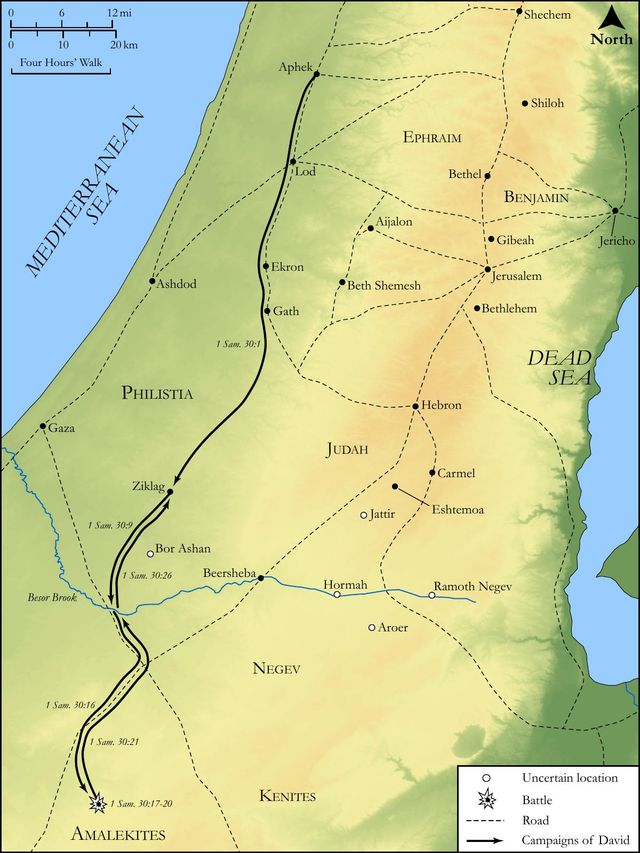
See on the biblical-era map
Study this verse
Public-domain commentary
Matthew Henry
From his Commentary on the Whole Bible. Henry comments on passages, not single verses — this entry covers 1 Samuel 30:21–31. His four-level outline is real structure in the source text, so it is rendered as structure.
We have here an account of the distribution of the spoil which as taken from the Amalekites. When the Amalekites had carried away a rich booty from the land of Judah and the Philistines they spent it in sensuality, in eating, and drinking, and making merry with it; but David disposed of the spoil taken after another manner, as one that knew that justice and charity must govern us in the use we make of whatever we have in this world. What God gives us he designs we should do good with, not serve our lusts with. In the distribution of the spoil,
I.David was just and kind to those who abode by the stuff.
They came forth to meet the conquerors, and to congratulate them on this success, though they could not contribute to it (Sa1 30:21); for we should rejoice in a good work done, though Providence had laid us aside and rendered us incapable of lending a hand to it. David received their address very kindly, and was so far from upbraiding them with their weakness that he showed himself solicitous concerning them. He saluted them; he asked them of peace (so the word is), enquired how they did, because he had left them faint and not well; or wished them peace, bade them be of good cheer, they should lose nothing by staying behind; for of this they seemed afraid, as perhaps David saw by their countenances.
1.There were those that opposed their coming in to share in the spoil; some of David's soldiers, probably the same that spoke of stoning him, spoke now of defrauding their brethren; they are called wicked men and men of Belial, Sa1 30:22. Let not the best of men think it strange if they have those attending them that are very bad and they cannot prevail to make them better. We may suppose that David had instructed his soldiers, and prayed with them, and yet there were many among them that were wicked men and men of Belial, often terrified with the apprehensions of death and yet wicked men still and men of Belial. These made a motion that the 200 men who abode by the stuff should only have their wives and children given them, but none of their goods. Well might they be called wicked men; for this bespeaks them,
(1.)Very covetous themselves and greedy of gain; for hereby the more would fall to their share. Awhile ago they would gladly have given half their own to recover the other half, yet now that they have all their own they are not content unless they can have their brethren's too; so soon do men forget their low estate. All seek their own, and too often more than their own.
(2.)Very barbarous to their brethren; for, to give them their wives and children, and not their estates, was to give them the mouths without the meat. What joy could they have of their families if they had nothing to maintain them with? Was this to do as they would be done by? Those are men of Belial indeed who delight in putting hardships upon their brethren, and care not who is starved, so they may be fed to the full.
2.David would by no means admit this, but ordered that those who tarried behind should come in for an equal share in the spoils with those that went to the battle, Sa1 30:23, Sa1 30:24. This he did,
(1.)In gratitude to God. The spoil we have is that which God has given us; we have it from him, and therefore must use it under his direction as good stewards. Let this check us when we are tempted to misapply that which God has entrusted us with of this world's goods. "Nay, I must not do so with that which God has given me, not serve Satan and a base lust with those things which are not only the creatures of his power, but the gifts of his bounty. God has recompensed us by delivering the company that came against us into our hand, let not us then wrong our brethren. God has been kind to us in preserving us and giving us victory, let not us be unkind to them." God's mercy to us should make us merciful to one another.
(2.)In justice to them. It was true they tarried behind; but,
[1.]It was not for want of good-will to the cause or to their brethren, but because they had not strength to keep up with them. It was not their fault, but their infelicity; and therefore they ought not to suffer for it.
[2.]Though they tarried behind now, they had formerly engaged many times in battle and done their part as well as the best of their brethren, and their former services must be considered now that there was something to enjoy.
[3.]Even now they did good service, for they abode by the stuff, to guard that which somebody must take care of, else that might have fallen into the hands of some other enemy. Every post of service is not alike a post of honour, yet those that are in any way serviceable to the common interest, though in a meaner station, ought to share in the common advantages, as in the natural body every member has its use and therefore has its share of the nourishment. First, Thus David overruled the wicked men, and men of Belial, with reason, but with a great deal of mildness; for the force of reason is sufficient, without the force of passion. He calls them his brethren, Sa1 30:23. Superiors often lose their authority by haughtiness, but seldom by courtesy and condescension. Secondly, Thus he settled the matter for the time to come, made it a statute of his kingdom (a statute of distributions, primo Davidis - in the first year of David's reign), an ordinance of war (Sa1 30:25), that as his part is that goes down to the battle, and hazards his life in the high places of the field, so shall his be that guards the carriages. Abraham returned the spoils of Sodom to the right owners, and quitted his title to them jure belli - derived from the laws of war. If we help others to recover their right, we must not think that this alienates the property and makes it ours. God appointed that the spoil of Midian should be divided between the soldiers and the whole congregation, Num 31:27. The case here was somewhat different, but governed by the same general rule - that we are members one of another. The disciples, at first, had all things common, and we should still be ready to distribute, willing to communicate, Ti1 6:18. When kings of armies did flee apace, she that tarried at home did divide the spoil, Psa 68:12.
II.David was generous and kind to all his friends.
When he had given every one his own with interest there was a considerable overplus, which David, as general, had the disposal of; probably the spoil of the tents of the Amalekites consisted much in plate and jewels (Jdg 8:24, Jdg 8:26), and these, because he thought they would but make his own soldiers proud and effeminate, he thought fit to make presents of to his friends, even the elders of Judah, Sa1 30:26. Several places are here named to which he sent of these presents, all of them in or near the tribe of Judah. The first place named is Bethel, which signifies the house of God; that place shall be first served for its name's sake; or perhaps it means not the city so called, but the place where the ark was, which was therefore the house of God. Thither David sent the first and best, to those that attended there, for his sake who is the first and best. Hebron is named last (Sa1 30:31), probably because thither he sent the residuum, which was the largest share, having an eye upon that place as fittest for his head-quarters, Sa2 2:1. In David's sending these presents observe,
1.His generosity. He aimed not to enrich himself, but to serve his country; and therefore God afterwards enriched him, and set him to rule the country he had served. It becomes gracious souls to be generous. There is that scatters, and yet increases.
2.His gratitude. He sent presents to all the places where he and his men were wont to haunt (Sa1 30:31), that is, to all that he had received kindness from, that had sheltered him and sent him intelligence or provisions. Note, Honesty, as well as honour, obliges us to requite the favours that have been done us, or at least to make a real acknowledgment of them as far as is in the power of our hand.
3.His piety. He calls his present a blessing; for no present we give to our friends will be a comfort to them but as it is made so by the blessing of God: it intimates that his prayers for them accompanied his present. He also sent it out of the spoil of the enemies of the Lord (so he calls them, not his enemies), that they might rejoice in the victory for the Lord's sake, and might join with him in thanksgivings for it.
4.His policy. He sent these presents among his countrymen to engage them to be ready to appear for him upon his accession to the throne, which he now saw at hand. A man's gift maketh room for him. He was fit to be a king who thus showed the bounty and liberality of a king. Munificence recommends a man more than magnificence. The Ziphites had none of his presents, nor the men of Keilah; and thus he showed that, though he was such a saint as not to revenge affronts, yet he was not such a fool as not to take notice of them.
Historical interpretation
Historical reception
1 surviving comment on this verse from the historical church.
And he sent gifts from the spoil to the elders of Judah, etc. The Lord loves and urges all the members of His Church, in various persons, conditions, and ages, to always rejoice in His victory, in the perpetual increase of His kingdom, and whenever they see souls previously corrupted by the devil's sedition restored to the Church, to glorify and bless the Father who is in heaven. He especially delights to see those doing this who have preserved their love in a pure heart and have held on to the sayings or examples of the saints in the diligent memory of a chaste conscience. For this is the true David exulting and either hosting or defending his men. Likewise, any catholic teacher, when investigating, exposing, and conquering the thorns of heretics, must not delay revealing these things to other brothers, whether by conversing or even writing, for the sake of the knowledge of avoiding and overcoming such things. And note, not only in believing in God but also in loving neighbors, the heretics greatly differ from the catholic and gentiles greatly from Christian perfection. The Amalekites leave behind their tired and dying companion of their journey and expose him as if to be torn apart by wild beasts and birds. But David prepares his tired companions in a safe place for battle and enriches them with abundant peace and blessing upon his return. The title of the fifty-second psalm also recalls this lesson, which reads, "To the end for Amalech, the understanding of David," signifying Christ, who is the end of the law for righteousness to everyone who believes (Rom. X), for the understanding of the figurative David in bearing with, persecuting, and fighting the Amalekites, what the city of the true David is to suffer from the faithless and what he himself is to repay to them. But the text of the psalm, very easy to understand, throughout rejoices in the mysteries of this lesson; because it begins with the endeavors of the wicked faithless saying, "The fool says in his heart, 'There is no God' (Psalm LII)," either claiming there is no God who cares for human affairs or considering within a foolish heart that any person in the holy Trinity is not truly God; and it ends in the triumph of the true David, "When the Lord restores the fortunes of His people, Jacob will exult and Israel will rejoice (Psalm XIII)."
Continue studying 1 Samuel 30:26 across the web’s major study libraries — every link below opens this exact verse, chapter, or book on the destination site.
Read & Compare
 BibleGatewayThis verse in more than 200 translations and 70 languages.
 Bible.comThe YouVersion reader — hundreds of translations, reading plans, and highlights.
 ESV.orgCrossway's official English Standard Version reader.
 NET BibleThe NET translation with 60,000+ translators' notes on every rendering decision.
 STEP BibleTyndale House's free study tool — original text, vocabulary, and scholarly resources.
 BibliaLogos Bible Software's free web reader.
 USCCBThe New American Bible (Revised Edition) with the U.S. bishops' study notes.
Commentaries
 BibleHub CommentariesDozens of classic commentaries on this verse, gathered on one page.
 StudyLightMore than 100 commentary sets — the largest collection on the web.
 BibleRefPlain-English commentary on what this verse means, verse by verse.
 Enduring WordDavid Guzik's free commentary on this chapter, widely used by Bible teachers.
 Bible Study ToolsVerse commentary alongside Greek and Hebrew study aids.
Original Language & Research
- BibleHub InterlinearThe verse word by word — original language, transliteration, and English.
- BibleHub LexiconEvery word's original-language definition and Strong's entry.
 Blue Letter BibleDeep-study tools — Strong's numbers, concordance, and word studies.
 SefariaThe Hebrew text with Rashi and centuries of Jewish commentary.
Sermons, Hymns & Audio


TrulyRandomVerse is not affiliated with these sites and doesn’t control their content. They’re linked because they’re genuinely useful.
Summary
Upon his triumphant return to Ziklag, having miraculously recovered all that was lost and secured abundant spoil from the Amalekites, David initiated a profound act of strategic generosity. He dispatched portions of this divinely sanctioned bounty to the elders of Judah, his tribal kin and future subjects. This distribution was not merely an act of sharing war gains but a deliberate and insightful gesture designed to build alliances, consolidate support, and lay the groundwork for his future reign, framing the recovered wealth as a "present... of the spoil of the enemies of the LORD," thereby imbuing it with spiritual significance and divine legitimacy.
Context
ShowHideLiterary Context
This verse serves as the concluding act of a pivotal narrative in David's life, meticulously detailed in 1 Samuel 30. The preceding events describe David and his men returning to Ziklag only to find it utterly destroyed by the Amalekites, their families and possessions carried off (1 Samuel 30:1-2). In a moment of profound despair, David famously "encouraged himself in the LORD his God" (1 Samuel 30:6). Seeking divine guidance through the ephod (1 Samuel 30:7-8), David pursued the raiders, achieving a decisive victory and recovering not only all that was lost but also significant additional spoil (1 Samuel 30:18-19). The distribution of this spoil among his men sparked a dispute, leading David to establish a just and equitable principle of sharing between those who fought and those who guarded the camp (1 Samuel 30:21-25). Verse 26, therefore, describes the subsequent, broader distribution of this spoil to secure political and spiritual favor, immediately preceding David's anointing as king over Judah in 2 Samuel 2, highlighting his transition from military leader to wise ruler.
Historical & Cultural Context
At this juncture, David was residing in Ziklag, a town granted to him by Achish, the Philistine king of Gath (1 Samuel 27:6). This arrangement placed David in a complex and often precarious position, serving a foreign monarch while simultaneously maintaining his identity and ties to Israel. The Amalekites, against whom David had just achieved victory, were ancient and persistent enemies of Israel, whose hostility dated back to the Exodus (Exodus 17:8-16). God had even commanded their utter destruction (Deuteronomy 25:17-19), a command King Saul had notoriously failed to fully execute (1 Samuel 15:1-9). David's decisive victory over them was thus perceived not merely as personal retribution but as a righteous act fulfilling divine judgment. In the tribal order of Israel, sending gifts to influential elders was a culturally significant act of diplomacy, patronage, and alliance-building. Such gestures demonstrated power, generosity, and laid crucial groundwork for future political leadership, particularly vital as David was poised to assume the kingship over Judah.
Key Themes
ShowHideThis verse powerfully illustrates several interconnected themes. Firstly, Divine Provision and Deliverance is central, as the spoil is explicitly designated as coming from "the enemies of the LORD," emphatically signifying God's direct hand in the victory and the subsequent blessing. Secondly, it highlights Wise and Strategic Leadership, showcasing David's political acumen in utilizing the recovered wealth not solely for his immediate followers but to cultivate essential support among the influential leaders of his own tribe, Judah. This act of calculated generosity also underscores Gratitude and Stewardship, as David acknowledges the divine source of the blessing and uses it to benefit his people, thereby laying a solid foundation for his impending reign (2 Samuel 2:4). Furthermore, the narrative subtly touches upon the theme of Justice and Righteous Warfare, as the spoil is justly gained from those who had unjustly attacked and plundered, and its distribution reflects a divinely guided principle of sharing and blessing.
Exposition and Analysis
ShowHideKey Word Analysis
ShowHideFrom the root בָרַךְ (barak), meaning "to bless," this word signifies a benediction, prosperity, or a gift. In this context, David's use of "present" (H1293) transforms the "spoil" from mere plunder into a deliberate, respectful offering. It elevates the act beyond a simple distribution of war gains, imbuing it with a sense of blessing and goodwill, reinforcing the political and relational intent behind David's actions towards the elders of Judah. It is a tangible expression of favor and a means of securing loyalty.
This term refers to plunder, booty, or captured goods taken from a defeated enemy (H7998). Here, it denotes the material wealth recovered from the Amalekites, including David's own possessions and additional riches. The crucial qualifier, "the spoil of the enemies of the LORD," elevates its significance beyond mere material gain. It casts the acquisition as divinely sanctioned, a tangible sign of God's judgment on Israel's adversaries and His abundant provision for His people.
An active participle meaning "hating" or "an adversary" (H341), this word emphasizes the hostile nature of those from whom the spoil was taken. By explicitly identifying them as "the enemies of the LORD," David frames the victory not just as a personal triumph but as God's triumph over His adversaries. This theological framing legitimizes the acquisition of the spoil and invites the elders to partake in a blessing derived from a divinely ordained victory against those who opposed God Himself.
Verse Breakdown
ShowHide"And when David came to Ziklag"
This opening clause firmly establishes the immediate setting and timing of the action. David's return to his base, now restored after its destruction and the recovery of all that was lost, signifies the completion of the immediate crisis and sets the stage for the strategic distribution of the additional spoil. It marks a transition from the intense pursuit and battle to a period of consolidation and planning.
"he sent of the spoil unto the elders of Judah, [even] to his friends"
This is the core action of the verse, revealing David's intentional and strategic outreach. Having secured abundant resources, David initiates a deliberate distribution. The recipients are precisely identified: "the elders of Judah," who were the influential leaders and representatives of his own tribe. The parenthetical "even to his friends" underscores the relational and diplomatic aspect of this gesture, indicating David's desire to strengthen existing bonds and cultivate loyalty among those who would be crucial to his future political aspirations and eventual reign.
"saying, Behold a present for you of the spoil of the enemies of the LORD;"
This declaration is profoundly significant, articulating David's intent and framing the nature of the gifts. David presents the recovered wealth not merely as material gain but as a "present" (Bᵉrâkâh) with a divinely sanctioned origin: "the spoil of the enemies of the LORD." This statement serves multiple, crucial purposes: it attributes the victory and the bounty to God's intervention, legitimizes the acquisition of the spoil as righteous, and implicitly invites the elders to partake in the blessing derived from God's triumph over His adversaries, thereby aligning their interests with David's divinely blessed endeavors and foreshadowing his role as God's chosen king.
Literary Devices
ShowHideThe verse employs several potent literary devices to convey its multifaceted meaning. Irony is subtly present in David's position; an outcast and fugitive, living in Philistine territory, he now acts as a benevolent and powerful leader, distributing the spoils of a divinely sanctioned victory. This contrasts sharply with King Saul's recent failures and foreshadows David's eventual rise to kingship. Symbolism is powerfully evident in the "spoil of the enemies of the LORD," which symbolizes not merely material wealth but profound divine favor, victory over spiritual and physical evil, and God's abundant provision. By distributing this spoil, David is symbolically sharing in God's blessing and judgment. Furthermore, the entire act serves as a form of Foreshadowing, as David's strategic generosity and deliberate alliance-building with the elders of Judah directly precede and meticulously pave the way for his anointing as king over Judah, demonstrating his astute political acumen and the unmistakable divine hand guiding his ascent to the throne.
Theological and Thematic Connections
ShowHideDavid's act of generosity and strategic distribution of the spoil resonates deeply with overarching biblical themes of divine provision, righteous stewardship, and the establishment of God's chosen leadership. The victory over the Amalekites was not merely a human triumph but a divinely orchestrated judgment against a long-standing enemy of God's people, making the recovered spoil a tangible sign of God's active blessing and vindication. David, in turn, demonstrates exemplary stewardship by using this blessing not for personal enrichment but to strengthen the bonds within his own tribe, laying the essential groundwork for the unified kingdom under his future reign. This principle of sharing blessings, particularly those divinely granted, for the common good and the advancement of God's purposes, is a recurring and vital motif throughout Scripture, emphasizing that all we possess ultimately belongs to God and should be used for His glory and the benefit of His people.
Reflection and Application
ShowHideDavid's actions in 1 Samuel 30:26 offer a profound and enduring model for leadership, gratitude, and the responsible, strategic use of blessings. In moments of personal triumph, significant gain, or divine provision, the natural human inclination can be to become self-focused or hoard resources. However, David chose to extend the blessing outward, demonstrating both generosity and astute foresight. This narrative powerfully reminds us that our successes, resources, talents, influence, and even our testimonies of deliverance are often not solely for our own immediate benefit. Instead, they are divine opportunities to bless others, build community, strengthen relationships, and advance God's broader purposes. It challenges us to prayerfully consider how we can use what God has entrusted to us—whether material wealth, spiritual gifts, or our personal stories of God's faithfulness—to support those around us, cultivate loyalty within our spiritual and natural families, and prepare for future endeavors, always acknowledging the divine source of our blessings and acting as faithful stewards.
Questions for Reflection
ShowHideFAQ
ShowHideWhy was it important for David to send gifts to the elders of Judah specifically?
ShowHideSending gifts to the elders of Judah was a highly strategic and culturally significant move for David, demonstrating his political acumen and divine guidance. First, Judah was David's own tribe, and securing their loyalty and unwavering support was absolutely crucial for his political future. David had already been privately anointed by Samuel to be king (1 Samuel 16:13), and this act laid essential groundwork for his eventual public anointing as king over Judah in 2 Samuel 2:4. Second, elders were not just older men but influential leaders and representatives within their communities. Gaining their favor meant gaining the favor and allegiance of the people they represented. By sharing the spoil, David demonstrated generosity, acknowledged their importance, and implicitly invited them to partake in the blessing of God's victory over the Amalekites, framing it as a shared triumph against "the enemies of the LORD." This solidified his standing, built a vital network of support, and eased his transition from a fugitive leader to the divinely appointed king.
Christ-Centered Fulfillment
ShowHideDavid's act of distributing the spoil from "the enemies of the LORD" to his people, particularly the elders of Judah, beautifully foreshadows the ultimate generosity and divine kingship of Jesus Christ. David, in this instance, serves as a compelling type of Christ, securing a decisive victory over a formidable enemy and then sharing the abundance of that victory with his future subjects. Similarly, Jesus Christ, through His triumphant death and glorious resurrection, secured a definitive and eternal victory over the ultimate enemies of humanity: sin, death, and the devil (Colossians 2:15). The "spoil" of Christ's victory is not perishable material wealth but immeasurable spiritual blessings: forgiveness of sins, imputed righteousness, eternal life, and the indwelling Holy Spirit (Ephesians 1:3-7). Just as David shared his bounty with his "friends" and future subjects, Christ, our heavenly King, freely distributes these incomprehensible spiritual riches to all who are His by faith, establishing His eternal rule not through force or conquest in the earthly sense, but through radical grace and the transformative outpouring of His Spirit (Acts 2:33). His ultimate act of generosity on the cross, giving His very life as a ransom for many (Mark 10:45), far surpasses David's gifts, establishing a kingdom that is eternal and a bond of friendship with His people that is unbreakable (John 15:13-15).