


Judges 8:26
Bible text: King James Version (1769 Blayney text) · Public domain
Bible text: King James Version with Strong's numbers · Public domain
Bible text: Berean Standard Bible · Public domain
Bible text: American Standard Version (1901) · Public domain
Bible text: World English Bible, Messianic edition · Public domain
Bible text: Geneva Bible (1599) · Public domain
Bible text: Young's Literal Translation · Public domain
- וַיְהִיvay·Hiand it wasH1961Conj-w ¦ V-Qal-ConsecImperf-3msVerb Qal Consecutive Imperfect 3rd Singular Masculineוַandיְהִיit was
- מִשְׁקַלmish·Kal[the] weight ofH4948N-mscNoun Singular Masculine Construct
- נִזְמֵיniz·Mei[the] earrings ofH5141N-mpcNoun Plural Masculine Construct
- הַזָּהָבha·za·Hav<the> goldH2091Art ¦ N-msNoun Singular Masculine Absoluteהַ<the>זָּהָבgold
- אֲשֶׁר'a·SherwhichH834RelParticle Relative
- שָׁאָלsha·'Alhe asked forH7592V-Qal-Perf-3msVerb Qal Perfect 3rd Singular Masculine
- אֶלֶף'E·lefone thousandH505N-cscNoun Singular common gender Construct
- וּשְׁבַעu·she·va'and sevenH7651Conj-w ¦ N-cscNoun Singular common gender Constructוּandשְׁבַעseven
- מֵאוֹתme·'othundred<s>H3967N-fpNoun Plural Feminine Absolute
- זָהָבza·HavgoldH2091N-msNoun Singular Masculine Absolute
- לְבַדLe·vad<to> apartH905Prep-l ¦ N-msNoun Singular Masculine Absoluteלְ<to>בַדapart
- מִןminfromH4480PrepPreposition
- הַשַּׂהֲרֹנִיםha·sa·ha·ro·Nimthe ornamentsH7720Art ¦ N-mpNoun Plural Masculine Absoluteהַtheשַּׂהֲרֹנִיםornaments
- וְהַנְּטִפוֹתve·ha·ne·ti·Fotand the pendantsH5188Conj-w ¦ Art ¦ N-fpNoun Plural Feminine Absoluteוְandהַtheנְּטִפוֹתpendants
- וּבִגְדֵיu·vig·Deiand [the] garments ofH899Conj-w ¦ N-mpcNoun Plural Masculine Constructוּandבִגְדֵי[the] garments of
- הָאַרְגָּמָןha·'ar·ga·Man<the> purpleH713Art ¦ N-msNoun Singular Masculine Absoluteהָ<the>אַרְגָּמָןpurple
- שֶׁעַלshe·'Althat [were] onH5921Rel-s ¦ PrepPrepositionשֶׁthatעַל[were] on
- מַלְכֵיmal·Khei[the] kings ofH4428N-mpcNoun Plural Masculine Construct
- מִדְיָןmid·YanMidianH4080N-properNoun Proper Location
- וּלְבַדu·le·Vadand <to> apartH905Conj-w ¦ Prep-l ¦ N-msNoun Singular Masculine Absoluteוּandלְ<to>בַדapart
- מִןminfromH4480PrepPreposition
- הָעֲנָקוֹתha·'a·na·Kotthe necklacesH6060Art ¦ N-fpNoun Plural Feminine Absoluteהָtheעֲנָקוֹתnecklaces
- אֲשֶׁר'a·SherwhichH834RelParticle Relative
- בְּצַוְּארֵיbe·tza·ve·Rei[were] on [the] necks ofH6677Prep-b ¦ N-mpcNoun Plural Masculine Constructבְּ[were] onצַוְּארֵי[the] necks of
- גְמַלֵּיהֶםge·ma·lei·Hemtheir camelsH1581N-mpc ¦ 3mpNoun Plural Masculine Constructגְמַלֵּיcamelsהֶםtheir
English is a literal word-by-word gloss of the Hebrew, not the KJV's wording. Why?
This is the original text the KJV's translators worked from — each Hebrew word with its own literal English meaning in this verse, prepared by scholars at Tyndale House, Cambridge. The KJV translates whole sentences, not word by word, so its wording differs: one Hebrew word can become several English words, and the KJV may choose “the LORD” where the gloss reads “Yahweh”. Both are faithful — they answer different questions. For the KJV's own rendering, switch to the KJV text.
Details
See on the biblical-era maps
Study this verse
Public-domain commentary
Matthew Henry
From his Commentary on the Whole Bible. Henry comments on passages, not single verses — this entry covers Judges 8:22–28. His three-level outline is real structure in the source text, so it is rendered as structure.
Here is, I. Gideon's laudable modesty, after his great victory, in refusing the government which the people offered him. 1. It was honest in them to offer it: Rule thou over us, for thou hast delivered us, Jdg 8:22. They thought it very reasonable that he who had gone through the toils and perils of their deliverance should enjoy the honour and power of commanding them ever afterwards, and very desirable that he who in this great and critical juncture had had such manifest tokens of God's presence with him should ever afterwards preside in their affairs. Let us apply it to the Lord Jesus: he hath delivered us out of the hands of our enemies, our spiritual enemies, the worst and most dangerous, and therefore it is fit he should rule over us; for how can we be better ruled than by one that appears to have so great an interest in heaven and so great a kindness for this earth? We are delivered that we may serve him without fear, Luk 1:74, Luk 1:75. 2. It was honourable in him to refuse it: I will not rule over you, Jdg 8:23. What he did was with a design to serve them, not to rule them - to make them safe, easy, and happy, not to make himself great or honourable. And, as he was not ambitious of grandeur himself, so he did not covet to entail it upon his family: "My son shall not rule over you, either while I live or when I am gone, but the Lord shall still rule over you, and constitute your judges by the special designation of his own Spirit, as he has done." This intimates, (1.) His modesty, and the mean opinion he had of himself and his own merits. He thought the honour of doing good was recompence enough for all his services, which needed not to be rewarded with the honour of bearing sway. He that is greatest, let him be your minister. (2.) His piety, and the great opinion he had of God's government. Perhaps he discerned in the people a dislike of the theocracy, or divine government, a desire of a king like the nations, and thought they availed themselves of his merits as a colourable pretence to move for this change of government. But Gideon would by no means admit it. No good man can be pleased with any honour done to himself which ought to be peculiar to God. Were you baptized in the name of Paul? Co1 1:13.
II.Gideon's irregular zeal to perpetuate the remembrance of this victory by an ephod made of the choicest of the spoils.
1.He asked the men of Israel to give him the ear-rings of their prey; for such ornaments they stripped the slain of in abundance. These he demanded, either because they were the finest gold, and therefore fittest for a religious use, or because they had had as ear-rings some superstitious signification, which he thought too well of. Aaron called for the ear-rings to make the golden calf of, Exo 32:2. These Gideon begged Jdg 8:24. And he had reason enough to think that those who offered him a crown, when he declined it, would not deny him their ear-rings, when he begged them, nor did they, Jdg 8:25.
2.He himself added the spoil he took from the kings of Midian, which, it should seem, had fallen to his share, Jdg 8:26. The generals had that part of the prey which was most splendid, the prey of divers colours, Jdg 5:30.
3.Of this he made an ephod, Jdg 8:27. It was plausible enough, and might be well intended to preserve a memorial of so divine a victory in the judge's own city. But it was a very unadvised thing to make that memorial to be an ephod, a sacred garment. I would gladly put the best construction that can be upon the actions of good men, and such a one we are sure Gideon was. But we have reason to suspect that this ephod had, as usual, a teraphim annexed to it (Hos 3:4), and that, having an altar already built by divine appointment (Jdg 6:26), which he erroneously imagined he might still use for sacrifice, he intended this for an oracle, to be consulted in doubtful cases. So the learned Dr. Spencer supposes. Each tribe having now very much its government within itself, they were too apt to covet their religion among themselves. We read very little of Shiloh, and the ark there, in all the story of the Judges. Sometimes by divine dispensation, and much oftener by the transgression of men, that law which obliged them to worship only at that one altar seems not to have been so religiously observed as one would have expected, any more than afterwards, when in the reigns even of very good kings the high places were not taken away, from which we may infer that that law had a further reach as a type of Christ, by whose mediation alone all our services are accepted. Gideon therefore, through ignorance or inconsideration, sinned in making this ephod, though he had a good intention in it. Shiloh, it is true, was not far off, but it was in Ephraim, and that tribe had lately disobliged him (v. 1), which made him perhaps not care to go so often among them as his occasions would lead him to consult the oracle, and therefore he would have one nearer home. However this might be honestly intended, and at first did little hurt, yet in process of time,
(1.)Israel went a whoring after it, that is, they deserted God's altar and priesthood, being fond of change, and prone to idolatry, and having some excuse for paying respect to this ephod, because so good a man as Gideon had set it up, and by degrees their respect to it grew more and more superstitious. Note, Many are led into false ways by one false step of a good man. The beginning of sin, particularly of idolatry and will-worship, is as the letting forth of water, so it has been found in the fatal corruptions of the church of Rome; therefore leave it off before it be meddled with.
(2.)It became a snare to Gideon himself, abating his zeal for the house of God in his old age, and much more to his house, who were drawn by it into sin, and it proved the ruin of the family.
III.Gideon's happy agency for the repose of Israel, Jdg 8:28.
The Midianites that had been so vexatious gave them no more disturbance. Gideon, though he would not assume the honour and power of a king, governed as a judge, and did all the good offices he could for his people; so that the country was in quietness forty years. Hitherto the times of Israel had been reckoned by forties. Othniel judged forty years, Ehud eighty - just two forties, Barak forty, and now Gideon forty, providence so ordering it to bring in mind the forty years of their wandering in the wilderness. Forty years long was I grieved with this generation. And see Eze 4:6. After these, Eli ruled forty years (Sa1 4:18), Samuel and Saul forty (Act 13:21), David forty, and Solomon forty. Forty years is about an age.
Continue studying Judges 8:26 across the web’s major study libraries — every link below opens this exact verse, chapter, or book on the destination site.
Read & Compare
 BibleGatewayThis verse in more than 200 translations and 70 languages.
 Bible.comThe YouVersion reader — hundreds of translations, reading plans, and highlights.
 ESV.orgCrossway's official English Standard Version reader.
 NET BibleThe NET translation with 60,000+ translators' notes on every rendering decision.
 STEP BibleTyndale House's free study tool — original text, vocabulary, and scholarly resources.
 BibliaLogos Bible Software's free web reader.
 USCCBThe New American Bible (Revised Edition) with the U.S. bishops' study notes.
Commentaries
 BibleHub CommentariesDozens of classic commentaries on this verse, gathered on one page.
 StudyLightMore than 100 commentary sets — the largest collection on the web.
 BibleRefPlain-English commentary on what this verse means, verse by verse.
 Enduring WordDavid Guzik's free commentary on this chapter, widely used by Bible teachers.
 Bible Study ToolsVerse commentary alongside Greek and Hebrew study aids.
Original Language & Research
- BibleHub InterlinearThe verse word by word — original language, transliteration, and English.
- BibleHub LexiconEvery word's original-language definition and Strong's entry.
 Blue Letter BibleDeep-study tools — Strong's numbers, concordance, and word studies.
 SefariaThe Hebrew text with Rashi and centuries of Jewish commentary.
Sermons, Hymns & Audio


TrulyRandomVerse is not affiliated with these sites and doesn’t control their content. They’re linked because they’re genuinely useful.
Summary
This verse provides a meticulous inventory of the immense spoils of war collected by Gideon and the Israelite forces after their decisive victory over the Midianites. This verse specifically details the staggering weight of golden earrings, amounting to seventeen hundred shekels, alongside other luxurious items such as various ornaments, collars, purple raiment worn by the Midianite kings, and even gold chains adorning their camels. This comprehensive enumeration not only underscores the vast wealth and elevated status of the defeated Midianite leadership but also serves as a tangible testament to the thoroughness of God's deliverance and the complete subjugation of Israel's formidable oppressors.
Context
ShowHideLiterary Context
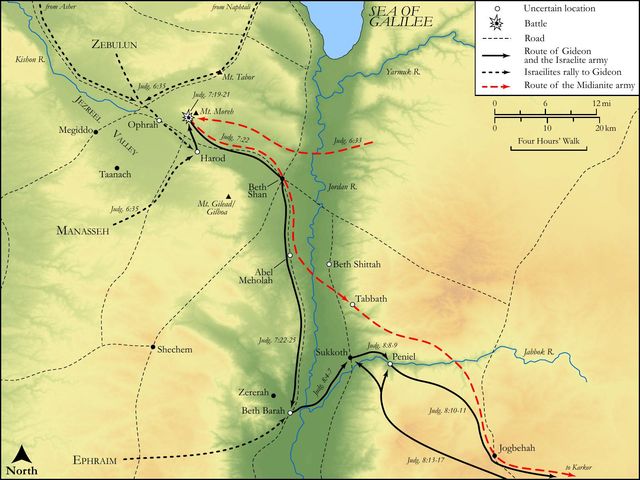
Judges 8:26 is strategically placed at the culmination of Gideon's military campaign against the Midianites, immediately following his relentless pursuit and capture of their kings, Zebah and Zalmunna. The preceding narrative, spanning from Judges 8:4 to Judges 8:21, vividly recounts Gideon's determination, his encounters with uncooperative Israelite towns, and the ultimate execution of the Midianite kings in vengeance for his brothers. This verse, therefore, functions as the formal accounting of the spoils of war, a customary practice in the wars of that day that signified the victor's complete triumph and the vanquished's utter defeat. It marks a definitive end to the military phase of Gideon's story, simultaneously setting the stage for the subsequent, problematic events concerning the ephod in Judges 8:27, where this very wealth becomes a spiritual stumbling block for Israel.
Historical & Cultural Context
The Midianites were a formidable, nomadic people who had subjected Israel to seven years of severe oppression, characterized by devastating raids on their agricultural produce and livestock, as vividly described in Judges 6:1-6. Their substantial wealth, meticulously itemized in this verse, was a hallmark of their mercantile and predatory lifestyle, accumulated through trade and plunder across the desert regions. The items listed—golden earrings, various ornaments, collars, purple raiment, and camel chains—were far more than mere decorations; they were potent symbols of immense status, power, and affluence among the kings of that day. Notably, purple dye, derived from rare murex snails, was exorbitantly expensive and reserved almost exclusively for royalty and the elite, signifying the Midianite kings' exalted position. The mention of gold chains adorning their camels further emphasizes their extraordinary prosperity, as camels were highly prized assets, and their adornment was an ultimate display of wealth. This cultural understanding profoundly amplifies the significance of the plunder, showcasing the comprehensive subjugation of a wealthy and powerful enemy.
Key Themes
ShowHideThis verse significantly contributes to several overarching themes within the book of Judges and the broader biblical narrative. Firstly, it powerfully illustrates the theme of Divine Deliverance and Victory, serving as tangible evidence of God's miraculous power in decisively overthrowing Israel's oppressors, even through an unlikely hero and a small, Spirit-empowered army, as seen in the miraculous rout described in Judges 7:22. The immense spoils underscore the totality of this divinely orchestrated triumph. Secondly, it subtly introduces the critical theme of The Perils of Prosperity and the Mismanagement of Blessings. While the wealth acquired was a legitimate outcome of God's victory, the subsequent narrative in Judges 8:27 reveals how this very prosperity becomes a source of temptation and spiritual deviation for Gideon and the nation. This foreshadows a recurring pattern throughout Judges, where periods of peace and material abundance often lead to spiritual complacency and idolatry. Lastly, the verse, in conjunction with its immediate sequel, highlights the theme of Human Fallibility, even among God's chosen leaders, demonstrating that even great victories can be marred by personal failures in stewardship and obedience to God's covenant.
Exposition and Analysis
ShowHideKey Word Analysis
ShowHideWhile commonly translated as "earrings," the Hebrew term nezem (H5141) broadly refers to various forms of ring-shaped jewelry worn on the face or body, including nose-rings. Among the Midianites, such adornments were not merely decorative but held significant social, economic, and sometimes religious value, denoting tribal affiliation, social status, or wealth. The fact that Gideon specifically requested these items, and their collective weight was so immense, highlights their high intrinsic and symbolic value as prized trophies from the defeated enemy, signifying their opulence and the completeness of their subjugation.
The term ʼargâmân (H713) refers to a rich, deep purple color or the fabric dyed with it. This dye was exceedingly rare and expensive, meticulously extracted from the Murex snails found in the Mediterranean Sea. Consequently, purple garments were almost exclusively reserved for royalty, high priests, and the extremely wealthy among the nations, as with the kings of Midian, symbolizing power, luxury, and exalted status. Their presence among the spoils reinforces the regal status of the Midianite kings and the opulent nature of their court, making their defeat and the stripping of these garments a profound act of humiliation and the transfer of their prestige.
The Hebrew word ʻânâq (H6060) refers to a necklace or a chain, often implying a form of adornment worn around the neck. In this context, the mention of "chains that were about their camels' necks" speaks to an extraordinary level of wealth and extravagance. Camels were highly valuable assets, essential for trade and desert travel. Adorning such valuable animals with gold chains was an ostentatious display of immense affluence, indicating that the Midianite kings' riches extended even to their most practical possessions, painting a vivid picture of their overall prosperity and the comprehensive nature of the plunder Gideon acquired.
Verse Breakdown
ShowHide"And the weight of the golden earrings that he requested was a thousand and seven hundred [shekels] of gold;"
This opening clause immediately establishes the astonishing scale of the wealth acquired. Gideon's specific request for the golden earrings, rather than a general share of the plunder, suggests their particular significance or perceived value. The stated weight of 1,700 shekels of gold represents an extraordinary sum (approximately 43 pounds or 19.5 kilograms), underscoring the vast riches of the Midianite leadership and the magnitude of Israel's victory. This quantity alone speaks volumes about the opulence of the defeated enemy.
"beside ornaments, and collars, and purple raiment that [was] on the kings of Midian,"
This phrase expands the inventory of the plunder beyond the initial earrings, detailing other highly valuable and symbolically significant items. "Ornaments" (H7720 sahărôn) and "collars" (H5188 nᵉṭîyphâh) refer to various forms of jewelry and adornments, likely made of precious metals and stones, further emphasizing the Midianite kings' opulence. The "purple raiment" (H713 ʼargâmân) is particularly noteworthy, as purple dye was a rare and costly symbol of royalty and extreme wealth among the kings of that day, reinforcing the high status of the defeated kings and the luxurious nature of their possessions.
"and beside the chains that [were] about their camels' necks."
The final clause adds another layer to the description of Midianite wealth, highlighting their extreme extravagance. Camels were themselves valuable assets, crucial for trade and desert travel. Adorning these animals with gold chains was an extravagant display of immense affluence, indicating that the Midianite kings' riches extended even to their livestock. This detail paints a vivid picture of their overall prosperity and the comprehensive nature of the plunder Gideon acquired, leaving no doubt about the extent of their defeat.
Literary Devices
ShowHideThe primary literary device employed in Judges 8:26 is Enumeration or Inventory. The verse meticulously lists the types and quantities of wealth acquired, specifically detailing the golden earrings, ornaments, collars, purple raiment, and camel chains. This precise and comprehensive inventory serves to emphasize the sheer magnitude of the Midianite kings' wealth and, by extension, the overwhelming nature of Israel's victory. The vivid description of these luxurious items also utilizes Imagery, painting a clear and opulent picture of the riches that were stripped from the defeated enemy. Furthermore, the selection of specific items, particularly the "purple raiment" and "chains about their camels' necks," functions as Symbolism, representing the high status, power, and extravagant lifestyle of the Midianite leadership. The detailed account of these spoils also creates a subtle sense of Foreshadowing, as the very next verse (Judges 8:27) reveals how this immense wealth, particularly the gold, becomes a spiritual snare for Gideon and Israel, illustrating how even legitimate gains can tragically lead to idolatry and deviation from God's will.
Theological and Thematic Connections
ShowHideJudges 8:26, while seemingly a straightforward inventory of war spoils, carries profound theological weight. It serves as a tangible demonstration of God's complete victory over Israel's oppressors, showcasing the immense wealth and power that was stripped from the Midianites and transferred to the Israelites. This transfer of wealth signifies not only a military triumph but also a divine judgment against those who afflicted God's people. However, the verse also subtly introduces a critical theological theme: the inherent danger of material prosperity when not stewarded according to God's will. The very next verse reveals how this immense gold became the raw material for an ephod, which unexpectedly became an object of idolatry for Gideon and his household, leading Israel astray. This highlights that blessings, if improperly handled, can become spiritual snares, diverting devotion from the true God. The passage thus underscores the importance of spiritual discernment and faithful stewardship, reminding us that true victory is not merely in acquiring wealth but in remaining faithful to the Giver of all blessings.
Reflection and Application
ShowHideJudges 8:26 presents a powerful, albeit subtle, lesson for believers today. It reminds us that while God is faithful to deliver and bless His people with victory and provision, the manner in which we handle those blessings is paramount. Gideon's acquisition of immense wealth was a direct result of God's miraculous intervention, yet this very blessing became a catalyst for spiritual compromise. This prompts us to examine our own lives: when God grants us success, material prosperity, influence, or any form of abundance, do we allow these gifts to draw us closer to Him in gratitude and faithful stewardship, or do they subtly become objects of trust, pride, or distraction that pull us away? The danger is not in the blessing itself, but in our hearts' posture towards it. We are called to be wise stewards of all that God entrusts to us, ensuring that our resources, talents, and achievements are consistently aligned with His purposes and do not become idols that compete for our ultimate devotion. Our ultimate treasure must remain God Himself, not the gifts He bestows.
Questions for Reflection
ShowHideFAQ
ShowHideWhat was the approximate value of 1,700 shekels of gold in modern terms?
ShowHideWhile a precise modern equivalent is difficult due to fluctuating gold prices, ancient economic contexts, and the purchasing power of gold, 1,700 shekels of gold would have been an extraordinarily vast sum. Given that an ancient shekel of gold typically weighed around 11.5 grams, 1,700 shekels would equate to approximately 19.55 kilograms (or about 43 pounds) of pure gold. At current market prices, this would represent a multi-million dollar value, underscoring the immense wealth of the Midianite kings and the sheer scale of the plunder Gideon acquired. This sum was not merely a personal fortune but a significant national treasure, highlighting the comprehensive nature of God's deliverance and the thorough defeat of Israel's oppressors, as well as the potential for great temptation, as seen in Judges 8:27.
Christ-Centered Fulfillment
ShowHideJudges 8:26, with its detailed inventory of earthly spoils and the subsequent spiritual snare they became, finds its profound Christ-centered fulfillment not in the accumulation of material wealth, but in the ultimate victory and spiritual riches secured by Jesus Christ. While Gideon's victory brought temporary relief and physical plunder, Christ's triumph on the cross secured an eternal deliverance from the true oppressors: sin, death, and the devil. The "purple raiment" of the Midianite kings symbolized earthly royalty and power, but Christ, though the true King of Kings, wore no such garments in His ultimate victory; instead, He was clothed in humility and suffered a crown of thorns (as recounted in Matthew 27:28-29). The spoils of His victory are not gold and silver, but spiritual blessings: redemption, forgiveness, and eternal life, freely given to those who believe (see Ephesians 1:7 and 2 Corinthians 8:9). Unlike Gideon's gold, which became a snare, the spiritual riches found in Christ never lead to idolatry but always draw us into deeper worship and communion with God. He is the true treasure, the one in whom "are hidden all the treasures of wisdom and knowledge" (Colossians 2:3). His victory ensures that we, His people, are not merely delivered from oppression but are made heirs to an incorruptible inheritance, far surpassing any earthly wealth or fleeting glory (1 Peter 1:4).