


Revelation 17:4
Bible text: King James Version (1769 Blayney text) · Public domain
Bible text: King James Version with Strong's numbers · Public domain
Bible text: Berean Standard Bible · Public domain
Bible text: American Standard Version (1901) · Public domain
Bible text: World English Bible, Messianic edition · Public domain
Bible text: Geneva Bible (1599) · Public domain
Bible text: Young's Literal Translation · Public domain
- καὶkaiAndG2532CONJConjunction
- ἡhētheG3588T-NSFDefinite article Nominative Singular Feminine
- γυνὴgunēwomanG1135N-NSFNoun Nominative Singular Feminine
- ἦνēnwasG1510V-IAI-3SVerb Imperfect Active Indicative 3rd Singular
- περιβεβλημένηperibeblēmenēclothed inG4016V-REP-NSFVerb Perfect Middle Or Passive Participle Nominative Singular Feminine
- πορφυροῦνporphurounpurpleG4210A-ASNAdjective Accusative Singular Neuter
- καὶkaiandG2532CONJConjunction
- κόκκινονkokkinonscarletG2847A-ASNAdjective Accusative Singular Neuter
- καὶkaiandG2532CONJConjunction
- κεχρυσωμένηkechrusōmenēadornedG5558V-RPP-NSFVerb Perfect Passive Participle Nominative Singular Feminine
- χρυσίῳchrusiōwith goldG5553N-DSNNoun Dative Singular Neuter
- καὶkaiandG2532CONJConjunction
- λίθῳlithōwith stoneG3037N-DSMNoun Dative Singular Masculine
- τιμίῳtimiōpreciousG5093A-DSMAdjective Dative Singular Masculine
- καὶkaiandG2532CONJConjunction
- μαργαρίταιςmargaritaiswith pearlsG3135N-DPMNoun Dative Plural Masculine
- ἔχουσαechousaholdingG2192V-PAP-NSFVerb Present Active Participle Nominative Singular Feminine
- ποτήριονpotēriona cupG4221N-ASNNoun Accusative Singular Neuter
- χρυσοῦνchrusoungoldenG5552A-ASNAdjective Accusative Singular Neuter
- ἐνeninG1722PREPPreposition
- τῇtēatheG3588T-DSFDefinite article Dative Singular Feminine
- χειρὶcheirihandG5495N-DSFNoun Dative Singular Feminine
- αὐτῆςautēsof herG846P-GSFPersonal pronoun Genitive Singular Feminine
- γέμονgemonbeing fullG1073V-PAP-ASNVerb Present Active Participle Accusative Singular Neuter
- βδελυγμάτωνbdelugmatōnof abominationsG946N-GPNNoun Genitive Plural Neuter
- καὶkaiandG2532CONJConjunction
- τὰtatheG3588T-APNDefinite article Accusative Plural Neuter
- ἀκάθαρταakathartaunclean [things]G169A-APNAdjective Accusative Plural Neuter
- τῆςtēsof theG3588T-GSFDefinite article Genitive Singular Feminine
- πορνείαςporneiassexual immoralityG4202N-GSFNoun Genitive Singular Feminine
- αὐτῆςautēsof herG846P-GSFPersonal pronoun Genitive Singular Feminine
English is a literal word-by-word gloss of the Greek, not the KJV's wording. Why?
This is the original text the KJV's translators worked from — each Greek word with its own literal English meaning in this verse, prepared by scholars at Tyndale House, Cambridge. The KJV translates whole sentences, not word by word, so its wording differs: one Greek word can become several English words, and the KJV may choose “charity” where the gloss reads “love”. Both are faithful — they answer different questions. For the KJV's own rendering, switch to the KJV text.
Details
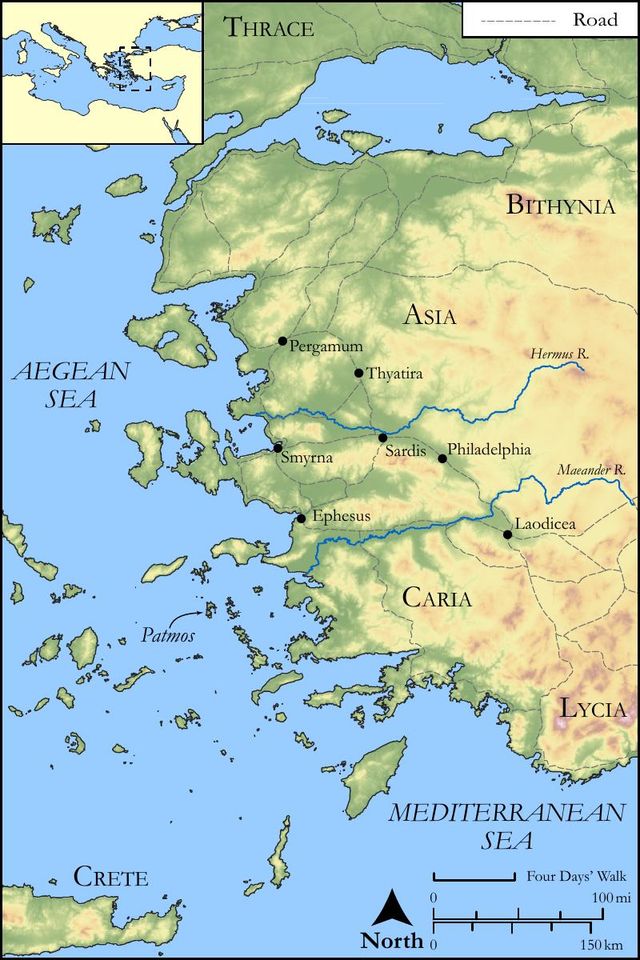
See on the biblical-era maps

Study this verse
Public-domain commentary
Matthew Henry
From his Commentary on the Whole Bible. Henry comments on passages, not single verses — this entry covers Revelation 17:1–6.
Here we have a new vision, not as to the matter of it, for that is contemporary with what came under the three last vials; but as to the manner of description, etc. Observe, 1. The invitation given to the apostle to take a view of what was here to be represented: Come hither, and I will show thee the judgment of the great whore, etc., Rev 17:1. This is a name of great infamy. A whore [in this passage] is one that is married, and has been false to her husband's bed, has forsaken the guide of her youth, and broken the covenant of God. She had been a prostitute to the kings of the earth, whom she had intoxicated with the wine of her fornication. 2. The appearance she made: it was gay and gaudy, like such sort of creatures: She was arrayed in purple, and scarlet colour, and decked with gold, and precious stones, and pearls, Rev 17:4. Here were all the allurements of worldly honour and riches, pomp and pride, suited to sensual and worldly minds. 3. Her principal seat and residence - upon the beast that had seven heads and ten horns; that is to say, Rome, the city on seven hills, infamous for idolatry, tyranny, and blasphemy. 4. Her name, which was written on her forehead. It was the custom of impudent harlots to hang out signs, with their names, that all might know what they were. Now in this observe, (1.) She is named from her place of residence - Babylon the great. But, that we might not take it for the old Babylon literally so called, we are told there is a mystery in the name; it is some other great city resembling the old Babylon. (2.) She is named from her infamous way and practice; not only a harlot, but a mother of harlots, breeding up harlots, and nursing and training them up to idolatry, and all sorts of lewdness and wickedness - the parent and nurse of all false religion and filthy conversation. 5. Her diet: she satiated herself with the blood of the saints and martyrs of Jesus. She drank their blood with such greediness that she intoxicated herself with it; it was so pleasant to her that she could not tell when she had had enough of it: she was satiated, but never satisfied.
Historical interpretation
Seven Centuries of Reception
8 surviving comments on this verse. Each one is dated, so this reads as a timeline rather than a list.
Select a marker to jump to its quote. Markers stagger vertically where authors wrote within a few decades of each other.
Showy adornments and clothing and the allurements of beauty are not becoming in any except prostitutes and shameless women, and of none, almost, is the dress more costly than those whose modesty is cheap. Thus in holy Scripture, by which the Lord has wished us to be instructed and admonished, a harlot city is described, beautifully attired and adorned, and with her adornments, and rather because of those very adornments, destined to perish. … Let chaste and modest virgins shun the attire of the unchaste, the clothing of the immodest, the insignia of brothels, the adornment of harlots.
"There came one of the seven angels, which have the seven bowls, and spake with me, saying, Come, I will show thee the judgment of that great whore who sitteth upon many waters. And I saw the woman drunk with the blood of the saints, and with the blood of the martyrs." The decrees of that senate are always accomplished against all, contrary to the preaching of the true faith; and now already mercy being cast aside, itself here gave the decree among all nations.
The purple symbolizes the pretense and deceit of her false rule, and the scarlet indicates the bloody disposition of her impiety.… [The jewels] symbolize all the allurements of that which deceitly claims to be true.… And then he discloses what is really on the inside of this beauty, saying, “She had in her hand a gold cup full of abominations and the impurities of the fornication of the whole world.” The gold symbolizes the hypocrisy, for as the Lord said, on the outside they appear to everyone as righteous, but on the inside they are full of every form of uncleanness.
She is clothed in scarlet and purple, for these are symbols of her dominion and rule over all. Therefore, she is decorated with precious stones and pearls. The “cup” indicates the sweetness of evil deeds before they are tasted, and it is gold because such deeds seem precious, as someone said of Job, “who drinks scoffing like water.” Moreover, the cup demonstrates that she is not sated by her evil but pursues further evil with a thirst for her own destruction. Therefore, she multiplies abominations for herself, that is, [she demands] practices that are abominable to God and that she makes the multitude who love the martyrs to drink. In this way she draws, as though it were a sweet drink, the abominable stupor of sin and the pollution of fornication from God.
And the woman was arrayed in purple and scarlet. In purple is shown the pretense of feigned rule, in scarlet the bloody habit of impiety is demonstrated.
Having a golden cup, etc. A golden cup full of impurities is hypocrisy, because hypocrites outwardly appear to people as just, but inside they are full of all filth. For what poison is in gold, this is the beast hidden under the guise of the harlot.
And adorned with gold and precious stones and pearls. That is, with all the allurements of simulated truth. What is, in fact, within this beauty, he explains, saying:
And "the woman was clothed in purple and scarlet, purple" for the kingdom, and "scarlet" for the shedding of the many holy bloods.
"Adorned with gold and precious stone and pearls." As a queen fittingly the text says "adorned" about her, with royal adornment.
"Holding a golden cup in her hand, full of abominations", golden indeed because honorable for her rulership, yet full nevertheless of idolatry and pollutions, by which she was nourished and to which she poured sacrifices to her own demons.
And he says, "the impurities of the earth's fornication"; for she attributes to it the causes of the idolatry of the other nations as well, as to the chief author of evils and of idolatrous madness.
Continue studying Revelation 17:4 across the web’s major study libraries — every link below opens this exact verse, chapter, or book on the destination site.
Read & Compare
 BibleGatewayThis verse in more than 200 translations and 70 languages.
 Bible.comThe YouVersion reader — hundreds of translations, reading plans, and highlights.
 ESV.orgCrossway's official English Standard Version reader.
 NET BibleThe NET translation with 60,000+ translators' notes on every rendering decision.
 STEP BibleTyndale House's free study tool — original text, vocabulary, and scholarly resources.
 BibliaLogos Bible Software's free web reader.
 USCCBThe New American Bible (Revised Edition) with the U.S. bishops' study notes.
Commentaries
 BibleHub CommentariesDozens of classic commentaries on this verse, gathered on one page.
 StudyLightMore than 100 commentary sets — the largest collection on the web.
 BibleRefPlain-English commentary on what this verse means, verse by verse.
 Enduring WordDavid Guzik's free commentary on this chapter, widely used by Bible teachers.
 Bible Study ToolsVerse commentary alongside Greek and Hebrew study aids.
Original Language & Research
- BibleHub InterlinearThe verse word by word — original language, transliteration, and English.
- BibleHub LexiconEvery word's original-language definition and Strong's entry.
 Blue Letter BibleDeep-study tools — Strong's numbers, concordance, and word studies.
 CNTR CollationThe earliest Greek manuscripts of this verse, collated letter by letter.
Sermons, Hymns & Audio


TrulyRandomVerse is not affiliated with these sites and doesn’t control their content. They’re linked because they’re genuinely useful.
Summary
Revelation 17:4 offers a vivid, symbolic portrayal of the "great harlot," a central figure representing a powerful, corrupt system or city that stands in opposition to God. This verse meticulously details her outward splendor and lavish adornment, which serve as a deceptive facade, concealing her profound spiritual depravity and the abominable nature of her influence, ultimately highlighting the stark contrast between external allure and internal corruption.
Context
ShowHideLiterary Context
Revelation 17:4 is an integral part of a larger vision granted to the Apostle John, specifically focusing on the judgment of "Babylon the Great," introduced by one of the seven angels who had the seven bowls (Revelation 17:1). The preceding verses describe the woman seated on many waters, signifying her widespread influence over peoples, multitudes, nations, and languages, and then riding a scarlet beast with seven heads and ten horns, which represents the political and imperial power that supports and is intertwined with her. Verse 4 then zeroes in on her appearance, providing a striking visual contrast between her deceptive outward glory and the hidden spiritual filth she carries, setting the stage for the revelation of her true identity and her ultimate demise.
Historical & Cultural Context
The imagery in Revelation 17:4 draws heavily on the historical and cultural symbols of the Roman Empire and of Babylon. "Purple and scarlet" were colors associated with royalty, immense wealth, and imperial power, often derived from expensive dyes, making garments of these hues exclusive to the elite. Gold, precious stones, and pearls further emphasize extravagant luxury and status, reminiscent of the opulence of pagan temples and imperial palaces. The "golden cup" evokes the practice of offering libations in pagan worship, but here it is filled with "abominations and filthiness," a direct indictment of idolatrous practices and moral corruption that were rampant in the Roman world and other ancient empires. This description would have immediately conveyed to John's original audience a sense of worldly power, idolatrous worship, and moral decay, often linked to the oppressive nature of Rome.
Key Themes
ShowHideThis verse powerfully contributes to several overarching themes within Revelation and biblical prophecy. The most prominent is Deceptive Splendor and Worldly Allure, where outward beauty and wealth mask profound spiritual corruption. The woman's attire and golden cup, though outwardly magnificent, are a snare, drawing people into idolatry and unfaithfulness to God. This ties into the theme of Spiritual Harlotry and Idolatry, a recurring motif in Old Testament prophetic books (e.g., Ezekiel 16) where unfaithfulness to God is depicted as spiritual adultery or fornication. The "abominations" in her cup explicitly point to detestable idolatrous practices. Finally, the verse foreshadows the theme of Divine Judgment, as this opulent yet corrupt system is destined for destruction, a judgment that will ultimately reveal the true nature of worldly power opposed to God, as seen later in the fall of Babylon (Revelation 18).
Exposition and Analysis
ShowHideKey Word Analysis
ShowHideWhile literally meaning "woman" or "wife," in prophetic contexts, this term can symbolize a spiritual entity, a city, or a system. Here, it is clearly not an individual but a personification of a powerful, corrupt spiritual and political force, often identified with "Babylon the Great," which stands in opposition to the "bride" of Christ (the Church) later depicted in Revelation.
This verb signifies being "swollen out" or "completely filled." It emphasizes the absolute saturation of the cup with its contents. The cup is not merely holding some abominations; it is overflowing with them, indicating the pervasive and inherent nature of the harlot's spiritual corruption. There is no room for anything pure or good within it.
This term refers to something utterly detestable, an object of disgust, particularly in a religious sense. In the Septuagint and New Testament, it is frequently used to describe idolatrous practices, pagan rituals, and things that are an affront to God's holiness. The harlot's cup is filled with acts and objects of worship that God finds repugnant, directly linking her influence to false worship and spiritual defilement.
While it can refer to physical sexual immorality, in prophetic and theological contexts, porneía often signifies spiritual unfaithfulness or idolatry. It describes the act of abandoning loyalty to God and instead pursuing illicit relationships with false gods, worldly systems, or practices that compromise one's devotion to the one true God. The "filthiness of her fornication" underscores the moral and spiritual pollution resulting from this unholy alliance.
Verse Breakdown
ShowHide"And the woman was arrayed in purple and scarlet colour"
This clause immediately establishes the woman's outward appearance as one of immense wealth, luxury, and power. Purple was the color of royalty and extreme expense, while scarlet often symbolized opulence, sin, or even bloodshed. This imagery suggests a system that commands respect and admiration from a worldly perspective, appearing glorious and desirable.
"and decked with gold and precious stones and pearls"
This further amplifies the description of her lavishness. "Decked" (Greek: chrysóō) means to be gilded or adorned with gold ornaments. The inclusion of gold, precious stones, and pearls signifies the highest level of material riches and ostentation, reinforcing the idea of a system that is outwardly magnificent and appeals to human desires for wealth and status.
"having a golden cup in her hand full of abominations and filthiness of her fornication"
This is the stark contrast that reveals her true nature. The cup itself is "golden," maintaining the theme of deceptive outward beauty, but its contents are utterly repulsive. "Abominations" refers to things detestable to God, specifically idolatrous practices, and "filthiness of her fornication" points to the moral and spiritual pollution resulting from spiritual unfaithfulness to God. This clause exposes the deep spiritual depravity hidden beneath the glittering exterior.
Literary Devices
ShowHideRevelation 17:4 is rich in Symbolism. The "woman" is not a literal individual but a symbolic representation of a powerful, corrupt entity, often interpreted as a global system, a city (Rome), or a religious-political power that opposes God. Her "purple and scarlet" attire symbolizes her royal status, wealth, and association with sin or violence. The "gold, precious stones, and pearls" symbolize the immense material riches and worldly allure she possesses. The "golden cup" is symbolic of influence and power, but its contents—"abominations and filthiness of her fornication"—symbolize the spiritual corruption, idolatry, and moral depravity she propagates. There is also profound Irony in the description: a "golden cup" that should hold something valuable or pure is instead filled with detestable things, highlighting the deceptive nature of this entity. The outward beauty is a stark contrast to the inward ugliness, creating a powerful sense of spiritual dissonance. This use of Personification gives a tangible, vivid form to abstract concepts of spiritual corruption and worldly power, making the warning more impactful.
Theological and Thematic Connections
ShowHideRevelation 17:4 serves as a profound theological statement on the nature of worldly power systems that set themselves against God. It underscores the biblical truth that outward splendor and material wealth, when divorced from divine truth and righteousness, lead to profound spiritual corruption and idolatry. The harlot's "golden cup" filled with "abominations and filthiness" vividly illustrates that what appears attractive and desirable in the world's eyes can be utterly detestable to God, leading people into spiritual unfaithfulness (fornication). This passage warns against the seductive power of worldly systems that promise glory and satisfaction but ultimately deliver spiritual death and judgment, highlighting the necessity of spiritual discernment and unwavering allegiance to God alone.
Reflection and Application
ShowHideRevelation 17:4 is a potent warning for believers in every age, urging us to cultivate keen spiritual discernment in a world brimming with deceptive allure. It challenges us to look beyond the glittering facades of power, wealth, and influence that worldly systems often present. The harlot's opulent attire and golden cup, though outwardly appealing, conceal a core of spiritual corruption, idolatry, and moral defilement. This calls us to examine our own allegiances: Are we captivated by the promises of worldly success, material gain, or societal acceptance, even if they subtly compromise our devotion to Christ? The verse reminds us that true spiritual richness and lasting peace are found not in accumulating earthly treasures or aligning with powerful human institutions, but in unwavering faithfulness to God and His truth. It is a call to be separate from the world's corrupting influences, to reject anything that leads to spiritual compromise, and to prioritize purity of heart and devotion to Christ above all else, recognizing that what the world esteems, God often abhors.
Questions for Reflection
ShowHideFAQ
ShowHideWhat does the "woman" in Revelation 17:4 symbolize?
ShowHideThe "woman" in Revelation 17:4 is a complex and highly symbolic figure, widely interpreted as "Babylon the Great" (Revelation 17:5). She represents a powerful, corrupt spiritual and political system or city that opposes God and persecutes His people. While some historical interpretations link her specifically to ancient Rome due to its imperial power and idolatry, broader theological interpretations understand her as any global, anti-God system that seduces humanity through wealth, power, and false religion, leading them into spiritual unfaithfulness. She stands in stark contrast to the pure "bride" of Christ, the Church (Revelation 21:2).
What is the significance of the "golden cup full of abominations and filthiness of her fornication"?
ShowHideThe "golden cup" is a powerful symbol of deceptive allure and the true nature of the harlot's influence. While gold suggests value and purity, the contents of the cup reveal her profound spiritual depravity. "Abominations" (Greek: bdélygma) refers to things utterly detestable to God, particularly idolatrous practices and pagan worship. "Filthiness of her fornication" signifies the moral and spiritual pollution resulting from her spiritual unfaithfulness to God, where devotion due to Him is given to false gods, worldly power, or illicit pleasures. This imagery vividly portrays how worldly systems, despite their outward splendor, are inherently corrupt and lead people into spiritual compromise and idolatry, offering a poisoned draught that appears appealing but leads to destruction. It echoes Old Testament warnings against spiritual harlotry, such as those found in Hosea 4:12.
Christ-Centered Fulfillment
ShowHideRevelation 17:4, with its vivid portrayal of the harlot's deceptive splendor and inherent corruption, finds its ultimate Christ-centered fulfillment in the stark contrast between the world's allure and the true glory of Jesus Christ and His kingdom. The harlot's gaudy display of "purple and scarlet," "gold and precious stones and pearls," represents the fleeting, corruptible riches and power of this world, which ultimately lead to "abominations and filthiness." In contrast, Christ embodies true, incorruptible glory and righteousness. He came not arrayed in worldly splendor, but in humility, offering a kingdom "not of this world" (John 18:36). While the harlot offers a cup of spiritual defilement, Jesus offers the "living water" that satisfies eternal thirst (John 4:10-14). Furthermore, the harlot's spiritual "fornication" stands in stark opposition to the pure, faithful relationship Christ has with His Church, His beloved Bride, whom He sanctifies and cleanses to be "without spot or wrinkle or any such thing" (Ephesians 5:25-27). The judgment pronounced upon the harlot ultimately highlights Christ's triumph over all worldly systems and spiritual wickedness, revealing Him as the true King of kings and Lord of lords (Revelation 19:11-16), whose reign is eternal and whose glory far surpasses any earthly facade.