


2 Kings 5:15
- וַיָּשָׁבvai·ya·Shavand he went backH7725Conj-w ¦ V-Qal-ConsecImperf-3msVerb Qal Consecutive Imperfect 3rd Singular Masculineוַandיָּשָׁבhe went back
- אֶל'eltoH413PrepPreposition
- אִישׁ'ish[the] man ofH376N-mscNoun Singular Masculine Construct
- הָאֱלֹהִיםha·'E·lo·Him<the> GodH430Art ¦ N-mpNoun Plural Masculine Absoluteהָ<the>אֱלֹהִיםGod
- הוּאhu'heH1931Pro-3msPronoun Personal 3rd Singular Masculine
- וְכָלve·kholand allH3605Conj-w ¦ N-mscNoun Singular Masculine Constructוְandכָלall
- מַחֲנֵהוּma·cha·Ne·huhis campH4264N-fsc ¦ 3msNoun Singular Feminine Constructמַחֲנֵcampהוּhis
- וַיָּבֹאvai·ya·Vo'and he cameH935Conj-w ¦ V-Qal-ConsecImperf-3msVerb Qal Consecutive Imperfect 3rd Singular Masculineוַandיָּבֹאhe came
- וַיַּעֲמֹדvai·ya·'a·Modand he stoodH5975Conj-w ¦ V-Qal-ConsecImperf-3msVerb Qal Consecutive Imperfect 3rd Singular Masculineוַandיַּעֲמֹדhe stood
- לְפָנָיוle·fa·Nav<to> before himH6440Prep-l ¦ N-mpc ¦ 3msNoun Plural Masculine Constructלְ<to>פָנָיbeforeוhim
- וַיֹּאמֶרvai·Yo·merand he saidH559Conj-w ¦ V-Qal-ConsecImperf-3msVerb Qal Consecutive Imperfect 3rd Singular Masculineוַandיֹּאמֶרhe said
- הִנֵּהhi·nehhere!H2009PrtParticle Interjection
- נָאna'pleaseH4994PrtParticle Interjection
- יָדַעְתִּיya·Da'·tiI knowH3045V-Qal-Perf-1csVerb Qal Perfect 1st Singular common gender
- כִּיkithatH3588PrtParticle Conditional
- אֵין'einthere notH369N-mscNoun Singular Masculine Construct
- אֱלֹהִים'E·lo·Him[is] a GodH430N-mpNoun Plural Masculine Absolute
- בְּכָלbe·kholin allH3605Prep-b ¦ N-mscNoun Singular Masculine Constructבְּinכָלall
- הָאָרֶץha·'A·retzthe earthH776Art ¦ N-fsNoun Singular Feminine Absoluteהָtheאָרֶץearth
- כִּיkithatH3588PrtParticle Conditional
- אִם'imexceptH518PrtParticle Conditional
- בְּיִשְׂרָאֵלbe·Yis·ra·'Elin IsraelH3478Prep-b ¦ N-properNoun Proper LocationבְּinיִשְׂרָאֵלIsrael
- וְעַתָּהve·'a·Tahand nowH6258Conj-w ¦ AdvAdverbוְandעַתָּהnow
- קַחkachacceptH3947V-Qal-Imp-2msVerb Qal Imperative 2nd Singular Masculine
- נָאna'pleaseH4994PrtParticle Interjection
- בְרָכָהve·ra·Khaha blessingH1293N-fsNoun Singular Feminine Absolute
- מֵאֵתme·'Etfrom withH854Prep-m ¦ PrepPrepositionמֵfromאֵתwith
- עַבְדֶּךָ'av·De·khayour servantH5650N-msc ¦ 2msNoun Singular Masculine Constructעַבְדֶּservantךָyour
English is a literal word-by-word gloss of the Hebrew, not the KJV's wording. Why?
This is the original text the KJV's translators worked from — each Hebrew word with its own literal English meaning in this verse, prepared by scholars at Tyndale House, Cambridge. The KJV translates whole sentences, not word by word, so its wording differs: one Hebrew word can become several English words, and the KJV may choose “the LORD” where the gloss reads “Yahweh”. Both are faithful — they answer different questions. For the KJV's own rendering, switch to the KJV text.
Details
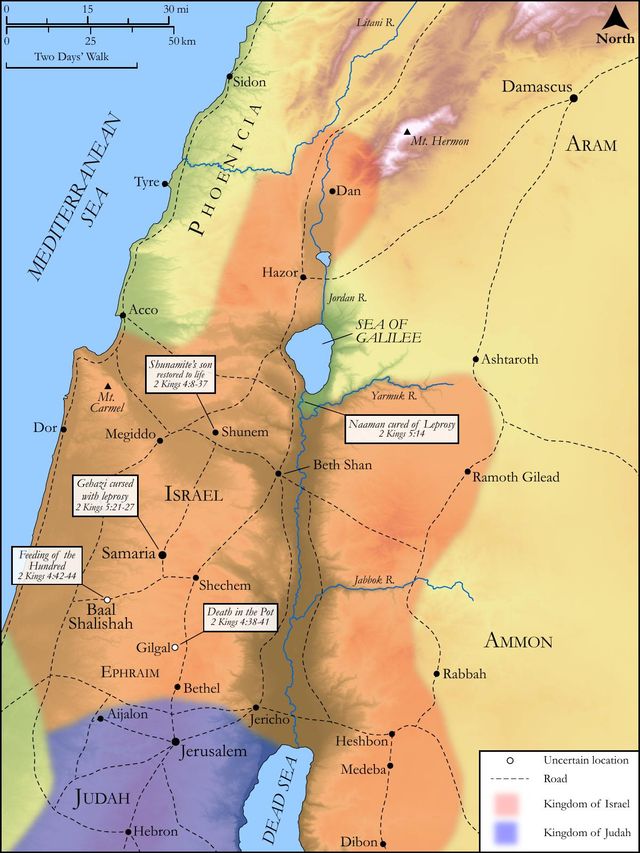
See on the biblical-era map
Study this verse
Public-domain commentary
Matthew Henry
From his Commentary on the Whole Bible. Henry comments on passages, not single verses — this entry covers 2 Kings 5:15–19.
Of the ten lepers that our Saviour cleansed, the only one that returned to give thanks was a Samaritan, Luk 17:16. This Syrian did so, and here expresses himself.
I.Convinced of the power of the God of Israel, not only that he is God, but that he is God alone, and that indeed there is no God in all the earth but in Israel (Kg2 5:15) - a noble confession, but such as intimates the misery of the Gentile world; for the nations that had many gods really had no God, but were without God in the world. He had formerly thought the gods of Syria gods indeed, but now experience had rectified his mistake, and he knew Israel's God was God alone, the sovereign Lord of all. Had he seen other lepers cleansed, perhaps the sight would not have convinced him, but the mercy of the cure affected him more than the miracle of it. Those are best able to speak of the power of divine grace who have themselves experienced it.
II.Grateful to Elisha the prophet:
"Therefore, for his sake whose servant thou art, I have a present for thee, silver, and gold, and raiment, whatever thou wilt please to accept." He valued the cure, not by the easiness of it to the prophet, but the acceptableness of it to himself, and would gladly pay for it accordingly. But Elisha generously refused the fee, though urged to accept it; and, to prevent further importunity, backed his refusal with an oath: As the Lord liveth, I will receive none (Kg2 5:16), not because he did not need it, for he was poor enough, and knew what to do with it, and how to bestow it among the sons of the prophets, nor because he thought it unlawful, for he received presents from others; but he would not be beholden to this Syrian, nor should he say, I have made Elisha rich, Gen 14:23. It would be much for the honour of God to show this new convert that the servants of the God of Israel were taught to look upon the wealth of this world with a holy contempt, which would confirm him in his belief that there was no God but in Israel. See Co1 9:18; Co2 11:9.
III.Proselyted to the worship of the God of Israel.
He will not only offer a sacrifice to the Lord, in thanks for his present cure, but he resolves he will never offer sacrifice to any other gods, Kg2 5:17. It was a happy cure of his leprosy which cured him of his idolatry, a more dangerous disease. But here are two instances of his weakness and infirmity in his conversion: - 1. In one instance he over-did it, that he would not only worship the God of Israel, but he would have clods of earth out of the prophet's garden, or at least of the prophet's ordering, to make an altar of, Kg2 5:17. He that awhile ago had spoken very slightly of the waters of Israel (Kg2 5:12) now is in another extreme, and over-values the earth of Israel, supposing (since God has appointed altars of earth, Exo 20:24) that an altar of that earth would be most acceptable to him, not considering that all the earth is the Lord's and the fulness thereof. Or perhaps the transport of his affection and veneration for the prophet, not only upon the account of his power, but of his virtue and generosity, made him, as we say, love the very ground he went upon and desire to have some of it home with him. The modern compliment equivalent to this would be, "Pray, sir, let me have your picture." 2. In another instance he under-did it, that he reserved to himself a liberty to bow in the house of Rimmon, in complaisance to the king his master, and according to the duty of his place at court (Kg2 5:18), in this thing he must be excused. He owns he ought not to do it, but that he cannot otherwise not do it, but that he cannot otherwise keep his place, - protests that his bowing is not, nor ever shall be, as it had been, in honour to the idol, but only in honour to the king, - and therefore he hopes God will forgive him. Perhaps, all things considered, this might admit of some apology, though it was not justifiable. But, as to us, I am sure, (1.) If, in covenanting with God, we make a reservation for any known sin, which we will continue to indulge ourselves in, that reservation is a defeasance of his covenant. We must cast away all our transgressions and not except any house of Rimmon. (2.) Though we are encouraged to pray for the remission of the sins we have committed, yet, if we ask for a dispensation to go on in any sin for the future, we mock God, and deceive ourselves. (3.) Those that know not how to quit a place at court when they cannot keep it without sinning against God, and wronging their consciences, do not rightly value the divine favour. (4.) Those that truly hate evil will make conscience of abstaining from all appearances of evil. Though Naaman's dissembling his religion cannot be approved, yet because his promise to offer no sacrifice to any god but the God of Israel only was a great point gained with a Syrian, and because, by asking pardon in this matter, he showed such a degree of conviction and ingenuousness as gave hopes of improvement, the prophet took fair leave of him, and bade him Go in peace, Kg2 5:19. Young converts must be tenderly dealt with.
Historical interpretation
Fourteen Centuries of Reception
3 surviving comments on this verse. Each one is dated, so this reads as a timeline rather than a list.
Select a marker to jump to its quote. Markers stagger vertically where authors wrote within a few decades of each other.
After Naaman had been persuaded by the prophet and had washed seven times in the Jordan, he eventually acknowledged his error. He was astonished, and a deep bewilderment took him when he realized that he had been delivered from his filthiness. And he thanked God for his healing and testified that the Lord of the universe, in his profound care for him, had conceded him that extraordinary power by simply using water. He also proclaimed that his healing could not have derived from the water of the river but had been caused by Elisha’s command. That is why he offered royal presents, but the prophet did not accept them and was not persuaded by the donor, even though he had pressed him many times. For that magnificently and very clearly prefigured the mystery of the healing, which is freely granted to all nations of the earth by our Lord through the intercession of the apostles. And this had been promised in advance to those masters by the prophet Isaiah, when he said, “You were sold for nothing, and you shall be redeemed without money.”Since all diseases are a sort of bondage, the prophet necessarily fixed the healing at the seventh bath, in parallel with the fact that the Law, too, orders and promises freedom for the slave at the seventh year.
Let us further see what blessed Elisha commanded Naaman the Syrian. “Go,” he says, “and wash seven times in the Jordan.” When Naaman heard that he was to wash seven times in the Jordan, he was indignant and did not want to comply, but accepting the advice of his friends, he consented to be washed and was cleansed. This signified that before Christ was crucified, the Gentiles did not believe in Christ when he spoke in his own person, but afterwards they devoutly came to the sacrament of baptism after the preaching of the apostles. For this reason Elisha told Naaman to wash seven times in the Jordan. See, brothers: Elisha sent Naaman to the river Jordan because Christ was to send the Gentiles to baptism. Moreover, the fact that Elisha did not touch Naaman himself or baptize him showed that Christ did not come to the Gentiles himself but through his apostles to whom he said, “Go, and baptize all nations in the name of the Father, and of the Son and of the Holy Spirit.” Notice further that Naaman, who prefigured the Gentiles, recovered his health in the same river that later Christ consecrated by his baptism. However, when Naaman heard that he was to wash seven times in the Jordan, he became angry and said, “Are not the waters of my region better, the rivers of Damascus, the Abana and the Pharphar, that I may wash in them and be made clean?” When he had said this, his servants advised him to agree to the counsel of the prophet. Carefully notice what this means, brothers.Holy Elisha, as we said, typified our Lord and Savior, while Naaman prefigured the Gentiles. The fact that Naaman believed he would recover his health as the result of his own rivers indicates that the human race presumed on its free will and its own merits; but without the grace of Christ their own merits cannot possess health, although they can have leprosy. For this reason if the human race had not followed the example of Naaman and listened to the advice of Elisha, with humility receiving the gift of baptism through the grace of Christ, they could not be freed from the leprosy of the original and actual sins. “Wash seven times,” he said, because of the sevenfold grace of the Holy Spirit, which reposed in Christ our Lord. Moreover, when our Lord was baptized in this river, the Holy Spirit came on him in the form of a dove. When Naaman descended into the river as a figure of baptism, “his flesh became like the flesh of a little child.” Notice, beloved brothers, that this likeness was perfected in the Christian people, for you know that all who are baptized are still called infants, whether they are old or young. Those who are born old through Adam and Eve are reborn as young people to death, the second one to life. The former produces children of wrath; the latter generates them again as vessels of mercy. The apostle says, “In Adam all die; in Christ all will be made to live.” Therefore, just as Naaman, although he was an old man, became like a boy by washing seven times, so the Gentiles, although old by reason of their former sins and covered with the many spots of iniquity as with leprosy, are renewed by the grace of baptism in such a way that no leprosy of either original or actual sin remains in them. Thus, following the example of Naaman, they are renewed like little children by salutary baptism, although they have always been bent down under the weight of sins.
A blessing: a present.
Continue studying 2 Kings 5:15 across the web’s major study libraries — every link below opens this exact verse, chapter, or book on the destination site.
Read & Compare
 BibleGatewayThis verse in more than 200 translations and 70 languages.
 Bible.comThe YouVersion reader — hundreds of translations, reading plans, and highlights.
 ESV.orgCrossway's official English Standard Version reader.
 NET BibleThe NET translation with 60,000+ translators' notes on every rendering decision.
 STEP BibleTyndale House's free study tool — original text, vocabulary, and scholarly resources.
 BibliaLogos Bible Software's free web reader.
 USCCBThe New American Bible (Revised Edition) with the U.S. bishops' study notes.
Commentaries
 BibleHub CommentariesDozens of classic commentaries on this verse, gathered on one page.
 StudyLightMore than 100 commentary sets — the largest collection on the web.
 BibleRefPlain-English commentary on what this verse means, verse by verse.
 Enduring WordDavid Guzik's free commentary on this chapter, widely used by Bible teachers.
 Bible Study ToolsVerse commentary alongside Greek and Hebrew study aids.
Original Language & Research
- BibleHub InterlinearThe verse word by word — original language, transliteration, and English.
- BibleHub LexiconEvery word's original-language definition and Strong's entry.
 Blue Letter BibleDeep-study tools — Strong's numbers, concordance, and word studies.
 SefariaThe Hebrew text with Rashi and centuries of Jewish commentary.
Sermons, Hymns & Audio


TrulyRandomVerse is not affiliated with these sites and doesn’t control their content. They’re linked because they’re genuinely useful.
Summary
Second Kings 5:15 marks the dramatic spiritual transformation of Naaman, the Syrian commander, immediately following his miraculous healing from leprosy. Having obeyed the prophet Elisha's instruction to wash in the Jordan River, Naaman returns to Elisha, no longer seeking a cure but expressing profound gratitude and, more significantly, a radical confession of faith. His declaration, "now I know that there is no God in all the earth, but in Israel," signifies a complete shift from polytheism to the exclusive worship of Yahweh, the God of Israel, culminating in an earnest offer of a gift as a token of his newfound devotion and respect.
Context
ShowHideLiterary Context
This verse serves as the powerful climax to the narrative of Naaman's healing, which begins in 2 Kings 5:1. Naaman, a powerful Syrian general, is afflicted with leprosy, a condition that would typically render him ritually unclean and socially ostracized. Through the testimony of a young Israelite servant girl, he learns of a prophet in Samaria who can heal him. After a diplomatic misunderstanding with the King of Israel and an initial display of pride and anger at Elisha's seemingly simplistic instructions to wash in the Jordan (2 Kings 5:11-12), Naaman is persuaded by his servants to humble himself and follow Elisha's command. His subsequent immersion seven times in the Jordan River results in his complete cleansing (2 Kings 5:14). Verse 15 is the immediate, transformative aftermath, demonstrating that the healing was not merely physical but profoundly spiritual, leading to a public confession of faith and an act of profound reverence.
Historical & Cultural Context
Naaman was a high-ranking military commander from Aram (Syria), a nation frequently hostile to Israel. In the ancient Near East, national gods were typically associated with specific territories and often seen as having limited power beyond their borders. Naaman, as a Syrian, would have worshipped the gods of Aram, such as Hadad. His journey to Israel and his expectation of a grand, magical display from Elisha reflect the common understanding of divine power and prophetic activity in that era. The act of offering a "blessing" or gift (Hebrew: bĕrākāh) was a widespread cultural custom, signifying respect, gratitude, and often a token of allegiance or submission from a vassal to a superior, or from one who received a great benefit. Naaman's insistence on Elisha taking a gift, despite Elisha's refusal in 2 Kings 5:16, highlights the deeply ingrained nature of this practice and Naaman's fervent desire to express his indebtedness and new allegiance.
Key Themes
ShowHideThe narrative of Naaman's healing and conversion powerfully illustrates several key themes. Firstly, it underscores the exclusive sovereignty and power of the God of Israel. Naaman's declaration, "now I know that there is no God in all the earth, but in Israel," is a profound confession of monotheism, challenging the polytheistic worldview prevalent in his time and among his people. Secondly, the story highlights God's universal reach and redemptive plan, demonstrating that His power and grace are not confined to the geographical or ethnic boundaries of Israel but can extend to Gentiles, even enemies, who humble themselves. This foreshadows the broader inclusion of nations in God's covenant, a theme developed throughout the prophetic books and profoundly realized in the New Testament. Lastly, Naaman's journey exemplifies the theme of humility leading to divine encounter and transformation. His initial pride and anger (2 Kings 5:11) give way to humble obedience, resulting in both physical healing and spiritual revelation, showcasing that God "resists the proud but gives grace to the humble" (James 4:6).
Exposition and Analysis
ShowHideKey Word Analysis
ShowHideThis verb (H3045) signifies more than mere intellectual assent; it denotes an experiential, intimate, and transformative knowledge, often gained through direct observation or encounter. Naaman's declaration is not a theoretical statement but a profound realization born from his personal encounter with God's power. He "knows" Yahweh through direct experience of His miraculous healing, leading to a complete reorientation of his understanding of deity.
While a generic term for deity (H430), in this context, especially with the qualifier "in Israel," it refers specifically to Yahweh, the covenant God of Israel. Naaman's statement is a radical affirmation that Yahweh is the only true God, distinct from and superior to all the gods he previously worshipped. His experience has revealed to him the singular, unmatched power of the God of Israel.
In this specific context, bᵉrâkâh (H1293) refers to a tangible gift or present, often offered as a token of gratitude, respect, or homage. It is not a spiritual pronouncement but a material expression of Naaman's deep appreciation and recognition of Elisha's role as God's servant, and by extension, his profound thankfulness to the God who healed him.
Verse Breakdown
ShowHide"And he returned to the man of God, he and all his company, and came, and stood before him:"
This phrase emphasizes Naaman's humility and respect. Instead of simply departing after his healing, he makes a deliberate, public return with his entire entourage. His act of "standing before him" signifies a posture of reverence and submission to Elisha, the representative of the true God, a stark contrast to his initial haughty demeanor and expectation of Elisha coming out to meet him.
"and he said, Behold, now I know that [there is] no God in all the earth, but in Israel:"
This is the pivotal confession of the verse and the climax of Naaman's spiritual journey. Naaman, a polytheist from a pagan nation, now declares exclusive monotheism. His experiential healing has shattered his previous worldview, leading him to acknowledge Yahweh as the unique and supreme deity, whose power transcends national boundaries and surpasses all other gods. This is a profound theological statement from a Gentile, recognizing Yahweh's universal sovereignty.
"now therefore, I pray thee, take a blessing of thy servant."
This clause reveals Naaman's deep gratitude and desire to honor Elisha, and by extension, God. The offer of a "blessing" (a gift) is a customary act of thanksgiving and reverence, demonstrating his changed heart and his recognition of the immense, unpayable debt he feels for the divine intervention that restored his life. It signifies his desire to establish a relationship of honor and service.
Literary Devices
ShowHideThe narrative of 2 Kings 5:15 is rich in Contrast and Transformation. Naaman's initial pride, anger, and skepticism (2 Kings 5:11) are sharply contrasted with his post-healing humility, reverence, and profound faith. His journey from a powerful, self-important general to a humble "servant" before Elisha showcases a complete Character Arc, emphasizing the spiritual change wrought by God. The Irony is palpable: a Syrian general, an enemy of Israel, is healed by the God of Israel and becomes a worshipper of Yahweh, while many Israelites remained idolatrous. Naaman's explicit Confession ("now I know that there is no God...") is a powerful rhetorical device, serving as the theological climax of his personal narrative and affirming the unique sovereignty of Yahweh. The entire episode functions as a Paradigm for how God can reveal Himself to anyone, regardless of background, through miraculous intervention, leading to genuine repentance and faith.
Theological and Thematic Connections
ShowHideNaaman's confession in 2 Kings 5:15 reverberates throughout biblical theology, affirming God's absolute sovereignty and His unique identity as the one true God. His conversion from polytheism to monotheism, a Gentile acknowledging Yahweh as the only God "in all the earth," is a powerful testament to God's universal reach and His desire to reveal Himself beyond the confines of Israel. This narrative foreshadows the inclusion of Gentiles into God's redemptive plan, demonstrating that salvation is not limited by ethnicity or nationality but is available to all who humble themselves and believe. It underscores that true healing, whether physical or spiritual, leads to a recognition of God's unmatched power and a heartfelt response of worship and gratitude.
Reflection and Application
ShowHideNaaman's story in 2 Kings 5:15 offers a profound blueprint for spiritual transformation and a call to authentic faith. His journey from prideful resistance to humble obedience, culminating in a radical confession of God's unique sovereignty, challenges us to examine our own hearts. Do we truly acknowledge that there is "no God in all the earth" but Yahweh, allowing this truth to shape every aspect of our lives, or do we subtly allow other "gods"—idols of success, comfort, or self-reliance—to compete for His rightful place? Naaman's immediate return and desire to offer a "blessing" speak to the natural outpouring of gratitude that should flow from a heart touched by divine grace. His transformation reminds us that genuine encounters with God lead to a profound reorientation of our lives, marked by humility, worship, and a desire to honor Him with our lives and resources.
Questions for Reflection
ShowHideFAQ
ShowHideWhy did Naaman return to Elisha after being healed?
ShowHideNaaman's return was not merely a polite gesture of thanks, but a profound expression of his spiritual transformation. His physical healing was accompanied by a radical shift in his worldview. He returned to confess his newfound faith in the God of Israel, acknowledging Him as the one true God above all others. This public declaration was a testament to the miraculous work God had done in his life, both physically and spiritually. He recognized Elisha as God's true prophet and sought to honor the source of his healing, demonstrating a complete change of heart and allegiance.
What is the significance of Naaman's declaration, "there is no God in all the earth, but in Israel"?
ShowHideThis declaration is incredibly significant because it represents a Gentile, a high-ranking official from a rival nation, abandoning his polytheistic beliefs and confessing exclusive monotheism in Yahweh, the God of Israel. In a world where each nation had its own gods, Naaman's statement asserts Yahweh's universal sovereignty and unique power. It foreshadows God's redemptive plan for all nations, demonstrating that His grace and power are not confined to Israel but extend to anyone who humbles themselves and believes, a theme echoed in the New Testament (e.g., Acts 10:34-35).
Why did Elisha refuse Naaman's "blessing" or gift?
ShowHideElisha refused Naaman's generous gift to make it unequivocally clear that divine healing and God's power cannot be bought or earned. His refusal prevented any suggestion that he was profiting from God's work or that the miracle was a transaction. It emphasized that God's grace is freely given, and the glory belongs solely to Him, not to the prophet or to any human effort. This act stands in stark contrast to the greed of Elisha's servant Gehazi, who later pursued Naaman for a portion of the rejected gift and suffered the consequences (2 Kings 5:20-27).
Christ-Centered Fulfillment
ShowHideThe story of Naaman in 2 Kings 5:15 finds its ultimate Christ-centered fulfillment in the person and work of Jesus. Naaman's leprosy, a debilitating and isolating disease, serves as a powerful Old Testament type for the pervasive and defiling nature of sin, which separates humanity from God. His miraculous cleansing, achieved not through grand rituals or human merit but through simple, humble obedience to the prophet's word, beautifully foreshadows the salvation offered through Christ. Just as Naaman was healed by washing in the Jordan, so too are believers cleansed from sin through the "washing of regeneration and renewal of the Holy Spirit" (Titus 3:5), made possible by the atoning sacrifice of Jesus. Naaman's radical confession, "now I know that there is no God in all the earth, but in Israel," points directly to Jesus as the ultimate revelation of the one true God, the "image of the invisible God" (Colossians 1:15). His conversion as a Gentile anticipates the universal scope of the Gospel, where "there is neither Jew nor Gentile, neither slave nor free, nor is there male and female, for you are all one in Christ Jesus" (Galatians 3:28). The "blessing" Naaman offered, though refused by Elisha, is ultimately surpassed by the immeasurable spiritual blessings we receive in Christ, who has "blessed us in the heavenly realms with every spiritual blessing" (Ephesians 1:3). Jesus, the true "man of God," is the one who heals, transforms, and brings all nations to the knowledge and worship of the Father, fulfilling the promise implicit in Naaman's profound encounter.