


Joshua 2:11
- וַנִּשְׁמַעva·nish·Ma'and we heardH8085Conj-w ¦ V-Qal-ConsecImperf-1cpVerb Qal Consecutive Imperfect 1st Plural common genderוַandנִּשְׁמַעwe heard
- וַיִּמַּסvai·yi·Masand it meltedH4549Conj-w ¦ V-Niphal-ConsecImperf-3msVerb Niphal Consecutive Imperfect 3rd Singular Masculineוַandיִּמַּסit melted
- לְבָבֵנוּle·va·Ve·nuour heartH3824N-msc ¦ 1cpNoun Singular Masculine Constructלְבָבֵheartנוּour
- וְלֹאve·lo'and notH3808Conj-w ¦ NegParticle Negativeוְandלֹאnot
- קָמָהKa·mahit aroseH6965V-Qal-Perf-3fsVerb Qal Perfect 3rd Singular Feminine
- עוֹדodagainH5750Adj-msAdjective Numerical Singular Masculine Absolute
- רוּחַRu·achspiritH7307N-fsNoun Singular Feminine Absolute
- בְּאִישׁbe·'Ishin anyoneH376Prep-b ¦ N-msNoun Singular Masculine Absoluteבְּinאִישׁanyone
- מִפְּנֵיכֶםmi·pe·nei·Khem<from> because of youH6440Prep-m ¦ N-mpc ¦ 2mpNoun Plural Masculine Constructמִ<from>פְּנֵיbecause ofכֶםyou
- כִּיkiforH3588PrtParticle Conditional
- יְהוָהYah·wehYahwehH3068N-properNoun Proper Title
- אֱלֹהֵיכֶם'e·lo·hei·Khemyour GodH430N-mpc ¦ 2mpNoun Plural Masculine ConstructאֱלֹהֵיGodכֶםyour
- הוּאhu'heH1931Pro-3msPronoun Personal 3rd Singular Masculine
- אֱלֹהִים'E·lo·Him[is] GodH430N-mpNoun Plural Masculine Absolute
- בַּשָּׁמַיִםba·sha·Ma·yimin the heavensH8064Prep-b ¦ N-mpNoun Plural Masculine Absoluteבַּin theשָּׁמַיִםheavens
- מִמַּעַלmi·Ma·'al<from> aboveH4605Prep-m ¦ Adj-csAdjective Numerical Singular common gender Absoluteמִ<from>מַּעַלabove
- וְעַלve·'aland onH5921Conj-w ¦ PrepPrepositionוְandעַלon
- הָאָרֶץha·'A·retzthe earthH776Art ¦ N-fsNoun Singular Feminine Absoluteהָtheאָרֶץearth
- מִתָּחַתmi·Ta·chat<from> beneathH8478Prep-m ¦ N-msNoun Singular Masculine Absoluteמִ<from>תָּחַתbeneath
English is a literal word-by-word gloss of the Hebrew, not the KJV's wording. Why?
This is the original text the KJV's translators worked from — each Hebrew word with its own literal English meaning in this verse, prepared by scholars at Tyndale House, Cambridge. The KJV translates whole sentences, not word by word, so its wording differs: one Hebrew word can become several English words, and the KJV may choose “the LORD” where the gloss reads “Yahweh”. Both are faithful — they answer different questions. For the KJV's own rendering, switch to the KJV text.
Details
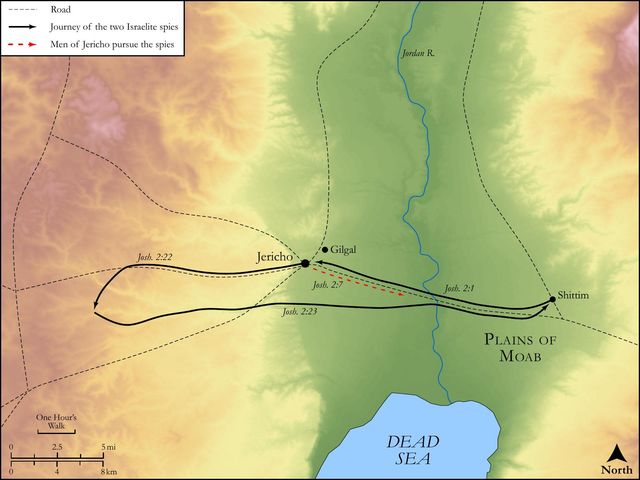
See on the biblical-era map
Study this verse
Public-domain commentary
Matthew Henry
From his Commentary on the Whole Bible. Henry comments on passages, not single verses — this entry covers Joshua 2:8–21. His two-level outline is real structure in the source text, so it is rendered as structure.
The matter is here settled between Rahab and the spies respecting the service she was now to do for them, and the favour they were afterwards to show to her. She secures them on condition that they should secure her.
I.She gives them, and by them sends to Joshua and Israel, all the encouragement that could be desired to make their intended descent upon Canaan. this was what they came for, and it was worth coming for. Having got clear of the officers, she comes up to them to the roof of the house where they lay hid, finds them perhaps somewhat dismayed at the peril they apprehended themselves in from the officers, and scarcely recovered from the fright, but has that to say to them which will give them abundant satisfaction.
1.She lets them know that the report of the great things God had done for them had come to Jericho (v. 10), not only that they had an account of their late victories obtained over the Amorites in the neighbouring country, on the other side of the river, but that their miraculous deliverance out of Egypt, and passage through the Red Sea, a great way off, and forty years ago, were remembered and talked of afresh in Jericho, to the amazement of every body. Thus this Joshua and his fellows were men wondered at, Zac 3:8. See how God makes his wonderful works to be remembered (Psa 111:4), so that men shall speak of the might of his terrible acts, Psa 145:6.
2.She tells them what impressions the tidings of these things had made upon the Canaanites: Your terror has fallen upon us (Jos 2:9); our hearts did melt, Jos 2:11. If she kept a public house, this would give her an opportunity of understanding the sense of various companies and of travellers from other parts of the country, so that they could not know this any way better than by her information; and it would be of great use to Joshua and Israel to know it; it would put courage into the most cowardly Israelite to hear how their enemies were dispirited, and it was easy to conclude that those who now fainted before them would infallibly fall before them, especially because it was the accomplishment of a promise God had made them, that he would lay the fear and dread of them upon all this land (Deu 11:25), and so it would be an earnest of the accomplishment of all the other promises God had made to them. Let not the stout man glory in his courage, any more than the strong man in his strength; for God can weaken both mind and body. Let not God's Israel be afraid of their most powerful enemies; for their God can, when he pleases, make their most powerful enemies afraid of them. Let none think to harden their hearts against God and prosper; for he that made man's soul can at any time make the sword of his terrors approach to it.
3.She hereupon makes profession of her faith in God and his promise; and perhaps there was not found so great faith (all things considered), no, not in Israel, as in this woman of Canaan. (1.) who believes God's power and dominion over all the world (v. 11): "Jehovah your God, whom you worship and call upon, is so far above all gods that he is the only true God; for he is God in heaven above and in earth beneath, and is served by all the hosts of both." A vast distance there is between heaven and earth, yet both are equally under the inspection and government of the great Jehovah. Heaven is not above his power, nor is earth below his cognizance. (2.) She believes his promise to his people Israel (v. 9): I know that the Lord hath given you the land. The king of Jericho had heard as much as she had of the great things God had done for Israel, yet he cannot infer thence that the Lord had given them this land, but resolves to hold it out against them to the last extremity; for the most powerful means of conviction will not of themselves attain the end without divine grace, and by that grace Rahab the harlot, who had only heard of the wonders God had wrought, speaks with more assurance of the truth of the promise made to the fathers than all the elders of Israel had done who were eye-witnesses of those wonders, many of whom perished through unbelief of this promise. Blessed are those that have not seen, and yet have believed; so Rahab did. O woman, great is thy faith!
II.She engaged them to take her and her relations under their protection, that they might not perish in the destruction of Jericho, v.
12, 13. Now, 1. It was an evidence of the sincerity and strength of her faith concerning the approaching revolution in her country that she was so solicitous to make an interest for herself with the Israelites, and courted their kindness. She foresaw the conquest of her country, and in the belief of that bespoke in time the favour of the conquerors. Thus Noah, being moved with fear, prepared an ark to the saving of his house, and the condemning of the world, Heb 11:7. Those who truly believe the divine revelation concerning the ruin of sinners, and the grant of the heavenly land to God's Israel, will give diligence to flee from the wrath to come, and to lay hold of eternal life, by joining themselves to God and to his people. 2. The provision she made for the safety of her relations, as well as for her own, is a laudable instance of natural affection, and an intimation to us in like manner to do all we can for the salvation of the souls of those that are dear to us, and, with ourselves, to bring them, if possible, into the bond of the covenant. No mention is made of her husband and children, but only her parents, and brothers, and sisters, for whom, though she was herself a housekeeper, she retained a due concern. 3. Her request that they would swear unto her by Jehovah is an instance of her acquaintance with the only true God, and her faith in him and devotion towards him, one act of which is religiously to swear by his name. 4. Her petition is very just and reasonable, that, since she had protected them, they should protect her, and since her kindness to them extended to their people, for whom they were now negotiating, their kindness to her should take in all hers. It was the least they could do for one that had saved their lives with the hazard of her own. Note, Those that show mercy may expect to find mercy. Observe, She does not demand any preferment by way of reward for her kindness to them, though they lay so much at her mercy that she might have made her own terms, but only indents for her Life, which in a general destruction would be a singular favour. Thus God promised Ebed-Melech, in recompence for his kindness to Jeremiah, that in the worst of times he should have his life for a prey, Jer 39:18. Yet this Rahab was afterwards advanced to be a princess in Israel, the wife of Salmon, and one of the ancestors of Christ, Mat 1:5. Those that faithfully serve Christ and suffer for him he will not only protect, but prefer, and will do for them more than they are able to ask or think.
III.They solemnly engaged for her preservation in the common destruction (Jos 2:14):
"Our life for yours. We will take as much care of your lives as of our own, and would as soon hurt ourselves as any of you." Nay, they imprecate God's judgments on themselves if they should violate their promise to her. She had pawned her life for theirs, and now they in requital pawn their lives for hers, and (as public persons) with them they pawn the public faith and the credit of their nation, for they plainly interest all Israel in the engagement in those words, When the Lord has given us the land, meaning not themselves only, but the people whose agents they were. No doubt they knew themselves sufficiently authorized to treat with Rahab concerning this matter, and were confident that Joshua would ratify what they did, else they had not dealt honestly; the general law that they should make no covenant with the Canaanites (Deu 7:2) did not forbid them to take under their protection a particular person, that had heartily come into their interests and had done them real kindnesses. The law of gratitude is one of the laws of nature. Now observe here, 1. The promises they made her. In general, "We will deal kindly and truly with thee, v. 14. We will not only be kind in promising now, but true in performing what we promise; and not only true in performing just what we promise, but kind in out-doing thy demands and expectations." The goodness of God is often expressed by his kindness and truth (Psa 117:2), and in both these we must be followers of him. In particular, "If a hand be upon any in the house with thee, his blood shall be on our head," v. 19. If hurt come through our carelessness to those whom we are obliged to protect, we thereby contract guilt, and blood will be found a heavy load. 2. The provisos and limitations of their promises. Though they were in haste, and it may be in some confusion, yet we find them very cautious in settling this agreement and the terms of it, not to bind themselves to more than was fit for them to perform. Note, Covenants must be made with care, and we must swear in judgment, lest we find ourselves perplexed and entangled when it is too late after vows to make enquiry. Those that will be conscientious in keeping their promises will be cautious in making them, and perhaps may insert conditions which others may think frivolous. Their promise is here accompanied with three provisos, and they were necessary ones. They will protect Rahab, and all her relations always, provided, (1.) That she tie the scarlet cord with which she was now about to let them down in the window of her house, v. 18. This was to be a mark upon the house, which the spies would take care to give notice of to the camp of Israel, that no soldier, how hot and eager soever he was in military executions, might offer any violence to the house that was thus distinguished. This was like the blood sprinkled upon the door-post, which secured the first-born from the destroying angel, and, being of the same colour, some allude to this also to represent the safety of believers under the protection of the blood of Christ sprinkled on the conscience. The same cord that she made use of for the preservation of these Israelites was to be made use of for her preservation. What we serve and honour God with we may expect he will bless and make comfortable to us. (2.) That she should have all those whose safety she had desired in the house with her and keep them there, and that, at the time of taking the town, none of them should dare to stir out of doors, v. 18, 19. This was a necessary proviso, for Rahab's kindred could not be distinguished any other way than by being in her distinguished house; should they mingle with their neighbours, there was no remedy, but the sword would devour one as well as another. It was a reasonable proviso that, since they were saved purely for Rahab's sake, her house should have the honour of being their castle, and that, if they would not perish with those that believed not, they should thus far believe the certainty and severity of the ruin coming upon their city as to retire into a place made safe by promise, as Noah into the ark and Lot into Zoar, and should save themselves from this untoward generation, by separating from them. It was likewise a significant proviso, intimating to us that those who are added to the church that they may be saved must keep close to the society of the faithful, and, having escaped the corruption that is in the world through lust, must take heed of being again entangled therein. (3.) That she should keep counsel (v. 14, 20): If thou utter this our business, that is, "If thou betray us when we are gone, or if thou make this agreement public, so as that others tie scarlet lines in their windows and so confound us, then we will be clear of thy oath." Those are unworthy of the secret of the Lord that know now how to keep it to themselves when there is occasion.
IV.She then took effectual care to secure her new friends, and sent them out another way, Jam 2:25.
Having fully understood the bargain they made with her, and consented to it (Jos 2:21), she then let them down by a cord over the city wall (Jos 2:15), the situation of her house befriending them herein: thus Paul made his escape out of Damascus, Co2 11:33. She also directed them which way to go for their own safety, being better acquainted with the country than they were, Jos 2:16. she directs them to leave the high road, and abscond in the mountains till the pursuers returned, for till then they could not safely venture over Jordan. those that are in the way of God and their duty may expect that Providence will protect them, but this will not excuse them from taking all prudent methods for their own safety. God will keep us, but then we must not wilfully expose ourselves. Providence must be trusted, but not tempted. Calvin thinks that their charge to Rahab to keep this matter secret, and not to utter it, was intended for her safety, lest she, boasting of her security from the sword of Israel, should, before they came to protect her, fall into the hands of the king of Jericho and be put to death for treason: thus do they prudently advise her for her safety, as she advised them for theirs. And it is good advice, which we should at any time be thankful for, to take heed to ourselves.
Historical interpretation
Four Centuries of Reception
4 surviving comments on this verse. Each one is dated, so this reads as a timeline rather than a list.
Select a marker to jump to its quote. Markers stagger vertically where authors wrote within a few decades of each other.
On account of her faith and hospitality, Rahab the harlot was saved. For when spies were sent by Joshua, the son of Nun, to Jericho, the king of the country ascertained that they had come to spy out their land, and sent men to seize them, in order that, when taken, they might be put to death. But the hospitable Rahab receiving them, concealed them on the roof of her house under some stalks of flax. And when the men sent by the king arrived and said, "There came men unto you who are to spy out our land; bring them forth, for so the king commands," she answered them, "The two men whom you seek came unto me, but quickly departed again and are gone," thus not discovering the spies to them. Then she said to the men, "I know assuredly that the Lord your God has given you this city, for the fear and dread of you have fallen on its inhabitants. When therefore you shall have taken it, keep ye me and the house of my father in safety." And they said to her, "It shall be as you have spoken to us. As soon, therefore, as you know that we are at hand, you shall gather all your family under your roof, and they shall be preserved, but all that are found outside of your dwelling shall perish." Moreover, they gave her a sign to this effect, that she should hang forth from her house a scarlet thread. And thus they made it manifest that redemption should flow through the blood of the Lord to all them that believe and hope in God. You see, beloved, that there was not only faith, but prophecy, in this woman.
Pass now, pray, to the others who were saved by repentance. Perhaps even among the women someone will say, “I have committed fornication and adultery. I have defiled my body with every excess. Can there be salvation for me?” Fix your eyes, woman, upon Rahab, and look for salvation for yourself too. For if she who openly and publicly practiced fornication was saved through repentance, will not she whose fornication preceded the gift of grace be saved by repentance and fasting? For observe how she was saved. She said only this: “Since the Lord, your God, is God in heaven above and on earth below.” “Your God,” she said, for she did not dare call him her God, because of her wantonness. If you want scriptural testimony of her salvation, you have it recorded in the Psalms: “I will think of Rahab and Babylon among those who know me.” The salvation procured by repentance is open to men and women alike.
Do you see how with faith she takes on her lips the word of the Lawgiver? “And I realize that your God is up in heaven and down on the earth, and that apart from him there is no God.” Rahab is a prefigurement of the church, which was at one time mixed up in the prostitution of the demons and which now accepts the spies of Christ, not the ones sent by Joshua the son of Nun, but the apostles who were sent by Jesus the true Savior. “I learned,” she says, “that your God is up in heaven and down on the earth, and that apart from him there is no God.” The Jews received these things and did not safeguard them; the church heard these things and preserved them. Therefore, Rahab, the prefigurement of the church, is worthy of all praise.
For he selected this one nation to teach the knowledge of God to all the others. Just as he had selected one man—at one time Moses, at another Joshua, at another Samuel, at another some other of the prophets—to look after the welfare of this race, one man who benefited his fellows by practicing true wisdom, so through the one race, Israel, he called all the races of the earth that shared the same nature to share the same religion. Rahab, the harlot, testifies that this is so. Though she belonged to a different race and was a harlot, she relied solely on their reputation, accepted their religion, abandoned her own beliefs and entrusted herself to strangers. “We have heard,” she said, “what things the Lord your God has done to the Egyptians, and fear of you fell on us.” Accordingly, she made a pact with the spies and sealed it with an oath.
Continue studying Joshua 2:11 across the web’s major study libraries — every link below opens this exact verse, chapter, or book on the destination site.
Read & Compare
 BibleGatewayThis verse in more than 200 translations and 70 languages.
 Bible.comThe YouVersion reader — hundreds of translations, reading plans, and highlights.
 ESV.orgCrossway's official English Standard Version reader.
 NET BibleThe NET translation with 60,000+ translators' notes on every rendering decision.
 STEP BibleTyndale House's free study tool — original text, vocabulary, and scholarly resources.
 BibliaLogos Bible Software's free web reader.
 USCCBThe New American Bible (Revised Edition) with the U.S. bishops' study notes.
Commentaries
 BibleHub CommentariesDozens of classic commentaries on this verse, gathered on one page.
 StudyLightMore than 100 commentary sets — the largest collection on the web.
 BibleRefPlain-English commentary on what this verse means, verse by verse.
 Enduring WordDavid Guzik's free commentary on this chapter, widely used by Bible teachers.
 Bible Study ToolsVerse commentary alongside Greek and Hebrew study aids.
Original Language & Research
- BibleHub InterlinearThe verse word by word — original language, transliteration, and English.
- BibleHub LexiconEvery word's original-language definition and Strong's entry.
 Blue Letter BibleDeep-study tools — Strong's numbers, concordance, and word studies.
 SefariaThe Hebrew text with Rashi and centuries of Jewish commentary.
Sermons, Hymns & Audio


TrulyRandomVerse is not affiliated with these sites and doesn’t control their content. They’re linked because they’re genuinely useful.
Summary
Joshua 2:11 captures the astonishing confession of Rahab, a Canaanite resident of Jericho, to the Israelite spies. Having received news of Yahweh's formidable acts—specifically the miraculous parting of the Red Sea and the decisive defeat of the Amorite kings—Rahab reveals the profound demoralization and utter loss of courage among Jericho's inhabitants. Her declaration culminates in a powerful theological affirmation: "the LORD your God, he is God in heaven above, and in earth beneath," a profound testament to His supreme and universal sovereignty that not only shapes the unfolding narrative but also seals Rahab's unique destiny.
Context
ShowHideLiterary Context
This verse serves as a critical theological and narrative pivot within the opening chapters of the book of Joshua. It immediately follows the Lord's commission to Joshua and the strategic dispatch of two Israelite spies to reconnoiter Jericho. Joshua 2:1-7 recounts the spies' arrival, their refuge in Rahab's house, and her courageous, deceptive actions to protect them from the king's pursuit. Rahab's profound confession in Joshua 2:9-11 provides the essential motivation for her actions, articulating her recognition of Yahweh's supremacy and setting the stage for the covenant she subsequently makes with the spies. Her words directly precede her earnest plea for the salvation of her family (Joshua 2:12-13), which the spies grant, establishing a powerful narrative of faith, redemption, and divine preservation amidst impending judgment. This confession also powerfully foreshadows the miraculous and divinely orchestrated fall of Jericho in Joshua 6, revealing that the city's inhabitants were already spiritually and psychologically defeated before the physical battle commenced.
Historical & Cultural Context
At the time of this pivotal event, Israel was encamped on the plains of Moab, poised on the eastern bank of the Jordan River, ready to enter Canaan—the land promised by God to their patriarchs. Jericho, one of the oldest continually inhabited cities in the world, was a formidable and strategically vital fortress, representing the first major obstacle to Israel's conquest. The Canaanite peoples were deeply entrenched in polytheism, worshipping a diverse pantheon of deities often associated with natural phenomena, and their religious practices frequently involved morally reprehensible acts such as child sacrifice and ritual prostitution. The reputation of Yahweh, the God of Israel, had clearly preceded His people, not merely as a tribal deity but as an active, powerful, and interventionist force in history. Rahab's specific mention of the parting of the Red Sea (Exodus 14) and the recent decisive victories over the Amorite kings Sihon and Og (Numbers 21:21-35) underscores the widespread and terrifying knowledge of God's miraculous and destructive power on behalf of Israel. The phrase "our hearts did melt" is a common and potent ancient Near Eastern idiom expressing utter terror, complete demoralization, and the profound loss of will to resist in the face of an overwhelming, often divinely-backed, adversary.
Key Themes
ShowHideRahab's confession in Joshua 2:11 contributes significantly to several overarching themes foundational to the book of Joshua and the broader biblical narrative. Firstly, it powerfully underscores God's Irresistible Sovereignty and Power over all creation and human affairs. Even the enemies of Israel, like Rahab and the people of Jericho, recognize Yahweh's ultimate dominion, demonstrating that no human resistance or military might can thwart His divine plans. Secondly, the verse highlights the Futility of Human Resistance Against God's Will. The melting hearts and complete loss of courage among the Canaanites vividly illustrate that their impending defeat was not merely a military outcome but a spiritual and psychological one, predetermined by God's judgment and the overwhelming manifestation of His power. Thirdly, and perhaps most remarkably, this verse introduces the profound theme of Redemption and Inclusion through Faith. Rahab, a Canaanite harlot, moves beyond mere fear to a profound theological confession of Yahweh's universal deity. This nascent faith, though born of fear, sets her apart and leads directly to her salvation and incorporation into the covenant community, powerfully foreshadowing the broader inclusion of Gentiles into God's people, as celebrated in the New Testament by authors like the writer of Hebrews 11:31 and James in James 2:25.
Exposition and Analysis
ShowHideKey Word Analysis
ShowHideFrom a primitive root meaning "to liquefy," this verb powerfully describes a complete psychological and emotional collapse when applied to the heart or courage. It signifies a total loss of spirit, will, and resolve, often induced by overwhelming fear or dread. This imagery emphasizes the utter demoralization of Jericho's inhabitants, rendering them incapable of resistance or effective action in the face of Yahweh's reputation.
This is the sacred, covenantal name of God, revealed to Moses as the "self-Existent or Eternal One" (Exodus 3:14-15). It signifies God's eternal nature and His active, faithful presence in history, particularly in His covenant relationship with Israel. Rahab's use of "the LORD your God" (יהוה אֱלֹהֵיכֶם, Yahweh Eloheikem) is profoundly significant, indicating her recognition of Israel's God by His unique, personal, and covenantal name, rather than merely a generic deity.
While a general plural term for "gods" or "deity," when used in conjunction with Yahweh, as in "the LORD your God, he is God," it takes on a superlative and emphatic meaning. Here, it underscores Yahweh's absolute supremacy, uniqueness, and ultimate authority among all so-called gods. Rahab's confession elevates Yahweh above all other deities, declaring Him the sole, true, and supreme God over all creation.
Verse Breakdown
ShowHide"And as soon as we had heard [these things], our hearts did melt"
Rahab explains that the news of God's mighty and fearsome acts on behalf of Israel—specifically the miraculous drying up of the Red Sea for their passage and the recent decisive victories over the Amorite kings Sihon and Og—had reached Jericho and caused widespread, paralyzing terror. The vivid phrase "our hearts did melt" describes the complete psychological and spiritual collapse of the people, signifying that their courage, resolve, and will to fight had utterly dissolved. This was not merely transient fear, but a deep-seated dread that rendered them helpless.
"neither did there remain any more courage in any man, because of you"
This clause powerfully reinforces the preceding statement, emphasizing the total and pervasive nature of the fear that gripped Jericho. No one, regardless of their status, strength, or previous bravery, retained any courage or fighting spirit. The phrase "because of you" directly attributes this paralysis to the approaching Israelites, but implicitly, and more profoundly, to the God who fights for them, whose fearsome reputation precedes them. It highlights the direct, demoralizing impact of God's renown on His adversaries.
"for the LORD your God, he [is] God in heaven above, and in earth beneath"
This is the theological climax of Rahab's confession and the core of the verse. It provides the ultimate reason for the Canaanites' fear and Rahab's subsequent actions. She declares Yahweh, the covenant God of Israel, to be the supreme and universal deity, sovereign over both the celestial realm ("heaven above") and the terrestrial realm ("earth beneath"). This is a remarkable and profound monotheistic confession from a pagan woman, acknowledging Yahweh's absolute dominion over all creation and His unique status as the one true God, transcending and nullifying the claims of all other deities.
Literary Devices
ShowHideJoshua 2:11 employs several powerful literary devices to convey its profound message. The phrase "our hearts did melt" functions as a vivid Idiom and Metaphor, conveying not merely fear but a complete and utter loss of resolve, spirit, and will, as if their very essence had dissolved. This hyperbolic language emphasizes the overwhelming psychological impact of Yahweh's fearsome reputation. Rahab's confession itself serves as a pivotal Theological Statement, articulating a profound truth about God's universal sovereignty that transcends the immediate narrative context. Her words also function as powerful Foreshadowing, indicating that the impending conquest of Jericho is not merely a military victory but a divinely ordained judgment, with the inhabitants already spiritually and psychologically defeated before the physical battle even begins. Furthermore, Rahab's recognition of God's supremacy, coming from such an unexpected source (a Canaanite harlot), utilizes Irony, highlighting God's sovereign ability to reveal truth and work through unlikely individuals, even those outside His covenant people.
Theological and Thematic Connections
ShowHideRahab's confession in Joshua 2:11 stands as a powerful and undeniable testament to the universal and absolute sovereignty of God. It reveals that God's reputation, built upon His mighty acts of deliverance for His people and judgment against His enemies, precedes His advancing army and instills a profound, paralyzing fear in their adversaries. This fear is not merely a human emotion but a divinely orchestrated response, demonstrating that the Lord's power extends over the hearts and minds of all people, even those who oppose Him. Rahab's declaration that Yahweh is "God in heaven above, and in earth beneath" is a profound theological statement, echoing and anticipating the monotheistic claims found throughout the Old Testament and affirming His absolute dominion over all creation. Her confession, born of fear yet blossoming into a saving faith, illustrates God's boundless capacity to draw individuals from any background into His redemptive plan, recognizing His unique and supreme authority.
Reflection and Application
ShowHideRahab's confession in Joshua 2:11 offers profound and enduring lessons for believers today. Her words serve as a powerful reminder that the God we serve is not a limited, regional deity, but the supreme sovereign over all creation, whose dominion extends "in heaven above, and in earth beneath." This foundational truth should instill in us a deep and unwavering confidence, knowing that the God who controls all things and orchestrates all history is actively working on our behalf. It also challenges us to consider the profound impact of our lives and witness: just as the reputation of God's mighty acts through Israel caused the hearts of Jericho to melt, our lives, lived in authentic obedience and courageous faith, should bear compelling witness to God's power, character, and redemptive work, potentially leading others to acknowledge His supremacy and turn to Him. Furthermore, Rahab's story reminds us that true faith can emerge from the most unexpected places and circumstances, and that God is always at work, drawing people to Himself, even those who seem furthest from Him. Her journey from fear to a transformative, saving faith encourages us to trust that God can use any situation or individual to reveal Himself, bring about repentance, and extend His gracious salvation.
Questions for Reflection
ShowHideFAQ
ShowHideWhy is Rahab's confession, "the LORD your God, he is God in heaven above, and in earth beneath," so significant?
ShowHideRahab's confession is profoundly significant for several interconnected reasons. Firstly, it is a remarkable theological statement coming from a Canaanite harlot, a pagan woman completely outside the covenant people of Israel. It powerfully demonstrates that the truth of Yahweh's supreme deity was so overwhelming and evident that it permeated even the hearts of His enemies. Secondly, it is a clear and unequivocal declaration of monotheism in a polytheistic world, acknowledging Yahweh not merely as a powerful tribal god, but as the one true God who governs all realms—celestial and terrestrial. This assertion of universal dominion is a core tenet of biblical theology, echoed throughout Scripture (e.g., Deuteronomy 4:39, 1 Kings 8:23). Thirdly, and perhaps most practically, it provides the theological basis for Rahab's subsequent courageous actions: her protection of the Israelite spies and her earnest request for salvation for her family. Her profound recognition of God's absolute power and authority compelled her to align herself with Him, leading directly to her redemption and, remarkably, her inclusion in the lineage of Christ (Matthew 1:5).
Christ-Centered Fulfillment
ShowHideRahab's profound confession in Joshua 2:11 finds its ultimate and glorious fulfillment in the person and redemptive work of Jesus Christ. Rahab's declaration that "the LORD your God, he is God in heaven above, and in earth beneath" points directly to the universal sovereignty of Yahweh, a sovereignty fully embodied, perfectly revealed, and eternally exercised by Jesus. As the incarnate Son of God, Jesus possesses "all authority in heaven and on earth" (Matthew 28:18), demonstrating His absolute power over creation, sickness, demonic forces, and even death itself. The "melting hearts" of Jericho's inhabitants, struck with terror at the fearsome reputation of Yahweh, powerfully foreshadow the ultimate fear, reverence, and willing or unwilling submission that every knee will one day offer to Christ, whether in worship or in judgment (Philippians 2:10-11). Furthermore, Rahab herself, a Gentile harlot, stands as a remarkable type of the Church, demonstrating that God's salvation through faith is extended to all, regardless of their past or ethnic origin. Her astonishing inclusion in the lineage of Christ (Matthew 1:5) powerfully illustrates that Jesus came to save not just Israel, but "the lost" from every nation, bringing them into His eternal kingdom through His atoning sacrifice and victorious resurrection, thereby establishing His sovereign reign as the true God over heaven and earth.