


Joshua 2:8
Bible text: King James Version (1769 Blayney text) · Public domain
Bible text: Berean Standard Bible · Public domain
Bible text: American Standard Version (1901) · Public domain
Bible text: World English Bible, Messianic edition · Public domain
Bible text: Geneva Bible (1599) · Public domain
Bible text: Young's Literal Translation · Public domain
- וְהֵמָּהve·He·mahand theyH1992Conj-w ¦ Pro-3mpPronoun Personal 3rd Plural Masculineוְandהֵמָּהthey
- טֶרֶםTe·remnot yetH2962Adj-csAdjective Numerical Singular common gender Absolute
- יִשְׁכָּבוּןyish·ka·Vunthey had lain down !H7901V-Qal-Imperf-3mp ¦ SfxVerb Qal Imperfect 3rd Plural Masculineיִשְׁכָּבוּthey had lain downן!
- וְהִיאve·Hi'and sheH1931Conj-w ¦ Pro-3fsPronoun Personal 3rd Singular Feminineוְandהִיאshe
- עָלְתָה'al·Tahshe went upH5927V-Qal-Perf-3fsVerb Qal Perfect 3rd Singular Feminine
- עֲלֵיהֶם'a·lei·Hemto themH5921Prep ¦ 3mpPreposition Definiteעֲלֵיtoהֶםthem
- עַל'alonH5921PrepPreposition
- הַגָּגha·Gagthe roofH1406Art ¦ N-msNoun Singular Masculine Absoluteהַtheגָּגroof
English is a literal word-by-word gloss of the Hebrew, not the KJV's wording. Why?
This is the original text the KJV's translators worked from — each Hebrew word with its own literal English meaning in this verse, prepared by scholars at Tyndale House, Cambridge. The KJV translates whole sentences, not word by word, so its wording differs: one Hebrew word can become several English words, and the KJV may choose “the LORD” where the gloss reads “Yahweh”. Both are faithful — they answer different questions. For the KJV's own rendering, switch to the KJV text.
Details
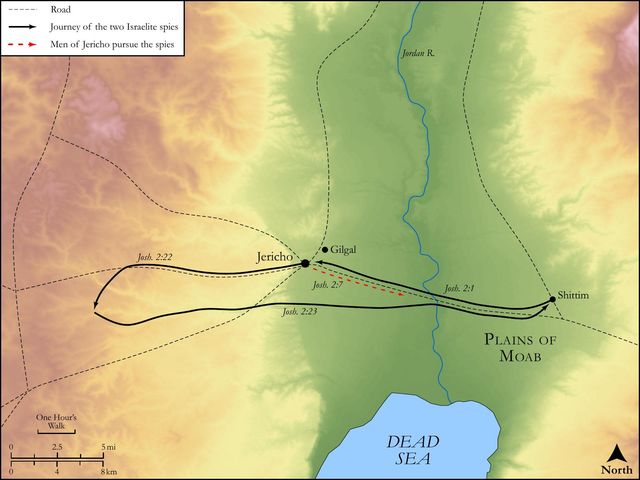
See on the biblical-era map
Study this verse
Public-domain commentary
Matthew Henry
From his Commentary on the Whole Bible. Henry comments on passages, not single verses — this entry covers Joshua 2:8–21. His two-level outline is real structure in the source text, so it is rendered as structure.
The matter is here settled between Rahab and the spies respecting the service she was now to do for them, and the favour they were afterwards to show to her. She secures them on condition that they should secure her.
I.She gives them, and by them sends to Joshua and Israel, all the encouragement that could be desired to make their intended descent upon Canaan. this was what they came for, and it was worth coming for. Having got clear of the officers, she comes up to them to the roof of the house where they lay hid, finds them perhaps somewhat dismayed at the peril they apprehended themselves in from the officers, and scarcely recovered from the fright, but has that to say to them which will give them abundant satisfaction.
1.She lets them know that the report of the great things God had done for them had come to Jericho (v. 10), not only that they had an account of their late victories obtained over the Amorites in the neighbouring country, on the other side of the river, but that their miraculous deliverance out of Egypt, and passage through the Red Sea, a great way off, and forty years ago, were remembered and talked of afresh in Jericho, to the amazement of every body. Thus this Joshua and his fellows were men wondered at, Zac 3:8. See how God makes his wonderful works to be remembered (Psa 111:4), so that men shall speak of the might of his terrible acts, Psa 145:6.
2.She tells them what impressions the tidings of these things had made upon the Canaanites: Your terror has fallen upon us (Jos 2:9); our hearts did melt, Jos 2:11. If she kept a public house, this would give her an opportunity of understanding the sense of various companies and of travellers from other parts of the country, so that they could not know this any way better than by her information; and it would be of great use to Joshua and Israel to know it; it would put courage into the most cowardly Israelite to hear how their enemies were dispirited, and it was easy to conclude that those who now fainted before them would infallibly fall before them, especially because it was the accomplishment of a promise God had made them, that he would lay the fear and dread of them upon all this land (Deu 11:25), and so it would be an earnest of the accomplishment of all the other promises God had made to them. Let not the stout man glory in his courage, any more than the strong man in his strength; for God can weaken both mind and body. Let not God's Israel be afraid of their most powerful enemies; for their God can, when he pleases, make their most powerful enemies afraid of them. Let none think to harden their hearts against God and prosper; for he that made man's soul can at any time make the sword of his terrors approach to it.
3.She hereupon makes profession of her faith in God and his promise; and perhaps there was not found so great faith (all things considered), no, not in Israel, as in this woman of Canaan. (1.) who believes God's power and dominion over all the world (v. 11): "Jehovah your God, whom you worship and call upon, is so far above all gods that he is the only true God; for he is God in heaven above and in earth beneath, and is served by all the hosts of both." A vast distance there is between heaven and earth, yet both are equally under the inspection and government of the great Jehovah. Heaven is not above his power, nor is earth below his cognizance. (2.) She believes his promise to his people Israel (v. 9): I know that the Lord hath given you the land. The king of Jericho had heard as much as she had of the great things God had done for Israel, yet he cannot infer thence that the Lord had given them this land, but resolves to hold it out against them to the last extremity; for the most powerful means of conviction will not of themselves attain the end without divine grace, and by that grace Rahab the harlot, who had only heard of the wonders God had wrought, speaks with more assurance of the truth of the promise made to the fathers than all the elders of Israel had done who were eye-witnesses of those wonders, many of whom perished through unbelief of this promise. Blessed are those that have not seen, and yet have believed; so Rahab did. O woman, great is thy faith!
II.She engaged them to take her and her relations under their protection, that they might not perish in the destruction of Jericho, v.
12, 13. Now, 1. It was an evidence of the sincerity and strength of her faith concerning the approaching revolution in her country that she was so solicitous to make an interest for herself with the Israelites, and courted their kindness. She foresaw the conquest of her country, and in the belief of that bespoke in time the favour of the conquerors. Thus Noah, being moved with fear, prepared an ark to the saving of his house, and the condemning of the world, Heb 11:7. Those who truly believe the divine revelation concerning the ruin of sinners, and the grant of the heavenly land to God's Israel, will give diligence to flee from the wrath to come, and to lay hold of eternal life, by joining themselves to God and to his people. 2. The provision she made for the safety of her relations, as well as for her own, is a laudable instance of natural affection, and an intimation to us in like manner to do all we can for the salvation of the souls of those that are dear to us, and, with ourselves, to bring them, if possible, into the bond of the covenant. No mention is made of her husband and children, but only her parents, and brothers, and sisters, for whom, though she was herself a housekeeper, she retained a due concern. 3. Her request that they would swear unto her by Jehovah is an instance of her acquaintance with the only true God, and her faith in him and devotion towards him, one act of which is religiously to swear by his name. 4. Her petition is very just and reasonable, that, since she had protected them, they should protect her, and since her kindness to them extended to their people, for whom they were now negotiating, their kindness to her should take in all hers. It was the least they could do for one that had saved their lives with the hazard of her own. Note, Those that show mercy may expect to find mercy. Observe, She does not demand any preferment by way of reward for her kindness to them, though they lay so much at her mercy that she might have made her own terms, but only indents for her Life, which in a general destruction would be a singular favour. Thus God promised Ebed-Melech, in recompence for his kindness to Jeremiah, that in the worst of times he should have his life for a prey, Jer 39:18. Yet this Rahab was afterwards advanced to be a princess in Israel, the wife of Salmon, and one of the ancestors of Christ, Mat 1:5. Those that faithfully serve Christ and suffer for him he will not only protect, but prefer, and will do for them more than they are able to ask or think.
III.They solemnly engaged for her preservation in the common destruction (Jos 2:14):
"Our life for yours. We will take as much care of your lives as of our own, and would as soon hurt ourselves as any of you." Nay, they imprecate God's judgments on themselves if they should violate their promise to her. She had pawned her life for theirs, and now they in requital pawn their lives for hers, and (as public persons) with them they pawn the public faith and the credit of their nation, for they plainly interest all Israel in the engagement in those words, When the Lord has given us the land, meaning not themselves only, but the people whose agents they were. No doubt they knew themselves sufficiently authorized to treat with Rahab concerning this matter, and were confident that Joshua would ratify what they did, else they had not dealt honestly; the general law that they should make no covenant with the Canaanites (Deu 7:2) did not forbid them to take under their protection a particular person, that had heartily come into their interests and had done them real kindnesses. The law of gratitude is one of the laws of nature. Now observe here, 1. The promises they made her. In general, "We will deal kindly and truly with thee, v. 14. We will not only be kind in promising now, but true in performing what we promise; and not only true in performing just what we promise, but kind in out-doing thy demands and expectations." The goodness of God is often expressed by his kindness and truth (Psa 117:2), and in both these we must be followers of him. In particular, "If a hand be upon any in the house with thee, his blood shall be on our head," v. 19. If hurt come through our carelessness to those whom we are obliged to protect, we thereby contract guilt, and blood will be found a heavy load. 2. The provisos and limitations of their promises. Though they were in haste, and it may be in some confusion, yet we find them very cautious in settling this agreement and the terms of it, not to bind themselves to more than was fit for them to perform. Note, Covenants must be made with care, and we must swear in judgment, lest we find ourselves perplexed and entangled when it is too late after vows to make enquiry. Those that will be conscientious in keeping their promises will be cautious in making them, and perhaps may insert conditions which others may think frivolous. Their promise is here accompanied with three provisos, and they were necessary ones. They will protect Rahab, and all her relations always, provided, (1.) That she tie the scarlet cord with which she was now about to let them down in the window of her house, v. 18. This was to be a mark upon the house, which the spies would take care to give notice of to the camp of Israel, that no soldier, how hot and eager soever he was in military executions, might offer any violence to the house that was thus distinguished. This was like the blood sprinkled upon the door-post, which secured the first-born from the destroying angel, and, being of the same colour, some allude to this also to represent the safety of believers under the protection of the blood of Christ sprinkled on the conscience. The same cord that she made use of for the preservation of these Israelites was to be made use of for her preservation. What we serve and honour God with we may expect he will bless and make comfortable to us. (2.) That she should have all those whose safety she had desired in the house with her and keep them there, and that, at the time of taking the town, none of them should dare to stir out of doors, v. 18, 19. This was a necessary proviso, for Rahab's kindred could not be distinguished any other way than by being in her distinguished house; should they mingle with their neighbours, there was no remedy, but the sword would devour one as well as another. It was a reasonable proviso that, since they were saved purely for Rahab's sake, her house should have the honour of being their castle, and that, if they would not perish with those that believed not, they should thus far believe the certainty and severity of the ruin coming upon their city as to retire into a place made safe by promise, as Noah into the ark and Lot into Zoar, and should save themselves from this untoward generation, by separating from them. It was likewise a significant proviso, intimating to us that those who are added to the church that they may be saved must keep close to the society of the faithful, and, having escaped the corruption that is in the world through lust, must take heed of being again entangled therein. (3.) That she should keep counsel (v. 14, 20): If thou utter this our business, that is, "If thou betray us when we are gone, or if thou make this agreement public, so as that others tie scarlet lines in their windows and so confound us, then we will be clear of thy oath." Those are unworthy of the secret of the Lord that know now how to keep it to themselves when there is occasion.
IV.She then took effectual care to secure her new friends, and sent them out another way, Jam 2:25.
Having fully understood the bargain they made with her, and consented to it (Jos 2:21), she then let them down by a cord over the city wall (Jos 2:15), the situation of her house befriending them herein: thus Paul made his escape out of Damascus, Co2 11:33. She also directed them which way to go for their own safety, being better acquainted with the country than they were, Jos 2:16. she directs them to leave the high road, and abscond in the mountains till the pursuers returned, for till then they could not safely venture over Jordan. those that are in the way of God and their duty may expect that Providence will protect them, but this will not excuse them from taking all prudent methods for their own safety. God will keep us, but then we must not wilfully expose ourselves. Providence must be trusted, but not tempted. Calvin thinks that their charge to Rahab to keep this matter secret, and not to utter it, was intended for her safety, lest she, boasting of her security from the sword of Israel, should, before they came to protect her, fall into the hands of the king of Jericho and be put to death for treason: thus do they prudently advise her for her safety, as she advised them for theirs. And it is good advice, which we should at any time be thankful for, to take heed to ourselves.
Historical interpretation
Four Centuries of Reception
4 surviving comments on this verse. Each one is dated, so this reads as a timeline rather than a list.
Select a marker to jump to its quote. Markers stagger vertically where authors wrote within a few decades of each other.
On account of her faith and hospitality, Rahab the harlot was saved. For when spies were sent by Joshua, the son of Nun, to Jericho, the king of the country ascertained that they had come to spy out their land, and sent men to seize them, in order that, when taken, they might be put to death. But the hospitable Rahab receiving them, concealed them on the roof of her house under some stalks of flax. And when the men sent by the king arrived and said, "There came men unto you who are to spy out our land; bring them forth, for so the king commands," she answered them, "The two men whom you seek came unto me, but quickly departed again and are gone," thus not discovering the spies to them. Then she said to the men, "I know assuredly that the Lord your God has given you this city, for the fear and dread of you have fallen on its inhabitants. When therefore you shall have taken it, keep ye me and the house of my father in safety." And they said to her, "It shall be as you have spoken to us. As soon, therefore, as you know that we are at hand, you shall gather all your family under your roof, and they shall be preserved, but all that are found outside of your dwelling shall perish." Moreover, they gave her a sign to this effect, that she should hang forth from her house a scarlet thread. And thus they made it manifest that redemption should flow through the blood of the Lord to all them that believe and hope in God. You see, beloved, that there was not only faith, but prophecy, in this woman.
Pass now, pray, to the others who were saved by repentance. Perhaps even among the women someone will say, “I have committed fornication and adultery. I have defiled my body with every excess. Can there be salvation for me?” Fix your eyes, woman, upon Rahab, and look for salvation for yourself too. For if she who openly and publicly practiced fornication was saved through repentance, will not she whose fornication preceded the gift of grace be saved by repentance and fasting? For observe how she was saved. She said only this: “Since the Lord, your God, is God in heaven above and on earth below.” “Your God,” she said, for she did not dare call him her God, because of her wantonness. If you want scriptural testimony of her salvation, you have it recorded in the Psalms: “I will think of Rahab and Babylon among those who know me.” The salvation procured by repentance is open to men and women alike.
Do you see how with faith she takes on her lips the word of the Lawgiver? “And I realize that your God is up in heaven and down on the earth, and that apart from him there is no God.” Rahab is a prefigurement of the church, which was at one time mixed up in the prostitution of the demons and which now accepts the spies of Christ, not the ones sent by Joshua the son of Nun, but the apostles who were sent by Jesus the true Savior. “I learned,” she says, “that your God is up in heaven and down on the earth, and that apart from him there is no God.” The Jews received these things and did not safeguard them; the church heard these things and preserved them. Therefore, Rahab, the prefigurement of the church, is worthy of all praise.
For he selected this one nation to teach the knowledge of God to all the others. Just as he had selected one man—at one time Moses, at another Joshua, at another Samuel, at another some other of the prophets—to look after the welfare of this race, one man who benefited his fellows by practicing true wisdom, so through the one race, Israel, he called all the races of the earth that shared the same nature to share the same religion. Rahab, the harlot, testifies that this is so. Though she belonged to a different race and was a harlot, she relied solely on their reputation, accepted their religion, abandoned her own beliefs and entrusted herself to strangers. “We have heard,” she said, “what things the Lord your God has done to the Egyptians, and fear of you fell on us.” Accordingly, she made a pact with the spies and sealed it with an oath.
Continue studying Joshua 2:8 across the web’s major study libraries — every link below opens this exact verse, chapter, or book on the destination site.
Read & Compare
 BibleGatewayThis verse in more than 200 translations and 70 languages.
 Bible.comThe YouVersion reader — hundreds of translations, reading plans, and highlights.
 ESV.orgCrossway's official English Standard Version reader.
 NET BibleThe NET translation with 60,000+ translators' notes on every rendering decision.
 STEP BibleTyndale House's free study tool — original text, vocabulary, and scholarly resources.
 BibliaLogos Bible Software's free web reader.
 USCCBThe New American Bible (Revised Edition) with the U.S. bishops' study notes.
Commentaries
 BibleHub CommentariesDozens of classic commentaries on this verse, gathered on one page.
 StudyLightMore than 100 commentary sets — the largest collection on the web.
 BibleRefPlain-English commentary on what this verse means, verse by verse.
 Enduring WordDavid Guzik's free commentary on this chapter, widely used by Bible teachers.
 Bible Study ToolsVerse commentary alongside Greek and Hebrew study aids.
Original Language & Research
- BibleHub InterlinearThe verse word by word — original language, transliteration, and English.
- BibleHub LexiconEvery word's original-language definition and Strong's entry.
 Blue Letter BibleDeep-study tools — Strong's numbers, concordance, and word studies.
 SefariaThe Hebrew text with Rashi and centuries of Jewish commentary.
Sermons, Hymns & Audio


TrulyRandomVerse is not affiliated with these sites and doesn’t control their content. They’re linked because they’re genuinely useful.
Summary
Joshua 2:8 captures a pivotal moment in the dramatic narrative of the Israelite spies in Jericho, depicting Rahab's immediate and decisive action. Following the departure of the king's search party, Rahab wastes no time, promptly ascending to the roof where she had strategically concealed the spies. This swift and purposeful movement underscores her urgency and resolve, signaling a critical transition from crisis management to strategic negotiation for the salvation of her household, driven by a burgeoning faith in Yahweh.
Context
ShowHideLiterary Context
This verse serves as a crucial hinge in the unfolding drama of Joshua chapter 2. It immediately follows the tense sequence where Rahab successfully deceives the king of Jericho's men, sending them on a futile chase after the spies, as detailed in Joshua 2:5-7. Having hidden the spies under stalks of flax on her roof, a detail provided in Joshua 2:6, Rahab's action in verse 8 marks the precise moment the immediate threat subsides. It directly precedes her profound declaration of faith in Yahweh and her subsequent appeal for a covenant of protection for her family, detailed in Joshua 2:9-13. Thus, Joshua 2:8 is not merely a descriptive detail but the necessary prelude to the theological and narrative climax of Rahab's encounter with the Israelite emissaries.
Historical & Cultural Context
The setting is ancient Jericho, a formidable Canaanite city known for its strong fortifications, as later evidenced by its miraculous fall in Joshua chapter 6. Rahab's house, notably situated on the city wall, as mentioned in Joshua 2:15, provided a strategic location for both concealment and escape. Culturally, flat roofs were ubiquitous in the houses of Israel and Canaan, serving as versatile spaces for drying produce (like flax, as seen in Joshua 2:6), storage, sleeping, and private communication. Rahab's ascent to the roof, therefore, was a culturally appropriate means of engaging the spies in a discreet and secure environment, away from the prying eyes of neighbors or other household members. Her profession, often translated "harlot," places her among the outcasts, making her courageous and faithful actions even more remarkable and unexpected within the social fabric of the time.
Key Themes
ShowHideJoshua 2:8 subtly contributes to several overarching themes within the book of Joshua and the broader biblical narrative. Firstly, it highlights Divine Providence, demonstrating God's meticulous orchestration of events to protect His people and advance His purposes, even through unexpected human agents. The precise timing of Rahab's action, immediately after the king's men depart, underscores this divine oversight, revealing God's hand at work even in the details. Secondly, the verse foreshadows Rahab's Faith and Courage. Her swift initiative is not merely pragmatic but stems from a burgeoning conviction about the power of the God of Israel, which she articulates explicitly in the subsequent verses, Joshua 2:9-11. This decisive action is a tangible expression of a faith that would later be commended in the New Testament, specifically in Hebrews 11:31. Lastly, it sets the stage for the theme of Covenant and Salvation, as Rahab's immediate goal is to secure a promise of deliverance for her family from the impending destruction of Jericho, a testament to God's grace extending beyond the covenant community of Israel.
Exposition and Analysis
ShowHideKey Word Analysis
ShowHideThis Hebrew verb means "to lie down," often implying to rest, sleep, or settle. In this context, "before they were laid down" emphasizes the extreme immediacy of Rahab's action. The spies had just endured a terrifying ordeal and would naturally be seeking rest or a moment to collect themselves. Rahab's intervention before they could even fully relax highlights her urgency and the critical nature of the moment she perceived, indicating she seized the first possible opportunity for crucial dialogue.
This verb signifies "to go up," "ascend," or "climb." Its use here emphasizes Rahab's active and deliberate movement towards the spies. She did not wait for them to descend or for a more convenient time; she took the initiative to seek them out in their place of concealment. This proactive pursuit underscores her determination and the importance of the conversation she was about to initiate, revealing her resolve to secure her family's future.
This noun refers to a flat roof, common in the houses of Israel and Canaan. The phrase "upon the roof" specifies the location of the encounter. As discussed in the cultural context, flat roofs served as private, elevated spaces. This detail is crucial because it indicates a secure and discreet environment for the sensitive negotiations that were about to take place, away from any potential eavesdroppers within her house or from the street below, ensuring the secrecy of their critical discussion.
Verse Breakdown
ShowHide"¶ And before they were laid down,"
This opening clause establishes the precise timing of Rahab's appearance. It conveys a strong sense of urgency and promptness, indicating that the spies had not yet settled down for rest or even fully recovered from the recent threat posed by the king's search party. Rahab seized the very first opportunity, demonstrating her alertness and determination to act immediately once the immediate danger had passed, highlighting her strategic thinking.
"she came up unto them"
This phrase highlights Rahab's initiative and directness. Rather than waiting for the spies to come to her or to initiate contact, she actively sought them out. This proactive step underscores her courageous and resolute character, revealing her intent to engage in a crucial conversation that would determine the fate of her family and demonstrating her leadership in a perilous situation.
"upon the roof;"
The specific location of their meeting is highly significant. The roof was where Rahab had hidden the spies under the flax stalks (Joshua 2:6). It provided a secluded and elevated space, ideal for a clandestine and vital discussion. This detail emphasizes the need for privacy and security for the sensitive negotiations that were about to unfold between Rahab and the Israelite emissaries, underscoring the high stakes involved.
Literary Devices
ShowHideThe verse employs several subtle but effective literary devices that enrich its meaning. There is a strong element of Foreshadowing, as Rahab's immediate and purposeful action on the roof directly anticipates her subsequent bold confession of faith and her pivotal role in the narrative of Jericho's fall. Her decisive movement hints at the significant theological and historical events she will soon initiate. The setting "upon the roof" also creates a sense of Irony, as the very place used for concealment and deception (hiding the spies from the king's men) now transforms into a sacred space for covenant negotiation and the foundation of Rahab's salvation. This transformation of a mundane space into a place of divine encounter is striking. Furthermore, the phrase "before they were laid down" contributes to the narrative's Pacing, marking a swift transition from the high tension of the search to the strategic calm of negotiation. This rapid shift effectively releases immediate suspense while simultaneously building anticipation for the crucial dialogue that will follow, drawing the reader deeper into the unfolding drama.
Theological and Thematic Connections
ShowHideJoshua 2:8, though brief, is rich in theological implications, primarily showcasing God's sovereign hand in using unexpected individuals for His divine purposes. Rahab's immediate and courageous action is not merely human ingenuity but an act stirred by a burgeoning faith in the God of Israel, a faith that responds decisively to divine providence. It underscores the biblical theme that God often works through those among the outcasts, demonstrating His expansive grace and ability to redeem and incorporate individuals from outside the covenant community into His grand redemptive plan. Her proactive step sets the stage for a covenant of salvation, illustrating that true faith is not passive but active, marked by works that demonstrate its authenticity and commitment. This moment highlights God's initiative in drawing all peoples to Himself, even before the full revelation of His covenant with Israel.
Reflection and Application
ShowHideRahab's immediate ascent to the roof in Joshua 2:8 offers a profound lesson on the importance of decisive action in moments of divine opportunity. She did not procrastinate or wait for a more convenient time; recognizing the critical window after the threat had passed, she acted with courage and conviction. This challenges believers today to cultivate spiritual discernment to recognize God-given opportunities and to respond with prompt obedience, even when such actions involve personal risk or stepping out of one's comfort zone. Rahab's story reminds us that God can use anyone, regardless of their past or social standing, to accomplish His redemptive purposes, honoring faith that translates into bold, purposeful action. It encourages us to be attentive to the "before they were laid down" moments in our own lives, where a quick and faithful response can unlock significant blessings or advance God's kingdom, demonstrating our trust and reliance on His leading.
Questions for Reflection
ShowHideFAQ
ShowHideWhy did Rahab go to the roof immediately after the king's men left?
ShowHideRahab's immediate action was driven by a clear sense of urgency and purpose. The departure of the king's search party created a critical window of opportunity. She knew that this was the moment to secure a covenant with the spies for the safety of her household, and any delay could jeopardize their lives or the success of her plan. Her promptness demonstrates her shrewdness, courage, and determination to act on her burgeoning faith in the God of Israel, as she would soon articulate in Joshua 2:9-11. She seized the moment, understanding the gravity of the situation and the fleeting nature of the opportunity.
What does "before they were laid down" mean in this verse?
ShowHideThis phrase emphasizes the swiftness and immediacy of Rahab's action. It means that the Israelite spies had not yet settled down for the night, or even for a moment of rest, after the intense and dangerous encounter with the king's men. Rahab approached them almost instantaneously, highlighting her immediate concern and the critical nature of the conversation she intended to have. It underscores that she wasted no time in moving from crisis management to strategic negotiation, recognizing that the window for action was narrow and precious.
What is the significance of the "roof" in this context?
ShowHideIn the homes of Israel and Canaan, flat roofs were multi-functional and commonly used for various purposes, including storage (as seen with the flax in Joshua 2:6), sleeping, and private gatherings. For Rahab, the roof served as an ideal, secluded location for a clandestine and highly sensitive conversation with the spies. It offered privacy and security, away from potential eavesdroppers within her household or from the street below, allowing for the crucial negotiation of the covenant that would save her and her family. The roof, therefore, became a place of profound theological significance, a stage for divine intervention.
Christ-Centered Fulfillment
ShowHideRahab's story, initiated by her decisive action in Joshua 2:8, profoundly foreshadows the expansive grace and redemptive plan of God culminating in Jesus Christ. Her salvation, secured through faith expressed in works (hiding the spies and the subsequent scarlet cord), serves as a powerful type for salvation through Christ's atoning blood. Just as Rahab, a Gentile and a harlot, was brought into the covenant family of Israel and ultimately into the Messianic lineage (Matthew 1:5), so too does Christ's sacrifice extend salvation to all, regardless of their past or ethnicity, breaking down the dividing wall between Jew and Gentile (Ephesians 2:14). Her faith, commended in Hebrews 11:31 and demonstrated by her works in James 2:25, prefigures the New Testament understanding that true faith in Jesus is never barren but always results in a transformed life that bears fruit. Rahab's inclusion in God's plan underscores the universal reach of the gospel, where God uses the unexpected and the lowly to accomplish His glorious purposes, inviting all who believe into His eternal kingdom through the ultimate Lamb of God, who takes away the sin of the world (John 1:29). Her story is a vibrant testament to God's redemptive reach, foreshadowing the universal scope of Christ's saving work.