


Daniel 6:26
- מִןminfromH4481PrepPreposition
- קֳדָמַיko·da·Maibefore meH6925N-cpc ¦ 1csNoun Plural common gender Constructקֳדָמַbeforeיme
- שִׂיםsimit is madeH7761V-Peil-Perf-3msVerb Peil Perfect 3rd Singular Masculine
- טְעֵםte·'Ema decreeH2942N-csNoun Singular common gender Absolute
- דִּיdithatH1768ConjConjunction
- בְּכָלbe·kholin allH3606Prep-b ¦ N-cscNoun Singular common gender Constructבְּinכָלall
- שָׁלְטָןshal·Tan[the] dominion ofH7985N-cscNoun Singular common gender Construct
- מַלְכוּתִיmal·khu·Timy kingdomH4437N-fsc ¦ 1csNoun Singular Feminine Constructמַלְכוּתִkingdomיmy
- לֶהֱוֹןle·he·Vonthey will beH1934V-Peal-Imperf-3mpVerb Peal Imperfect 3rd Plural Masculine
- זָיְעִיןza·'a·'intremblingH2112V-Peal-Prtcpl-mpVerb Peal Participle Plural Masculine Absolute
- וְדָחֲלִיןve·Da·cha·Linand fearingH1763Conj-w ¦ V-Qal-Prtcpl-mpVerb Qal Participle Plural Masculine Absoluteוְandדָחֲלִיןfearing
- מִןminfromH4481PrepPreposition
- קֳדָםko·DambeforeH6925N-cscNoun Singular common gender Construct
- אֱלָהֵהּ'e·la·Hehhis GodH426N-csc ¦ 3msNoun Singular common gender ConstructאֱלָהֵGodהּhis
- דִּיdiofH1768ConjConjunction
- דָנִיֵּאלda·ni·YelDanielH1841N-proper-mNoun Proper Masculine
- דִּיdithatH1768ConjConjunction
- הוּאhu'heH1932Pro-3msPronoun Personal 3rd Singular Masculine
- אֱלָהָא'e·la·Ha'[is] God theH426N-cs ¦ ArtNoun Singular common gender Definiteאֱלָהָ[is] Godאthe
- חַיָּאchai·Ya'<the> livingH2417Adj-cs ¦ ArtAdjective Singular common gender Definiteחַיָּ<the>אliving
- וְקַיָּםve·kai·Yamand enduringH7011Conj-w ¦ Adj-csAdjective Singular common gender Absoluteוְandקַיָּםenduring
- לְעָלְמִיןle·'A·le·Minfor everH5957Prep-l ¦ N-mpNoun Plural Masculine Absoluteלְforעָלְמִיןever
- וּמַלְכוּתֵהּu·mal·khu·Tehand his kingdomH4437Conj-w ¦ N-fsc ¦ 3msNoun Singular Feminine Constructוּandמַלְכוּתֵkingdomהּhis
- דִּיdiwhichH1768ConjConjunction
- לָאla'notH3809NegParticle Negative
- תִתְחַבַּלtit·cha·Balit will be destroyedH2255V-Hitpaal-Imperf-3fsVerb Hitpaal Imperfect 3rd Singular Feminine
- וְשָׁלְטָנֵהּve·shal·ta·Nehand his dominionH7985Conj-w ¦ N-csc ¦ 3msNoun Singular common gender Constructוְandשָׁלְטָנֵdominionהּhis
- עַד'ad[is] toH5705PrepPreposition
- סוֹפָאso·Fa'end theH5491N-cs ¦ ArtNoun Singular common gender Definiteסוֹפָendאthe
English is a literal word-by-word gloss of the Hebrew, not the KJV's wording. Why?
This is the original text the KJV's translators worked from — each Hebrew word with its own literal English meaning in this verse, prepared by scholars at Tyndale House, Cambridge. The KJV translates whole sentences, not word by word, so its wording differs: one Hebrew word can become several English words, and the KJV may choose “the LORD” where the gloss reads “Yahweh”. Both are faithful — they answer different questions. For the KJV's own rendering, switch to the KJV text.
Details
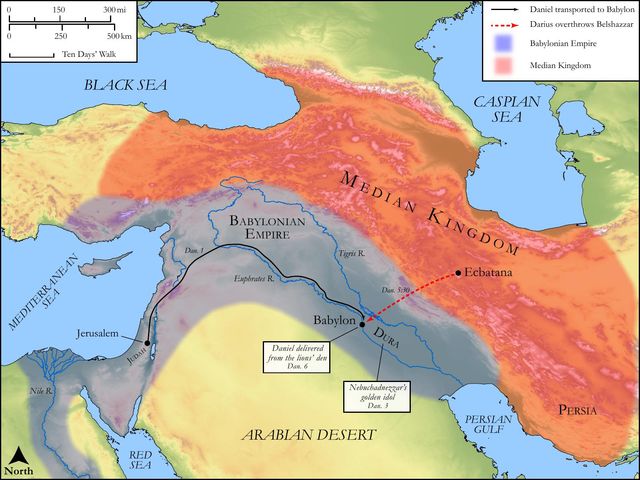
See on the biblical-era map
Study this verse
Public-domain commentary
Matthew Henry
From his Commentary on the Whole Bible. Henry comments on passages, not single verses — this entry covers Daniel 6:25–28. His two-level outline is real structure in the source text, so it is rendered as structure.
Darius here studies to make some amends for the dishonour he had done both to God and Daniel, in casting Daniel into the lions' den, by doing honour to both.
I.He gives honour to God by a decree published to all nations, by which they are required to fear before him.
And this is a decree which is indeed fit to be made unalterable, according to the laws of the Medes and Persians, for it is the everlasting gospel, preached to those that dwell on the earth, Rev 14:7. Fear God, and give glory to him. Observe,
1.To whom he sends this decree - to all people, nations and languages, that dwell in all the earth, Dan 6:25. These are great words, and it is true that all the inhabitants of the earth are obliged to that which is here decreed; but here they mean no more than every dominion of his kingdom, which, though it contained many nations, did not contain all nations; but so it is, those that have much are ready to think they have all.
2.What the matter of the decree is - that men tremble and fear before the God of Daniel. This goes further than Nebuchadnezzar's decree upon a similar occasion, for that only restrained people from speaking amiss of this God, but this requires them to fear before him, to keep up and express awful reverent thoughts of him. And well might this decree he prefaced, as it is, with Peace be multiplied unto you, for the only foundation of true and abundant peace is laid in the fear of God, for that is true wisdom. If we live in the fear of God, and walk according to that rule, peace shall be upon us, peace shall be multiplied to us. But, though this decree goes far, it does not go far enough; had he done right, and come up to his present convictions, he would have commanded all men not only to tremble and fear before this God, but to love him and trust in him, to forsake the service of their idols, and to worship him only, and call upon him as Daniel did. But idolatry had been so long and so deeply rooted that it was not to be extirpated by the edicts of princes, nor by any power less than that which went along with the glorious gospel of Christ.
3.What are the causes and considerations moving him to make this decree. They are sufficient to have justified a decree for the total suppression of idolatry, much more will they serve to support this. There is good reason why all men should fear before this God, for, (1.) His being is transcendent. "He is the living God, lives as a God, whereas the gods we worship are dead things, have not so much as an animal life." (2.) His government is incontestable. He has a kingdom, and a dominion; he not only lives, but reigns as an absolute sovereign. (3.) Both his being and his government are unchangeable. He is himself stedfast for ever, and with him is no shadow of turning. And his kingdom too is that which shall not be destroyed by any external force, nor has his dominion any thing in itself that threatens a decay or tends towards it, and therefore it shall be even to the end. (4.) He has an ability sufficient to support such an authority, Dan 6:27. He delivers his faithful servants from trouble and rescues them out of trouble; he works signs and wonders, quite above the utmost power of nature to effect, both in heaven and on earth, by which it appears that he is sovereign Lord of both. (5.) He has given a fresh proof of all this in delivering his servant Daniel from the power of the lions. This miracle, and that of the delivering of the three children, were wrought in the eyes of the world, were seen, published, and attested by two of the greatest monarchs that ever were, and were illustrious confirmations of the first principles of religion, abstracted from the narrow scheme of Judaism, effectual confutations of all the errors of heathenism, and very proper preparations for pure catholic Christianity.
II.He puts honour upon Daniel (Dan 6:28):
So this Daniel prospered. See how God brought to him good out of evil. This bold stroke which his enemies made at his life was a happy occasion of taking them off, and their children too, who otherwise would still have stood in the way of his preferment, and have been upon all occasions vexatious to him; and now he prospered more than ever, was more in favour with his prince and in reputation with the people, which gave him a great opportunity of doing good to his brethren. Thus out of the eater (and that was a lion too) comes forth meat, and out of the strong sweetness.
Historical interpretation
Two Centuries of Reception
2 surviving comments on this verse. Each one is dated, so this reads as a timeline rather than a list.
Select a marker to jump to its quote. Markers stagger vertically where authors wrote within a few decades of each other.
The foundation and strength of hope and faith is fear. In Psalm 111: “The fear of the Lord is the beginning of wisdom.” Of the same thing in the Wisdom of Solomon, … in the Proverbs, … in Isaiah, … in Genesis, … and in Psalm 2, … Then Darius the king wrote, “To all peoples, tribes and languages that are in my kingdom, peace be to you from my face. I decree and ordain that all those who are in my kingdom shall fear and tremble before the Most High God whom Daniel serves.”
Verses 25-27. "Then king Darius wrote unto all the peoples, tribes and language-groups who dwelt in all the earth, saying: 'Your peace be multiplied! I have enacted a decree that in all my empire and kingdom men are to dread and tremble before the God of Daniel. For it is He who is the living God and the One who abides forever, and His rule shall not be overthown, and His power shall eternally endure. It is He who is the Deliverer and Savior, who performs signs and wonders in heaven and on earth, and who has delivered Daniel from the pit of lions.'" Just as in the case of Nebuchadnezzar's writing unto the language-groups and nations one authority has interpreted them to signify hostile powers, so also this same man interprets the action of Darius, on the ground that he summons them all to repentance. And he poses the question as to whether this will take place in this world or in the other world, or even after other worlds have intervened. We deem these speculations to be absurd and account them as empty fables, and make this single observation: that the reason why signs are performed amid barbarian peoples through the agency of God's servants is that the worship and religion of the only God may be proclaimed.
Continue studying Daniel 6:26 across the web’s major study libraries — every link below opens this exact verse, chapter, or book on the destination site.
Read & Compare
 BibleGatewayThis verse in more than 200 translations and 70 languages.
 Bible.comThe YouVersion reader — hundreds of translations, reading plans, and highlights.
 ESV.orgCrossway's official English Standard Version reader.
 NET BibleThe NET translation with 60,000+ translators' notes on every rendering decision.
 STEP BibleTyndale House's free study tool — original text, vocabulary, and scholarly resources.
 BibliaLogos Bible Software's free web reader.
 USCCBThe New American Bible (Revised Edition) with the U.S. bishops' study notes.
Commentaries
 BibleHub CommentariesDozens of classic commentaries on this verse, gathered on one page.
 StudyLightMore than 100 commentary sets — the largest collection on the web.
 BibleRefPlain-English commentary on what this verse means, verse by verse.
 Enduring WordDavid Guzik's free commentary on this chapter, widely used by Bible teachers.
 Bible Study ToolsVerse commentary alongside Greek and Hebrew study aids.
Original Language & Research
- BibleHub InterlinearThe verse word by word — original language, transliteration, and English.
- BibleHub LexiconEvery word's original-language definition and Strong's entry.
 Blue Letter BibleDeep-study tools — Strong's numbers, concordance, and word studies.
 SefariaThe Hebrew text with Rashi and centuries of Jewish commentary.
Sermons, Hymns & Audio


TrulyRandomVerse is not affiliated with these sites and doesn’t control their content. They’re linked because they’re genuinely useful.
Summary
Daniel 6:26 records King Darius's extraordinary decree, issued across his vast empire, commanding all subjects to revere and fear the God of Daniel. This momentous declaration, prompted by God's miraculous deliverance of Daniel from the lions' den, extols the God of Israel as the "living God," eternally steadfast, whose kingdom is indestructible and whose dominion endures forever. It stands as a profound testament to divine sovereignty, an affirmation of God's unique nature, and a public acknowledgment of His supremacy over all earthly powers and false deities.
Context
ShowHideLiterary Context
This verse serves as the climactic and official declaration following the dramatic narrative of Daniel's miraculous deliverance from the lions' den in Daniel chapter 6. The chapter meticulously details the jealous machinations of Daniel's administrative rivals, who exploit King Darius's vanity by manipulating him into issuing an irrevocable decree forbidding prayer to any god or man except the king for thirty days. Daniel, demonstrating unwavering faithfulness, continues his daily prayers, leading to his condemnation and casting into the lions' den. God's direct intervention, specifically sending an angel to shut the lions' mouths (as Daniel himself testifies in Daniel 6:22), utterly transforms Darius's perspective. Witnessing this undeniable divine power, Darius is compelled to issue this universal decree, which stands in stark theological and practical contrast to his earlier, ill-conceived edict.
Historical & Cultural Context
The events of Daniel 6 unfold during the early years of the Persian Empire, specifically under King Darius the Mede, who is often understood as a historical figure associated with Cyrus the Great's reign after the conquest of Babylon. The Persian Empire was a colossal, multi-ethnic, and polytheistic dominion where kings often held semi-divine status or were considered divinely favored. Royal decrees were typically considered absolute and unchangeable, as painfully demonstrated by Darius's predicament in Daniel 6:8. Within this cultural and political framework, a pagan king's public declaration of the God of an exiled Jew as the supreme, living, and eternal God was an unprecedented and revolutionary theological statement. It directly challenged the prevailing polytheistic worldview and the notion of the king's ultimate authority, unequivocally attributing true ultimate power and dominion to Yahweh.
Key Themes
ShowHideDaniel 6:26 powerfully reinforces several core themes prevalent throughout the book of Daniel. Firstly, it underscores Divine Sovereignty, demonstrating that God's power transcends even the mightiest earthly empires and their rulers. Darius, initially constrained by his own law, ultimately bows to the superior authority of Daniel's God, acknowledging His control over life and death. Secondly, the verse highlights the Uniqueness of the Living God, contrasting Him sharply with the impotent idols and transient deities worshipped by the pagan world. This echoes the theological declarations found elsewhere in the Old Testament, such as the explicit contrast between idols and the true God in Psalm 115:4-7 and the scathing critique of idolatry in Isaiah 44:9-20. Thirdly, the decree emphasizes the Eternal and Indestructible Nature of God's Kingdom, a central prophetic theme in Daniel, foreshadowed in visions like the stone cut without human hands that destroys all earthly kingdoms and fills the whole earth (Daniel 2:44). This theme provides enduring hope amidst the inevitable rise and fall of human empires.
Exposition and Analysis
ShowHideKey Word Analysis
ShowHideThis Aramaic word, corresponding to the Hebrew "zachal," signifies to slink, to fear, or to be formidable. In this context, commanded by King Darius, it denotes a profound, reverential awe and respect, bordering on dread, for the God of Daniel. It implies acknowledging God's immense power and authority, which inspires both a holy fear and a posture of worshipful submission.
Derived from the Aramaic root "chaya" (to live), this term describes God as being intrinsically alive, possessing inherent vitality, and being the ultimate source of all life. This stands in stark contrast to the lifeless, inanimate idols worshipped by pagan nations, emphasizing God's dynamic presence, active power, and unique ability to intervene decisively in the world.
This Aramaic word means to ruin, destroy, or hurt. Its use in the negative construction ("shall not be destroyed") powerfully highlights the eternal, immutable, and invincible nature of God's kingdom and dominion. Unlike all human empires, which are destined to rise and fall, God's reign is presented as utterly secure, beyond any possibility of ruin, decay, or overthrow.
Verse Breakdown
ShowHide"I make a decree"
King Darius, as the supreme earthly authority of the vast Persian Empire, issues a formal, authoritative, and universally binding edict. This highlights the profound impact of God's intervention, compelling the most powerful human ruler of the day to use his royal prerogative to promote reverence for Daniel's God.
"That in every dominion of my kingdom men tremble and fear before the God of Daniel"
This clause establishes both the universal scope and the required response to the decree. "Every dominion" signifies the vast geographical and political reach of the Persian Empire. "Tremble and fear" conveys a sense of profound reverence, awe, and respectful submission to God's power and holiness, rather than mere terror. The specific reference to "the God of Daniel" grounds this decree in the recent miraculous event, directly attributing the divine intervention to the God whom Daniel served.
"for he is the living God, and stedfast for ever"
This provides the theological justification and the core attributes of the God being proclaimed. God is declared "living," actively present, powerful, and the source of life, unlike the dead and impotent idols. "Stedfast for ever" emphasizes His unchanging, reliable, and eternal nature, a stark contrast to the transient and unreliable nature of human rulers and kingdoms.
"and his kingdom that which shall not be destroyed, and his dominion shall be even unto the end"
This final clause describes the eternal, invincible, and universal nature of God's reign. It underscores that God's rule is not subject to the limitations, decay, or overthrow that characterize all earthly empires. His dominion extends "unto the end," signifying its perpetual, ultimate, and boundless nature, reaching beyond all temporal and spatial boundaries.
Literary Devices
ShowHideDaniel 6:26 employs several significant literary devices that amplify its theological impact. The most prominent is Decree/Edict, as King Darius formally issues a command throughout his empire, lending a sense of official weight and universal applicability to his declaration about God. There is a powerful Contrast woven throughout the verse: the "living God" is contrasted with the lifeless idols of the pagan world, and God's eternal, indestructible kingdom is contrasted with the temporal, perishable kingdoms of humanity, including Darius's own. The phrase "every dominion of my kingdom" functions as a form of Hyperbole or Exaggeration of Scope, emphasizing the immense vastness of Darius's empire and, by extension, the universal recognition he demands for Daniel's God, underscoring the magnitude of God's self-revelation. Finally, the entire verse serves as a Declaration or Affirmation, a strong theological statement by a pagan king, attesting to God's unique attributes and supreme authority, which is a testament to God's power to reveal Himself even to those outside the covenant community.
Theological and Thematic Connections
ShowHideKing Darius's decree in Daniel 6:26 is a profound theological statement, asserting the absolute supremacy of the God of Israel over all other deities and earthly powers. It highlights God's unique attribute as the "living God," actively involved in human affairs, unlike the inert idols of paganism. Furthermore, it explicitly declares the eternal and indestructible nature of God's kingdom and dominion, a foundational theme in Daniel's prophecies that contrasts sharply with the transient rise and fall of human empires. This divine sovereignty and everlasting reign provide an anchor of hope and a call to ultimate allegiance for all who recognize His truth, demonstrating that even the most powerful earthly rulers are ultimately subject to the King of Kings.
Reflection and Application
ShowHideDaniel 6:26 serves as a powerful reminder that God's sovereignty is not limited by human decrees, political power, or adverse circumstances. Just as He delivered Daniel and compelled a pagan king to acknowledge His supremacy, so too does He remain the "living God" who actively intervenes in the lives of His faithful. For believers today, this verse calls us to an unwavering trust in God's power and an acknowledgment of His eternal reign, even when earthly kingdoms seem to dominate or threaten. Our ultimate fear should not be of man or circumstances, but a reverential awe for the God whose dominion is "unto the end." This passage challenges us to live with such integrity and faithfulness that our lives, like Daniel's, become a compelling testimony to God's reality and power, prompting others to recognize Him. It encourages us to find our ultimate security and hope not in fleeting human systems, but in the unshakeable, eternal kingdom of God.
Questions for Reflection
ShowHideFAQ
ShowHideWhy does a pagan king like Darius issue such a decree about the God of Daniel?
ShowHideKing Darius issues this decree not out of a pre-existing monotheistic belief, but as a direct, undeniable response to God's miraculous intervention on behalf of Daniel. Having been manipulated by his officials into condemning Daniel to the lions' den, Darius was deeply distressed. When he found Daniel unharmed, he recognized this as an extraordinary act of the divine, far surpassing the power of any god he knew or worshipped. The decree is a pragmatic and awe-filled acknowledgment of the God of Daniel's superior power and authority, compelling Darius to use his royal prerogative to command reverence for this "living God" throughout his vast empire. It's a testament to God's ability to reveal Himself powerfully, even to those outside the covenant, through the faithfulness of His servants and His sovereign acts of deliverance, as seen in Daniel 6:27.
Christ-Centered Fulfillment
ShowHideDaniel 6:26, with its declaration of the "living God" whose kingdom "shall not be destroyed, and his dominion shall be even unto the end," finds its ultimate and most profound fulfillment in Jesus Christ. The "living God" is perfectly revealed in Jesus, who is "the way, the truth, and the life" (John 14:6), and who declared, "I am the resurrection and the life" (John 11:25). The eternal and indestructible kingdom that Darius unknowingly prophesied is the very kingdom inaugurated by Christ's first advent and consummated at His second coming. Jesus Himself proclaimed the nearness of this kingdom (Mark 1:15) and taught His disciples to pray for its coming (Matthew 6:10). Unlike earthly dominions that rise and fall, Christ's reign is truly "unto the end," a kingdom that "cannot be shaken" (Hebrews 12:28). The command to "tremble and fear before the God of Daniel" is transformed into the call to worship and submit to Christ, the King of Kings and Lord of Lords, before whom "every knee should bow, in heaven and on earth and under the earth" (Philippians 2:10-11). Thus, Darius's decree, born of a miraculous deliverance, points forward to the ultimate deliverance and eternal reign established through the Lamb of God.