


Daniel 4:3
- אָתוֹהִי'a·To·hi[are] his signsH852N-mpc ¦ 3msNoun Plural Masculine Constructאָתוֹ[are] signsהִיhis
- כְּמָהke·Mahhow much!H4101Prep-k ¦ InterrogPronoun Interrogativeכְּhowמָהmuch!
- רַבְרְבִיןrav·re·VingreatH7260Adj-mpAdjective Plural Masculine Absolute
- וְתִמְהוֹהִיve·tim·Ho·hiand [are] his wondersH8540Conj-w ¦ N-mpc ¦ 3msNoun Plural Masculine Constructוְandתִמְהוֹ[are] wondersהִיhis
- כְּמָהke·Mahhow much!H4101Prep-k ¦ InterrogPronoun Interrogativeכְּhowמָהmuch!
- תַקִּיפִיןta·ki·FinstrongH8624Adj-mpAdjective Plural Masculine Absolute
- מַלְכוּתֵהּmal·khu·Tehhis kingdomH4437N-fsc ¦ 3msNoun Singular Feminine Constructמַלְכוּתֵkingdomהּhis
- מַלְכוּתmal·Khut[is] a kingdom ofH4437N-fscNoun Singular Feminine Construct
- עָלַם'a·LamperpetuityH5957N-csNoun Singular common gender Absolute
- וְשָׁלְטָנֵהּve·shal·ta·Nehand his dominionH7985Conj-w ¦ N-csc ¦ 3msNoun Singular common gender Constructוְandשָׁלְטָנֵdominionהּhis
- עִם'im[is] withH5974PrepPreposition
- דָּרdargenerationH1859N-csNoun Singular common gender Absolute
- וְדָרve·Darand generationH1859Conj-w ¦ N-csNoun Singular common gender Absoluteוְandדָרgeneration
English is a literal word-by-word gloss of the Hebrew, not the KJV's wording. Why?
This is the original text the KJV's translators worked from — each Hebrew word with its own literal English meaning in this verse, prepared by scholars at Tyndale House, Cambridge. The KJV translates whole sentences, not word by word, so its wording differs: one Hebrew word can become several English words, and the KJV may choose “the LORD” where the gloss reads “Yahweh”. Both are faithful — they answer different questions. For the KJV's own rendering, switch to the KJV text.
Details
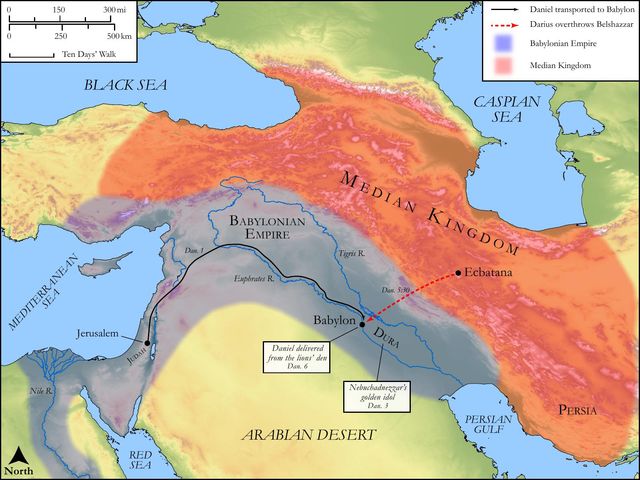
See on the biblical-era map
Study this verse
Public-domain commentary
Matthew Henry
From his Commentary on the Whole Bible. Henry comments on passages, not single verses — this entry covers Daniel 4:1–3. His three-level outline is real structure in the source text, so it is rendered as structure.
Here is, I. Something of form, which was usual in writs, proclamations, or circular letters, issued by the king, Dan 4:1. The royal style which Nebuchadnezzar makes use of has nothing in it of pomp or fancy, but is plain, short, and unaffected - Nebuchadnezzar the king. If at other times he made use of great swelling words of vanity in his title, how he laid them all aside; for he was old, he had lately recovered from a distraction which had humbled and mortified him, and was now in the actual contemplation of God's greatness and sovereignty. The declaration is directed not only to his own subjects, but to all to whom this present writing shall come - to all people, nations, and languages, that dwell in all the earth. He is not only willing that they should all hear of it, though it carry the account if his own infamy (which perhaps none durst have published if he had not done it himself, and therefore Daniel published the original paper), but he strictly charges and commands all manner of persons to take notice of it; for all are concerned, and it may be profitable to all. He salutes those to whom he writes, in the usual form, Peace be multiplied unto you. Note, It becomes kings with their commands to disperse their good wishes, and, as fathers of their country, to bless their subjects. So the common form with us. We send greeting, Omnibus quibus hae praesentes literae pervenerint, salutem - To all to whom these presents shall come, health; and sometimes Salutem sempiternam - Health and salvation everlasting.
II.Something of substance and matter. He writes this,
1.To acquaint others with the providences of God that had related to him (Dan 4:2): I thought it good to show the signs and wonders that the high God (so he calls the true God) has wrought towards me. He thought it seemly (so the word is), that it was his duty, and did well become him, that it was a debt he owed to God and the world, now that he had recovered from his distraction, to relate to distant places, and record for future ages, how justly God had humbled him and how graciously he had at length restored him. All the nations, no doubt, had heard what befell Nebuchadnezzar, and rang of it; but he thought it fit that they should have a distinct account of it from himself, that they might know the hand of God in it, and what impressions were made upon his own spirit by it, and might speak of it not as a matter of news, but as a matter of religion. The events concerning him were not only wonders to be admired, but signs to be instructed by, signifying to the world that Jehovah is greater than all gods. Note, We ought to show to others God's dealings with us, both the rebukes we have been under and the favours we have received; and though the account hereof may reflect disgrace upon ourselves, as this did upon Nebuchadnezzar, yet we must not conceal it, as long as it may redound to the glory of God. Many will be forward to tell what God has done for their souls, because that turns to their own praise, who care not for telling what God has done against them, and how they deserved it; whereas we ought to give glory to God, not only by praising him for his mercies, but by confessing our sins, accepting the punishment of our iniquity, and in both taking shame to ourselves, as this mighty monarch here does.
2.To show how much he was himself affected with them and convinced by them, Dan 4:3. We should always speak of the word and works of God with concern and seriousness and show ourselves affected with those great things of God which we desire others should take notice of.
(1.)He admires God's doings. He speaks of them as one amazed: How great are his signs, and how mighty are his wonders! Nebuchadnezzar was now old, had reigned above forty years, and had seen as much of the world and the revolutions of it as most men ever did; and yet never till now, when himself was nearly touched, was he brought to admire surprising events as God's signs and his wonders. Now, How great, how mighty, are they! Note, The more we see events to be the Lord's doing, and see in them the product of a divine power and the conduct of a divine wisdom, the more marvellous they will appear in our eyes, Psa 118:23; Psa 66:2.
(2.)He thence infers God's dominion. This is that which he is at length brought to subscribe to: His kingdom is an everlasting kingdom; and not like his own kingdom, which he saw, and long since foresaw, in a dream, hastening towards a period. He now owns that there is a God that governs the world and has a universal, incontestable, absolute dominion in and over all the affairs of the children of men. And it is the glory of this kingdom that it is everlasting. Other reigns are confined to one generation, and other dynasties to a few generations, but God's dominion is from generation to generation. It should seem, Nebuchadnezzar here refers to what Daniel had foretold of a kingdom which the God of heaven would set up, that should never be destroyed (Dan 2:44), which, though meant of the kingdom of the Messiah, he understood of the providential kingdom. Thus we may make a profitable practical use and application of those prophetical scriptures which yet we do not fully, and perhaps not rightly, comprehend the meaning of.
Historical interpretation
Historical reception
2 surviving comments on this verse. Each one is dated, so this reads as a timeline rather than a list.
Select a marker to jump to its quote. Markers stagger vertically where authors wrote within a few decades of each other.
Nothing is excluded from the dominion of God, for Scripture says of him, “All things serve you.” God, then, rules over all things, and in his forbearance he endures even murderers and robbers and fornicators, having determined a fixed time for requiting each, that they who, granted a long reprieve, remain impenitent may suffer the greater condemnation. There are kings … who reign on earth, yet not without power from on high. This, of old, Nebuchadnezzar knew from experience when he said, “his kingdom is an everlasting kingdom.”
Verses 1-3. "Nebuchadnezzar the king unto all the peoples, nations and languages who dwell upon the whole earth: peace be multiplied unto you. The Most High God hath performed signs and wonders towards me. Therefore I have thought it well to declare His signs, for they are great, and His marvels, for they are mighty, and His kingdom, because it is (the Vulgate omits "because it is") an eternal kingdom, and His dominion is from generation to generation." The epistle of Nebuchadnezzar was inserted in the volume of the prophet, in order that the book might not afterwards be thought to have been manufactured by some other author, as the accuser (Porphyry) falsely asserts, but the product of Daniel himself.
Continue studying Daniel 4:3 across the web’s major study libraries — every link below opens this exact verse, chapter, or book on the destination site.
Read & Compare
 BibleGatewayThis verse in more than 200 translations and 70 languages.
 Bible.comThe YouVersion reader — hundreds of translations, reading plans, and highlights.
 ESV.orgCrossway's official English Standard Version reader.
 NET BibleThe NET translation with 60,000+ translators' notes on every rendering decision.
 STEP BibleTyndale House's free study tool — original text, vocabulary, and scholarly resources.
 BibliaLogos Bible Software's free web reader.
 USCCBThe New American Bible (Revised Edition) with the U.S. bishops' study notes.
Commentaries
 BibleHub CommentariesDozens of classic commentaries on this verse, gathered on one page.
 StudyLightMore than 100 commentary sets — the largest collection on the web.
 BibleRefPlain-English commentary on what this verse means, verse by verse.
 Enduring WordDavid Guzik's free commentary on this chapter, widely used by Bible teachers.
 Bible Study ToolsVerse commentary alongside Greek and Hebrew study aids.
Original Language & Research
- BibleHub InterlinearThe verse word by word — original language, transliteration, and English.
- BibleHub LexiconEvery word's original-language definition and Strong's entry.
 Blue Letter BibleDeep-study tools — Strong's numbers, concordance, and word studies.
 SefariaThe Hebrew text with Rashi and centuries of Jewish commentary.
Sermons, Hymns & Audio


TrulyRandomVerse is not affiliated with these sites and doesn’t control their content. They’re linked because they’re genuinely useful.
Summary
Daniel 4:3 serves as King Nebuchadnezzar's profound and public declaration of praise and submission to the Most High God, issued after his dramatic humbling and subsequent restoration. This pivotal verse encapsulates the central theological message of Daniel chapter 4: the absolute and unchallenged sovereignty of God over all earthly rulers and kingdoms, powerfully highlighting His unparalleled might demonstrated through miraculous acts and the eternal, unceasing nature of His dominion, which transcends all human generations.
Context
ShowHideLiterary Context
Daniel 4:3 is strategically placed within King Nebuchadnezzar's personal testimony, which he presents as an official royal decree addressed to "all people, nations, and languages that dwell in all the earth" Daniel 4:1. The chapter commences with Nebuchadnezzar's peace greeting, immediately followed by his earnest desire to proclaim the "signs and wonders" of the Most High God. This verse, along with Daniel 4:2, forms the climactic expression of his newfound understanding and worship. It precedes the detailed recounting of his prophetic dream, Daniel's interpretation, the king's subsequent period of divine judgment (marked by madness and living like a beast), and his ultimate restoration to sanity and kingship. This opening declaration of praise effectively frames the entire narrative of the king's humbling, making it unequivocally clear that the purpose of his extraordinary ordeal was to bring him to this very acknowledgment of God's supreme and eternal authority.
Historical & Cultural Context
Nebuchadnezzar reigned as the preeminent monarch of his era, presiding over the vast and formidable Neo-Babylonian Empire. His kingdom represented the dominant world power, and he was accustomed to wielding absolute authority, frequently perceiving himself as divinely appointed or even divine. Babylonian culture was steeped in polytheism, venerating a sprawling pantheon of gods, with Marduk holding the chief position. For a king of such immense stature to issue a decree publicly acknowledging the God of Israel as the "Most High" and unequivocally asserting His everlasting kingdom was an unprecedented and revolutionary departure from the typical royal rhetoric of the time. This public declaration would have sent shockwaves across his empire, directly challenging the prevailing pagan worldview and the king's own deeply ingrained self-perception of ultimate power. The events detailed in the chapter, particularly the king's descent into madness, would have been interpreted by his court and subjects as a profound curse or divine judgment, rendering his subsequent praise of Yahweh an undeniable testament to a radical, divinely-orchestrated transformation.
Key Themes
ShowHideThis verse serves as a powerful articulation of several overarching themes woven throughout the book of Daniel. Firstly, it profoundly underscores the Sovereignty of God, unequivocally demonstrating that even the most formidable earthly rulers are ultimately subject to His absolute control. This truth is a consistent thread throughout Daniel, exemplified in passages like Daniel 2:21, where God is depicted as the one who "removes kings and sets up kings." Secondly, the verse highlights the stark Contrast Between Earthly and Divine Kingdoms. Nebuchadnezzar's once-invincible empire, though mighty, is inherently temporary and finite, whereas God's kingdom is emphatically declared "an everlasting kingdom," echoing the prophetic vision found in Daniel 2:44, which speaks of a kingdom that "shall never be destroyed." Thirdly, Daniel 4:3 exemplifies the theme of Humility and Divine Discipline. The king's profound pride was decisively broken through severe divine intervention, leading him to a genuine and public recognition of God's supremacy—a central lesson that permeates the entire narrative of Daniel 4. Finally, it powerfully showcases God's Demonstrative Power, as His "signs" and "wonders" are not abstract theological concepts but tangible, miraculous acts that compel even a pagan king to worship and acknowledge His unparalleled might.
Exposition and Analysis
ShowHideKey Word Analysis
ShowHideThis term refers to a "portent" or a "sign," signifying a miraculous event or a supernatural occurrence that serves as a divine indicator, proof, or warning. In the context of Nebuchadnezzar's extraordinary experience, these "signs" would encompass the prophetic dream itself, Daniel's supernaturally accurate interpretation, the king's subsequent period of divine judgment, and his miraculous restoration. All these events served as undeniable, divinely orchestrated evidence of God's active intervention, power, and communication with humanity.
Derived from a root meaning "to be astonished" or "to be amazed," this word denotes a "miracle" or an "astonishing deed." It emphasizes the awe-inspiring, extraordinary, and inexplicable nature of God's acts, which transcend human capability and evoke profound wonder, reverence, and even fear. These "wonders" are not merely impressive feats but are supernatural occurrences that defy natural explanation, pointing directly and irrefutably to a divine origin and omnipotent power.
This word conveys the concept of "remote time," encompassing both the indefinite future and the distant past. When applied to God's kingdom, as it is here, it emphatically signifies "forever" or "eternal." It stands in stark contrast to the inherently finite and transient nature of human empires and reigns, stressing the enduring, unending, and perpetual reign of God, which is not subject to the rise and fall of earthly powers, nor to the limitations of time.
Verse Breakdown
ShowHide"How great are his signs!"
This exclamatory phrase expresses Nebuchadnezzar's profound awe, astonishment, and worship in response to God's miraculous interventions. The "signs" refer to the undeniable, divinely-orchestrated evidence of God's power and active presence that the king had personally witnessed and experienced, most notably his prophetic dream, its accurate interpretation by Daniel, and his own humbling and subsequent restoration. It is a heartfelt declaration of wonder at the sheer magnitude and clarity of God's self-revelation.
"and how mighty are his wonders!"
This parallel exclamation further intensifies the emphasis on the overwhelming power and extraordinary nature of God's deeds. The "wonders" are those acts that evoke astonishment and are clearly beyond human capacity, serving as irrefutable proof of divine omnipotence and supernatural intervention. Together with "signs," this phrase highlights the compelling, awe-inspiring, and undeniably supernatural character of God's work in the world and, specifically, in the king's life.
"his kingdom is an everlasting kingdom"
This pivotal clause declares the eternal, unending, and perpetual nature of God's reign. Unlike any human kingdom, which is inherently temporal, limited, and subject to eventual decline and destruction, God's kingdom has no beginning or end. This statement serves as a direct theological contrast to Nebuchadnezzar's own mighty but ultimately transient Babylonian empire, affirming God's unique, absolute, and perpetual dominion over all time and creation.
"and his dominion is from generation to generation."
This final clause powerfully reiterates and reinforces the eternal scope and universal continuity of God's rule. The phrase "from generation to generation" is an idiomatic expression signifying that God's authority, control, and sovereign reign are not confined to a specific era, a particular people, or a limited period of history. Instead, His dominion extends universally and perpetually through all time, impacting and overseeing every successive generation of humanity without interruption or cessation.
Literary Devices
ShowHideThe verse employs several powerful literary devices to convey Nebuchadnezzar's profound declaration. The opening phrases, "How great are his signs! and how mighty are his wonders!", utilize exclamation to convey the king's overwhelming awe and wonder. This is coupled with parallelism, where the similar grammatical structure and thematic content of the two clauses ("How great... signs!" and "how mighty... wonders!") create a rhythmic emphasis, amplifying the king's praise and highlighting the dual, yet complementary, aspects of God's miraculous activity. There is also a strong element of contrast implicitly woven throughout the verse and explicitly throughout the chapter, comparing the temporary, limited dominion of earthly kings (like Nebuchadnezzar himself) with the eternal and universal dominion of God. The phrase "from generation to generation" functions as a merism, a figure of speech in which a totality is expressed by two contrasting parts, signifying the entirety of time—from the earliest to the latest generations—thereby emphasizing the boundless and unending nature of God's reign.
Theological and Thematic Connections
ShowHideDaniel 4:3 stands as a pivotal declaration of divine sovereignty, asserting God's absolute and unquestionable control over all creation and human affairs. It reveals that God is not merely a distant, detached deity but an active, intervening Lord whose power is demonstrably revealed through "signs" and "wonders" that are so compelling they can humble even the most arrogant of rulers to acknowledge His supremacy. This profound truth underpins the entire biblical narrative, serving as a constant reminder that no earthly power, no matter how formidable or seemingly invincible, can ultimately thwart God's eternal purposes or resist His sovereign will. The stark contrast between Nebuchadnezzar's temporary and fading kingdom and God's "everlasting kingdom" is a fundamental theological statement, affirming that true, enduring, and ultimate authority rests solely with the Most High, whose dominion spans all generations and encompasses all of history.
Reflection and Application
ShowHideNebuchadnezzar's extraordinary journey from a proud, self-exalting monarch to a humble worshiper, culminating in this profound declaration, offers timeless and deeply relevant lessons for contemporary believers. In a world often dominated by human power struggles, shifting political systems, and overwhelming economic forces, Daniel 4:3 serves as a potent reminder that God's ultimate authority remains unchallenged and supreme. It calls each of us to cultivate a posture of profound humility, recognizing that our own strength, accomplishments, plans, and even our very lives are finite and ultimately subject to His sovereign will. This verse profoundly encourages us to trust implicitly in God's eternal kingdom, finding true peace, security, and stability not in the shifting sands of earthly circumstances or human endeavors, but in the enduring, unwavering reign of the Most High. Just as Nebuchadnezzar learned the humbling truth that God "rules in the kingdom of men" Daniel 4:17, we too are invited to surrender our anxieties, ambitions, and fears to the One whose dominion is truly "from generation to generation," knowing with absolute certainty that His righteous purposes will ultimately prevail.
Questions for Reflection
ShowHideFAQ
ShowHideWhat is the significance of King Nebuchadnezzar's declaration in Daniel 4:3, given his previous pride and self-exaltation?
ShowHideThe profound significance of Nebuchadnezzar's declaration in Daniel 4:3 lies in the radical and divinely-orchestrated transformation of his character. Prior to this, Nebuchadnezzar was an arrogant monarch who proudly attributed the greatness of his kingdom to his own power and for his own glory, as evidenced in Daniel 4:30. God's severe and humbling discipline, which included a period of madness that stripped him of his humanity and kingship, was specifically designed to teach him the fundamental truth that "the Most High rules in the kingdom of men, and gives it to whomever He chooses" Daniel 4:25. Therefore, his public declaration in Daniel 4:3 is far more than mere lip service; it is a powerful testament to a genuine, profound, and undeniable spiritual humbling. It represents a public acknowledgment of God's supreme, eternal, and universal sovereignty, serving as an impactful witness to all nations and a timeless lesson on the dangers of human pride and the necessity of divine submission.
Christ-Centered Fulfillment
ShowHideDaniel 4:3, with Nebuchadnezzar's awe-filled declaration of God's "everlasting kingdom" and "dominion... from generation to generation," finds its ultimate and most glorious fulfillment in the person and redemptive work of Jesus Christ. While Nebuchadnezzar was granted a profound revelation of the Most High God's eternal reign, the New Testament unveils that this promised eternal kingdom is not merely an abstract concept but is inaugurated, embodied, and perfectly administered by Jesus. He is the prophesied King whose kingdom, unlike any earthly empire, "shall never be destroyed" Daniel 2:44, a kingdom that is fundamentally "not of this world" in its origin and nature John 18:36, yet destined to encompass all things. Christ's own "signs" and "wonders"—His countless miracles of healing, His power over nature, His authoritative teachings, and supremely, His resurrection from the dead—are the ultimate and most profound demonstrations of God's mighty power, far surpassing those witnessed by Nebuchadnezzar. These acts irrefutably prove His divine authority and establish His redemptive reign. The dominion that is "from generation to generation" is perfectly realized in Christ, who, having completed His earthly ministry, has been given "all authority in heaven and on earth" Matthew 28:18 and "must reign till He has put all enemies under His feet" 1 Corinthians 15:25. Thus, Nebuchadnezzar's ancient praise of God's eternal kingdom becomes a prophetic echo, a foreshadowing of the glorious, unending, and universal reign of Jesus Christ, the true King of kings and Lord of lords Revelation 19:16.