


Daniel 4:30
- עָנֵה'a·Neh[was] replyingH6032V-Peal-Prtcpl-msVerb Peal Participle Singular Masculine Absolute
- מַלְכָּאmal·Ka'king theH4430N-cs ¦ ArtNoun Singular common gender Definiteמַלְכָּkingאthe
- וְאָמַרve·'a·Marand [was] sayingH560Conj-w ¦ V-Qal-Prtcpl-msVerb Qal Participle Singular Masculine Absoluteוְandאָמַר[was] saying
- הֲלָאha·La'¿ notH3809Interrog ¦ NegParticle Negativeהֲ¿לָאnot
- דָאda'[is] thisH1668PrtParticle Demonstrative
- הִיאhi'itH1932Pro-3fsPronoun Personal 3rd Singular Feminine
- בָּבֶלba·VelBabylonH895N-properNoun Proper Location
- רַבְּתָאra·be·Ta'<the> greatH7229Adj-fs ¦ ArtAdjective Singular Feminine Definiteרַבְּתָ<the>אgreat
- דִּיdiwhichH1768ConjConjunction
- אֲנָה'a·NahIH576Pro-1csPronoun Personal 1st Singular common gender
- בֱנַיְתַהּve·nay·TahI built itH1124V-Peal-Perf-1cs ¦ 3fsVerb Peal Perfect 1st Singular common genderבֱנַיְתַI builtהּit
- לְבֵיתle·Veitto a house ofH1005Prep-l ¦ N-cscNoun Singular common gender Constructלְtoבֵיתa house of
- מַלְכוּmal·Khua kingdomH4437N-csNoun Singular common gender Absolute
- בִּתְקַףbit·Kafby [the] strength ofH8632Prep-b ¦ N-cscNoun Singular common gender Constructבִּbyתְקַף[the] strength of
- חִסְנִיchis·Nimy powerH2632N-csc ¦ 1csNoun Singular common gender Constructחִסְנִpowerיmy
- וְלִיקָרve·li·Karand for [the] honor ofH3367Conj-w ¦ Prep-l ¦ N-cscNoun Singular common gender Constructוְandלִforיקָר[the] honor of
- הַדְרִיhad·Rimy majestyH1923N-csc ¦ 1csNoun Singular common gender Constructהַדְרִmajestyיmy
English is a literal word-by-word gloss of the Hebrew, not the KJV's wording. Why?
This is the original text the KJV's translators worked from — each Hebrew word with its own literal English meaning in this verse, prepared by scholars at Tyndale House, Cambridge. The KJV translates whole sentences, not word by word, so its wording differs: one Hebrew word can become several English words, and the KJV may choose “the LORD” where the gloss reads “Yahweh”. Both are faithful — they answer different questions. For the KJV's own rendering, switch to the KJV text.
Details
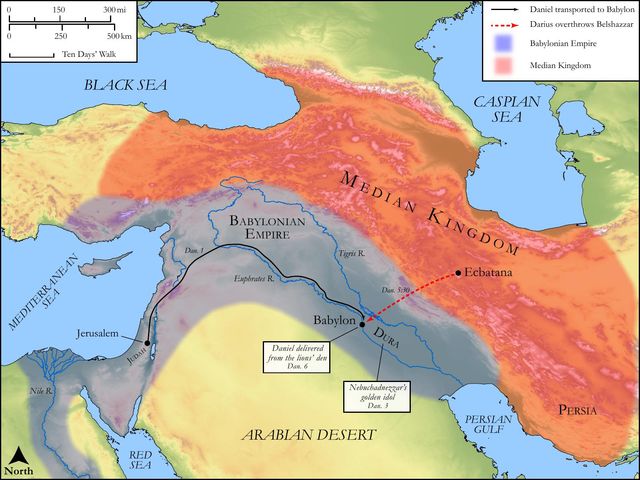
See on the biblical-era map
Study this verse
Public-domain commentary
Matthew Henry
From his Commentary on the Whole Bible. Henry comments on passages, not single verses — this entry covers Daniel 4:28–33. His three-level outline is real structure in the source text, so it is rendered as structure.
We have here Nebuchadnezzar's dream accomplished, and Daniel's application of it to him justified and confirmed. How he took it we are not told, whether he was pleased with Daniel or displeased; but here we have,
I.God's patience with him:
All this came upon him, but not till twelve months after (Dan 4:29), so long there was a lengthening of his tranquility, though it does not appear that he broke off his sins, or showed any mercy to the poor captives, for this was still God's quarrel with him, that he opened not the house of his prisoners, Isa 14:17. Daniel having counselled him to repent, God so far confirmed his word that he gave him space to repent; he let him alone this year also, this one year more, before he brought this judgment upon him. Note, God is long-suffering with provoking sinners, because he is not willing that any should perish, but that all should come to repentance, Pe2 3:9.
II.His pride, and haughtiness, and abuse of that patience.
He walked in the palace of the kingdom of Babylon, in pomp and pride, pleasing himself with the view of that vast city, which, with all the territories thereunto belonging, was under his command, and he said, either to himself or to those about him, perhaps some foreigners to whom he was showing his kingdom and the glory of it, Is not this great Babylon? Yes, it is great, of vast extent, no less that forty-five miles compass within the walls. It is full of inhabitants, and they are full of wealth. It is a golden city, and that is enough to proclaim it great, Isa 14:4. See the grandeur of the houses, walls, towers, and public edifices. Every thing in Babylon he thinks looks great; "and this great Babylon I have built." Babylon was built many ages before he was born, but because he fortified and beautified it, and we may suppose much of it was rebuilt during his long and prosperous reign, he boasts that he has built it, as Augustus Caesar boasted concerning Rome, Lateritiam inveni, marmoream reliqui - I found it brick, but I left it marble. He boasts that he built it for the house of the kingdom, that is, the metropolis of his empire. This vast city, compared with the countries that belonged to his dominions, was but as one house. He built it with the assistance of his subjects, yet boasts that he did it by the might of his power; he built it for his security and convenience, yet, as if he had no occasion for it, boasts that he built it purely for the honour of his majesty. Note, Pride and self-conceitedness are sins that most easily beset great men, who have great things in the world. They are apt to take the glory to themselves which is due to God only.
III.His punishment for his pride.
When he was thus strutting, and vaunting himself, and adoring his own shadow, while the proud word was in the king's mouth the powerful word came from heaven, by which he was immediately deprived,
1.Of his honour as a king: The kingdom has departed from thee. When he thought he had erected impregnable bulwarks for the preserving of his kingdom, now, in an instant, it has departed from him; when he thought it so well guarded that none could take it from him, behold, it departs of itself. As soon as he becomes utterly incapable to manage it, it is of course taken out of his hands.
2.He is deprived of his honour as a man. He loses his reason, and by that means loses his dominion: They shall drive thee from men, Dan 4:32. And it was fulfilled (Dan 4:33): he was driven from men the same hour. On a sudden he fell stark mad, distracted in the highest degree that ever any man was. His understanding and memory were gone, and all the faculties of a rational soul broken, so that he became a perfect brute in the shape of a man. He went naked, and on all four, like a brute, did himself shun the society of reasonable creatures and run wild into the fields and woods, and was driven out by his own servants, who, after some time of trial, despairing of his return to his right mind, abandoned him, and looked after him no more. He had not the spirit of a beast of prey (that of the royal lion), but of the abject and less honourable species, for he was made to eat grass as oxen; and, probably, he did not speak with human voice, but lowed like an ox. Some think that his body was all covered with hair; however, the hair of his head and beard, being never cut nor combed, grew like eagles feathers, and his nails like birds' claws. Let us pause a little, and view this miserable spectacle; and let us receive instruction from it.
(1.)Let us see here what a mercy it is to have the use of our reason, how thankful we ought to be for it, and how careful we ought to be not to do any thing which may either provoke God or may have a natural tendency to put us out of the possession of our own souls. Let us learn how to value our own reason, and to pity the case of those that are under the prevailing power of melancholy or distraction, or are delirious, and to be very tender in our censures of them and conduct towards them, for it is a trial common to men, and a case which, some time or other, may be our own.
(2.)Let us see here the vanity of human glory and greatness. Is this Nebuchadnezzar the Great? What this despicable animal that is meaner than the poorest beggar? Is this he that looked so glorious on the throne, so formidable in the camp, that had politics enough to subdue and govern kingdoms, and now has not so much sense as to keep his own clothes on his back? Is this the man that made the earth to tremble, that did shake kingdoms? Isa 14:16. Never let the wise man then glory in his wisdom, nor the mighty man in his strength.
(3.)Let us see here how God resists the proud, and delights to abase them and put contempt upon them. Nebuchadnezzar would be more than a man, and therefore God justly makes him less than a man, and puts him upon a level with the beasts who set up for a rival with his Maker. See Job 40:11-13.
Historical interpretation
Historical reception
1 surviving comment on this verse from the historical church.
Then the king became even more insolent, even as God was patient and had shown magnanimity by endeavoring to lead him to repentance. And as he walked on the terrace of the royal house and looked around over his fortune, he said, “Where became of all those sad omens by which the saint had meant to frighten me? I certainly rule Babylon, which I made magnificent.”
Continue studying Daniel 4:30 across the web’s major study libraries — every link below opens this exact verse, chapter, or book on the destination site.
Read & Compare
 BibleGatewayThis verse in more than 200 translations and 70 languages.
 Bible.comThe YouVersion reader — hundreds of translations, reading plans, and highlights.
 ESV.orgCrossway's official English Standard Version reader.
 NET BibleThe NET translation with 60,000+ translators' notes on every rendering decision.
 STEP BibleTyndale House's free study tool — original text, vocabulary, and scholarly resources.
 BibliaLogos Bible Software's free web reader.
 USCCBThe New American Bible (Revised Edition) with the U.S. bishops' study notes.
Commentaries
 BibleHub CommentariesDozens of classic commentaries on this verse, gathered on one page.
 StudyLightMore than 100 commentary sets — the largest collection on the web.
 BibleRefPlain-English commentary on what this verse means, verse by verse.
 Enduring WordDavid Guzik's free commentary on this chapter, widely used by Bible teachers.
 Bible Study ToolsVerse commentary alongside Greek and Hebrew study aids.
Original Language & Research
- BibleHub InterlinearThe verse word by word — original language, transliteration, and English.
- BibleHub LexiconEvery word's original-language definition and Strong's entry.
 Blue Letter BibleDeep-study tools — Strong's numbers, concordance, and word studies.
 SefariaThe Hebrew text with Rashi and centuries of Jewish commentary.
Sermons, Hymns & Audio


TrulyRandomVerse is not affiliated with these sites and doesn’t control their content. They’re linked because they’re genuinely useful.
Summary
Daniel 4:30 vividly captures the zenith of King Nebuchadnezzar's hubris as he surveys the magnificent city of Babylon, arrogantly attributing its grandeur and his vast accomplishments solely to his own strength and for his personal glory. This self-exalting declaration, spoken from a position of unparalleled human authority and temporal power, serves as the immediate and dramatic catalyst for God's swift and profound judgment upon the king, powerfully illustrating the perilous nature of human arrogance when it directly challenges divine sovereignty.
Context
ShowHideLiterary Context
Daniel chapter 4 is uniquely presented as a personal testimony from King Nebuchadnezzar himself, recounting his humbling experience of divine judgment and subsequent restoration. Preceding this pivotal verse, God had granted the king a prophetic dream of a majestic tree that was dramatically cut down, symbolizing his impending descent into madness and humiliation. Daniel, God's faithful prophet, had meticulously interpreted this dream, unequivocally warning Nebuchadnezzar that he would be driven from human society and live like a wild beast until he acknowledged the absolute dominion of the Most High God over all earthly kingdoms (Daniel 4:24-26). Daniel had even implored the king to repent and practice righteousness and mercy as a means to potentially avert or delay this severe judgment (Daniel 4:27). However, a full year elapsed without genuine repentance or a change of heart from the king, setting the stage for the audacious boast in Daniel 4:30 and the immediate, dramatic fulfillment of the prophecy. This narrative arc powerfully underscores the book of Daniel's overarching theological theme: God's absolute and unwavering sovereignty over all earthly rulers and empires, regardless of their perceived might or glory.
Historical & Cultural Context
Nebuchadnezzar II, who reigned from approximately 605-562 BC, was arguably the most formidable and influential ruler of the Neo-Babylonian Empire, expanding its dominion to become the preeminent power in the ancient Near East. The city of Babylon itself was an architectural and engineering marvel of the ancient world, widely celebrated for its colossal defensive walls, the iconic Ishtar Gate, the grand Processional Way, and potentially the legendary Hanging Gardens, often cited as one of the Seven Wonders of the Ancient World. This urban masterpiece was a testament to sophisticated planning, immense material resources, and vast human labor, much of which was initiated, overseen, and completed under Nebuchadnezzar's direct command. Kings of this era frequently perceived themselves as divine or divinely appointed, and their monumental building projects were not merely practical endeavors but served as grandiose expressions of their power, immense wealth, and perceived personal glory. Nebuchadnezzar's boast, likely uttered from the commanding heights of his royal palace, would have been a typical expression of royal pride in the ancient world. Yet, in the context of Daniel's monotheistic message, it represented a direct and egregious contradiction to the understanding of ultimate power residing solely with God.
Key Themes
ShowHideThis verse serves as a potent encapsulation of several critical themes woven throughout the book of Daniel and foundational to broader biblical theology. Foremost among these is the theme of Human Pride and Arrogance, as Nebuchadnezzar's declaration stands as a quintessential example of hubris, where a human ruler audaciously claims sole credit for achievements that are ultimately contingent upon divine allowance and provision. His repetitive use of "I" and "my" ("I have built," "my power," "my majesty") starkly highlights a profound self-exaltation that leaves no room for the Most High God. This stands in stark contrast to the overarching theme of Divine Sovereignty, which forms the bedrock of Daniel's prophetic message. The king's boast, though spoken by a mighty earthly monarch, immediately precedes God's direct and dramatic intervention, vividly demonstrating that true power and ultimate authority belong to God alone, not to any human ruler, no matter how formidable. Consequently, the verse also powerfully illustrates the Danger of Self-Glorification and the Inevitability of Divine Judgment for those who stubbornly refuse to acknowledge God's supremacy. Despite Daniel's clear and urgent warning a year prior, Nebuchadnezzar's failure to humble himself inexorably led to the swift and certain consequence of God's judgment, as vividly detailed in Daniel 4:31 and Daniel 4:33.
Exposition and Analysis
ShowHideKey Word Analysis
ShowHideThis Aramaic verb (H1124) corresponds to the Hebrew bana, meaning "to build" or "to make." In Nebuchadnezzar's boast, it signifies his active role and immense effort in constructing the city of Babylon. While he indeed initiated and oversaw vast building projects, his claim "I have built" implies not just the physical construction but also the sole origination of the power and resources that enabled it, thereby usurping God's ultimate role as the provider and sustainer of all things.
The Aramaic word (H8632) refers to "power" or "strength." When Nebuchadnezzar declares "by the might of my power," he is emphasizing the inherent strength and capability he believes resides within himself. This phrase, combined with "my power" (Aramaic chêçen, H2632, meaning "strength"), underscores his complete self-reliance and the absence of any acknowledgment of a higher, divine source for his capabilities or dominion. It is a declaration of self-sufficiency.
This Aramaic term (H1923) denotes "magnificence," "honor," or "majesty." Nebuchadnezzar's final phrase, "and for the honour of my majesty," reveals the ultimate purpose of his building endeavors and his entire reign: to glorify himself. The splendor of Babylon was intended to reflect his own personal glory and status, rather than being seen as a gift, a stewardship, or a platform for God's glory. This self-centered focus on personal honor is a direct affront to God, who alone is worthy of ultimate honor and glory.
Verse Breakdown
ShowHide"The king spake, and said,"
This opening clause sets the scene for a formal, public, and deliberate declaration. Nebuchadnezzar is not merely contemplating these thoughts; he is articulating his pride aloud, likely from a prominent vantage point on his palace roof, making his boast a public offense against divine sovereignty. The verbs "spake" (H6032, ʻănâh) and "said" (H560, ʼămar) emphasize the intentional and authoritative nature of his pronouncement.
"Is not this great Babylon,"
This rhetorical question is not seeking information but functions as a self-congratulatory affirmation, drawing attention to the city's immense scale and splendor. Babylon was indeed a marvel of the ancient world, and the word "great" (H7229, rab) highlights its impressive size, significance, and the king's pride in its magnificence.
"that I have built for the house of the kingdom"
Here, Nebuchadnezzar explicitly claims personal credit ("I have built," H1124, bᵉnâʼ') for the construction of Babylon, designating it as the capital ("house of the kingdom," H1005 bayith H4437 malkûw) of his vast empire. This statement reveals his conviction that he is the sole architect and sustainer of this magnificent realm, ignoring the countless laborers and divine provision.
"by the might of my power,"
This phrase further intensifies his self-attribution, asserting that the construction was achieved not by divine blessing, the contributions of his subjects, or the labor of others, but purely "by the might" (H8632, tᵉqôph) of "my power" (H2632, chêçen). It underscores his belief in his own inherent, self-sufficient strength and capability, a direct challenge to God's ultimate source of all power.
"and for the honour of my majesty?"
The final clause reveals the ultimate motivation behind his prodigious endeavors: personal glory. The city's splendor and the vastness of his empire were intended to elevate his own "honour" (H3367, yᵉqâr) and "majesty" (H1923, hădar). This declaration of self-glorification is the culmination of his pride, directly challenging God's exclusive right to all honor and glory.
Literary Devices
ShowHideDaniel 4:30 is rich with literary devices that amplify its profound theological message. The most prominent is Irony, as Nebuchadnezzar's boast of absolute power and self-sufficiency immediately precedes his utter and dramatic humiliation and loss of reason, demonstrating the extreme fragility of human might when confronted by divine sovereignty. The king's rhetorical question, "Is not this great Babylon, that I have built...?", functions as a form of Self-Congratulation and a veiled challenge, intended to elicit awe and admiration for his achievements rather than an honest inquiry. The emphatic and repetitive use of the first-person singular pronoun and possessive adjectives ("I," "my power," "my majesty") creates a powerful sense of Emphasis on Nebuchadnezzar's self-centeredness and profound hubris, highlighting his complete lack of humility. Furthermore, the verse serves as a dramatic Foreshadowing of the immediate and severe judgment that follows, building narrative tension and underscoring the swiftness and absolute certainty of God's response to unrepentant pride.
Theological and Thematic Connections
ShowHideDaniel 4:30 stands as a profound theological statement on the stark contrast between human pride and divine sovereignty. Nebuchadnezzar's boast is not merely an expression of ego; it is a direct and audacious affront to the Most High God, who alone establishes and removes kings, and who holds ultimate dominion over all earthly affairs. It powerfully reveals the inherent human tendency to claim credit for accomplishments and blessings that are ultimately gifts and opportunities granted by God. This verse powerfully teaches that true power, lasting glory, and ultimate authority belong exclusively to the Creator, and any attempt by humanity to usurp that glory inevitably leads to a humbling and undeniable demonstration of God's supreme authority. It serves as a timeless warning against the dangers of self-exaltation and a profound call to humility, reminding us that all we possess, achieve, and even our very existence are by God's grace and ultimately for His glory.
Reflection and Application
ShowHideDaniel 4:30 serves as a powerful and enduring cautionary tale for all who achieve success, influence, or power in any sphere of life. It compels us to critically examine the true source of our accomplishments and the ultimate object of our praise. In a world that often celebrates self-made individuals, champions self-reliance, and encourages aggressive self-promotion, this verse calls us back to a fundamental and liberating truth: every good and perfect gift, every talent, every opportunity, and indeed every breath we take comes directly from God. To attribute success solely to our own strength, intellect, or relentless effort is to fall into the very same trap of pride that ensnared Nebuchadnezzar and led to his profound downfall. True wisdom, spiritual health, and lasting peace lie in cultivating a posture of deep humility and profound gratitude, recognizing God's sovereign hand in all things. When we acknowledge Him as the ultimate source of all blessings, we not only avoid the perilous pitfalls of arrogance but also align ourselves with His divine purposes, finding true freedom, enduring joy, and eternal significance in giving Him the glory He alone deserves.
Questions for Reflection
ShowHideFAQ
ShowHideWhat was Nebuchadnezzar's specific boast in Daniel 4:30?
ShowHideIn Daniel 4:30, King Nebuchadnezzar audaciously boasted, "Is not this great Babylon, that I have built for the house of the kingdom by the might of my power, and for the honour of my majesty?" His boast was an explicit and comprehensive claim of sole responsibility and credit for the magnificent city of Babylon and his vast empire. He attributed its existence, its splendor, and his dominion entirely to his own inherent strength and for his own personal glory, completely disregarding God's sovereign role in his rise to power and the provision of his resources.
Why was this boast particularly offensive to God?
ShowHideNebuchadnezzar's boast was profoundly offensive to God because it represented the pinnacle of human pride and self-exaltation, directly challenging God's supreme and absolute sovereignty. Throughout the book of Daniel, God consistently demonstrates that He is the one who "removes kings and sets up kings" (Daniel 2:21). Nebuchadnezzar had been repeatedly shown God's immense power through Daniel's interpretations and miraculous events, and he had even acknowledged it at times (e.g., Daniel 2:47). His boast, coming a full year after Daniel's clear warning to humble himself and turn from his sins (Daniel 4:27), indicated a hardened heart that stubbornly refused to acknowledge God as the true source of his power, authority, and all his accomplishments. This act of self-glorification directly usurped the glory due to God alone.
What happened immediately after Nebuchadnezzar's declaration?
ShowHideImmediately after Nebuchadnezzar uttered his boast, while the words were still in his mouth, a voice from heaven declared that his kingdom had departed from him (Daniel 4:31). As prophesied in his dream and interpreted by Daniel, he was instantly driven from human society, ate grass like an ox, and his body was wet with the dew of heaven until his hair grew like eagles' feathers and his nails like birds' claws (Daniel 4:33). This swift, dramatic, and humiliating judgment served as a direct and undeniable demonstration of God's absolute sovereignty over all earthly rulers, humbling the proud king until he finally acknowledged the Most High God's eternal dominion.
Christ-Centered Fulfillment
ShowHideNebuchadnezzar's boast in Daniel 4:30 serves as a stark and illuminating contrast to the person and redemptive work of Jesus Christ, highlighting the fundamental difference between fallen human pride and divine humility. Nebuchadnezzar sought to build a vast earthly kingdom for his own glory and by his own perceived might, a quintessential testament to fallen humanity's inherent desire for autonomy and self-exaltation. This stands in direct opposition to Christ, who, "though he was in the form of God, did not count equality with God a thing to be grasped, but emptied himself, by taking the form of a servant, being born in the likeness of men" (Philippians 2:6-7). While Nebuchadnezzar claimed to have built Babylon, Christ is the eternal Son "through whom also he created the world" (Hebrews 1:2), and indeed, "all things were created through him and for him" (Colossians 1:16). The earthly kingdom of Babylon, built by human hands and for human glory, was temporary, subject to divine judgment, and ultimately fell. In contrast, Christ's kingdom is "not of this world" (John 18:36), an eternal and unshakable kingdom established not by human might or earthly conquest but by God's sovereign power through His sacrificial death and glorious resurrection. He is the "King of kings and Lord of lords" (Revelation 19:16), whose majesty is inherent, eternal, and whose glory is given by the Father, not self-proclaimed. Nebuchadnezzar's profound humbling ultimately led him to acknowledge God's eternal dominion (Daniel 4:34-37), powerfully foreshadowing the universal and ultimate confession that "at the name of Jesus every knee should bow, in heaven and on earth and under the earth, and every tongue confess that Jesus Christ is Lord, to the glory of God the Father" (Philippians 2:10-11).