


Daniel 4:29
- לִקְצָתlik·Tzatto [the] end ofH7118Prep-l ¦ N-cscNoun Singular common gender Constructלִtoקְצָת[the] end of
- יַרְחִיןyar·ChinmonthsH3393N-mpNoun Plural Masculine Absolute
- תְּרֵיte·reitwo [plus]H8648Adj-cdcAdjective Numerical Dual common gender Construct
- עֲשַׂר'a·SartenH6236Adj-csAdjective Numerical Singular common gender Absolute
- עַל'alonH5922PrepPreposition
- הֵיכַלhei·Khal[the] palace ofH1965N-cscNoun Singular common gender Construct
- מַלְכוּתָאmal·khu·Ta'kingdom theH4437N-fs ¦ ArtNoun Singular Feminine Definiteמַלְכוּתָkingdomאthe
- דִּיdiofH1768ConjConjunction
- בָבֶלva·VelBabylonH895N-properNoun Proper Location
- מְהַלֵּךְme·ha·Lekhwalking aboutH1981V-Pael-Prtcpl-msVerb Pael Participle Singular Masculine Absolute
- הֲוָהha·Vahhe wasH1934V-Peal-Perf-3msVerb Peal Perfect 3rd Singular Masculine
English is a literal word-by-word gloss of the Hebrew, not the KJV's wording. Why?
This is the original text the KJV's translators worked from — each Hebrew word with its own literal English meaning in this verse, prepared by scholars at Tyndale House, Cambridge. The KJV translates whole sentences, not word by word, so its wording differs: one Hebrew word can become several English words, and the KJV may choose “the LORD” where the gloss reads “Yahweh”. Both are faithful — they answer different questions. For the KJV's own rendering, switch to the KJV text.
Details
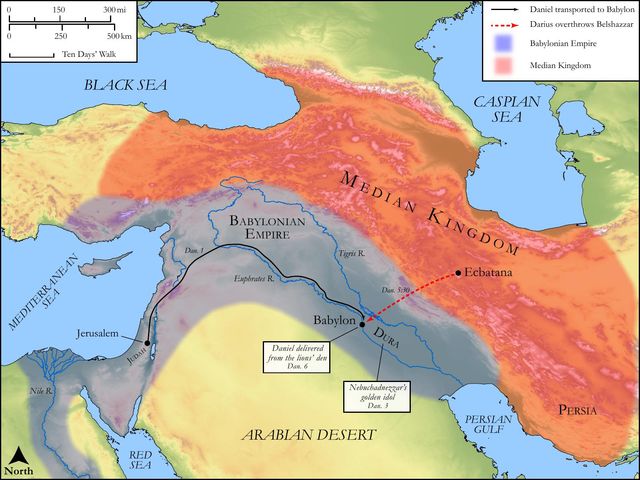
See on the biblical-era map
Study this verse
Public-domain commentary
Matthew Henry
From his Commentary on the Whole Bible. Henry comments on passages, not single verses — this entry covers Daniel 4:28–33. His three-level outline is real structure in the source text, so it is rendered as structure.
We have here Nebuchadnezzar's dream accomplished, and Daniel's application of it to him justified and confirmed. How he took it we are not told, whether he was pleased with Daniel or displeased; but here we have,
I.God's patience with him:
All this came upon him, but not till twelve months after (Dan 4:29), so long there was a lengthening of his tranquility, though it does not appear that he broke off his sins, or showed any mercy to the poor captives, for this was still God's quarrel with him, that he opened not the house of his prisoners, Isa 14:17. Daniel having counselled him to repent, God so far confirmed his word that he gave him space to repent; he let him alone this year also, this one year more, before he brought this judgment upon him. Note, God is long-suffering with provoking sinners, because he is not willing that any should perish, but that all should come to repentance, Pe2 3:9.
II.His pride, and haughtiness, and abuse of that patience.
He walked in the palace of the kingdom of Babylon, in pomp and pride, pleasing himself with the view of that vast city, which, with all the territories thereunto belonging, was under his command, and he said, either to himself or to those about him, perhaps some foreigners to whom he was showing his kingdom and the glory of it, Is not this great Babylon? Yes, it is great, of vast extent, no less that forty-five miles compass within the walls. It is full of inhabitants, and they are full of wealth. It is a golden city, and that is enough to proclaim it great, Isa 14:4. See the grandeur of the houses, walls, towers, and public edifices. Every thing in Babylon he thinks looks great; "and this great Babylon I have built." Babylon was built many ages before he was born, but because he fortified and beautified it, and we may suppose much of it was rebuilt during his long and prosperous reign, he boasts that he has built it, as Augustus Caesar boasted concerning Rome, Lateritiam inveni, marmoream reliqui - I found it brick, but I left it marble. He boasts that he built it for the house of the kingdom, that is, the metropolis of his empire. This vast city, compared with the countries that belonged to his dominions, was but as one house. He built it with the assistance of his subjects, yet boasts that he did it by the might of his power; he built it for his security and convenience, yet, as if he had no occasion for it, boasts that he built it purely for the honour of his majesty. Note, Pride and self-conceitedness are sins that most easily beset great men, who have great things in the world. They are apt to take the glory to themselves which is due to God only.
III.His punishment for his pride.
When he was thus strutting, and vaunting himself, and adoring his own shadow, while the proud word was in the king's mouth the powerful word came from heaven, by which he was immediately deprived,
1.Of his honour as a king: The kingdom has departed from thee. When he thought he had erected impregnable bulwarks for the preserving of his kingdom, now, in an instant, it has departed from him; when he thought it so well guarded that none could take it from him, behold, it departs of itself. As soon as he becomes utterly incapable to manage it, it is of course taken out of his hands.
2.He is deprived of his honour as a man. He loses his reason, and by that means loses his dominion: They shall drive thee from men, Dan 4:32. And it was fulfilled (Dan 4:33): he was driven from men the same hour. On a sudden he fell stark mad, distracted in the highest degree that ever any man was. His understanding and memory were gone, and all the faculties of a rational soul broken, so that he became a perfect brute in the shape of a man. He went naked, and on all four, like a brute, did himself shun the society of reasonable creatures and run wild into the fields and woods, and was driven out by his own servants, who, after some time of trial, despairing of his return to his right mind, abandoned him, and looked after him no more. He had not the spirit of a beast of prey (that of the royal lion), but of the abject and less honourable species, for he was made to eat grass as oxen; and, probably, he did not speak with human voice, but lowed like an ox. Some think that his body was all covered with hair; however, the hair of his head and beard, being never cut nor combed, grew like eagles feathers, and his nails like birds' claws. Let us pause a little, and view this miserable spectacle; and let us receive instruction from it.
(1.)Let us see here what a mercy it is to have the use of our reason, how thankful we ought to be for it, and how careful we ought to be not to do any thing which may either provoke God or may have a natural tendency to put us out of the possession of our own souls. Let us learn how to value our own reason, and to pity the case of those that are under the prevailing power of melancholy or distraction, or are delirious, and to be very tender in our censures of them and conduct towards them, for it is a trial common to men, and a case which, some time or other, may be our own.
(2.)Let us see here the vanity of human glory and greatness. Is this Nebuchadnezzar the Great? What this despicable animal that is meaner than the poorest beggar? Is this he that looked so glorious on the throne, so formidable in the camp, that had politics enough to subdue and govern kingdoms, and now has not so much sense as to keep his own clothes on his back? Is this the man that made the earth to tremble, that did shake kingdoms? Isa 14:16. Never let the wise man then glory in his wisdom, nor the mighty man in his strength.
(3.)Let us see here how God resists the proud, and delights to abase them and put contempt upon them. Nebuchadnezzar would be more than a man, and therefore God justly makes him less than a man, and puts him upon a level with the beasts who set up for a rival with his Maker. See Job 40:11-13.
Historical interpretation
Historical reception
1 surviving comment on this verse from the historical church.
The text then conveys also the span of divine longsuffering: after the passage of twelve months the threat in the prophecy reached its factual conclusion. Though given such a length of time to repent, he failed to meet the deadline for repentance; it would be of him that blessed Paul spoke, “Do you despise the riches of his kindness, forbearance and longsuffering? Are you unaware that the kindness of God leads you to repentance? In your hard and impenitent heart, however, you are storing up wrath for yourselves on the day of wrath, revelation and right judgment by God, who will render to everyone according to each one’s works: eternal life to those who by perseverance in good works seek glory and honor and immortality, while anger and wrath will come to those who in self-seeking do not obey the truth but obey iniquity. There will be tribulation and distress for every person guilty of evildoing.”
Continue studying Daniel 4:29 across the web’s major study libraries — every link below opens this exact verse, chapter, or book on the destination site.
Read & Compare
 BibleGatewayThis verse in more than 200 translations and 70 languages.
 Bible.comThe YouVersion reader — hundreds of translations, reading plans, and highlights.
 ESV.orgCrossway's official English Standard Version reader.
 NET BibleThe NET translation with 60,000+ translators' notes on every rendering decision.
 STEP BibleTyndale House's free study tool — original text, vocabulary, and scholarly resources.
 BibliaLogos Bible Software's free web reader.
 USCCBThe New American Bible (Revised Edition) with the U.S. bishops' study notes.
Commentaries
 BibleHub CommentariesDozens of classic commentaries on this verse, gathered on one page.
 StudyLightMore than 100 commentary sets — the largest collection on the web.
 BibleRefPlain-English commentary on what this verse means, verse by verse.
 Enduring WordDavid Guzik's free commentary on this chapter, widely used by Bible teachers.
 Bible Study ToolsVerse commentary alongside Greek and Hebrew study aids.
Original Language & Research
- BibleHub InterlinearThe verse word by word — original language, transliteration, and English.
- BibleHub LexiconEvery word's original-language definition and Strong's entry.
 Blue Letter BibleDeep-study tools — Strong's numbers, concordance, and word studies.
 SefariaThe Hebrew text with Rashi and centuries of Jewish commentary.
Sermons, Hymns & Audio


TrulyRandomVerse is not affiliated with these sites and doesn’t control their content. They’re linked because they’re genuinely useful.
Summary
Daniel 4:29 marks a pivotal moment in the unfolding narrative of King Nebuchadnezzar, serving as the quiet interlude before the dramatic and undeniable fulfillment of divine prophecy. After a full year of divine grace and opportunity following Daniel's interpretation of his terrifying dream, the king is found walking in the opulent splendor of his Babylonian palace, seemingly oblivious to or unheeding of the solemn divine warning. This verse powerfully underscores God's profound patience and Nebuchadnezzar's persistent pride, setting the stage for the immediate and spectacular display of God's absolute sovereignty over all earthly rulers.
Context
ShowHideLiterary Context
This verse serves as a crucial narrative hinge, directly preceding Nebuchadnezzar's infamous boast in Daniel 4:30, which immediately triggers the foretold divine judgment. It follows the detailed account of the king's terrifying dream, Daniel's clear interpretation, and his earnest counsel for repentance, found in Daniel 4:24-27. The mention of "twelve months" is critically important, highlighting a precise period of divine patience and opportunity for the king to humble himself—an opportunity Nebuchadnezzar tragically failed to seize. The preceding verse, Daniel 4:28, states that "all this came upon the king Nebuchadnezzar," making Daniel 4:29 the precise temporal and spatial setting just moments before the prophecy's dramatic manifestation. It functions as a narrative pause, intensifying the dramatic tension before the inevitable and spectacular fall.
Historical & Cultural Context
Nebuchadnezzar reigned as the most powerful monarch of the Neo-Babylonian Empire (605-562 BC), a dominant force in the ancient Near East. Babylon itself was a city of unparalleled grandeur and architectural marvel, celebrated for its massive defensive walls, the magnificent Ishtar Gate, and the fabled Hanging Gardens, which Nebuchadnezzar himself proudly claimed to have built. The "palace of the kingdom of Babylon" refers to the sprawling and magnificent royal complex, a tangible symbol of his absolute power, immense wealth, and architectural prowess. Kings in this era, particularly in the ancient Near East, were often considered divine or divinely appointed, fostering an environment where human pride and self-exaltation could easily flourish unchecked. Nebuchadnezzar's leisurely walk in his opulent palace signifies his continued enjoyment of this earthly glory and his deep-seated sense of security, contrasting sharply with the divine decree that was about to strip him of it.
Key Themes
ShowHideDaniel 4:29 contributes significantly to several overarching themes woven throughout the book of Daniel. Firstly, it powerfully illustrates Divine Patience and Longsuffering, as God graciously extends a full year for Nebuchadnezzar to humble himself, demonstrating that His judgments are not arbitrary but are preceded by ample opportunity for repentance (Romans 2:4). Secondly, it highlights Human Pride and Arrogance, especially when unchecked by a recognition of divine authority. Nebuchadnezzar's continued presence in his opulent palace, seemingly unrepentant, underscores the deep-seated pride that would soon lead to his dramatic downfall, as explicitly stated in his boast in Daniel 4:30). Thirdly, the verse sets the stage for the theme of Unheeded Warnings, emphasizing the severe consequences of ignoring divine counsel. Despite Daniel's clear interpretation and exhortation in Daniel 4:27, the king remained unchanged. Finally, and most centrally, it reinforces the book's foundational theme of God's Unwavering Sovereignty, proving that "the Most High rules in the kingdom of men and gives it to whomsoever he will" (Daniel 4:25, also Daniel 2:21).
Exposition and Analysis
ShowHideKey Word Analysis
ShowHideThis Aramaic verb, corresponding to the Hebrew halak, means "to walk." In this specific context, it describes Nebuchadnezzar's physical movement within the confines of his royal residence. However, it subtly implies more than mere locomotion; it suggests his continued routine, his unperturbed state of mind, and his persistent unrepentant conduct. He was going about his normal life, perhaps with a sense of security and self-importance, rather than reflecting on the divine warning and changing his "walk" or way of life.
Corresponding to the Hebrew heykal, this term denotes a grand, royal residence or even a temple. Its use here powerfully emphasizes the sheer magnificence and opulent splendor of Nebuchadnezzar's surroundings. The "palace" serves as a potent physical representation of his immense power, his vast wealth, and the pinnacle of his human achievement and self-exaltation, making his subsequent, dramatic humiliation even more striking and illustrative of the utter futility of human pride before the Almighty God.
This Aramaic word simply means "a month." The precise phrase "twelve months" specifically highlights the duration of a full year. This period is profoundly significant because it signifies God's deliberate patience and the ample time afforded to Nebuchadnezzar to heed the solemn warning and humble himself. The completion of this full annual cycle underscores the king's persistent unrepentance and sets a precise temporal marker for the impending, divinely ordained judgment.
Verse Breakdown
ShowHide"At the end of twelve months"
This phrase precisely marks the passage of a full year since Daniel's interpretation of Nebuchadnezzar's dream and his subsequent counsel to the king. It signifies a period of profound divine grace and patience, during which God deliberately withheld judgment, offering the king ample opportunity to repent and acknowledge the sovereignty of the Most High. The completion of this specific timeframe indicates that the period of grace has concluded, and the foretold judgment is now undeniably imminent.
"he walked"
This describes Nebuchadnezzar's activity. He was not in hiding, nor was he in a state of fear or anxiety; rather, he was moving freely, confidently, and perhaps even leisurely within his royal domain. This seemingly mundane action is highly significant, suggesting a king who felt utterly secure and perhaps even complacent in his power, having seemingly forgotten or deliberately disregarded the stern divine warning he received a year prior. It implies a continuation of his normal, proud, and self-assured routine.
"in the palace of the kingdom of Babylon"
This specifies the exact location of the king's walk. The "palace" represents the epitome of his earthly power, his vast wealth, and his architectural achievements. It is the very seat of his dominion and the most potent symbol of his self-exaltation and human pride. His presence here, at the very heart of his magnificent empire, underscores the height of his human pride and perceived security just moments before God's decisive and humbling intervention.
Literary Devices
ShowHideThe verse employs several powerful literary devices that amplify its dramatic impact. Foreshadowing is prominently featured, as the calm setting of Nebuchadnezzar's seemingly ordinary walk in his magnificent palace, after a full year of unheeded divine warning, ominously hints at the impending and dramatic divine judgment. This creates a palpable sense of dramatic tension, the quiet and deceptive calm before the inevitable storm. Irony is also powerfully at play; the king is found walking proudly and securely in the very symbol of his earthly power, the "palace of the kingdom of Babylon," just moments before he is dramatically stripped of that power and driven out to live like a wild beast. The height of his perceived security immediately precedes his profound and public humiliation. Furthermore, the "palace" itself functions as potent Symbolism, representing the pinnacle of human achievement, pride, and self-sufficiency, which stands in stark and direct opposition to God's ultimate and absolute sovereignty.
Theological and Thematic Connections
ShowHideDaniel 4:29 powerfully illustrates the divine attribute of patience and the solemn reality of human accountability before God. God, in His long-suffering and immense grace, granted Nebuchadnezzar a full year to reflect on the prophetic warning and to humble himself before the Most High. This extended period of grace underscores that God's judgments are never arbitrary but are always preceded by ample opportunity for repentance and realignment with His will. The king's tragic failure to heed this warning, evident in his continued proud walk in his opulent palace, highlights the inherent dangers of unchecked arrogance and the ultimate futility of human power when it fails to acknowledge and submit to divine sovereignty. The verse serves as a stark and timeless reminder that God's word will always come to pass, and no earthly power or human pride can ultimately defy His sovereign will.
Reflection and Application
ShowHideDaniel 4:29 stands as a profound mirror for contemporary believers, challenging us to deeply examine our own responses to God's warnings and His patient, extending grace. The "twelve months" so graciously granted to Nebuchadnezzar serve as a powerful reminder that God often provides seasons of opportunity for reflection, repentance, and a crucial realignment with His divine will before consequences fully manifest. Do we, in our own lives, utilize such precious periods for genuine introspection and humility, or do we, like Nebuchadnezzar, persist in our pride, complacency, and self-sufficiency, perhaps even boasting in our own achievements, resources, or positions? This verse calls us to cultivate a profound spirit of humility, acknowledging with gratitude that all our accomplishments, all our resources, and all our positions are ultimately undeserved gifts from God, subject entirely to His sovereign will. It urgently urges us to take divine warnings seriously, whether they come through the inspired words of Scripture, the wise counsel of mature believers, or the challenging circumstances of life, responding with prompt obedience and a heart overflowing with worship that gives God the glory due His holy name.
Questions for Reflection
ShowHideFAQ
ShowHideWhy did God wait twelve months before judging Nebuchadnezzar?
ShowHideGod waited twelve months to profoundly demonstrate His divine patience, long-suffering, and unwavering justice. This extended period provided Nebuchadnezzar ample time to reflect deeply on Daniel's interpretation of his terrifying dream and, crucially, to humble himself before the Most High God, as Daniel had explicitly advised him to "break off your sins by righteousness, and your iniquities by showing mercy to the poor" (Daniel 4:27). God's delay was a profound act of grace, offering a clear and sustained opportunity for repentance. It also serves to highlight the king's persistent pride and unrepentance, making the subsequent judgment a clear demonstration of divine justice and absolute sovereignty, rather than impulsive wrath. This patient waiting is entirely consistent with God's character, who is "not willing that any should perish, but that all should come to repentance" (2 Peter 3:9).
What is the significance of Nebuchadnezzar "walking in the palace of the kingdom of Babylon" at this specific moment?
ShowHideThe act of Nebuchadnezzar "walking in the palace of the kingdom of Babylon" is profoundly significant because it represents the very pinnacle of his earthly power, his overwhelming pride, and his deep-seated self-sufficiency. The palace was not merely a building; it was the ultimate symbol of his dominion, his unparalleled architectural achievements, and his perceived invincibility. His presence there, seemingly secure and perhaps even boastful, immediately precedes his arrogant declaration in Daniel 4:30, "Is not this great Babylon, that I have built... by the might of my power, and for the honour of my majesty?" This setting underscores the dramatic and stark contrast between human pride and God's ultimate, unchallengeable sovereignty. It powerfully emphasizes that even at the zenith of his earthly glory, Nebuchadnezzar was utterly dependent on and subject to the Most High God, who was about to humble him in a most spectacular and unforgettable fashion.
Christ-Centered Fulfillment
ShowHideDaniel 4:29, with its vivid depiction of Nebuchadnezzar's unrepentant pride in his magnificent earthly kingdom, stands in stark and profound contrast to the person and eternal kingdom of Jesus Christ. Nebuchadnezzar, despite a full year of divine grace and a clear warning, clung tenaciously to his self-glory and the fleeting splendor of his Babylonian palace, ultimately leading to his dramatic and public humiliation. In striking antithesis, Christ, though "in the form of God, did not count equality with God a thing to be grasped, but emptied himself, by taking the form of a servant, being born in the likeness of men" (Philippians 2:6-7). While Nebuchadnezzar walked proudly in a palace built by human hands, boasting of his own power and majesty, Jesus, the true and eternal King, walked the dusty roads of Galilee and Judea, humbly proclaiming a kingdom "not of this world" (John 18:36). He taught His disciples to learn from Him, for He is "gentle and lowly in heart" (Matthew 11:29), embodying a profound and redemptive antithesis to the proud Babylonian monarch. The temporary and ultimately fragile nature of Nebuchadnezzar's kingdom, built on human might and pride, foreshadows the ultimate and everlasting triumph of Christ's eternal kingdom, which will one day fill the whole earth and endure forever (Revelation 11:15). Thus, Daniel 4:29 not only highlights the severe consequences of human pride but also magnificently magnifies the unparalleled and redemptive humility of Christ, who, unlike Nebuchadnezzar, willingly surrendered all earthly glory to secure an eternal and indestructible kingdom for His beloved people.