


Daniel 4:25
- וְלָךְve·Lakhand <obj.> youConj-w ¦ Prep-l ¦ 2msSuffix Personal 2nd Singular Masculineוְandלָ<obj.>ךְyou
- טָרְדִיןta·re·Din[they will be] chasingH2957V-Peal-Prtcpl-mpVerb Peal Participle Plural Masculine Absolute
- מִןminaway fromH4481PrepPreposition
- אֲנָשָׁא'a·na·Sha'<the> humankindH606N-cs ¦ ArtNoun Singular common gender Definiteאֲנָשָׁ<the>אhumankind
- וְעִםve·'imand withH5974Conj-w ¦ PrepPrepositionוְandעִםwith
- חֵיוַתchei·Vat[the] animal[s] ofH2423N-fscNoun Singular Feminine Construct
- בָּרָאba·Ra'field theH1251N-cs ¦ ArtNoun Singular common gender Definiteבָּרָfieldאthe
- לֶהֱוֵהle·he·Vehit will beH1934V-Peal-Imperf-3msVerb Peal Imperfect 3rd Singular Masculine
- מְדֹרָךְme·do·Rakhyour dwelling placeH4070N-csc ¦ 2msNoun Singular common gender Constructמְדֹרָdwelling placeךְyour
- וְעִשְׂבָּאve·'is·Ba'and <the> grassH6211Conj-w ¦ N-cs ¦ ArtNoun Singular common gender Definiteוְandעִשְׂבָּ<the>אgrass
- כְתוֹרִיןkhe·to·Rinlike oxenH8450Prep-k ¦ N-mpNoun Plural Masculine Absoluteכְlikeתוֹרִיןoxen
- לָךְlakhto youPrep-l ¦ 2msSuffix Personal 2nd Singular Masculineלָtoךְyou
- יְטַעֲמוּןye·ta·'a·Munthey will feedH2939V-Pael-Imperf-3mpVerb Pael Imperfect 3rd Plural Masculine
- וּמִטַּלu·mi·Taland from [the] dew ofH2920Conj-w ¦ Prep-m ¦ N-cscNoun Singular common gender Constructוּandמִfromטַּל[the] dew of
- שְׁמַיָּאshe·mai·Ya'heavens theH8065N-mp ¦ ArtNoun Plural Masculine Definiteשְׁמַיָּheavensאthe
- לָךְlakh<obj.> youPrep-l ¦ 2msSuffix Personal 2nd Singular Masculineלָ<obj.>ךְyou
- מְצַבְּעִיןme·tza·be·'In[they will be] making wetH6647V-Pael-Prtcpl-mpVerb Pael Participle Plural Masculine Absolute
- וְשִׁבְעָהve·shiv·'Ahand sevenH7655Conj-w ¦ Adj-fsAdjective Numerical Singular Feminine Absoluteוְandשִׁבְעָהseven
- עִדָּנִין'i·da·NintimesH5732N-mpNoun Plural Masculine Absolute
- יַחְלְפוּןyach·le·Funthey will passH2499V-Peal-Imperf-3mpVerb Peal Imperfect 3rd Plural Masculine
- עֲלָךְa·la·yikhover youH5922Prep ¦ 2msPrepositionעֲלָoverךְyou
- עַד'aduntilH5705PrepPreposition
- דִּיdithatH1768ConjConjunction
- תִנְדַּעtin·Da'you will knowH3046V-Peal-Imperf-2msVerb Peal Imperfect 2nd Singular Masculine
- דִּיdithatH1768ConjConjunction
- שַׁלִּיטsha·Lit[is] having masteryH7990Adj-csAdjective Singular common gender Absolute
- עִלָּאָהi·la·ya'Most High theH5943Adj-cs ¦ ArtAdjective Singular common gender DefiniteעִלָּאָMost Highהthe
- בְּמַלְכוּתbe·mal·Khutover [the] kingdom ofH4437Prep-b ¦ N-fscNoun Singular Feminine Constructבְּoverמַלְכוּת[the] kingdom of
- אֲנָשָׁא'a·na·Sha'<the> humankindH606N-cs ¦ ArtNoun Singular common gender Definiteאֲנָשָׁ<the>אhumankind
- וּלְמַןu·le·manand to whomeverH4479Conj-w ¦ Prep-l ¦ InterrogPronoun Interrogativeוּandלְtoמַןwhomever
- דִּיdiwhomH1768ConjConjunction
- יִצְבֵּאyitz·Be'he will be pleasedH6634V-Peal-Imperf-3msVerb Peal Imperfect 3rd Singular Masculine
- יִתְּנִנַּהּyi·te·ni·Nahhe will give itH5415V-Peal-Imperf-3ms ¦ 3fsVerb Peal Imperfect 3rd Singular Masculineיִתְּנִנַּhe will giveהּit
English is a literal word-by-word gloss of the Hebrew, not the KJV's wording. Why?
This is the original text the KJV's translators worked from — each Hebrew word with its own literal English meaning in this verse, prepared by scholars at Tyndale House, Cambridge. The KJV translates whole sentences, not word by word, so its wording differs: one Hebrew word can become several English words, and the KJV may choose “the LORD” where the gloss reads “Yahweh”. Both are faithful — they answer different questions. For the KJV's own rendering, switch to the KJV text.
Details
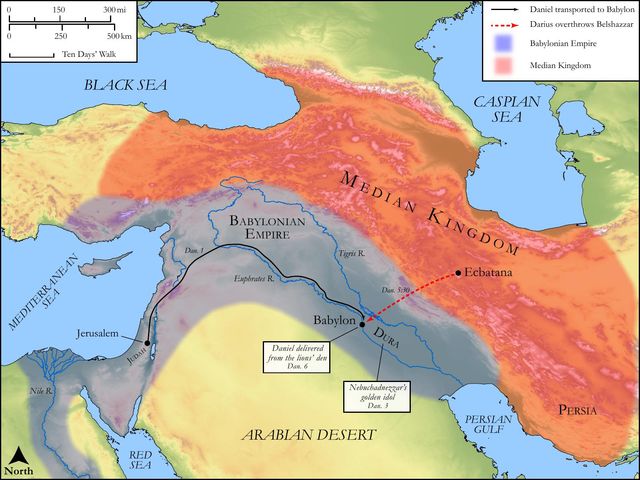
See on the biblical-era map
Study this verse
Public-domain commentary
Matthew Henry
From his Commentary on the Whole Bible. Henry comments on passages, not single verses — this entry covers Daniel 4:19–27. His two-level outline is real structure in the source text, so it is rendered as structure.
We have here the interpretation of Nebuchadnezzar's dream; and when once it is applied to himself, and it is declared that he is the tree in the dream (Mutato nomine de te fabula narratur - Change but the name, the fable speaks of thee), when once it is said, Thou art the man, there needs little more to be said for the explication of the dream. Out of his own mouth he is judged; so shall his doom be, he himself has decided it. The thing was so plain that Daniel, upon hearing the dream, was astonished for one hour, Dan 4:19. He was struck with amazement and terror at so great a judgment coming upon so great a prince. His flesh trembled for fear of God. He was likewise struck with confusion when he found himself under a necessity of being the man that must bring to the king these heavy tidings, which, having received so many favours from the king, he had rather he should have heard from any one else; so far is he from desiring the woeful day that he dreads it, and the thoughts of it trouble him. Those that come after the ruined sinner are said to be astonished at his day, as those that went before, and saw it coming (as Daniel here), were affrighted, Job 18:20.
I.The preface to the interpretation is a civil compliment which, as a courtier, he passes upon the king.
The king observed him to stand as one astonished, and, thinking he was loth to speak out for fear of offending him, he encouraged him to deal plainly and faithfully with him; Let not the dream, nor the interpretation thereof, trouble thee. This he speaks either,
1.As one that sincerely desired to know this truth. Note, Those that consult the oracles of God must be ready to receive them as they are, whether they be for them or against them, and must accordingly give their ministers leave to be free with them. Or,
2.As one that despised the truth, and set it at defiance. When we see how regardless he was of this warning afterwards we are tempted to think that this was his meaning; "Let it not trouble thee, for I am resolved it shall not trouble me; nor will I lay it to heart." But, whether he have any concern for himself or no, Daniel is concerned for him, and therefore wishes, "The dream be to those that hate thee. Let the ill it bodes light on the head of thy enemies, not on thy head." Though Nebuchadnezzar was an idolater, a persecutor, and an oppressor of the people of God, yet he was, at present, Daniel's prince; and therefore, though Daniel foresees, and is now going to foretell, ill concerning him, he dares not wish ill to him.
II.The interpretation itself is only a repetition of the dream, with application to the king.
"As for the tree which thou sawest flourishing (Dan 4:20, Dan 4:21), it is thou, O king!" Dan 4:22. And willing enough would the king be to hear this (as, before, to hear, Thou art the head of gold), but for that which follows. He shows the king his present prosperous state in the glass of his own dream; "Thy greatness has grown and reaches as near to heaven as human greatness can do, and thy dominion is to the end of the earth," Dan 2:37, Dan 2:38. "As for the doom passed upon the tree (Dan 4:23), it is the decree of the Most High, which comes upon my lord the king," Dan 4:24. He must not only be deposed from his throne, but driven from men, and being deprived of his reason, and having a beast's heart given him, his dwelling shall be with the beasts of the field, and with them he shall be a fellow-commoner: he shall eat grass as oxen, and, like them, lie out all weathers, and be wet with the dew of heaven, and this till seven times pass over him, that is, seven years; and then he shall know that the Most High rules, and when he is brought to know and own this he shall be restored to his dominion again (Dan 4:26): "Thy kingdom shall be sure unto thee, shall remain as firm as the stump of the tree in the ground, and thou shalt have it, after thou shalt have known that the heavens do rule." God is here called the heavens, because it is in heaven that he has prepared his throne (Psa 103:19), thence he beholds all the sons of men, Psa 33:13. The heavens, even the heavens, are the Lord's; and the influence which the visible heavens have upon this earth is intended as a faint representation of the dominion the God of heaven has over this lower world; we are said to sin against heaven, Luk 15:18. Note, Then only we may expect comfortably to enjoy our right in, and government of, both ourselves and others, when we dutifully acknowledge God's title to, and dominion over, us and all we have.
III.The close of the interpretation is the pious counsel which Daniel, as a prophet, gave the king, Dan 4:27.
Whether he appeared concerned or not at the interpretation of the dream, a word of advice would be very seasonable - if careless, to awaken him, if troubled, to comfort him; and it is not inconsistent with the dream and the interpretation of it, for Daniel knew not but it might be conditional, like the prediction of Nineveh's destruction. Observe,
1.How humbly he gives his advice, and with what tenderness and respect: "O king! let my counsel be acceptable unto thee; take it in good part, as coming from love, and well-meant, and let it not be misinterpreted." Note, Sinners need to be courted to their own good, and respectfully entreated to do well for themselves. The apostle beseeches men to suffer the word of exhortation, Heb 13:22. We think it a good point gained if people will be persuaded to take good counsel kindly; nay, if they will take it patiently.
2.What his advice is. He does not counsel him to enter into a course of physic, for the preventing of the distemper in his head, but to break off a course of sin that he was in, to reform his life. He wronged his own subjects, and dealt unfairly with his allies; and he must break off this by righteousness, by rendering to all their due, making amends for wrong done, and not triumphing over right with might. He had been cruel to the poor, to God's poor, to the poor Jews; and he must break off this iniquity by showing mercy to those poor, pitying those oppressed ones, setting them at liberty or making their captivity easy to them. Note, It is necessary, in repentance, that we not only cease to do evil, but learn to do well, not only do no wrong to any, but do good to all.
3.What the motive is with which he backs this advice: If it may be a lengthening of thy tranquility. Though it should not wholly prevent the judgment, yet by this means a reprieve may be obtained, as by Ahab's humbling himself, Kg1 21:29. Either the trouble may be the longer before it comes or the shorter when it does come; yet he cannot assure him of this, but it may be, it may prove so. Note, The mere probability of preventing a temporal judgment is inducement enough to a work so good in itself as the leaving off of our sins and reforming of our lives, much more the certainty of preventing our eternal ruin. "That will be a healing of thy error" (so some read it); "thus the quarrel will be taken up, and all will be well again."
Historical interpretation
Historical reception
3 surviving comments on this verse. Each one is dated, so this reads as a timeline rather than a list.
Select a marker to jump to its quote. Markers stagger vertically where authors wrote within a few decades of each other.
Verses 24, 25. "'This is the interpretation of the sentence of the Most High which has come upon my lord the king. They shall cast thee forth from among men and thy habitation shall be with cattle and wild beasts...'" Daniel moderates the severity of the sentence by complimentary language, so that (variant: and) after he has first set forth the harsher aspects, he may moderate the king's alarm by assurances of the kindlier treatment to follow. He draws the final inference:
Now, while some commentators claimed the “seven times” are seven years, others said three and a half. The divine Scripture, in fact, divides the year not into four seasons but into two more generic parts, winter and summer; so seven divisions of that kind amount to three and a half years. You will spend such a length of time in misfortune.
God will take from you even human reason and will make you resemble the beasts so that you may learn from experience what is human and what is God, what is human fortune and what is divine kingship, and the fact that it is impossible to attain it unless God wishes.
Continue studying Daniel 4:25 across the web’s major study libraries — every link below opens this exact verse, chapter, or book on the destination site.
Read & Compare
 BibleGatewayThis verse in more than 200 translations and 70 languages.
 Bible.comThe YouVersion reader — hundreds of translations, reading plans, and highlights.
 ESV.orgCrossway's official English Standard Version reader.
 NET BibleThe NET translation with 60,000+ translators' notes on every rendering decision.
 STEP BibleTyndale House's free study tool — original text, vocabulary, and scholarly resources.
 BibliaLogos Bible Software's free web reader.
 USCCBThe New American Bible (Revised Edition) with the U.S. bishops' study notes.
Commentaries
 BibleHub CommentariesDozens of classic commentaries on this verse, gathered on one page.
 StudyLightMore than 100 commentary sets — the largest collection on the web.
 BibleRefPlain-English commentary on what this verse means, verse by verse.
 Enduring WordDavid Guzik's free commentary on this chapter, widely used by Bible teachers.
 Bible Study ToolsVerse commentary alongside Greek and Hebrew study aids.
Original Language & Research
- BibleHub InterlinearThe verse word by word — original language, transliteration, and English.
- BibleHub LexiconEvery word's original-language definition and Strong's entry.
 Blue Letter BibleDeep-study tools — Strong's numbers, concordance, and word studies.
 SefariaThe Hebrew text with Rashi and centuries of Jewish commentary.
Sermons, Hymns & Audio


TrulyRandomVerse is not affiliated with these sites and doesn’t control their content. They’re linked because they’re genuinely useful.
Summary
Daniel 4:25 articulates the precise and severe judgment prophesied against King Nebuchadnezzar, detailing his expulsion from human society, his forced dwelling among wild animals, and his sustenance on grass like an ox. This profound and public humbling, marked by a divinely ordained period of "seven times," is explicitly purposed to bring the proud monarch to an undeniable realization: that the Most High God alone possesses ultimate sovereignty over all earthly kingdoms and bestows authority according to His divine will.
Context
ShowHideLiterary Context
This verse is the interpretive core of Daniel's explanation of King Nebuchadnezzar's second significant dream, recorded in Daniel 4:10-17. The dream vividly depicted a magnificent tree symbolizing the king's immense power and dominion over the known world. However, a divine decree commanded the tree's felling, leaving only a stump, signifying Nebuchadnezzar's impending fall from power and sanity. Daniel, uniquely gifted by God to interpret such mysteries, reveals that this judgment is a direct consequence of the king's escalating pride, particularly his boastful declaration in Daniel 4:30 about his own might in building Babylon. Verse 25 precisely articulates the nature, duration, and ultimate purpose of this divinely ordained discipline, setting the stage for the king's eventual restoration and profound confession of God's supremacy, as detailed in Daniel 4:34-37.
Historical & Cultural Context
Nebuchadnezzar reigned over the Neo-Babylonian Empire, an unparalleled superpower of its time. Ancient Near Eastern monarchs, including Nebuchadnezzar, often viewed themselves as divine or divinely appointed, holding absolute and unquestionable authority. The city of Babylon itself, with its monumental architecture like the Ishtar Gate and the Hanging Gardens, was a testament to Nebuchadnezzar's power and served as a physical manifestation of his pride. For such a king, accustomed to opulent palaces, universal deference, and the worship of his subjects, being "driven from men" and reduced to living like an animal was the ultimate humiliation and an unthinkable disgrace. This public and profound degradation was designed to shatter his self-perception and challenge the very foundation of his perceived divine right to rule, demonstrating God's superior authority over even the most powerful earthly potentates.
Key Themes
ShowHideThis verse profoundly contributes to several overarching themes within the book of Daniel. First and foremost is Divine Sovereignty, powerfully articulated by the phrase "the most High ruleth in the kingdom of men, and giveth it to whomsoever he will." This asserts God's absolute control over all earthly powers and rulers, a truth consistently emphasized throughout Daniel, notably in Daniel 4:17 and Daniel 2:21. Second is the theme of Humility and Judgment, where Nebuchadnezzar's transformation into a beast-like state serves as a stark warning against pride and self-exaltation. God uses drastic measures to humble those who refuse to acknowledge His supremacy, underscoring the biblical principle that pride goes before destruction. Finally, the verse highlights Discipline for Recognition, as the affliction is explicitly stated to last "till thou know that the most High ruleth." This reveals the remedial nature of God's judgment, designed not merely for punishment but to bring Nebuchadnezzar to a genuine understanding and acknowledgment of God's ultimate authority and to foster true repentance.
Exposition and Analysis
ShowHideKey Word Analysis
ShowHideThis Aramaic word (H2957) corresponds to the Hebrew ṭārad, meaning "to expel" or "to drive out." In the context of Daniel 4:25, it signifies a forceful and involuntary removal of Nebuchadnezzar from human society. It implies a complete severance from his royal duties, his palace, and all human interaction, emphasizing the severity and totality of his judgment.
This Aramaic term (H4070) refers to a habitation or abode. Here, it starkly contrasts Nebuchadnezzar's former opulent palace with a new, animalistic abode "with the beasts of the field." This word underscores the radical shift in his living conditions, highlighting his degradation from a king of men to a companion of wild animals in the open "field" (H1251, bar).
This Aramaic word (H3046) corresponds to the Hebrew yādaʿ, signifying "to know." It encompasses understanding, recognition, and experiential knowledge. The phrase "till thou know" reveals the ultimate purpose of Nebuchadnezzar's humbling: it is a divinely orchestrated process intended to bring him to a profound, undeniable, and personal acknowledgment of God's supreme rule. It implies a transformation from mere intellectual assent to a deep, experiential conviction of God's sovereignty.
Verse Breakdown
ShowHide"That they shall drive thee from men,"
This clause describes the initial and most shocking aspect of the judgment: Nebuchadnezzar's complete expulsion from human society. "They" refers to the divine agents, likely angels, who execute God's decree. This removal signifies not just physical separation but a loss of his human identity, status, and reason.
"and thy dwelling shall be with the beasts of the field,"
This specifies the nature of his new existence. The king, once residing in the grandest palace of the ancient world, will now live in the wilderness, sharing the habitat of wild animals. This detail emphasizes his profound degradation and loss of human dignity.
"and they shall make thee to eat grass as oxen,"
This further illustrates the extent of his transformation and humiliation. His diet will change from royal delicacies to the food of cattle, reinforcing his animalistic existence. This is a vivid image of his complete loss of human reason and sophisticated behavior.
"and they shall wet thee with the dew of heaven,"
This detail paints a picture of his exposure to the elements, living outdoors without shelter. The dew of heaven, normally a blessing for vegetation, here highlights his vulnerability and the harshness of his new, unsheltered life, further emphasizing his animalistic state.
"and seven times shall pass over thee,"
This crucial phrase indicates the duration of his affliction. While "times" (ʻiddân, H5732) can be ambiguous, scholarly consensus, supported by the narrative's context, interprets this as "seven years." This fixed period signifies a divinely determined duration for his judgment and subsequent restoration.
"till thou know that the most High ruleth in the kingdom of men,"
This is the pivotal purpose clause of the entire judgment. The affliction is not arbitrary but remedial, designed to bring Nebuchadnezzar to a profound, experiential understanding and acknowledgment of God's absolute sovereignty over all human affairs and rulers.
"and giveth it to whomsoever he will."
This final declaration reinforces the Most High's ultimate authority. God is not merely a distant ruler but actively intervenes in human history, raising up and bringing down kings and kingdoms according to His sovereign will and purpose, without needing human consultation or permission.
Literary Devices
ShowHideDaniel 4:25 is rich in Symbolism and Irony. The magnificent tree from Nebuchadnezzar's dream is a powerful symbol of his vast power and dominion, which is then dramatically cut down, symbolizing his fall. His transformation into a beast, eating grass and living among animals, is a profound symbol of his loss of reason and human dignity, directly contrasting with his former elevated status. This entire scenario is steeped in Irony: the most powerful king on earth, who boasted of his own might and built the grandest city, is reduced to the lowest possible state, becoming indistinguishable from the very animals he once ruled over. This reversal of fortune serves as a stark and unforgettable lesson in humility. The verse also functions as Prophecy, foretelling the precise nature and duration of Nebuchadnezzar's affliction, which is later fulfilled within the chapter, demonstrating the reliability of God's word and His absolute control over future events.
Theological and Thematic Connections
ShowHideDaniel 4:25 serves as a profound theological statement on the nature of divine sovereignty and human pride. It asserts that God's rule is not merely over the spiritual realm but extends directly into the temporal affairs of humanity, including the rise and fall of nations and their leaders. Nebuchadnezzar's humbling demonstrates that no human power, however vast or seemingly invincible, can stand against the Most High. This judgment is a powerful reminder that all authority is delegated by God, and true wisdom lies in acknowledging His ultimate supremacy rather than succumbing to self-exalting pride. The "seven times" of affliction highlight God's patient yet firm discipline, designed to bring about a transformative knowledge and acknowledgment of His rightful place as the supreme ruler.
Reflection and Application
ShowHideDaniel 4:25 offers enduring lessons for every individual, especially those in positions of influence or authority. It is a powerful call to humility, reminding us that any power, talent, or success we possess is ultimately a gift from God, to be stewarded for His glory, not our own. The narrative challenges us to examine our hearts for any subtle forms of pride or self-sufficiency, urging us to acknowledge God's sovereignty in every aspect of our lives. Furthermore, the "seven times" of Nebuchadnezzar's suffering reveal God's redemptive purpose even in severe trials; difficulties and humbling experiences can be God's instruments to bring us to a deeper, more authentic understanding of His character and our absolute dependence on Him. It teaches us to trust that even when life feels like a wilderness, God is at work, shaping us to recognize His supreme rule and to live in alignment with His will.
Questions for Reflection
ShowHideFAQ
ShowHideWhat does "seven times" mean in Daniel 4:25?
ShowHideWhile the Aramaic word for "times" (ʻiddân, H5732) can refer to an indefinite period, in the context of Daniel 4:25 and the subsequent narrative, it is almost universally interpreted by scholars to mean "seven years." This specific duration signifies the divinely appointed period of Nebuchadnezzar's madness and animalistic existence, after which his sanity and kingdom would be restored. This interpretation is supported by the detailed description of his physical transformation and eventual recovery, as recorded in Daniel 4:33.
Was Nebuchadnezzar's illness a known medical condition?
ShowHideScholars have debated the precise medical diagnosis for Nebuchadnezzar's condition. Some suggest a rare psychological disorder called clinical lycanthropy or boanthropy, where an individual believes they are an animal (in this case, an ox) and acts accordingly. However, the biblical account describes a supernatural intervention, a direct divine judgment that transcends typical medical explanations. The severity, suddenness, and specific duration of his condition, coupled with its explicit purpose ("till thou know that the most High ruleth"), point to a miraculous, divinely orchestrated affliction rather than a purely natural illness, demonstrating God's direct involvement in human affairs as stated in Daniel 4:17.
How does this verse apply to modern leaders and nations?
ShowHideDaniel 4:25 serves as a timeless reminder that all earthly authority, whether held by political leaders, corporate executives, or any individual in a position of influence, is ultimately subordinate to God's supreme sovereignty. It warns against the dangers of pride and self-exaltation, emphasizing that God can humble even the most powerful. For nations, it underscores that their rise and fall are ultimately within God's control, and He "giveth it to whomsoever he will." Modern leaders are called to govern with humility, justice, and an acknowledgment of a higher authority, recognizing that their power is a stewardship from God, as exhorted in passages like Romans 13:1.
Christ-Centered Fulfillment
ShowHideDaniel 4:25, with its profound declaration that "the most High ruleth in the kingdom of men, and giveth it to whomsoever he will," finds its ultimate and glorious fulfillment in the person and work of Jesus Christ. While Nebuchadnezzar was humbled by divine judgment to acknowledge God's sovereignty, Jesus, the eternal Son of God, voluntarily humbled Himself, not from pride but from divine love, taking "the form of a servant, being born in the likeness of men" (Philippians 2:7). The authority that God the Father gives "to whomsoever he will" is definitively given to Christ, for "all authority in heaven and on earth has been given to me" (Matthew 28:18). Nebuchadnezzar's temporary reign pales in comparison to Christ's eternal and universal dominion; He is the "King of kings and Lord of lords" (Revelation 19:16), whose kingdom "shall never be destroyed" (Daniel 2:44). The humbling of Nebuchadnezzar served to reveal God's power over human kingdoms, but in Christ, we see God's ultimate reign not just over humanity, but for humanity, culminating in His redemptive work on the cross and His glorious resurrection, through which He establishes a spiritual kingdom that will encompass all who believe (John 18:36). Through Him, God's sovereign will is perfectly executed, bringing salvation and eternal life to all who acknowledge His supreme rule.