


Job 30:8
Bible text: King James Version (1769 Blayney text) · Public domain
Bible text: Berean Standard Bible · Public domain
Bible text: American Standard Version (1901) · Public domain
Bible text: World English Bible, Messianic edition · Public domain
Bible text: Geneva Bible (1599) · Public domain
Bible text: Young's Literal Translation · Public domain
- בְּנֵיbe·neisons ofH1121N-mpcNoun Plural Masculine Construct
- נָבָלNa·vola foolH5036Adj-msAdjective Singular Masculine Absolute
- גַּםgamalsoH1571AdvAdverb
- בְּנֵיbe·Neisons ofH1121N-mpcNoun Plural Masculine Construct
- בְלִיve·linotH1097N-mscNoun Singular Masculine Construct
- שֵׁםShema nameH8034N-msNoun Singular Masculine Absolute
- נִכְּאוּni·ke·'Uthey have been scourgedH5217V-Niphal-Perf-3cpVerb Niphal Perfect 3rd Plural common gender
- מִןminfromH4480PrepPreposition
- הָאָרֶץha·'A·retzthe landH776Art ¦ N-fsNoun Singular Feminine Absoluteהָtheאָרֶץland
English is a literal word-by-word gloss of the Hebrew, not the KJV's wording. Why?
This is the original text the KJV's translators worked from — each Hebrew word with its own literal English meaning in this verse, prepared by scholars at Tyndale House, Cambridge. The KJV translates whole sentences, not word by word, so its wording differs: one Hebrew word can become several English words, and the KJV may choose “the LORD” where the gloss reads “Yahweh”. Both are faithful — they answer different questions. For the KJV's own rendering, switch to the KJV text.
Details
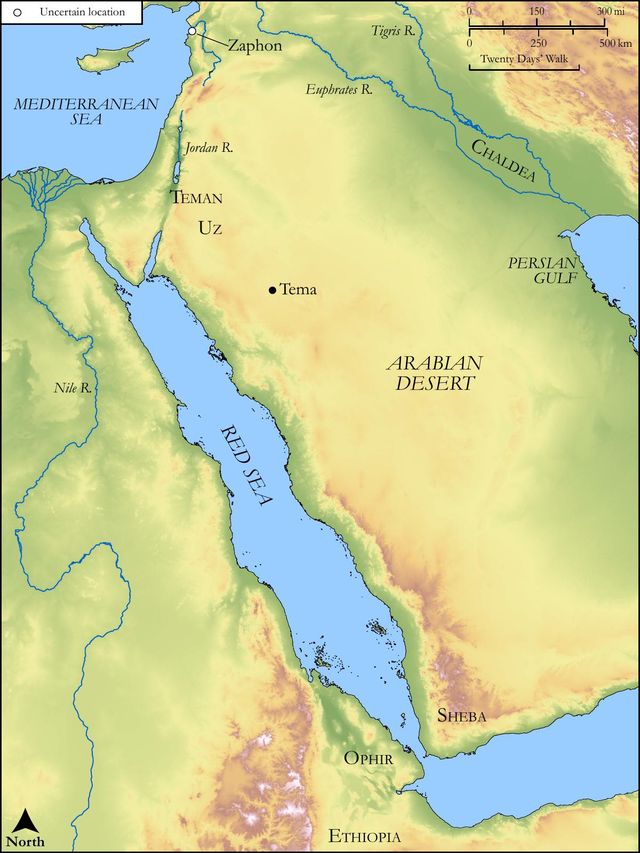
See on the biblical-era map
Study this verse
Public-domain commentary
Matthew Henry
From his Commentary on the Whole Bible. Henry comments on passages, not single verses — this entry covers Job 30:1–14. His three-level outline is real structure in the source text, so it is rendered as structure.
Here Job makes a very large and sad complaint of the great disgrace he had fallen into, from the height of honour and reputation, which was exceedingly grievous and cutting to such an ingenuous spirit as Job's was. Two things he insists upon as greatly aggravating his affliction: -
I.The meanness of the persons that affronted him.
As it added much to his honour, in the day of his prosperity, that princes and nobles showed him respect and paid a deference to him, so it added no less to his disgrace in his adversity that he was spurned by the footmen, and trampled upon by those that were not only every way his inferiors, but were the meanest and most contemptible of all mankind. None can be represented as more base than those are here represented who insulted Job, upon all accounts.
1.They were young, younger than he (Job 30:1), the youth (Job 30:12), who ought to have behaved themselves respectfully towards him for his age and gravity. Even the children, in their play, played upon him, as the children of Bethel upon the prophet, Go up, thou bald-head. Children soon learn to be scornful when they see their parents so.
2.They were of a mean extraction. Their fathers were so very despicable that such a man as Job would have disdained to take them into the lowest service about his house, as that of tending the sheep and attending the shepherds with the dogs of his flock, Job 30:1. They were so shabby that they were not fit to be seen among his servants, so silly that they were not fit to be employed, and so false that they were not fit to be trusted in the meanest post. Job here speaks of what he might have done, not of what he did: he was not of such a spirit as to set any of the children of men with the dogs of his flock; he knew the dignity of human nature better than to do so.
3.They and their families were the unprofitable burdens of the earth, and good for nothing. Job himself, with all his prudence and patience, could make nothing of them, Job 30:2. The young were not fit for labour, they were so lazy, and went about their work so awkwardly: Whereto might the strength of their hands profit me? The old were not to be advised with in the smallest matters, for in them was old age indeed, but their old age was perished, they were twice children.
4.They were extremely poor, Job 30:3. They were ready to starve, for they would not dig, and to beg they were ashamed. Had they been brought to necessity by the providence of God, their neighbours would have sought them out as proper objects of charity and would have relieved them; but, being brought into straits by their own slothfulness and wastefulness, nobody was forward to relieve them. Hence they were forced to flee into the deserts both for shelter and sustenance, and were put to sorry shifts indeed, when they cut up mallows by the bushes, and were glad to eat them, for want of food that was fit for them, Job 30:4. See what hunger will bring men to: one half of the world does not know how the other half lives; yet those that have abundance ought to think sometimes of those whose fare is very coarse and who are brought to a short allowance of that too. But we must own the righteousness of God, and not think it strange, if slothfulness clothe men with rags and the idle soul be made to suffer hunger. This beggarly world is full of the devil's poor.
5.They were very scandalous wicked people, not only the burdens, but the plagues, of the places where they lived, arrant scoundrels, the scum of the country: They were driven forth from among men, Job 30:5. They were such lying, thieving, lurking, mischievous people, that the best service the magistrates could do was to rid the country of them, while the very mob cried after them as after a thief. Away with such fellows from the earth; it is not fit they should live. They were lazy and would not work, and therefore they were exclaimed against as thieves, and justly; for those that do not earn their own bread by honest labour do, in effect, steal the bread out of other people's mouths. An idle fellow is a public nuisance; but it is better to drive such into a workhouse than, as here, into a wilderness, which will punish them indeed, but never reform them. They were forced to dwell in caves of the earth, and they brayed like asses among the bushes, Job 30:6, Job 30:7. See what is the lot of those that have the cry of the country, the cry of their own conscience, against them; they cannot but be in a continual terror and confusion. They groan among the trees (so Broughton) and smart among the nettles; they are stung and scratched there, where they hoped to be sheltered and protected. See what miseries wicked people bring themselves to in this world; yet this is nothing to what is in reserve for them in the other world. 8. They had nothing at all in them to recommend them to any man's esteem. They were a vile kind; yea, a kind without fame, people that nobody could give a good word to nor had a good wish for; they were banished from the earth as being viler than the earth. One would not think it possible that ever the human nature should sink so low, and degenerate so far, as it did in these people. When we thank God that we are men we have reason to thank him that we are not such men. But such as these were abusive to Job,
(1.)In revenge, because when he was in prosperity and power, like a good magistrate, he put in execution the laws which were in force against vagabonds, and rogues, and sturdy beggars, which these base people now remembered against him.
(2.)In triumph over him, because they thought he had now become like one of them. Isa 14:10, Isa 14:11. The abjects, men of mean spirits, insult over the miserable, Psa 35:15.
II.The greatness of the affronts that were given him. It cannot be imagined how abusive they were.
1.They made ballads on him, with which they made themselves and their companions merry (Job 30:9): I am their song and their byword. Those have a very base spirit that turn the calamities of their honest neighbours into a jest, and can sport themselves with their griefs.
2.They shunned him as a loathsome spectacle, abhorred him, fled far from him, (Job 30:10), as an ugly monster or as one infected. Those that were themselves driven out from among men would have had him driven out. For,
3.They expressed the greatest scorn and indignation against him. They spat in his face, or were ready to do so; they tripped up his heels, pushed away his feet (Job 30:12), kicked him, either in wrath, because they hated him, or in sport, to make themselves merry with him, as they did with their companions at foot-ball. The best of saints have sometimes received the worst of injuries and indignities from a spiteful, scornful, wicked world, and must not think it strange; our Master himself was thus abused.
4.They were very malicious against him, and not only made a jest of him, but made a prey of him - not only affronted him, but set themselves to do him all the real mischief they could devise: They raise up against me the ways of their destruction; or (as some read it), They cast upon me the cause of their woe; that is, "They lay the blame of their being driven out upon me;" and it is common for criminals to hate the judges and laws by which they are punished. But under this pretence,
(1.)They accused him falsely, and misrepresented his former conversation, which is here called marring his path. They reflected upon him as a tyrant and an oppressor because he had done justice upon them; and perhaps Job's friends grounded their uncharitable censures of him (Job 22:6, etc.) upon the unjust and unreasonable clamours of these sorry people; and it was an instance of their great weakness and inconsideration, for who can be innocent if the accusations of such persons may be heeded?
(2.)They not only triumphed in his calamity, but set it forward, and did all they could to add to his miseries and make them more grievous to him. It is a great sin to forward the calamity of any, especially of good people. In this they have no helper, nobody to set them on or to countenance them in it, nobody to bear them out or to protect them, but they do it of their own accord; they are fools in other things, but wise enough to do mischief, and need no help in inventing that. Some read it thus, They hold my heaviness a profit, though they be never the better. Wicked people, though they get nothing by the calamities of others, yet rejoice in them.
5.Those that did him all this mischief were numerous, unanimous, and violent (Job 30:14): They came upon me as a wide breaking in of waters, when the dam is broken; or, "They came as soldiers into a broad breach which they have made in the wall of a besieged city, pouring in upon me with the utmost fury;" and in this they took a pride and a pleasure: They rolled themselves in the desolation as a man rolls himself in a soft and easy bed, and they rolled themselves upon him with all the weight of their malice.
III.All this contempt put upon him was caused by the troubles he was in (Job 30:11):
"Because he has loosed my cord, has taken away the honour and power with which I was girded (Job 12:18), has scattered what I had got together and untwisted all my affairs - because he has afflicted me, therefore they have let loose the bridle before me," that is, "have given themselves a liberty to say and do what they please against me." Those that by Providence are stripped of their honour may expect to be loaded with contempt by inconsiderate ill-natured people. "Because he hath loosed his cord" (the original has that reading also), that is, "because he has taken off his bridle of restraint from off their malice, they cast away the bridle from me," that is, "they make no account of my authority, nor stand in any awe of me." It is owing to the hold God has of the consciences even of bad men, and the restraints he lays upon them, that we are not continually thus insulted and abused; and, if at any time we meet with such ill treatment, we must acknowledge the hand of God in taking off those restraints, as David did when Shimei cursed him: So let him curse, for the Lord hath bidden him. Now in all this,
1.We may see the uncertainty of worldly honour, and particularly of popular applause, how suddenly a man may fail from the height of dignity into the depth of disgrace. What little cause therefore have men to be ambitious or proud of that which may be so easily lost, and what little confidence is to be put in it! Those that today cry Hosannah may tomorrow cry Crucify. But there is an honour which comes from God, which if we secure, we shall find it not thus changeable and loseable.
2.We may see that it has often been the lot of very wise and good men to be trampled upon and abused. And,
3.That those who look only at the things that are seen despise those whom the world frowns upon, though they are ever so much the favourites of Heaven. Nothing is more grievous in poverty than that it renders men contemptible. Turba Remi sequitur fortunam, ut semper odit damnatos - The Roman populace, faithful to the turns of fortune, still persecute the fallen.
4.We may see in Job a type of Christ, who was thus made a reproach of men and despised of the people (Psa 22:6; Isa 53:3), and who hid not his face from shame and spitting, but bore the indignity better than Job did.
Historical interpretation
Two Centuries of Reception
3 surviving comments on this verse. Each one is dated, so this reads as a timeline rather than a list.
Select a marker to jump to its quote. Markers stagger vertically where authors wrote within a few decades of each other.
41. It is right for us to know that some within the pale of Holy Church are styled ‘fools,’ but yet ‘noble,’ whilst others are ‘fools’ and ‘base.’ For they are called ‘fools,’ but cannot be ‘base,’ who contemning the wisdom of the flesh, desire foolishness that shall stand them in stead, and after the newness of the interior descent are exalted by the nobility of virtue, who set at nought the foolish wisdom of the world, and covet the wise foolishness of God. Since it is written, Because the foolishness of God is wiser than men. This ‘foolishness’ Paul charges ourselves to lay hold of, when he says, If any man among you seemeth to be wise in this world, let him become a fool, that he may be wise. [1 Cor. 1, 25] This ‘foolishness’ they that perfectly followed obtained to hear from the voice of Wisdom, Ye which have followed Me in the regeneration, when the Son of Man shall sit in the throne of His glory, ye also shall sit upon twelve thrones judging the twelve tribes of Israel. [Matt. 19, 28] Mark how by abandoning temporal things they purchased the glory of eternal power. Accordingly what is there more foolish in this world than to abandon one’s own? And what more noble in the eternal world than to come with God as judges? Verily the nobility of these judges is made mention of by Solomon bearing record, where this which I have already spoken before is said, Her husband is noble in the gates, when he sitteth among the senators of the land. [Prov. 31, 23] For noble above measure does he regard those, whom he calls ‘senators.’ This ‘nobility’ Paul had beheld in himself, when being united by the spirit to the relationship of the Creator, he said, Forasmuch then as we are the offspring of God, we ought not to think that the Godhead is like unto gold, or silver, or stone graven by art or man’s device; [Acts 17, 29] i.e. we are styled ‘the offspring of God,’ not as being brought forth in His Nature, but as being by His Spirit both created by His Will and made anew by His adoption. So much the more then is each one lifted up to this nobility, in proportion as he is renewed in the image he has received to the likeness of That Being in a copy.
42. But contrariwise they are ‘fools and base men,’ who while, in following themselves, they flee from the wisdom Above, are lulled to sleep in their ignorance as in the vileness of an abject descent. For in proportion as they do not understand that for which they were made, in the same measure they lose the relationship of high birth vouchsafed then in the Likeness. So they are ‘fools and base men,’ whom the slavery of the soul withholds from the fellowship of the Eternal Inheritance. As it is written, Whosoever committeth sin is the servant of sin. [John 8, 34] And it is spoken by the voice of the great preacher, For the wisdom of this world is foolishness with God. [1 Cor. 3, 19] They then, who whilst they were wise in earthly things were held back from the interior nobility, were ‘fools and base men’ at once. Whose actions while very many imitate they are rendered ‘the children of fools and base men,’ and whilst they follow these in notions and practices, they are at once ‘fools,’ because they do not understand true wisdom, and ‘base men,’ because they are not renewed by any freedom of the Spirit. But these persons though they may practise the arts of the wicked, yet very often in this life occupy the places of the just, and they account themselves the children of those, whose offices from lust of honour they outwardly discharge. Which persons holy correction recals to the knowledge of themselves, i.e. that being settled in bad desires, they should mind whose children they are. For they are not the children of those whose places they occupy, but whose deeds they execute: Therefore let it be rightly said, The children of fools and base men. Where it is fitly subjoined;
And on earth utterly not appearing.
43. For as there are very many persons upon earth, and they are hidden from the knowledge of their fellow creatures by the lowness of their vile condition, as by a kind of overlaying of a cloak, so there are some in the Church, who whilst they submit themselves to the degradation of wicked deeds, are not known to the Divine sight. To which persons it is one day to be said, Verily I say unto you, I know you not. So, ‘to be on earth and appear’ is in a right faith through the excellency of practice to display the nobility of the soul. ‘To be on earth and utterly not appear,’ is to be set fast in the Church indeed by faith, but to show forth nothing worthy of faith in practice. These then being within the pale of Holy Church, to the eyes of the Divine Being both ‘appear’ in respect of judgment, and yet do ‘not appear’ in respect of the deserts of a good life, because those things, which by confessing they hold, by living they do not show forth. Concerning whom Paul saith, They profess that they know God, but in works they deny Him. [Tit. 1, 16] These persons in Holy Church bear down rather than venerate the faith which they protest that they hold, whereas by her name they covet rather to secure their own profits than her’s. But the Elect, whilst they take care to preserve the deservingness of faith by right deeds, are brought near to the knowledge of their Maker even amidst the throngs of lost sinners. Which is well denoted in the Gospel by the woman suffering from the bloody flux. Concerning whom the Lord says, Who touched Me? Peter answered reasoning, Master, the multitude throng Thee and press Thee, and sayest Thou, Who touched Me? [Luke 8, 45. 46.] But he obtained to hear the causes in true reason, when the Lord said to him, Somebody hath touched Me, for I likewise perceive that virtue is gone out of Me. See how the throng ‘pressed’ the Lord, but she only ‘touched’ Him, who came to Him in humility, because surely even many lost sinners in Holy Church by learning ‘press’ the truth, which same they neglect to ‘touch’ by living well. They ‘press’ and are far off, because by professions they follow Divine knowledge, by habits flee it. They ‘press,’ I say, and are far off, because by acting they contradict that faith, which by speaking they assert. As then we are instructed by this testimony, that by touching some do not ‘touch’ the Lord, so some are not ‘seen’ by the Lord, even when they are seen; because to His secret regards, and for the punishment of condemnation, they do appear, but for the claim of Election they do not appear. Therefore let it be rightly said, And on earth utterly not appearing, because though the Church held them to the extent of seeming, yet those being within her the Creator did not see, in that He did not know them. Who in the season of peace for this reason maintain the faith to the extent of words, because they see that that faith flourishes generally. But when a sudden storm of adversity rises up against that Church, they are directly parted from her by a public denial; and whatever they before held as if venerating her, they afterwards fight against the same as deriding her.
25. That is to say, the children of those, who were the masters of errors. So they are called ‘children,’ not as engendered by the seed, but by the imitating of those, who by teaching what is wrong were ‘fools’ in respect of ignorance, and by living wicked lives ‘base men’ in respect of conduct. Who are not allied to our Redeemer by any relationship of wisdom, or by any of life. Concerning which it is said by the voice of Solomon in commendation of Holy Church, Her husband is noble in the gates. [Prov. 31, 23] So these, because they followed the froward examples of those going’ astray, were recorded as being ‘the children of fools and of base men.’ Now it is rightly subjoined, and on the earth not appearing at all. Because whilst they aim to appear something here, surely from the land of the living they are made outcasts.
26. But this which we have delivered in a type of heretics, nothing is at all in the way, if we understand it as well of persons froward and carnal, though set in the right faith. For neither does Holy Church account those only adversaries to her, who, as placed without, dissent from her faith, but those also who by living amiss inwardly stifle her life. So then let her, afflicted with the wofulness of adversity coming down upon her, survey how in the season of her prosperity, by the wickedness of evil-doers living within her even she was burthened. Let her consider that in due of the deserts of some, the life of all was not unjustly disturbed in her, and let her say, Who gnawed in solitude, scurvy with affliction and misery. As I before said in the first part of this work, the solitude of the interior is sometimes used to be understood in respect of the excellency of contemplation. But in this place, where ‘solitude’ is mentioned in the way of reproach, what else is there demonstrated but a barrenness of goodness? And hence, under the type of Judaea, Jeremiah mourns over the soul of the sinner, saying, How doth the city sit solitary that was full of people! [Lam. 1, 1] But when it is said by blessed Job respecting the evil-doers, they gnawed in solitude, it is well to look at that also which is delivered by the Psalmist, His enemies shall lick the dust. [Ps. 72, 9]
27. For there are two sorts of men that lend themselves to their own ambition, i.e. one which always employs the flatteries of the tongue to serve to avarice, another which is bent on robbery by open force. For we ‘gnaw’ when we wear away any thing outwardly with strong effort. For there is ‘licking’ when that which cannot be eaten with ease is tasted by the lightness of the tongue being pressed upon it. All persons then who even under a guise of faith live wickedly, who long after what belongs to another, but are not any way able to seize upon the object that they long after, but try by flattering speeches, and as it were by the softening of sweetness, to carry off the things coveted, what else do they save ‘lick the ground?’ because the several things of earth, which they cannot by power, they strive to make away with by the softness of the tongue. But they who are sustained in this world by any degree of power, and whilst coveting the things of others, scorn indeed to cozen by deceit, because they are able even by unjust strength to fulfil what they have a mind for, the thing that they long for these persons do not ‘lick’ but ‘gnaw’; because they demolish the life of their fellow-creatures by the forcibleness of power as by the effect of teeth. So then let Holy Church regard the true riches of the Eternal Country, let her behold the throng of the citizens Above, let her discern in her Elect Children the culture of the mind, and the excellencies of countless virtues, and from these let her recall the eye of the mind to the life of the wicked, which is made void of all goodness, and by comparison with them let her see how and in what way that life is destitute of all virtuous attainments, because it has abandoned the things on high, and coveted those beneath. Let her see how very often that thing which he longs for, if perchance he has power, he even seizes by violence. Let her see that she has long been subject to such persons as set within her pale, and that by their offences she has come even to the very jeopardy and hurts of the good too, and let her say, Who gnawed in solitude. As though she complained openly, saying, ‘The things of others they would not gnaw, even by seizing them by violence, except they themselves first remained in their own interior solitary, and bare of the culture of virtues.’ But she rightly explains the kind and sort of those, saying, Scurvy with affliction and misery. For unhealthy flesh, if it be overlooked to be heedfully taken care of, is by foulness growing over it worse pressed with disease, and whilst to the misfortune of sickness the wretchedness of neglect is superadded, heavier inconvenience is undergone by scurf arising.
28. Therefore Human Nature having been created aright, but having sunk into disease by the demerit of its own will, it fell into utter overthrow, because being pressed by countless necessities, it found nought in this life save that whereby it should be beaten down; but whereas those same necessities of our nature we generally minister to beyond what is advisable, and overlook the care of the soul, by the wretchedness of neglect we add to our infirmity the foulness of sin. For the necessities of nature are such as to have this in them fraught with the greatest danger, that often there is no discerning therein, what there is done relating to them in the aim at usefulness, and what in the evil of self-gratification. For very frequently occasion of beguilement being met with, whilst we render the things due to necessity we are doing service to the evil of self-gratification, if our self-excusing cloaks itself with the veil of infirmity before the eyes of discernment, and as it were hides itself under the countenance of discharging the useful. But to let loose the frailty of our nature by neglect is nothing else than to add misery to affliction, and by that misery to redouble the foulness of the vices. Whence holy men, in every thing they do, discriminate with the most earnest aim, that the frailty of their nature exact not from them more than is owed, and that under the cloak of necessity there grow not up in them the evil of gratification. For they undergo one thing from infirmity, and another thing from the prompting of temptation, and being appointed as a kind of most equitable umpires between necessity and pleasure, they lift up the one by comforting, and bridle the other by keeping down. Whence it comes to pass, that even if they are exposed to the affliction of their infirmity, yet they never descend from neglect to the foulness of misery. For this mere thing, to be in affliction, is to be subject to the necessities of nature from the frailty of flesh still liable to corruption. Which same necessities he longed to get quit of, who said, Deliver me from my necessities. [Ps. 25, 17] For he knew that, for the most part, the sins of the pleasures break forth by occasion of necessities, and that he might not of his own will commit aught unlawful, he was busy to have that itself plucked up which he was subject to unwillingly in the roots. [An example of this case is found in St. Augustine’s Confessions, B. x. § 43—47.]
29. But on the other hand, the evil-minded take delight in those necessities of their corrupt state, because they force them back to serve the occasion of gratifications. For while they minister to nature by recruiting their bodies with food, through the gratification of the palate they are swelled out in the glutting of delight. When they seek clothing for covering the limbs, they look out not only for things that may cover, but also may uplift, and against the numbness of cold not only what may defend by thickness, but likewise delight by softness; not only what may soothe the touch by softness, but also beguile the eyes by the colour. So then, to turn occasion of necessity to the use of pleasure, what other thing is it but to join the foulness of misery to his affliction? Thus let the Church, being borne down in the season of adversity, call to mind those by whose deserts she undergoes these things, and let her say, Who gnawed in solitude, scurvy with affliction and misery. They indeed would not be made foul by affliction, if they did not superadd to inherent necessities the misery of gratifications. Which same necessities we have earned by the offence of the first parent. But they who add misery to their affliction, from the torture of punishment, break forth into augmentations of guilt. But would that such persons, whilst they scorn to be changed for the better, did things wrong in such a way as not to proffer them to others as well. Would that their own death only were enough for them, and that by their baneful persuasions they did not kill another’s life likewise. For they grudge others being what they are not, they grieve for others to obtain the thing that they lose; for if by chance they perceive any good points springing up in the acts of others, they directly pluck them up with the hand of mischievous reviling. Whence too it follows, And they did eat herbs and the barks of trees.
30. For what is denoted by ‘herbs,’ but the life of those beginning well tender and close to the ground? and what by the barks of trees, but the outward deeds of those who henceforth seek after things aloft? For bad men, when they see persons beginning what is right, either by deriding or as if counselling them, offer opposition. But when they now think with themselves that certain persons are making way to the highest things, because they cannot wholly and entirely scatter to the winds their advancements, they divert those persons from some of their deeds. Thus then to ‘eat herbs and the barks of trees,’ is by pestilent persuasions as by a kind of teeth of their evil-mindedness to scatter to nought, whether the aims of those beginning aright, or the doings of persons now henceforth after the manner of trees making towards that which is above. The children of perdition ‘eat herbs,’ when by scoffing they consume the beginnings of the frail sort. Likewise they ‘eat the barks of trees,’ when with the hand of evil counsel they withdraw from the life of those growing rightly the covering of good deeds. Now these latter they strip like trees in particular actions, but those because like herbs they drag whilst despising them, they as it were eat what they tread under them. The strength of some now rising on high they in part make away with, but the tenderness of some even still placed below they utterly break in pieces. So then let him say, they eat herbs and the barks of trees, because by wicked mockings in some they broke up piecemeal external deeds, and in some hearts in hope growing lively.
31. Or surely to ‘eat herbs’ is to copy some things light and tender belonging to the ancient Fathers. Whilst to ‘eat the barks of trees’ is to practise their deeds so far as the outside, but in these same works not to maintain a right intention. For there are some persons who, whereas they cannot obtain the glory of the present world by that world’s courses of conduct, seek after a semblance of sanctity, assume the garb of reverence, long to appear imitators of the old Fathers, and some few things indeed, little and light, they do employ themselves upon, but their strong things, and such as come forth from the root of charity alone, they are indifferent to imitate. These truly ‘eat herbs,’ because they overlook what is great, and are filled with what is worthless. Yet very often they put in execution even some deeds seemingly more vigorous, but they do not hold a right intention in those same deeds. To which persons surely to ‘eat the barks of trees’ is to take to them the outward acts of the Elect, and not to have a good intention in good acts. For whilst for the sake of human applause they search out right deeds, but are indifferent to imitate the heart of those doing rightly, they are filled ‘by the barks of trees’ alone. For with all the desire they seek after the glory or abundance of the present life. Whence too it is rightly subjoined, And the root of junipers was their meat.
32. For being set within by faith, whilst they for the most part lend themselves to thoughts of avarice, they as it were ‘eat’ that, whereby in the final close of life the roughnesses of punishments are put forth. Which persons, while they do not long after the fruitage of divine revelation, but make themselves subservient for the going after things temporal, are never filled with the bread of wheat, but with the ‘root of the juniper.’ For the mere things springing up from what is beneath and lowest engross them, that they may prick them afterwards after the manner of the juniper by the hardness of recompensing, as by the sharpness of leaves. For whilst they despise God here, they are never made sensible what great evil it is that they do. For still they are ‘eating the root of the juniper,’ but how sharp the branches of this root are they do not give heed; because verily bad conduct now as it were in the root gives delight in sin, but afterwards as it were in the branches it pricks in punishment. Where also it is well subjoined; Who, carrying these same off from the valleys, when they found each one, did run thereto with clamour.
33. In comparison surely with things above, all the present life is a ‘valley.’ But these, because they know not to contemplate the heights of mountains, i.e. the strong deeds of the Saints, are always busied in the lowest gratification as in ‘the valleys,’ and when they find any gain, even of a slight acquisition, they run with clamouring, because they strive even by wrangling to make off with this, for ‘upon each being found in the valley to run with clamour,’ is on the occasions of cases arising to wrangle even for small payment. Now it very often happens that him, whom good conduct exhibits as holy, occasion of earthly advantage springing up puts to the proof. For you may see persons already employed on what is lofty, already in the practice of abstinence, already in the work of instruction, following after the patterns of the fathers that went before; but when they suddenly find the gain of the present life, as the fruit of the valley, they ‘run thereto with clamour’; because the quiet of overlaid sanctity being broken through they spring forth to that.
34. It may be too that by ‘herbs and the barks of trees’ not only the deeds of the good are meant, as has been said before, but consolations and blessings in this life. For oftentimes Almighty God, when He enriches His Elect with interior gifts, uplifts them with external honours as well. And while He renders them objects of honour by advancing them above others, He exhibits them the wider as objects of imitation; and sometimes the evil-minded despise indeed the life of those, but long to attain their good success in this world. And so because they seek here below the flatteries of transitory comfort, they ‘eat herbs’; because in their thoughts they dwell on the external glory of these persons, they ‘chew the barks of trees’; and because in all these they minister to avarice alone with the entire bent of their mind, they are filled with the ‘root of the juniper.’ All which things they ‘carry off from the valleys,’ because from love of this low corruptible life they are made to burn with boundless lusts. And ‘when they find each one, they run thereto with clamours,’ because surely of the holy Fathers, whose merits they never seek to acquire, they are busy to lay hold of the posts and governments, and when they very frequently cannot attain these by quiet means, they even try it by bursting asunder the peacefulness of concord.
35. And for this that these are widely separated from the conduct of the Fathers going before, it is rightly subjoined; They dwelled in the desert places of torrents, and in the caves of the earth, or upon the gravel. For on the side of good we rightly take the ‘torrents’ for the holy preachers, who whilst in the present life they flow into us by divine effusions, are as it were collected by a concourse of waters in the winter season. Who also withdraw themselves on the summer sun appearing, because when the light of the Eternal Country shines forth, they will cease to preach. ‘The desert places of these torrents’ are the benefits of the life of time. For these they abandon, and betake themselves to the obtaining of heavenly gains. But all these that ‘torrent’ had forsaken who said; For whom I have suffered the loss of all things, and do count them but dung. [Phil. 3, 8] But because the minds of the wicked seek to obtain those things in this life, which the righteous abandon despising them, they are related to ‘dwell in the desert places of the torrents.’ For those things which are unworthy of the Saints, those same long to win as great. But the ‘caves of the earth’ are wicked thoughts, in which they bury themselves from the eyes of their fellow-creatures. For as they are evil, they shun being seen by men, and whilst they pretend themselves something else than what they are, they conceal themselves in the lurking places of their conscience, as ‘in caves of the earth,’ which persons would not do all these things, unless they were hopeless of an eternal and substantial life, unless they set their mind in this uncertainty of the temporal state. Whence it is well added, Or upon the gravel.
36. For the ‘gravel’ is the present life, which by the mere failure of mutability, as by the impulse of a river, is unceasingly being brought to its end. Hence to ‘dwell upon the gravel’ is to attach one’s self to the tide of the present life, and there to set the bent of the mind, where it cannot stablish the step by standing firmly. There is another circumstance ‘in gravel,’ which ought in no wise to be passed over in silence, namely, that when the foot is set upon the top of it, it slips by the mere rolling tendency thereof, and is made to roll down to the bottom. From which circumstance the life of the wicked is in nothing at variance, because whilst for love of the world they set themselves to do some things lawful and respectable, they in a manner set the foot flat upon the top, but suddenly the foot slips to the bottom, because their course of conduct, whilst it ever seeks after more, descends even to what is wicked and unlawful. So then, when Holy Church meets with the crosses of this period, let her in remembrance have recourse to the life of the carnal, whom even in her prosperity she bore as adversaries to her, and by whose deserts it is that she suffers these things let her see and know, saying, They dwelled in the desert places of torrents, and in caves of the earth, and upon the gravel. For because they are bared of the teaching of the Fathers, they are related to ‘dwell in the desert places of the torrents’; because they cover themselves up in the hidden thoughts of the heart, they are related to ‘dwell in caves of the earth’; whilst because they desire to fix their aim in the changeableness of the present state of being, they are related to ‘dwell upon the gravel.’ But would that such, seeing that sins when they tempt they have no mind to do violence to, even after they have been committed, cleansed them away by weeping: would that at all events, when done, they acquainted themselves with their evil deeds, ‘and applied to the barren fig-tree the basket of dung, i.e. to the unfruitful soul the richness of lamenting.
37. But the mind of man has for the most part this thing proper to it, that as soon as ever it falls into transgression, it is still further removed from the knowledge of self. For this very evil, that it commits, inserts itself to the soul as a bar before the eye of reason. Whence it comes to pass, that the soul, being first encompassed by voluntary darkness, afterwards does not any longer even know the good it should seek. For the more it attaches itself to evil things, the less does it apprehend the good ones that it loses. Since the light of truth, because it minutely tries the offences of lost sinners, in the same degree that it is neglected when had, so does it, judging rigidly, allow it to be, that not even when lost it should be sought back, and when it is banished from the act, it departs from the perception; that that whereof the face, as it were, is slighted in practice, should now no longer have its very hinder parts appear in the remembrance. Thus, hence it is that lost sinners, whilst subject to sins to be lamented, rejoice; concerning whom it is said by Solomon, Who rejoice to do evil, and delight in the worst things. [Prov. 2, 14] Hence it is that occasions of lamentations they go through dancing; hence it is that the business of their death they carry on laughing.
The words “under the rocks and the thorny bushes,” that is, those, who are on the prowl in the mountains and the deserts, live on the fruits of thorny bushes because of their destitution.
Continue studying Job 30:8 across the web’s major study libraries — every link below opens this exact verse, chapter, or book on the destination site.
Read & Compare
 BibleGatewayThis verse in more than 200 translations and 70 languages.
 Bible.comThe YouVersion reader — hundreds of translations, reading plans, and highlights.
 ESV.orgCrossway's official English Standard Version reader.
 NET BibleThe NET translation with 60,000+ translators' notes on every rendering decision.
 STEP BibleTyndale House's free study tool — original text, vocabulary, and scholarly resources.
 BibliaLogos Bible Software's free web reader.
 USCCBThe New American Bible (Revised Edition) with the U.S. bishops' study notes.
Commentaries
 BibleHub CommentariesDozens of classic commentaries on this verse, gathered on one page.
 StudyLightMore than 100 commentary sets — the largest collection on the web.
 BibleRefPlain-English commentary on what this verse means, verse by verse.
 Enduring WordDavid Guzik's free commentary on this chapter, widely used by Bible teachers.
 Bible Study ToolsVerse commentary alongside Greek and Hebrew study aids.
Original Language & Research
- BibleHub InterlinearThe verse word by word — original language, transliteration, and English.
- BibleHub LexiconEvery word's original-language definition and Strong's entry.
 Blue Letter BibleDeep-study tools — Strong's numbers, concordance, and word studies.
 SefariaThe Hebrew text with Rashi and centuries of Jewish commentary.
Sermons, Hymns & Audio


TrulyRandomVerse is not affiliated with these sites and doesn’t control their content. They’re linked because they’re genuinely useful.
Summary
Job 30:8 powerfully encapsulates the profound depths of Job's humiliation and social degradation. Once a revered patriarch, he now laments being scorned and mocked by individuals he considers the absolute lowest and most contemptible in society—those characterized by moral depravity and utter worthlessness. This verse vividly portrays the agonizing reversal of his fortunes, highlighting the stark contrast between his former esteemed position and his current state of abject public derision, where those "viler than the earth" now hold him in contempt.
Context
ShowHideLiterary Context
Job 30:8 is strategically placed within Job's final, extensive monologue, which serves as a poignant contrast between his former glory in Job 29 and his present, agonizing misery in Job 30. Chapter 29 meticulously details Job's past eminence, portraying him as a respected patriarch, a wise counselor, a righteous judge, and a compassionate benefactor, enjoying universal esteem. This idyllic portrayal sets a stark backdrop for the abject misery and social ostracism depicted in Job 30. Immediately preceding Job 30:8, Job describes how even those younger than him, whose fathers he would have disdained to put with his sheepdogs, now mock him and sing songs of derision, highlighting the complete inversion of his social standing and the profound psychological torment he endures.
Historical & Cultural Context
Among the men of the east, social standing, honor, and reputation were paramount. A man's worth was intrinsically tied to his family, wealth, wisdom, and his ability to contribute positively to the community. To be an outcast, a wanderer, or one without a clear lineage or means of support was to occupy the very bottom rung of the social hierarchy. The "children of fools" and "base men" Job refers to would likely have been nomadic outcasts, perhaps even those driven from settled communities due to their lawlessness, extreme poverty, or moral depravity, living in desolate places or caves as described in Job 30:3-7. For a man of Job's former stature—a wealthy, righteous, and highly respected leader—to be subjected to the scorn of such individuals was an insult of the highest order, signifying a complete loss of honor, a profound public shaming, and an unbearable indignity.
Key Themes
ShowHideThis verse powerfully contributes to several overarching themes in the book of Job. It underscores the theme of profound humiliation and social inversion, as the once-revered Job is now scorned by those at the lowest rung of society, illustrating the arbitrary and inexplicable nature of his suffering. It also highlights the theme of human perception of worth and dignity, contrasting Job's judgment of his tormentors as "viler than the earth" with the broader biblical emphasis on God's impartial concern for the lowly and despised, as seen in passages like Psalm 107:40. Furthermore, it deepens the exploration of unjust suffering, as Job's torment is not merely physical but deeply psychological and social, challenging the conventional wisdom of his friends that suffering is always a direct consequence of personal sin.
Exposition and Analysis
ShowHideKey Word Analysis
ShowHideThis term, H1121, is not merely a biological designation but an idiom indicating that these individuals are characterized by, or embody the very essence of, the qualities that follow. To be "children of fools" means they are inherently foolish, and "children of base men" signifies their intrinsic worthlessness. It points to their nature and disposition rather than just their parentage, implying a deep-seated identity.
This term, H5036, carries a much deeper meaning than simple intellectual deficiency. In biblical wisdom literature, a nāḇāl is characterized by moral depravity, spiritual insensitivity, and a practical rejection of God or divine wisdom. They are not simply unwise but are morally bankrupt, acting contemptibly and often with a disregard for ethical boundaries or the fear of the Lord, as exemplified in Proverbs 1:7. Their foolishness is a chosen way of life, leading to wickedness and ruin.
This word, H8034, primarily means "name" but can also denote character, reputation, or honor. In this context, with the accompanying phrase "children of," it takes on the meaning of "base" or "infamous." It refers to individuals who are utterly without honor or good reputation, whose character is contemptible, and who are considered worthless or ignoble. Job's use of this term emphasizes his perception of his tormentors as not just poor or outcast, but morally destitute and actively malevolent in their very being.
This term, H5217, comes from a primitive root meaning "to smite" or "drive away," but here it is used in the sense of being "viler" or "more abject." It conveys the extreme degree of degradation or contempt. To be "viler than the earth" means to be considered lower, more contemptible, and more debased than even the common dust or soil, signifying the lowest possible rung of existence and a complete absence of dignity or decency in Job's eyes.
Verse Breakdown
ShowHide"[They were] children of fools, yea, children of base men:"
This opening clause immediately establishes Job's profound contempt for his tormentors. The idiomatic phrase "children of" indicates that these individuals are characterized by, or embody the very essence of, foolishness and worthlessness. By linking them to "fools" (nāḇāl) and "base men" (shêm in this context), Job is not merely describing their social status but their moral and spiritual character as utterly depraved and without value. The repetition, "yea, children of base men," serves to intensify the accusation, emphasizing the depth of their perceived moral degradation and inherent lack of worth.
"they were viler than the earth."
This powerful declaration serves as a hyperbole, expressing the extreme degree of Job's disgust and the perceived utter lack of worth of his tormentors. The earth, specifically the dust or soil, is often seen as the lowest and most common substance, from which humanity is formed and to which it returns. To be "viler than the earth" means to be considered less valuable, more contemptible, and more debased than even the common dust, signifying the lowest possible rung of existence and a complete absence of dignity or decency in Job's eyes. It highlights the profound reversal of Job's status, as he is now scorned by those he considers utterly beneath even the most common elements of creation.
Literary Devices
ShowHideJob 30:8 employs several potent literary devices to convey the depth of Job's anguish and the extremity of his situation. Parallelism is evident in the two phrases "children of fools" and "children of base men," which are structurally similar and semantically reinforce each other, intensifying the description of his tormentors' character. This repetition emphasizes Job's perception of their inherent depravity and worthlessness. Hyperbole is powerfully used in the declaration "they were viler than the earth." This exaggerated statement is not meant to be taken literally but serves to underscore Job's profound disgust and the absolute degradation he feels by being mocked by such individuals, whom he perceives as having no value whatsoever. Furthermore, the entire context of Job 30, following Job 29, creates a stark Contrast and Irony. The man who once sat as chief in the city gate, revered by all, is now the object of scorn from those he considers the dregs of society, highlighting the complete and devastating inversion of his social status and the bitter irony of his suffering.
Theological and Thematic Connections
ShowHideJob 30:8, though a lament born of extreme human suffering and a deeply wounded ego, touches upon profound theological themes regarding human dignity, justice, and God's perspective on worth. Job's perception of his tormentors as "viler than the earth" reflects a human tendency to judge worth based on social standing, character, or utility. However, the broader biblical narrative often challenges such human hierarchies, emphasizing God's impartial love and concern for all, especially the lowly and despised. While Job's language reveals his despair and contempt, it also implicitly raises questions about the nature of true worth in God's eyes, prompting us to consider how divine justice and compassion extend beyond human social constructs and human-defined measures of value.
Reflection and Application
ShowHideJob's raw lament in Job 30:8 offers a poignant window into the human experience of profound humiliation and social rejection. It reminds us that suffering is not solely physical; the pain of scorn, mockery, and the loss of dignity can be equally, if not more, devastating. In a world where social status, reputation, and public perception often dictate worth, Job's experience highlights the vulnerability of even the most esteemed individuals to the whims of fortune and the cruelty of others. This verse challenges us to consider our own reactions when faced with contempt, whether from those we deem "beneath" us or from unexpected sources. It also serves as a mirror, prompting us to examine how we perceive and treat those among the outcasts, reminding us that true worth is not determined by human accolades or social standing, but by our inherent dignity as image-bearers of God. Even in the depths of despair, Job's persistent cry, though laced with human frailty, is a testament to the enduring human spirit's quest for justice and understanding in the face of inexplicable suffering. It calls us to cultivate compassion for those who suffer social indignity and to resist the temptation to judge others based on outward appearances or societal labels.
Questions for Reflection
ShowHideFAQ
ShowHideWho are these "children of fools" and "base men" Job refers to?
ShowHideJob describes these individuals as the lowest stratum of society among the men of the east. They are not merely poor, but are characterized by Job as morally depraved and utterly worthless. The terms "fools" (nāḇāl) and "base men" (shêm in this context) denote individuals who are wicked, godless, and without any redeeming social or moral value. Job further elaborates in Job 30:3-7 that they are rootless outcasts, starving and desperate, living in desolate places, often driven out of settled communities due to their lawlessness. For a man of Job's former stature and honor, to be mocked by such individuals represented the ultimate humiliation and a complete inversion of the social order.
Why is Job so concerned with their social status, and does his language reflect a righteous indignation or a sinful pride?
ShowHideJob's concern with their social status is deeply rooted in the honor-shame culture of his time. For a man who was once universally revered and sought after (as described in Job 29), to be scorned by those he considered utterly contemptible was a profound blow to his honor and dignity. His language, while raw and filled with human despair, reflects a wounded pride and a sense of deep injustice. It's a testament to the psychological toll of his suffering, where not only his physical well-being but his entire social identity has been stripped away. While his words are harsh, they are an honest expression of his human anguish, not necessarily a sinful pride, but rather a desperate cry for understanding in the face of inexplicable and utterly degrading suffering. The book of Job ultimately affirms Job's righteousness despite his lamentations, highlighting the validity of expressing even uncomfortable emotions to God.
Christ-Centered Fulfillment
ShowHideJob's lament in Job 30:8 finds its ultimate, though paradoxically redemptive, fulfillment in the person and work of Jesus Christ. While Job suffered unjustly for no sin of his own, Jesus, the perfect and sinless Son of God, willingly embraced an even more profound humiliation. He was not merely mocked by the "children of fools" or "base men" but was "despised and rejected by men, a man of sorrows and acquainted with grief" (Isaiah 53:3). The very Son of God, who deserved all honor and glory, allowed Himself to be treated as "viler than the earth" by those He came to save. He was condemned by religious leaders (Matthew 26:59-66), abandoned by His disciples (Matthew 26:56), and scorned by the crowds (Matthew 27:39-44), ultimately suffering the ignominious death of crucifixion, a punishment reserved for the lowest criminals (Philippians 2:8). Yet, unlike Job's suffering which was a test, Christ's humiliation was a substitutionary act, bearing the full weight of humanity's sin and shame (2 Corinthians 5:21). Through His ultimate degradation, He secured our exaltation, demonstrating that true power and worth are found not in social standing or human honor, but in humble self-sacrifice. His journey from the highest glory to the deepest shame, culminating in His resurrection and exaltation (Philippians 2:9-11), provides hope and dignity to all who are despised, rejected, or feel "viler than the earth," for in Christ, the last shall be first, and the humble shall be exalted (Matthew 23:12).