


Daniel 4:32
Bible text: King James Version (1769 Blayney text) · Public domain
Bible text: King James Version with Strong's numbers · Public domain
Bible text: Berean Standard Bible · Public domain
Bible text: American Standard Version (1901) · Public domain
Bible text: World English Bible, Messianic edition · Public domain
Bible text: Geneva Bible (1599) · Public domain
Bible text: Young's Literal Translation · Public domain
- וּמִןu·minand away fromH4481Conj-w ¦ PrepPrepositionוּandמִןaway from
- אֲנָשָׁא'a·na·Sha'<the> humankindH606N-cs ¦ ArtNoun Singular common gender Definiteאֲנָשָׁ<the>אhumankind
- לָךְlakh<obj.> youPrep-l ¦ 2msSuffix Personal 2nd Singular Masculineלָ<obj.>ךְyou
- טָרְדִיןta·re·Din[they are] about to chaseH2957V-Peal-Prtcpl-mpVerb Peal Participle Plural Masculine Absolute
- וְעִםve·'imand [will be] withH5974Conj-w ¦ PrepPrepositionוְandעִם[will be] with
- חֵיוַתchei·Vat[the] animal[s] ofH2423N-fscNoun Singular Feminine Construct
- בָּרָאba·Ra'field theH1251N-cs ¦ ArtNoun Singular common gender Definiteבָּרָfieldאthe
- מְדֹרָךְme·do·Rakhyour dwelling placeH4070N-csc ¦ 2msNoun Singular common gender Constructמְדֹרָdwelling placeךְyour
- עִשְׂבָּא'is·Ba'<the> grassH6211N-cs ¦ ArtNoun Singular common gender Definiteעִשְׂבָּ<the>אgrass
- כְתוֹרִיןkhe·to·Rinlike oxenH8450Prep-k ¦ N-mpNoun Plural Masculine Absoluteכְlikeתוֹרִיןoxen
- לָךְlakhto youPrep-l ¦ 2msSuffix Personal 2nd Singular Masculineלָtoךְyou
- יְטַעֲמוּןye·ta·'a·Munthey will feedH2939V-Pael-Imperf-3mpVerb Pael Imperfect 3rd Plural Masculine
- וְשִׁבְעָהve·shiv·'Ahand sevenH7655Conj-w ¦ Adj-fsAdjective Numerical Singular Feminine Absoluteוְandשִׁבְעָהseven
- עִדָּנִין'i·da·NintimesH5732N-mpNoun Plural Masculine Absolute
- יַחְלְפוּןyach·le·Funthey will passH2499V-Peal-Imperf-3mpVerb Peal Imperfect 3rd Plural Masculine
- עֲלָךְa·la·yikhover youH5922Prep ¦ 2msPrepositionעֲלָoverךְyou
- עַד'aduntilH5705PrepPreposition
- דִּיdithatH1768ConjConjunction
- תִנְדַּעtin·Da'you will knowH3046V-Peal-Imperf-2msVerb Peal Imperfect 2nd Singular Masculine
- דִּיdithatH1768ConjConjunction
- שַׁלִּיטsha·Lit[is] having masteryH7990Adj-csAdjective Singular common gender Absolute
- עִלָּיָאi·la·ya'Most High theH5943Adj-cs ¦ ArtAdjective Singular common gender DefiniteעִלָּיָMost Highאthe
- בְּמַלְכוּתbe·mal·Khutover [the] kingdom ofH4437Prep-b ¦ N-fscNoun Singular Feminine Constructבְּoverמַלְכוּת[the] kingdom of
- אֲנָשָׁא'a·na·Sha'<the> humankindH606N-cs ¦ ArtNoun Singular common gender Definiteאֲנָשָׁ<the>אhumankind
- וּלְמַןu·le·manand to whomeverH4479Conj-w ¦ Prep-l ¦ InterrogPronoun Interrogativeוּandלְtoמַןwhomever
- דִּיdiwhomH1768ConjConjunction
- יִצְבֵּאyitz·Be'he will be pleasedH6634V-Peal-Imperf-3msVerb Peal Imperfect 3rd Singular Masculine
- יִתְּנִנַּהּyi·te·ni·Nahhe will give itH5415V-Peal-Imperf-3ms ¦ 3fsVerb Peal Imperfect 3rd Singular Masculineיִתְּנִנַּhe will giveהּit
English is a literal word-by-word gloss of the Hebrew, not the KJV's wording. Why?
This is the original text the KJV's translators worked from — each Hebrew word with its own literal English meaning in this verse, prepared by scholars at Tyndale House, Cambridge. The KJV translates whole sentences, not word by word, so its wording differs: one Hebrew word can become several English words, and the KJV may choose “the LORD” where the gloss reads “Yahweh”. Both are faithful — they answer different questions. For the KJV's own rendering, switch to the KJV text.
Details
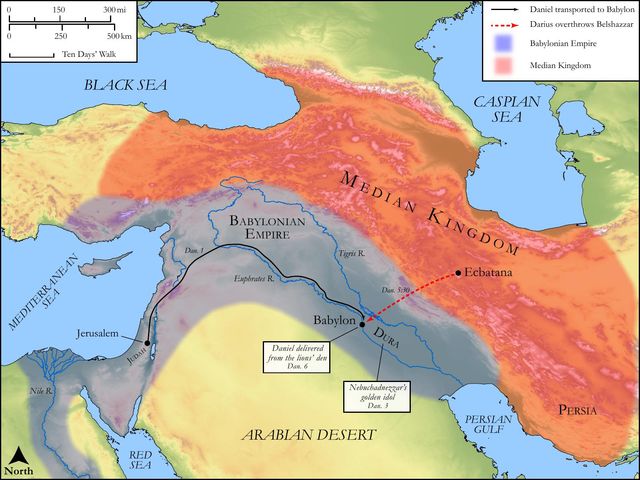
See on the biblical-era map
Study this verse
Public-domain commentary
Matthew Henry
From his Commentary on the Whole Bible. Henry comments on passages, not single verses — this entry covers Daniel 4:28–33. His three-level outline is real structure in the source text, so it is rendered as structure.
We have here Nebuchadnezzar's dream accomplished, and Daniel's application of it to him justified and confirmed. How he took it we are not told, whether he was pleased with Daniel or displeased; but here we have,
I.God's patience with him:
All this came upon him, but not till twelve months after (Dan 4:29), so long there was a lengthening of his tranquility, though it does not appear that he broke off his sins, or showed any mercy to the poor captives, for this was still God's quarrel with him, that he opened not the house of his prisoners, Isa 14:17. Daniel having counselled him to repent, God so far confirmed his word that he gave him space to repent; he let him alone this year also, this one year more, before he brought this judgment upon him. Note, God is long-suffering with provoking sinners, because he is not willing that any should perish, but that all should come to repentance, Pe2 3:9.
II.His pride, and haughtiness, and abuse of that patience.
He walked in the palace of the kingdom of Babylon, in pomp and pride, pleasing himself with the view of that vast city, which, with all the territories thereunto belonging, was under his command, and he said, either to himself or to those about him, perhaps some foreigners to whom he was showing his kingdom and the glory of it, Is not this great Babylon? Yes, it is great, of vast extent, no less that forty-five miles compass within the walls. It is full of inhabitants, and they are full of wealth. It is a golden city, and that is enough to proclaim it great, Isa 14:4. See the grandeur of the houses, walls, towers, and public edifices. Every thing in Babylon he thinks looks great; "and this great Babylon I have built." Babylon was built many ages before he was born, but because he fortified and beautified it, and we may suppose much of it was rebuilt during his long and prosperous reign, he boasts that he has built it, as Augustus Caesar boasted concerning Rome, Lateritiam inveni, marmoream reliqui - I found it brick, but I left it marble. He boasts that he built it for the house of the kingdom, that is, the metropolis of his empire. This vast city, compared with the countries that belonged to his dominions, was but as one house. He built it with the assistance of his subjects, yet boasts that he did it by the might of his power; he built it for his security and convenience, yet, as if he had no occasion for it, boasts that he built it purely for the honour of his majesty. Note, Pride and self-conceitedness are sins that most easily beset great men, who have great things in the world. They are apt to take the glory to themselves which is due to God only.
III.His punishment for his pride.
When he was thus strutting, and vaunting himself, and adoring his own shadow, while the proud word was in the king's mouth the powerful word came from heaven, by which he was immediately deprived,
1.Of his honour as a king: The kingdom has departed from thee. When he thought he had erected impregnable bulwarks for the preserving of his kingdom, now, in an instant, it has departed from him; when he thought it so well guarded that none could take it from him, behold, it departs of itself. As soon as he becomes utterly incapable to manage it, it is of course taken out of his hands.
2.He is deprived of his honour as a man. He loses his reason, and by that means loses his dominion: They shall drive thee from men, Dan 4:32. And it was fulfilled (Dan 4:33): he was driven from men the same hour. On a sudden he fell stark mad, distracted in the highest degree that ever any man was. His understanding and memory were gone, and all the faculties of a rational soul broken, so that he became a perfect brute in the shape of a man. He went naked, and on all four, like a brute, did himself shun the society of reasonable creatures and run wild into the fields and woods, and was driven out by his own servants, who, after some time of trial, despairing of his return to his right mind, abandoned him, and looked after him no more. He had not the spirit of a beast of prey (that of the royal lion), but of the abject and less honourable species, for he was made to eat grass as oxen; and, probably, he did not speak with human voice, but lowed like an ox. Some think that his body was all covered with hair; however, the hair of his head and beard, being never cut nor combed, grew like eagles feathers, and his nails like birds' claws. Let us pause a little, and view this miserable spectacle; and let us receive instruction from it.
(1.)Let us see here what a mercy it is to have the use of our reason, how thankful we ought to be for it, and how careful we ought to be not to do any thing which may either provoke God or may have a natural tendency to put us out of the possession of our own souls. Let us learn how to value our own reason, and to pity the case of those that are under the prevailing power of melancholy or distraction, or are delirious, and to be very tender in our censures of them and conduct towards them, for it is a trial common to men, and a case which, some time or other, may be our own.
(2.)Let us see here the vanity of human glory and greatness. Is this Nebuchadnezzar the Great? What this despicable animal that is meaner than the poorest beggar? Is this he that looked so glorious on the throne, so formidable in the camp, that had politics enough to subdue and govern kingdoms, and now has not so much sense as to keep his own clothes on his back? Is this the man that made the earth to tremble, that did shake kingdoms? Isa 14:16. Never let the wise man then glory in his wisdom, nor the mighty man in his strength.
(3.)Let us see here how God resists the proud, and delights to abase them and put contempt upon them. Nebuchadnezzar would be more than a man, and therefore God justly makes him less than a man, and puts him upon a level with the beasts who set up for a rival with his Maker. See Job 40:11-13.
Historical interpretation
Historical reception
1 surviving comment on this verse from the historical church.
Verses 31, 32. "While the saying was yet in the king's mouth, a voice from heaven assailed him: 'King Nebuchadnezzar, to thee it is spoken, thy kingdom shall pass away (variant reading: is passing away) from thee and they shall cast thee forth from among mankind.'" His arrogant boasting is immediately punished by the Lord. For this reason the execution of the sentence is not delayed, lest mercy towards the poor seem to have profited him not at all. But as soon as he has spoken in pride, he straightway loses the kingdom which had been reserved for him on account of his works of charity.
"...until thou dost recognize that the Most High reigns in the kingdom of men." In misery it comes as a great consolation to know, when one is in a painful situation, that a more favorable future will ensue. Yet Nebuchadnezzar's fury and madness were so pronounced that in time of affliction he would not have remembered the blessings which God had promised him.
Continue studying Daniel 4:32 across the web’s major study libraries — every link below opens this exact verse, chapter, or book on the destination site.
Read & Compare
 BibleGatewayThis verse in more than 200 translations and 70 languages.
 Bible.comThe YouVersion reader — hundreds of translations, reading plans, and highlights.
 ESV.orgCrossway's official English Standard Version reader.
 NET BibleThe NET translation with 60,000+ translators' notes on every rendering decision.
 STEP BibleTyndale House's free study tool — original text, vocabulary, and scholarly resources.
 BibliaLogos Bible Software's free web reader.
 USCCBThe New American Bible (Revised Edition) with the U.S. bishops' study notes.
Commentaries
 BibleHub CommentariesDozens of classic commentaries on this verse, gathered on one page.
 StudyLightMore than 100 commentary sets — the largest collection on the web.
 BibleRefPlain-English commentary on what this verse means, verse by verse.
 Enduring WordDavid Guzik's free commentary on this chapter, widely used by Bible teachers.
 Bible Study ToolsVerse commentary alongside Greek and Hebrew study aids.
Original Language & Research
- BibleHub InterlinearThe verse word by word — original language, transliteration, and English.
- BibleHub LexiconEvery word's original-language definition and Strong's entry.
 Blue Letter BibleDeep-study tools — Strong's numbers, concordance, and word studies.
 SefariaThe Hebrew text with Rashi and centuries of Jewish commentary.
Sermons, Hymns & Audio


TrulyRandomVerse is not affiliated with these sites and doesn’t control their content. They’re linked because they’re genuinely useful.
Summary
Daniel 4:32 encapsulates the severe divine judgment pronounced upon King Nebuchadnezzar, detailing the precise nature and duration of his humbling. This verse describes the king's expulsion from human society, his forced dwelling among wild animals, and his sustenance on grass like an ox, a condition prophesied to last for "seven times." The ultimate purpose of this extraordinary ordeal is explicitly stated: to compel Nebuchadnezzar to acknowledge the supreme sovereignty of the Most High God, who alone holds ultimate authority over all earthly kingdoms and bestows power according to His sovereign will. It stands as a powerful testament to God's absolute rule over human affairs and His ability to humble the proud.
Context
ShowHideLiterary Context
Daniel 4:32 is a direct fulfillment of the dream interpretation given by the prophet Daniel to King Nebuchadnezzar, as recorded earlier in Daniel chapter 4. The chapter opens with Nebuchadnezzar's own testimony, recounting a disturbing dream of a great tree that was cut down, leaving only a stump. Daniel's interpretation, found in Daniel 4:20-26, revealed that the tree represented the king himself, and its felling signified his impending fall from power and sanity. Specifically, Daniel 4:25 foretold his expulsion from human society and his living like a beast. Daniel 4:32 serves as the king's retrospective confirmation that this prophecy indeed came to pass exactly as foretold, underscoring the reliability of God's word and the certainty of His judgments. The verses immediately following Daniel 4:33 describe the immediate onset of the madness, leading to the king's eventual restoration and profound praise of God in Daniel 4:34-37.
Historical & Cultural Context
King Nebuchadnezzar II was the most powerful monarch of the Neo-Babylonian Empire (605-562 BC), renowned for his military conquests, including the destruction of Jerusalem and the exile of the Judeans, and for his magnificent building projects in Babylon. His reign marked the zenith of Babylonian power and grandeur. In this cultural milieu, kings were often seen as divine or divinely appointed, holding absolute authority. Nebuchadnezzar's pride, as evidenced in Daniel 4:30, was not unusual for a monarch of his stature. However, the narrative of Daniel 4 challenges this human-centric view of power, asserting a higher, divine sovereignty. The concept of a king being reduced to the level of an animal would have been utterly shocking and humiliating in a society that highly valued royal dignity and human superiority over the animal kingdom. This public display of divine judgment served as a powerful lesson not only for Nebuchadnezzar but also for his vast empire, demonstrating that even the mightiest human ruler is subject to the will of the God of heaven.
Key Themes
ShowHideThis verse is central to several profound themes woven throughout the book of Daniel. First and foremost is the theme of Divine Sovereignty, asserting that God is the ultimate ruler over all earthly kingdoms and rulers, as explicitly stated: "the most High ruleth in the kingdom of men, and giveth it to whomsoever he will." This challenges the prevailing humanistic view of power and authority. Secondly, it highlights the destructive nature of Pride and the Necessity of Humility. Nebuchadnezzar's downfall is a direct consequence of his arrogance, illustrating the biblical principle that "pride goeth before destruction, and a haughty spirit before a fall." God actively humbles the proud to bring them to a place of recognition and submission. Lastly, the passage underscores God's Redemptive Purpose in Judgment. The "seven times" indicates a set, temporary duration for the judgment, not a permanent condemnation. This period of suffering was designed to bring the king to a saving knowledge of God's authority, ultimately leading to his restoration and profound praise of God, as seen in Daniel 4:34-37, demonstrating God's desire for all people, even powerful rulers, to acknowledge His lordship.
Exposition and Analysis
ShowHideKey Word Analysis
ShowHideThis word (H2957) means "to expel" or "to drive." In the context of Daniel 4:32, it signifies a forceful, involuntary expulsion of King Nebuchadnezzar from his palace and from human civilization. It conveys the complete removal of his royal status and social standing, emphasizing the severity and divine compulsion of his judgment.
This term (H4070) refers to "a dwelling" or habitation. Its use here highlights the stark contrast between Nebuchadnezzar's former opulent palace and his new, animalistic abode. His "dwelling with the beasts of the field" underscores the profound degradation and dehumanization he experienced as part of God's humbling process.
This (H5943) is a title for God, meaning "supreme" or "highest." It emphasizes God's elevated and ultimate position above all creation, including human rulers and kingdoms. The entire purpose of Nebuchadnezzar's ordeal was for him to "know that the most High ruleth," signifying the recognition of God's absolute and unparalleled sovereignty.
Verse Breakdown
ShowHide"And they shall drive thee from men,"
This clause describes the initial phase of Nebuchadnezzar's judgment: his forced removal from human society. "They" refers to the agents of divine judgment, whether angelic or through the natural course of his madness, indicating a complete separation from his former life and human interaction.
"and thy dwelling [shall be] with the beasts of the field:"
This specifies the nature of his new existence. His habitation would be among wild animals, signifying a regression to a primitive, uncivilized state, stripped of all human dignity and comfort.
"they shall make thee to eat grass as oxen,"
This details the extreme humiliation and physical transformation. Nebuchadnezzar, a king accustomed to lavish banquets, would be reduced to grazing like cattle, a clear sign of his loss of reason and human faculties, emphasizing the depth of his degradation.
"and seven times shall pass over thee,"
This sets the divinely appointed duration of his affliction. "Seven times" (Aramaic, shiv'ah 'iddanin') is generally understood to mean seven years, a fixed period determined by God for the king's humbling and transformation.
"until thou know that the most High ruleth in the kingdom of men,"
This is the core purpose of the judgment. The suffering is not arbitrary but redemptive, designed to bring Nebuchadnezzar to a profound, experiential knowledge and acknowledgment of God's supreme authority over all human governments and affairs.
"and giveth it to whomsoever he will."
This final clause reinforces God's absolute sovereignty, emphasizing His prerogative to appoint and depose rulers as He sees fit, independent of human will or merit. It underlines the ultimate source of all power and authority.
Literary Devices
ShowHideDaniel 4:32 is rich in Symbolism and Irony. The king's transformation into a beast-like existence, eating grass and dwelling in the field, is highly symbolic of his loss of human reason, dignity, and divine favor due to his pride. His regal status is stripped away, reducing him to the level of the very creatures he once ruled over. The Irony is profound: a king who boasted of his own power and achievements (Daniel 4:30) is utterly humbled by the very God he ignored, becoming less than human in his outward condition. The phrase "seven times shall pass over thee" functions as a form of Prophetic Time Marker, indicating a specific, divinely ordained period for the fulfillment of the judgment. The entire narrative also serves as a powerful Didactic Narrative, teaching a timeless lesson about divine sovereignty and the perils of human pride.
Theological and Thematic Connections
ShowHideDaniel 4:32 stands as a monumental declaration of God's absolute sovereignty over all earthly powers. It unequivocally asserts that human authority, no matter how vast or impressive, is ultimately derivative and subservient to the will of the Most High. Nebuchadnezzar's dramatic fall from the pinnacle of human power to the depths of animalistic existence serves as a stark object lesson that God is not merely a distant observer but an active, intervening ruler in the affairs of humanity. His judgment is purposeful, designed not merely to punish but to bring about a profound recognition of His ultimate dominion, demonstrating His patience and desire for even the most arrogant to acknowledge His rightful place. This truth resonates throughout Scripture, affirming God's control over all aspects of creation and history.
Reflection and Application
ShowHideDaniel 4:32 offers a timeless and sobering reflection on the nature of power, pride, and divine authority. For individuals, it serves as a potent reminder that true humility is not weakness but an acknowledgment of our creaturely status and God's supreme lordship. Any achievements, talents, or positions we hold are gifts from Him, and to boast in them as if they are solely our own is to invite divine correction. For leaders, especially those in positions of significant influence, this verse is a profound warning against hubris and self-exaltation. It calls for a recognition that all authority is delegated and that accountability ultimately rests with God. In a world where human leaders often forget their limitations, Daniel 4:32 powerfully asserts that God "removeth kings, and setteth up kings" (Daniel 2:21). This should inspire both awe and trust in God's sovereign control over global events, even amidst political turmoil or seemingly insurmountable challenges. Our ultimate hope and allegiance must rest in the Most High, who rules in the kingdom of men.
Questions for Reflection
ShowHideFAQ
ShowHideWhat does "seven times shall pass over thee" mean in Daniel 4:32?
ShowHideThe phrase "seven times" (Aramaic: shiv'ah 'iddanin) is widely understood by biblical scholars to mean seven years. The Aramaic word for "times" ('iddan) can refer to a specific period or a year, and in the context of a prolonged period of living like a beast, seven years makes the most contextual sense. This duration signifies a divinely appointed period for Nebuchadnezzar's humbling and eventual restoration, emphasizing that God's judgment is not arbitrary but has a set purpose and a defined end.
Was Nebuchadnezzar's madness a literal event or a symbolic one?
ShowHideThe text of Daniel 4 presents Nebuchadnezzar's madness as a literal, historical event. The detailed description of his behavior—being driven from men, dwelling with beasts, eating grass, and his hair growing like eagles' feathers and nails like birds' claws (Daniel 4:33)—points to a severe mental illness, possibly a form of clinical lycanthropy or boanthropy, where a person believes they are an animal. The narrative's emphasis on his eventual restoration and his subsequent praise of God further supports the literal interpretation of his affliction and recovery.
Christ-Centered Fulfillment
ShowHideWhile Daniel 4:32 directly concerns the judgment and humbling of a pagan king, its profound theological truths find ultimate fulfillment and illumination in the person and work of Jesus Christ. Nebuchadnezzar's forced recognition that "the most High ruleth in the kingdom of men, and giveth it to whomsoever he will" foreshadows the ultimate reign of God through His Son. Unlike Nebuchadnezzar, who was humbled by force due to his pride, Jesus, though "being in the form of God, thought it not robbery to be equal with God," yet "made himself of no reputation, and took upon him the form of a servant, and was made in the likeness of men." His voluntary humiliation, culminating in His death on the cross, was not a judgment but a redemptive act, demonstrating the ultimate humility and obedience to the Father's will (Philippians 2:8). Because of this unparalleled humility and obedience, God has "highly exalted him, and given him a name which is above every name," ensuring that "at the name of Jesus every knee should bow, of things in heaven, and things in earth, and things under the earth" (Philippians 2:10). Thus, the sovereignty declared in Daniel 4:32 is ultimately realized in Christ, who is now "King of kings, and Lord of lords," to whom all authority in heaven and on earth has been given (Matthew 28:18). Nebuchadnezzar's humbling pointed to the truth that all human power is temporary; Christ's reign is eternal and absolute.