


Genesis 14:23
Bible text: King James Version (1769 Blayney text) · Public domain
Bible text: King James Version with Strong's numbers · Public domain
Bible text: Berean Standard Bible · Public domain
Bible text: American Standard Version (1901) · Public domain
Bible text: World English Bible, Messianic edition · Public domain
Bible text: Geneva Bible (1599) · Public domain
Bible text: Young's Literal Translation · Public domain
- אִם'imifH518PrtParticle Conditional
- מִחוּטmi·Chutfrom a threadH2339Prep-m ¦ N-msNoun Singular Masculine Absoluteמִfromחוּטa thread
- וְעַדve·'Adand untoH5704Conj-w ¦ PrepPrepositionוְandעַדunto
- שְׂרוֹךְse·rokha thong ofH8288N-mscNoun Singular Masculine Construct
- נַעַלNa·'ala sandalH5275N-fsNoun Singular Feminine Absolute
- וְאִםve·'imand ifH518Conj-w ¦ PrtParticle Conditionalוְandאִםif
- אֶקַּח'e·KachI will takeH3947V-Qal-Imperf-1csVerb Qal Imperfect 1st Singular common gender
- מִכָּלmi·kolany of allH3605Prep-m ¦ N-msNoun Singular Masculine Absoluteמִany ofכָּלall
- אֲשֶׁר'a·SherthatH834RelParticle Relative
- לָךְLakh[belongs] to <the> youPrep-l ¦ 2msSuffix Personal 2nd Singular Masculineלָ[belongs] to <the>ךְyou
- וְלֹאve·Lo'and notH3808Conj-w ¦ NegParticle Negativeוְandלֹאnot
- תֹאמַרto·Maryou will sayH559V-Qal-Imperf-2msVerb Qal Imperfect 2nd Singular Masculine
- אֲנִי'a·NiIH589Pro-1csPronoun Personal 1st Singular common gender
- הֶעֱשַׁרְתִּיhe·'e·Shar·tiI made richH6238V-Hiphil-Perf-1csVerb Hiphil Perfect 1st Singular common gender
- אֶת'et<obj.>H853DirObjMParticle Object Indicator
- אַבְרָם'av·RamAbramH87N-proper-mNoun Proper Masculine
English is a literal word-by-word gloss of the Hebrew, not the KJV's wording. Why?
This is the original text the KJV's translators worked from — each Hebrew word with its own literal English meaning in this verse, prepared by scholars at Tyndale House, Cambridge. The KJV translates whole sentences, not word by word, so its wording differs: one Hebrew word can become several English words, and the KJV may choose “the LORD” where the gloss reads “Yahweh”. Both are faithful — they answer different questions. For the KJV's own rendering, switch to the KJV text.
Details
See on the biblical-era maps


Study this verse
Public-domain commentary
Matthew Henry
From his Commentary on the Whole Bible. Henry comments on passages, not single verses — this entry covers Genesis 14:21–24. His four-level outline is real structure in the source text, so it is rendered as structure.
We have here an account of what passed between Abram and the king of Sodom, who succeeded him that fell in the battle (Gen 14:10), and thought himself obliged to do this honour to Abram, in return for the good services he had done him. Here is,
I.The king of Sodom's grateful offer to Abram (Gen 14:21):
Give me the soul, and take thou the substance; so the Hebrew reads it. Here he fairly begs the persons, but as freely bestows the goods on Abram. Note,
1.Where a right is dubious and divided, it is wisdom to compound the matter by mutual concessions rather than to contend. The king of Sodom had an original right both to the persons and to the goods, and it would bear a debate whether Abram's acquired right by rescue would supersede his title and extinguish it; but, to prevent all quarrels, the king of Sodom makes this fair proposal.
2.Gratitude teaches us to recompense to the utmost of our power those that have undergone fatigues, run hazards, and been at expense for our service and benefit. Who goes a warfare at his own charges? Co1 9:7. Soldiers purchase their pay dearer than any labourers, and are well worthy of it, because they expose their lives.
II.Abram's generous refusal of this offer.
He not only resigned the persons to him, who, being delivered out of the hand of their enemies, ought to have served Abram, but he restored all the goods too. He would not take from a thread to a shoe-latchet, not the least thing that had ever belonged to the king of Sodom or any of his. Note, A lively faith enables a man to look upon the wealth of this world with a holy contempt, Jo1 5:4. What are all the ornaments and delights of sense to one that has God and heaven ever in his eye? He resolves even to a thread and a shoe-latchet; for a tender conscience fears offending in a small matter. Now,
1.Abram ratifies this resolution with a solemn oath: I have lifted up my hand to the Lord that I will not take any thing, Gen 14:22. Here observe,
(1.)The titles he gives to God, The most high God, the possessor of heaven and earth, the same that Melchizedek had just now used, Gen 14:19. Note, It is good to learn of others how to order our speech concerning God, and to imitate those who speak well in divine things. This improvement we are to make of the conversation of devout good men, we must learn to speak after them.
(2.)The ceremony used in this oath: I have lifted up my hand. In religious swearing we appeal to God's knowledge of our truth and sincerity and imprecate his wrath if we swear falsely, and the lifting up of the hand is very significant and expressive of both.
(3.)The matter of the oath, namely, that he would not take any reward from the king of Sodom, was lawful, but what he was not antecedently obliged to.
[1.]Probably Abram vowed, before he went to the battle, that, if God would give him success, he would, for the glory of God and the credit of his profession, so far deny himself and his own right as to take nothing of the spoils to himself. Note, the vows we have made when we are in pursuit of a mercy must be carefully and conscientiously kept when we have obtained the mercy, though they were made against our interest. A citizen of Zion, if he has sworn, whether it be to God or man, though it prove to his own hurt, yet he changeth not, Psa 15:4. Or,
[2.]Perhaps Abram, now when he saw cause to refuse the offer made him, at the same time confirmed his refusal with this oath, to prevent further importunity. Note, First, There may be good reason sometimes why we should debar ourselves of that which is our undoubted right, as St. Paul, Co1 8:13; Co1 9:12. Secondly, That strong resolutions are of good use to put by the force of temptations.
2.He backs his refusal with a good reason: Lest thou shouldest say, I have made Abram rich, which would reflect reproach,
(1.)Upon the promise and covenant of God, as if they would not have enriched Abram without the spoils of Sodom. And,
(2.)Upon the piety and charity of Abram, as if all he had in his eye, when he undertook that hazardous expedition, was to enrich himself. Note,
[1.]We must be very careful that we give no occasion to others to say things which they ought not.
[2.]The people of God must, for their credit's sake, take heed of doing any thing that looks mean or mercenary, or that savours of covetousness and self-seeking. Probably Abram knew the king of Sodom to be a proud and scornful man, and one that would be apt to turn such a thing as this to his reproach afterwards, though most unreasonably. When we have to do with such men, we have need to act with particular caution.
3.He limits his refusal with a double proviso, Gen 14:24. In making vows, we ought carefully to insert the necessary exceptions, that we may not afterwards say before the angel, It was an error, Ecc 5:6. Abram here excepts,
(1.)The food of his soldiers; they were worthy of their meat while they trod out the corn. This would give no colour to the king of Sodom to say that he had enriched Abram.
(2.)The shares of his allies and confederates: Let them take their portion. Note, Those who are strict in restraining their own liberty yet ought not to impose those restraints upon the liberties of others, nor to judge of them accordingly. We must not make ourselves the standard to measure others by. A good man will deny himself that liberty which he will not deny another, contrary to the practice of the Pharisees, Mat 23:4. There was not the same reason why Aner, Eshcol, and Mamre, should quit their right, that there was why Abram should. They did not make the profession that he made, nor were they, as he was, under the obligation of a vow. They had not the hopes that Abram had of a portion in the other world, and therefore, by all means, let them take their portion of this.
Historical interpretation
Three Centuries of Reception
4 surviving comments on this verse. Each one is dated, so this reads as a timeline rather than a list.
Select a marker to jump to its quote. Markers stagger vertically where authors wrote within a few decades of each other.
It is characteristic of the perfect mind not to take for itself any earthly thing, anything prone to bodily seduction. This is why Abraham says, “I will take nothing of what is yours.” He avoids intemperance like the plague. He flees from sensual bodily temptations as from filth. He rejects worldly pleasures to seek those that are above the world. This is what it means to raise one’s hands to the Lord. The hand that does good is the virtue of the soul. He puts forth his hand not to the fruit of the earthly tree but to the Lord, “who,” Scripture says, “made heaven and earth,” that is to say, both intelligible and visible substance. In fact, the invisible ousia, or substance, is heaven, while the earth is the visible and sensible substance. The passage then means that Abraham raises the virtue of his mind to heavenly things. From that intelligible substance he might reach the heights of the contemplative life, looking not to the things that are seen but to those that are not seen; not to earthly things, not to bodily things; not to things present but to things that are immaterial, eternal, heavenly. But from that other substance, the visible, he extracts the benefit of a discipline related to the practical order and to civil life.
He would not take even a chance item, even something worthless or anything thought beneath contempt, even the shoelace at the tip of the shoe, where it comes to a point. Then he states the reason for his refusal. It is “in case you were to say, ‘I gave Abram his wealth.’ I have on my side the supplier of countless goods; I enjoy much favor from on high. I have no need of wealth from you. I don’t want human resources. I am content with the regard God pays me. I know the generosity of his gifts toward me. Having yielded to Lot worthless scraps, I have been granted great promises beyond telling. Now by not accepting wealth from you I earn for myself greater wealth and enjoy further grace from him.” This in my opinion … was the reason why he took the oath in the words “I will raise my hand to swear before God the most high”; namely, that the king should not think that he was simply putting up a pretense about what was likely to happen but should rather be quite clear about his not taking the least trinket from him. He was honoring that command given by Christ to the disciples: “Freely you have received, freely give.” In other words, he is saying, Surely I have contributed nothing to the course of the war other than consent and encouragement, whereas the victory and the spoils and everything else has been God’s work in his invisible might.
The patriarch’s contempt for material wealth was intense. Why is it with an oath that he rejects the offer in the words “I will raise my hand to swear before God the most high, who created heaven and earth”? He wants to give the king of Sodom two lessons. First, he is above the gifts offered by him; and this gives evidence of great wisdom. He is ready to prove an instructor for him in reverence, as if to teach him in so many words: I am calling to witness the Creator of all that I will take nothing of yours, so that you may come to know the God over all and not regard as gods the things shaped by human hands. This One in fact is the maker of heaven and earth, who indeed determined the course of this war and was the cause of victory. So don’t expect me to be ready to take anything you’ve offered me. It was not, you see, for a reward that I wreaked vengeance. Instead, in the first instance it was out of love for my nephew, and then from the very nature of a good man that I should wrest from the clutches of barbarians people wrongfully abducted.
But the king of Sodom said to Abram, "Give me the persons, and take the goods for yourself." But he replied to him, "I raise my hand to the Lord, God most high, possessor of heaven and earth, that I will not take a thread or a sandal strap or anything that is yours, lest you should say, 'I have made Abram rich.’" It should be noted carefully and drawn as an example of moral life, that Abraham, who, truly compassionate towards his neighbors in need, had exposed himself to danger to free Lot, and as a devout man to God gave tithes to the priest by whom he was blessed; he, as a despiser of money, refused to accept anything from the spoils he had taken, even when offered by the king he had defeated. As a lover of justice, he did not neglect to distribute their share to the soldiers who had fought with him. Rightly, such a conscience, in order to reach the peak of virtues more swiftly, is always elevated by new benefits of divine grace. Hence, after these things had rightfully passed, he immediately became a recipient of the gift of a heavenly oracle and divine blessing, which should be better considered and examined by the reading of the following book.
Continue studying Genesis 14:23 across the web’s major study libraries — every link below opens this exact verse, chapter, or book on the destination site.
Read & Compare
 BibleGatewayThis verse in more than 200 translations and 70 languages.
 Bible.comThe YouVersion reader — hundreds of translations, reading plans, and highlights.
 ESV.orgCrossway's official English Standard Version reader.
 NET BibleThe NET translation with 60,000+ translators' notes on every rendering decision.
 STEP BibleTyndale House's free study tool — original text, vocabulary, and scholarly resources.
 BibliaLogos Bible Software's free web reader.
 USCCBThe New American Bible (Revised Edition) with the U.S. bishops' study notes.
Commentaries
 BibleHub CommentariesDozens of classic commentaries on this verse, gathered on one page.
 StudyLightMore than 100 commentary sets — the largest collection on the web.
 BibleRefPlain-English commentary on what this verse means, verse by verse.
 Enduring WordDavid Guzik's free commentary on this chapter, widely used by Bible teachers.
 Bible Study ToolsVerse commentary alongside Greek and Hebrew study aids.
Original Language & Research
- BibleHub InterlinearThe verse word by word — original language, transliteration, and English.
- BibleHub LexiconEvery word's original-language definition and Strong's entry.
 Blue Letter BibleDeep-study tools — Strong's numbers, concordance, and word studies.
 SefariaThe Hebrew text with Rashi and centuries of Jewish commentary.
Sermons, Hymns & Audio


TrulyRandomVerse is not affiliated with these sites and doesn’t control their content. They’re linked because they’re genuinely useful.
Summary
Abram's resolute declaration in Genesis 14:23 details his refusal to accept any material gain from the King of Sodom, stating he would not take even the most insignificant item, "from a thread even to a shoelatchet." This decisive act profoundly underscores his unwavering reliance on God as his exclusive provider and his commitment to ensure that divine blessing, not worldly influence, receives credit for his prosperity, thereby preventing the King of Sodom from falsely claiming, "I have made Abram rich."
Context
ShowHideLiterary Context
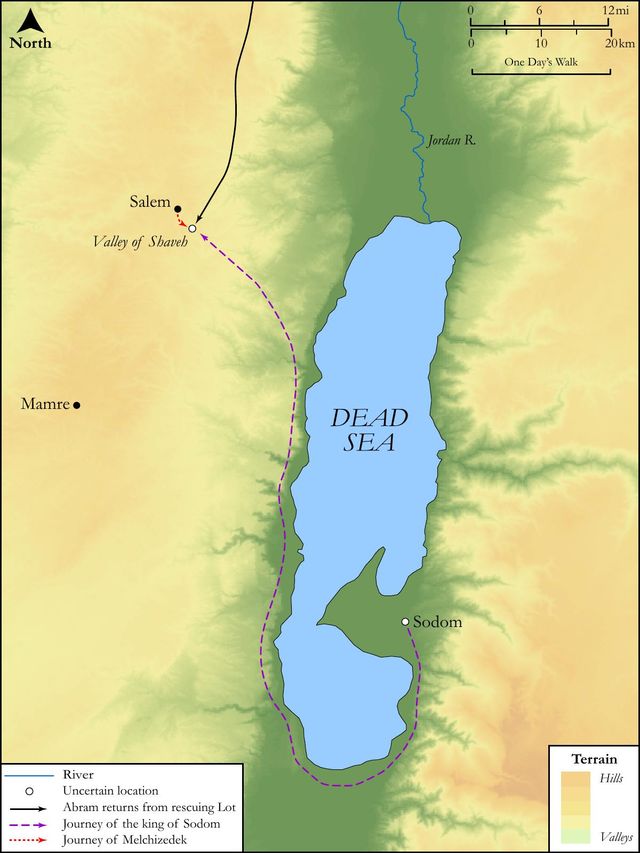
This verse concludes the dramatic narrative of Genesis chapter 14, which describes a major regional conflict. A coalition of four eastern kings, led by Chedorlaomer, defeats the kings of Sodom and Gomorrah, plundering their cities and taking captives, including Abram's nephew, Lot. Upon hearing of Lot's capture, Abram, with a small but determined force of 318 trained men from his household, pursues the victorious kings, defeats them, and recovers all the spoils and captives. Abram's refusal of the spoils from the King of Sodom immediately follows his encounter with Melchizedek, the King of Salem and priest of God Most High, to whom Abram gave a tenth of everything. This sequence highlights Abram's spiritual priorities and his commitment to God's glory over personal enrichment.
Historical & Cultural Context
Among the kings of that day, it was customary for the victor in battle to claim all the spoils of war. The King of Sodom's offer to Abram—to "give me the persons, and take the goods to thyself" (Genesis 14:21)—was a standard practice, acknowledging Abram's right as the liberator. However, Sodom was known for its wickedness (Genesis 13:13), representing a corrupt and ungodly society. Abram's refusal, therefore, was not merely a rejection of material wealth but a profound statement of spiritual separation and integrity. He was operating within a cultural framework where such an offer was expected, yet he subverted that expectation based on a higher principle: his covenant relationship with God.
Key Themes
ShowHideGenesis 14:23 powerfully contributes to several overarching themes in the book of Genesis and the broader biblical narrative. It underscores the theme of Divine Provision, emphasizing that God alone is the source of true blessing and prosperity, as seen in God's later declaration to Abram in Genesis 15:1. It also highlights the theme of Integrity and Separation, portraying Abram as a man set apart from the corrupting influences of the world, prioritizing his testimony and God's glory above all else. This act reinforces the concept of Soli Deo Gloria (Glory to God Alone), a foundational principle that all credit and honor for success and blessing belong to the Almighty.
Exposition and Analysis
ShowHideKey Word Analysis
ShowHideThis primitive root means "to take" in a wide variety of applications, including to accept, bring, buy, receive, or seize. In this context, Abram's repeated use of "I will not take" signifies a deliberate and complete refusal to accept any form of material compensation or benefit from the King of Sodom, emphasizing his active rejection of the offer.
Derived from a root meaning "to sew," this word refers to a string, cord, or thread. As the smallest and most insignificant item imaginable in ancient commerce or daily life, its inclusion here, alongside "shoelatchet," forms an idiom signifying the absolute minimum, emphasizing the totality of Abram's refusal.
This term refers to a thong or strap used for lacing or tying a sandal. Like a thread, a shoelatchet represents an item of negligible value. Its pairing with "thread" creates a merism, an idiomatic expression that encompasses the entirety of something by naming its extreme parts, reinforcing that Abram would take nothing whatsoever.
Verse Breakdown
ShowHide"That I will not take from a thread even to a shoelatchet"
This opening clause immediately establishes the absolute and comprehensive nature of Abram's refusal. The phrase "from a thread even to a shoelatchet" is a common Hebrew idiom, a merism, signifying "not even the smallest thing" or "absolutely nothing at all." It underscores the completeness of Abram's detachment from the spoils of war and, more significantly, from any perceived indebtedness to the King of Sodom. His integrity is so profound that he will not accept even the most trivial item.
"and that I will not take any thing that is thine"
This reiterates and broadens the previous statement, making it explicit that Abram's refusal applies to anything belonging to the King of Sodom. It moves from the specific idiom to a general principle, leaving no room for ambiguity. This comprehensive rejection highlights Abram's commitment to maintaining a clear distinction between himself, as a servant of the Most High God, and the corrupt kingdom of Sodom.
"lest thou shouldest say, I have made Abram rich"
This final clause reveals the profound theological motivation behind Abram's actions. His primary concern is to prevent the King of Sodom from taking credit for his prosperity. Abram understands that allowing such a claim would diminish God's glory and potentially compromise his testimony. He desires that all credit for his wealth and success be attributed solely to God, his true Provider, thereby safeguarding the integrity of his faith and the honor of God's name.
Literary Devices
ShowHideThe verse employs a significant Idiom in the phrase "from a thread even to a shoelatchet." This is a classic example of Merism, a rhetorical device where two contrasting or extreme parts are mentioned to represent the whole. By specifying the smallest and seemingly most insignificant items, Abram conveys that he will accept absolutely nothing. This literary choice powerfully emphasizes the totality of his refusal and his unwavering commitment to his principles. Furthermore, the explicit statement of motivation, "lest thou shouldest say, I have made Abram rich," functions as a form of Anticipation, revealing Abram's foresight and his proactive stance against any potential misattribution of divine blessing.
Theological and Thematic Connections
ShowHideAbram's resolute refusal of the King of Sodom's spoils serves as a powerful theological statement on divine provision and the nature of true blessedness. It is a testament to his profound faith that God alone is his source and sustainer, demonstrating a radical trust that transcends immediate material gain. This act establishes a foundational principle for believers: that God's glory must be paramount, and human pride or worldly boasting must be entirely circumvented when it comes to divine blessing. Abram's integrity here prefigures the call to separation and holiness for God's people throughout salvation history, ensuring that their identity and prosperity are unequivocally linked to their covenant relationship with the Almighty, not to worldly systems or corrupt benefactors.
Reflection and Application
ShowHideAbram's principled stand in Genesis 14:23 offers profound and enduring lessons for believers navigating the complexities of modern life. It challenges us to critically examine the sources of our provision and success, asking whether our trust is truly placed in God alone, or if we subtly seek validation or enrichment from worldly systems that might compromise our spiritual integrity. This passage calls us to cultivate a radical dependence on divine provision, recognizing that true blessing comes from God and not from human benefactors or questionable alliances. Moreover, Abram's explicit desire to prevent the King of Sodom from boasting reminds us of the paramount importance of giving God full credit for every achievement and blessing in our lives, actively avoiding situations where our prosperity could be attributed to anything other than His grace. It compels us to maintain a clear distinction between our values and those of the world, ensuring our testimony remains unblemished and our allegiance to Christ is unambiguous, even when faced with opportunities for personal gain.
Questions for Reflection
ShowHideFAQ
ShowHideWhy did Abram refuse the spoils from the King of Sodom?
ShowHideAbram refused the spoils primarily to prevent the King of Sodom from taking credit for his wealth and prosperity. He wanted it to be unequivocally clear that his blessings came from God Most High, not from any worldly ruler or system. His refusal demonstrated his profound trust in God as his sole provider and his commitment to giving God all the glory, as God later affirmed in Genesis 15:1.
What does the phrase "from a thread even to a shoelatchet" signify?
ShowHideThis phrase is a common Hebrew idiom meaning "not even the smallest thing" or "absolutely nothing at all." It emphasizes the completeness and totality of Abram's refusal, indicating his unwavering commitment to take nothing from the King of Sodom, not even the most insignificant item. It's a merism that uses two extremes to represent the entire spectrum of things.
How does Abram's act demonstrate his faith?
ShowHideAbram's refusal demonstrates his faith by showing his complete reliance on God's provision over worldly gain. Despite having just won a battle and being entitled to the spoils by custom, he chose to trust God to fulfill His promise to be his "exceeding great reward" (Genesis 15:1). This act prioritized God's glory and his covenant relationship above immediate material enrichment, proving his deep conviction that God alone was sufficient for his needs.
Christ-Centered Fulfillment
ShowHideAbram's profound integrity and unwavering reliance on God in Genesis 14:23 powerfully prefigure the perfect obedience and complete dependence of Jesus Christ on the Father. While Abram refused worldly riches to ensure God received glory, Christ perfectly embodied this principle, never seeking earthly power, material gain, or human acclaim, but always living to glorify the Father (John 8:50 and John 17:4). He resisted all temptations to compromise His mission for worldly kingdoms or personal comfort, famously rejecting Satan's offer of all the kingdoms of the world in the wilderness (Matthew 4:8-10). Unlike earthly kings who offer fleeting wealth and demand allegiance, Christ offers eternal riches and true, inexhaustible provision, making us spiritually rich through His ultimate sacrifice and resurrection (2 Corinthians 8:9). He is the ultimate fulfillment of divine provision, the true source of all blessing, and the one through whom God's name is eternally glorified, ensuring that all boasting is in the Lord alone (1 Corinthians 1:31).