


Genesis 14:24
Bible text: King James Version (1769 Blayney text) · Public domain
Bible text: King James Version with Strong's numbers · Public domain
Bible text: Berean Standard Bible · Public domain
Bible text: American Standard Version (1901) · Public domain
Bible text: World English Bible, Messianic edition · Public domain
Bible text: Geneva Bible (1599) · Public domain
Bible text: Young's Literal Translation · Public domain
- בִּלְעָדַיbil·'a·Daiapart from meH1107Adj-csc ¦ 1csAdjective Numerical Singular common gender Constructבִּלְעָדַapart fromיme
- רַקrakonlyH7535AdvAdverb
- אֲשֶׁר'a·Sher[that] whichH834RelParticle Relative
- אָכְלוּ'a·khe·Luthey have eatenH398V-Qal-Perf-3cpVerb Qal Perfect 3rd Plural common gender
- הַנְּעָרִיםha·ne·'a·Rimthe young menH5288Art ¦ N-mpNoun Plural Masculine Absoluteהַtheנְּעָרִיםyoung men
- וְחֵלֶקve·Che·lekand [the] share ofH2506Conj-w ¦ N-mscNoun Singular Masculine Constructוְandחֵלֶק[the] share of
- הָאֲנָשִׁיםha·'a·na·Shimthe menH582Art ¦ N-mpNoun Plural Masculine Absoluteהָtheאֲנָשִׁיםmen
- אֲשֶׁר'a·SherwhoH834RelParticle Relative
- הָלְכוּhal·Khu<they> wentH1980V-Qal-Perf-3cpVerb Qal Perfect 3rd Plural common gender
- אִתִּי'i·Tiwith meH854Prep ¦ 1csPreposition Definiteאִתִּwithיme
- עָנֵר'a·NerAnerH6063N-proper-mNoun Proper Masculine
- אֶשְׁכֹּל'esh·KolEshcolH812N-proper-mNoun Proper Masculine
- וּמַמְרֵאu·mam·Re'and MamreH4471Conj-w ¦ N-proper-mNoun Proper MasculineוּandמַמְרֵאMamre
- הֵםhemtheyH1992Pro-3mpPronoun Personal 3rd Plural Masculine
- יִקְחוּyik·Chulet them takeH3947V-Qal-Imperf-3mpVerb Qal Imperfect 3rd Plural Masculine
- חֶלְקָםchel·Kamtheir shareH2506N-msc ¦ 3mpNoun Singular Masculine Constructחֶלְקָshareםtheir
English is a literal word-by-word gloss of the Hebrew, not the KJV's wording. Why?
This is the original text the KJV's translators worked from — each Hebrew word with its own literal English meaning in this verse, prepared by scholars at Tyndale House, Cambridge. The KJV translates whole sentences, not word by word, so its wording differs: one Hebrew word can become several English words, and the KJV may choose “the LORD” where the gloss reads “Yahweh”. Both are faithful — they answer different questions. For the KJV's own rendering, switch to the KJV text.
Details
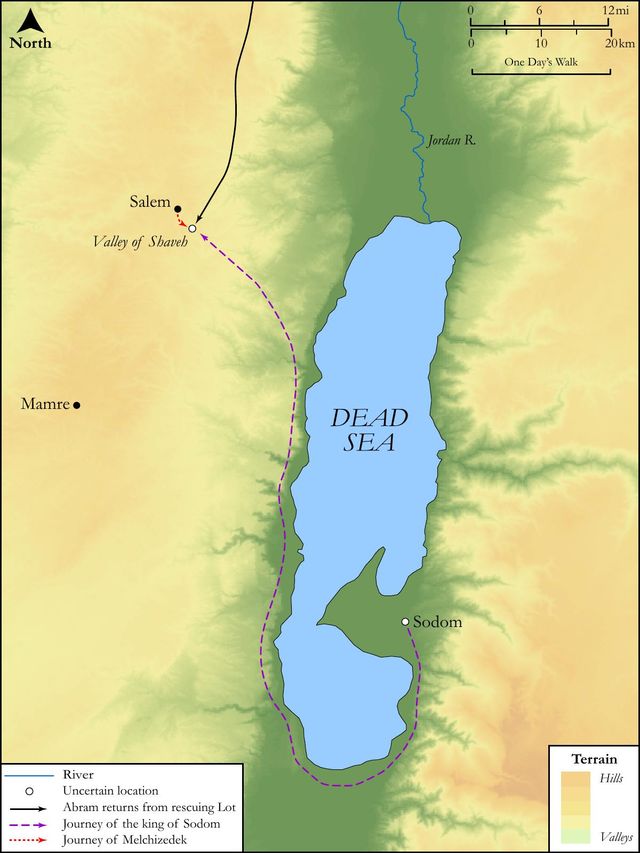
See on the biblical-era maps


Study this verse
Public-domain commentary
Matthew Henry
From his Commentary on the Whole Bible. Henry comments on passages, not single verses — this entry covers Genesis 14:21–24. His four-level outline is real structure in the source text, so it is rendered as structure.
We have here an account of what passed between Abram and the king of Sodom, who succeeded him that fell in the battle (Gen 14:10), and thought himself obliged to do this honour to Abram, in return for the good services he had done him. Here is,
I.The king of Sodom's grateful offer to Abram (Gen 14:21):
Give me the soul, and take thou the substance; so the Hebrew reads it. Here he fairly begs the persons, but as freely bestows the goods on Abram. Note,
1.Where a right is dubious and divided, it is wisdom to compound the matter by mutual concessions rather than to contend. The king of Sodom had an original right both to the persons and to the goods, and it would bear a debate whether Abram's acquired right by rescue would supersede his title and extinguish it; but, to prevent all quarrels, the king of Sodom makes this fair proposal.
2.Gratitude teaches us to recompense to the utmost of our power those that have undergone fatigues, run hazards, and been at expense for our service and benefit. Who goes a warfare at his own charges? Co1 9:7. Soldiers purchase their pay dearer than any labourers, and are well worthy of it, because they expose their lives.
II.Abram's generous refusal of this offer.
He not only resigned the persons to him, who, being delivered out of the hand of their enemies, ought to have served Abram, but he restored all the goods too. He would not take from a thread to a shoe-latchet, not the least thing that had ever belonged to the king of Sodom or any of his. Note, A lively faith enables a man to look upon the wealth of this world with a holy contempt, Jo1 5:4. What are all the ornaments and delights of sense to one that has God and heaven ever in his eye? He resolves even to a thread and a shoe-latchet; for a tender conscience fears offending in a small matter. Now,
1.Abram ratifies this resolution with a solemn oath: I have lifted up my hand to the Lord that I will not take any thing, Gen 14:22. Here observe,
(1.)The titles he gives to God, The most high God, the possessor of heaven and earth, the same that Melchizedek had just now used, Gen 14:19. Note, It is good to learn of others how to order our speech concerning God, and to imitate those who speak well in divine things. This improvement we are to make of the conversation of devout good men, we must learn to speak after them.
(2.)The ceremony used in this oath: I have lifted up my hand. In religious swearing we appeal to God's knowledge of our truth and sincerity and imprecate his wrath if we swear falsely, and the lifting up of the hand is very significant and expressive of both.
(3.)The matter of the oath, namely, that he would not take any reward from the king of Sodom, was lawful, but what he was not antecedently obliged to.
[1.]Probably Abram vowed, before he went to the battle, that, if God would give him success, he would, for the glory of God and the credit of his profession, so far deny himself and his own right as to take nothing of the spoils to himself. Note, the vows we have made when we are in pursuit of a mercy must be carefully and conscientiously kept when we have obtained the mercy, though they were made against our interest. A citizen of Zion, if he has sworn, whether it be to God or man, though it prove to his own hurt, yet he changeth not, Psa 15:4. Or,
[2.]Perhaps Abram, now when he saw cause to refuse the offer made him, at the same time confirmed his refusal with this oath, to prevent further importunity. Note, First, There may be good reason sometimes why we should debar ourselves of that which is our undoubted right, as St. Paul, Co1 8:13; Co1 9:12. Secondly, That strong resolutions are of good use to put by the force of temptations.
2.He backs his refusal with a good reason: Lest thou shouldest say, I have made Abram rich, which would reflect reproach,
(1.)Upon the promise and covenant of God, as if they would not have enriched Abram without the spoils of Sodom. And,
(2.)Upon the piety and charity of Abram, as if all he had in his eye, when he undertook that hazardous expedition, was to enrich himself. Note,
[1.]We must be very careful that we give no occasion to others to say things which they ought not.
[2.]The people of God must, for their credit's sake, take heed of doing any thing that looks mean or mercenary, or that savours of covetousness and self-seeking. Probably Abram knew the king of Sodom to be a proud and scornful man, and one that would be apt to turn such a thing as this to his reproach afterwards, though most unreasonably. When we have to do with such men, we have need to act with particular caution.
3.He limits his refusal with a double proviso, Gen 14:24. In making vows, we ought carefully to insert the necessary exceptions, that we may not afterwards say before the angel, It was an error, Ecc 5:6. Abram here excepts,
(1.)The food of his soldiers; they were worthy of their meat while they trod out the corn. This would give no colour to the king of Sodom to say that he had enriched Abram.
(2.)The shares of his allies and confederates: Let them take their portion. Note, Those who are strict in restraining their own liberty yet ought not to impose those restraints upon the liberties of others, nor to judge of them accordingly. We must not make ourselves the standard to measure others by. A good man will deny himself that liberty which he will not deny another, contrary to the practice of the Pharisees, Mat 23:4. There was not the same reason why Aner, Eshcol, and Mamre, should quit their right, that there was why Abram should. They did not make the profession that he made, nor were they, as he was, under the obligation of a vow. They had not the hopes that Abram had of a portion in the other world, and therefore, by all means, let them take their portion of this.
Historical interpretation
Historical reception
2 surviving comments on this verse. Each one is dated, so this reads as a timeline rather than a list.
Select a marker to jump to its quote. Markers stagger vertically where authors wrote within a few decades of each other.
How remarkable it is, then, that Abraham did not wish to touch any of the spoil gained by his victory or to take even what was offered him? The fact is that to receive recompense diminishes the joy of a victory and blunts the gratuitous character of a favor. For it makes a great difference whether one has fought for money or for fame. In one case, a person will be regarded as a mercenary. In the other case he will be deemed worthy of fame as a deliverer. The holy patriarch rightly refuses to appropriate any of the spoil, even if it was offered to him, lest the one who gave it say, “I made him rich.” He testifies that he is content to receive what had been needed for the upkeep of the young warriors. But someone will say, since he had won the battle, why does he say to the king of the Sodomites, “I will take nothing from you”? Surely the booty belonged to the victor! Abraham is giving instruction for military protocol. Everything should be left to the king. Naturally he affirms that any who might have been enlisted to help in his military engagement should be given a part of the profit in recompense for their effort.
These I will allow to take a portion, he says, since they have given evidence of deep friendship. “These,” you see, the text says, “were Abram’s confederates,” that is, they were joined in friendship, willing to share the perils with him. Hence, with the intention of rewarding them, he is even prepared to take some portion, and in this once again he fulfills the apostolic law in the words “the worker deserves his fare.” I mean, he lets them take no more than their due: “except what my young men consumed and the portion for the men who accompanied me, Eschol, Aner and Mamre—they will take a portion.” Do you see the precision of the patriarch’s virtue? He gives evidence as well of good sense in the matter of his disregard and scorn for wealth. And at the same time [he does] everything so as not to appear to have acted from pretense or contempt and thus to have entertained grandiose notions about winning the victory.
Continue studying Genesis 14:24 across the web’s major study libraries — every link below opens this exact verse, chapter, or book on the destination site.
Read & Compare
 BibleGatewayThis verse in more than 200 translations and 70 languages.
 Bible.comThe YouVersion reader — hundreds of translations, reading plans, and highlights.
 ESV.orgCrossway's official English Standard Version reader.
 NET BibleThe NET translation with 60,000+ translators' notes on every rendering decision.
 STEP BibleTyndale House's free study tool — original text, vocabulary, and scholarly resources.
 BibliaLogos Bible Software's free web reader.
 USCCBThe New American Bible (Revised Edition) with the U.S. bishops' study notes.
Commentaries
 BibleHub CommentariesDozens of classic commentaries on this verse, gathered on one page.
 StudyLightMore than 100 commentary sets — the largest collection on the web.
 BibleRefPlain-English commentary on what this verse means, verse by verse.
 Enduring WordDavid Guzik's free commentary on this chapter, widely used by Bible teachers.
 Bible Study ToolsVerse commentary alongside Greek and Hebrew study aids.
Original Language & Research
- BibleHub InterlinearThe verse word by word — original language, transliteration, and English.
- BibleHub LexiconEvery word's original-language definition and Strong's entry.
 Blue Letter BibleDeep-study tools — Strong's numbers, concordance, and word studies.
 SefariaThe Hebrew text with Rashi and centuries of Jewish commentary.
Sermons, Hymns & Audio


TrulyRandomVerse is not affiliated with these sites and doesn’t control their content. They’re linked because they’re genuinely useful.
Summary
Genesis 14:24 concludes Abram's principled refusal of the spoils of war from the King of Sodom, clarifying that while he would take nothing for himself, his "young men" (his retinue) and his three Amorite allies—Aner, Eshcol, and Mamre—were justly entitled to their rightful portion. This verse underscores Abram's unwavering integrity, his commitment to God's glory over personal gain, and his just leadership in ensuring his companions were properly compensated for their efforts, distinguishing his personal vow from the rights of those who fought alongside him.
Context
ShowHideLiterary Context
Genesis 14:24 serves as the concluding statement to Abram's interaction with the King of Sodom following his decisive victory over the confederacy of kings led by Kedorlaomer. Prior to this verse, Abram had rescued his nephew Lot and recovered all plundered goods. He then encountered Melchizedek, King of Salem and priest of the Most High God, to whom he gave a tithe of everything (Genesis 14:20). Immediately after, the King of Sodom offered Abram all the recovered spoils. Abram's famous refusal in Genesis 14:23—"I will not take from a thread even to a shoelatchet, and that I will not take anything that is thine, lest thou shouldest say, I have made Abram rich"—sets the stage. Verse 24 then functions as a crucial clarification, delineating the specific exceptions to his personal vow, highlighting his nuanced leadership and commitment to justice for his allies and servants.
Historical & Cultural Context
The events of Genesis 14 unfold amid the warfare and alliances of the kings of Canaan and the invaders who came against them. It was customary for victors in battle to claim the spoils of war, including goods, livestock, and captives. The concept of "portion" or "share" (Hebrew: cheleq) was well-established, signifying a rightful allotment from the plunder. Abram's alliance with the Amorite chieftains Aner, Eshcol, and Mamre reflects the common practice of forming regional defensive pacts. His insistence that they receive their due portion, despite his personal vow, demonstrates adherence to established military customs and the importance of maintaining honorable relations with allies. Furthermore, Abram's concern about the King of Sodom claiming credit for his wealth highlights the cultural significance of reputation and the potential for a powerful king to assert dominance or patronage over a lesser figure.
Key Themes
ShowHideThis chapter, and particularly Genesis 14:24, contributes significantly to several overarching themes in Genesis and the broader biblical narrative. It powerfully illustrates Abram's integrity and faith, showcasing his reliance on God as his sole provider and his refusal to compromise his spiritual standing for worldly gain. This act also underscores the theme of righteous leadership, as Abram demonstrates fairness and responsibility towards his dependents and allies, distinguishing his personal convictions from the just compensation owed to others. Moreover, the narrative subtly develops the theme of separation from worldly corruption, as Abram, a man of God, deliberately distances himself from the wealth of Sodom, a city later depicted as morally depraved in Genesis 19. This anticipatory separation foreshadows the call for God's people to live distinctly from the nations round about.
Exposition and Analysis
ShowHideGenesis 14:24 specifies the two categories of individuals who were permitted to take a share of the recovered spoils, despite Abram's personal refusal. This verse highlights Abram's nuanced and just leadership, distinguishing between his personal vow and the rights of those who fought alongside him.
Key Word Analysis
ShowHideThis word functions as a preposition or adverb meaning "except," "without," or "besides." In this context, it clearly marks the exception to Abram's overarching refusal to take any spoils. It emphasizes that while Abram personally abstained, there were legitimate and necessary allowances made for others involved in the campaign, underscoring the precise nature of his vow.
Derived from a root meaning "to divide" or "allot," chêleq refers to a rightful share, inheritance, or allotment. Here, it specifically denotes the customary share of plunder due to warriors. Abram's insistence that his allies and young men receive their chêleq demonstrates his commitment to justice and established norms, ensuring they were not unfairly deprived due to his personal spiritual conviction.
This primitive root is broad in its meaning, encompassing "to take," "receive," "accept," or "seize." In Genesis 14:24, it signifies the act of receiving or appropriating the designated share of the spoils. The use of this verb for the "young men" and allies contrasts with Abram's explicit refusal to "take" anything for himself in the preceding verse, highlighting the distinction in their respective entitlements.
Verse Breakdown
ShowHide"Save only that which the young men have eaten,"
This clause specifies the first exception to Abram's vow. It refers to the provisions (food and supplies) consumed by Abram's own retinue or trained fighting men during the military campaign. This was not considered "spoils" in the sense of profit, but rather a necessary and legitimate expense of the expedition, acknowledging that basic sustenance for those under his command was a practical necessity and not a personal gain to be refused by Abram.
"and the portion of the men which went with me, Aner, Eshcol, and Mamre;"
This identifies the second category of individuals and their entitlement. It explicitly names Abram's three Amorite allies—Aner, Eshcol, and Mamre—who joined him in the pursuit and battle. These men were not part of Abram's household but independent leaders who had formed a defensive alliance. Their "portion" refers to their rightful share of the recovered goods, consistent with the customs of ancient warfare for allied forces.
"let them take their portion."
This final imperative clause underscores Abram's active endorsement and authorization for his allies and young men to receive their due. It reinforces his just leadership, demonstrating that his personal, God-honoring vow did not override the customary rights or earned recompense of those who fought alongside him. Abram ensures fairness and proper compensation for their efforts.
Literary Devices
ShowHideThe primary literary device at play in Genesis 14:24 is Contrast. This verse starkly contrasts Abram's personal, principled refusal to take any spoils for himself (as stated in Genesis 14:23) with his explicit allowance for his "young men" to consume provisions and for his Amorite allies to take their rightful "portion." This Juxtaposition highlights Abram's unique integrity and his commitment to God's glory above personal gain, while simultaneously showcasing his just and practical leadership in ensuring his companions were not unfairly deprived. The naming of Aner, Eshcol, and Mamre also serves as Emphasis, underscoring the specific and deliberate nature of Abram's exceptions, reinforcing his meticulous adherence to both spiritual principle and customary justice.
Theological and Thematic Connections
ShowHideGenesis 14:24 offers profound theological insights into righteous living and leadership. Abram's actions embody a deep trust in God as his ultimate provider, demonstrating that true prosperity comes from divine blessing, not from worldly accumulation or compromise. His refusal to be enriched by the King of Sodom, a representative of a corrupt system, sets a powerful precedent for God's people to maintain spiritual integrity and avoid entanglement with ungodly sources of wealth, ensuring that God alone receives the glory for their blessings and success. This passage also highlights the importance of justice and fairness in leadership, as Abram, despite his personal vow, ensures that his companions receive their rightful due, reflecting God's own character of equity and care for those under His charge.
Reflection and Application
ShowHideGenesis 14:24 provides enduring lessons for believers today, particularly concerning integrity, leadership, and our interaction with worldly systems. Abram's example challenges us to cultivate an unwavering commitment to God's glory, prioritizing His honor above any potential personal gain or worldly advantage, especially when dealing with individuals or systems whose values conflict with divine principles. It prompts us to ask: Are we willing to forgo opportunities for personal enrichment if it compromises our witness or diminishes God's glory? Furthermore, this verse illustrates the crucial balance between personal conviction and responsible leadership. Abram did not impose his personal vow on others but ensured that those who served alongside him received their just compensation. This teaches us the importance of acting with fairness and equity, honoring our commitments to others even as we uphold our own spiritual principles. It calls us to be leaders who are both principled and practical, reflecting God's justice in all our dealings, ensuring that our personal walk with God does not lead to unfairness or neglect of those under our care.
Questions for Reflection
ShowHideFAQ
ShowHideWhy did Abram refuse the spoils but allow his allies to take them?
ShowHideAbram's refusal was a deeply personal and spiritual vow to God, articulated in Genesis 14:23, specifically to prevent the wicked King of Sodom from claiming credit for his future wealth ("lest thou shouldest say, I have made Abram rich"). This was about protecting God's glory and his own integrity. However, his allies (Aner, Eshcol, and Mamre) and his own "young men" (servants/soldiers) were entitled to their portion according to the established customs of warfare. Abram, as a just and honorable leader, ensured that his personal spiritual conviction did not unfairly deprive others of their rightful compensation for their efforts and risks taken in battle.
Who were Aner, Eshcol, and Mamre?
ShowHideAner, Eshcol, and Mamre were Amorite chieftains or leaders who were allied with Abram. They are described as brothers and lived in the vicinity of Hebron, near Abram's encampment at the oaks of Mamre (Genesis 14:13). They joined Abram with their forces in the pursuit and battle against Kedorlaomer and his allies, demonstrating a military alliance and shared interest in the region's stability. Their inclusion highlights Abram's ability to form strategic alliances with local powers and his commitment to treating his partners justly and honorably, even when their motivations or spiritual standing might differ from his own.
Christ-Centered Fulfillment
ShowHideAbram's actions in Genesis 14:24, particularly his selflessness and unwavering focus on God's glory over personal gain, profoundly prefigure the ultimate self-emptying and divine focus of Jesus Christ. Just as Abram refused earthly riches and honor from a corrupt king to ensure God alone received the glory for his prosperity, Christ, "though he was in the form of God, did not count equality with God a thing to be grasped, but emptied himself, by taking the form of a servant, being born in the likeness of men" (Philippians 2:6-7). Jesus consistently rejected worldly power, acclaim, and material wealth, choosing instead the path of humility, suffering, and sacrifice to fulfill God's redemptive plan, ensuring all glory would ultimately redound to the Father (John 17:4). Furthermore, Abram's just leadership and compassionate care for his "young men" and allies, ensuring their rightful portion, foreshadow Christ's perfect shepherding of His disciples. Jesus, the Good Shepherd, provides for the needs of His flock, protects them, and ensures their ultimate inheritance in the Kingdom of God, even as He pursues the higher, divine purpose of redemption through His own sacrifice (John 10:11; John 6:39). In both instances, the focus is on a leader who prioritizes divine will and the well-being of others above personal earthly gain.