


Genesis 14:21
Bible text: King James Version (1769 Blayney text) · Public domain
Bible text: Berean Standard Bible · Public domain
Bible text: American Standard Version (1901) · Public domain
Bible text: World English Bible, Messianic edition · Public domain
Bible text: Geneva Bible (1599) · Public domain
Bible text: Young's Literal Translation · Public domain
- וַיֹּאמֶרvai·Yo·merand he saidH559Conj-w ¦ V-Qal-ConsecImperf-3msVerb Qal Consecutive Imperfect 3rd Singular Masculineוַandיֹּאמֶרhe said
- מֶלֶךְMe·lekh[the] king ofH4428N-mscNoun Singular Masculine Construct
- סְדֹםse·DomSodomH5467N-properNoun Proper Location
- אֶל'eltoH413PrepPreposition
- אַבְרָם'av·RamAbramH87N-proper-mNoun Proper Masculine
- תֶּןtengiveH5414V-Qal-Imp-2msVerb Qal Imperative 2nd Singular Masculine
- לִיlito <the> mePrep-l ¦ 1csSuffix Personal 1st Singular common genderלִto <the>יme
- הַנֶּפֶשׁha·Ne·feshthe person[s]H5315Art ¦ N-fsNoun Singular Feminine Absoluteהַtheנֶּפֶשׁperson[s]
- וְהָרְכֻשׁve·ha·re·Khushand the possession[s]H7399Conj-w ¦ Art ¦ N-msNoun Singular Masculine Absoluteוְandהָtheרְכֻשׁpossession[s]
- קַחkachtakeH3947V-Qal-Imp-2msVerb Qal Imperative 2nd Singular Masculine
- לָךְLakhfor <the> yourselfPrep-l ¦ 2msSuffix Personal 2nd Singular Masculineלָfor <the>ךְyourself
English is a literal word-by-word gloss of the Hebrew, not the KJV's wording. Why?
This is the original text the KJV's translators worked from — each Hebrew word with its own literal English meaning in this verse, prepared by scholars at Tyndale House, Cambridge. The KJV translates whole sentences, not word by word, so its wording differs: one Hebrew word can become several English words, and the KJV may choose “the LORD” where the gloss reads “Yahweh”. Both are faithful — they answer different questions. For the KJV's own rendering, switch to the KJV text.
Details
See on the biblical-era maps


Study this verse
Public-domain commentary
Matthew Henry
From his Commentary on the Whole Bible. Henry comments on passages, not single verses — this entry covers Genesis 14:21–24. His four-level outline is real structure in the source text, so it is rendered as structure.
We have here an account of what passed between Abram and the king of Sodom, who succeeded him that fell in the battle (Gen 14:10), and thought himself obliged to do this honour to Abram, in return for the good services he had done him. Here is,
I.The king of Sodom's grateful offer to Abram (Gen 14:21):
Give me the soul, and take thou the substance; so the Hebrew reads it. Here he fairly begs the persons, but as freely bestows the goods on Abram. Note,
1.Where a right is dubious and divided, it is wisdom to compound the matter by mutual concessions rather than to contend. The king of Sodom had an original right both to the persons and to the goods, and it would bear a debate whether Abram's acquired right by rescue would supersede his title and extinguish it; but, to prevent all quarrels, the king of Sodom makes this fair proposal.
2.Gratitude teaches us to recompense to the utmost of our power those that have undergone fatigues, run hazards, and been at expense for our service and benefit. Who goes a warfare at his own charges? Co1 9:7. Soldiers purchase their pay dearer than any labourers, and are well worthy of it, because they expose their lives.
II.Abram's generous refusal of this offer.
He not only resigned the persons to him, who, being delivered out of the hand of their enemies, ought to have served Abram, but he restored all the goods too. He would not take from a thread to a shoe-latchet, not the least thing that had ever belonged to the king of Sodom or any of his. Note, A lively faith enables a man to look upon the wealth of this world with a holy contempt, Jo1 5:4. What are all the ornaments and delights of sense to one that has God and heaven ever in his eye? He resolves even to a thread and a shoe-latchet; for a tender conscience fears offending in a small matter. Now,
1.Abram ratifies this resolution with a solemn oath: I have lifted up my hand to the Lord that I will not take any thing, Gen 14:22. Here observe,
(1.)The titles he gives to God, The most high God, the possessor of heaven and earth, the same that Melchizedek had just now used, Gen 14:19. Note, It is good to learn of others how to order our speech concerning God, and to imitate those who speak well in divine things. This improvement we are to make of the conversation of devout good men, we must learn to speak after them.
(2.)The ceremony used in this oath: I have lifted up my hand. In religious swearing we appeal to God's knowledge of our truth and sincerity and imprecate his wrath if we swear falsely, and the lifting up of the hand is very significant and expressive of both.
(3.)The matter of the oath, namely, that he would not take any reward from the king of Sodom, was lawful, but what he was not antecedently obliged to.
[1.]Probably Abram vowed, before he went to the battle, that, if God would give him success, he would, for the glory of God and the credit of his profession, so far deny himself and his own right as to take nothing of the spoils to himself. Note, the vows we have made when we are in pursuit of a mercy must be carefully and conscientiously kept when we have obtained the mercy, though they were made against our interest. A citizen of Zion, if he has sworn, whether it be to God or man, though it prove to his own hurt, yet he changeth not, Psa 15:4. Or,
[2.]Perhaps Abram, now when he saw cause to refuse the offer made him, at the same time confirmed his refusal with this oath, to prevent further importunity. Note, First, There may be good reason sometimes why we should debar ourselves of that which is our undoubted right, as St. Paul, Co1 8:13; Co1 9:12. Secondly, That strong resolutions are of good use to put by the force of temptations.
2.He backs his refusal with a good reason: Lest thou shouldest say, I have made Abram rich, which would reflect reproach,
(1.)Upon the promise and covenant of God, as if they would not have enriched Abram without the spoils of Sodom. And,
(2.)Upon the piety and charity of Abram, as if all he had in his eye, when he undertook that hazardous expedition, was to enrich himself. Note,
[1.]We must be very careful that we give no occasion to others to say things which they ought not.
[2.]The people of God must, for their credit's sake, take heed of doing any thing that looks mean or mercenary, or that savours of covetousness and self-seeking. Probably Abram knew the king of Sodom to be a proud and scornful man, and one that would be apt to turn such a thing as this to his reproach afterwards, though most unreasonably. When we have to do with such men, we have need to act with particular caution.
3.He limits his refusal with a double proviso, Gen 14:24. In making vows, we ought carefully to insert the necessary exceptions, that we may not afterwards say before the angel, It was an error, Ecc 5:6. Abram here excepts,
(1.)The food of his soldiers; they were worthy of their meat while they trod out the corn. This would give no colour to the king of Sodom to say that he had enriched Abram.
(2.)The shares of his allies and confederates: Let them take their portion. Note, Those who are strict in restraining their own liberty yet ought not to impose those restraints upon the liberties of others, nor to judge of them accordingly. We must not make ourselves the standard to measure others by. A good man will deny himself that liberty which he will not deny another, contrary to the practice of the Pharisees, Mat 23:4. There was not the same reason why Aner, Eshcol, and Mamre, should quit their right, that there was why Abram should. They did not make the profession that he made, nor were they, as he was, under the obligation of a vow. They had not the hopes that Abram had of a portion in the other world, and therefore, by all means, let them take their portion of this.
Historical interpretation
Historical reception
1 surviving comment on this verse from the historical church.
But the king of Sodom said to Abram, "Give me the persons, and take the goods for yourself." But he replied to him, "I raise my hand to the Lord, God most high, possessor of heaven and earth, that I will not take a thread or a sandal strap or anything that is yours, lest you should say, 'I have made Abram rich.’" It should be noted carefully and drawn as an example of moral life, that Abraham, who, truly compassionate towards his neighbors in need, had exposed himself to danger to free Lot, and as a devout man to God gave tithes to the priest by whom he was blessed; he, as a despiser of money, refused to accept anything from the spoils he had taken, even when offered by the king he had defeated. As a lover of justice, he did not neglect to distribute their share to the soldiers who had fought with him. Rightly, such a conscience, in order to reach the peak of virtues more swiftly, is always elevated by new benefits of divine grace. Hence, after these things had rightfully passed, he immediately became a recipient of the gift of a heavenly oracle and divine blessing, which should be better considered and examined by the reading of the following book.
Continue studying Genesis 14:21 across the web’s major study libraries — every link below opens this exact verse, chapter, or book on the destination site.
Read & Compare
 BibleGatewayThis verse in more than 200 translations and 70 languages.
 Bible.comThe YouVersion reader — hundreds of translations, reading plans, and highlights.
 ESV.orgCrossway's official English Standard Version reader.
 NET BibleThe NET translation with 60,000+ translators' notes on every rendering decision.
 STEP BibleTyndale House's free study tool — original text, vocabulary, and scholarly resources.
 BibliaLogos Bible Software's free web reader.
 USCCBThe New American Bible (Revised Edition) with the U.S. bishops' study notes.
Commentaries
 BibleHub CommentariesDozens of classic commentaries on this verse, gathered on one page.
 StudyLightMore than 100 commentary sets — the largest collection on the web.
 BibleRefPlain-English commentary on what this verse means, verse by verse.
 Enduring WordDavid Guzik's free commentary on this chapter, widely used by Bible teachers.
 Bible Study ToolsVerse commentary alongside Greek and Hebrew study aids.
Original Language & Research
- BibleHub InterlinearThe verse word by word — original language, transliteration, and English.
- BibleHub LexiconEvery word's original-language definition and Strong's entry.
 Blue Letter BibleDeep-study tools — Strong's numbers, concordance, and word studies.
 SefariaThe Hebrew text with Rashi and centuries of Jewish commentary.
Sermons, Hymns & Audio


TrulyRandomVerse is not affiliated with these sites and doesn’t control their content. They’re linked because they’re genuinely useful.
Summary
Genesis 14:21 records the King of Sodom's strategic proposition to Abram following Abram's decisive victory over the allied kings and the recovery of all plundered goods and captives. The king offers Abram all the material spoils of war, requesting only the return of his people, thereby setting a crucial moral and spiritual test for Abram and providing the backdrop for his profound demonstration of integrity and unwavering reliance on divine provision.
Context
ShowHideLiterary Context
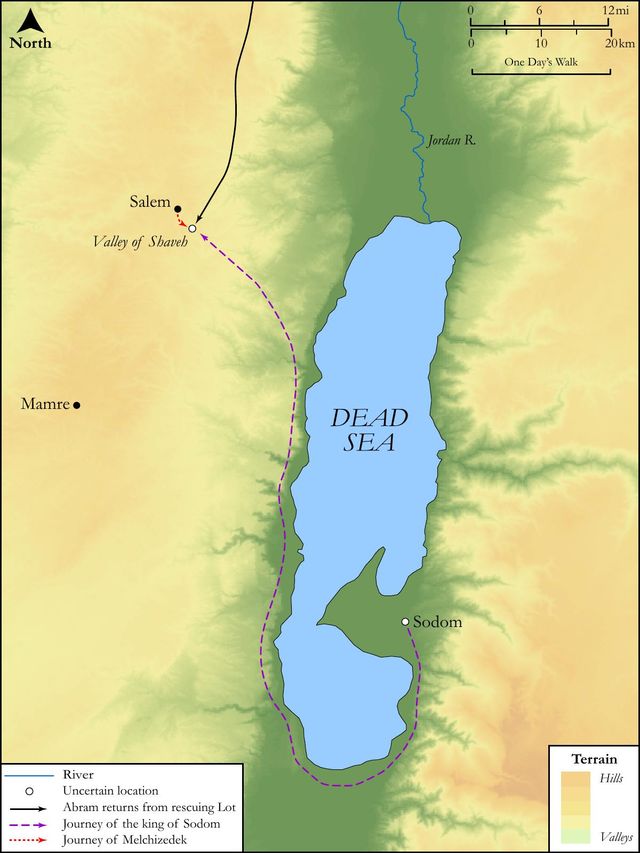
This verse is strategically placed immediately after Abram's triumphant military campaign. Having pursued and decisively defeated Chedorlaomer and his confederates, Abram successfully rescued his nephew Lot, along with all the people and possessions plundered from Sodom and Gomorrah. This military success, detailed in Genesis 14:14-16, establishes Abram as a powerful and respected figure. The encounter with the King of Sodom in this verse directly follows Abram's pivotal meeting with Melchizedek, the King of Salem and priest of God Most High, to whom Abram gave a tithe (Genesis 14:18-20). This spiritual encounter, affirming God's sovereignty as "Possessor of heaven and earth," profoundly shapes Abram's subsequent response to the King of Sodom's offer.
Historical & Cultural Context
Among the nations, the spoils of war were typically divided among the victorious parties, and the right to claim such spoils was a recognized prerogative of the conqueror. Kings often sought to restore their populations after defeat, as people were considered valuable assets for labor, taxation, and military strength. Sodom itself was known for its wickedness (Genesis 13:13), a reputation that would later lead to its destruction. Abram, as a nomadic tribal leader, was operating within a complex geopolitical landscape, navigating alliances and conflicts among various city-states and kings. His actions in this chapter, including his military prowess and his interaction with both Melchizedek and the King of Sodom, elevate his status beyond that of a mere wanderer.
Key Themes
ShowHideGenesis 14 contributes significantly to several overarching themes within the book. The theme of Divine Protection and Provision is central, as God empowers Abram to achieve victory against overwhelming odds and then provides for him, negating the need for worldly gain. The chapter also develops the theme of Abram's Faith and Righteousness, showcasing his integrity and his commitment to God's honor above personal enrichment, particularly in his refusal of the King of Sodom's offer, which is detailed in Genesis 14:22-24. Furthermore, the introduction of Melchizedek and Abram's tithe highlights the theme of Worship and Acknowledgment of God's Sovereignty, setting the stage for Abram's principled stand against potential compromise with the ungodly King of Sodom.
Exposition and Analysis
ShowHideGenesis 14:21 records the King of Sodom's direct and calculated proposal to Abram, a moment that serves as a moral and spiritual crucible for the patriarch. Having been rescued by Abram, the king attempts to reassert some control and establish terms for the recovered spoils.
Key Word Analysis
ShowHideThis primitive root signifies more than mere utterance; it implies declaring, commanding, or even intending. Here, it conveys the King of Sodom's authoritative proposition, a direct and purposeful statement setting forth his terms, reflecting his position as a ruler despite his recent defeat.
Derived from a root meaning "to breathe," nephesh refers to a living creature, soul, or individual. In this context, it specifically denotes the human captives from Sodom, emphasizing their status as living beings rather than mere possessions, and highlighting the king's immediate concern for the restoration of his populace.
This term refers to property, possessions, or gathered wealth, specifically the plunder taken by Chedorlaomer's coalition. It encompasses all the material spoils of war recovered by Abram, highlighting the tangible, worldly value at stake and the king's willingness to cede these items to Abram.
Verse Breakdown
ShowHide"And the king of Sodom said unto Abram"
This opening establishes the direct interaction between two significant figures. The King of Sodom, Bera, approaches Abram, acknowledging Abram's victorious position and the power he wields, setting the stage for a negotiation rather than a demand.
"Give me the persons"
The king's primary concern is the return of his people, the citizens of Sodom who were taken captive. This highlights a pragmatic, perhaps even humanitarian, concern for his subjects, as their return is essential for the city's restoration, its economy, and his continued rule.
"and take the goods to thyself"
This part of the offer presents Abram with the material spoils of war—the recovered wealth and possessions. The king's willingness to cede these "goods" to Abram is a strategic move, potentially to obligate Abram, express gratitude, or simply to avoid further contention over the plunder, prioritizing the return of his populace.
Literary Devices
ShowHideThe verse primarily employs Dialogue, presenting the direct speech of the King of Sodom to Abram, which immediately draws the reader into the tension of the scene. There is also a clear Contrast established between "the persons" (human lives) and "the goods" (material possessions), highlighting the different values at play and the king's immediate priorities. Furthermore, this verse functions as a powerful Foreshadowing device, setting the stage for Abram's pivotal and principled response in the subsequent verses, where his integrity and reliance on God will be profoundly demonstrated.
Theological and Thematic Connections
ShowHideGenesis 14:21, in conjunction with Abram's response, serves as a profound theological statement on the source of true blessing and the nature of spiritual integrity. It underscores the principle that God's people are to rely solely on His provision, refusing any worldly gain that might compromise their witness or suggest indebtedness to ungodly sources. This encounter highlights the importance of maintaining a clear distinction between the values of the world and the values of God's kingdom, ensuring that God alone receives glory for any prosperity.
Reflection and Application
ShowHideThe King of Sodom's offer to Abram in Genesis 14:21, though seemingly generous, represents a subtle spiritual snare. It challenges Abram to choose between immediate, worldly gain and a deeper, more profound trust in God's exclusive provision. For believers today, this passage serves as a powerful reminder to examine the source and nature of our blessings. Are we willing to compromise our principles or align ourselves with ungodly influences for temporal advantage? Like Abram, we are called to live with uncompromising integrity, ensuring that our prosperity is clearly attributed to God alone, so that no one can boast of having made us rich (Genesis 14:23). This requires a deep-seated conviction that God is our ultimate provider and protector, capable of meeting all our needs without requiring us to sacrifice our spiritual purity or compromise our witness. It also compels us to discern carefully the opportunities and associations we entertain, ensuring they do not entangle us in ways that diminish God's glory or our spiritual walk.
Questions for Reflection
ShowHideFAQ
ShowHideWhy did the King of Sodom offer Abram the goods?
ShowHideThe King of Sodom likely offered Abram the goods for several reasons. Primarily, it was a gesture of gratitude and acknowledgment for Abram's decisive victory and the rescue of his people and property. Among the kings of that day, the victor had the right to all spoils, so offering them to Abram was a recognition of his power and a way to avoid further conflict. It was also a strategic move to quickly re-establish control over his city's population without having to negotiate for the material wealth, and perhaps to subtly obligate Abram to Sodom, fostering a sense of indebtedness or alliance.
Christ-Centered Fulfillment
ShowHideAbram's resolute refusal to accept worldly gain from the King of Sodom, instead relying solely on God as his provider, profoundly foreshadows Christ's absolute purity and His rejection of all earthly temptations for power or wealth. While Abram, a man of faith, still wrestled with human limitations, Jesus perfectly embodied this principle, famously refusing the kingdoms of the world offered by Satan in the wilderness (Matthew 4:8-10). Christ, the true King and ultimate deliverer, did not merely recover physical captives or material possessions; He redeemed humanity from the bondage of sin and death, not for any earthly reward or to be enriched by worldly powers, but through His sacrificial love on the cross (Ephesians 1:7). By His perfect obedience and self-giving, Jesus established a heavenly kingdom whose riches are eternal and untainted by worldly compromise, demonstrating that true wealth and authority come from God alone (Philippians 2:9-11).