


Genesis 14:10
Bible text: King James Version (1769 Blayney text) · Public domain
Bible text: King James Version with Strong's numbers · Public domain
Bible text: Berean Standard Bible · Public domain
Bible text: American Standard Version (1901) · Public domain
Bible text: World English Bible, Messianic edition · Public domain
Bible text: Geneva Bible (1599) · Public domain
Bible text: Young's Literal Translation · Public domain
- וְעֵמֶקve·'E·mekand [the] valley ofH6010Conj-w ¦ N-mscNoun Singular Masculine Constructוְandעֵמֶק[the] valley of
- הַשִׂדִּיםha·si·Dim<the> SiddimH7708Art ¦ N-properNoun Proper Locationהַ<the>שִׂדִּיםSiddim
- בֶּאֱרֹתbe·'e·Rot[was] pitsH875N-fpcNoun Plural Feminine Construct
- בֶּאֱרֹתbe·'e·Rotpits ofH875N-fpcNoun Plural Feminine Construct
- חֵמָרche·MarbitumenH2564N-msNoun Singular Masculine Absolute
- וַיָּנֻסוּvai·ya·Nu·suand they fledH5127Conj-w ¦ V-Qal-ConsecImperf-3mpVerb Qal Consecutive Imperfect 3rd Plural Masculineוַandיָּנֻסוּthey fled
- מֶלֶךְMe·lekh[the] king ofH4428N-mscNoun Singular Masculine Construct
- סְדֹםse·DomSodomH5467N-properNoun Proper Location
- וַעֲמֹרָהva·'a·mo·Rahand GomorrahH6017Conj-w ¦ N-properNoun Proper LocationוַandעֲמֹרָהGomorrah
- וַיִּפְּלוּvai·yi·pe·luand they fellH5307Conj-w ¦ V-Qal-ConsecImperf-3mpVerb Qal Consecutive Imperfect 3rd Plural Masculineוַandיִּפְּלוּthey fell
- שָׁמָּהSha·mahthere towardsH8033Adv ¦ SfxAdverbשָׁמָּthereהtowards
- וְהַנִּשְׁאָרִיםve·ha·nish·'a·Rimand those [who] survivedH7604Conj-w ¦ Art ¦ V-Niphal-Prtcpl-mpVerb Niphal Participle Plural Masculine Absoluteוְandהַthoseנִּשְׁאָרִים[who] survived
- הֶרָהHe·rah[the] hill country towardsH2022N-ms ¦ SfxNoun Singular Masculine Absoluteהֶרָ[the] hill countryהtowards
- נָּסוּNa·suthey fledH5127V-Qal-Perf-3cpVerb Qal Perfect 3rd Plural common gender
English is a literal word-by-word gloss of the Hebrew, not the KJV's wording. Why?
This is the original text the KJV's translators worked from — each Hebrew word with its own literal English meaning in this verse, prepared by scholars at Tyndale House, Cambridge. The KJV translates whole sentences, not word by word, so its wording differs: one Hebrew word can become several English words, and the KJV may choose “the LORD” where the gloss reads “Yahweh”. Both are faithful — they answer different questions. For the KJV's own rendering, switch to the KJV text.
Details
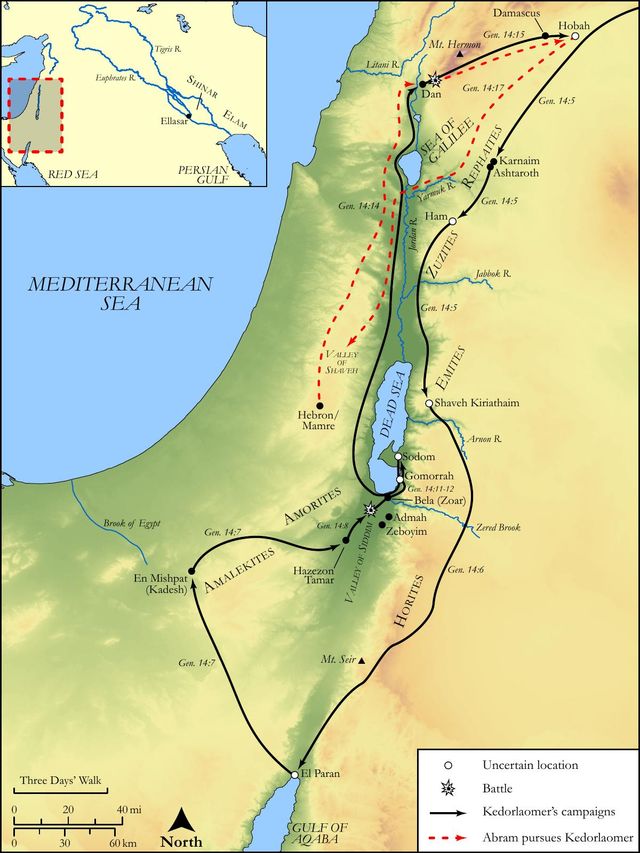
See on the biblical-era maps


Study this verse
Public-domain commentary
Matthew Henry
From his Commentary on the Whole Bible. Henry comments on passages, not single verses — this entry covers Genesis 14:1–12. His three-level outline is real structure in the source text, so it is rendered as structure.
We have here an account of the first war that ever we read of in scripture, which (though the wars of the nations make the greatest figure in history) we should not have had the history of if Abram and Lot had not been concerned in it. Now, concerning this war, we may observe,
I.The parties engaged in it.
The invaders were four kings, two of them no less than kings of Shinar and Elam (that is, Chaldea and Persia), yet probably not the sovereign princes of those great kingdoms in their own persons, but either officers under them, or rather the heads and leaders of some colonies which came out of those great nations, and settled themselves near Sodom, but retained the names of the countries from which they had their origin. The invaded were the kings of five cities that lay near together in the plain of Jordan, namely, Sodom, Gomorrah, Admah, Zeboiim, and Zoar. Four of them are named, but not the fifth, the king of Zoar or Bela, either because he was much more mean and inconsiderable or because he was much more wicked and inglorious than the rest, and worthy to be forgotten.
II.The occasion of this war was the revolt of the five kings from under the government of Chedorlaomer.
Twelve years they served him. Small joy they had of their fruitful land, while thus they were tributaries to a foreign power, and could not call what they had their own. Rich countries are a desirable prey, and idle luxurious countries are an easy prey, to growing greatness. The Sodomites were the posterity of Canaan whom Noah had pronounced a servant to Shem, from whom Elam descended; thus soon did that prophecy begin to e fulfilled. In the thirteenth year, beginning to be weary of their subjection, they rebelled, denied their tribute, and attempted to shake off the yoke and retrieve their ancient liberties. In the fourteenth year, after some pause and preparation, Chedorlaomer, in conjunction with his allies, set himself to chastise and reduce the rebels, and, since he could not have it otherwise, to fetch his tribute from them on the point of his sword. Note, Pride, covetousness, and ambition, are the lusts from which wars and fightings come. To these insatiable idols the blood of thousands has been sacrificed.
III.The progress and success of the war.
The four kings laid the neighbouring countries waste and enriched themselves with the spoil of them (Gen 14:5-7), upon the alarm of which it had been the wisdom of the king of Sodom to submit, and desire conditions of peace; for how could he grapple with an enemy thus flushed with victory? But he would rather venture the utmost extremity than yield, and it sped accordingly. Quos Deus destruet eos dementat - Those whom God means to destroy he delivers up to infatuation.
1.The forces of the king of Sodom and his allies were routed; and, it should seem, many of them perished in the slime-pits who had escaped the sword, Gen 14:10. In all places we are surrounded with deaths of various kinds, especially in the field of battle.
2.The cities were plundered, Gen 14:11. All the goods of Sodom, and particularly their stores and provisions of victuals, were carried off by the conquerors. Note, When men abuse the gifts of a bountiful providence to gluttony and excess, it is just with God, and his usual way, by some judgment or other to strip them of that which they have so abused, Hos 2:8, Hos 2:9.
3.Lot was carried captive, Gen 14:12. They took Lot among the rest, and his goods. Now Lot may here be considered,
(1.)As sharing with his neighbours in this common calamity. Though he was himself a righteous man, and (which is here expressly noticed) Abram's brother's son, yet he was involved with the rest in all this trouble. Note, All things come alike to all, Ecc 9:2. The best of men cannot promise themselves an exemption from the greatest troubles in this life; neither from our own piety nor our relation to those that are the favourites of heaven will be our security, when God's judgments are abroad. Note, further, Many an honest man fares the worse for his wicked neighbours. It is therefore our wisdom to separate ourselves, or at least to distinguish ourselves, from them (Co2 6:17), and so deliver ourselves, Rev 18:4.
(2.)As smarting for the foolish choice he made of a settlement here. This is plainly intimated when it is said, They took Abram's brother's son, who dwelt in Sodom. So near a relation of Abram should have been a companion and disciple of Abram, and should have abode by his tents; but, if he choose to dwell in Sodom, he must thank himself if he share in Sodom's calamities. Note, When we go out of the way of our duty we put ourselves from under God's protection, and cannot expect that the choices which are made by our lusts should issue to our comfort. Particular mention is made of their taking Lot's goods, those goods which had occasioned his contest with Abram and his separation from him. Note, It is just with God to deprive us of those enjoyments by which we have suffered ourselves to be deprived of our enjoyment of him.
Continue studying Genesis 14:10 across the web’s major study libraries — every link below opens this exact verse, chapter, or book on the destination site.
Read & Compare
 BibleGatewayThis verse in more than 200 translations and 70 languages.
 Bible.comThe YouVersion reader — hundreds of translations, reading plans, and highlights.
 ESV.orgCrossway's official English Standard Version reader.
 NET BibleThe NET translation with 60,000+ translators' notes on every rendering decision.
 STEP BibleTyndale House's free study tool — original text, vocabulary, and scholarly resources.
 BibliaLogos Bible Software's free web reader.
 USCCBThe New American Bible (Revised Edition) with the U.S. bishops' study notes.
Commentaries
 BibleHub CommentariesDozens of classic commentaries on this verse, gathered on one page.
 StudyLightMore than 100 commentary sets — the largest collection on the web.
 BibleRefPlain-English commentary on what this verse means, verse by verse.
 Enduring WordDavid Guzik's free commentary on this chapter, widely used by Bible teachers.
 Bible Study ToolsVerse commentary alongside Greek and Hebrew study aids.
Original Language & Research
- BibleHub InterlinearThe verse word by word — original language, transliteration, and English.
- BibleHub LexiconEvery word's original-language definition and Strong's entry.
 Blue Letter BibleDeep-study tools — Strong's numbers, concordance, and word studies.
 SefariaThe Hebrew text with Rashi and centuries of Jewish commentary.
Sermons, Hymns & Audio


TrulyRandomVerse is not affiliated with these sites and doesn’t control their content. They’re linked because they’re genuinely useful.
Summary
This verse vividly depicts a pivotal moment in the "Battle of the Kings," where the rebellious kings of Sodom and Gomorrah, in their desperate flight from defeat, became ensnared in the treacherous bitumen pits of the Vale of Siddim, while their remaining forces sought refuge in the surrounding mountains. This verse not only highlights the immediate, chaotic consequences of the conflict but also underscores the perilous nature of the terrain, setting the stage for Abraham's subsequent intervention and rescue.
Context
ShowHideLiterary Context
Genesis 14 stands as a unique historical narrative within the patriarchal accounts, interrupting the family history of Abraham. It details a major regional conflict, the "Battle of the Kings," which precedes Abraham's direct involvement. Verses Genesis 14:1-9 establish the political backdrop: a rebellion by five Canaanite city-states (including Sodom and Gomorrah) against their eastern overlords after twelve years of subjugation. Our verse, Genesis 14:10, immediately follows the description of the battle's location and the initial engagement, serving as the dramatic climax of the battle itself, detailing the decisive defeat of the rebellious kings. This defeat directly precipitates the capture of Lot, Abraham's nephew, which then triggers Abraham's heroic rescue mission in Genesis 14:11-16.
Historical & Cultural Context
The setting, the Vale of Siddim, is consistently identified with the southern end of the Dead Sea basin, a region historically known for its asphalt (bitumen) deposits. These "slimepits" (tar pits) were natural geological features, often bubbling to the surface, making the terrain hazardous. In the warfare of that day, such natural obstacles could prove decisive, turning a retreat into a rout. The mention of "kings" (Hebrew: melek) reflects the common political structure of the Canaanite city-states, where each city had its own ruler. The conflict itself, involving a coalition of eastern kings against a western alliance, is plausible for the days of Abraham, showcasing the dynamic and often violent geopolitical landscape of the region during Abraham's time. The vulnerability of these kings, despite their royal status, to both military defeat and natural hazards, speaks to the harsh realities of ancient life and warfare.
Key Themes
ShowHideThis verse contributes to several overarching themes in Genesis. Firstly, it highlights the theme of divine judgment and consequence, subtly foreshadowing the eventual destruction of Sodom and Gomorrah in Genesis 19. The "slimepits" act as a natural trap, prefiguring a more ultimate reckoning. Secondly, it underscores the fragility of human power and sovereignty in the face of both superior military might and natural forces; even kings are not immune to ignominious defeat. Thirdly, the chaos and defeat described here create the necessary backdrop for the emergence of Abraham as a deliverer and a figure of divine blessing, setting the stage for his righteous intervention and the subsequent encounters with Melchizedek and the king of Sodom in Genesis 14:17-24.
Exposition and Analysis
ShowHideKey Word Analysis
ShowHideMeaning "bitumen (as rising to the surface); slime(-pit)." This term specifically refers to the asphalt or tar pits, which were a distinctive and dangerous feature of the Vale of Siddim. Their presence made the terrain treacherous, especially for those in panicked flight, acting as natural traps that ensnared the fleeing forces.
A primitive root meaning "to flit, i.e. vanish away (subside, escape; causatively, chase, impel, deliver); [idiom] abate, away, be displayed, (make to) flee (away, -ing), put to flight, [idiom] hide, lift up a standard." This word captures the desperate, unorganized retreat of the defeated kings and their armies, emphasizing their hurried attempt to escape the pursuing forces.
A primitive root meaning "to fall, in a great variety of applications (intransitive or causative, literal or figurative); be accepted, cast (down, self, (lots), out), cease, die, divide (by lot), (let) fail, (cause to, let, make, ready to) fall (away, down, -en, -ing), fell(-ing), fugitive, have (inheritance), inferior, be judged (by mistake for פָּלַל), lay (along), (cause to) lie down, light (down), be ([idiom] hast) lost, lying, overthrow, overwhelm, perish, present(-ed, -ing), (make to) rot, slay, smite out, [idiom] surely, throw down." In this context, it signifies not merely a physical stumble but a catastrophic collapse, implying capture, incapacitation, or even death, particularly for the kings who "fell there" into the pits.
A shortened form of הָרָר; "a mountain or range of hills (sometimes used figuratively); hill (country), mount(-ain), [idiom] promotion." The flight to the mountain represents a desperate attempt to find refuge and higher, more defensible ground, contrasting sharply with the entrapment in the low-lying pits.
Verse Breakdown
ShowHide"And the vale of Siddim [was full of] slimepits"
This opening clause establishes the critical geographical feature of the battlefield. The Vale of Siddim (Hebrew: ʻêmeq Siddîym), a broad depression near the Dead Sea, was characterized by numerous bitumen or asphalt pits. The parenthetical "[was full of]" clarifies the state of the vale, emphasizing that these natural hazards were abundant and pervasive, making escape through this area extremely perilous.
"and the kings of Sodom and Gomorrah fled, and fell there"
This phrase describes the immediate and ignominious fate of the two most prominent rebellious kings. In their desperate flight from the victorious eastern coalition, they encountered the treacherous slimepits. Their "fall" into these pits signifies not just a physical mishap but their strategic defeat, capture, or incapacitation, highlighting their vulnerability despite their royal status. This moment is a decisive turning point in the battle.
"and they that remained fled to the mountain"
This final clause details the fate of the rest of the routed forces. While the kings were ensnared by the pits, those soldiers who survived and were not trapped sought refuge in the higher, more secure terrain of the surrounding mountains. This emphasizes the complete disarray of the defeated army, with some perishing or being captured in the pits, and others scattering to escape the pursuit.
Literary Devices
ShowHideThe verse employs several impactful literary devices. Setting as Character is prominent, as the "vale of Siddim" with its "slimepits" is not merely a backdrop but an active participant in the narrative, directly influencing the outcome of the battle by trapping the fleeing kings. This creates a powerful sense of Irony, where the very ground intended for battle becomes a decisive instrument of defeat for the local kings. The contrast between the kings falling into the pits and "they that remained" fleeing "to the mountain" serves as a form of Juxtaposition, highlighting the divergent fates of the defeated forces and emphasizing the chaos and desperation of the rout. The description of the kings' fall is also a form of Understatement, as "fell there" implies a catastrophic end without explicitly detailing death or capture, allowing the reader to infer the severity of their plight.
Theological and Thematic Connections
ShowHideThis verse, while describing a historical battle, carries profound theological and thematic weight. It subtly introduces the concept of natural consequences aligning with divine purposes. The treacherous "slimepits" can be seen as instruments in the unfolding of God's permissive will, contributing to the defeat of the wicked kings of Sodom and Gomorrah. This defeat, in turn, serves as a significant foreshadowing of the ultimate judgment that would befall these cities due to their profound wickedness, as detailed in Genesis 19. The vulnerability of these powerful kings to both military might and natural hazards also underscores the limits of human strength and autonomy, reminding us that even earthly rulers are subject to forces beyond their control. This sets the stage for the true and ultimate sovereignty of God, soon to be demonstrated through Abraham's righteous actions and God's covenant promises.
Reflection and Application
ShowHideGenesis 14:10 offers a stark reminder that the terrain of our lives, both literal and metaphorical, profoundly influences the outcomes of our choices and conflicts. The kings' desperate flight into the "slimepits" illustrates the immediate and often ignominious consequences of rebellion, poor judgment, or a refusal to acknowledge superior forces. For us, life presents its own "pits"—situations born of our own folly, the consequences of sin, or unexpected adversities that can ensnare and defeat us. This passage challenges us to cultivate wisdom and discernment, to understand the "terrain" we navigate, and to avoid paths that lead to entrapment. It reminds us that even those in positions of power or influence are not immune to the consequences of their actions, and that humility in the face of life's challenges is paramount. Ultimately, it points us to the need for a deliverer when we find ourselves in such pits, a theme beautifully developed in the subsequent narrative of Abraham's rescue.
Questions for Reflection
ShowHideFAQ
ShowHideWhat were the "slimepits" mentioned in Genesis 14:10?
ShowHideThe "slimepits" (Hebrew: bᵉʼêr chêmâr, literally "wells of bitumen") were natural pits filled with bitumen or asphalt, a tar-like, sticky substance. This geological feature was common in the Vale of Siddim, which is generally identified with the area that later became the southern basin of the Dead Sea. These pits were extremely treacherous, acting as natural traps that could ensnare people, especially those fleeing in panic during battle.
Why is the detail about the "slimepits" important to the narrative?
ShowHideThis detail is crucial for several reasons. Primarily, it provides the immediate explanation for the decisive defeat and capture of the kings of Sodom and Gomorrah. Their fall into these natural hazards highlights their vulnerability and the chaotic nature of their rout. The "slimepits" also serve as a subtle yet potent foreshadowing of the later, more catastrophic destruction of Sodom and Gomorrah in Genesis 19, where divine judgment would consume the very ground of their cities, echoing the idea of a natural (or supernatural) trap leading to their demise.
What happened to the kings of Sodom and Gomorrah after falling into the pits?
ShowHideThe verse states they "fled, and fell there." While it doesn't explicitly detail their immediate demise in the pits, their fall signifies their complete defeat and incapacitation. Interestingly, the king of Sodom is later seen alive in Genesis 14:17, suggesting he either managed to escape the pit, was rescued by his own remaining forces, or was captured by the victorious eastern kings and later released or allowed to return. Regardless, his initial fall marked a decisive moment of vulnerability and loss for his kingdom.
Christ-Centered Fulfillment
ShowHideWhile Genesis 14:10 describes a specific historical battle and the ignominious defeat of earthly kings, it subtly points to a greater reality fulfilled in Christ. The narrative of kings falling into treacherous pits and the subsequent need for rescue (as seen in Abraham's intervention) serves as an ancient echo of humanity's fallen state. Humanity, represented by these kings, has fallen into the "pit" of sin and spiritual death, a trap from which no earthly power or wisdom can escape. Christ, as the ultimate King and Deliverer, fulfills the archetype of a rescuer far beyond Abraham's temporary military victory. He did not merely avoid the pit but willingly descended into the depths of human sin and death, not to be trapped, but to conquer. His death on the cross, a descent into the ultimate "pit" of judgment for sin, was followed by His glorious resurrection, demonstrating His triumph over sin, death, and the grave. Through His perfect sacrifice and victorious resurrection, Jesus offers true and eternal rescue from the ultimate "pit" of condemnation, providing a final escape and triumph for all who believe in Him, as promised in John 3:16 and realized in Romans 6:23. His sovereignty extends not only over human conflicts and natural forces but over all spiritual realities, offering a path to abundant life and eternal freedom (John 10:10).