


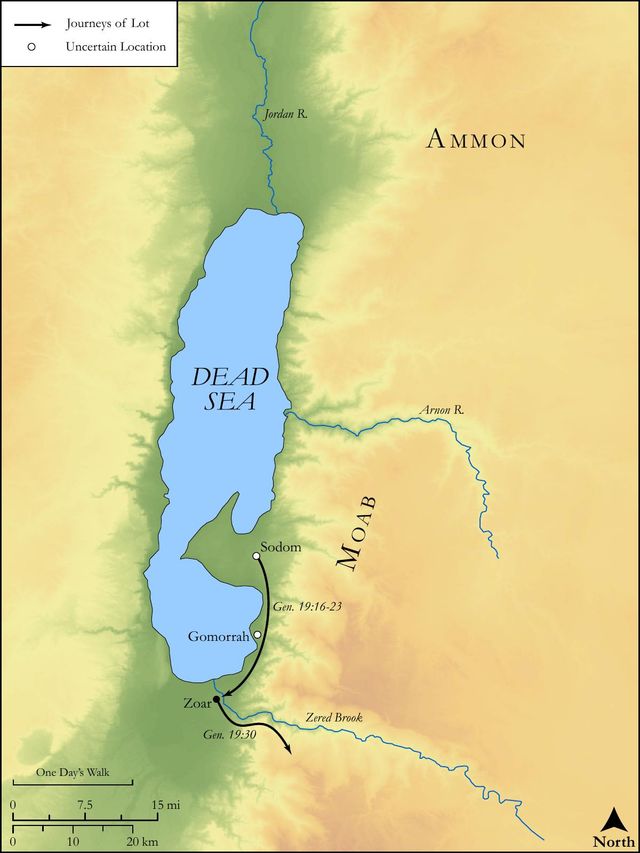
Genesis 19:30
Bible text: King James Version (1769 Blayney text) · Public domain
Bible text: King James Version with Strong's numbers · Public domain
Bible text: Berean Standard Bible · Public domain
Bible text: American Standard Version (1901) · Public domain
Bible text: World English Bible, Messianic edition · Public domain
Bible text: Geneva Bible (1599) · Public domain
Bible text: Young's Literal Translation · Public domain
- וַיַּעַלvai·ya·'Aland he went upH5927Conj-w ¦ V-Qal-ConsecImperf-3msVerb Qal Consecutive Imperfect 3rd Singular Masculineוַandיַּעַלhe went up
- לוֹטLotLotH3876N-proper-mNoun Proper Masculine
- מִצּוֹעַרmi·Tzo·'arfrom ZoarH6820Prep-m ¦ N-properNoun Proper LocationמִfromצּוֹעַרZoar
- וַיֵּשֶׁבvai·Ye·shevand he dweltH3427Conj-w ¦ V-Qal-ConsecImperf-3msVerb Qal Consecutive Imperfect 3rd Singular Masculineוַandיֵּשֶׁבhe dwelt
- בָּהָרba·Harin the hill countryH2022Prep-b ¦ N-msNoun Singular Masculine Absoluteבָּin theהָרhill country
- וּשְׁתֵּיu·she·Teiand [the] twoH8147Conj-w ¦ Adj-fdcAdjective Numerical Dual Feminine Constructוּandשְׁתֵּי[the] two
- בְנֹתָיוve·no·Tavhis daughtersH1323N-fpc ¦ 3msNoun Plural Feminine Constructבְנֹתָיdaughtersוhis
- עִמּוֹi·Mo[were] with himH5973Prep ¦ 3msPreposition Definiteעִמּ[were] withוֹhim
- כִּיkiforH3588PrtParticle Conditional
- יָרֵאya·Re'he was afraidH3372V-Qal-Perf-3msVerb Qal Perfect 3rd Singular Masculine
- לָשֶׁבֶתla·She·vetto dwellH3427Prep-l ¦ V-Qal-InfVerb Qal Infinitive Constructלָtoשֶׁבֶתdwell
- בְּצוֹעַרbe·Tzo·'arin ZoarH6820Prep-b ¦ N-properNoun Proper LocationבְּinצוֹעַרZoar
- וַיֵּשֶׁבvai·Ye·shevand he dweltH3427Conj-w ¦ V-Qal-ConsecImperf-3msVerb Qal Consecutive Imperfect 3rd Singular Masculineוַandיֵּשֶׁבhe dwelt
- בַּמְּעָרָהba·me·'a·Rahin the caveH4631Prep-b ¦ N-fsNoun Singular Feminine Absoluteבַּin theמְּעָרָהcave
- הוּאhu'heH1931Pro-3msPronoun Personal 3rd Singular Masculine
- וּשְׁתֵּיu·she·Teiand [the] twoH8147Conj-w ¦ Adj-fdcAdjective Numerical Dual Feminine Constructוּandשְׁתֵּי[the] two
- בְנֹתָיוve·no·Tavhis daughtersH1323N-fpc ¦ 3msNoun Plural Feminine Constructבְנֹתָיdaughtersוhis
English is a literal word-by-word gloss of the Hebrew, not the KJV's wording. Why?
This is the original text the KJV's translators worked from — each Hebrew word with its own literal English meaning in this verse, prepared by scholars at Tyndale House, Cambridge. The KJV translates whole sentences, not word by word, so its wording differs: one Hebrew word can become several English words, and the KJV may choose “the LORD” where the gloss reads “Yahweh”. Both are faithful — they answer different questions. For the KJV's own rendering, switch to the KJV text.
Details
See on the biblical-era maps


Study this verse
Public-domain commentary
Matthew Henry
From his Commentary on the Whole Bible. Henry comments on passages, not single verses — this entry covers Genesis 19:30–38. His four-level outline is real structure in the source text, so it is rendered as structure.
Here is, I. The great trouble and distress that Lot was brought into after his deliverance, Gen 19:30. 1. He was frightened out of Zoar, durst not dwell there; probably because he was conscious to himself that it was a refuge of his own choosing and that herein he had foolishly prescribed to God, and therefore he could not but distrust his safety in it; or because he found it as wicked as Sodom, and therefore concluded it could not long survive it; or perhaps he observed the rise and increase of those waters which after the conflagration, perhaps from Jordan, began to overflow the plain, and which, mixing with the ruins, by degrees made the Dead Sea; in those waters he concluded Zoar must needs perish (though it had escaped the fire) because it stood upon the same flat. Note, Settlements and shelters of our own choosing, and in which we do not follow God, commonly prove uneasy to us. 2. He was forced to betake himself to the mountain, and to take up with a cave for his habitation there. Methinks it was strange that he did not return to Abraham, and put himself under his protection, to whom he had once and again owed his safety: but the truth is there are some good men that are not wise enough to know what is best for themselves. Observe, (1.) He was now glad to go to the mountain, the place which God had appointed for his shelter. Note, It is well if disappointment in our way drive us at last to God's way. (2.) He that, awhile ago, could not find room enough for himself and his stock in the whole land, but must jostle with Abraham, and get as far from him as he could, is now confined to a hole in a hill, where he has scarcely room to turn himself, and there he is solitary and trembling. Note, It is just with God to reduce those to poverty and restraint who have abused their liberty and plenty. See also in Lot what those bring themselves to, at last, that forsake the communion of saints for secular advantages; they will be beaten with their own rod.
II.The great sin that Lot and his daughters were guilty of, when they were in this desolate place. It is a sad story.
1.His daughters laid a very wicked plot to bring him to sin; and theirs was, doubtless, the greater guilt. They contrived, under pretence of cheering up the spirits of their father in his present condition, to make him drunk, and then to lie with him, Gen 19:31, Gen 19:32.
(1.)Some think that their pretence was plausible. Their father had no sons, they had no husbands, nor knew they were to have any of the holy seed, or, if they had children by others, their father's name would not be preserved in them. Some think that they had the Messiah in their eye, who, they hoped, might descend form their father; for he came from Terah's elder son, who separated from the rest of Shem's posterity as well as Abraham, and was now signally delivered out of Sodom. Their mother, and the rest of the family, were gone; they might not marry with the cursed Canaanites; and therefore they supposed that the end they aimed at and the extremity they were brought to, would excuse the irregularity. Thus the learned Monsieur Allix. Note, Good intentions are often abused to patronize bad actions. But,
(2.)Whatever their pretence was, it is certain that their project was very wicked and vile, and an impudent affront to the very light and law of nature. Note,
[1.]The sight of God's most tremendous judgments upon sinners will not of itself, without the grace of God, restrain evil hearts from evil practices: one would wonder how the fire of lust could possibly kindle upon those, who had so lately been the eye-witnesses of Sodom's flames.
[2.]Solitude has its temptations as well as company, and particularly to uncleanness. When Joseph was alone with his mistress he was in danger, Gen 39:11. Relations that dwell together, especially if solitary, have need carefully to watch even against the least evil thought of this kind, lest Satan get an advantage.
2.Lot himself, by his own folly and unwariness, was wretchedly overcome, and suffered himself so far to be imposed upon by his own children as, two nights together, to be drunk, and to commit incest, Gen 19:33, etc. Lord, what is man! What are the best of men, when God leaves them to themselves! See here,
(1.)The peril of security. Lot, who not only kept himself sober and chaste in Sodom, but was a constant mourner for the wickedness of the place and a witness against it, was yet, in the mountain, where he was alone, and as he thought quite out of the way of temptation, shamefully overtaken. Let him therefore that thinks he stands, stands high and stands firm, take heed lest he fall. No mountain, on this side the holy hill above, can set us out of the reach of Satan's fiery darts.
(2.)The peril of drunkenness. It is not only a great sin itself, but it is the inlet of many sins; it may prove the inlet of the worst and mast unnatural sins, which may b a perpetual wound and dishonour. Excellently does Mr. Herbert describe it,
He that is drunken may his mother kill
Big with his sister -
A man may do that without reluctance, when he is drunk, which, when he is sober, he could not think of without horror. (3.) The peril of temptation from our dearest relations and friends, whom we love, and esteem, and expect kindness from. Lot, whose temperance and chastity were impregnable against the batteries of foreign force, was surprised into sin and shame by the base treachery of his own daughters: we must dread a snare wherever we are, and be always upon our guard.
3.In the close we have an account of the birth of the two sons, or grandsons (call them which you will), of Lot, Moab and Ammon, the fathers of two nations, neighbours to Israel, and which we often read of in the Old Testament; both together are called the children of Lot, Psa 83:8. Note, Though prosperous births may attend incestuous conceptions, yet they are so far from justifying them that they rather perpetuate the reproach of them and entail infamy upon posterity; yet the tribe of Judah, of which our Lord sprang, descended from such a birth, and Ruth, a Moabitess, has a name in his genealogy, Mat 1:3, Mat 1:5.
Lastly, Observe that, after this, we never read any more of Lot, nor what became of him: no doubt he repented of his sin, and was pardoned; but from the silence of the scripture concerning him henceforward we may learn that drunkenness, as it makes men forgetful, so it makes them forgotten; and many a name, which otherwise might have been remembered with respect, is buried by it in contempt and oblivion.
Historical interpretation
Three Centuries of Reception
2 surviving comments on this verse. Each one is dated, so this reads as a timeline rather than a list.
Select a marker to jump to its quote. Markers stagger vertically where authors wrote within a few decades of each other.
(Verse 30.) And Lot went up from Segor and settled in the mountain, and his two daughters with him. For he was afraid to stay in Segor. It is asked why, when he first preferred the mountain of Segor for his escape, and wanted to be saved in it as his dwelling, he now flees from Segor back to the mountain? We will answer that the Hebrew conjecture about Segor is true, that it was frequently destroyed by earthquakes, first known as Bale, and later Salisa: and Lot feared, saying, If this place is often destroyed while the other cities still stand, how much more now, in a general destruction, will it not be able to be saved? And because of this occasion of unfaithfulness, they also gave rise to sexual relations with their daughters. For he who had seen other cities being destroyed and this one remaining, and himself being saved by the help of God, should not have doubted what he had heard granted to him. Therefore, the excuse that is given for the daughters, that they believed the human race had perished and therefore slept with their father, does not excuse the father. In fact, the Hebrews, as it follows:
Lot went up from Zoar and stayed on the mountain with his two daughters. He had feared to stay in Zoar. He hurried to ascend the mountain from Zoar because he recognized that this was more pleasing to the angels through whom he was rescued, fearing that the city which at the moment of his intercession had escaped the danger of death might later, due to the citizens' sins, be consumed with a similar destruction as the neighboring cities; he feared greatly, since he knew that it had been frequently devastated by earthquakes in earlier times, hence it was called Bela, that is, 'submerging' or 'devouring.' But also according to spiritual understanding, because Sodom represents the flames of vices, Zoar a small beginning of good works, and the mountain the height of virtues, it is necessary that when someone has moved from the fire of vices to the beginning of virtue, they should not remain sluggish at the outset, but should always strive and hurry with a lively step toward higher progress in good action.
Continue studying Genesis 19:30 across the web’s major study libraries — every link below opens this exact verse, chapter, or book on the destination site.
Read & Compare
 BibleGatewayThis verse in more than 200 translations and 70 languages.
 Bible.comThe YouVersion reader — hundreds of translations, reading plans, and highlights.
 ESV.orgCrossway's official English Standard Version reader.
 NET BibleThe NET translation with 60,000+ translators' notes on every rendering decision.
 STEP BibleTyndale House's free study tool — original text, vocabulary, and scholarly resources.
 BibliaLogos Bible Software's free web reader.
 USCCBThe New American Bible (Revised Edition) with the U.S. bishops' study notes.
Commentaries
 BibleHub CommentariesDozens of classic commentaries on this verse, gathered on one page.
 StudyLightMore than 100 commentary sets — the largest collection on the web.
 BibleRefPlain-English commentary on what this verse means, verse by verse.
 Enduring WordDavid Guzik's free commentary on this chapter, widely used by Bible teachers.
 Bible Study ToolsVerse commentary alongside Greek and Hebrew study aids.
Original Language & Research
- BibleHub InterlinearThe verse word by word — original language, transliteration, and English.
- BibleHub LexiconEvery word's original-language definition and Strong's entry.
 Blue Letter BibleDeep-study tools — Strong's numbers, concordance, and word studies.
 SefariaThe Hebrew text with Rashi and centuries of Jewish commentary.
Sermons, Hymns & Audio


TrulyRandomVerse is not affiliated with these sites and doesn’t control their content. They’re linked because they’re genuinely useful.
Summary
Genesis 19:30 records Lot's immediate post-Sodom decision to abandon Zoar, a city divinely spared at his own request, due to an overwhelming and unexplained fear. This profound anxiety led him to retreat with his two daughters into the desolate isolation of a mountain cave, a choice that, while perhaps intended for safety, paradoxically created the conditions for severe moral compromise and set a tragic trajectory for his family's future.
Context
ShowHideLiterary Context
Genesis 19:30 immediately follows the cataclysmic destruction of Sodom and Gomorrah, from which Lot, his wife, and two daughters were miraculously delivered by divine intervention. The narrative flow highlights a series of dramatic events: the angels' urgent command to flee (Genesis 19:15-17), Lot's plea for Zoar to be spared as a refuge (Genesis 19:18-22), his wife's tragic disobedience and transformation into a pillar of salt (Genesis 19:26), and then Lot's inexplicable decision in this verse to abandon the very city he had begged to be saved. This verse serves as a crucial transition, moving from external divine judgment to the internal spiritual and moral decay that would manifest in the subsequent incestuous acts of Lot's daughters (Genesis 19:31-38), revealing the profound impact of his compromised past and present fear.
Historical & Cultural Context
In the days of the patriarchs, cities provided security, community, and economic stability. Retreating to mountains or caves, as Lot does here, was typically a desperate measure taken by outlaws, refugees, or those seeking extreme isolation from society, often due to fear or persecution. This choice would have been seen as a profound rejection of settled life and its associated protections. The region, known as the "cities of the plain," was fertile but also notoriously wicked, leading to divine judgment. Lot's fear, though not explicitly defined, can be understood within the context of witnessing such unprecedented divine wrath and the lingering moral corruption of the land. His choice to dwell in a cave reflects a deep-seated trauma and a desire for self-preservation that overrides reliance on divine provision or communal safety.
Key Themes
ShowHideThis verse contributes significantly to several key themes within Genesis and the broader biblical narrative. It underscores the theme of divine judgment and its profound psychological impact on survivors, even those divinely spared. Lot's actions highlight human fear and frailty, demonstrating how trauma and a lack of complete trust in God's sustained protection can lead individuals to make choices driven by anxiety rather than faith, even after experiencing miraculous deliverance. The retreat to a cave introduces the theme of isolation and its dangers, showing how self-imposed separation, while seemingly offering safety, can paradoxically lead to greater vulnerability and moral compromise, as seen in the subsequent narrative of Lot's daughters. Furthermore, it subtly explores the consequences of compromised living, as Lot's prolonged association with the wickedness of Sodom (Genesis 13:10-13) left a lasting imprint, affecting his judgment and leading to a tragic trajectory for his family, despite his personal righteousness affirmed later in 2 Peter 2:7-8.
Exposition and Analysis
ShowHideGenesis 19:30 records the immediate aftermath of Lot's miraculous escape from the destruction of the cities of the plain, highlighting his lingering fear and subsequent retreat. The verse states: "And Lot went up out of Zoar, and dwelt in the mountain, and his two daughters with him; for he feared to dwell in Zoar: and he dwelt in a cave, he and his two daughters."
Key Word Analysis
ShowHideThis primitive root primarily means "to fear," but also carries the moral sense of "to revere." In this context, it signifies a deep, overwhelming terror or dread. Lot's fear is not a reverential awe of God, but a paralyzing anxiety that drives his decision-making. It suggests a lack of trust in God's specific provision for Zoar, overriding even his own prior plea and God's gracious response. This fear is a direct consequence of the trauma he has endured, demonstrating that divine deliverance from external danger does not automatically heal internal psychological wounds.
This versatile root means "to sit down," and by implication, "to dwell," "to remain," or "to settle." Its repeated use in this verse ("dwelt in the mountain," "feared to dwell in Zoar," "dwelt in a cave") emphasizes Lot's attempt to establish a new, albeit temporary, habitation. However, the context reveals that this "dwelling" is not one of peace or security, but of anxious retreat. It highlights his restless search for a stable place, a search ultimately driven by fear rather than faith, contrasting with the secure dwelling God provides for those who trust Him.
Derived from a root meaning "to be bare" or "to be naked," this word refers to a cavern or den, often associated with darkness and concealment. Choosing a cave signifies the most extreme form of isolation and withdrawal from human society. It is a place of desperate refuge, far from the communal life of a city. This choice is symbolic of Lot's complete retreat from any form of social interaction or established civilization, inadvertently setting the stage for the moral degradation that follows within the confines of this isolated dwelling.
Verse Breakdown
ShowHide"And Lot went up out of Zoar, and dwelt in the mountain, and his two daughters with him;"
This opening clause describes Lot's physical movement and the immediate consequence of his decision. Having been granted refuge in Zoar, a small city specifically spared at his request, Lot now chooses to abandon it. The phrase "went up out of Zoar" indicates an ascent, moving from the valley or plain (where Zoar was located) into the higher, more rugged terrain of the "mountain." This ascent is not merely geographical; it symbolizes a deliberate retreat from human society and settled life. His two daughters are explicitly mentioned as his sole companions, underscoring the extreme isolation of their small, vulnerable family unit.
"for he feared to dwell in Zoar:"
This crucial clause reveals the motivation behind Lot's seemingly irrational decision. Despite Zoar being divinely protected at his own plea, Lot harbored a deep-seated, overwhelming fear. The exact nature of this fear is not specified, but it likely stemmed from the immense trauma of witnessing the cataclysmic destruction of Sodom and Gomorrah, the lingering wickedness of the region, or a general distrust in the stability of any earthly dwelling after such an experience. His fear superseded the divine provision and his own prior request, driving him to seek an even more secluded, self-reliant form of safety, highlighting a profound lack of trust in God's sustained protection.
"and he dwelt in a cave, he and his two daughters."
This final phrase reiterates and specifies Lot's chosen dwelling, emphasizing the depth of his retreat. The "cave" signifies a place of deep concealment and natural shelter, often associated with desperate refuge, isolation, or even a return to a more primitive existence. The repetition of "he and his two daughters" underscores their complete withdrawal from any form of community or civilization. This extreme isolation, while perhaps perceived as the ultimate form of safety by Lot, inadvertently created the confined and desperate conditions that directly led to the moral compromise detailed in the subsequent verses, exposing the dangers of self-imposed spiritual and social seclusion.
Literary Devices
ShowHideThe verse employs several significant literary devices. Irony is prominent, as Zoar, meaning "little one," was spared at Lot's specific request, yet he finds even this "little" refuge too daunting to inhabit, abandoning it due to fear. This highlights the ironic contrast between divine mercy and human distrust. Symbolism is rich throughout the verse: the "mountain" and "cave" symbolize a retreat from civilization, a desperate search for security, and a place of extreme isolation, contrasting sharply with the communal safety of a city. The "cave" particularly symbolizes a dark, confined space, foreshadowing the moral darkness that will soon engulf Lot and his daughters. The repetition of "dwelt" and "he and his two daughters" emphasizes Lot's desperate search for a secure place and the complete isolation of his family unit, drawing the reader's attention to their vulnerability and the profound shift in their living conditions. This repetition also creates a sense of foreboding, subtly hinting at the dire consequences of such extreme seclusion.
Theological and Thematic Connections
ShowHideLot's decision to abandon Zoar for a cave, driven by fear, offers profound theological and thematic insights. Despite experiencing miraculous divine deliverance from the judgment of Sodom, Lot's lingering trauma and lack of complete trust in God's sustained provision led him to seek a self-made refuge. This highlights the human tendency to rely on self-preservation and perceived safety rather than fully embracing God's sovereign care. His retreat into extreme isolation, while perhaps intended to protect his family, paradoxically created a context ripe for moral failure, demonstrating that physical safety does not equate to spiritual security and that self-imposed separation can lead to greater vulnerability to sin. Lot's story serves as a cautionary tale, illustrating that while God saves, the enduring effects of past environments and unaddressed fears can profoundly shape one's trajectory, even for those counted as righteous.
Reflection and Application
ShowHideLot's experience in Genesis 19:30 serves as a powerful and poignant reminder that salvation from external danger does not automatically eradicate internal struggles like fear, anxiety, or the lingering effects of past trauma and compromised living. Even when God provides a clear way of escape and a designated refuge, our human fears can lead us to make choices that further complicate our lives and remove us from the very provision He has made. This verse challenges us to honestly examine our own motivations for seeking refuge and security. Do we truly trust in God's continued protection and provision, even when circumstances seem daunting or recent traumas weigh heavily on our souls? Or do we, like Lot, retreat into self-made, isolated forms of safety that, while seemingly secure, can inadvertently expose us to new vulnerabilities and moral pitfalls? The narrative subtly warns against extreme isolation, which, while perhaps offering a sense of control, can sometimes lead to greater spiritual and relational dangers. Instead, we are called to cultivate a deep and abiding trust in God, finding our true refuge and security not in physical seclusion but in His presence and within the community of faith He provides.
Questions for Reflection
ShowHideFAQ
ShowHideWhy did Lot fear to dwell in Zoar when God had spared it for him?
ShowHideLot's fear is not explicitly detailed, but it most likely stemmed from the immense psychological trauma of witnessing the cataclysmic destruction of Sodom and Gomorrah. Despite God's specific mercy in sparing Zoar at his request (Genesis 19:20-22), Lot may have felt that no place in that region was truly safe from divine judgment, or he might have been overwhelmed by the sheer scale of the devastation. His fear superseded his trust in God's specific provision for Zoar, leading him to seek an even more remote and isolated refuge, demonstrating how human anxiety can override divine grace.
What is the significance of Lot choosing to dwell in a cave?
ShowHideDwelling in a cave signifies extreme isolation and a complete withdrawal from society. While it offered physical concealment and natural shelter, it also represented a desperate retreat from perceived danger and a profound lack of faith in communal or divinely designated safety. This isolation, though perhaps intended for security, inadvertently created a confined and desperate environment where Lot and his daughters were left to their own devices, setting the stage for the morally compromising and incestuous events that immediately follow in the narrative (Genesis 19:31-38). It highlights the paradox that seeking extreme self-preservation can lead to greater vulnerability.
Does Lot's fear negate his righteousness, as mentioned in 2 Peter?
ShowHideNo, Lot's fear does not negate his righteousness. The Bible often portrays righteous individuals grappling with human frailties, including fear, doubt, and making flawed choices. Lot was "righteous" in the sense that his soul was "vexed" by the wickedness around him in Sodom (2 Peter 2:7-8), indicating an internal moral alignment with God's standards despite his compromised living situation and imperfect actions. His fear in Genesis 19:30 highlights that even the righteous can struggle with trust and make decisions driven by human anxiety rather than perfect faith, demonstrating the ongoing need for God's grace and guidance in their lives.
Christ-Centered Fulfillment
ShowHideLot's fear-driven retreat to a cave, seeking a self-made refuge from perceived danger, stands in stark contrast to the ultimate refuge and security found in Jesus Christ. Lot's attempt to secure safety through isolation ultimately led to moral compromise and a diminished future for his lineage. In contrast, Jesus Christ is the true "strong tower" and "refuge" for all who trust in Him, as proclaimed in Proverbs 18:10 and Psalm 46:1. He offers a profound peace that transcends all fear and circumstances (John 14:27), providing not merely physical safety but spiritual security, eternal life, and a restoration of relationship with God. Unlike Lot's isolated cave, the refuge in Christ draws believers into a vibrant community of faith, the Church, where they are strengthened, protected, and grow in grace (Ephesians 2:19-22), fulfilling the promise of true rest, belonging, and an unshakeable dwelling that Lot desperately sought but could not find on his own. In Christ, we find not a fearful retreat from the world, but a courageous engagement with it, empowered by His presence and promise to be "with you always, to the end of the age" (Matthew 28:20).