


Genesis 19:33
Bible text: King James Version (1769 Blayney text) · Public domain
Bible text: King James Version with Strong's numbers · Public domain
Bible text: Berean Standard Bible · Public domain
Bible text: American Standard Version (1901) · Public domain
Bible text: World English Bible, Messianic edition · Public domain
Bible text: Geneva Bible (1599) · Public domain
Bible text: Young's Literal Translation · Public domain
- וַתַּשְׁקֶיןָva·tash·Kei·naand they made drinkH8248Conj-w ¦ V-Hiphil-ConsecImperf-3fpVerb Hiphil Consecutive Imperfect 3rd Plural Feminineוַandתַּשְׁקֶיןָthey made drink
- אֶת'et<obj.>H853DirObjMParticle Object Indicator
- אֲבִיהֶן'a·vi·Hentheir fatherH1N-msc ¦ 3fpNoun Singular Masculine Constructאֲבִיfatherהֶןtheir
- יַיִןYa·yinwineH3196N-msNoun Singular Masculine Absolute
- בַּלַּיְלָהba·Lay·lahin the nightH3915Prep-b ¦ N-msNoun Singular Masculine Absoluteבַּin theלַּיְלָהnight
- הוּאHu'thatH1931Pro-3msPronoun Personal 3rd Singular Masculine
- וַתָּבֹאva·ta·Vo'and she cameH935Conj-w ¦ V-Qal-ConsecImperf-3fsVerb Qal Consecutive Imperfect 3rd Singular Feminineוַandתָּבֹאshe came
- הַבְּכִירָהha·be·khi·Rahthe firstbornH1067Art ¦ N-fsNoun Singular Feminine Absoluteהַtheבְּכִירָהfirstborn
- וַתִּשְׁכַּבva·tish·Kavand she lay withH7901Conj-w ¦ V-Qal-ConsecImperf-3fsVerb Qal Consecutive Imperfect 3rd Singular Feminineוַandתִּשְׁכַּבshe lay with
- אֶת'et<obj.>H853DirObjMParticle Object Indicator
- אָבִיהָ'a·Vi·haher fatherH1N-msc ¦ 3fsNoun Singular Masculine Constructאָבִיfatherהָher
- וְלֹאve·lo'and notH3808Conj-w ¦ NegParticle Negativeוְandלֹאnot
- יָדַעya·Da'he knewH3045V-Qal-Perf-3msVerb Qal Perfect 3rd Singular Masculine
- בְּשִׁכְבָהּbe·shikh·Vahwhen she lay downH7901Prep-b ¦ V-Qal-Inf ¦ 3fsVerb Qal Infinitive Constructבְּwhenשִׁכְבָlay downהּshe
- וּבְקׄוּמָהּu·ve·ku·Mahand when she aroseH6965Conj-w ¦ Prep-b ¦ V-Qal-Inf ¦ 3fsVerb Qal Infinitive Constructוּandבְwhenקׄוּמָaroseהּshe
English is a literal word-by-word gloss of the Hebrew, not the KJV's wording. Why?
This is the original text the KJV's translators worked from — each Hebrew word with its own literal English meaning in this verse, prepared by scholars at Tyndale House, Cambridge. The KJV translates whole sentences, not word by word, so its wording differs: one Hebrew word can become several English words, and the KJV may choose “the LORD” where the gloss reads “Yahweh”. Both are faithful — they answer different questions. For the KJV's own rendering, switch to the KJV text.
Details
See on the biblical-era maps


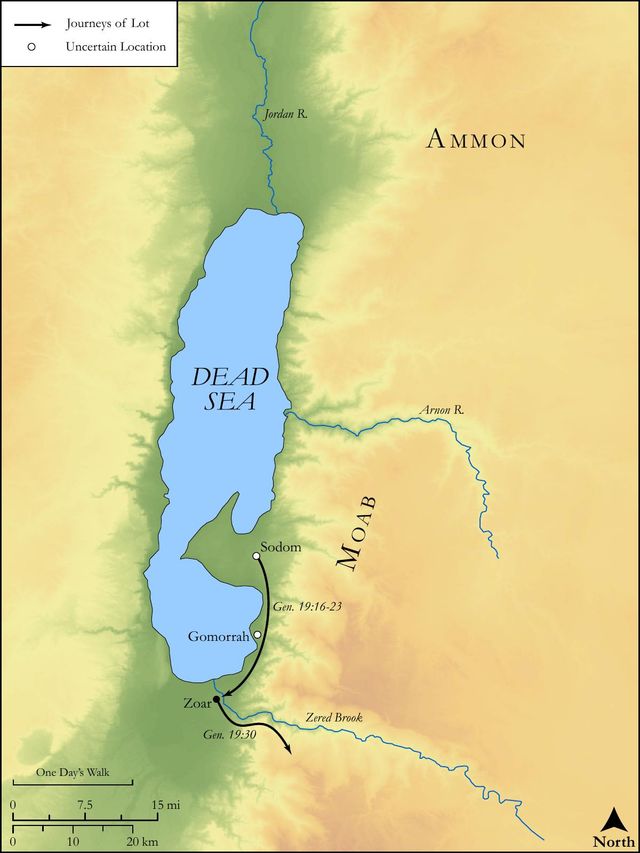
Study this verse
Public-domain commentary
Matthew Henry
From his Commentary on the Whole Bible. Henry comments on passages, not single verses — this entry covers Genesis 19:30–38. His four-level outline is real structure in the source text, so it is rendered as structure.
Here is, I. The great trouble and distress that Lot was brought into after his deliverance, Gen 19:30. 1. He was frightened out of Zoar, durst not dwell there; probably because he was conscious to himself that it was a refuge of his own choosing and that herein he had foolishly prescribed to God, and therefore he could not but distrust his safety in it; or because he found it as wicked as Sodom, and therefore concluded it could not long survive it; or perhaps he observed the rise and increase of those waters which after the conflagration, perhaps from Jordan, began to overflow the plain, and which, mixing with the ruins, by degrees made the Dead Sea; in those waters he concluded Zoar must needs perish (though it had escaped the fire) because it stood upon the same flat. Note, Settlements and shelters of our own choosing, and in which we do not follow God, commonly prove uneasy to us. 2. He was forced to betake himself to the mountain, and to take up with a cave for his habitation there. Methinks it was strange that he did not return to Abraham, and put himself under his protection, to whom he had once and again owed his safety: but the truth is there are some good men that are not wise enough to know what is best for themselves. Observe, (1.) He was now glad to go to the mountain, the place which God had appointed for his shelter. Note, It is well if disappointment in our way drive us at last to God's way. (2.) He that, awhile ago, could not find room enough for himself and his stock in the whole land, but must jostle with Abraham, and get as far from him as he could, is now confined to a hole in a hill, where he has scarcely room to turn himself, and there he is solitary and trembling. Note, It is just with God to reduce those to poverty and restraint who have abused their liberty and plenty. See also in Lot what those bring themselves to, at last, that forsake the communion of saints for secular advantages; they will be beaten with their own rod.
II.The great sin that Lot and his daughters were guilty of, when they were in this desolate place. It is a sad story.
1.His daughters laid a very wicked plot to bring him to sin; and theirs was, doubtless, the greater guilt. They contrived, under pretence of cheering up the spirits of their father in his present condition, to make him drunk, and then to lie with him, Gen 19:31, Gen 19:32.
(1.)Some think that their pretence was plausible. Their father had no sons, they had no husbands, nor knew they were to have any of the holy seed, or, if they had children by others, their father's name would not be preserved in them. Some think that they had the Messiah in their eye, who, they hoped, might descend form their father; for he came from Terah's elder son, who separated from the rest of Shem's posterity as well as Abraham, and was now signally delivered out of Sodom. Their mother, and the rest of the family, were gone; they might not marry with the cursed Canaanites; and therefore they supposed that the end they aimed at and the extremity they were brought to, would excuse the irregularity. Thus the learned Monsieur Allix. Note, Good intentions are often abused to patronize bad actions. But,
(2.)Whatever their pretence was, it is certain that their project was very wicked and vile, and an impudent affront to the very light and law of nature. Note,
[1.]The sight of God's most tremendous judgments upon sinners will not of itself, without the grace of God, restrain evil hearts from evil practices: one would wonder how the fire of lust could possibly kindle upon those, who had so lately been the eye-witnesses of Sodom's flames.
[2.]Solitude has its temptations as well as company, and particularly to uncleanness. When Joseph was alone with his mistress he was in danger, Gen 39:11. Relations that dwell together, especially if solitary, have need carefully to watch even against the least evil thought of this kind, lest Satan get an advantage.
2.Lot himself, by his own folly and unwariness, was wretchedly overcome, and suffered himself so far to be imposed upon by his own children as, two nights together, to be drunk, and to commit incest, Gen 19:33, etc. Lord, what is man! What are the best of men, when God leaves them to themselves! See here,
(1.)The peril of security. Lot, who not only kept himself sober and chaste in Sodom, but was a constant mourner for the wickedness of the place and a witness against it, was yet, in the mountain, where he was alone, and as he thought quite out of the way of temptation, shamefully overtaken. Let him therefore that thinks he stands, stands high and stands firm, take heed lest he fall. No mountain, on this side the holy hill above, can set us out of the reach of Satan's fiery darts.
(2.)The peril of drunkenness. It is not only a great sin itself, but it is the inlet of many sins; it may prove the inlet of the worst and mast unnatural sins, which may b a perpetual wound and dishonour. Excellently does Mr. Herbert describe it,
He that is drunken may his mother kill
Big with his sister -
A man may do that without reluctance, when he is drunk, which, when he is sober, he could not think of without horror. (3.) The peril of temptation from our dearest relations and friends, whom we love, and esteem, and expect kindness from. Lot, whose temperance and chastity were impregnable against the batteries of foreign force, was surprised into sin and shame by the base treachery of his own daughters: we must dread a snare wherever we are, and be always upon our guard.
3.In the close we have an account of the birth of the two sons, or grandsons (call them which you will), of Lot, Moab and Ammon, the fathers of two nations, neighbours to Israel, and which we often read of in the Old Testament; both together are called the children of Lot, Psa 83:8. Note, Though prosperous births may attend incestuous conceptions, yet they are so far from justifying them that they rather perpetuate the reproach of them and entail infamy upon posterity; yet the tribe of Judah, of which our Lord sprang, descended from such a birth, and Ruth, a Moabitess, has a name in his genealogy, Mat 1:3, Mat 1:5.
Lastly, Observe that, after this, we never read any more of Lot, nor what became of him: no doubt he repented of his sin, and was pardoned; but from the silence of the scripture concerning him henceforward we may learn that drunkenness, as it makes men forgetful, so it makes them forgotten; and many a name, which otherwise might have been remembered with respect, is buried by it in contempt and oblivion.
Historical interpretation
Historical reception
1 surviving comment on this verse from the historical church.
After these things now that well-known story is related in which it is written that Lot’s daughters cunningly lay with their father by stealth. In this matter I do not know if anyone can so excuse Lot as to free him from sin. Nor again do I think he should be so accused that he ought to become party to such serious incest. For I do not find him to have plotted against or to have violently snatched away the chastity of his daughters but rather to have been the victim of a plot and cunningly ensnared. But neither would he have been ensnared by the girls unless he could have been inebriated. Thus he seems to me to be found partly culpable and partly excusable. For indeed he can be excused because he is free of the offense of concupiscence and pleasure, and because he is shown neither to have wished nor to have consented to those wishing. But he is at fault because he could be trapped, because he indulged in wine too much, and this not once, but he did it a second time.For instance, even Scripture seems to me to make excuse for him in a certain manner when it says, “For he did not know when he slept with them and when he arose.” This is not said of the daughters, who intentionally and cunningly deceive their father. He, however, was so senseless from wine that he did not know that he lay with his older daughter or with the younger.
Hear what drunkenness does. Hear what an outrage intoxication produces. Hear and beware, you who do not hold that evil to be a fault but practice it. Drunkenness deceives him whom Sodom did not deceive. He whom the sulphurous flame did not burn is burned by the flames of women.
Continue studying Genesis 19:33 across the web’s major study libraries — every link below opens this exact verse, chapter, or book on the destination site.
Read & Compare
 BibleGatewayThis verse in more than 200 translations and 70 languages.
 Bible.comThe YouVersion reader — hundreds of translations, reading plans, and highlights.
 ESV.orgCrossway's official English Standard Version reader.
 NET BibleThe NET translation with 60,000+ translators' notes on every rendering decision.
 STEP BibleTyndale House's free study tool — original text, vocabulary, and scholarly resources.
 BibliaLogos Bible Software's free web reader.
 USCCBThe New American Bible (Revised Edition) with the U.S. bishops' study notes.
Commentaries
 BibleHub CommentariesDozens of classic commentaries on this verse, gathered on one page.
 StudyLightMore than 100 commentary sets — the largest collection on the web.
 BibleRefPlain-English commentary on what this verse means, verse by verse.
 Enduring WordDavid Guzik's free commentary on this chapter, widely used by Bible teachers.
 Bible Study ToolsVerse commentary alongside Greek and Hebrew study aids.
Original Language & Research
- BibleHub InterlinearThe verse word by word — original language, transliteration, and English.
- BibleHub LexiconEvery word's original-language definition and Strong's entry.
 Blue Letter BibleDeep-study tools — Strong's numbers, concordance, and word studies.
 SefariaThe Hebrew text with Rashi and centuries of Jewish commentary.
Sermons, Hymns & Audio


TrulyRandomVerse is not affiliated with these sites and doesn’t control their content. They’re linked because they’re genuinely useful.
Summary
Genesis 19:33 starkly portrays a morally desperate act by Lot's daughters, who, believing themselves to be the last hope for humanity's continuation after the destruction of Sodom and Gomorrah, conspire to intoxicate their father. The verse details the first night of this incestuous scheme, where the elder daughter lies with Lot, who, rendered completely oblivious by the wine, remains unaware of the profound violation occurring. This disturbing account underscores the extreme lengths to which perceived necessity can drive human behavior, the devastating consequences of intoxication, and the pervasive nature of sin even in the aftermath of divine judgment.
Context
ShowHideLiterary Context
Genesis 19:33 is situated immediately following the divine judgment upon Sodom and Gomorrah, from which Lot and his two daughters are miraculously delivered by angels. The preceding verses (Genesis 19:15-26) describe their urgent escape and the tragic fate of Lot's wife, who disobeys the angelic warning and is turned into a pillar of salt. Lot and his daughters then seek refuge in a cave in the mountains, a place of isolation and perceived desolation. This verse initiates a new, dark chapter in their story, driven by the daughters' perceived need to preserve their family line, directly leading to the origins of the Moabite and Ammonite peoples.
Historical & Cultural Context
In the households of the patriarchs, the continuation of a family line was paramount, often seen as a form of immortality and a sacred duty. The concept of "raising up offspring" for a deceased kinsman (levirate marriage, though not directly applicable here, illustrates the cultural emphasis on lineage) or ensuring the survival of a clan was deeply ingrained. The daughters' actions, while abhorrent, are presented within a context where they genuinely believe all other potential mates have been annihilated in the cataclysm. Their isolation in the cave, away from any surviving populations, likely reinforced this extreme perception. Furthermore, the narrative implicitly critiques the dangers of intoxication, a theme common in biblical wisdom literature, where loss of control often leads to moral failure.
Key Themes
ShowHideThis passage contributes to several overarching themes in Genesis and the broader biblical narrative. It highlights the pervasiveness of human sin and depravity, demonstrating that even those spared from judgment can quickly succumb to moral compromise, as seen in the daughters' scheme and Lot's vulnerability. It also explores the consequences of human desperation and fear, showing how extreme circumstances can lead individuals to violate fundamental moral boundaries. Furthermore, the narrative continues the theme of lineage and covenant, albeit through a morally compromised origin, setting the stage for the future interactions between Israel and the Moabite and Ammonite nations, whose origins are explicitly traced back to these events in Genesis 19:37-38. The story also serves as a cautionary tale regarding the dangers of intoxication, a theme echoed in later wisdom literature like Proverbs 20:1.
Exposition and Analysis
ShowHideKey Word Analysis
ShowHideThis term denotes Lot, the direct paternal figure. Its use here emphasizes the profound violation of familial bonds and natural order inherent in the incestuous act. The daughters' scheme targets their own father, highlighting the depth of their desperation and the moral degradation.
This primitive root means "to quaff" or "to furnish a potion to." Here, it is used causatively, indicating the daughters actively "made their father drink" wine. This highlights their premeditated action and their intent to incapacitate Lot, removing his agency and awareness.
This feminine noun specifically refers to the eldest daughter. The text's explicit mention of "the firstborn" and then "the younger" in the subsequent verse (Genesis 19:34) emphasizes the systematic and sequential nature of their plan, with each daughter taking her turn.
This versatile primitive root means "to know," "to ascertain by seeing," or "to be aware." In this context, the negative "he perceived not" (wəloʾ-yāḏaʿ) is crucial, underscoring Lot's complete lack of awareness or knowledge of the sexual act. This ignorance is directly attributed to his intoxication, mitigating his direct culpability for the sexual sin while still implicating him in the broader moral failure of drunkenness.
Verse Breakdown
ShowHide"And they made their father drink wine that night:"
This clause establishes the daughters' initiative and the calculated nature of their plan. They are the active agents in intoxicating Lot, setting the stage for the subsequent events. The mention of "that night" emphasizes the darkness and secrecy surrounding the act, a common biblical motif for deeds of shame.
"and the firstborn went in, and lay with her father;"
This is the direct and unambiguous description of the incestuous act. The Hebrew verb "lay" (shâkab) is a common euphemism for sexual intercourse, leaving no doubt about the nature of the encounter. The phrase "went in" further emphasizes the physical intimacy and violation.
"and he perceived not when she lay down, nor when she arose."
This concluding clause highlights Lot's state of utter unconsciousness or extreme intoxication. His inability to "perceive" (yada') or know what happened, both at the beginning and end of the act, is central to understanding his passive role and the daughters' deception. It underscores the profound dangers of drunkenness, which can render an individual completely vulnerable and unaware of grievous sin committed against or by them.
Literary Devices
ShowHideThe passage employs several potent literary devices. Irony is evident in the fact that Lot, who was miraculously saved from the moral depravity of Sodom, now becomes a participant, albeit unwitting, in an equally grievous sin. The divine judgment on Sodom was for its sexual perversion, and here, a form of sexual perversion occurs within the family of the one spared. The Repetition of Lot's lack of perception ("he perceived not when she lay down, nor when she arose") emphasizes his complete incapacitation and the daughters' successful manipulation. The Foreshadowing of the future Moabite and Ammonite nations through this act of incest subtly points to the morally compromised origins of these peoples, which will later be significant in Israel's history. The stark, unadorned language used to describe the act itself (e.g., "lay with her father") serves as a form of Understatement or Litotes, allowing the shocking nature of the event to speak for itself without excessive embellishment, thus increasing its impact.
Theological and Thematic Connections
ShowHideThis disturbing narrative serves as a stark reminder of the pervasive reach of sin, even into the lives of those who have experienced divine deliverance. While Lot and his daughters were spared from the fiery judgment of Sodom, they quickly fall prey to a different form of moral corruption, driven by fear and desperation. This illustrates the inherent human tendency towards sin, regardless of external circumstances or divine intervention, emphasizing the need for ongoing spiritual vigilance and reliance on God's grace. The passage also highlights the severe consequences of intoxication, which impairs judgment and renders individuals vulnerable to grievous sin and exploitation.
Reflection and Application
ShowHideThe account in Genesis 19:33, though unsettling, offers profound lessons for contemporary believers. It compels us to examine the sources of our own decisions, particularly when confronted with fear or perceived hopelessness. The daughters' actions, born of extreme desperation, serve as a cautionary tale against allowing circumstances, no matter how dire, to dictate our moral compass. Our hope and security must always be rooted in God's sovereign plan and unfailing provision, rather than in human schemes that violate His commands. Furthermore, Lot's unwitting complicity due to intoxication is a powerful warning against the dangers of excessive alcohol consumption. It underscores how losing control of one's faculties can lead to vulnerability, moral compromise, and a loss of dignity and awareness, making one susceptible to sin and exploitation. This narrative calls us to cultivate sobriety, self-control, and a steadfast commitment to God's standards, trusting that His grace is sufficient even in the most challenging of times.
Questions for Reflection
ShowHideFAQ
ShowHideWhy did Lot's daughters believe there were no other men on earth?
ShowHideAfter witnessing the cataclysmic destruction of Sodom, Gomorrah, and the surrounding cities, and having been explicitly instructed by the angels to flee to the mountains and not look back (as seen in Genesis 19:17), Lot's daughters likely interpreted the widespread devastation as a complete annihilation of all humanity outside of their immediate family. Their subsequent isolation in the cave, away from any signs of life or other human settlements, would have reinforced this perception of utter desolation, leading them to believe they were the last hope for human procreation.
Was Lot culpable for the incestuous act?
ShowHideThe text states that Lot "perceived not" the act, emphasizing his complete unawareness due to his extreme intoxication. This mitigates his direct culpability for willingly participating in the sexual act itself. However, Lot is certainly culpable for his state of profound drunkenness. The Bible consistently warns against the dangers of excessive alcohol consumption, which impairs judgment and renders an individual vulnerable to sin and exploitation. While the daughters were the instigators and deceivers, Lot's failure to maintain sobriety created the conditions for this moral atrocity, making him indirectly responsible for the situation that unfolded.
What is the significance of the offspring born from these acts?
ShowHideThe sons born from these incestuous unions were Moab (from the elder daughter) and Ben-Ammi (the progenitor of the Ammonites, from the younger daughter), as detailed in Genesis 19:37-38. These two nations, the Moabites and the Ammonites, became significant and often antagonistic neighbors to Israel throughout their history. Their origins in incest and Lot's moral failure served as a perpetual reminder of their separation from the covenant people of God and their morally compromised beginnings. This narrative explains the deep-seated animosity and cultural distinctions between Israel and these nations, which are frequently mentioned in subsequent biblical books like Numbers 22-24 and Judges 10:6-9.
Christ-Centered Fulfillment
ShowHideWhile Genesis 19:33 paints a grim picture of human depravity and moral compromise, it powerfully underscores the profound need for a divine Savior. This narrative demonstrates that even those who have witnessed God's direct intervention and judgment remain susceptible to the pervasive corruption of sin, highlighting humanity's inherent brokenness and inability to redeem itself. In the person and work of Jesus Christ, we find the ultimate answer to such moral darkness. His perfect life, atoning death on the cross, and victorious resurrection provide the only true escape from the cycle of sin, desperation, and moral failure that Lot's family exemplifies. The fact that God's redemptive plan, culminating in Christ, unfolds even through such morally compromised lineages (for instance, Ruth, a Moabitess, is found in Christ's genealogy in Matthew 1:5) beautifully illustrates His sovereign grace and His ability to work His purposes despite, and even through, human sin. Christ is the Lamb of God who takes away the sin of the world, offering forgiveness and new life where only despair and depravity once reigned, as proclaimed in John 1:29. He is the one who delivers us from the power of darkness and transfers us into His kingdom of light, as celebrated in Colossians 1:13-14.