


Genesis 14:9
Bible text: King James Version (1769 Blayney text) · Public domain
Bible text: King James Version with Strong's numbers · Public domain
Bible text: Berean Standard Bible · Public domain
Bible text: American Standard Version (1901) · Public domain
Bible text: World English Bible, Messianic edition · Public domain
Bible text: Geneva Bible (1599) · Public domain
Bible text: Young's Literal Translation · Public domain
- אֵת'etwithH854PrepPreposition
- כְּדָרְלָעֹמֶרke·da·re·la·'O·merKedorlaomerH3540N-proper-mNoun Proper Masculine
- מֶלֶךְMe·lekh[the] king ofH4428N-mscNoun Singular Masculine Construct
- עֵילָם'ei·LamElamH5867N-properNoun Proper Location
- וְתִדְעָלve·tid·'Aland TidalH8413Conj-w ¦ N-proper-mNoun Proper MasculineוְandתִדְעָלTidal
- מֶלֶךְMe·lekh[the] king ofH4428N-mscNoun Singular Masculine Construct
- גּוֹיִםgo·YimGoyimH1471N-properNoun Proper Location
- וְאַמְרָפֶלve·'am·ra·Feland AmraphelH569Conj-w ¦ N-proper-mNoun Proper MasculineוְandאַמְרָפֶלAmraphel
- מֶלֶךְMe·lekh[the] king ofH4428N-mscNoun Singular Masculine Construct
- שִׁנְעָרshin·'ArShinarH8152N-properNoun Proper Location
- וְאַרְיוֹךְve·'ar·Yokhand AriochH746Conj-w ¦ N-proper-mNoun Proper MasculineוְandאַרְיוֹךְArioch
- מֶלֶךְMe·lekh[the] king ofH4428N-mscNoun Singular Masculine Construct
- אֶלָּסָר'e·la·SarEllasarH495N-properNoun Proper Location
- אַרְבָּעָה'ar·ba·'AhfourH702Adj-csAdjective Numerical Singular common gender Absolute
- מְלָכִיםme·la·KhimkingsH4428N-mpNoun Plural Masculine Absolute
- אֶת'etwithH854PrepPreposition
- הַחֲמִשָּׁהha·cha·mi·Shahthe fiveH2568Art ¦ Adj-csAdjective Numerical Singular common gender Absoluteהַtheחֲמִשָּׁהfive
English is a literal word-by-word gloss of the Hebrew, not the KJV's wording. Why?
This is the original text the KJV's translators worked from — each Hebrew word with its own literal English meaning in this verse, prepared by scholars at Tyndale House, Cambridge. The KJV translates whole sentences, not word by word, so its wording differs: one Hebrew word can become several English words, and the KJV may choose “the LORD” where the gloss reads “Yahweh”. Both are faithful — they answer different questions. For the KJV's own rendering, switch to the KJV text.
Details
See on the biblical-era maps


Study this verse
Public-domain commentary
Matthew Henry
From his Commentary on the Whole Bible. Henry comments on passages, not single verses — this entry covers Genesis 14:1–12. His three-level outline is real structure in the source text, so it is rendered as structure.
We have here an account of the first war that ever we read of in scripture, which (though the wars of the nations make the greatest figure in history) we should not have had the history of if Abram and Lot had not been concerned in it. Now, concerning this war, we may observe,
I.The parties engaged in it.
The invaders were four kings, two of them no less than kings of Shinar and Elam (that is, Chaldea and Persia), yet probably not the sovereign princes of those great kingdoms in their own persons, but either officers under them, or rather the heads and leaders of some colonies which came out of those great nations, and settled themselves near Sodom, but retained the names of the countries from which they had their origin. The invaded were the kings of five cities that lay near together in the plain of Jordan, namely, Sodom, Gomorrah, Admah, Zeboiim, and Zoar. Four of them are named, but not the fifth, the king of Zoar or Bela, either because he was much more mean and inconsiderable or because he was much more wicked and inglorious than the rest, and worthy to be forgotten.
II.The occasion of this war was the revolt of the five kings from under the government of Chedorlaomer.
Twelve years they served him. Small joy they had of their fruitful land, while thus they were tributaries to a foreign power, and could not call what they had their own. Rich countries are a desirable prey, and idle luxurious countries are an easy prey, to growing greatness. The Sodomites were the posterity of Canaan whom Noah had pronounced a servant to Shem, from whom Elam descended; thus soon did that prophecy begin to e fulfilled. In the thirteenth year, beginning to be weary of their subjection, they rebelled, denied their tribute, and attempted to shake off the yoke and retrieve their ancient liberties. In the fourteenth year, after some pause and preparation, Chedorlaomer, in conjunction with his allies, set himself to chastise and reduce the rebels, and, since he could not have it otherwise, to fetch his tribute from them on the point of his sword. Note, Pride, covetousness, and ambition, are the lusts from which wars and fightings come. To these insatiable idols the blood of thousands has been sacrificed.
III.The progress and success of the war.
The four kings laid the neighbouring countries waste and enriched themselves with the spoil of them (Gen 14:5-7), upon the alarm of which it had been the wisdom of the king of Sodom to submit, and desire conditions of peace; for how could he grapple with an enemy thus flushed with victory? But he would rather venture the utmost extremity than yield, and it sped accordingly. Quos Deus destruet eos dementat - Those whom God means to destroy he delivers up to infatuation.
1.The forces of the king of Sodom and his allies were routed; and, it should seem, many of them perished in the slime-pits who had escaped the sword, Gen 14:10. In all places we are surrounded with deaths of various kinds, especially in the field of battle.
2.The cities were plundered, Gen 14:11. All the goods of Sodom, and particularly their stores and provisions of victuals, were carried off by the conquerors. Note, When men abuse the gifts of a bountiful providence to gluttony and excess, it is just with God, and his usual way, by some judgment or other to strip them of that which they have so abused, Hos 2:8, Hos 2:9.
3.Lot was carried captive, Gen 14:12. They took Lot among the rest, and his goods. Now Lot may here be considered,
(1.)As sharing with his neighbours in this common calamity. Though he was himself a righteous man, and (which is here expressly noticed) Abram's brother's son, yet he was involved with the rest in all this trouble. Note, All things come alike to all, Ecc 9:2. The best of men cannot promise themselves an exemption from the greatest troubles in this life; neither from our own piety nor our relation to those that are the favourites of heaven will be our security, when God's judgments are abroad. Note, further, Many an honest man fares the worse for his wicked neighbours. It is therefore our wisdom to separate ourselves, or at least to distinguish ourselves, from them (Co2 6:17), and so deliver ourselves, Rev 18:4.
(2.)As smarting for the foolish choice he made of a settlement here. This is plainly intimated when it is said, They took Abram's brother's son, who dwelt in Sodom. So near a relation of Abram should have been a companion and disciple of Abram, and should have abode by his tents; but, if he choose to dwell in Sodom, he must thank himself if he share in Sodom's calamities. Note, When we go out of the way of our duty we put ourselves from under God's protection, and cannot expect that the choices which are made by our lusts should issue to our comfort. Particular mention is made of their taking Lot's goods, those goods which had occasioned his contest with Abram and his separation from him. Note, It is just with God to deprive us of those enjoyments by which we have suffered ourselves to be deprived of our enjoyment of him.
Continue studying Genesis 14:9 across the web’s major study libraries — every link below opens this exact verse, chapter, or book on the destination site.
Read & Compare
 BibleGatewayThis verse in more than 200 translations and 70 languages.
 Bible.comThe YouVersion reader — hundreds of translations, reading plans, and highlights.
 ESV.orgCrossway's official English Standard Version reader.
 NET BibleThe NET translation with 60,000+ translators' notes on every rendering decision.
 STEP BibleTyndale House's free study tool — original text, vocabulary, and scholarly resources.
 BibliaLogos Bible Software's free web reader.
 USCCBThe New American Bible (Revised Edition) with the U.S. bishops' study notes.
Commentaries
 BibleHub CommentariesDozens of classic commentaries on this verse, gathered on one page.
 StudyLightMore than 100 commentary sets — the largest collection on the web.
 BibleRefPlain-English commentary on what this verse means, verse by verse.
 Enduring WordDavid Guzik's free commentary on this chapter, widely used by Bible teachers.
 Bible Study ToolsVerse commentary alongside Greek and Hebrew study aids.
Original Language & Research
- BibleHub InterlinearThe verse word by word — original language, transliteration, and English.
- BibleHub LexiconEvery word's original-language definition and Strong's entry.
 Blue Letter BibleDeep-study tools — Strong's numbers, concordance, and word studies.
 SefariaThe Hebrew text with Rashi and centuries of Jewish commentary.
Sermons, Hymns & Audio


TrulyRandomVerse is not affiliated with these sites and doesn’t control their content. They’re linked because they’re genuinely useful.
Summary
A critical enumeration of the formidable eastern coalition: Chedorlaomer, king of Elam; Tidal, king of nations; Amraphel, king of Shinar; and Arioch, king of Ellasar. This verse precisely identifies the four powerful monarchs who united to confront the five rebellious kings of the Jordan plain, thereby establishing the overwhelming geopolitical scale and military might that directly led to Lot's capture and, subsequently, precipitated Abraham's divinely empowered intervention.
Context
ShowHideLiterary Context
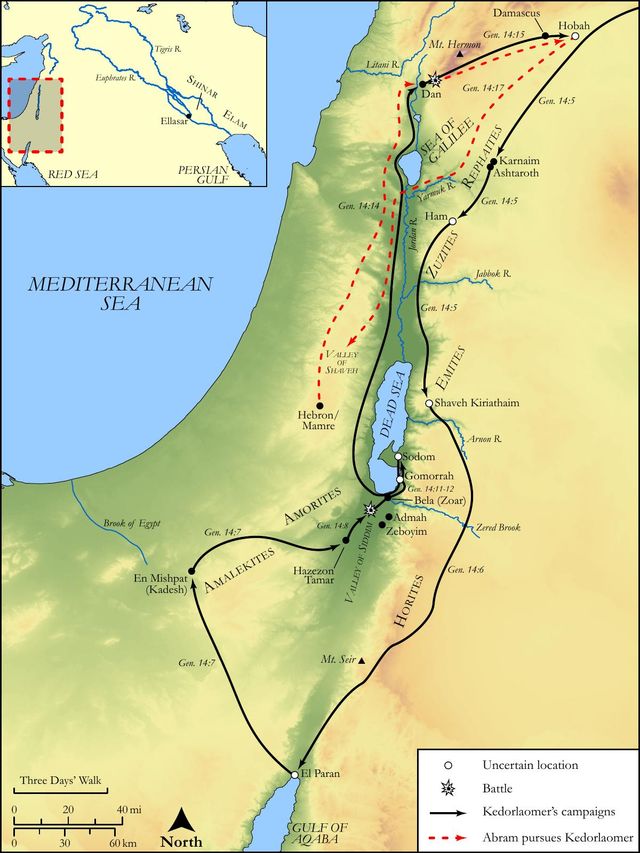
This verse is deeply embedded within Genesis chapter 14, a unique narrative within the patriarchal history that details a significant regional conflict. The preceding verses, Genesis 14:1-4, introduce Chedorlaomer's long-standing dominion over the Jordan plain kings and their subsequent rebellion. Following this, Genesis 14:5-7 describes the eastern kings' punitive campaign against various peoples south and east of the Jordan, demonstrating their military prowess and strategic intent before directly engaging the rebellious kings. Genesis 14:9 specifically names the leaders of this eastern alliance, setting the stage for the climactic battle in Genesis 14:8-10 where they decisively defeat the kings of Sodom and Gomorrah, leading to Lot's capture in Genesis 14:12 and Abraham's subsequent heroic rescue.
Historical & Cultural Context
The events of Genesis 14 reflect the geopolitical realities of the early second millennium BCE, a period characterized by powerful city-states and regional empires vying for dominance and control over trade routes and resources. Elam, located in modern-day southwestern Iran, was a significant political and military force, often in conflict or alliance with the kings of Shinar. Shinar refers to Sumer or Babylonia, the cradle of civilization between the Tigris and Euphrates rivers. "King of nations" (Hebrew: Tidal goyim) suggests a ruler over a confederation of diverse peoples, possibly nomadic groups or a loosely defined territory, rather than a single, established kingdom. Ellasar's exact location is debated but is generally placed in Mesopotamia, perhaps Larsa. The narrative accurately portrays the practice of tribute and punitive expeditions common in that day, lending a strong sense of historical verisimilitude to the biblical account of these powerful rulers from distant lands asserting their authority over smaller, local city-states in the fertile crescent.
Key Themes
ShowHideGenesis 14:9 contributes to several overarching themes within Genesis and the broader biblical narrative. Firstly, it underscores the sovereignty of God over human history and geopolitical affairs, even amidst the seemingly chaotic conflicts of powerful empires. The detailed listing of these formidable kings serves to magnify the later divine empowerment of Abraham, highlighting that his victory was not merely a human feat but a testament to God's intervention on behalf of His covenant people. This episode also introduces the theme of Abraham's role as a deliverer and protector of his kin, foreshadowing the future role of Israel and ultimately, Christ. Furthermore, the conflict between these "kings of the world" and the nascent people of God establishes an early biblical precedent for the ongoing spiritual warfare between the kingdom of God and worldly powers, a theme that resonates throughout the Old Testament and finds its ultimate culmination in the New Testament's depiction of Christ's triumph over all earthly and spiritual dominion, as seen in passages like Colossians 2:15.
Exposition and Analysis
ShowHideGenesis 14:9 presents a stark and direct listing of the four allied eastern kings: Chedorlaomer king of Elam, Tidal king of nations, Amraphel king of Shinar, and Arioch king of Ellasar. This enumeration is not merely a roll call; it serves to underscore the immense power and widespread reach of the forces arrayed against the local kings of the Jordan plain, setting the stage for the dramatic events that follow.
Key Word Analysis
ShowHideDerived from the root meaning "to rule" or "to reign," this term denotes a sovereign ruler, one who exercises authority over a territory or people. Its repeated use in Genesis 14:9 emphasizes the royal status and inherent power of each individual named, highlighting that this is not a mere band of marauders but a coalition of established monarchs, each with their own realm and military might. The presence of multiple "kings" underscores the significant political and military alliance formed.
This word, often translated as "Gentile" or "heathen," refers to a foreign people or a collective group. In the context of Tidal, "king of nations" suggests a dominion that is not confined to a single, clearly defined kingdom but perhaps encompasses a diverse confederation of tribes, peoples, or a broad, undefined territory. This implies a formidable and potentially unpredictable force, drawing strength from a wide array of sources, making Tidal's military contribution particularly significant and diverse.
These primitive numerals succinctly summarize the two opposing alliances. The "four kings with five" immediately establishes the numerical and implied power imbalance. It signifies four unified, powerful eastern monarchs confronting five rebellious, likely less cohesive, local kings. This concise numerical summary sets the stage for the decisive battle, emphasizing the overwhelming odds faced by the Jordan plain kings and, by extension, the daunting challenge that Abraham would later confront.
Verse Breakdown
ShowHide"With Chedorlaomer the king of Elam"
This clause introduces the apparent leader and dominant figure of the eastern coalition. Chedorlaomer, from the powerful kingdom of Elam (modern-day southwestern Iran), had held the Jordan plain kings in subjection for twelve years, indicating his established authority and military might. His presence signifies the primary force behind the punitive expedition.
"and with Tidal king of nations"
Tidal's title, "king of nations," is unique and suggests a ruler not of a single, defined kingdom but possibly a confederation of various peoples or tribes. This indicates a broad and diverse military contribution to the alliance, perhaps from nomadic groups or a loosely organized dominion, adding to the formidable nature of the eastern forces.
"and Amraphel king of Shinar"
Amraphel rules over Shinar, the biblical name for Sumer or Babylonia, a central and historically significant region in Mesopotamia. This places his kingdom in a powerful and ancient land, known for its advanced civilization and military capabilities, further solidifying the formidable nature of the eastern alliance.
"and Arioch king of Ellasar"
Arioch, king of Ellasar, completes the list of the four allied monarchs. While Ellasar's exact location is debated, it is generally placed in Mesopotamia, possibly linked to the city-state of Larsa. His inclusion underscores the widespread nature of this coalition, drawing power from Elam, Shinar, and Ellasar.
"four kings with five"
This concluding phrase is a concise and powerful summary of the opposing forces. It highlights the numerical superiority of the eastern coalition (four unified kings) against the five rebellious kings of the Jordan plain. This succinct statement immediately communicates the overwhelming odds and sets the stage for the decisive victory of the eastern alliance, which directly leads to Lot's capture and Abraham's subsequent intervention.
Literary Devices
ShowHideGenesis 14:9 effectively employs several literary devices to convey its message. The primary device is Enumeration, as the verse meticulously lists the four allied kings and their respective kingdoms. This detailed listing serves not merely as an informative roll call but as a means of establishing the immense power, geographical reach, and formidable nature of the eastern coalition. By naming each king and their domain, the text creates a sense of gravitas and historical specificity, grounding the narrative in a discernible geopolitical reality. Furthermore, there is an element of Juxtaposition in the concluding phrase "four kings with five." This concise statement immediately highlights the numerical imbalance and implied power disparity between the two alliances, setting up the dramatic conflict that follows. The repetition of "king" throughout the verse also functions as a subtle form of Anaphora (though not at the beginning of clauses), reinforcing the royal authority and military might of each individual leader, collectively emphasizing the overwhelming force they represent.
Theological and Thematic Connections
ShowHideThe enumeration of these powerful kings in Genesis 14:9 serves to magnify the scale of the conflict and, by extension, the miraculous nature of God's intervention through Abraham. It underscores the theological truth that even the grandest human empires and their geopolitical machinations operate within the overarching framework of God's divine sovereignty. This episode demonstrates that God is not confined by human power structures or military might; rather, He orchestrates events, even through seemingly secular conflicts, to advance His redemptive purposes and protect His chosen covenant line. The formidable nature of these "kings of the world" highlights the contrast with God's chosen servant, Abraham, who, by divine empowerment, is able to overcome what appears to be an insurmountable worldly force, thereby affirming God's faithfulness to His covenant promises and His ability to deliver His people from overwhelming odds.
Reflection and Application
ShowHideGenesis 14:9, though a historical detail, profoundly reminds us that human history, with its intricate conflicts and power struggles, unfolds under the watchful and sovereign eye of God. The enumeration of these powerful kings highlights the daunting challenges that often arise in life—whether personal struggles, societal injustices, or global conflicts—which can feel overwhelming and insurmountable. Yet, it is precisely within such circumstances that God's providence and power become most evident. Abraham's courageous decision to confront and defeat such a formidable alliance, as described later in Genesis 14:14-16, serves as an enduring example of how God can empower His people to overcome seemingly impossible odds, even when facing forces far greater than their own resources. This narrative encourages believers to trust in God's strength when confronted with overwhelming opposition, to act courageously in defense of truth and righteousness, and to remain loyal to family and community, much like Abraham's initial call to leave his homeland in Genesis 12:1, trusting that God's purposes will prevail for those who follow His call and rely on His divine intervention.
Questions for Reflection
ShowHideFAQ
ShowHideWere these kings historically verifiable outside of the biblical account?
ShowHideWhile direct, unequivocal archaeological or extra-biblical evidence for these specific four kings in the precise configuration of Genesis 14 is not yet definitively established, the names of the kings (Chedorlaomer, Amraphel, Arioch, Tidal) and their kingdoms (Elam, Shinar/Babylonia, Ellasar, "nations") are remarkably consistent with known names, places, and geopolitical realities of the early second millennium BCE. Powerful Elamite rulers, city-states like Larsa (possibly Ellasar), and confederations of "nations" (like the Amorites or Hurrians) are well-attested in extra-biblical records. This consistency lends strong historical plausibility to the biblical narrative, suggesting that the author was familiar with the historical context of the period. While specific corroborating inscriptions for this exact event remain elusive, the general historical framework aligns with what is known of that day, affirming the trustworthiness of the biblical account as a historically grounded narrative.
Christ-Centered Fulfillment
ShowHideThe conflict detailed in Genesis 14, initiated by the formidable kings listed in Genesis 14:9, ultimately leads to Abraham's decisive victory and the rescue of Lot. This event powerfully prefigures Christ's ultimate triumph over the forces of sin, death, and spiritual darkness. Just as Abraham, a type of Christ, confronted and defeated overwhelming worldly powers to deliver his kinsman from captivity, so too did Christ, the true King and Deliverer, conquer the spiritual enemies that held humanity captive, securing eternal salvation for all who believe in Him, as celebrated in Colossians 2:15. Furthermore, Abraham's encounter with Melchizedek, king of Salem and priest of God Most High, immediately following this victory, profoundly points to Christ as the eternal King-Priest, superior to the Levitical priesthood, whose reign and intercession are established not through earthly conflict but through His perfect sacrifice and resurrection, a theme beautifully expounded in Hebrews 7. Thus, the seemingly historical detail of these ancient kings ultimately serves to magnify the far greater victory and eternal reign of our Lord Jesus Christ, the King of kings and Lord of lords, as proclaimed in Revelation 19:16.