


Joshua 8:24
Bible text: King James Version (1769 Blayney text) · Public domain
Bible text: King James Version with Strong's numbers · Public domain
Bible text: Berean Standard Bible · Public domain
Bible text: American Standard Version (1901) · Public domain
Bible text: World English Bible, Messianic edition · Public domain
Bible text: Geneva Bible (1599) · Public domain
Bible text: Young's Literal Translation · Public domain
- וַיְהִיvay·Hiand it wasH1961Conj-w ¦ V-Qal-ConsecImperf-3msVerb Qal Consecutive Imperfect 3rd Singular Masculineוַandיְהִיit was
- כְּכַלּוֹתke·kha·Lotwhen had finishedH3615Prep-k ¦ V-Piel-InfVerb Piel Infinitive Constructכְּwhenכַלּוֹתhad finished
- יִשְׂרָאֵלYis·ra·'ElIsraelH3478N-properNoun Proper Location
- לַהֲרֹגla·ha·Rogto killH2026Prep-l ¦ V-Qal-InfVerb Qal Infinitive Constructלַtoהֲרֹגkill
- אֶת'et<obj.>H853DirObjMParticle Object Indicator
- כָּלkolallH3605N-mscNoun Singular Masculine Construct
- יֹשְׁבֵיyo·she·Vei[the] inhabitants ofH3427V-Qal-Prtcpl-mpVerb Qal Participle Plural Masculine Construct
- הָעַיha·'Ai<the> AiH5857Art ¦ N-properNoun Proper Locationהָ<the>עַיAi
- בַּשָּׂדֶהba·sa·Dehin the open countryH7704Prep-b ¦ N-msNoun Singular Masculine Absoluteבַּin theשָּׂדֶהopen country
- בַּמִּדְבָּרba·mid·Barin the wildernessH4057Prep-b ¦ N-msNoun Singular Masculine Absoluteבַּin theמִּדְבָּרwilderness
- אֲשֶׁר'a·SherwhichH834RelParticle Relative
- רְדָפוּםre·da·Fumthey had pursued themH7291V-Qal-Perf-3cp ¦ 3mpVerb Qal Perfect 3rd Plural common genderרְדָפוּthey had pursuedםthem
- בּוֹboin <the> itPrep-b ¦ 3msSuffix Personal 3rd Singular Masculineבּin <the>וֹit
- וַיִּפְּלוּvai·yi·pe·Luand they had fallenH5307Conj-w ¦ V-Qal-ConsecImperf-3mpVerb Qal Consecutive Imperfect 3rd Plural Masculineוַandיִּפְּלוּthey had fallen
- כֻלָּםkhu·Lamall of themH3605N-msc ¦ 3mpNoun Singular Masculine Constructכֻלָּall ofםthem
- לְפִיle·fito [the] mouth ofH6310Prep-l ¦ N-mscNoun Singular Masculine Constructלְtoפִי[the] mouth of
- חֶרֶבChe·rev[the] swordH2719N-fsNoun Singular Feminine Absolute
- עַד'aduntilH5704PrepPreposition
- תֻּמָּםtu·Mamthey were finishedH8552V-Qal-Inf ¦ 3mpVerb Qal Infinitive Constructתֻּמָּwere finishedםthey
- וַיָּשֻׁבוּvai·ya·Shu·vuand they returnedH7725Conj-w ¦ V-Qal-ConsecImperf-3mpVerb Qal Consecutive Imperfect 3rd Plural Masculineוַandיָּשֻׁבוּthey returned
- כָלkholallH3605N-mscNoun Singular Masculine Construct
- יִשְׂרָאֵלYis·ra·'ElIsraelH3478N-properNoun Proper Location
- הָעַיha·'Ai<the> AiH5857Art ¦ N-properNoun Proper Locationהָ<the>עַיAi
- וַיַּכּוּvai·ya·Kuand they attackedH5221Conj-w ¦ V-Hiphil-ConsecImperf-3mpVerb Hiphil Consecutive Imperfect 3rd Plural Masculineוַandיַּכּוּthey attacked
- אֹתָהּ'o·Tah<obj.> itH853DirObjM ¦ 3fsParticle Object Indicatorאֹתָ<obj.>הּit
- לְפִיle·fito [the] mouth ofH6310Prep-l ¦ N-mscNoun Singular Masculine Constructלְtoפִי[the] mouth of
- חָרֶבCha·rev[the] swordH2719N-fsNoun Singular Feminine Absolute
English is a literal word-by-word gloss of the Hebrew, not the KJV's wording. Why?
This is the original text the KJV's translators worked from — each Hebrew word with its own literal English meaning in this verse, prepared by scholars at Tyndale House, Cambridge. The KJV translates whole sentences, not word by word, so its wording differs: one Hebrew word can become several English words, and the KJV may choose “the LORD” where the gloss reads “Yahweh”. Both are faithful — they answer different questions. For the KJV's own rendering, switch to the KJV text.
Details
See on the biblical-era maps
Study this verse
Public-domain commentary
Matthew Henry
From his Commentary on the Whole Bible. Henry comments on passages, not single verses — this entry covers Joshua 8:23–29.
We have here an account of the improvement which the Israelites made of their victory over Ai. 1. They put all to the sword, not only in the field, but in the city, man, woman, and child, none of them remained, Jos 8:24. God, the righteous Judge, had passed this sentence upon them for their wickedness, so that the Israelites were only the ministers of his justice and the executioners of his doom. Once in this story, and but once, mention is made of the men of Beth-el, as confederates with the men of Ai, Jos 8:17. Though they had a king of their own, and were not subjects to the king of Ai (for the king of Beth-el is reckoned among the thirty-one kings that Joshua destroyed, Jos 12:16), yet Ai being a stronger place they threw themselves into that, for their own safety, and the strengthening of their neighbours' hands, and so (we may presume) were all cut off with them; thus that by which they hoped to prevent their own ruin hastened it. The whole number of the slain, it seems, was but 12,000, and inconsiderable body to make head against all the thousands of Israel; but those whom God will destroy he infatuates. Here it is said (Jos 8:26) that Joshua drew not his hand back wherewith he stretched out the spear (Jos 8:18) till the slaughter was completed. Some think the spear he stretched out was not to slay the enemies, but to animate and encourage his own soldiers, some flag or ensign being hung out at the end of this spear; and they observe it as an instance of his self-denial that though the fire of courage wherewith his breast was filled would have pushed him forward, sword in hand, into the hottest of the action, yet, in obedience to God, he kept the inferior post of a standard-bearer, and did not quit it till the work was done. By the spear stretched out, he directed the people to expect their help from God, and to him to give the praise. 2. They plundered the city and took all the spoil to themselves, Jos 8:27. Thus the wealth of the sinner is laid up for the just; the spoil they brought out of Egypt, by borrowing of their neighbours, was much of it expended upon the tabernacle they had reared in the wilderness, for which they are now reimbursed with interest. The spoil here taken, it is probable, was all brought together, and distributed by Joshua in due proportions, as that of the Midianites was, Num 31:26, etc. It was not seized with irregularity or violence, for God is the God or order and equity, and not of confusion. 3. They laid the city in ashes, and left it to remain so, Jos 8:28. Israel must yet dwell in tents, and therefore this city, as well as Jericho, must be burnt. And, though there was no curse entailed upon him that should rebuild it, yet, it seems, it was not rebuilt unless it be the same with Aijah, which we read of, long after, Neh 11:31. Some think it was not rebuilt because Israel had received a defeat before it, the remembrance of which should be buried in the ruins of the city. 4. The king of Ai was taken prisoner and cut off, not by the sword of war as a soldier, but by the sword of justice as a malefactor. Joshua ordered him to be hanged, and his dead body thrown at the gate of his own city, under a heap of stone, Jos 8:23, Jos 8:29. Some particular reason, no doubt, there was for this severity against the king of Ai; it is likely he had been notoriously wicked and vile, and a blasphemer of the God of Israel, perhaps upon occasion of the repulse he had given to the forces of Israel in their first onset. Some observe that his dead body was thrown at the gate where he had been wont to sit in judgment that so much the greater contempt might thereby be poured upon the dignity he had been proud of, and he might be punished for the unrighteous decrees he had made in the very place where he had made them. Thus the Lord is known by the judgments which he executes.
Continue studying Joshua 8:24 across the web’s major study libraries — every link below opens this exact verse, chapter, or book on the destination site.
Read & Compare
 BibleGatewayThis verse in more than 200 translations and 70 languages.
 Bible.comThe YouVersion reader — hundreds of translations, reading plans, and highlights.
 ESV.orgCrossway's official English Standard Version reader.
 NET BibleThe NET translation with 60,000+ translators' notes on every rendering decision.
 STEP BibleTyndale House's free study tool — original text, vocabulary, and scholarly resources.
 BibliaLogos Bible Software's free web reader.
 USCCBThe New American Bible (Revised Edition) with the U.S. bishops' study notes.
Commentaries
 BibleHub CommentariesDozens of classic commentaries on this verse, gathered on one page.
 StudyLightMore than 100 commentary sets — the largest collection on the web.
 BibleRefPlain-English commentary on what this verse means, verse by verse.
 Enduring WordDavid Guzik's free commentary on this chapter, widely used by Bible teachers.
 Bible Study ToolsVerse commentary alongside Greek and Hebrew study aids.
Original Language & Research
- BibleHub InterlinearThe verse word by word — original language, transliteration, and English.
- BibleHub LexiconEvery word's original-language definition and Strong's entry.
 Blue Letter BibleDeep-study tools — Strong's numbers, concordance, and word studies.
 SefariaThe Hebrew text with Rashi and centuries of Jewish commentary.
Sermons, Hymns & Audio


TrulyRandomVerse is not affiliated with these sites and doesn’t control their content. They’re linked because they’re genuinely useful.
Summary
Joshua 8:24 meticulously chronicles the decisive and comprehensive victory of the Israelites over the city of Ai, marking the culmination of a divinely orchestrated military strategy. Following their initial defeat and subsequent repentance, Israel, under God's renewed command, successfully lured the men of Ai into the open wilderness through a feigned retreat. This verse details the complete annihilation of Ai's inhabitants in the field, where they were pursued and slain, and the subsequent return of the Israelite forces to utterly destroy the city itself, underscoring the thoroughness of their obedience to God's command for holy war.
Context
ShowHideLiterary Context
Joshua 8:24 serves as the climactic conclusion to Israel's second campaign against Ai, a narrative arc that began with their humiliating defeat in Joshua 7 due to Achan's sin. After Achan's judgment and the restoration of Israel's covenant purity, God provides Joshua with a new, detailed strategy for taking Ai, involving an ambush and a feigned retreat (Joshua 8:1-13). The preceding verses (Joshua 8:14-23) describe the successful execution of this plan: the men of Ai are drawn out, the ambushers seize the undefended city, and the main Israelite force turns to engage the Ai army in the wilderness. Verse 24 then provides the grim, yet victorious, conclusion to this engagement, confirming the total destruction of the enemy forces before the Israelites return to sack the city itself, a process further detailed in Joshua 8:25-29. This verse is crucial in demonstrating the fulfillment of God's strategic guidance and the complete reversal of Israel's earlier failure, showcasing renewed divine favor.
Historical & Cultural Context
The conquest of Canaan, as depicted in the book of Joshua, occurred in a day when warfare was often brutal and involved the complete destruction of defeated cities and their populations, particularly in cases of holy war or cherem (devotion to destruction). The Canaanite nations, including the inhabitants of Ai, were deeply entrenched in idolatry, child sacrifice, and other abhorrent practices that God had declared an abomination and for which He had pronounced judgment. The divine command to utterly destroy them, as outlined in Deuteronomy 7:1-6, was not merely a military tactic but a divine mandate to prevent spiritual contamination of Israel and to execute God's righteous judgment on a people whose "iniquity was not yet full" but now had reached its zenith (Genesis 15:16). The "wilderness" mentioned refers to the open, uncultivated land surrounding Ai, which provided the ideal terrain for the Israelite ambush and pursuit, allowing for the comprehensive slaughter described.
Key Themes
ShowHideThis verse powerfully contributes to several key themes within the book of Joshua and the broader Pentateuch. Firstly, it highlights Divine Judgment and Justice, demonstrating God's righteous wrath against persistent wickedness and idolatry, fulfilled through Israel as His instrument. The complete annihilation of Ai's inhabitants underscores the severity of God's holiness and His intolerance for sin that has reached its full measure. Secondly, it exemplifies Total Obedience, as Israel's meticulous execution of the cherem command—"slaying all the inhabitants" and "smote it with the edge of the sword"—shows their renewed commitment to God's instructions after their initial disobedience at Joshua 7. This thoroughness was vital for maintaining their covenant purity and securing God's blessing. Thirdly, the narrative arc culminating in this verse powerfully illustrates God's Faithfulness and Restoration. Despite Israel's initial failure at Ai due to Achan's sin, God, in His grace, provided a path to repentance and restored their success when they returned to obedience, proving that His promises to Joshua, such as "I will not fail thee, nor forsake thee" (Joshua 1:5), are contingent on covenant faithfulness.
Exposition and Analysis
ShowHideKey Word Analysis
ShowHideThis primitive root signifies to smite with deadly intent, to kill, murder, or put to death. In the context of Joshua 8:24, it emphasizes the deliberate and lethal action taken by the Israelites against the inhabitants of Ai. It conveys the intentionality of the destruction, aligning with the divine command for cherem, which mandated the complete eradication of the enemy.
This noun refers to a cutting instrument, specifically a sword, dagger, or other sharp implement, deriving its meaning from its destructive effect. The repeated mention of the "sword" in this verse highlights the primary instrument of the Israelites' victory and the brutal reality of ancient warfare, where close-quarters combat with such weapons was common. It underscores the physical, violent nature of the conquest.
This primitive root means to complete, terminate, or utterly destroy, in either a good or bad sense. When applied to the enemy in this verse, it signifies that they were entirely wiped out, brought to an end, or annihilated without remnant. This word reinforces the absolute and comprehensive nature of the slaughter, indicating that no one was left alive, thereby fulfilling the cherem command to its fullest extent.
Verse Breakdown
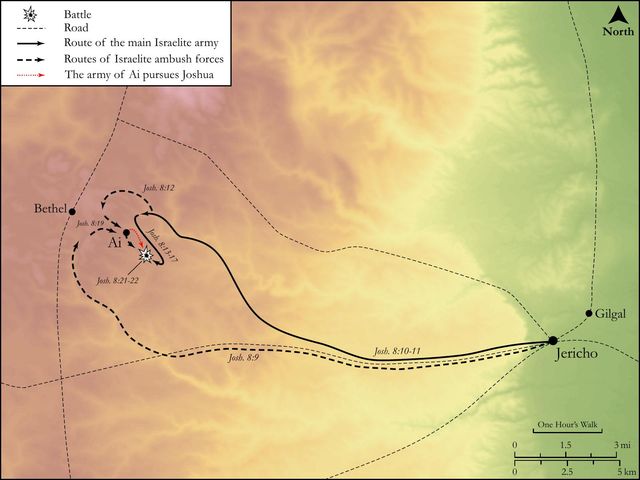
ShowHide"And it came to pass, when Israel had made an end of slaying all the inhabitants of Ai in the field, in the wilderness wherein they chased them,"
This initial clause describes the first phase of the battle's conclusion. It depicts the main Israelite forces, having successfully lured the men of Ai out of their city, engaging and systematically slaughtering them in the open terrain. The specific mention of "the field" and "the wilderness" highlights the strategic success of the ambush, as the enemy was drawn away from their fortifications and trapped in an exposed environment, making their destruction comprehensive.
"and when they were all fallen on the edge of the sword, until they were consumed,"
This phrase emphasizes the totality and finality of the destruction of Ai's fighting men. The word "all" leaves no room for survivors among those who pursued Israel into the wilderness. "Fallen on the edge of the sword" (literally "mouth of the sword") vividly portrays their violent demise by the blade. The concluding phrase "until they were consumed" reinforces the idea of utter annihilation, signifying that no one from the army of Ai remained alive. This was a complete and decisive military victory, leaving no remnant to pose a future threat.
"that all the Israelites returned unto Ai, and smote it with the edge of the sword."
This final clause describes the second and concluding phase of the destruction: the sacking of the city itself. Having dealt with the military forces in the field, the unified Israelite army returned to the now undefended city of Ai. The phrase "smote it with the edge of the sword" indicates the systematic killing of any remaining inhabitants (likely women, children, and the elderly, who would have been left behind in the city) and the destruction of the city's structures. This action completes the cherem command, demonstrating Israel's full obedience in leaving nothing alive that breathed within the city walls, as commanded by God.
Literary Devices
ShowHideJoshua 8:24 employs several potent literary devices to convey the intensity and finality of the battle. Idiom is prominent in the repeated phrase "edge of the sword" (Hebrew: pî-ḥerev, "mouth of the sword"), which personifies the weapon as a devouring entity, emphasizing its destructive power and the complete consumption of the enemy. This vivid imagery is a form of Anthropomorphism, attributing a mouth and the act of eating to an inanimate object. Furthermore, the pervasive use of "all" and "consumed" throughout the verse functions as Hyperbole to underscore the absolute and total nature of the victory, leaving no doubt about the annihilation of Ai's inhabitants. While literally true in the context of the cherem, the language is designed to convey overwhelming completeness. The Repetition of "edge of the sword" reinforces the primary instrument and method of destruction, creating a rhythmic emphasis on the thoroughness of the conquest and the unwavering obedience of Israel.
Theological and Thematic Connections
ShowHideJoshua 8:24 is a stark reminder of God's righteous judgment against sin and His absolute holiness. While challenging for modern sensibilities, the complete destruction of Ai serves as a powerful theological statement about the consequences of persistent rebellion against God and the necessity of removing spiritual corruption from His people's midst. This act was not arbitrary but a fulfillment of divine decree against Canaanite wickedness, demonstrating that God, though merciful, is also a God of justice who will not tolerate unrepentant evil indefinitely. For Israel, it underscored the critical importance of total obedience to God's commands, even the difficult ones, as their success and blessing were directly tied to their faithfulness. This event also highlights God's restorative grace; despite their previous failure at Ai, God's renewed instruction and the subsequent victory demonstrated His willingness to re-engage with His people upon their repentance and renewed commitment to His will.
Reflection and Application
ShowHideJoshua 8:24, while describing a historical event of ancient warfare, offers profound lessons for believers today. It compels us to confront the gravity of sin and the reality of God's righteous judgment. Just as the iniquity of the Canaanites reached its full measure, so too does sin in our lives and in the world incur divine displeasure. This passage calls us to a radical separation from evil and a complete obedience to God's commands, not out of fear, but out of reverence for His holiness and trust in His perfect wisdom. It reminds us that spiritual victory often follows repentance and renewed commitment to God's revealed will. Furthermore, the narrative of Ai's fall, coming after Israel's initial defeat, serves as a powerful testament to God's faithfulness to restore His people after failure, provided they humble themselves, deal with sin, and return to full obedience. It encourages us that even when we stumble, God provides a path to renewed success and blessing when we align our lives with His purposes and diligently remove all that is an offense to His holiness.
Questions for Reflection
ShowHideFAQ
ShowHideWhy did God command such extreme violence, including the complete annihilation of the inhabitants of Ai?
ShowHideThe command for cherem (devotion to destruction) against the Canaanite nations, including Ai, was a unique, divinely ordained act of judgment against peoples whose wickedness had reached its full measure. As outlined in Leviticus 18:24-30, their practices included child sacrifice, pervasive idolatry, and widespread sexual immorality, which defiled the land itself. God, as the righteous Judge of all the earth, was executing a holy judgment, using Israel as His instrument. Furthermore, this command served to protect Israel from spiritual contamination, preventing them from adopting the abhorrent practices of the Canaanites, which would have jeopardized their covenant relationship with God and their role as a holy nation. This was not a general license for violence but a specific, limited, and theologically charged act in salvation history, demonstrating God's justice and His commitment to preserving a holy people through whom He would ultimately bring salvation to the world.
Christ-Centered Fulfillment
ShowHideWhile Joshua 8:24 describes a physical conquest and the execution of divine judgment in the Old Testament, its Christ-centered fulfillment points to a far greater spiritual victory. The thorough destruction of Ai's inhabitants, "consumed" by the "edge of the sword," foreshadows the definitive and total victory of Christ over sin, death, and the powers of darkness. Just as Israel's obedience led to the complete eradication of an earthly enemy, so too does Christ's perfect obedience, culminating in His death and resurrection, secure the complete defeat of our spiritual enemies. He is the ultimate "Lamb of God, who takes away the sin of the world!" (John 1:29), whose sacrifice "consumes" the power of sin and brings an end to its dominion over those who believe. The "sword" in the New Testament often symbolizes the "word of God" (Ephesians 6:17), through which Christ judges and conquers all spiritual opposition, ultimately putting "all his enemies under his feet" (1 Corinthians 15:25). His victory is so complete that it secures a spiritual inheritance for His people that far surpasses the physical land of Canaan, leading them into the eternal rest of God (Hebrews 4:9-11) and the promise of a new heavens and new earth where righteousness dwells (2 Peter 3:13).