


Joshua 8:25
Bible text: King James Version (1769 Blayney text) · Public domain
Bible text: Berean Standard Bible · Public domain
Bible text: American Standard Version (1901) · Public domain
Bible text: World English Bible, Messianic edition · Public domain
Bible text: Geneva Bible (1599) · Public domain
Bible text: Young's Literal Translation · Public domain
- וַיְהִיvay·Hiand it wasH1961Conj-w ¦ V-Qal-ConsecImperf-3msVerb Qal Consecutive Imperfect 3rd Singular Masculineוַandיְהִיit was
- כָלkholallH3605N-msNoun Singular Masculine Absolute
- הַנֹּפְלִיםha·No·fe·Limthose [who] fellH5307Art ¦ V-Qal-Prtcpl-mpVerb Qal Participle Plural Masculine Absoluteהַthoseנֹּפְלִים[who] fell
- בַּיּוֹםbai·Yomon the dayH3117Prep-b ¦ N-msNoun Singular Masculine Absoluteבַּon theיּוֹםday
- הַהוּאha·Hu'<the> thatH1931Art ¦ Pro-3msPronoun Personal 3rd Singular Masculineהַ<the>הוּאthat
- מֵאִישׁme·'Ishfrom manH376Prep-m ¦ N-msNoun Singular Masculine Absoluteמֵfromאִישׁman
- וְעַדve·'adand untoH5704Conj-w ¦ PrepPrepositionוְandעַדunto
- אִשָּׁה'i·ShahwomanH802N-fsNoun Singular Feminine Absolute
- שְׁנֵיםshe·Neimtwo [plus]H8147Adj-cdAdjective Numerical Dual common gender Absolute
- עָשָׂר'a·SartenH6240Adj-csAdjective Numerical Singular common gender Absolute
- אָלֶף'A·lefthousandH505Adj-csAdjective Numerical Singular common gender Absolute
- כֹּלkolallH3605N-mscNoun Singular Masculine Construct
- אַנְשֵׁי'an·Shei[the] people ofH582N-mpcNoun Plural Masculine Construct
- הָעָיha·'Ai<the> AiH5857Art ¦ N-properNoun Proper Locationהָ<the>עָיAi
English is a literal word-by-word gloss of the Hebrew, not the KJV's wording. Why?
This is the original text the KJV's translators worked from — each Hebrew word with its own literal English meaning in this verse, prepared by scholars at Tyndale House, Cambridge. The KJV translates whole sentences, not word by word, so its wording differs: one Hebrew word can become several English words, and the KJV may choose “the LORD” where the gloss reads “Yahweh”. Both are faithful — they answer different questions. For the KJV's own rendering, switch to the KJV text.
Details
See on the biblical-era maps
Study this verse
Public-domain commentary
Matthew Henry
From his Commentary on the Whole Bible. Henry comments on passages, not single verses — this entry covers Joshua 8:23–29.
We have here an account of the improvement which the Israelites made of their victory over Ai. 1. They put all to the sword, not only in the field, but in the city, man, woman, and child, none of them remained, Jos 8:24. God, the righteous Judge, had passed this sentence upon them for their wickedness, so that the Israelites were only the ministers of his justice and the executioners of his doom. Once in this story, and but once, mention is made of the men of Beth-el, as confederates with the men of Ai, Jos 8:17. Though they had a king of their own, and were not subjects to the king of Ai (for the king of Beth-el is reckoned among the thirty-one kings that Joshua destroyed, Jos 12:16), yet Ai being a stronger place they threw themselves into that, for their own safety, and the strengthening of their neighbours' hands, and so (we may presume) were all cut off with them; thus that by which they hoped to prevent their own ruin hastened it. The whole number of the slain, it seems, was but 12,000, and inconsiderable body to make head against all the thousands of Israel; but those whom God will destroy he infatuates. Here it is said (Jos 8:26) that Joshua drew not his hand back wherewith he stretched out the spear (Jos 8:18) till the slaughter was completed. Some think the spear he stretched out was not to slay the enemies, but to animate and encourage his own soldiers, some flag or ensign being hung out at the end of this spear; and they observe it as an instance of his self-denial that though the fire of courage wherewith his breast was filled would have pushed him forward, sword in hand, into the hottest of the action, yet, in obedience to God, he kept the inferior post of a standard-bearer, and did not quit it till the work was done. By the spear stretched out, he directed the people to expect their help from God, and to him to give the praise. 2. They plundered the city and took all the spoil to themselves, Jos 8:27. Thus the wealth of the sinner is laid up for the just; the spoil they brought out of Egypt, by borrowing of their neighbours, was much of it expended upon the tabernacle they had reared in the wilderness, for which they are now reimbursed with interest. The spoil here taken, it is probable, was all brought together, and distributed by Joshua in due proportions, as that of the Midianites was, Num 31:26, etc. It was not seized with irregularity or violence, for God is the God or order and equity, and not of confusion. 3. They laid the city in ashes, and left it to remain so, Jos 8:28. Israel must yet dwell in tents, and therefore this city, as well as Jericho, must be burnt. And, though there was no curse entailed upon him that should rebuild it, yet, it seems, it was not rebuilt unless it be the same with Aijah, which we read of, long after, Neh 11:31. Some think it was not rebuilt because Israel had received a defeat before it, the remembrance of which should be buried in the ruins of the city. 4. The king of Ai was taken prisoner and cut off, not by the sword of war as a soldier, but by the sword of justice as a malefactor. Joshua ordered him to be hanged, and his dead body thrown at the gate of his own city, under a heap of stone, Jos 8:23, Jos 8:29. Some particular reason, no doubt, there was for this severity against the king of Ai; it is likely he had been notoriously wicked and vile, and a blasphemer of the God of Israel, perhaps upon occasion of the repulse he had given to the forces of Israel in their first onset. Some observe that his dead body was thrown at the gate where he had been wont to sit in judgment that so much the greater contempt might thereby be poured upon the dignity he had been proud of, and he might be punished for the unrighteous decrees he had made in the very place where he had made them. Thus the Lord is known by the judgments which he executes.
Continue studying Joshua 8:25 across the web’s major study libraries — every link below opens this exact verse, chapter, or book on the destination site.
Read & Compare
 BibleGatewayThis verse in more than 200 translations and 70 languages.
 Bible.comThe YouVersion reader — hundreds of translations, reading plans, and highlights.
 ESV.orgCrossway's official English Standard Version reader.
 NET BibleThe NET translation with 60,000+ translators' notes on every rendering decision.
 STEP BibleTyndale House's free study tool — original text, vocabulary, and scholarly resources.
 BibliaLogos Bible Software's free web reader.
 USCCBThe New American Bible (Revised Edition) with the U.S. bishops' study notes.
Commentaries
 BibleHub CommentariesDozens of classic commentaries on this verse, gathered on one page.
 StudyLightMore than 100 commentary sets — the largest collection on the web.
 BibleRefPlain-English commentary on what this verse means, verse by verse.
 Enduring WordDavid Guzik's free commentary on this chapter, widely used by Bible teachers.
 Bible Study ToolsVerse commentary alongside Greek and Hebrew study aids.
Original Language & Research
- BibleHub InterlinearThe verse word by word — original language, transliteration, and English.
- BibleHub LexiconEvery word's original-language definition and Strong's entry.
 Blue Letter BibleDeep-study tools — Strong's numbers, concordance, and word studies.
 SefariaThe Hebrew text with Rashi and centuries of Jewish commentary.
Sermons, Hymns & Audio


TrulyRandomVerse is not affiliated with these sites and doesn’t control their content. They’re linked because they’re genuinely useful.
Summary
Joshua 8:25 precisely records the comprehensive and devastating defeat of Ai, detailing the total eradication of its population—a staggering twelve thousand individuals, encompassing both men and women. This verse marks the climactic point of Israel's second, divinely orchestrated assault on the city, marking a pivotal moment of restored divine favor and triumphant obedience following the initial defeat caused by Achan's sin. It powerfully underscores God's unwavering justice against Canaanite wickedness and His absolute faithfulness to His covenant promises when His people walk in humble and meticulous obedience.
Context
ShowHideLiterary Context
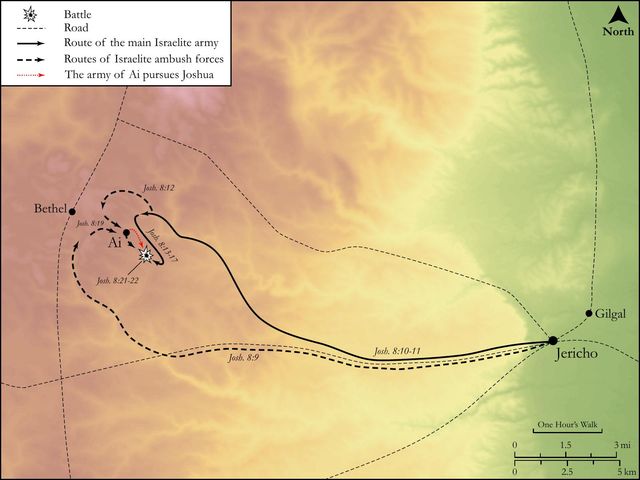
Joshua 8:25 stands near the close of the narrative arc concerning the conquest of Ai. This segment of Israel's history began with a humiliating defeat in Joshua 7, a stark contrast to the miraculous victory at Jericho. That initial failure was not due to military weakness but to Achan's transgression against God's explicit command regarding the devoted things (cherem) from Jericho. Following Achan's judgment and Israel's purification, God graciously restored His favor, providing Joshua with a meticulous, divinely engineered strategy for a second assault on Ai, detailed extensively in Joshua 8:1-29. This strategy involved an elaborate ambush, a feigned retreat to draw the inhabitants out of the city, and the subsequent burning of Ai. Verse 25 specifically provides the casualty count, confirming the complete success of this operation and serving as a direct fulfillment of God's promise to deliver Ai into Israel's hands, as stated in Joshua 8:1. The verses immediately following Joshua 8:26-29 describe the aftermath, including Joshua's unwavering commitment to the cherem command, further emphasizing the totality of the victory and the divine mandate behind it.
Historical & Cultural Context
The conquest of Canaan, including the destruction of cities like Ai, must be understood within the warfare of that day, yet with a crucial theological distinction. While the nations often practiced total war, frequently dedicating conquered peoples and their possessions to their gods, Israel's application of cherem (the "ban" in Hebrew) was unique. It was not a general military tactic but a specific, divinely commanded act from Yahweh, aimed at preventing the spiritual contamination of Israel by the deeply idolatrous and morally corrupt practices of the Canaanites, as explicitly outlined in Deuteronomy 7:1-6. Ai, though perhaps smaller than Jericho, was strategically significant, and its destruction served as a clear message to other Canaanite city-states of Yahweh's supreme power and Israel's divine backing. The explicit mention of "men and women" in the casualty count, while jarring to modern sensibilities, reflects the ancient practice of total war and, in this theological context, signifies the comprehensive nature of God's judgment against a culture steeped in profound wickedness, including child sacrifice, cultic prostitution, and other abominations that defiled the land (Leviticus 18:24-28).
Key Themes
ShowHideJoshua 8:25 powerfully contributes to several overarching themes in the book of Joshua and the broader Old Testament narrative. Firstly, it highlights Divine Judgment and Justice, demonstrating God's sovereign right and intent to judge the wickedness of nations, particularly those whose sin had reached its full measure, as prophesied in Genesis 15:16. Secondly, it underscores the theme of Obedience Leads to Victory. The stark contrast between the initial defeat at Ai (due to Achan's disobedience) and the subsequent overwhelming victory (due to Joshua's meticulous adherence to God's strategy) serves as a potent illustration of this principle, echoing the blessings promised for obedience in Deuteronomy 28:1-14. Thirdly, the detailed divine strategy for Ai showcases God's Strategic Wisdom and Sovereignty. It teaches that God's ways are higher than human ways, and His plans, though sometimes unconventional, lead to guaranteed success when followed faithfully, reinforcing the idea that the battle ultimately belongs to the Lord, as seen in 1 Samuel 17:47. This decisive victory also reaffirms God's Covenant Faithfulness to Israel, demonstrating His unwavering commitment to giving them the promised land, provided they remained faithful to Him.
Exposition and Analysis
ShowHideKey Word Analysis
ShowHideThis primitive root literally means "to fall," but in a military context, it is a common and powerful euphemism for being killed or defeated in battle. Its use here indicates the precise number of casualties suffered by the inhabitants of Ai, emphasizing the complete and utter destruction of the city's population, not merely its fighting men. It conveys the finality and totality of the defeat, signifying that none survived the onslaught.
The explicit inclusion of "men and women" underscores the comprehensive nature of the judgment. This phrase highlights that the cherem command was applied to the entire population, not solely to combatants. It signifies the complete eradication of the Canaanite presence in Ai, as commanded by God to purge the land of its spiritual corruption and prevent the spread of their idolatrous and immoral practices into the nascent Israelite nation. This detail emphasizes the severity and totality of God's judgment.
This specific numerical figure, "twelve thousand," represents a significant population for an ancient city-state. While it could be a precise count, large numbers in Hebrew narrative sometimes function as round figures or ideal numbers signifying completeness, overwhelming victory, or a vast scale. Regardless of whether it's an exact census or a symbolic representation of totality, it emphasizes the immense scale of the victory and the devastating impact of God's judgment. It serves as a concrete measure of the fulfillment of God's promise to deliver Ai into Israel's hands.
Verse Breakdown
ShowHide"And so it was, that all that fell that day"
This introductory phrase sets the scene, indicating the outcome of the day's decisive battle. "All that fell" refers to every inhabitant of Ai who perished during the Israelite assault, emphasizing the comprehensive nature of the casualties. The phrase underscores the totality of the divine judgment, implying that no one escaped the fate executed through Israel's obedient actions.
"both of men and women"
This clause provides a crucial detail regarding the nature of the casualties. It explicitly states that the destruction was not limited to the male fighting force but extended to the entire population, including women. This aligns perfectly with the concept of cherem, the divine command to utterly destroy the Canaanite inhabitants, irrespective of age or gender, to purge the land of its spiritual corruption and prevent future idolatry among Israel.
"were twelve thousand, even all the men of Ai"
This final clause specifies the precise number of casualties: twelve thousand. The concluding phrase, "even all the men of Ai," might seem redundant or slightly contradictory after "men and women." However, "men of Ai" here likely functions as a synecdoche, representing the entire populace or the general inhabitants of the city, rather than exclusively the male population. It serves to re-emphasize the comprehensive nature of the destruction, confirming that the stated number accounts for the entire city's population that perished, leaving no survivors.
Literary Devices
ShowHideJoshua 8:25, while a straightforward factual statement, employs several subtle Literary Devices that enhance its impact and theological weight. The explicit numerical count of "twelve thousand" provides a strong sense of Verisimilitude and factual reporting, lending undeniable credibility to the narrative. The phrase "both of men and women" emphasizes Totality and Universal Reach, highlighting the comprehensive nature of the divine judgment and the cherem command, demonstrating that God's judgment spared no one in Ai. This verse functions as a powerful Narrative Climax for the Ai conquest story, providing the definitive and conclusive outcome after the initial failure and subsequent divine strategy. The verse also serves as a stark example of Divine Retribution, where the consequences of Canaanite wickedness are fully realized through Israel's obedient action. Finally, the repetition of the idea of "all" (implied in "all that fell" and explicit in "all the men of Ai") reinforces the Completeness of the victory and the judgment, leaving no doubt about the thoroughness of God's command and its execution.
Theological and Thematic Connections
ShowHideJoshua 8:25 stands as a profound testament to God's unwavering holiness and perfect justice, demonstrating His sovereign right and intent to judge sin and remove obstacles to His redemptive plan for humanity. The total destruction of Ai, a direct consequence of God's command, highlights the severity with which God views the pervasive wickedness of the Canaanite nations. Yet, it also underscores His absolute faithfulness to His covenant people, Israel, providing them overwhelming victory when they align their will with His. This event serves as a stark reminder that while God is infinitely merciful, He is also perfectly just, and His commands, though sometimes challenging to our modern sensibilities, are always rooted in His perfect character and ultimate purposes for His people and the world. The victory at Ai, following the purification from Achan's sin, powerfully illustrates the principle that obedience is paramount for experiencing God's blessings and fulfilling His divine mission.
Reflection and Application
ShowHideThe account of Ai's destruction in Joshua 8:25, while set in a specific historical and theological context, offers profound and enduring lessons for believers today. It reminds us that God is a God of both immense grace and unwavering justice, and that His holiness demands a response from His people. Just as Israel's initial defeat at Ai was a direct consequence of Achan's unconfessed sin, our own spiritual progress can be hindered by unaddressed disobedience, hidden idols, or a lack of full surrender to God's will. However, the subsequent overwhelming victory, achieved through meticulous obedience to God's revealed strategy, provides a powerful model for restoration, repentance, and triumph. When we humbly confess our sins, genuinely repent, and align our lives with God's Word, we open the door for His divine power to work in and through us. This passage challenges us to trust God's wisdom even when His plans seem counter-intuitive or demand actions outside our comfort zone. It calls us to live in reverent awe of His holiness, understanding that true blessing and enduring victory come from walking in faithful obedience to His perfect will, knowing that He is sovereign over all circumstances and capable of delivering us from any "Ai" in our lives.
Questions for Reflection
ShowHideFAQ
ShowHideWhy did God command the total destruction of Ai, including women and children?
ShowHideThe command for the total destruction of Ai, including "men and women," is part of the cherem (devotion to destruction) command given by God for the conquest of Canaan. This command, while morally challenging to modern readers, must be understood within its specific historical and theological context. The Canaanite nations were steeped in extreme wickedness, including child sacrifice, ritual prostitution, and other abominable practices that deeply defiled the land (Leviticus 18:24-28). God, as the righteous judge of all the earth, was executing His long-delayed judgment upon these nations whose "iniquity was not yet complete" (Genesis 15:16) but had now reached its full measure. The primary purpose of the cherem was not wanton cruelty but a divinely mandated act of purification to prevent the spiritual contamination of Israel. If the Canaanites had been allowed to remain, their idolatry and immorality would have inevitably led Israel astray, as indeed happened later in their history (Judges 2:1-3). This was a surgical act of judgment to preserve the purity of the covenant people through whom the Messiah would eventually come, ensuring the lineage of salvation.
What is the significance of the number "twelve thousand" in this verse?
ShowHideThe number "twelve thousand" signifies the immense scale of the victory and the completeness of the divine judgment against Ai. While it could be a precise count, large numbers in ancient texts sometimes function as round figures or ideal numbers to convey totality and overwhelming success. In this context, it emphasizes that the entire population of Ai, both combatants and non-combatants, was wiped out according to the cherem command. This number underscores the devastating effectiveness of God's strategy and Israel's obedience, highlighting that the victory was comprehensive and left no survivors to perpetuate the wickedness that God was judging. It confirms the full execution of God's command given to Joshua in Joshua 8:2, demonstrating that God's word is always fulfilled.
How does the victory at Ai relate to the earlier defeat?
ShowHideThe victory at Ai in Joshua 8:25 stands in stark contrast to Israel's humiliating defeat in their first attempt to conquer the city, as recorded in Joshua 7. The initial failure was not due to Israel's military weakness or Ai's strength, but directly because of Achan's sin of taking devoted things from Jericho, which brought God's judgment upon the entire community. The subsequent overwhelming victory, therefore, highlights the critical importance of Israel's obedience and purity before God. Once Achan's sin was dealt with and the nation purified through judgment, God restored His favor and provided a detailed, winning strategy. This narrative arc powerfully illustrates the principle that God's blessing and success are contingent upon His people's faithfulness and obedience to His commands. It demonstrates God's willingness to restore and lead to victory after genuine repentance and purification, a principle echoed throughout the biblical narrative, such as in 2 Chronicles 7:14.
Christ-Centered Fulfillment
ShowHideWhile Joshua 8:25 details a historical event of judgment and conquest, its profound theological undercurrents find ultimate and glorious fulfillment in Jesus Christ. The total destruction of Ai, an act of divine judgment against sin and a means of purifying the land for God's people, foreshadows the ultimate and decisive victory achieved by Christ over sin, death, and the powers of darkness. Just as the victory at Ai was contingent upon Israel's obedience and purification from sin (Achan's transgression), so too is our spiritual victory and entry into God's promised rest contingent upon the perfect obedience and sacrificial work of Jesus. He is the true and greater Joshua, who leads His people not into a physical land through military conquest, but into spiritual freedom and eternal life through His atoning sacrifice. The cherem command, which saw the complete eradication of wickedness in Ai, points forward to Christ's definitive triumph over evil on the cross, where He "disarmed the powers and authorities, he made a public spectacle of them, triumphing over them by the cross" (Colossians 2:15). Moreover, the judgment enacted at Ai reminds us of God's unchanging holiness and His ultimate judgment against all sin, a judgment that was fully borne by Christ on behalf of those who believe (2 Corinthians 5:21). Through Christ, believers are delivered from the "wages of sin" (Romans 6:23) and are granted access to a spiritual inheritance far greater than Canaan, the eternal kingdom of God (Ephesians 1:11-14). Thus, the victory at Ai, a testament to God's power and justice, ultimately points to the infinitely greater and redemptive victory accomplished by the Lamb of God, who takes away the sin of the world!.