


Joshua 8:1
Bible text: King James Version (1769 Blayney text) · Public domain
Bible text: King James Version with Strong's numbers · Public domain
Bible text: Berean Standard Bible · Public domain
Bible text: American Standard Version (1901) · Public domain
Bible text: World English Bible, Messianic edition · Public domain
Bible text: Geneva Bible (1599) · Public domain
Bible text: Young's Literal Translation · Public domain
- וַיֹּאמֶרvai·Yo·merand he saidH559Conj-w ¦ V-Qal-ConsecImperf-3msVerb Qal Consecutive Imperfect 3rd Singular Masculineוַandיֹּאמֶרhe said
- יְהוָהYah·wehYahwehH3068N-properNoun Proper Title
- אֶל'eltoH413PrepPreposition
- יְהוֹשֻׁעַye·ho·Shu·a'JoshuaH3091N-proper-mNoun Proper Masculine
- אַל'almay notH408NegParticle Negative
- תִּירָאti·Ra'you fearH3372V-Qal-Imperf-2msVerb Qal Imperfect 2nd Singular Masculine
- וְאַלve·'aland may notH408Conj-w ¦ NegParticle Negativeוְandאַלmay not
- תֵּחָתte·Chatyou be dismayedH2865V-Niphal-Imperf-2msVerb Niphal Imperfect 2nd Singular Masculine
- קַחkachtakeH3947V-Qal-Imp-2msVerb Qal Imperative 2nd Singular Masculine
- עִמְּךָ'i·me·Khawith youH5973Prep ¦ 2msPreposition Definiteעִמְּwithךָyou
- אֵת'et<obj.>H853DirObjMParticle Object Indicator
- כָּלkolallH3605N-mscNoun Singular Masculine Construct
- עַם'am[the] people ofH5971N-mscNoun Singular Masculine Construct
- הַמִּלְחָמָהha·mil·cha·Mah<the> warH4421Art ¦ N-fsNoun Singular Feminine Absoluteהַ<the>מִּלְחָמָהwar
- וְקוּםve·Kumand ariseH6965Conj-w ¦ V-Qal-Imp-2msVerb Qal Imperative 2nd Singular Masculineוְandקוּםarise
- עֲלֵה'a·Lehgo upH5927V-Qal-Imp-2msVerb Qal Imperative 2nd Singular Masculine
- הָעָיha·'Ai<the> AiH5857Art ¦ N-properNoun Proper Locationהָ<the>עָיAi
- רְאֵהre·'EhseeH7200V-Qal-Imp-2msVerb Qal Imperative 2nd Singular Masculine
- נָתַתִּיna·Ta·tiI have givenH5414V-Qal-Perf-1csVerb Qal Perfect 1st Singular common gender
- בְיָדְךָve·ya·de·Khain your handH3027Prep-b ¦ N-csc ¦ 2msNoun Singular common gender Constructבְinיָדְhandךָyour
- אֶת'et<obj.>H853DirObjMParticle Object Indicator
- מֶלֶךְMe·lekh[the] king ofH4428N-mscNoun Singular Masculine Construct
- הָעַיha·'Ai<the> AiH5857Art ¦ N-properNoun Proper Locationהָ<the>עַיAi
- וְאֶתve·'Etand <obj.>H853Conj-w ¦ DirObjMParticle Object Indicatorוְandאֶת<obj.>
- עַמּוֹa·Mohis peopleH5971N-msc ¦ 3msNoun Singular Masculine Constructעַמּpeopleוֹhis
- וְאֶתve·'Etand <obj.>H853Conj-w ¦ DirObjMParticle Object Indicatorוְandאֶת<obj.>
- עִירוֹi·Rohis cityH5892N-fsc ¦ 3msNoun Singular Feminine Constructעִירcityוֹhis
- וְאֶתve·'Etand <obj.>H853Conj-w ¦ DirObjMParticle Object Indicatorוְandאֶת<obj.>
- אַרְצוֹ'ar·Tzohis landH776N-fsc ¦ 3msNoun Singular Feminine Constructאַרְצlandוֹhis
English is a literal word-by-word gloss of the Hebrew, not the KJV's wording. Why?
This is the original text the KJV's translators worked from — each Hebrew word with its own literal English meaning in this verse, prepared by scholars at Tyndale House, Cambridge. The KJV translates whole sentences, not word by word, so its wording differs: one Hebrew word can become several English words, and the KJV may choose “the LORD” where the gloss reads “Yahweh”. Both are faithful — they answer different questions. For the KJV's own rendering, switch to the KJV text.
Details
See on the biblical-era maps
Study this verse
Public-domain commentary
Matthew Henry
From his Commentary on the Whole Bible. Henry comments on passages, not single verses — this entry covers Joshua 8:1–2. His two-level outline is real structure in the source text, so it is rendered as structure.
Israel were very happy in having such a commander as Joshua, but Joshua was more happy in having such a director as God himself; when any difficulty occurred, he needed not to call a council of war who had God so nigh unto him, not only to answer, but even to anticipate, his enquiries. It should seem, Joshua was now at a stand, had scarcely recovered the discomposure he was put into by the trouble Achan gave them, and could not think, without fear and trembling, of pushing forward, lest there should be in the camp another Achan; then God spoke to him, either by vision, as before (Jos 5:1-15), or by the breastplate of judgment. Note, When we have faithfully put away sin, that accursed thing, which separates between us and God, then, and not till then, we may expect to hear from God to our comfort; and God's directing us how to go on in our Christian work and warfare is a good evidence of his being reconciled to us. Observe here,
I.The encouragement God gives to Joshua to proceed:
Fear not, neither be thou dismayed, Jos 8:1. This intimates that the sin of Achan, and the consequences of it, had been a very great discouragement to Joshua, and made his heart almost ready to fail. Corruptions within the church weaken the hands, and damp the spirits, of her guides and helpers, more than oppositions from without; treacherous Israelites are to be dreaded more than malicious Canaanites. But God bids Joshua not be dismayed; the same power that keeps Israel from being ruined by their enemies shall keep them from ruining themselves. To animate him,
1.He assures him of success against Ai, tells him it is all his own; but he must take it as god's gift: I have given it into thy hands, which secured him both title and possession, and obliged him to give God the glory of both, Psa 44:3.
2.He allows the people to take the spoil to themselves. Here the spoil was not consecrated to God as that of Jericho, and therefore there was no danger of the people's committing such a trespass as they had committed there. Observe, How Achan who caught at forbidden spoil lost that, and life, and all, but the rest of the people who had conscientiously refrained from the accursed thing were quickly recompensed for their obedience with the spoil of Ai. the way to have the comfort of what God allows us is to forbear what he forbids us. No man shall lose by his self-denial; let God have his dues first, and then all will be clean to us and sure, Kg1 17:13. God did not bring them to these goodly cities, and houses filled with all good things, to tantalize them with the sight of that which they might not touch; but, having received the first-fruits from Jericho, the spoil of Ai, and of all the cities which thenceforward came into their hands, they might take for a prey to themselves.
II.The direction he gives him in attacking Ai.
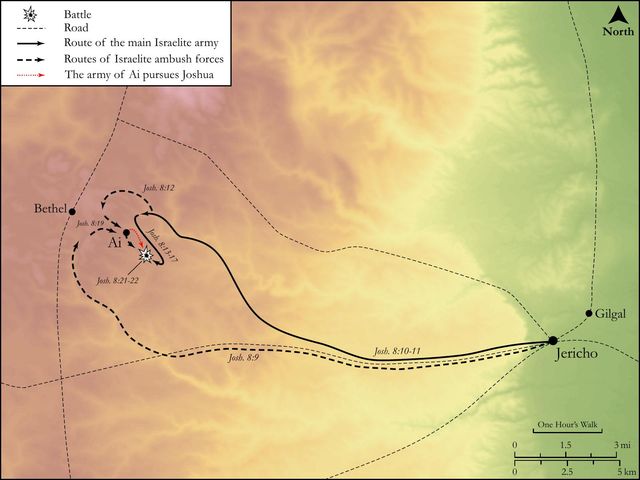
It must not be such a work of time as the taking of Jericho was; this would have prolonged the war too much. Those that had patiently waited seven days for Jericho shall have Ai given them in one day. Nor was it, as that, to be taken by miracle, and purely by the act of God, but now their own conduct and courage must be exercised; having seen God work for them, they must now bestir themselves. God directs him, 1. to take all the people, that they might all be spectators of the action and sharers in the spoil. Hereby God gave him a tacit rebuke for sending so small a detachment against Ai in the former attempt upon it, Jos 7:4. 2. To lay an ambush behind the city; this was a method which perhaps Joshua would not have thought of at this time, if God had not directed him to it; and though now we are not to expect direction, as here, by visions, voices, or oracles, yet, whenever those who are entrusted with public councils take prudent measures for the public good, it must be acknowledged that god puts it into their hears; he that teaches the husbandman discretion no doubt teaches statesman and general.
Continue studying Joshua 8:1 across the web’s major study libraries — every link below opens this exact verse, chapter, or book on the destination site.
Read & Compare
 BibleGatewayThis verse in more than 200 translations and 70 languages.
 Bible.comThe YouVersion reader — hundreds of translations, reading plans, and highlights.
 ESV.orgCrossway's official English Standard Version reader.
 NET BibleThe NET translation with 60,000+ translators' notes on every rendering decision.
 STEP BibleTyndale House's free study tool — original text, vocabulary, and scholarly resources.
 BibliaLogos Bible Software's free web reader.
 USCCBThe New American Bible (Revised Edition) with the U.S. bishops' study notes.
Commentaries
 BibleHub CommentariesDozens of classic commentaries on this verse, gathered on one page.
 StudyLightMore than 100 commentary sets — the largest collection on the web.
 BibleRefPlain-English commentary on what this verse means, verse by verse.
 Enduring WordDavid Guzik's free commentary on this chapter, widely used by Bible teachers.
 Bible Study ToolsVerse commentary alongside Greek and Hebrew study aids.
Original Language & Research
- BibleHub InterlinearThe verse word by word — original language, transliteration, and English.
- BibleHub LexiconEvery word's original-language definition and Strong's entry.
 Blue Letter BibleDeep-study tools — Strong's numbers, concordance, and word studies.
 SefariaThe Hebrew text with Rashi and centuries of Jewish commentary.
Sermons, Hymns & Audio


TrulyRandomVerse is not affiliated with these sites and doesn’t control their content. They’re linked because they’re genuinely useful.
Summary
Joshua 8:1 marks a profound turning point in Israel's conquest of Canaan, immediately following their humiliating defeat at Ai and the subsequent purging of Achan's sin. In this pivotal moment, the LORD directly addresses Joshua, dispelling his fear and dismay with a powerful declaration of assured victory over Ai. This verse signals God's restoration of His covenant favor and His unwavering commitment to deliver the Promised Land, providing both a fresh command for military action and the foundational promise that the king, people, city, and land of Ai have already been "given" into Israel's hand.
Context
ShowHideLiterary Context
This verse serves as a crucial hinge in the book of Joshua, directly succeeding the deeply unsettling events of Joshua 7. After the miraculous and divinely orchestrated victory at Jericho, Israel suffered an unexpected and humiliating defeat at Ai, resulting in the loss of 36 men and a profound crisis of faith for Joshua and the nation. The subsequent revelation of Achan's transgression—his coveting and taking of devoted things from Jericho—and its swift, severe judgment (the stoning of Achan and his family in the Valley of Achor) were necessary to restore Israel's covenant purity and God's favor. Joshua 8:1 immediately follows this purging, signifying that the obstacle to God's presence and blessing has been removed, and the path is now clear for the resumption of the conquest under renewed divine guidance. It sets the stage for a new, divinely orchestrated strategy for the capture of Ai, contrasting sharply with the previous, ill-fated attempt.
Historical & Cultural Context
The conquest of Canaan was understood by Israel as a divinely mandated "holy war" (Hebrew: ḥerem), where God fought on behalf of His people, and the land, along with its inhabitants and spoils, was to be utterly devoted to Him. The defeat at Ai was not merely a military setback but a theological crisis, suggesting God had abandoned His people or that His power was insufficient. Among the nations, a military defeat often implied the defeat of a people's god, as the Rabshakeh boasted before Jerusalem, leading to profound despair and questioning of divine favor. Thus, Joshua's lament and despair were rooted in the perceived dishonor to Yahweh's name (Joshua 7:9). The command to "take all the people of war" for the second attempt at Ai, unlike the initial small force of 3,000 (Joshua 7:3), underscores the importance of full national commitment and unity in the renewed divine strategy. The concept of God "giving into thy hand" was a common idiom of assured victory in ancient warfare, emphasizing that the outcome was predetermined by divine decree, not merely human strength.
Key Themes
ShowHideJoshua 8:1 powerfully articulates several core themes central to the book of Joshua and the broader Old Testament narrative. First, it highlights Divine Restoration and Reassurance: God's immediate response to Israel's repentance and the removal of sin is not condemnation but renewed grace and encouragement. The command "Fear not, neither be thou dismayed" directly counters the despair that gripped Joshua, echoing God's foundational promise in Joshua 1:9. Second, it emphasizes God's Unwavering Sovereignty and Promise-Keeping: Despite Israel's failure, God's ultimate plan for the conquest of Canaan remains unchanged. His declaration, "I have given into thy hand," asserts His absolute control over history and His commitment to fulfill His covenant promises, regardless of temporary setbacks. This divine initiative is the true source of Israel's victory. Third, the verse underscores Renewed Call to Obedience and Corporate Action: God commands Joshua to "take all the people of war with thee, and arise, go up to Ai." This signifies a fresh mandate for unified, obedient action, demonstrating that while victory is divinely assured, human participation and faithfulness are still required. The previous defeat served as a stark lesson in the consequences of disobedience, and now, with purity restored, the nation is ready to move forward in unity under God's explicit direction.
Exposition and Analysis
ShowHideKey Word Analysis
ShowHideThis imperative phrase, derived from the verb H3372 (yârêʾ), meaning "to fear; morally, to revere; caus. to frighten," is a common biblical reassurance from God. Here, it directly addresses Joshua's profound despair and anxiety following the defeat at Ai. It is a command to cast off terror and apprehension, rooted in the understanding that God's presence and power are sufficient to overcome any threat or past failure.
From the verb H2865 (châthath), meaning "to prostrate; hence, to break down, either (literally) by violence, or (figuratively) by confusion and fear," this term describes a state of inner collapse, discouragement, or loss of resolve. Coupled with "Fear not," it forms a comprehensive call to spiritual and psychological fortitude. God is addressing not just external fear but the internal sense of being overwhelmed and defeated, assuring Joshua that his spirit should not be broken.
This is a perfect tense verb from H5414 (nâthan), "to give, used with greatest latitude of application (put, make, etc.)." The perfect tense here is crucial, indicating a completed action with ongoing results. It's not "I will give" but "I have already given." This signifies a divine decree, a settled reality in the heavenly realm that precedes and guarantees the earthly outcome. God's declaration makes the victory a certainty, not a possibility contingent on Israel's strength, but a gift already bestowed.
Verse Breakdown
ShowHide"And the LORD said unto Joshua,"
This opening clause immediately re-establishes divine initiative and direct communication. After the silence and judgment of Joshua 7, God speaks directly to Joshua, signaling the restoration of His relationship with His chosen leader and, by extension, with Israel. It underscores that the renewed mission is entirely God-ordained and God-empowered, demonstrating His faithfulness to His covenant people.
"Fear not, neither be thou dismayed:"
This is a direct, emphatic command designed to counteract Joshua's deep despair and the nation's collective discouragement. It is a divine antidote to the fear that had gripped them after the unexpected defeat and the subsequent judgment. God's reassurance here is foundational, reminding Joshua of God's unwavering presence and power, echoing the initial commissioning in Joshua 1:9 and reinforcing His steadfast support.
"take all the people of war with thee, and arise, go up to Ai:"
This is a clear, actionable command for renewed military engagement. The instruction to take "all the people of war" is significant, contrasting with the small, overconfident force sent previously (Joshua 7:3). It implies a comprehensive and unified national effort, now under divine blessing and detailed strategic guidance (revealed in subsequent verses). "Arise, go up" conveys urgency and a call to immediate, obedient action, signaling a decisive shift from lament to renewed purpose.
"see, I have given into thy hand the king of Ai, and his people, and his city, and his land:"
This powerful declaration is the bedrock of the renewed command. The perfect tense "I have given" indicates a divinely accomplished fact, a guaranteed outcome. God is not merely promising victory; He is declaring that the victory is already secured in His sovereign plan, emphasizing His preeminence over all earthly powers. The comprehensive list ("king," "people," "city," "land") emphasizes that the conquest will be total and complete, leaving no aspect of Ai untouched by God's decree, reinforcing the certainty of His promise.
Literary Devices
ShowHideJoshua 8:1 employs several impactful literary devices. Direct Address is prominent, as God speaks personally and intimately to Joshua, signaling a restoration of their direct communication after the breach of covenant in Joshua 7. This personal address underscores the divine initiative in overcoming Israel's despair. The verse is replete with Divine Command, expressed through imperative verbs like "Fear not," "take," "arise," and "go up," highlighting God's absolute authority and Joshua's role as an obedient servant. There is also a significant Repetition or Echo of God's initial commissioning words to Joshua in Joshua 1:9, where God similarly commanded him not to fear or be dismayed. This repetition serves to reinforce God's consistent character and promises, reminding Joshua that despite the recent setback, God's original mandate remains unchanged. Finally, the phrase "I have given into thy hand" functions as a powerful Idiom or Metaphor for assured victory and complete control, emphasizing that the triumph is a divine gift, not merely a human achievement, and that the outcome is already sealed by God's sovereign decree.
Theological and Thematic Connections
ShowHideJoshua 8:1 profoundly illustrates God's unwavering faithfulness and sovereignty, even in the face of human failure. It teaches that while sin breaks covenant fellowship and hinders divine blessing, God's redemptive purposes are not ultimately thwarted. Once sin is dealt with through confession and judgment, God is quick to restore and recommission His people. This passage underscores the principle that true victory in spiritual warfare, or in any endeavor, stems from God's prior declaration and empowerment, not from human strength or strategy alone. It highlights the importance of divine assurance in overcoming fear and discouragement, reminding believers that God's promises are firm, and His presence guarantees success when His people walk in obedience.
Reflection and Application
ShowHideJoshua 8:1 offers profound encouragement and practical lessons for believers navigating life's challenges. It reminds us that even after significant failures, setbacks, or periods of spiritual discouragement, God's grace and purposes for us remain. Just as Israel's defeat at Ai was linked to unconfessed sin, this passage prompts us to honestly examine our own lives for areas of disobedience or unfaithfulness that might be hindering our spiritual progress or sense of God's presence. The immediate restoration of God's voice and command to Joshua, coupled with the powerful "Fear not, neither be thou dismayed," serves as a divine antidote to our own anxieties and despair. It calls us to move beyond past mistakes, to trust in God's unfailing presence and power, and to embrace His renewed call to action. Our true strength and success come from His divine assurance and our humble obedience to His commands, knowing that He has already secured the victory for us in Christ. This verse invites us to lay down our fears and anxieties, pick up our spiritual mandate, and step forward in the confidence of a God who has already declared the outcome.
Questions for Reflection
ShowHideFAQ
ShowHideWhat is the significance of God telling Joshua "Fear not, neither be thou dismayed" again, given He said it in Joshua 1:9?
ShowHideThe repetition of "Fear not, neither be thou dismayed" (Joshua 1:9) is highly significant. In Joshua 1, it was a foundational charge for a new leader embarking on an immense, daunting task—the conquest of Canaan. Here, in Joshua 8:1, it's a specific antidote to a profound crisis of faith and despair. Joshua and Israel had just experienced a humiliating defeat at Ai (Joshua 7:4-5) and the severe judgment for Achan's sin (Joshua 7:25). Their confidence was shattered, and they likely felt God had abandoned them. The repetition serves as a powerful reminder that despite their failure, God's presence, promises, and power remain unchanged. It's a re-affirmation of His covenant faithfulness and a direct address to the specific fear and discouragement caused by their recent setback, demonstrating God's compassionate restoration.
Why did God command Joshua to "take all the people of war" for the second attempt at Ai, when only a smaller force was sent initially?
ShowHideThe command to "take all the people of war" (Joshua 8:1) for the second assault on Ai contrasts sharply with the initial, overconfident deployment of only 3,000 men (Joshua 7:3-4). This shift serves multiple purposes. First, it emphasizes that the victory is not to be attributed to human strength or strategy alone, but to God's comprehensive plan involving the entire nation's obedience and participation. Second, it underscores the severity of the previous lesson: God's commands must be followed precisely, and sin must be purged for success. The initial defeat demonstrated that even a small enemy could overcome Israel if God's favor was withheld due to sin. Third, it was integral to God's specific military strategy for Ai, which involved a complex ambush (Joshua 8:4-8) requiring a large force for both the feigned retreat and the actual attack. Finally, it could symbolize a renewed corporate commitment and unity after the divisive impact of Achan's sin, reinforcing that the entire nation was now aligned with God's will.
Christ-Centered Fulfillment
ShowHideJoshua 8:1 finds its ultimate and profound fulfillment in Jesus Christ. Just as God reassured Joshua after a devastating defeat and the purging of sin, so too does God, through Christ, offer ultimate reassurance and victory over the greatest defeat—sin and death. Where Achan's sin brought judgment and separation, Christ's perfect obedience and atoning sacrifice (Hebrews 9:26) dealt with sin once and for all, making possible our reconciliation with God. We, like Joshua, are often dismayed by our failures and the spiritual battles we face, but the resurrected Christ declares to us, "Fear not, for I have overcome the world" (John 16:33). The "given into thy hand" promise to Joshua foreshadows the ultimate triumph of Christ, who disarmed the powers and authorities and made a public spectacle of them, triumphing over them by the cross (Colossians 2:15). Through faith in Him, we are not merely conquerors but "more than conquerors" (Romans 8:37), inheriting a spiritual "promised land" of abundant life and eternal communion with God. Our victory over sin, fear, and spiritual enemies is not based on our strength or past performance, but on Christ's finished work and His ongoing intercession for us as our great High Priest (Hebrews 4:14-16). He is the true Joshua, leading His people into their eternal inheritance.