


Joshua 6:2
Bible text: King James Version (1769 Blayney text) · Public domain
Bible text: Berean Standard Bible · Public domain
Bible text: American Standard Version (1901) · Public domain
Bible text: World English Bible, Messianic edition · Public domain
Bible text: Geneva Bible (1599) · Public domain
Bible text: Young's Literal Translation · Public domain
- וַיֹּאמֶרvai·Yo·merand he saidH559Conj-w ¦ V-Qal-ConsecImperf-3msVerb Qal Consecutive Imperfect 3rd Singular Masculineוַandיֹּאמֶרhe said
- יְהוָהYah·wehYahwehH3068N-properNoun Proper Title
- אֶל'eltoH413PrepPreposition
- יְהוֹשֻׁעַye·ho·Shu·a'JoshuaH3091N-proper-mNoun Proper Masculine
- רְאֵהre·'EhseeH7200V-Qal-Imp-2msVerb Qal Imperative 2nd Singular Masculine
- נָתַתִּיna·Ta·tiI have givenH5414V-Qal-Perf-1csVerb Qal Perfect 1st Singular common gender
- בְיָדְךָve·ya·de·Khain your handH3027Prep-b ¦ N-csc ¦ 2msNoun Singular common gender Constructבְinיָדְhandךָyour
- אֶת'et<obj.>H853DirObjMParticle Object Indicator
- יְרִיחוֹye·ri·ChoJerichoH3405N-properNoun Proper Location
- וְאֶתve·'Etand <obj.>H853Conj-w ¦ DirObjMParticle Object Indicatorוְandאֶת<obj.>
- מַלְכָּהּmal·Kahits kingH4428N-msc ¦ 3fsNoun Singular Masculine Constructמַלְכָּkingהּits
- גִּבּוֹרֵיgi·bo·Rei[the] mighty [men] ofH1368N-mpcNoun Plural Masculine Construct
- הֶחָיִלhe·Cha·yil<the> strengthH2428Art ¦ N-msNoun Singular Masculine Absoluteהֶ<the>חָיִלstrength
English is a literal word-by-word gloss of the Hebrew, not the KJV's wording. Why?
This is the original text the KJV's translators worked from — each Hebrew word with its own literal English meaning in this verse, prepared by scholars at Tyndale House, Cambridge. The KJV translates whole sentences, not word by word, so its wording differs: one Hebrew word can become several English words, and the KJV may choose “the LORD” where the gloss reads “Yahweh”. Both are faithful — they answer different questions. For the KJV's own rendering, switch to the KJV text.
Details
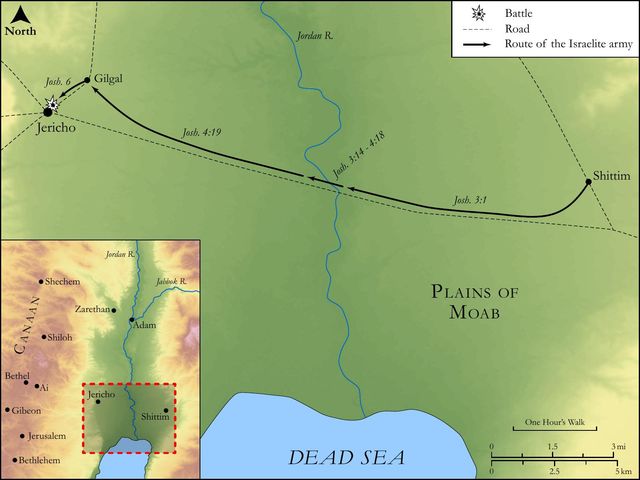
See on the biblical-era map
Study this verse
Public-domain commentary
Matthew Henry
From his Commentary on the Whole Bible. Henry comments on passages, not single verses — this entry covers Joshua 6:1–5. His three-level outline is real structure in the source text, so it is rendered as structure.
We have here a contest between God and the men of Jericho, and their different resolutions, upon which it is easy to say whose word shall prevail.
I.Jericho resolves Israel shall not be its master, Jos 6:1.
It was straitly shut up, because of the children of Israel. It did shut up, and it was shut up (so it is in the margin); it did shut up itself, being strongly fortified both by art and nature, and it was shut up by the obstinacy and resolution of the inhabitants, who agreed never to surrender nor so much as sound a parley; none went out as deserters or to treat of peace, nor were any admitted in to offer peace. Thus were they infatuated, and their hearts hardened to their own destruction - the miserable case and character of all those that strengthen themselves against the Almighty, Job 15:25.
II.God resolves Israel shall be its master, and that quickly, The captain of the Lord's host, here called Jehovah, taking notice how strongly Jericho was fortified and how strictly guarded, and knowing Joshua's thoughts and cares about reducing it, and perhaps his fears of a disgrace there and of stumbling at the threshold, gave him here all the assurance he could desire of success (Jos 6:2): See, I have given into thy hand Jericho. Not, "I will do it, but, I have done it; it is all thy own, as sure as if it were already in thy possession." It was designed that this city, being the first-fruits of Canaan, should be entirely devoted to God, and that neither Joshua nor Israel should ever be one mite the richer for it, and yet it is here said to be given into their hand; for we must reckon that most our own which we have an opportunity of honouring God with and employing in his service. Now.
1.The captain of the Lord's host gives directions how the city should be besieged. No trenches are to be opened, no batteries erected, nor battering rams drawn up, nor any military preparations made; but the ark of God must be carried by the priests round the city once a day for six days together, and seven times the seventh day, attended by the men of war in silence, the priests all the while blowing with trumpets of rams' horns, Jos 6:3, Jos 6:4. This was all they were to do.
2.He assures them that on the seventh day before night they should, without fail, be masters of the town. Upon a signal given, they must all shout, and immediately the wall should fall down, which would not only expose the inhabitants, but so dispirit them that they would not be able to make any resistance, Jos 6:5. God appointed this way,
(1.)To magnify his own power, that he might be exalted in his own strength (Psa 21:13), not in the strength of instruments. God would hereby yet further make bare his own almighty arm for the encouragement of Israel and the terror and confusion of the Canaanites.
(2.)To put an honour upon his ark, the instituted token of his presence, and to give a reason for the laws by which the people were obliged to look upon it with the most profound veneration and respect. When, long after this, the ark was brought into the camp without orders from God, it was looked upon as a profanation of it, and the people paid dearly for their presumption, Sa1 4:3, etc. but now that it was done by the divine appointment it was an honour to the ark of God, and a great encouragement to the faith of Israel.
(3.)It was likewise to put honour upon the priests, who were appointed upon this occasion to carry the ark and sound the trumpets. Ordinarily the priests were excused from war, but that this privilege, with other honours and powers that the law had given them, might not be grudged them, in this service they are principally employed, and so the people are made sensible what blessings they were to the public and how well worthy of all the advantages conferred upon them.
(4.)It was to try the faith, obedience, and patience, of the people, to try whether they would observe a precept which to human policy seemed foolish to obey and believe a promise which in human probability seemed impossible to be performed. They were also proved whether they could patiently bear the reproaches of their enemies and patiently wait for the salvation of the Lord. Thus by faith, not by force, the walls of Jericho fell down.
(5.)It was to encourage the hope of Israel with reference to the remaining difficulties that were before them. That suggestion of the evil spies that Canaan could never be conquered because the cities were walled up to heaven (Deu 1:28) would by this be for ever silenced. The strongest and highest walls cannot hold out against Omnipotence; they needed not to fight, and therefore needed not to fear, because God fought for them.
Historical interpretation
Two Centuries of Reception
3 surviving comments on this verse. Each one is dated, so this reads as a timeline rather than a list.
Select a marker to jump to its quote. Markers stagger vertically where authors wrote within a few decades of each other.
But the Jews are sure to say that ever since this precept was given through Moses, the observance has been binding. But it is clear according to the text that the precept was not eternal or spiritual but temporary, which would one day cease. In short, so true is it that it is not in the exemption from work of the sabbath—that is, of the seventh day—that the celebration of this solemnity is to consist, that Joshua the son of Nun, at the time that he was reducing the city Jericho by war, stated that he had received from God a precept to order the people that priests should carry the ark of the testament of God seven days, making the circuit of the city; and thus, when the seventh day’s circuit had been performed, the walls of the city would spontaneously fall. This was done. When the space of the seventh day was finished, just as was predicted, down fell the walls of the city. [By this] it is manifestly shown that in the number of the seven days there intervened a Sabbath day. For seven days, whenever they may have commenced, must necessarily include within them a Sabbath day; on which day not only must the priests have worked, but the city must have been made a prey by the edge of the sword by all the people of Israel.
Though we appear unarmed in body, we nonetheless are bearing arms with which even in time of sunny peace we grapple in spirit against the unsubstantial foe. Now we need God to help us, and him only we must fear; without him our armor falls from us, but with him our armor gains strength. He will be your tower within the walls; he will be your wall where there are no walls.Let us hereafter recall the deeds of our ancestors recorded in the consecrated books. Observe who had the better protection—those enclosed in a city girded by great walls but without God, or those defended by God’s strength and friendly support but without city walls. I refer to the city destroyed by the eager Joshua, whose own name was changed to delineate his power. He did not subdue it in the usual military way, by conducting the regular long and weary blockade. No, through God’s help his army in sacred symbolism performed a lustration, brandishing its weapons without using them. It withdrew its violence; its arms were silent. For seven days they made seven repeated circuits round the walls. By the strength of this powerful number and by the fearful din of the priests’ trumpets, which aped the flashing thunder of divine wrath, they laid hold of the enemy trapped within. Then that people which trusted in its wealth and city perished, and their graves were mingled with their houses.
The walls of Jericho fell down on account of the priestly trumpets because they contained within themselves a sinful people. A battering ram did not strike it, nor did a machine of war storm it, but—what is remarkable—the terror of the priestly sound brought it down. The walls that had stood impervious to iron collapsed at the sacred voice of the trumpets. Who would not be amazed that when the sound had been made, stones were broken to pieces, foundations were shattered by the noise, and everything collapsed in such a way that, although the conquerors did not injure their own forces, nonetheless among the enemy nothing remained standing? But although no one touched those walls, still they were taken from without at the sound of the righteous while sinners dwelled within. For this reason, then, they gave way, lest they offer resistance to the ones or somehow protect the others. To the righteous they opened a path and to the faithless they denied protection. Therefore, brothers, if the sound of the priestly voice was so powerful at that time, such that its blast in the air announced a certain confusion, how much more do we believe that that priestly voice is living now, which shows forth something magnificent when it speaks Christ in words!… Or how could feeling creatures resist when even unfeeling ones were unable to endure the sacred dread? For we believe that hearts can more easily be softened than rocks at the words of the priests and that sins can be forgiven in a shorter time than those stones were split asunder. For the voice of the Spirit, when it comes, destroys the stain of sin more easily than it breaks apart a tangible fortification of rock.
Continue studying Joshua 6:2 across the web’s major study libraries — every link below opens this exact verse, chapter, or book on the destination site.
Read & Compare
 BibleGatewayThis verse in more than 200 translations and 70 languages.
 Bible.comThe YouVersion reader — hundreds of translations, reading plans, and highlights.
 ESV.orgCrossway's official English Standard Version reader.
 NET BibleThe NET translation with 60,000+ translators' notes on every rendering decision.
 STEP BibleTyndale House's free study tool — original text, vocabulary, and scholarly resources.
 BibliaLogos Bible Software's free web reader.
 USCCBThe New American Bible (Revised Edition) with the U.S. bishops' study notes.
Commentaries
 BibleHub CommentariesDozens of classic commentaries on this verse, gathered on one page.
 StudyLightMore than 100 commentary sets — the largest collection on the web.
 BibleRefPlain-English commentary on what this verse means, verse by verse.
 Enduring WordDavid Guzik's free commentary on this chapter, widely used by Bible teachers.
 Bible Study ToolsVerse commentary alongside Greek and Hebrew study aids.
Original Language & Research
- BibleHub InterlinearThe verse word by word — original language, transliteration, and English.
- BibleHub LexiconEvery word's original-language definition and Strong's entry.
 Blue Letter BibleDeep-study tools — Strong's numbers, concordance, and word studies.
 SefariaThe Hebrew text with Rashi and centuries of Jewish commentary.
Sermons, Hymns & Audio


TrulyRandomVerse is not affiliated with these sites and doesn’t control their content. They’re linked because they’re genuinely useful.
Summary
Joshua 6:2 is a profound divine declaration from the LORD to Joshua, delivered at the threshold of Israel's conquest of Jericho. This verse, immediately following Joshua's encounter with the Commander of the LORD's army, reveals God's absolute sovereignty by proclaiming the victory over Jericho as a completed act before any battle has been fought. It underscores that the city, its king, and even its most formidable defenders are already "given" into Israel's hand, thereby establishing divine initiative and the certainty of God's covenant promises as the foundational truth for the impending, seemingly impossible, triumph.
Context
ShowHideLiterary Context
Joshua 6:2 directly follows a pivotal moment in the narrative: Joshua's encounter with the Commander of the LORD's army in Joshua 5:13-15. This theophany establishes God's direct presence and supreme leadership in the impending conquest, clarifying that Joshua is not merely a military commander but an obedient servant under divine authority. Prior to this, the Israelites had miraculously crossed the Jordan River, re-established their covenant identity through circumcision at Gilgal, and observed Passover, fulfilling the requirements of the Mosaic Covenant before entering the promised land, as detailed in Joshua 5:2-12. Thus, Joshua 6:2 serves as the divine command and assurance of victory, directly flowing from a renewed covenant relationship and God's revealed presence, setting the stage for the unconventional battle plan that follows in Joshua 6.
Historical & Cultural Context
Jericho was one of the oldest and most heavily fortified cities of Canaan, strategically located at a major crossroads in the Jordan Valley, controlling access to the central highlands. Its formidable walls left the city "straitly shut up because of the children of Israel," an impenetrable fortress by conventional military standards. The Canaanites, known for their polytheistic worship, including child sacrifice and fertility cults, were deemed morally corrupt by God, necessitating their displacement due to their grievous sin. The concept of herem, or "devotion to destruction," was a specific command for the conquest of certain cities like Jericho, signifying God's judgment against the inhabitants and preventing Israel from being corrupted by their idolatrous practices. From a human perspective, conquering Jericho was an impossible task, highlighting the cultural and military disparity between the newly formed nation of Israel and the entrenched Canaanite city-states.
Key Themes
ShowHideJoshua 6:2 introduces and powerfully reinforces several foundational themes crucial to the book of Joshua and the broader biblical narrative. The most prominent is Divine Sovereignty and Promise, as God declares the victory as an accomplished fact, demonstrating His absolute control over history and His unwavering faithfulness to the covenant promises made to Abraham regarding the land of Canaan, as seen in Genesis 12:7 and Genesis 15:18-21. This pre-declared victory renders the strength of Jericho's defenses or its "mighty men of valour" utterly irrelevant in the face of God's decree. Closely related is the theme of Faith and Obedience, where despite God's guarantee, Joshua and Israel are still required to act in faith, following God's specific and unconventional instructions. Their participation is not to earn the victory, but to demonstrate their trust in God's power and His unique methods. Finally, the verse powerfully establishes God as the Giver of Victory, emphasizing that true success in the conquest, and indeed in all of life, comes not from human strength, military prowess, or strategic genius, but solely from God's divine intervention and power. This sets a precedent for the entire conquest narrative, underscoring that all triumphs are gifts from the LORD.
Exposition and Analysis
ShowHideKey Word Analysis
ShowHideThis Hebrew verb, used here in the perfect tense, signifies a completed action. The theological weight of this grammatical form is immense; it means that from God's perspective, the transfer of Jericho into Israel's possession is not a future promise or a conditional possibility, but an already established, settled fact. This highlights God's omnipotence and His ability to declare outcomes before they physically manifest, emphasizing His divine decree as the ultimate reality. The verb nathan carries a broad semantic range, often meaning "to put," "to place," or "to bestow," underscoring that the city is a divine gift, not a human conquest.
This common biblical idiom, "into thine hand," denotes possession, power, control, or authority. The term yad literally refers to the open hand, symbolizing the capacity to grasp, hold, and exert power. Its use here signifies that Jericho is not merely to be defeated, but fully delivered into Joshua's (and by extension, Israel's) complete control and ownership. It reinforces the idea of a comprehensive and total victory, where all aspects of the city and its inhabitants are brought under the dominion of God's chosen people.
This phrase combines two significant Hebrew words. Gibbôwr (H1368) refers to a powerful individual, a warrior, or a champion, indicating strength and prowess. Chayil (H2428) denotes force, strength, or valor, often used in military contexts to describe an army or a valiant host. Together, "mighty men of valour" refers to the strongest, most capable, and courageous warriors of Jericho. Their explicit inclusion emphasizes the formidable nature of Jericho's defense from a human standpoint. By mentioning these "mighty men," God highlights the apparent impossibility of the task by conventional means, thereby magnifying the miraculous nature of His intervention and ensuring that the victory will be attributed solely to Him, not to Israel's military might or the weakness of their foes.
Verse Breakdown
ShowHide"And the LORD said unto Joshua"
This opening clause immediately establishes the divine origin and supreme authority of the message. It signifies a direct, personal revelation from God (Yahweh, H3068) to His chosen leader, Joshua (H3091), underscoring that the entire enterprise of the conquest is initiated, directed, and empowered by God Himself, not by human strategy or ambition. This divine initiative is foundational to understanding the events that follow, setting the tone for a supernatural intervention.
"See, I have given into thine hand Jericho"
This is the core declaration of the verse. The imperative "See" (רְאֵה, re'eh, H7200) calls Joshua to perceive and acknowledge a spiritual reality that transcends present circumstances and physical appearances. The perfect tense "I have given" (נָתַתִּי, natatti, H5414) powerfully asserts God's accomplished act. Jericho, the seemingly impenetrable fortress, is already, in God's sovereign plan, delivered into Joshua's possession. This statement serves as both a divine guarantee and a profound call to faith, requiring Joshua to believe in a victory that is not yet visible or physically realized.
"and the king thereof, [and] the mighty men of valour"
This concluding phrase specifies the totality of the victory and the comprehensive nature of God's gift. Not only the city itself but also its leadership (the king, H4428) and its most formidable defenders (the mighty men of valour, H1368, H2428) are included in God's pre-declared gift. This emphasizes that no aspect of Jericho's strength, authority, or human resistance will withstand God's decree, ensuring a complete and decisive triumph that leaves no room for human boasting or doubt about the source of the victory.
Literary Devices
ShowHideThe primary literary device at play in Joshua 6:2 is Proleptic Declaration (or Prolepsis), where a future event is presented as if it has already occurred ("I have given"). This creates a powerful sense of divine certainty and inevitability, underscoring God's absolute sovereignty over time and events. It functions as a divine guarantee, shifting the focus from the human task to God's accomplished will. The inclusion of "the mighty men of valour" serves as a form of Emphasis or Anticipation, highlighting the overwhelming human challenge to magnify the divine power required for the victory. This creates a stark Contrast between human strength (or perceived strength) and divine omnipotence, ensuring that the credit for the triumph belongs solely to God. Furthermore, the phrase "into thine hand" is a common Idiom signifying possession and control, succinctly conveying the complete transfer of authority and ownership from Jericho's inhabitants to Joshua and Israel. The imperative "See" functions as a Call to Attention, drawing Joshua's focus to the profound spiritual reality being declared.
Theological and Thematic Connections
ShowHideJoshua 6:2 stands as a powerful testament to God's unwavering faithfulness to His covenant promises and His absolute sovereignty over all creation and history. It demonstrates that God's plans are not contingent upon human strength or favorable circumstances, but are established by His divine decree. This pre-declared victory over Jericho serves as a microcosm of God's redemptive work throughout history, where He often declares the outcome before the battle, calling His people to faith and obedience in the face of apparent impossibilities. It reinforces the biblical truth that salvation and victory are ultimately gifts from God, received by faith, rather than earned by human effort. This principle resonates deeply with the broader narrative of God's initiative in bringing about His purposes for His people, emphasizing His role as the primary actor in all redemptive history.
Reflection and Application
ShowHideJoshua 6:2 offers profound encouragement and a vital paradigm for believers navigating the challenges of life. It reminds us that our "Jerichos"—whether they be seemingly insurmountable obstacles, deeply entrenched habits, overwhelming circumstances, or spiritual battles—are not outside the scope of God's sovereign declaration. Just as God had already "given" Jericho to Joshua, He has already secured victory for us in Christ. Our call, therefore, is not to muster sufficient strength or devise perfect strategies, but to perceive God's pre-declared triumph and respond with faith-filled obedience to His specific, often unconventional, instructions. This verse shifts our focus from our limitations and the formidable nature of our challenges to God's limitless power, urging us to trust that the battle is truly the LORD's, and that His promises are certain, even when the means to their fulfillment seem illogical or impossible from a human perspective. It invites us to walk by faith, knowing that God's "I have given" precedes our "I will receive," empowering us to face life's impossibilities with divine confidence.
Questions for Reflection
ShowHideFAQ
ShowHideWhy does God declare victory before the battle begins in Joshua 6:2?
ShowHideGod declares victory before the battle to unequivocally establish His absolute sovereignty and omnipotence. This pre-declaration serves several critical purposes: it builds Joshua's and Israel's faith, demonstrating that the victory is not dependent on their military prowess but solely on God's power and faithfulness to His covenant promises. It also ensures that all glory for the triumph will go to God, preventing any human boasting and clearly attributing the success to divine intervention. By stating "I have given," God emphasizes that the outcome is already settled in His divine plan, calling His people to respond with obedient faith rather than striving in their own strength. This pattern is seen throughout Scripture, where God often reveals His finished work before its physical manifestation, as in the ultimate victory over sin and death declared in Colossians 2:15.
What is the significance of mentioning "the king thereof, [and] the mighty men of valour" if God has already given the city?
ShowHideThe specific mention of "the king thereof, [and] the mighty men of valour" is highly significant because it underscores the totality of God's pre-declared victory and highlights the formidable nature of the challenge from a human perspective. The king represents the political and military leadership, embodying the city's authority and resistance. The "mighty men of valour" represent the city's elite fighting force and its human strength, the very best of its defenders. By explicitly including them in the "given" declaration, God emphasizes that every aspect of Jericho's power, authority, and defense is rendered utterly impotent before His decree. This serves to magnify God's power by demonstrating that even the strongest human opposition is no match for His sovereign will, ensuring that no human agent can take credit for the victory. It eliminates any doubt that the conquest is a divine act, not a human achievement.
Christ-Centered Fulfillment
ShowHideJoshua 6:2, with its powerful declaration of a pre-won victory, finds its ultimate and most profound fulfillment in Jesus Christ. Just as God declared Jericho "given" into Joshua's hand before the walls fell, so too did God, in Christ, declare victory over the ultimate "Jerichos" of sin, death, and the powers of darkness. On the cross, Jesus cried out, "It is finished!," a perfect tense declaration akin to "I have given," signifying a complete and decisive triumph over all spiritual adversaries (Colossians 2:15). His resurrection was the divine proof that the victory was secured, disarming the one who had the power of death (Hebrews 2:14-15). For believers, this means we do not fight for victory, but from victory. Our participation in the Christian life is not to earn salvation or overcome sin by our own strength, but to walk in faith and obedience to the One who has already conquered, knowing that in Him, we are "more than conquerors" and have "victory through our Lord Jesus Christ". The walls of our spiritual Jericho—the strongholds of sin and Satan—have already fallen because of Christ's finished work, calling us to live in the reality of His accomplished triumph and to stand firm in the freedom He has secured.