


Joshua 6:9
- וְהֶחָלוּץve·he·cha·Lutzand the armed [man]H2502Conj-w ¦ Art ¦ V-Qal-PassPrtcpl-msVerb Qal Participle Passive Singular Masculine Absoluteוְandהֶtheחָלוּץarmed [man]
- הֹלֵךְho·Lekh[was] walkingH1980V-Qal-Prtcpl-msVerb Qal Participle Singular Masculine Absolute
- לִפְנֵיlif·Nei<to> beforeH6440Prep-l ¦ N-mpcNoun Plural Masculine Constructלִ<to>פְנֵיbefore
- הַכֹּהֲנִיםha·Ko·ha·Nimthe priestsH3548Art ¦ N-mpNoun Plural Masculine Absoluteהַtheכֹּהֲנִיםpriests
- תֹּקְעֵיta·ke·'u[who] give a blast onH8628V-Qal-Prtcpl-mpVerb Qal Participle Plural Masculine Construct
- הַשּׁוֹפָרוֹתha·sho·fa·Rot<of> the trumpetsH7782Art ¦ N-fpNoun Plural Feminine Absoluteהַ<of> theשּׁוֹפָרוֹתtrumpets
- וְהַמְאַסֵּףve·ham·'a·Sefand the rearguardH622Conj-w ¦ Art ¦ V-Piel-Prtcpl-msVerb Piel Participle Singular Masculine Absoluteוְandהַtheמְאַסֵּףrearguard
- הֹלֵךְho·leKh[was] walkingH1980V-Qal-Prtcpl-msVerb Qal Participle Singular Masculine Absolute
- אַחֲרֵי'a·cha·ReibehindH310Adj-mpcAdjective Numerical Plural Masculine Construct
- הָאָרוֹןha·'a·Ronthe arkH727Art ¦ N-msNoun Singular Masculine Absoluteהָtheאָרוֹןark
- הָלוֹךְha·LokhwalkingH1980V-Qal-InfAbsVerb Qal Infinitive Absolute
- וְתָקוֹעַve·ta·Ko·a'and giving blastsH8628Conj-w ¦ V-Qal-InfAbsVerb Qal Infinitive Absoluteוְandתָקוֹעַgiving blasts
- בַּשּׁוֹפָרוֹתba·sho·fa·Roton the trumpetsH7782Prep-b ¦ N-fpNoun Plural Feminine Absoluteבַּon theשּׁוֹפָרוֹתtrumpets
English is a literal word-by-word gloss of the Hebrew, not the KJV's wording. Why?
This is the original text the KJV's translators worked from — each Hebrew word with its own literal English meaning in this verse, prepared by scholars at Tyndale House, Cambridge. The KJV translates whole sentences, not word by word, so its wording differs: one Hebrew word can become several English words, and the KJV may choose “the LORD” where the gloss reads “Yahweh”. Both are faithful — they answer different questions. For the KJV's own rendering, switch to the KJV text.
Details
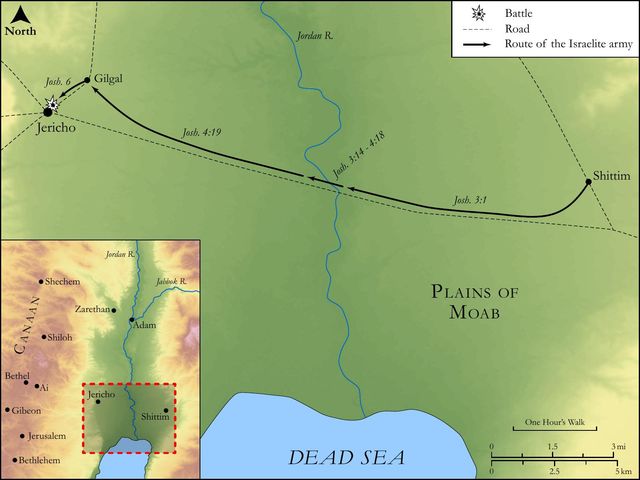
See on the biblical-era map
Study this verse
Public-domain commentary
Matthew Henry
From his Commentary on the Whole Bible. Henry comments on passages, not single verses — this entry covers Joshua 6:6–16.
We have here an account of the cavalcade which Israel made about Jericho, the orders Joshua gave concerning it, as he had received them from the Lord and their punctual observance of these orders. We do not find that he gave the people the express assurances God had given him that he would deliver the city into their hands; but he tried whether they would obey orders with a general confidence that it would end well, and we find them very observant both of God and Joshua.
I.Wherever the ark went the people attended it, Jos 6:9.
The armed men went before it to clear the way, not thinking it any disparagement to them, though they were men of war, to be pioneers to the ark of God. If any obstacle should be found in crossing the roads that led to the city (which they must do in walking round it) they would remove it; if any opposition should be made by the enemy, they would encounter it, that the priests' march with the ark might be easy and safe. It is an honour to the greatest men to do any good office to the ark and to serve the interests of religion in their country. The rereward, either another body of armed men, or Dan's squadron, which marched last through the wilderness, or, as some think, the multitude of the people who were not armed or disciplined for war (as many of them as would) followed the ark, to testify their respect to it, to grace the solemnity, and to be witnesses of what was done. Every faithful zealous Israelite would be willing to undergo the same fatigues and run the same hazard with the priests that bore the ark.
II.Seven priests went immediately before the ark, having trumpets in their hands, with which they were continually sounding, Jos 6:4, Jos 6:5, Jos 6:9, Jos 6:13. The priests were God's ministers, and thus in his name, 1. They proclaimed war with the Canaanites, and so stuck a terror upon them; for by terrors upon their spirits they were to be conquered and subdued. Thus God's ministers, by the solemn declarations of his wrath against all ungodliness and unrighteousness of men, must blow the trumpet in Zion, and sound an alarm in the holy mountain, that the sinners in Zion may be afraid. They are God's heralds to denounce war against all those that go on still in their trespasses, but say, "We shall have peace, though we go on." 2. They proclaimed God's gracious presence with Israel, and so put life and courage into them. It was appointed that when they went to war the priests should encourage them with the assurance of God's presence with them, Deu 20:2-4. And particularly their blowing with trumpets was to be a sign to the people that they should be remembered before the Lord Their God in the day of battle, Num 10:9. It encouraged Abijah, Ch2 13:12. Thus God's ministers, by sounding the Jubilee trumpet of the everlasting gospel, which proclaims liberty and victory, must encourage the good soldiers of Jesus Christ in their spiritual warfare.
III.The trumpets they used were not those silver trumpets which were appointed to be made for their ordinary service, but trumpets of rams' horns, bored hollow for the purpose, as some think. These trumpets were of the basest matter, dullest sound, and least show, that the excellency of the power might be of God. Thus by the foolishness of preaching, fitly compared to the sounding of these rams' horns, the devil's kingdom is thrown down; and the weapons of our warfare, though they are not carnal nor seem to a carnal eye likely to bring any thing to pass, are yet mighty through God to the pulling down of strong-holds, Co2 10:4, Co2 10:5. The word here is trumpets of Jobel, that is, such trumpets as they used to blow withal in the year of jubilee; so many interpreters understand it, as signifying the complete liberty to which Israel was now brought, and the bringing of the land of Canaan into the hands of its just and rightful owners.
IV.All the people were commanded to be silent, not to speak a word, nor make any noise (Jos 6:10), that they might the more carefully attend to the sound of the sacred trumpets, which they were now to look upon as the voice of God among them; and it does not become us to speak when God is speaking. It likewise intimates their reverent expectation of the event. Zac 2:13, Be silent, O all flesh, before the Lord. Exo 14:14, God shall fight, and you shall hold your peace.
V.They were to do this once a day for six days together and seven times the seventh day, and they did so, Jos 6:14, Jos 6:15.
God could have caused the walls of Jericho to fall upon the first surrounding of them, but they must go round them thirteen times before they fall, that they might be kept waiting patiently for the Lord. Though they had lately come into Canaan, and their time was very precious (for they had a great deal of work before them), yet they must linger so many days about Jericho, seeming to do nothing, nor to make any progress in their business. As promised deliverances must be expected in God's way, so they must be expected in his time. He that believes does not make haste, not more haste than God would have him make. Go yet seven times, before any thing hopeful appears, Kg1 18:43.
VI.One of these days must needs be a sabbath day, and the Jews say that it was the last, but this is not certain; however, if he that appointed them to rest on the other sabbath days appointed them to walk on this, that was sufficient to justify them in it; he never intended to bind himself by his own laws, but that when he pleased he might dispense with them. The impotent man went upon this principle when he argued (Joh 5:11), He that made me whole (and therefore has a divine power) said unto me, Take up thy bed. And, in this case here, it was an honour to the sabbath day, by which our time is divided into weeks, that just seven days were to be spent in this work, and seven priests were employed to sound seven trumpets, this number being, on this occasion, as well as many others, made remarkable, in remembrance of the six day's work of creation and the seventh day's rest from it. And, besides, the law of the sabbath forbids our own work, which is servile and secular, but this which they did was a religious act. It is certainly no breach of the sabbath rest to do the sabbath work, for the sake of which the rest was instituted; and what is the sabbath work but to attend the ark in all its motions?
VII.They continued to do this during the time appointed, and seven times the seventh day, though they saw not any effect of it, believing that at the end the vision would speak and not lie, Hab 2:3. If we persevere in the way of duty, we shall lose nothing by it in the long run. It is probable they walked at such a distance from the walls as to be out of the reach of the enemies' arrows and out of the hearing of their scoffs. We may suppose the oddness of the thing did at first amuse the besieged, but by the seventh day they had grown secure, feeling no harm from that which perhaps they looked upon as an enchantment. Probably they bantered the besiegers, as those mentioned in Neh 4:2, "What do these feeble Jews? Is this the people we thought so formidable? Are these their methods of attack?" Thus they cried peace and safety, that the destruction might be the more terrible when it came. Wicked men (says bishop Hall) think God in jest when he is preparing for their judgment; but they will be convinced of their mistake when it is too late.
VIII.At last they were to give a shout, and did so, and immediately the walls fell, Jos 6:16.
This was a shout for mastery, a triumphant shout; the shout of a king is among them, Num 23:21. This was a shout of faith; they believed that the walls of Jericho would fall, and by this faith the walls were thrown down. It was a shot of prayer, an echo to the sound of the trumpets which proclaimed the promise that God would remember them; with one accord, as one man, they cry to heaven for help, and help comes in. Some allude to this to show that we must never expect a complete victory over our own corruptions till the very evening of our last day, and then we shall shout in triumph over them, when we come to the number and measure of our perfection, as bishop Hall expresses it. A good heart (says he) groans under the sense of his infirmities, fain would be rid of them, and strives and prays, but, when all is done, until the end of the seventh day it cannot be; then judgment shall be brought forth unto victory. And at the end of time, when our Lord shall descend from heaven with a shout, and the sound of a trumpet, Satan's kingdom shall be completely ruined, and not till then, when all opposing rule, principality, and power, shall be effectually and eternally put down.
Continue studying Joshua 6:9 across the web’s major study libraries — every link below opens this exact verse, chapter, or book on the destination site.
Read & Compare
 BibleGatewayThis verse in more than 200 translations and 70 languages.
 Bible.comThe YouVersion reader — hundreds of translations, reading plans, and highlights.
 ESV.orgCrossway's official English Standard Version reader.
 NET BibleThe NET translation with 60,000+ translators' notes on every rendering decision.
 STEP BibleTyndale House's free study tool — original text, vocabulary, and scholarly resources.
 BibliaLogos Bible Software's free web reader.
 USCCBThe New American Bible (Revised Edition) with the U.S. bishops' study notes.
Commentaries
 BibleHub CommentariesDozens of classic commentaries on this verse, gathered on one page.
 StudyLightMore than 100 commentary sets — the largest collection on the web.
 BibleRefPlain-English commentary on what this verse means, verse by verse.
 Enduring WordDavid Guzik's free commentary on this chapter, widely used by Bible teachers.
 Bible Study ToolsVerse commentary alongside Greek and Hebrew study aids.
Original Language & Research
- BibleHub InterlinearThe verse word by word — original language, transliteration, and English.
- BibleHub LexiconEvery word's original-language definition and Strong's entry.
 Blue Letter BibleDeep-study tools — Strong's numbers, concordance, and word studies.
 SefariaThe Hebrew text with Rashi and centuries of Jewish commentary.
Sermons, Hymns & Audio


TrulyRandomVerse is not affiliated with these sites and doesn’t control their content. They’re linked because they’re genuinely useful.
Summary
Joshua 6:9 meticulously details the precise formation of Israel's unique procession around Jericho, highlighting the strategic placement of the armed vanguard, the priests continuously blowing trumpets, the sacred Ark of the Covenant at the very center, and the rearguard. This verse provides a vivid snapshot of Israel's approach to warfare under divine instruction, emphasizing that the impending victory was not to be secured by conventional military might, but through an ordered display of faith, unwavering obedience, and the manifest, active presence of God among His people.
Context
ShowHideLiterary Context
Joshua 6:9 is intricately woven into the dramatic narrative of the conquest of Jericho, serving as a crucial description of the daily procession that preceded the city's miraculous fall. The preceding verses, particularly Joshua 6:1-5, lay out God's highly specific and unconventional strategy for taking the heavily fortified city: a silent, daily march for six days, followed by a climactic seven marches on the seventh day, culminating in a trumpet blast and a great shout that would cause the city walls to collapse. Joshua 6:7-8 provides an initial command for this formation, and verse 9 elaborates on the precise order, underscoring the meticulous adherence to divine command that was paramount for the impending victory. This detailed description sets the stage for the supernatural event, emphasizing that the means of victory were entirely God's, not Israel's.
Historical & Cultural Context
The conquest of Jericho represents a pivotal moment in Israel's history, marking their initial, strategic entry into the Promised Land and the beginning of the fulfillment of God's ancient promise to Abraham (see Genesis 12:7). Jericho itself was a formidable stronghold, strategically positioned at a crucial pass into the central highlands of Canaan, making its capture essential for further territorial control. While ancient Near Eastern warfare often involved elaborate military processions and psychological tactics, Israel's march around Jericho was unique in its profound religious and symbolic elements. The prominent role of the priests and the Ark of the Covenant reflects Israel's distinct identity as a covenant people whose battles were ultimately fought by Yahweh. The trumpets mentioned were specifically shofars (ram's horns), instruments with deep religious significance, used not merely for military signals but for proclaiming God's presence, announcing holy days, and signaling divine intervention (e.g., Leviticus 25:9). This extraordinary blend of military discipline and sacred ritual underscored the unique, divinely-led nature of Israel's campaigns.
Key Themes
ShowHideJoshua 6:9 powerfully contributes to several overarching themes within the book of Joshua and the broader biblical narrative. Firstly, it highlights Divine Sovereignty and Unconventional Strategy, demonstrating that God's ways and means often transcend human logic and conventional military wisdom. The detailed instructions and specific order underscore God's active, meticulous involvement in Israel's affairs, asserting His ultimate control over the outcome. Secondly, the verse profoundly emphasizes Obedience and Faith, as Israel's success was entirely contingent upon their meticulous adherence to God's seemingly absurd commands, a principle later affirmed in Hebrews 11:30. Thirdly, the centrality of the Ark of the Covenant reinforces the theme of God's Presence as the Source of Victory. The Ark, symbolizing God's covenant faithfulness and His active presence among His people (as seen in Numbers 10:33-36), was not merely a ceremonial object but the focal point of divine power and the true leader of the expedition. Finally, the spiritual nature of the procession, with priests and trumpets taking precedence over direct military engagement, points to Spiritual Warfare, indicating that the battle was ultimately God's, fought by spiritual means, before any physical engagement.
Exposition and Analysis
ShowHideKey Word Analysis
ShowHideThis term, derived from the root H2502, refers to those who are "equipped" or "prepared for battle," specifically indicating soldiers ready for combat. In this context, it signifies the vanguard or shock troops who went before the main body of the army. Their presence at the front signifies readiness, but their non-engagement in direct fighting underscores the unconventional nature of this battle, where human might was secondary to divine action.
Derived from H3548, this term denotes one "officiating," a priest. In ancient Israel, priests were mediators between God and His people, responsible for sacred duties, sacrifices, and carrying the Ark of the Covenant. Their prominent role in the procession, particularly in blowing the trumpets, transformed a military march into a sacred, prophetic declaration, emphasizing the spiritual authority and divine sanction behind the siege.
This word, from H7782, specifically refers to a "cornet" or "curved horn," typically a ram's horn (shofar). Distinct from the silver trumpets used for assembly or war signals (e.g., Numbers 10:2), the shofar had deep religious significance, used for proclaiming God's presence, announcing holy days, and signaling divine intervention. Here, their continuous blowing by the priests transformed a military march into a sacred, prophetic declaration of God's impending judgment and victory, emphasizing the spiritual dimension of the siege.
From the root H622, meaning "to gather" or "to take away," this term denotes the rearguard, the contingent that brings up the rear of a marching column. This group protects the column from attack from behind and ensures no one is left behind. Its placement after the Ark in the procession is significant, symbolizing God's comprehensive protection and care for His people, encompassing them from front to back and speaking to the discipline and order of the Israelite camp under divine command.
Verse Breakdown
ShowHide"And the armed men went before the priests that blew with the trumpets"
This clause establishes the vanguard of the procession. The "armed men" (soldiers prepared for battle) led the way, not as an offensive force, but as a protective escort for the sacred elements. Their presence signified readiness, yet their silence and non-engagement highlighted that this was not a conventional military assault. The priests, continuously blowing the shofars, immediately followed, their sound serving as a constant, audible declaration of God's presence and the unfolding divine strategy, setting a sacred and solemn tone for the entire march.
"and the rereward came after the ark"
This specifies the position of the rearguard, the final contingent of the procession. Crucially, the Ark of the Covenant, symbolizing the very presence and power of Yahweh, was positioned between the trumpet-blowing priests and the rearguard. This arrangement places God's presence at the absolute center of the entire movement, reinforcing that the Lord Himself was leading the charge and was the true source of Israel's strength and protection. The rearguard's role was to protect the rear of this sacred formation, ensuring the integrity and safety of the entire column.
"[the priests] going on, and blowing with the trumpets"
This final phrase, while partially an editorial clarification in the KJV, reiterates and emphasizes the continuous action of the priests. It underscores the relentless, sustained nature of the trumpet blasts throughout the entire march. This continuous sound was not merely a signal but a persistent act of worship, declaration, and spiritual warfare, maintaining the sacred atmosphere and reinforcing the divine command throughout the six days of silent marching and the final, climactic day.
Literary Devices
ShowHideJoshua 6:9 employs several literary devices to convey its profound message and underscore the unique nature of the Jericho campaign. Repetition is evident in the repeated mention of "blowing with the trumpets," which serves to emphasize the continuous, persistent, and central role of this auditory act in the procession. This auditory repetition creates a sense of solemnity, persistence, and an ever-present divine declaration. Symbolism is paramount, with each element of the procession carrying deep theological meaning: the "armed men" symbolize human readiness and protection, yet their silence emphasizes the supernatural nature of the battle; the "priests" represent spiritual leadership and the sacred nature of the endeavor; the "trumpets" symbolize divine proclamation, warning, and spiritual power; and the "Ark of the Covenant" is the ultimate symbol of God's active, covenantal presence and power among His people. The entire formation itself functions as a profound Theophany, a visible manifestation of God's presence and power, as the meticulously ordered march demonstrates divine orchestration and control over the seemingly chaotic act of war. Furthermore, the unusual, non-military order of the procession, prioritizing sacred elements over conventional battle lines, serves as powerful Foreshadowing, hinting at the unconventional and miraculous victory that is about to unfold—a victory achieved not by human might but by divine intervention.
Theological and Thematic Connections
ShowHideJoshua 6:9 serves as a profound theological statement on the nature of God's warfare and His relationship with His people. It illustrates that true victory comes not from human strength, strategic genius, or conventional military tactics, but from unwavering obedience to God's specific, often counter-intuitive, commands and from placing His presence at the absolute center of all endeavors. The meticulous order of the procession reflects God's character as a God of order and purpose, who works through disciplined faith. This event teaches that God's power is unleashed when His people prioritize His presence and follow His leading, transforming what appears to be a military exercise into an act of profound worship and spiritual declaration, demonstrating that the battle truly belongs to the Lord.
Reflection and Application
ShowHideThe detailed order of the Jericho procession in Joshua 6:9 offers timeless and profound lessons for believers today. In a world that often values human ingenuity, strategic planning, and visible strength as the keys to success, this passage challenges us to embrace God's unconventional methods. It calls us to trust that His wisdom far surpasses our own, and that true success in life's battles—whether spiritual, relational, professional, or personal—is found in radical obedience to His Word, even when His instructions seem illogical, inefficient, or even foolish by worldly standards. Placing God's presence (symbolized by the Ark) at the core of our lives means prioritizing His will, seeking His guidance through prayer and scripture, and allowing Him to lead our every step. The continuous blowing of the trumpets reminds us of the power of persistent spiritual declaration, worship, and intercession, transforming our daily routines and challenges into acts of faith and spiritual warfare. Ultimately, this verse encourages us to walk in disciplined faith, confident that God's comprehensive protection surrounds us, and that His power, not our own, is the ultimate source of victory in every circumstance.
Questions for Reflection
ShowHideFAQ
ShowHideWhat was the significance of the specific order of the procession around Jericho?
ShowHideThe order described in Joshua 6:9 was profoundly significant, emphasizing the spiritual and divine nature of the conquest rather than a conventional military assault. The "armed men" (vanguard) were present not for immediate combat, but to clear the path and protect the sacred elements, highlighting that human military might was secondary to God's power. The priests blowing shofars immediately followed, symbolizing that the battle was a spiritual declaration, a divine proclamation of judgment and victory, and an act of worship. The Ark of the Covenant, representing God's active presence, covenant faithfulness, and the very throne of Yahweh, was at the absolute center, underscoring that Yahweh Himself was leading the charge and was the true power behind the impending victory. Finally, the "rereward" (rearguard) protected the rear, signifying God's comprehensive protection over His people from all sides. This unique formation demonstrated that the victory would be God's alone, achieved through faith and obedience rather than conventional military strategy, as seen in the miraculous collapse of the walls in Joshua 6:20.
Christ-Centered Fulfillment
ShowHideThe meticulously ordered procession around Jericho, with the Ark of the Covenant at its heart and the priests proclaiming God's presence, powerfully foreshadows the ultimate victory achieved through Jesus Christ. The Ark, symbolizing God's presence among His people, finds its ultimate fulfillment in Christ, who is Immanuel, "God with us". Just as the Ark led Israel into battle and secured victory, so Christ, the incarnate Son of God, leads His people in spiritual warfare, securing triumph over sin, death, and the powers of darkness (see Colossians 2:15). The seemingly illogical method of marching and trumpet blasts, culminating in a miraculous collapse, points to God's "foolishness" that is wiser than human wisdom, a theme powerfully articulated by Paul in 1 Corinthians 1:25. The cross, appearing as a defeat to human eyes, was God's unconventional strategy for ultimate victory, where Christ disarmed the spiritual powers and triumphed over them. The trumpet blasts, signaling divine judgment and victory, anticipate the final trumpet call at Christ's return, when His ultimate triumph will be fully realized and the new heavens and new earth established (see 1 Thessalonians 4:16 and Revelation 11:15). Thus, Joshua 6:9 is not merely a historical account but a profound type, pointing to the greater Captain of our salvation, Jesus Christ, who leads His people to victory through faith and His sovereign power.