


Numbers 10:2
Bible text: King James Version (1769 Blayney text) · Public domain
Bible text: King James Version with Strong's numbers · Public domain
Bible text: Berean Standard Bible · Public domain
Bible text: American Standard Version (1901) · Public domain
Bible text: World English Bible, Messianic edition · Public domain
Bible text: Geneva Bible (1599) · Public domain
Bible text: Young's Literal Translation · Public domain
- עֲשֵׂה'a·SehmakeH6213V-Qal-Imp-2msVerb Qal Imperative 2nd Singular Masculine
- לְךָle·Khafor <the> yourselfPrep-l ¦ 2msSuffix Personal 2nd Singular Masculineלְfor <the>ךָyourself
- שְׁתֵּיshe·TeitwoH8147Adj-fdcAdjective Numerical Dual Feminine Construct
- חֲצוֹצְרֹתcha·tzotz·Rottrumpets ofH2689N-fpcNoun Plural Feminine Construct
- כֶּסֶףKe·sefsilverH3701N-msNoun Singular Masculine Absolute
- מִקְשָׁהmik·Shahhammered workH4749N-fsNoun Singular Feminine Absolute
- תַּעֲשֶׂהta·'a·Sehyou will makeH6213V-Qal-Imperf-2msVerb Qal Imperfect 2nd Singular Masculine
- אֹתָם'o·Tam<obj.> themH853DirObjM ¦ 3mpParticle Object Indicatorאֹתָ<obj.>םthem
- וְהָיוּve·ha·Yuand they will beH1961Conj-w ¦ V-Qal-ConsecPerf-3cpVerb Qal Consecutive Perfect 3rd Plural common genderוְandהָיוּthey will be
- לְךָle·Khafor <the> youPrep-l ¦ 2msSuffix Personal 2nd Singular Masculineלְfor <the>ךָyou
- לְמִקְרָאle·mik·Ra'for [the] convocation ofH4744Prep-l ¦ N-mscNoun Singular Masculine Constructלְforמִקְרָא[the] convocation of
- הָעֵדָהha·'e·Dahthe congregationH5712Art ¦ N-fsNoun Singular Feminine Absoluteהָtheעֵדָהcongregation
- וּלְמַסַּעu·le·ma·Sa'and for breakingH4550Conj-w ¦ Prep-l ¦ N-msNoun Singular Masculine Absoluteוּandלְforמַסַּעbreaking
- אֶת'et<obj.>H853DirObjMParticle Object Indicator
- הַמַּחֲנוֹתHa·ma·cha·Notthe campsH4264Art ¦ N-fpNoun Plural Feminine Absoluteהַtheמַּחֲנוֹתcamps
English is a literal word-by-word gloss of the Hebrew, not the KJV's wording. Why?
This is the original text the KJV's translators worked from — each Hebrew word with its own literal English meaning in this verse, prepared by scholars at Tyndale House, Cambridge. The KJV translates whole sentences, not word by word, so its wording differs: one Hebrew word can become several English words, and the KJV may choose “the LORD” where the gloss reads “Yahweh”. Both are faithful — they answer different questions. For the KJV's own rendering, switch to the KJV text.
Details
See on the biblical-era map
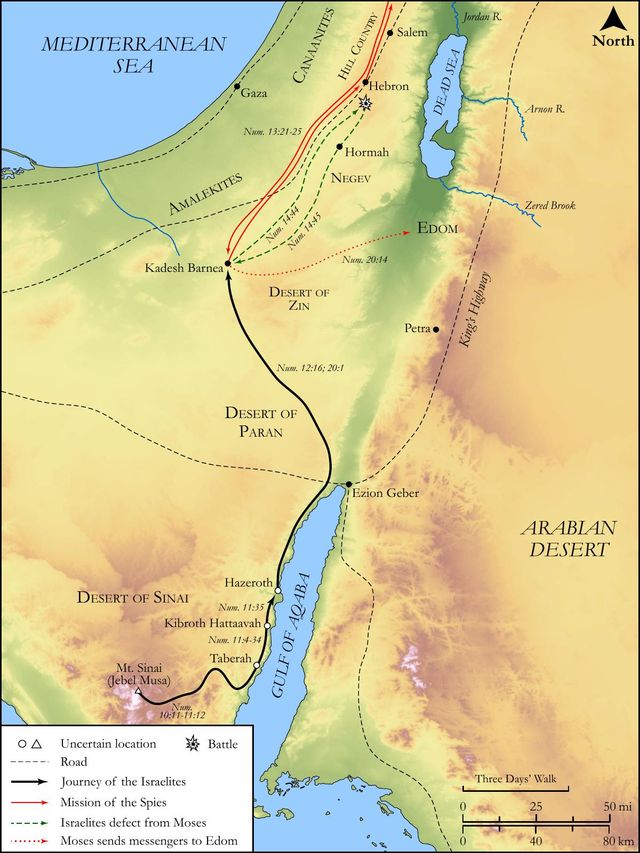
Study this verse
Public-domain commentary
Matthew Henry
From his Commentary on the Whole Bible. Henry comments on passages, not single verses — this entry covers Numbers 10:1–10.
We have here directions concerning the public notices that were to be given to the people upon several occasions by sound of trumpet. In a thing of this nature, one would think, Moses needed not to have been taught of God: his own reason might teach him the conveniency of trumpets; but the constitution of Israel was to be in every thing divine, and therefore even in this matter, small as it seems. Moses is here directed, 1. About the making of them. They must be made of silver; not cast but of beaten work (as some read it), the matter and shape, no doubt, very fit for the purpose. He was now ordered to make but two, because there were but two priests to use them. But in Solomon's time we read of 120 priests sounding with trumpets, Ch2 5:12. The form of these trumpets is supposed to have been much like ours at this day. 2. Who were to make use of them; not any inferior person, but the priests themselves, the sons of Aaron, Num 10:8. As great as they were, they must not think it a disparagement to them to be trumpeters in the house of God; the meanest office there was honourable. This signified that the Lord's ministers should lift up their voice like a trumpet, to show people their sins (Isa 58:1), to call them to Christ, Isa 27:13. 3. Upon what occasions the trumpets were to be sounded. (1.) For the calling of assemblies, Num 10:2. Thus they are told to blow the trumpet in Zion for the calling of a solemn assembly together, to sanctify a fast, Joe 2:15. Public notice ought to be given of the time and place of religious assemblies; for the invitation to the benefit or ordinances is general: whoever will, let him come. wisdom cries in the chief places of concourse. But, that the trumpet might not give an uncertain sound, they are directed, if only the princes and elders were to meet, to blow but one of the trumpets; less should serve to call them together, who ought to be examples of forwardness in any thing that is good: but, if the body of the people were to be called together, both the trumpets must be sounded, that they might be heard at the greater distance. In allusion to this, they are said to be blessed that hear the joyful sound (Psa 89:15), that is, that are invited and called upon to wait upon God in public ordinances, Psa 122:1. And the general assembly at the great day will be summoned by the sound of the archangel's trumpet, Mat 24:31. (2.) For the journeying of the camps, to give notice when each squadron must move; for no man's voice could reach to give the word of command: soldiers with us that are well disciplined may be exercised by beat of drums. When the trumpets were blown for this purpose, they mustsound an alarm (Num 10:5), a broken, quavering, interrupted sound, which was proper to excite and encourage the minds of people in their marches against their enemies; whereas a continued equal sound was more proper for the calling of the assembly together (Num 10:7): yet when the people were called together to deprecate God's judgments we find an alarm sounded, Joe 2:1. At the first sounding, Judah's squadron marched, at the second Reuben's, at the third Ephraim's, at the fourth Dan's, Num 10:5, Num 10:6. And some think that this was intended to sanctify their marches, for thus were proclaimed by the priests, who were God's mouth to the people, not only the divine orders given them to move, but the divine blessing upon them in all their motions. He that hath ears, let him hear that God is with them of a truth. King Abijah valued himself and his army very much upon this (Ch2 13:12), God himself is with us for our captain and his priests with sounding trumpets. (3.) For the animating and encouraging of their armies, when they went out in battle (Num 10:9): "If you go to war, blow with the trumpets, signifying thereby your appeal to heaven for the decision of the controversy, and your prayer to God to give you victory; and God will own this his own institution, and you shall be remembered before the Lord your God." God will take notice of this sound of the trumpet, and be engaged to fight their battles, and let all the people take notice of it, and be encouraged to fight his, as David, when he heard a sound of a going upon the tops of the mulberry trees. Not that God needed to be awaked by sound of trumpet any more than Christ needed to be awaked by his disciples in the storm, Mat 8:25. But where he intends mercy it is his will that we should solicit it; ministers must stir up the good soldiers of Jesus Christ to fight manfully against sin, the world, and the devil, by assuring them that Christ is the captain of their salvation, and will tread Satan under their feet. (4.) For the solemnizing of their sacred feasts, Mat 8:10. One of their feasts was called a memorial of the blowing of trumpets, Lev 23:23, etc. And it should seem they were thus to grace the solemnity of all their feasts (Psa 81:3), and their sacrifices (Ch2 29:27), to intimate with what joy and delight they performed their duty to God, and to raise the minds of those that attended the services to a holy triumph in the God they worshipped. And then their performances were for a memorial before God; for he takes pleasure in our religious exercises when we take pleasure in them. Holy work should be done with holy joy.
Historical interpretation
Two Centuries of Reception
2 surviving comments on this verse. Each one is dated, so this reads as a timeline rather than a list.
Select a marker to jump to its quote. Markers stagger vertically where authors wrote within a few decades of each other.
“Make for yourself two trumpets of hammered silver.” The army is led by two trumpets because the people are called to readiness in faith by the two commandments of charity. Scripture bids them to be made of silver, so that the words of the preachers may shine with gleaming light and not confuse the minds of the hearers with any darkness of their own. They are to be hammered, because those who preach the life to come grow through the blows of the present tribulations. Scripture says well, “When the short signal sounds, the camps will move.” When the preacher’s word is subtle and concise, the hearers are aroused more ardently for the struggle against temptation. Exposition of the Old and New Testament, Numbers
“Make for yourself two trumpets of hammered silver.” The army is led by two trumpets because the people are called to readiness in faith by the two commandments of charity. Scripture bids them to be made of silver, so that the words of the preachers may shine with gleaming light and not confuse the minds of the hearers with any darkness of their own. They are to be hammered, because those who preach the life to come grow through the blows of the present tribulations. Scripture says well, “When the short signal sounds, the camps will move.” When the preacher’s word is subtle and concise, the hearers are aroused more ardently for the struggle against temptation.
Continue studying Numbers 10:2 across the web’s major study libraries — every link below opens this exact verse, chapter, or book on the destination site.
Read & Compare
 BibleGatewayThis verse in more than 200 translations and 70 languages.
 Bible.comThe YouVersion reader — hundreds of translations, reading plans, and highlights.
 ESV.orgCrossway's official English Standard Version reader.
 NET BibleThe NET translation with 60,000+ translators' notes on every rendering decision.
 STEP BibleTyndale House's free study tool — original text, vocabulary, and scholarly resources.
 BibliaLogos Bible Software's free web reader.
 USCCBThe New American Bible (Revised Edition) with the U.S. bishops' study notes.
Commentaries
 BibleHub CommentariesDozens of classic commentaries on this verse, gathered on one page.
 StudyLightMore than 100 commentary sets — the largest collection on the web.
 BibleRefPlain-English commentary on what this verse means, verse by verse.
 Enduring WordDavid Guzik's free commentary on this chapter, widely used by Bible teachers.
 Bible Study ToolsVerse commentary alongside Greek and Hebrew study aids.
Original Language & Research
- BibleHub InterlinearThe verse word by word — original language, transliteration, and English.
- BibleHub LexiconEvery word's original-language definition and Strong's entry.
 Blue Letter BibleDeep-study tools — Strong's numbers, concordance, and word studies.
 SefariaThe Hebrew text with Rashi and centuries of Jewish commentary.
Sermons, Hymns & Audio


TrulyRandomVerse is not affiliated with these sites and doesn’t control their content. They’re linked because they’re genuinely useful.
Summary
Numbers 10:2 records a precise divine directive given to Moses for the creation of two silver trumpets, expertly crafted from a single piece of metal. These instruments were not mere ceremonial objects but served critical, dual functions: to summon the vast Israelite congregation for instruction and worship, and to signal the coordinated movements of the camps during their arduous journey through the wilderness. This command profoundly underscores God's commitment to order, clear communication, and the unified action of His covenant people as they embarked on their pilgrimage toward the Promised Land.
Context
ShowHideLiterary Context
Numbers 10:2 marks a pivotal moment of transition within the book of Numbers, bridging the period of static encampment at Mount Sinai with the dynamic wilderness journey. The preceding chapters, particularly Numbers 7 and Numbers 8, detail the meticulous organization of Israel's worship life around the Tabernacle, including tribal offerings and the consecration of the Levites, following nearly a year at Sinai where the covenant was established and the Law given. This verse, therefore, provides the practical means for maintaining that divinely ordained order and communication as the nation prepares to move. Immediately following these instructions, Numbers 10:11 records the long-anticipated departure of the Israelites from Sinai, initiating their challenging trek towards Canaan. The trumpets are thus presented as an essential tool for divine communication and logistical coordination for a mobile nation, complementing the primary guidance of the cloud by day and fire by night.
Historical & Cultural Context
The command for the silver trumpets arose from the unique historical and cultural circumstances of ancient Israel as a massive, nascent nation on the move. With an estimated population potentially exceeding two million people, maintaining order, unity, and effective communication across twelve distinct tribes in a vast, often hostile wilderness environment presented an immense logistical and leadership challenge. Without modern communication methods, a people on the march relied heavily on audible signals for large-scale coordination, particularly in military or nomadic contexts. The trumpets provided a standardized, divinely ordained method for Moses and the priests to convey God's will regarding assembly and movement. While other instruments like the shofar (ram's horn) were used for different, often more solemn or martial purposes, the chatzozerah (silver trumpet) was specifically associated with priestly functions and regular, orderly communication, emphasizing its role in the daily life and movement of the camp under divine authority.
Key Themes
ShowHideNumbers 10:2 contributes significantly to several overarching themes within the book of Numbers and the Pentateuch. Firstly, it highlights the theme of Divine Order and Guidance, demonstrating God's meticulous care in providing practical means for His people to live in an organized and unified manner, even in the chaotic wilderness. The trumpets are instruments of divine communication, ensuring that God's will is clearly conveyed for both gathering and movement. Secondly, the verse underscores the theme of Corporate Unity and Obedience. The trumpets were for the "calling of the assembly" and the "journeying of the camps," emphasizing that Israel was to function as a single, cohesive unit, responding collectively to God's signals. This reinforces the covenantal nature of their relationship with God, where individual and tribal actions contribute to the well-being and progress of the entire nation. Finally, it speaks to the theme of Priestly Mediation, as the sounding of these sacred trumpets was specifically entrusted to the sons of Aaron (Numbers 10:8), underscoring the role of the priesthood in facilitating communication between God and His people and in maintaining the sacred order of the camp.
Exposition and Analysis
ShowHideKey Word Analysis
ShowHideThis term refers to a specific type of trumpet, distinct from the shofar (ram's horn). According to the provided Strong's data, it denotes "a trumpet (from its sundered or quavering note)." The instruction that they be made of "silver" (כֶּסֶף, keçeph'), which signifies "silver (from its pale color); by implication, money," adds to their significance, suggesting purity, preciousness, and a reflection of divine authority.
This word describes the method of craftsmanship, specifically "rounded work, i.e., moulded by hammering (repousse); beaten (out of one piece, work), upright." This detail emphasizes the integrity, durability, and high quality required for these sacred instruments. It implies that the trumpets were to be free of seams or imperfections, symbolizing the purity and undivided nature of God's command and the unity expected of His people.
This term, defined as "a stated assemblage (specifically, a concourse, or generally, a family or crowd); assembly, company, congregation, multitude, people, swarm," denotes the congregation or community of Israel. Its use here highlights the corporate nature of God's covenant relationship with His people. The trumpets were not for individual summons but for gathering the entire collective body, signifying the importance of communal worship, instruction, and decision-making under divine guidance.
Verse Breakdown
ShowHide"Make thee two trumpets of silver;"
This phrase initiates a direct, imperative command from God to Moses, indicating divine initiative and the precise material to be used. The specification of "two" trumpets suggests a duality of purpose or the necessity for distinct signals, allowing for a nuanced system of communication within the vast Israelite camp. Silver, as a precious and pure metal, elevates these instruments beyond mere utilitarian tools to sacred objects, reflecting their divine origin and purpose.
"of a whole piece shalt thou make them:"
This clause meticulously specifies the method of construction, emphasizing meticulous craftsmanship and structural integrity. Being hammered from a single piece, much like the menorah in Exodus 25:31, ensured strength, purity, and a lack of imperfections. This detail symbolizes the unblemished nature of God's commands and the unity and wholeness that these commands were meant to foster within His people.
"that thou mayest use them for the calling of the assembly,"
This states the first primary purpose of the trumpets: to gather the entire congregation of Israel. In a vast, nomadic society, a clear, audible signal was absolutely essential for convening the people for divine instruction, judicial matters, or corporate worship. This highlights God's profound desire for His people to gather as a unified body, to hear His voice, and to receive His direction.
"and for the journeying of the camps."
This states the second primary purpose: to direct the movement of the various tribal camps. The wilderness journey was inherently perilous, and coordinated movement was critical for the safety, efficiency, and order of such a large multitude. Different trumpet signals, as further detailed in Numbers 10:5-6, would have indicated precisely when and how each division of the camp was to break camp and proceed, ensuring a disciplined and divinely guided progression.
Literary Devices
ShowHideNumbers 10:2 is rich with several significant literary devices that amplify its theological import. The most prominent is Divine Command, expressed through the direct imperative "Make thee," which underscores God's absolute authority and His meticulous involvement in the practical details of Israel's communal life. Symbolism is profoundly employed: the choice of "silver" symbolizes purity, preciousness, and divine authority, setting these instruments apart as sacred. The construction "of a whole piece" symbolizes integrity, unity, and the flawless nature of God's design for His people. The two trumpets, in their duality, symbolize the two primary functions of divine communication: the gathering of the people and the direction of their journey, reflecting God's comprehensive care. Furthermore, the trumpets function as a form of Metonymy, where the physical instrument stands for the divine communication, authority, and order that it facilitates. The very sound of the trumpet, though physical, becomes a direct manifestation of God's will being audibly and authoritatively conveyed to His covenant people.
Theological and Thematic Connections
ShowHideNumbers 10:2 profoundly illustrates God's character as a God of order, clear communication, and meticulous care for His people. He does not abandon His vast congregation to chaos but provides clear, divinely ordained means for their organization and guidance, demonstrating His active presence and sovereign rule. The trumpets symbolize the vital importance of listening to God's voice, uniting under His authority, and moving in accordance with His divine timing and direction. This principle extends beyond the physical journey in the ancient wilderness to the spiritual pilgrimage of believers today, emphasizing the necessity of corporate gathering for worship and instruction, and the continuous discernment of divine guidance for our individual lives and the collective mission of the church. The passage reminds us that God desires His people to be unified, responsive, and ordered for His purposes.
Reflection and Application
ShowHideWhile we no longer rely on physical silver trumpets for assembly or movement, the timeless principles embedded in Numbers 10:2 remain profoundly relevant for believers in the modern era. God still calls His people to assembly—to gather for corporate worship, to hear His Word faithfully taught, to engage in meaningful fellowship, and to participate in the ordinances and mission of the church. This underscores the vital importance of actively participating in the life of a local church, as it is through this gathered body that God often communicates His will, provides spiritual nourishment, and strengthens His people for service. Furthermore, just as God guided Israel's journey through the wilderness with precise signals, He continues to guide His church and individual believers through the complexities and challenges of life. This guidance comes primarily through His Holy Spirit, His inspired Word, and the wise, Spirit-led leadership within the body of Christ. We are called to cultivate a posture of attentive listening, to respond with humble obedience, and to move forward in unity, trusting that God's signals, though now spiritual and often discerned through prayer and Scripture, are just as precise and purposeful as the ancient trumpet blasts. Our spiritual journey, like Israel's, requires divine direction and communal responsiveness.
Questions for Reflection
ShowHideFAQ
ShowHideWhy were two trumpets specified, not one or three?
ShowHideThe specification of "two" trumpets likely served several practical and symbolic purposes. Practically, two trumpets allowed for distinct and nuanced signals. For instance, one trumpet blast could signal a general assembly, while two blasts could indicate the movement of specific camps or the entire congregation, as detailed in Numbers 10:3-6. This provided a more sophisticated communication system for a large, organized multitude. Symbolically, the number two often represents witness, confirmation, or the establishment of truth in biblical thought (e.g., "by the mouth of two or three witnesses" in Deuteronomy 19:15). It also highlights the dual, yet complementary, purposes of the trumpets: calling the assembly and directing the journey.
What was the difference between the chatzozerah (silver trumpet) and the shofar (ram's horn)?
ShowHideWhile both were used as signaling instruments in ancient Israel, the chatzozerah and shofar had distinct forms, materials, and primary functions. The chatzozerah, as described in Numbers 10:2, was a long, straight, metal (specifically silver) trumpet, typically associated with priestly functions, regular assembly, and orderly movement. It was a more refined instrument used for daily, administrative communication within the camp. The shofar, on the other hand, was a curved ram's horn, primarily used for more solemn, ceremonial, or urgent purposes, such as signaling war, announcing the New Moon, or marking the Jubilee year (Leviticus 25:9). Its sound was often described as a loud, piercing blast, distinct from the more controlled and varied notes of the chatzozerah. The sounding of the silver trumpets was specifically reserved for the priests, the sons of Aaron (Numbers 10:8).
Were these trumpets only for practical purposes, or did they have spiritual significance?
ShowHideThe silver trumpets served both vital practical and profound spiritual purposes. Practically, they were indispensable tools for managing the logistics of a vast nomadic population, ensuring order, unity, and efficient movement through the wilderness. Spiritually, however, their significance was immense. They were divinely commanded, made of pure silver, and sounded exclusively by the consecrated priests, the sons of Aaron (Numbers 10:8). This made them instruments of divine communication, through which God's will was audibly conveyed to His people. They symbolized God's active presence, His meticulous care for His covenant community, and His sovereign guidance over their journey, transforming a logistical necessity into a sacred act of obedience and worship. They were a tangible sign of God's ongoing relationship with Israel.
Christ-Centered Fulfillment
ShowHideNumbers 10:2, with its command for silver trumpets to call the assembly and guide the journey, finds its ultimate and glorious fulfillment in Jesus Christ. He is the divine "voice" who calls His people, not with a physical silver trumpet, but with the authoritative and life-giving word of God. Just as the trumpets summoned ancient Israel, Jesus calls His chosen ones to Himself, forming the new assembly—the Church. His sheep "hear His voice and follow Him" (John 10:27), and He gathers them into His eternal fold. He is the ultimate leader and guide for our spiritual pilgrimage, leading us through the wilderness of this world towards the promised eternal inheritance and the New Jerusalem. The Holy Spirit, whom Christ sends, acts as the internal "signal," guiding believers into all truth and empowering them for their journey and mission (John 16:13). Moreover, the imagery of trumpets often points to eschatological events in the New Testament, culminating in the "trumpet call of God" at Christ's glorious return, when He will gather His perfected assembly from all corners of the earth to Himself (1 Thessalonians 4:16). Thus, the ancient silver trumpets foreshadow the comprehensive and saving work of Christ, who calls, gathers, guides, and will ultimately return for His people to bring them into their eternal rest.