


Joel 1:14
Bible text: King James Version (1769 Blayney text) · Public domain
Bible text: King James Version with Strong's numbers · Public domain
Bible text: Berean Standard Bible · Public domain
Bible text: American Standard Version (1901) · Public domain
Bible text: World English Bible, Messianic edition · Public domain
Bible text: Geneva Bible (1599) · Public domain
Bible text: Young's Literal Translation · Public domain
- קַדְּשׁוּka·de·shuconsecrateH6942V-Piel-Imp-2mpVerb Piel Imperative 2nd Plural Masculine
- צוֹםtzOma fastH6685N-msNoun Singular Masculine Absolute
- קִרְאוּkir·'UcallH7121V-Qal-Imp-2mpVerb Qal Imperative 2nd Plural Masculine
- עֲצָרָה'a·tza·Rahan assemblyH6116N-fsNoun Singular Feminine Absolute
- אִסְפוּ'is·FugatherH622V-Qal-Imp-2mpVerb Qal Imperative 2nd Plural Masculine
- זְקֵנִיםze·ke·Nim[the] eldersH2205Adj-mpAdjective Plural Masculine Absolute
- כֹּלkolallH3605N-mscNoun Singular Masculine Construct
- יֹשְׁבֵיyo·she·Vei[the] inhabitants ofH3427V-Qal-Prtcpl-mpVerb Qal Participle Plural Masculine Construct
- הָאָרֶץha·'A·retzthe landH776Art ¦ N-fsNoun Singular Feminine Absoluteהָtheאָרֶץland
- בֵּיתbeit[the] house ofH1004N-mscNoun Singular Masculine Construct
- יְהוָהYah·wehYahwehH3068N-properNoun Proper Title
- אֱלֹהֵיכֶם'e·lo·hei·Khemyour GodH430N-mpc ¦ 2mpNoun Plural Masculine ConstructאֱלֹהֵיGodכֶםyour
- וְזַעֲקוּve·za·'a·Kuand cry outH2199Conj-w ¦ V-Qal-Imp-2mpVerb Qal Imperative 2nd Plural Masculineוְandזַעֲקוּcry out
- אֶל'eltoH413PrepPreposition
- יְהוָהYah·wehYahwehH3068N-properNoun Proper Title
English is a literal word-by-word gloss of the Hebrew, not the KJV's wording. Why?
This is the original text the KJV's translators worked from — each Hebrew word with its own literal English meaning in this verse, prepared by scholars at Tyndale House, Cambridge. The KJV translates whole sentences, not word by word, so its wording differs: one Hebrew word can become several English words, and the KJV may choose “the LORD” where the gloss reads “Yahweh”. Both are faithful — they answer different questions. For the KJV's own rendering, switch to the KJV text.
Details
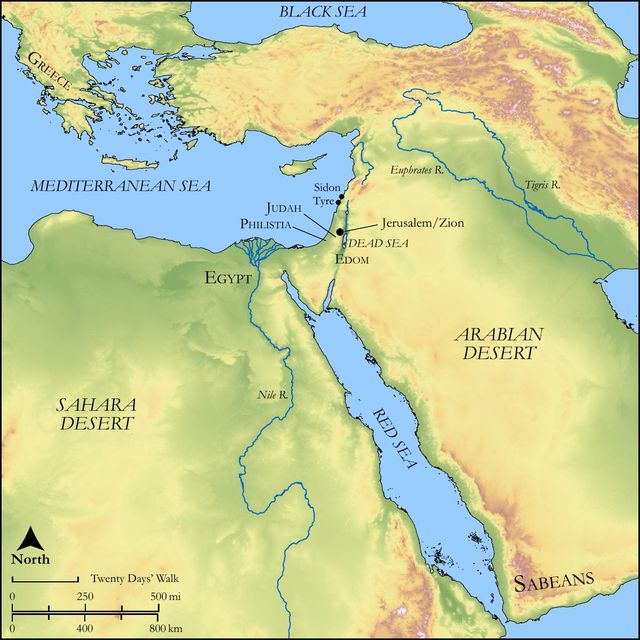
See on the biblical-era map
Study this verse
Public-domain commentary
Matthew Henry
From his Commentary on the Whole Bible. Henry comments on passages, not single verses — this entry covers Joel 1:14–20. His three-level outline is real structure in the source text, so it is rendered as structure.
We have observed abundance of tears shed for the destruction of the fruits of the earth by the locusts; now here we have those tears turned into the right channel, that of repentance and humiliation before God. The judgment was very heavy, and here they are directed to own the hand of God in it, his mighty hand, and to humble themselves under it. Here is,
I.A proclamation issued out for a general fast.
The priests are ordered to appoint one; they must not only mourn themselves, but they must call upon others to mourn too: "Sanctify a fast; let some time be set apart from all worldly business to be spent in the exercises of religion, in the expressions of repentance and other extraordinary instances of devotion." Note, Under public judgments there ought to be public humiliations; for by them the Lord God calls to weeping and mourning. With all the marks of sorrow and shame sin must be confessed and bewailed, the righteous of God must be acknowledged, and his favour implored. Observe what is to be done by a nation at such a time.
1.A day is to be appointed for this purpose, a day of restraint (so the margin reads it), a day in which people must be restrained from their other ordinary business (that they may more closely attend God's service), and from all bodily refreshments; for,
2.It must be a fast, a religious abstaining from meat and drink, further than is of absolute necessity. The king of Nineveh appointed a fast, in which they were to taste nothing, Jon 3:7. Hereby we own ourselves unworthy of our necessary food, and that we have forfeited it and deserve to be wholly deprived of it, we punish ourselves and mortify the body, which has been the occasion of sin, we keep it in a frame fit to serve the soul in serving God, and, by the appetite's craving food, the desires of the soul towards that which is better than life, and all the supports of it, are excited. This was in a special manner seasonable now that God was depriving them of their meat and drink; for hereby they accommodated themselves to the affliction they were under. When God says, You shall fast, it is time to say, We will fast.
3.There must be a solemn assembly. The elders and the people, magistrates and subjects, must be gathered together, even all the inhabitants of the land, that God might be honoured by their public humiliations, that they might thereby take the more shame to themselves, and that they might excite and stir up one another to the religious duties of the day. All had contributed to the national guilt, all shared in the national calamity, and therefore they must all join in the professions of repentance.
4.They must come together in the temple, the house of the Lord their God, because that was the house of prayer, and there they might be hope to meet with God because it was the place which he had chosen to put his name there, there they might hope to speed because it was a type of Christ and his mediation. Thus they interested themselves in Solomon's prayer for the acceptance of all the requests that should be put up in or towards this house, in which their present case was particularly mentioned. Kg1 7:37, If there be locust, if there be caterpillar.
5.They must sanctify this fast, must observe it in a religious manner, with sincere devotion. What is a fast worth if it be not sanctified?
6.They must cry unto the Lord. To him they must make their complaint and offer up their supplication. When we cry in our affliction we must cry to the Lord; this is fasting to him, Zac 7:5.
II.Some considerations suggested to induce them to proclaim this fast and to observe it strictly.
1.God was beginning a controversy with them. It is time to cry unto the Lord, for the day of the Lord is at hand, Joe 1:15. Either they mean the continuance and consequences of this present judgment which they now saw but breaking in upon them, or some greater judgments which this was but a preface to. However it be, this they are taught to make the matter of their lamentation: Alas, for the day! for the day of the Lord is at hand. Therefore cry to God. For, (1.) "The day of his judgment is very near, it is at hand; it will not slumber, and therefore you should not. It is time to fast and pray, for you have but a little time to turn yourselves in." (2.) It will be very terrible; there is no escaping it, no resisting it: As a destruction from the Almighty shall it come. See Isa 13:6. It is not a correction, but a destruction; and it comes from the hand, not of a weak creature, but of the Almighty; and who knows (nay, who does not know) the power of his anger? Whither should we go with our cries but to him from whom the judgment we dread comes? There is no fleeing from him but by fleeing to him, no escaping destruction from the Almighty but by making our submission and supplication to the Almighty; this is taking hold on his strength, that we may make peace, Isa 27:5.
2.They saw themselves already under the tokens of his displeasure. It is time to fast and pray, for their distress is very great, Joe 1:16.
(1.)Let them look into their own houses, and was no plenty there, as used to be. Those who kept a good table were now obliged to retrench: Is not the meat cut off before our eyes? If, when God's hand is lifted up, men will not see, when his hand is laid on they shall see. Is not the meat many a time cut off before our eyes? Let us then labour for that spiritual meat which is not before our eyes, and which cannot be cut off.
(2.)Let them look into God's house, and see the effects of the judgment there; joy and gladness were cut off from the house of God. Note, The house of our God is the proper place of joy and gladness; when David goes to the altar of God, it is to God my exceeding joy; but when joy and gladness are cut off from God's house, either by corruption of holy things or the persecution of holy persons, when serious godly decays and love waxes cold, then it time to cry to the Lord, time to cry, Alas!
3.The prophet returns to describe the grievousness of the calamity, in some particulars of it. Corn and cattle are the husbandman's staple commodities; now here he is deprived of both.
(1.)The caterpillars have devoured the corn, Joe 1:17. The garners, which they used to fill with corn, are laid desolate, and the barns broken down, because the corn has withered, and the owners think it not worth while to be at the charge of repairing them when they have nothing to put in them, nor are likely to have any thing; for the seed it rotten under the clods, either through too much rain or (which was the more common case in Canaan) for want of rain, or perhaps some insects under ground ate it up. When one crop fails the husbandman hopes the next may make it up; but here they despair of that, the seedness being as bad as the harvest.
(2.)The cattle perish too for want of grass (Joe 1:18): How do the beasts groan! This the prophet takes notice of, that the people might be affected with it and lay to heart the judgment. The groans of the cattle should soften their hard and impenitent hearts. The herds of cattle, the large cattle (black cattle we call them), are perplexed; nay, even the flocks of sheep, which will live upon a common and be content with very short grass, are made desolate. See here the inferior creatures suffering for our transgression, and groaning under the double burden of being serviceable to the sin of man and subject to the curse of God for it. Cursed is the ground for thy sake.
III.The prophet stirs them up to cry to God, with the consideration of the examples given them for it.
1.His own example (Joe 1:19): O Lord! to thee will I cry. He would not put them upon doing that which he would not resolve to do himself; nay, whether they would do it or no, he would. Note, If God's ministers cannot prevail to affect others with the discoveries of divine wrath, yet they ought to be themselves affected with them; if they cannot bring others to cry to God, yet they themselves be much in prayer. In time of trouble we must not only pray, but cry, must be fervent and importunate in prayer; and to God, from whom both the destruction is and the salvation must be, ought our cry to be always directed. That which engaged him to cry to God was, not so much any personal affliction, as the national calamity: The fire has devoured the pastures of the wilderness, which seems to be meant of some parching scorching heat of the sun, which was as fire to the fruits of the earth; it consumed them all. Note, When God calls to contend by fire it concerns those that have any interest in heaven to cry mightily to him for relief. See Num 11:2; Amo 7:4, Amo 7:5.
2.The example of the inferior creatures: "The beasts of the field do not only groan, but cry unto thee, Joe 1:20. They appeal to thy pity, according to their capacity, and as if, though they are not capable of a rational and revealed religion, yet they had something of dependence upon God by natural instinct." At least, when they groan by reason of their calamity, he is pleased to interpret it as if they cried to him; much more will he put a favourable construction upon the groanings of his own children, though sometimes so feeble that they cannot be uttered, Rom 8:26. The beasts are here said to cry unto God, as from him the lions seek their meat (Psa 104:21) and the young ravens, Job 38:41. The complaints of the brute-creatures here are for want of water (The rivers are dried up, through the excessive heat), and for want of grass, for the fire has devoured the pastures of the wilderness. And what better are those than beasts who never cry to God but for corn and wine, and complain of nothing but the want of delight of sense? Yet their crying to God in those cases shames the stupidity of those who cry not to God in any case.
Historical interpretation
Historical reception
2 surviving comments on this verse. Each one is dated, so this reads as a timeline rather than a list.
If God does not desire fasting, how is it that in Leviticus he commands the whole people in the seventh month, on the tenth day of the month, to fast until the evening, and threatens that he who does not constrain his soul shall die and be cut off from his people? How is it that the graves of lust, where the people fell in their devotions to flesh, remain even to this day in the wilderness? Do we not read that the stupid people gorged themselves with quails until the wrath of God came upon them? Why was the man of God at whose prophecy the hand of King Jeroboam withered, and who ate contrary to the command of God, immediately smitten? Strange that the lion which left the ass safe and sound should not spare the prophet just risen from his meal. He who, while he is fasting, had wrought miracles, no sooner ate a meal than he paid the penalty for the gratification. Joel also cries aloud: “Sanctify a fast, proclaim a time of healing.” So it appears that a holy fast may avail toward the cure of sin.
(Verse 13, 14.) Clothe yourselves and lament, priests; howl, ministers of the altar; enter, lie down in sackcloth, ministers of my God, because the sacrifice and libation have perished from the house of your God; sanctify a fast, call an assembly, gather the elders, all the inhabitants of the land into the house of your God, and cry out to the Lord. LXX: Clothe yourselves and lament, priests; bewail, you who minister at the altar; enter, sleep in sacks, ministers of God, because the sacrifice and libation have failed from the house of your God; sanctify a fast, proclaim healing; gather the elders, all the inhabitants of the land into the house of your God, and cry out to the Lord forcefully. Whoever is a holy priest and eats the Pascha of the Lord, let him gird himself with the belt of chastity and listen with the apostles: Let your loins be girded and your lamps burning in your hands (Luke XII, 35). But whoever is a sinner and is tormented by his own conscience, let him gird himself with sackcloth and weep, either for his own sins or for the sins of the people, and let him enter the Church from which he had departed because of his sins, and let him lie down or sleep in sackcloth, so that he may make up for the past pleasures, through which he had offended God, with the austerity of life. For those who dress in soft clothing are in the houses of kings (Matt. XV). But let the priests gird themselves and wail and howl, and sleep in sackcloth, as the prophet exhorts them to repentance, saying: O ministers of my God, how the sacrifice and libation have perished from the house of your God (Joel II), of which it has been said above. It is not enough to weep or lament and put on the attire of mourners, unless they sanctify the fast and call for a gathering. If every fasting pleased God, He would never say: 'Sanctify the fast.' And: 'I have not chosen such a fast,' says the Lord (Isaiah 58). And in the Gospel, those who make their faces appear pale, so that they may be seen by men to fast, are condemned (Matthew 6); and on the days of your fasts, you strike with fists, and oppress the poor. Therefore, now He says: 'Sanctify the fast.' Manichaeus fasts, and many heretics, especially the Encratites, of whom Tatianus is the leader, but this fast is worse because of excess and drunkenness. And let us call upon heaven, or healing, that through our repentance we may cure our sins. For it is written in Hebrew, Asara (), which Symmachus interprets as a council, Aquila as a day of gathering. Let the elders be gathered, whose age is near death, and whose mature judgment seeks more fear and reverence for God. Also, let all the inhabitants of the earth, of whom it was said above: Hear this, elders, and perceive with your ears, let both the elders and the inhabitants of the earth be gathered into the house of God, which is the Church. And when they are in the Church, with priests and people from different groups, the elderly and the inhabitants of the land, let there be one group formed, and cry out, he says, to the Lord in your hearts and say:
Continue studying Joel 1:14 across the web’s major study libraries — every link below opens this exact verse, chapter, or book on the destination site.
Read & Compare
 BibleGatewayThis verse in more than 200 translations and 70 languages.
 Bible.comThe YouVersion reader — hundreds of translations, reading plans, and highlights.
 ESV.orgCrossway's official English Standard Version reader.
 NET BibleThe NET translation with 60,000+ translators' notes on every rendering decision.
 STEP BibleTyndale House's free study tool — original text, vocabulary, and scholarly resources.
 BibliaLogos Bible Software's free web reader.
 USCCBThe New American Bible (Revised Edition) with the U.S. bishops' study notes.
Commentaries
 BibleHub CommentariesDozens of classic commentaries on this verse, gathered on one page.
 StudyLightMore than 100 commentary sets — the largest collection on the web.
 BibleRefPlain-English commentary on what this verse means, verse by verse.
 Enduring WordDavid Guzik's free commentary on this chapter, widely used by Bible teachers.
 Bible Study ToolsVerse commentary alongside Greek and Hebrew study aids.
Original Language & Research
- BibleHub InterlinearThe verse word by word — original language, transliteration, and English.
- BibleHub LexiconEvery word's original-language definition and Strong's entry.
 Blue Letter BibleDeep-study tools — Strong's numbers, concordance, and word studies.
 SefariaThe Hebrew text with Rashi and centuries of Jewish commentary.
Sermons, Hymns & Audio


TrulyRandomVerse is not affiliated with these sites and doesn’t control their content. They’re linked because they’re genuinely useful.
Summary
Joel 1:14 issues a dire command for national repentance and corporate supplication in the face of an unprecedented ecological disaster in Judah. The prophet Joel urges the people, from elders to all inhabitants, to consecrate a solemn fast and gather in the temple, the "house of the LORD," to collectively and desperately cry out to God for deliverance from the devastating locust plague and severe drought that have ravaged their land and livelihoods. This verse marks a pivotal turning point, moving from lamentation to a prescribed, unified act of seeking divine intervention.
Context
ShowHideLiterary Context
Joel 1:14 serves as the climax of the first chapter's vivid depiction of national calamity. Chapters 1 and 2 describe an unparalleled locust plague, likened to an invading army, followed by a severe drought, leading to widespread famine and despair. The land mourns, the fields are desolate, and even the priests lament the cessation of offerings. Prior to this verse, Joel has called upon various groups—drunkards, farmers, priests—to lament and acknowledge the disaster's severity. Verse 14, however, shifts from lament to a specific, urgent, and universal directive for a national response, setting the stage for God's eventual restoration and judgment described in later chapters.
Historical & Cultural Context
The book of Joel does not provide explicit historical markers, making precise dating challenging, though many scholars place it in the post-exilic period, possibly around the 5th or 4th century BC. Regardless of the exact date, the setting is Judah, centered around Jerusalem and its temple. Fasts and solemn assemblies were established practices in ancient Israel for times of national crisis, mourning, or seeking divine favor. The "house of the LORD" refers to the Temple in Jerusalem, the central place of worship and sacrifice, where the people would gather to present their petitions and offerings to God. The devastation described would have been a direct threat to the agrarian society's survival and was understood as divine judgment, necessitating a communal act of repentance and intercession.
Key Themes
ShowHideJoel 1:14 powerfully contributes to several overarching themes in the book of Joel and broader biblical theology. It underscores the theme of Corporate Repentance and Humility, highlighting that in times of widespread calamity, a unified, communal act of humility before God is essential. This moves beyond individual lament to a collective acknowledgment of sin and a desperate plea for mercy, echoing the principle found in 2 Chronicles 7:14. The command to gather in the "house of the LORD" emphasizes the Centrality of Public Worship and Communal Prayer in times of crisis, where the community seeks God's face. Finally, the instruction to "cry unto the LORD" encapsulates the theme of Desperate Supplication, signifying an impassioned, heartfelt cry for divine intervention and deliverance from what is perceived as divine judgment.
Exposition and Analysis
ShowHideKey Word Analysis
ShowHideMeaning "to be (causatively, make, pronounce or observe as) clean (ceremonially or morally); appoint, bid, consecrate, dedicate, defile, hallow, (be, keep) holy(-er, place), keep, prepare, proclaim, purify, sanctify(-ied one, self), [idiom] wholly." In this context, "sanctify a fast" means to set apart the fast as a holy act, consecrated to God, indicating that it is not merely abstaining from food but a sacred spiritual discipline intended to draw near to God in purity and sincerity.
Meaning "an assembly, especially on a festival or holiday; (solemn) assembly (meeting)." This term refers to a sacred, often restricted, gathering for religious purposes, emphasizing its serious, binding, and divinely ordained nature. It implies a cessation from normal activities to focus entirely on spiritual matters.
Meaning "to shriek (from anguish or danger); by analogy, (as a herald) to announce or convene publicly; assemble, call (together), (make a) cry (out), come with such a company, gather (together), cause to be proclaimed." This word denotes a loud, urgent, and often distressed cry for help, signifying a deep sense of need, desperation, and dependence on God for rescue and intervention. It is not a casual prayer but an impassioned plea.
Verse Breakdown
ShowHide"Sanctify ye a fast"
This is a direct, imperative command to consecrate a period of abstention from food. The purpose is not merely physical deprivation but spiritual preparation and dedication to God, setting aside time and resources to focus entirely on repentance and seeking divine mercy. It signifies a profound act of humility and earnest seeking.
"call a solemn assembly"
Following the call to fast, the prophet commands the convocation of a sacred gathering. This assembly is not ordinary; it is "solemn," indicating its serious, religious, and binding nature. It implies a formal, communal act of worship, lament, and supplication, bringing the entire community together for a unified purpose before God.
"gather the elders [and] all the inhabitants of the land [into] the house of the LORD your God"
This clause specifies the participants and the location. "Elders" represent the leadership and wisdom of the community, while "all the inhabitants of the land" emphasizes the universal scope of the command—no one is exempt. The designated place is the "house of the LORD," the Temple in Jerusalem, which was the spiritual center and the customary place for national gatherings and appeals to God. This highlights the corporate nature of the crisis and the required response.
"and cry unto the LORD"
This final imperative reveals the ultimate purpose of the fast and assembly: to make an urgent, desperate appeal to God. The word "cry" (Hebrew: zâʻaq) suggests a loud, anguished, and fervent plea, born out of profound distress and a recognition of utter dependence on God's intervention. It is a direct and impassioned act of intercession, acknowledging God's sovereignty over the calamity and His power to deliver.
Literary Devices
ShowHideJoel 1:14 employs several powerful literary devices to convey its urgent message. The most prominent is the Imperative Mood, seen in "Sanctify," "call," "gather," and "cry." These direct commands create a sense of immediate urgency and non-negotiable action, emphasizing the prophet's authority and the gravity of the situation. Inclusio is subtly present in the call for "elders" and "all the inhabitants," encompassing the entire social spectrum, ensuring no one is excluded from the corporate act of repentance. Symbolism is rich throughout the verse: the "fast" symbolizes humility, self-denial, and earnest seeking; the "solemn assembly" symbolizes unity and corporate responsibility; and the "house of the LORD" symbolizes God's presence, the place of atonement, and the spiritual heart of the nation. The very act of "crying unto the LORD" is a powerful Metonymy for desperate prayer and intercession, where the physical act of crying stands for the spiritual state of profound distress and reliance on divine mercy.
Theological and Thematic Connections
ShowHideJoel 1:14 profoundly articulates the biblical principle that national calamity often serves as a divine call to corporate repentance and a return to God. It underscores the belief that God is sovereign over natural phenomena and that His people's spiritual state has direct implications for their communal well-being. The prescribed response—fasting, solemn assembly, and desperate crying out—demonstrates a deep theological understanding of humanity's dependence on God, the efficacy of corporate prayer, and the necessity of humility before a holy God. It teaches that true repentance involves not just individual introspection but also a communal turning, acknowledging shared responsibility and seeking collective mercy. This act of national supplication is an appeal to God's covenant faithfulness and His willingness to restore when His people genuinely seek Him.
Reflection and Application
ShowHideJoel 1:14 offers timeless principles for how communities, nations, and even local churches can respond to severe crises, whether they are natural disasters, pandemics, economic downturns, or moral decay. It teaches that in times of profound adversity, a collective turning to God in humility and earnest prayer is not merely an option but a spiritual imperative. This requires leaders and all people to acknowledge their need for God's mercy and to participate in a unified act of seeking His face. Corporate prayer, especially when accompanied by genuine humility and fasting, is a powerful spiritual discipline that demonstrates a profound reliance on God's sovereignty and opens the door for His intervention. The "house of the LORD" today often symbolizes the gathered body of believers, reminding the church of its vital role in leading communities in prayer and intercession during times of adversity, demonstrating faith and hope in God's power to restore and heal.
Questions for Reflection
ShowHideFAQ
ShowHideWhat is the significance of "the house of the LORD" in Joel 1:14?
ShowHide"The house of the LORD" (H1004, bayith) in Joel 1:14 refers specifically to the Temple in Jerusalem. It was the central place of worship for the Israelites, where sacrifices were offered, and where God's presence was believed to dwell. Its significance in this verse is multifaceted: it emphasizes the corporate nature of the command, as the entire community was to gather there; it highlights the sacredness of the assembly, as they were entering God's dwelling place; and it underscores the idea that appeals to God, especially for national deliverance, were to be made at the designated place of covenant encounter. Gathering there demonstrated their reliance on God's covenant promises and His established means of reconciliation.
Why is a "fast" commanded in response to a locust plague and drought?
ShowHideA fast (H6685, tsôwm) in ancient Israel was a spiritual discipline undertaken in times of mourning, repentance, or intense supplication. In Joel 1:14, it is commanded in response to the devastating locust plague and drought because these calamities were understood as divine judgment for the people's sins. Fasting was a tangible expression of humility, sorrow for sin, and utter dependence on God. It was a way to deny the flesh and focus the spirit, demonstrating the sincerity of their repentance and their desperate plea for God's mercy and intervention. It was believed that such a collective act of humility could move God to relent from His judgment, as seen in the example of Nineveh in Jonah 3:5-10.
Christ-Centered Fulfillment
ShowHideJoel 1:14, with its urgent call for corporate repentance, solemn assembly, and a desperate cry to the LORD in the face of judgment, finds its ultimate fulfillment and transformation in Jesus Christ. While the Old Testament fasts and assemblies pointed to a need for atonement and divine intervention, they were temporary measures. Christ is the perfect fulfillment of the "house of the LORD," for He declared Himself to be the true temple, the place where God truly dwells among humanity (John 2:19-21). The desperate "cry unto the LORD" for deliverance from the consequences of sin finds its answer in the ultimate sacrifice of the Lamb of God who takes away the sin of the world, whose death on the cross atoned for humanity's greatest plague—sin. Through His finished work, believers are now called to a spiritual fast—a life of self-denial and devotion to God (Matthew 6:16-18), and to gather not in a physical temple, but as the living temple of God, the church, where the Spirit dwells (1 Corinthians 3:16). Our "cry unto the LORD" is now made with confidence through our great High Priest, Jesus, who ever lives to intercede for us (Hebrews 4:14-16), ensuring that our prayers are heard and answered according to God's perfect will. Thus, Joel's call for repentance is ultimately a foreshadowing of the profound spiritual repentance and turning to God made possible only through faith in Christ.