


Joel 1:15
Bible text: King James Version (1769 Blayney text) · Public domain
Bible text: Berean Standard Bible · Public domain
Bible text: American Standard Version (1901) · Public domain
Bible text: World English Bible, Messianic edition · Public domain
Bible text: Geneva Bible (1599) · Public domain
Bible text: Young's Literal Translation · Public domain
- אֲהָהּ'a·Hahalas!H162PrtParticle Interjection
- לַיּוֹםlai·Yomfor the dayH3117Prep-l ¦ N-msNoun Singular Masculine Absoluteלַfor theיּוֹםday
- כִּיkiforH3588PrtParticle Conditional
- קָרוֹבka·rOv[is] nearH7138Adj-msAdjective Singular Masculine Absolute
- יוֹםYom[the] day ofH3117N-mscNoun Singular Masculine Construct
- יְהוָהYah·wehYahwehH3068N-properNoun Proper Title
- וּכְשֹׁדu·khe·Shodand like devastationH7701Conj-w ¦ Prep-k ¦ N-msNoun Singular Masculine Absoluteוּandכְlikeשֹׁדdevastation
- מִשַׁדַּיmi·sha·Daifrom [the] AlmightyH7706Prep-m ¦ N-properNoun Proper Titleמִfromשַׁדַּי[the] Almighty
- יָבוֹאya·Vo'it will comeH935V-Qal-Imperf-3msVerb Qal Imperfect 3rd Singular Masculine
English is a literal word-by-word gloss of the Hebrew, not the KJV's wording. Why?
This is the original text the KJV's translators worked from — each Hebrew word with its own literal English meaning in this verse, prepared by scholars at Tyndale House, Cambridge. The KJV translates whole sentences, not word by word, so its wording differs: one Hebrew word can become several English words, and the KJV may choose “the LORD” where the gloss reads “Yahweh”. Both are faithful — they answer different questions. For the KJV's own rendering, switch to the KJV text.
Details
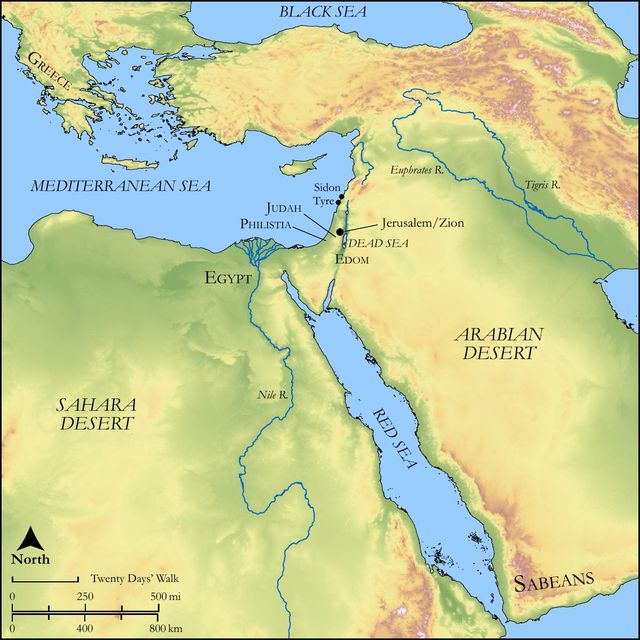
See on the biblical-era map
Study this verse
Public-domain commentary
Matthew Henry
From his Commentary on the Whole Bible. Henry comments on passages, not single verses — this entry covers Joel 1:14–20. His three-level outline is real structure in the source text, so it is rendered as structure.
We have observed abundance of tears shed for the destruction of the fruits of the earth by the locusts; now here we have those tears turned into the right channel, that of repentance and humiliation before God. The judgment was very heavy, and here they are directed to own the hand of God in it, his mighty hand, and to humble themselves under it. Here is,
I.A proclamation issued out for a general fast.
The priests are ordered to appoint one; they must not only mourn themselves, but they must call upon others to mourn too: "Sanctify a fast; let some time be set apart from all worldly business to be spent in the exercises of religion, in the expressions of repentance and other extraordinary instances of devotion." Note, Under public judgments there ought to be public humiliations; for by them the Lord God calls to weeping and mourning. With all the marks of sorrow and shame sin must be confessed and bewailed, the righteous of God must be acknowledged, and his favour implored. Observe what is to be done by a nation at such a time.
1.A day is to be appointed for this purpose, a day of restraint (so the margin reads it), a day in which people must be restrained from their other ordinary business (that they may more closely attend God's service), and from all bodily refreshments; for,
2.It must be a fast, a religious abstaining from meat and drink, further than is of absolute necessity. The king of Nineveh appointed a fast, in which they were to taste nothing, Jon 3:7. Hereby we own ourselves unworthy of our necessary food, and that we have forfeited it and deserve to be wholly deprived of it, we punish ourselves and mortify the body, which has been the occasion of sin, we keep it in a frame fit to serve the soul in serving God, and, by the appetite's craving food, the desires of the soul towards that which is better than life, and all the supports of it, are excited. This was in a special manner seasonable now that God was depriving them of their meat and drink; for hereby they accommodated themselves to the affliction they were under. When God says, You shall fast, it is time to say, We will fast.
3.There must be a solemn assembly. The elders and the people, magistrates and subjects, must be gathered together, even all the inhabitants of the land, that God might be honoured by their public humiliations, that they might thereby take the more shame to themselves, and that they might excite and stir up one another to the religious duties of the day. All had contributed to the national guilt, all shared in the national calamity, and therefore they must all join in the professions of repentance.
4.They must come together in the temple, the house of the Lord their God, because that was the house of prayer, and there they might be hope to meet with God because it was the place which he had chosen to put his name there, there they might hope to speed because it was a type of Christ and his mediation. Thus they interested themselves in Solomon's prayer for the acceptance of all the requests that should be put up in or towards this house, in which their present case was particularly mentioned. Kg1 7:37, If there be locust, if there be caterpillar.
5.They must sanctify this fast, must observe it in a religious manner, with sincere devotion. What is a fast worth if it be not sanctified?
6.They must cry unto the Lord. To him they must make their complaint and offer up their supplication. When we cry in our affliction we must cry to the Lord; this is fasting to him, Zac 7:5.
II.Some considerations suggested to induce them to proclaim this fast and to observe it strictly.
1.God was beginning a controversy with them. It is time to cry unto the Lord, for the day of the Lord is at hand, Joe 1:15. Either they mean the continuance and consequences of this present judgment which they now saw but breaking in upon them, or some greater judgments which this was but a preface to. However it be, this they are taught to make the matter of their lamentation: Alas, for the day! for the day of the Lord is at hand. Therefore cry to God. For, (1.) "The day of his judgment is very near, it is at hand; it will not slumber, and therefore you should not. It is time to fast and pray, for you have but a little time to turn yourselves in." (2.) It will be very terrible; there is no escaping it, no resisting it: As a destruction from the Almighty shall it come. See Isa 13:6. It is not a correction, but a destruction; and it comes from the hand, not of a weak creature, but of the Almighty; and who knows (nay, who does not know) the power of his anger? Whither should we go with our cries but to him from whom the judgment we dread comes? There is no fleeing from him but by fleeing to him, no escaping destruction from the Almighty but by making our submission and supplication to the Almighty; this is taking hold on his strength, that we may make peace, Isa 27:5.
2.They saw themselves already under the tokens of his displeasure. It is time to fast and pray, for their distress is very great, Joe 1:16.
(1.)Let them look into their own houses, and was no plenty there, as used to be. Those who kept a good table were now obliged to retrench: Is not the meat cut off before our eyes? If, when God's hand is lifted up, men will not see, when his hand is laid on they shall see. Is not the meat many a time cut off before our eyes? Let us then labour for that spiritual meat which is not before our eyes, and which cannot be cut off.
(2.)Let them look into God's house, and see the effects of the judgment there; joy and gladness were cut off from the house of God. Note, The house of our God is the proper place of joy and gladness; when David goes to the altar of God, it is to God my exceeding joy; but when joy and gladness are cut off from God's house, either by corruption of holy things or the persecution of holy persons, when serious godly decays and love waxes cold, then it time to cry to the Lord, time to cry, Alas!
3.The prophet returns to describe the grievousness of the calamity, in some particulars of it. Corn and cattle are the husbandman's staple commodities; now here he is deprived of both.
(1.)The caterpillars have devoured the corn, Joe 1:17. The garners, which they used to fill with corn, are laid desolate, and the barns broken down, because the corn has withered, and the owners think it not worth while to be at the charge of repairing them when they have nothing to put in them, nor are likely to have any thing; for the seed it rotten under the clods, either through too much rain or (which was the more common case in Canaan) for want of rain, or perhaps some insects under ground ate it up. When one crop fails the husbandman hopes the next may make it up; but here they despair of that, the seedness being as bad as the harvest.
(2.)The cattle perish too for want of grass (Joe 1:18): How do the beasts groan! This the prophet takes notice of, that the people might be affected with it and lay to heart the judgment. The groans of the cattle should soften their hard and impenitent hearts. The herds of cattle, the large cattle (black cattle we call them), are perplexed; nay, even the flocks of sheep, which will live upon a common and be content with very short grass, are made desolate. See here the inferior creatures suffering for our transgression, and groaning under the double burden of being serviceable to the sin of man and subject to the curse of God for it. Cursed is the ground for thy sake.
III.The prophet stirs them up to cry to God, with the consideration of the examples given them for it.
1.His own example (Joe 1:19): O Lord! to thee will I cry. He would not put them upon doing that which he would not resolve to do himself; nay, whether they would do it or no, he would. Note, If God's ministers cannot prevail to affect others with the discoveries of divine wrath, yet they ought to be themselves affected with them; if they cannot bring others to cry to God, yet they themselves be much in prayer. In time of trouble we must not only pray, but cry, must be fervent and importunate in prayer; and to God, from whom both the destruction is and the salvation must be, ought our cry to be always directed. That which engaged him to cry to God was, not so much any personal affliction, as the national calamity: The fire has devoured the pastures of the wilderness, which seems to be meant of some parching scorching heat of the sun, which was as fire to the fruits of the earth; it consumed them all. Note, When God calls to contend by fire it concerns those that have any interest in heaven to cry mightily to him for relief. See Num 11:2; Amo 7:4, Amo 7:5.
2.The example of the inferior creatures: "The beasts of the field do not only groan, but cry unto thee, Joe 1:20. They appeal to thy pity, according to their capacity, and as if, though they are not capable of a rational and revealed religion, yet they had something of dependence upon God by natural instinct." At least, when they groan by reason of their calamity, he is pleased to interpret it as if they cried to him; much more will he put a favourable construction upon the groanings of his own children, though sometimes so feeble that they cannot be uttered, Rom 8:26. The beasts are here said to cry unto God, as from him the lions seek their meat (Psa 104:21) and the young ravens, Job 38:41. The complaints of the brute-creatures here are for want of water (The rivers are dried up, through the excessive heat), and for want of grass, for the fire has devoured the pastures of the wilderness. And what better are those than beasts who never cry to God but for corn and wine, and complain of nothing but the want of delight of sense? Yet their crying to God in those cases shames the stupidity of those who cry not to God in any case.
Historical interpretation
Historical reception
1 surviving comment on this verse from the historical church.
(Verse 15.) Ah, ah, ah, woe to the day, for the day of the Lord is near, and it will come like a devastation (or storm) from the Almighty. LXX: Woe is me, woe is me, woe is me on that day! For the day of the Lord is near, and it will come like misery upon misery. Because we have translated it as 'from the Almighty,' in Hebrew it is said Saddai (), which is one of the ten names of God, as we have mentioned several times, the LXX translated as misery, reading Sod () instead of Saddai. Therefore, the voice of the priests and the people crying out to the Lord is heard, so that they may say for the third time, 'Woe is me!' I believe that, because of the sins they have committed, they have offended the Holy Trinity. But that day is the day of retribution for all sins, of which all the prophets write, and especially Isaiah cries out: 'Behold, the day of the Lord, inexorable, of fury and wrath, is coming, to make the whole world a desert, and to destroy sinners from it.' (Isaiah XIII, 9). This day is rightly called incurable; because when the day of judgment comes, there will be no place for repentance, which is compared to eternity, it is near, and not far. And what follows: And as misery will come from misery, or, devastation will come from the powerful, this means that evils will succeed evils, and all affliction will be dispensed by God the judge, who is able to destroy both body and soul into hell (Matthew X). Let us now specifically refer to the time of the Jewish captivity when Jerusalem was captured and the temple was destroyed; for not long after, the captivity of the ten and a half tribes by the Assyrians and Chaldeans followed. And it is predicted that this future event will not seem to have happened by chance or by the strength of the enemies, but by the anger and threat of God, or certainly, if the people continue in their sins, it will come as a result of their repentance.
Continue studying Joel 1:15 across the web’s major study libraries — every link below opens this exact verse, chapter, or book on the destination site.
Read & Compare
 BibleGatewayThis verse in more than 200 translations and 70 languages.
 Bible.comThe YouVersion reader — hundreds of translations, reading plans, and highlights.
 ESV.orgCrossway's official English Standard Version reader.
 NET BibleThe NET translation with 60,000+ translators' notes on every rendering decision.
 STEP BibleTyndale House's free study tool — original text, vocabulary, and scholarly resources.
 BibliaLogos Bible Software's free web reader.
 USCCBThe New American Bible (Revised Edition) with the U.S. bishops' study notes.
Commentaries
 BibleHub CommentariesDozens of classic commentaries on this verse, gathered on one page.
 StudyLightMore than 100 commentary sets — the largest collection on the web.
 BibleRefPlain-English commentary on what this verse means, verse by verse.
 Enduring WordDavid Guzik's free commentary on this chapter, widely used by Bible teachers.
 Bible Study ToolsVerse commentary alongside Greek and Hebrew study aids.
Original Language & Research
- BibleHub InterlinearThe verse word by word — original language, transliteration, and English.
- BibleHub LexiconEvery word's original-language definition and Strong's entry.
 Blue Letter BibleDeep-study tools — Strong's numbers, concordance, and word studies.
 SefariaThe Hebrew text with Rashi and centuries of Jewish commentary.
Sermons, Hymns & Audio


TrulyRandomVerse is not affiliated with these sites and doesn’t control their content. They’re linked because they’re genuinely useful.
Summary
Joel 1:15 issues a profound lament and urgent warning regarding the imminent "Day of the LORD," portraying it not merely as a future event but as a present and destructive force. The prophet declares that this day, characterized by desolation and judgment, is at hand and will come with the overwhelming power of the Almighty, serving as a stark reminder of divine sovereignty and the certainty of reckoning.
Context
ShowHideLiterary Context
Joel 1:15 is strategically placed within the prophet's initial lament over a devastating locust plague and severe drought that has ravaged Judah. Chapters 1 and 2 describe this ecological catastrophe in vivid detail, interpreting it as a direct precursor and a microcosm of the greater, more terrifying "Day of the LORD." The preceding verses (e.g., Joel 1:4-12) detail the destruction of crops and vineyards, leading to widespread famine and despair. Joel's call to lamentation, fasting, and repentance in Joel 1:13-14 immediately precedes this verse, setting the stage for the declaration of the Day's imminence. This verse serves as the climax of Joel's initial warning, transitioning from the immediate physical devastation to the ultimate divine judgment.
Historical & Cultural Context
The book of Joel does not provide specific historical markers, making its precise dating challenging. However, the vivid description of an unprecedented locust plague and drought suggests a real historical event that deeply impacted the agrarian society of Judah. In ancient Israelite culture, such natural disasters were often interpreted not as random occurrences but as signs of divine displeasure or judgment for covenant unfaithfulness. The "Day of the LORD" was a well-established theological concept in prophetic tradition, referring to a time when Yahweh would decisively intervene in history, often bringing judgment upon His enemies and salvation to His people. The prophet's call for national lament and assembly at the temple (e.g., Joel 1:14) reflects the communal response to crisis within Israelite religious practice, where public repentance and prayer were seen as means to avert or mitigate divine wrath.
Key Themes
ShowHideJoel 1:15 contributes significantly to several overarching themes in the book of Joel and broader prophetic literature. The most prominent is The Day of the LORD, which is presented as both a present reality (manifested in the plague) and a future eschatological event, emphasizing God's decisive intervention in history (e.g., Joel 2:1 and Joel 3:14). Another key theme is the Imminence of Divine Judgment, underscored by the phrase "is at hand," conveying a sense of urgency and demanding an immediate response from the people. The verse also highlights Divine Sovereignty and Omnipotence, particularly through the reference to "the Almighty," emphasizing God's absolute power to bring about both natural calamities and ultimate judgment. Finally, the opening cry, "Alas for the day!", introduces the theme of Lament and Repentance, urging the people to recognize the gravity of their situation and turn back to God (e.g., Joel 2:12-13).
Exposition and Analysis
ShowHideKey Word Analysis
ShowHideThis is a primitive word expressing intense pain, grief, or dread. It functions as an interjection, conveying a profound sense of sorrow and alarm. In Joel 1:15, it sets the tone of urgency and lament, reflecting the prophet's anguish over the impending judgment and his desire to awaken the people to the gravity of their situation. It is a cry of despair, anticipating the severity of what is to come.
This crucial theological phrase refers to a specific time when God (Yahweh, the self-existent, covenant God of Israel) decisively intervenes in human history. While it can encompass both judgment upon the wicked and deliverance for the righteous, in Joel's immediate context, it primarily signifies a time of divine reckoning and destruction. The "day" (yôwm) here is not merely a 24-hour period but a defined period of God's active involvement, often marked by significant historical or eschatological events. Its use here underscores the divine origin and purpose behind the impending catastrophe.
Derived from a root meaning "to devastate" or "to ravage," this word denotes violence, desolation, oppression, or plunder. It describes the nature of the coming "Day of the LORD" as one that brings ruin and devastation. The use of "destruction" emphasizes the severe and comprehensive nature of God's judgment, which will leave nothing untouched. It highlights the destructive power inherent in God's intervention when He acts in judgment against sin.
This is one of the ancient names for God, emphasizing His omnipotence, self-sufficiency, and absolute power. Often translated as "Almighty," it conveys God's ability to fulfill all His purposes, including His judgments. The phrase "from the Almighty shall it come" unequivocally attributes the source and irresistible force of the "destruction" to God Himself, reinforcing His sovereignty over all events and His capacity to execute His will without hindrance.
Verse Breakdown
ShowHide"Alas for the day!"
This opening exclamation, rooted in deep sorrow and dread, immediately conveys the prophet's anguish and the dire nature of the message. It is a lament, a cry of woe, signaling that the day being announced is one of profound suffering and judgment, not celebration. It aims to evoke a similar sense of urgency and despair in the hearers, preparing them for the solemn declaration that follows.
"for the day of the LORD is at hand,"
This clause reveals the specific object of the lament: the "Day of the LORD." The conjunction "for" indicates that the imminence of this day is the reason for the prophet's lamentation. The phrase "is at hand" (Hebrew, qârôwb') emphasizes the proximity and urgency of this divine intervention. It signifies that the time for God's decisive action is not distant but immediate, demanding an urgent response of repentance and preparation from the people.
"and as a destruction from the Almighty shall it come."
This final clause describes the nature and source of the "Day of the LORD." It will come "as a destruction," meaning it will be characterized by devastation, ruin, and violence. The simile "as a destruction" highlights the comprehensive and overwhelming nature of this coming event. Crucially, this destruction is not random or accidental but originates "from the Almighty" (Hebrew, Shadday'), underscoring God's absolute power, sovereignty, and deliberate intent in bringing about this judgment. It signifies that this is a purposeful act of divine reckoning.
Literary Devices
ShowHideJoel 1:15 is rich in literary devices that amplify its urgent message. The opening Exclamation, "Alas for the day!", immediately establishes a tone of profound lament and distress, drawing the reader into the prophet's emotional state and signaling the gravity of the impending event. The Repetition of "day" ("day! for the day of the LORD") serves to emphasize the central theme and its imminence, creating a sense of inescapable focus on this crucial period. The phrase "as a destruction from the Almighty" employs a Simile, likening the coming Day to an overwhelming force of ruin, vividly portraying its devastating impact. This also functions as a form of Hyperbole, exaggerating the destructive power to impress upon the audience the severity of God's judgment. Furthermore, the verse utilizes Prophetic Language characterized by a direct, declarative tone and an emphasis on divine intervention, typical of Old Testament prophetic warnings of judgment. The very concept of the "Day of the LORD" is a Theological Motif that carries significant weight and expectation for the original audience.
Theological and Thematic Connections
ShowHideJoel 1:15 profoundly connects to the broader biblical narrative of divine judgment and sovereignty. It underscores the truth that God is not a passive observer of human history but an active, righteous judge who will decisively intervene to address sin and establish His justice. The "Day of the LORD" is a recurring theme throughout the prophets, symbolizing a time when God's holiness and power are unmistakably revealed, often bringing about a cataclysmic reckoning for those who have rebelled against Him. This verse serves as a stark reminder that God's patience has limits and that unrepentant sin inevitably leads to His just wrath. It highlights the serious consequences of spiritual apathy and disobedience, calling for a radical reorientation towards God in light of His impending judgment. The power attributed to "the Almighty" reinforces the absolute certainty and irresistible force of this divine intervention.
Reflection and Application
ShowHideJoel 1:15 serves as a timeless call to spiritual vigilance and genuine repentance. While the immediate context was a physical plague foreshadowing a future judgment, the underlying principle remains profoundly relevant: God is sovereign, and He will indeed bring all things to account. This verse challenges us to consider our own lives in light of God's ultimate justice. Are we living in a way that acknowledges His authority and anticipates His return, or are we complacent, ignoring the signs of His sovereign hand in the world? The "Alas!" is a lament that should echo in our hearts, prompting us to examine our spiritual posture. It is a reminder that the time for turning to God is always "at hand" and that genuine transformation is a matter of urgent necessity, not future convenience. This urgency should not breed fear in believers, but rather a deeper commitment to holiness and a greater passion for sharing the hope found in Christ with a world that desperately needs it.
Questions for Reflection
ShowHideFAQ
ShowHideWhat is the "Day of the LORD" and how does it relate to Joel 1:15?
ShowHideThe "Day of the LORD" is a pivotal theological concept in Old Testament prophecy, referring to a specific time when God (Yahweh) decisively intervenes in human history to execute His judgment and/or bring about salvation. In Joel 1:15, it signifies a time of impending divine judgment and destruction. Joel interprets the devastating locust plague and drought (described in Joel 1:4-12) as a foretaste or a present manifestation of this "Day," emphasizing its imminence ("is at hand") and its destructive power, which comes "from the Almighty." While it had immediate implications for Judah, it also points to a future, ultimate day of reckoning that will encompass all nations, as seen in later prophecies like Joel 3:14.
Christ-Centered Fulfillment
ShowHideJoel 1:15, with its urgent declaration of the "Day of the LORD" and its coming "as a destruction from the Almighty," finds its ultimate Christ-centered fulfillment in the person and work of Jesus Christ. While the Old Testament prophets often spoke of this Day as a time of terrifying judgment, the New Testament reveals that Jesus is both the one who inaugurates this Day and the one who delivers from its wrath. His first coming, though marked by grace, initiated a new era of God's decisive intervention, fulfilling prophecies and bringing judgment upon sin through His atoning sacrifice on the cross. The "destruction" spoken of in Joel is ultimately borne by Christ, the Lamb of God who takes away the sin of the world, allowing those who believe in Him to escape the condemnation of that Day. Furthermore, the "Day of the LORD" points powerfully to Christ's second coming, when He will return not as a suffering servant but as the righteous Judge and King, bringing final judgment upon the ungodly and establishing His eternal kingdom in its fullness (e.g., Matthew 25:31-32). Believers are called to live in readiness for this Day, not in fear of destruction, but in joyful anticipation of their Savior's glorious return and the full consummation of their salvation (e.g., Titus 2:13). Thus, Joel's warning serves as a powerful backdrop, highlighting the profound need for the saving work of Christ, who transforms the "Day of destruction" into a "Day of salvation" for all who trust in Him.