


Joel 1:13
- חִגְרוּchig·Rugird yourselvesH2296V-Qal-Imp-2mpVerb Qal Imperative 2nd Plural Masculine
- וְסִפְדוּve·sif·Duand lamentH5594Conj-w ¦ V-Qal-Imp-2mpVerb Qal Imperative 2nd Plural Masculineוְandסִפְדוּlament
- הַכֹּהֲנִיםha·ko·ha·NimO priestsH3548Art ¦ N-mpNoun Plural Masculine AbsoluteהַOכֹּהֲנִיםpriests
- הֵילִילוּhei·Li·luwailH3213V-Hiphil-Imp-2mpVerb Hiphil Imperative 2nd Plural Masculine
- מְשָׁרְתֵיme·sha·re·TeiO servants ofH8334V-Piel-Prtcpl-mpVerb Piel Participle Plural Masculine Construct
- מִזְבֵּחַmiz·Be·ach[the] altarH4196N-msNoun Singular Masculine Absolute
- בֹּאוּBo·'ucomeH935V-Qal-Imp-2mpVerb Qal Imperative 2nd Plural Masculine
- לִינוּLi·nuspend [the] nightH3885V-Qal-Imp-2mpVerb Qal Imperative 2nd Plural Masculine
- בַשַּׂקִּיםva·sa·Kimin <the> sackcloth<s>H8242Prep-b ¦ N-mpNoun Plural Masculine Absoluteבַin <the>שַּׂקִּיםsackcloth<s>
- מְשָׁרְתֵיme·sha·re·TeiO servants ofH8334V-Piel-Prtcpl-mpVerb Piel Participle Plural Masculine Construct
- אֱלֹהָי'e·lo·Haimy GodH430N-mpc ¦ 1csNoun Plural Masculine ConstructאֱלֹהָGodיmy
- כִּיkiforH3588PrtParticle Conditional
- נִמְנַעnim·Na'it has been withheldH4513V-Niphal-Perf-3msVerb Niphal Perfect 3rd Singular Masculine
- מִבֵּיתmi·Beitfrom [the] house ofH1004Prep-m ¦ N-mscNoun Singular Masculine Constructמִfromבֵּית[the] house of
- אֱלֹהֵיכֶם'e·lo·hei·Khemyour GodH430N-mpc ¦ 2mpNoun Plural Masculine ConstructאֱלֹהֵיGodכֶםyour
- מִנְחָהmin·Chahgrain offeringH4503N-fsNoun Singular Feminine Absolute
- וָנָסֶךְva·Na·sekhand drink offeringH5262Conj-w ¦ N-msNoun Singular Masculine Absoluteוָandנָסֶךְdrink offering
English is a literal word-by-word gloss of the Hebrew, not the KJV's wording. Why?
This is the original text the KJV's translators worked from — each Hebrew word with its own literal English meaning in this verse, prepared by scholars at Tyndale House, Cambridge. The KJV translates whole sentences, not word by word, so its wording differs: one Hebrew word can become several English words, and the KJV may choose “the LORD” where the gloss reads “Yahweh”. Both are faithful — they answer different questions. For the KJV's own rendering, switch to the KJV text.
Details
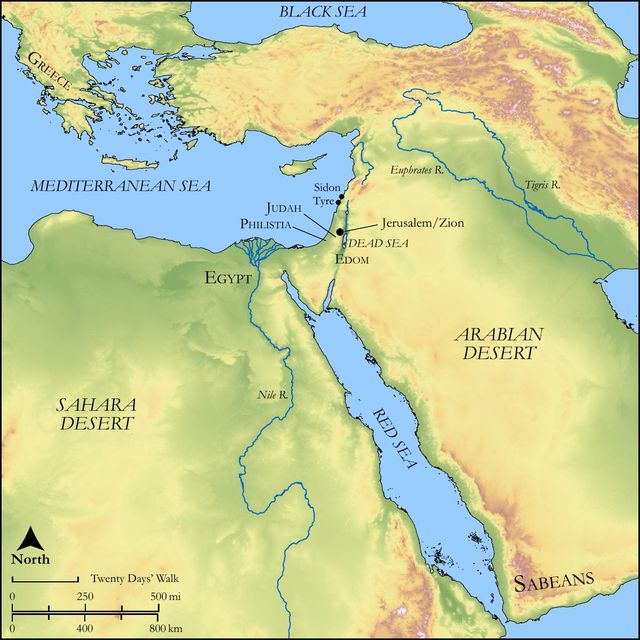
See on the biblical-era map
Study this verse
Public-domain commentary
Matthew Henry
From his Commentary on the Whole Bible. Henry comments on passages, not single verses — this entry covers Joel 1:8–13. His two-level outline is real structure in the source text, so it is rendered as structure.
The judgment is here described as very lamentable, and such as all sorts of people should share in; it shall not only rob the drunkards of their pleasure (if that were the worst of it, it might be the better borne), but it shall deprive others of their necessary subsistence, who are therefore called to lament (Joe 1:8), as a virgin laments the death of her lover to whom she was espoused, but not completely married, yet so that he was in effect her husband, or as a young woman lately married, from whom the husband of her youth, her young husband, or the husband to whom she was married when she was young, is suddenly taken away by death. Between a new-married couple that are young, that married for love, and that are every way amiable and agreeable to each other, there is great fondness, and consequently great grief if either be taken away. Such lamentation shall there be for the loss of their corn and wine. Note, The more we are wedded to our creature-comforts that harder it is to part with them. See that parallel place, Isa 32:10-12. Two sorts of people are here brought in, as concerned to lament this devastation, countrymen and clergymen.
I.Let the husbandmen and vine-dressers lament, Joe 1:11.
Let them be ashamed of the care and pains they have taken about their vineyards, for it will be all labour lost, and they shall gain no advantage by it; they shall see the fruit of their labour eaten up before their eyes, and shall not be able to save any of it. Note, Those who labour only for the meat that perishes will, sooner or later, be ashamed of their labour. The vine-dressers will then express their extreme grief by howling, when they see their vineyards stripped of leaves and fruit, and the vines withered, so that nothing is to be had or hoped for from them, wherewith they might pay their rent and maintain their families. The destruction is particularly described here: The field is laid waste (Joe 1:10); all is consumed that is produced; the land mourns; the ground has a melancholy aspect, and looks ruefully; all the inhabitants of the land are in tears for what they have lost, are in fear of perishing for want, Isa 24:4; Jer 4:28. "The corn, the bread-corn, which is the staff of life, is wasted; the new wine, which should be brought into the cellars for a supply when the old is drunk, is dried up, is ashamed of having promised so fair what it is not now able to perform; the oil languishes, or is diminished, because (as the Chaldee renders it) the olives have fallen off." The people were not thankful to God as they should have been for the bread that strengthens man's heart, the wine that makes glad the heart, and the oil that makes the face to shine (Psa 104:14, Psa 104:15); and therefore they are justly brought to lament the loss and want of them, of all the products of the earth, which God had given either for necessity or for delight (this is repeated, Joe 1:11, Joe 1:12) - the wheat and barley, the two principal grains bread was then made of, wheat for the rich and barley for the poor, so that the rich and poor meet together in the calamity. The trees are destroyed, not only the vine and the fig-tree (as before, Joe 1:7), which were more useful and necessary, but other trees also that were for delight - the pomegranate, palm-tree, and apple-tree, yea, all the trees of the field, as well as those of the orchard, timber-trees as well as fruit-trees. In short, all the harvest of the field has perished, Joe 1:11. And by this means joy has withered away from the children of men (Joe 1:11); the joy of harvest, which is used to express great and general joy, has come to nothing, is turned into shame, is turned into lamentation. Note, The perishing of the harvest is the withering of the joy of the children of men. Those that place their happiness in the delights of the sense, when they are deprived of them, or in any way disturbed in the enjoyment of them, lose all their joy; whereas the children of God, who look upon the pleasures of sense with holy indifference and contempt, and know what it is to make God their hearts' delight, can rejoice in him as the God of their salvation even when the fig-tree does not blossom; spiritual joy is so far from withering then, that it flourishes more than ever, Hab 3:17, Hab 3:18. Let us see here,
1.What perishing uncertain things all our creature-comforts are. We can never be sure of the continuance of them. Here the heavens had given their rains in due season, the earth had yielded her strength, and, when the appointed weeks of harvest were at hand, they saw no reason to doubt but that they should have a very plentiful crop; yet then they are invaded by these unthought-of enemies, that lay all waste, and not by fire and sword. It is our wisdom not to lay up our treasure in those things which are liable to so many untoward accidents.
2.See what need we have to live in continual dependence upon God and his providence, for our own hands are not sufficient for us. When we see the full corn in the ear, and think we are sure of it - nay, when we have brought it home, if he blow upon it, nay, if he do not bless it, we are not likely to have any good of it.
3.See what ruinous work sin makes. A paradise is turned into a wilderness, a fruitful land, the most fruitful land upon earth, into barrenness, for the iniquity of those that dwelt therein.
II.Let the priests, the Lord's ministers, lament, for they share deeply in the calamity:
Gird yourselves with sackcloth (Joe 1:13); nay, they do mourn, Joe 1:9. Observe, The priests are called the ministers of the altar, for on that they attended, and the ministers of the Lord (of my God, says the prophet), for in attending on the altar they served him, did is work, and did him honour. Note, Those that are employed in holy things are therein God's ministers, and on him they attend. The ministers of the altar used to rejoice before the Lord, and to spend their time very much in singing; but now they must lament and howl, for the meat-offering and drink-offering were cut off from the house of the Lord (Joe 1:9), and the same again (Joe 1:13), from the house of your God. "He is your God in a particular manner; you are in a nearer relation to him than other Israelites are; and therefore it is expected that you should be more concerned than others for that which is a hindrance to the service of his sanctuary." It is intimated,
1.That the people, as long as they had the fruits of the earth brought in in their season, presented to the Lord his dues out of them, and brought the offerings to the altar and tithes to those that served at the altar. Note, A people may be filling up the measure of their iniquity apace, and yet may keep up a course of external performances in religion.
2.That, when the meat and drink failed, the meat-offering and drink-offering failed of course; and this was the sorest instance of the calamity. Note, As far as any public trouble is an obstruction to the course of religion it is to be upon that account, more than any other, sadly lamented, especially by the priests, the Lord's ministers. As far as poverty occasions the decay of piety and the neglect of divine offices, and starves the cause of religion among a people, it is indeed a sore judgment. When the famine prevailed God could not have his sacrifices, nor could the priests have their maintenance; and therefore let the Lord's ministers mourn.
Historical interpretation
Historical reception
2 surviving comments on this verse. Each one is dated, so this reads as a timeline rather than a list.
Select a marker to jump to its quote. Markers stagger vertically where authors wrote within a few decades of each other.
Joel again summons us wailing and will have the ministers of the altar lament under the conditions of famine. He does not allow us to revel in the misfortunes of others. After sanctifying a fast, calling a solemn assembly and gathering the old men, the children, and those of tender age, we ourselves must further haunt the temple in sackcloth and ashes, prostrated humbly on the ground, because the field is wasted and the meat offering and the drink offering is cut off from the house of the Lord, till we draw down mercy by our humiliation.
(Verse 13, 14.) Clothe yourselves and lament, priests; howl, ministers of the altar; enter, lie down in sackcloth, ministers of my God, because the sacrifice and libation have perished from the house of your God; sanctify a fast, call an assembly, gather the elders, all the inhabitants of the land into the house of your God, and cry out to the Lord. LXX: Clothe yourselves and lament, priests; bewail, you who minister at the altar; enter, sleep in sacks, ministers of God, because the sacrifice and libation have failed from the house of your God; sanctify a fast, proclaim healing; gather the elders, all the inhabitants of the land into the house of your God, and cry out to the Lord forcefully. Whoever is a holy priest and eats the Pascha of the Lord, let him gird himself with the belt of chastity and listen with the apostles: Let your loins be girded and your lamps burning in your hands (Luke XII, 35). But whoever is a sinner and is tormented by his own conscience, let him gird himself with sackcloth and weep, either for his own sins or for the sins of the people, and let him enter the Church from which he had departed because of his sins, and let him lie down or sleep in sackcloth, so that he may make up for the past pleasures, through which he had offended God, with the austerity of life. For those who dress in soft clothing are in the houses of kings (Matt. XV). But let the priests gird themselves and wail and howl, and sleep in sackcloth, as the prophet exhorts them to repentance, saying: O ministers of my God, how the sacrifice and libation have perished from the house of your God (Joel II), of which it has been said above. It is not enough to weep or lament and put on the attire of mourners, unless they sanctify the fast and call for a gathering. If every fasting pleased God, He would never say: 'Sanctify the fast.' And: 'I have not chosen such a fast,' says the Lord (Isaiah 58). And in the Gospel, those who make their faces appear pale, so that they may be seen by men to fast, are condemned (Matthew 6); and on the days of your fasts, you strike with fists, and oppress the poor. Therefore, now He says: 'Sanctify the fast.' Manichaeus fasts, and many heretics, especially the Encratites, of whom Tatianus is the leader, but this fast is worse because of excess and drunkenness. And let us call upon heaven, or healing, that through our repentance we may cure our sins. For it is written in Hebrew, Asara (), which Symmachus interprets as a council, Aquila as a day of gathering. Let the elders be gathered, whose age is near death, and whose mature judgment seeks more fear and reverence for God. Also, let all the inhabitants of the earth, of whom it was said above: Hear this, elders, and perceive with your ears, let both the elders and the inhabitants of the earth be gathered into the house of God, which is the Church. And when they are in the Church, with priests and people from different groups, the elderly and the inhabitants of the land, let there be one group formed, and cry out, he says, to the Lord in your hearts and say:
Continue studying Joel 1:13 across the web’s major study libraries — every link below opens this exact verse, chapter, or book on the destination site.
Read & Compare
 BibleGatewayThis verse in more than 200 translations and 70 languages.
 Bible.comThe YouVersion reader — hundreds of translations, reading plans, and highlights.
 ESV.orgCrossway's official English Standard Version reader.
 NET BibleThe NET translation with 60,000+ translators' notes on every rendering decision.
 STEP BibleTyndale House's free study tool — original text, vocabulary, and scholarly resources.
 BibliaLogos Bible Software's free web reader.
 USCCBThe New American Bible (Revised Edition) with the U.S. bishops' study notes.
Commentaries
 BibleHub CommentariesDozens of classic commentaries on this verse, gathered on one page.
 StudyLightMore than 100 commentary sets — the largest collection on the web.
 BibleRefPlain-English commentary on what this verse means, verse by verse.
 Enduring WordDavid Guzik's free commentary on this chapter, widely used by Bible teachers.
 Bible Study ToolsVerse commentary alongside Greek and Hebrew study aids.
Original Language & Research
- BibleHub InterlinearThe verse word by word — original language, transliteration, and English.
- BibleHub LexiconEvery word's original-language definition and Strong's entry.
 Blue Letter BibleDeep-study tools — Strong's numbers, concordance, and word studies.
 SefariaThe Hebrew text with Rashi and centuries of Jewish commentary.
Sermons, Hymns & Audio


TrulyRandomVerse is not affiliated with these sites and doesn’t control their content. They’re linked because they’re genuinely useful.
Summary
Joel 1:13 issues an urgent, impassioned divine command to the priests and ministers of Judah, compelling them to engage in profound lamentation and public mourning. This desperate call is necessitated by the catastrophic locust plague and subsequent drought, which have decimated the land's produce, rendering the customary grain and drink offerings impossible to present at the temple. The verse underscores the severity of God's judgment, the disruption of sacred worship, and the critical responsibility of spiritual leaders to lead the nation in a collective act of repentance and intercession in the face of such spiritual and physical desolation.
Context
ShowHideLiterary Context
Joel 1:13 is a pivotal command within the prophet Joel's opening chapter, which vividly describes an unprecedented and devastating locust plague followed by a severe drought. The preceding verses detail the widespread destruction of crops, vineyards, and fruit trees, leading to agricultural ruin and national despair (e.g., Joel 1:4-7). This ecological catastrophe is presented not merely as a natural disaster but as a direct manifestation of divine judgment. The lamentable state of the land culminates in the inability to provide the necessary produce for the daily temple sacrifices, specifically the grain and drink offerings mentioned in Joel 1:10-12. Therefore, verse 13 serves as a direct, urgent response to this spiritual and physical crisis, calling the religious leaders to lead the people in a profound act of mourning and repentance, essential for national restoration.
Historical & Cultural Context
The book of Joel is notoriously difficult to date, but its message resonates with periods of national crisis in ancient Judah. The "locust plague" and "drought" described are not just metaphors but likely real events that would have had catastrophic economic and social consequences in an agrarian society dependent on rainfall and harvests. In ancient Israelite worship, the "meat offering" (more accurately, the grain or meal offering, minchâh) and "drink offering" (nesech) were fundamental components of daily temple rituals, symbolizing devotion, thanksgiving, and atonement. Their cessation, due to the lack of produce, was a profound spiritual crisis, indicating a broken covenant relationship and the suspension of the means by which the people typically approached God. Sackcloth was a coarse, dark fabric worn as a public sign of deep grief, mourning, humility, or repentance, often accompanied by fasting and ashes. The call for priests to "lie all night in sackcloth" signifies an extreme, public display of contrition and intercession, reflecting the gravity of the national calamity.
Key Themes
ShowHideJoel 1:13 powerfully contributes to several key themes woven throughout the book of Joel. Firstly, it highlights Divine Judgment and its Impact on Worship, demonstrating how sin and its consequences can directly impede or even halt the corporate worship of God. The inability to offer prescribed sacrifices signifies a practical breakdown in the covenant relationship, a theme further explored in Joel 2:1-11. Secondly, the verse emphasizes The Indispensable Role of Religious Leaders. Priests and ministers are explicitly called to lead the nation in sorrow and repentance, underscoring their unique responsibility to intercede for the people and guide them in spiritual matters. Their public display of grief and humility is presented as crucial for initiating a national return to God, a call echoed in Joel 2:15-17. Finally, the passage strongly conveys the Urgency of Repentance and Lamentation. The commands to "gird yourselves, and lament," "howl," and "lie all night in sackcloth" underscore the depth of sorrow and the immediate need for heartfelt contrition required to avert further divine wrath and seek restoration, a message that culminates in the promise of restoration upon genuine repentance in Joel 2:18-32.
Exposition and Analysis
ShowHideKey Word Analysis
ShowHideWhile often meaning to prepare for action by tightening one's garments, in this context, châgar takes on the specific nuance of preparing for intense mourning, typically by putting on sackcloth. It implies a deliberate act of readiness for lamentation, emphasizing the solemnity and urgency of the prophet's call to the priests.
This word denotes a loud, mournful cry, a wailing sound indicative of deep anguish and distress. It suggests a public, audible expression of profound grief, far beyond mere sadness, demanding an unrestrained outpouring of sorrow from the religious leaders.
This term refers to those who attend or serve, particularly in a religious or ceremonial capacity. Here, it specifically designates the priests and other temple functionaries who are responsible for the sacred service of God. The use of this word underscores their unique role and responsibility in leading the people in worship and, consequently, in repentance when that worship is disrupted.
Verse Breakdown
ShowHide"Gird yourselves, and lament, ye priests"
This is a direct, imperative command to the kôhên (priests), who were the primary officiants of temple worship. "Gird yourselves" (often with sackcloth) signals a preparation for deep, public mourning, not for activity. "Lament" (from çâphad) implies a loud, demonstrative expression of grief, akin to tearing clothes or beating breasts, signifying profound sorrow over the national calamity and its spiritual implications.
"howl, ye ministers of the altar"
This intensifies the previous command, directing the shârath (ministers/servants) who attend the altar to utter a piercing, wailing cry (yâlal). The altar, the focal point of sacrifice and atonement, is now barren, making the call to howl a poignant response to the desecration of worship.
"come, lie all night in sackcloth, ye ministers of my God"
The command to "come" (bôwʼ) emphasizes urgency and immediacy. "Lie all night" (lûwn) signifies an extended, public vigil of mourning and supplication, demonstrating extreme humility and contrition. "Sackcloth" (saq) is the traditional garment of mourning and repentance, worn to symbolize a broken and contrite spirit before God. The repetition of "ministers" and the possessive "my God" underscore their direct accountability to God and their unique role as spiritual intermediaries.
"for the meat offering and the drink offering is withholden from the house of your God"
This clause provides the devastating reason for the profound lament. The "meat offering" (minchâh, grain/meal offering) and "drink offering" (neçek, libation) were essential, daily components of temple worship, symbolizing devotion and maintaining covenant relationship. Their "withholden" (mânaʻ) status—not offered because there is no produce—represents a complete breakdown in the ritual system and, more importantly, a severe disruption in the people's ability to approach God through prescribed means. "The house of your God" (bayith) refers to the Temple in Jerusalem, the sacred center of Israelite worship, now deprived of its customary offerings.
Literary Devices
ShowHideJoel 1:13 employs several powerful literary devices to convey its urgent message. The repeated use of imperative verbs ("Gird yourselves," "lament," "howl," "come," "lie") creates a sense of immediate command and intense urgency, underscoring the gravity of the situation and the necessity of an immediate response from the religious leaders. The parallelism between "priests" and "ministers of the altar," and then "ministers of my God," emphasizes the specific target audience and reinforces their collective responsibility. Symbolism is prominent, with "sackcloth" representing deep mourning, humility, and repentance, and the "meat offering and the drink offering" symbolizing the disrupted covenant relationship and the inability to properly worship God. The pathos is palpable, as the prophet evokes a deep emotional response by describing the cessation of sacred rituals, a sign of God's judgment and the spiritual desolation of the people. Finally, the causal conjunction "for" ("for the meat offering...") clearly links the command to lament with its devastating cause, highlighting the direct consequence of the agricultural ruin on the nation's spiritual life.
Theological and Thematic Connections
ShowHideJoel 1:13 profoundly illustrates the interconnectedness of national well-being, spiritual obedience, and the practice of worship. The withholding of offerings due to famine is not merely an inconvenience but a theological crisis, signifying a breach in the covenant relationship between God and His people. It reveals that God's judgment can directly impact the very means by which His people approach Him, forcing a confrontation with their spiritual state. The call for the priests to lead in lament underscores the principle of corporate responsibility and the vital role of spiritual leadership in guiding a community through repentance. This passage teaches that true worship is not merely ritualistic but must flow from a heart responsive to God's dealings, especially in times of discipline. It highlights that when the customary forms of worship are interrupted, it should provoke profound introspection, grief, and a desperate plea for divine mercy.
Reflection and Application
ShowHideJoel 1:13 serves as a timeless summons for deep spiritual introspection, both individually and corporately. In our own lives, when circumstances hinder our ability to engage in customary spiritual practices—whether personal devotion, corporate worship, or acts of service—we are called not to merely lament the loss of the practice itself, but to discern if such hindrances are a divine call to examine the spiritual health of our hearts and communities. Is there unconfessed sin, spiritual apathy, or a broken relationship with God that has led to a "withholding" of His presence or blessing? This passage reminds us that genuine repentance begins with a profound recognition of our spiritual poverty and a willingness to publicly humble ourselves before God, much like the priests in sackcloth. For leaders, it underscores the immense responsibility to be vigilant, to discern the spiritual climate of their flock, and to courageously lead the way in repentance and intercession, even when it means public vulnerability. Ultimately, it challenges us to value our access to God through worship and to never take for granted the means by which we draw near to Him, ensuring our worship is always heartfelt and responsive to His truth.
Questions for Reflection
ShowHideFAQ
ShowHideWhy are the "meat offering" and "drink offering" specifically mentioned as being withheld?
ShowHideThe "meat offering" (Hebrew: minchâh) was primarily a grain or meal offering, often presented with fine flour, oil, and frankincense, symbolizing devotion, thanksgiving, and the dedication of the fruits of one's labor to God (e.g., Leviticus 2:1-3). The "drink offering" (Hebrew: neçek) typically consisted of wine poured out as a libation, accompanying other sacrifices as an act of worship and dedication (e.g., Numbers 28:7). These were daily, fundamental components of the temple worship system. Their absence, due to the complete destruction of crops by the locust plague and drought, meant that the people could not fulfill their covenant obligations or express their devotion through these prescribed means. This was not just a logistical problem but a profound spiritual crisis, indicating a broken relationship with God and the suspension of the very acts that symbolized their communion with Him.
What is the significance of the priests being told to "lie all night in sackcloth"?
ShowHideThe command for the priests to "lie all night in sackcloth" signifies an extreme and public act of mourning, humility, and repentance. Sackcloth, a coarse, dark fabric, was the traditional garment of grief and contrition in ancient Israel (e.g., Jonah 3:5-8). To "lie all night" in it indicates an extended vigil, a prolonged period of lamentation, fasting, and intercession. This was not a private act but a public demonstration by the spiritual leaders, intended to set an example for the entire nation and to convey the profound gravity of their situation before God. It underscored their role as intercessors and their responsibility to lead the people in a desperate plea for divine mercy and restoration, acknowledging the severity of God's judgment and the nation's sin.
Christ-Centered Fulfillment
ShowHideJoel 1:13, with its desperate call for lament over the cessation of temple offerings, finds its ultimate fulfillment and transformation in Jesus Christ. The "meat offering" and "drink offering" were shadows, pointing to the perfect and complete sacrifice that would one day be offered. In Christ, the need for these repeated, material offerings is entirely superseded, for He is the Lamb of God who takes away the sin of the world, whose body was broken and blood poured out as the definitive and all-sufficient sacrifice for sin. The lament of Joel's day over the inability to approach God through offerings is replaced by the joy and confidence of believers who now have bold access to the Father through Christ's blood. Furthermore, while the priests of Joel's time were called to lead in lamentation, Christ, our Great High Priest, perfectly intercedes for us, having sympathy with our weaknesses and offering Himself once for all. Our "offerings" now are not grain or wine, but spiritual sacrifices of praise, good deeds, and our very lives, presented through Him. Thus, Joel's lament foreshadows the profound spiritual crisis of humanity separated from God, a crisis definitively resolved by Christ's atoning work, transforming a call to mourn into an invitation to worship Him who has opened the way to God forever.