


Numbers 10:7
Bible text: King James Version (1769 Blayney text) · Public domain
Bible text: King James Version with Strong's numbers · Public domain
Bible text: Berean Standard Bible · Public domain
Bible text: American Standard Version (1901) · Public domain
Bible text: World English Bible, Messianic edition · Public domain
Bible text: Geneva Bible (1599) · Public domain
Bible text: Young's Literal Translation · Public domain
- וּבְהַקְהִילu·ve·hak·Hiland when summonH6950Conj-w ¦ Prep-b ¦ V-Hiphil-InfVerb Hiphil Infinitive Constructוּandבְwhenהַקְהִילsummon
- אֶת'et<obj.>H853DirObjMParticle Object Indicator
- הַקָּהָלha·ka·Halthe assemblyH6951Art ¦ N-msNoun Singular Masculine Absoluteהַtheקָּהָלassembly
- תִּתְקְעוּtit·ke·'Uyou will give a blastH8628V-Qal-Imperf-2mpVerb Qal Imperfect 2nd Plural Masculine
- וְלֹאve·Lo'and notH3808Conj-w ¦ NegParticle Negativeוְandלֹאnot
- תָרִיעוּta·Ri·'uyou will give an alarmH7321V-Hiphil-Imperf-2mpVerb Hiphil Imperfect 2nd Plural Masculine
English is a literal word-by-word gloss of the Hebrew, not the KJV's wording. Why?
This is the original text the KJV's translators worked from — each Hebrew word with its own literal English meaning in this verse, prepared by scholars at Tyndale House, Cambridge. The KJV translates whole sentences, not word by word, so its wording differs: one Hebrew word can become several English words, and the KJV may choose “the LORD” where the gloss reads “Yahweh”. Both are faithful — they answer different questions. For the KJV's own rendering, switch to the KJV text.
Details
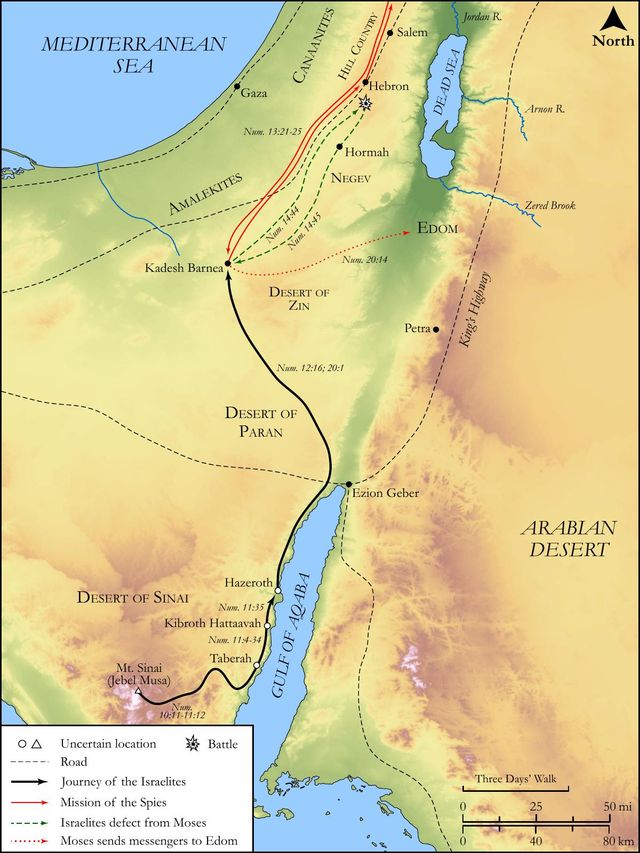
See on the biblical-era map
Study this verse
Public-domain commentary
Matthew Henry
From his Commentary on the Whole Bible. Henry comments on passages, not single verses — this entry covers Numbers 10:1–10.
We have here directions concerning the public notices that were to be given to the people upon several occasions by sound of trumpet. In a thing of this nature, one would think, Moses needed not to have been taught of God: his own reason might teach him the conveniency of trumpets; but the constitution of Israel was to be in every thing divine, and therefore even in this matter, small as it seems. Moses is here directed, 1. About the making of them. They must be made of silver; not cast but of beaten work (as some read it), the matter and shape, no doubt, very fit for the purpose. He was now ordered to make but two, because there were but two priests to use them. But in Solomon's time we read of 120 priests sounding with trumpets, Ch2 5:12. The form of these trumpets is supposed to have been much like ours at this day. 2. Who were to make use of them; not any inferior person, but the priests themselves, the sons of Aaron, Num 10:8. As great as they were, they must not think it a disparagement to them to be trumpeters in the house of God; the meanest office there was honourable. This signified that the Lord's ministers should lift up their voice like a trumpet, to show people their sins (Isa 58:1), to call them to Christ, Isa 27:13. 3. Upon what occasions the trumpets were to be sounded. (1.) For the calling of assemblies, Num 10:2. Thus they are told to blow the trumpet in Zion for the calling of a solemn assembly together, to sanctify a fast, Joe 2:15. Public notice ought to be given of the time and place of religious assemblies; for the invitation to the benefit or ordinances is general: whoever will, let him come. wisdom cries in the chief places of concourse. But, that the trumpet might not give an uncertain sound, they are directed, if only the princes and elders were to meet, to blow but one of the trumpets; less should serve to call them together, who ought to be examples of forwardness in any thing that is good: but, if the body of the people were to be called together, both the trumpets must be sounded, that they might be heard at the greater distance. In allusion to this, they are said to be blessed that hear the joyful sound (Psa 89:15), that is, that are invited and called upon to wait upon God in public ordinances, Psa 122:1. And the general assembly at the great day will be summoned by the sound of the archangel's trumpet, Mat 24:31. (2.) For the journeying of the camps, to give notice when each squadron must move; for no man's voice could reach to give the word of command: soldiers with us that are well disciplined may be exercised by beat of drums. When the trumpets were blown for this purpose, they mustsound an alarm (Num 10:5), a broken, quavering, interrupted sound, which was proper to excite and encourage the minds of people in their marches against their enemies; whereas a continued equal sound was more proper for the calling of the assembly together (Num 10:7): yet when the people were called together to deprecate God's judgments we find an alarm sounded, Joe 2:1. At the first sounding, Judah's squadron marched, at the second Reuben's, at the third Ephraim's, at the fourth Dan's, Num 10:5, Num 10:6. And some think that this was intended to sanctify their marches, for thus were proclaimed by the priests, who were God's mouth to the people, not only the divine orders given them to move, but the divine blessing upon them in all their motions. He that hath ears, let him hear that God is with them of a truth. King Abijah valued himself and his army very much upon this (Ch2 13:12), God himself is with us for our captain and his priests with sounding trumpets. (3.) For the animating and encouraging of their armies, when they went out in battle (Num 10:9): "If you go to war, blow with the trumpets, signifying thereby your appeal to heaven for the decision of the controversy, and your prayer to God to give you victory; and God will own this his own institution, and you shall be remembered before the Lord your God." God will take notice of this sound of the trumpet, and be engaged to fight their battles, and let all the people take notice of it, and be encouraged to fight his, as David, when he heard a sound of a going upon the tops of the mulberry trees. Not that God needed to be awaked by sound of trumpet any more than Christ needed to be awaked by his disciples in the storm, Mat 8:25. But where he intends mercy it is his will that we should solicit it; ministers must stir up the good soldiers of Jesus Christ to fight manfully against sin, the world, and the devil, by assuring them that Christ is the captain of their salvation, and will tread Satan under their feet. (4.) For the solemnizing of their sacred feasts, Mat 8:10. One of their feasts was called a memorial of the blowing of trumpets, Lev 23:23, etc. And it should seem they were thus to grace the solemnity of all their feasts (Psa 81:3), and their sacrifices (Ch2 29:27), to intimate with what joy and delight they performed their duty to God, and to raise the minds of those that attended the services to a holy triumph in the God they worshipped. And then their performances were for a memorial before God; for he takes pleasure in our religious exercises when we take pleasure in them. Holy work should be done with holy joy.
Continue studying Numbers 10:7 across the web’s major study libraries — every link below opens this exact verse, chapter, or book on the destination site.
Read & Compare
 BibleGatewayThis verse in more than 200 translations and 70 languages.
 Bible.comThe YouVersion reader — hundreds of translations, reading plans, and highlights.
 ESV.orgCrossway's official English Standard Version reader.
 NET BibleThe NET translation with 60,000+ translators' notes on every rendering decision.
 STEP BibleTyndale House's free study tool — original text, vocabulary, and scholarly resources.
 BibliaLogos Bible Software's free web reader.
 USCCBThe New American Bible (Revised Edition) with the U.S. bishops' study notes.
Commentaries
 BibleHub CommentariesDozens of classic commentaries on this verse, gathered on one page.
 StudyLightMore than 100 commentary sets — the largest collection on the web.
 BibleRefPlain-English commentary on what this verse means, verse by verse.
 Enduring WordDavid Guzik's free commentary on this chapter, widely used by Bible teachers.
 Bible Study ToolsVerse commentary alongside Greek and Hebrew study aids.
Original Language & Research
- BibleHub InterlinearThe verse word by word — original language, transliteration, and English.
- BibleHub LexiconEvery word's original-language definition and Strong's entry.
 Blue Letter BibleDeep-study tools — Strong's numbers, concordance, and word studies.
 SefariaThe Hebrew text with Rashi and centuries of Jewish commentary.
Sermons, Hymns & Audio


TrulyRandomVerse is not affiliated with these sites and doesn’t control their content. They’re linked because they’re genuinely useful.
Summary
Numbers 10:7, a precise divine instruction within the larger context of Israel's wilderness journey, delineates the specific trumpet signal for gathering the entire congregation. It mandates a plain, sustained blast, distinct from the agitated, staccato sound reserved for breaking camp or signaling battle. This directive underscores God's meticulous commitment to order, clear communication, and precise responses within His covenant community, ensuring unity, preventing confusion, and fostering disciplined movement and assembly for His people.
Context
ShowHideLiterary Context
The command in Numbers 10:7 is an integral part of a detailed set of instructions regarding the use of two silver trumpets, as outlined in Numbers 10:1-10. This passage marks a crucial transition for Israel, moving from their prolonged encampment at Mount Sinai, where the Tabernacle was dedicated and the tribes were counted, to the dynamic journey toward the Promised Land. The preceding verses establish the trumpets' construction and their various designated signals: a single trumpet blast for calling the leaders (Numbers 10:4), and specific "alarms" for the movement of different tribal divisions (Numbers 10:5-6). Verse 7 specifically differentiates the signal for gathering the entire congregation from these other, more urgent or segmented calls, emphasizing a distinct, unifying sound for a full assembly, highlighting the divine precision required for the nation's coordinated actions.
Historical & Cultural Context
At this juncture in their history, the Israelite nation was a vast multitude, potentially numbering over two million people, requiring an extraordinary level of organization for movement, encampment, and assembly in the challenging wilderness environment. The use of trumpets as signaling devices was a well-established practice among the nations, employed by armies, caravans, and even in religious ceremonies to convey commands, announce events, or gather people. For Israel, however, these trumpets were more than mere practical tools; they were divinely ordained instruments, symbolizing God's direct communication, authority, and meticulous ordering of His covenant people. The wilderness journey itself was a period of intense divine instruction and communal formation, where every detail, from the precise layout of the camp described in Numbers 2 to the signaling methods, served to instill discipline, unity, and an absolute reliance on God's directives. The clear distinction between a general assembly call and an alarm for war or movement was crucial for preventing chaos and ensuring appropriate, unified responses from such a diverse and numerous population.
Key Themes
ShowHideNumbers 10:7 contributes significantly to several overarching themes within the book of Numbers and the Pentateuch. Firstly, it powerfully illustrates the theme of Divine Order and Sovereignty. God is not a God of confusion, and His meticulous instructions for the trumpet calls demonstrate His desire for clarity, discipline, and unity within His covenant community. This principle extends beyond the physical camp, revealing a theological truth about divine communication: God's commands are precise, and their understanding requires careful attention and obedience, as seen in the detailed laws given at Sinai (Exodus 20). Secondly, the verse highlights the theme of Communal Unity and Obedience. The ability of such a vast congregation to move and assemble cohesively was entirely dependent on their unified response to God's precise signals. This underscores the importance of corporate obedience and the dangers of individualistic or fragmented responses, a lesson often revisited throughout Israel's wilderness wanderings (Numbers 14). Finally, the distinct trumpet sounds emphasize the theme of Discernment in Divine Communication. The difference between the "blow" and the "alarm" serves as a metaphor for discerning God's different calls in our lives—some for quiet assembly and instruction, others for urgent action or spiritual warfare. This echoes the broader biblical call to listen carefully to God's voice and understand His specific will for each moment (Deuteronomy 6:4-9).
Exposition and Analysis
ShowHideKey Word Analysis
ShowHideThis noun (H6951) refers to an "assemblage" or "assembly," specifically the entire body of the people of Israel. Derived from the root "to convoke," it emphasizes a formally gathered community, not merely a scattered multitude. In this context, it signifies the full, collective gathering of God's covenant people for purposes such as worship, instruction, or judicial proceedings, distinct from the gathering of leaders or the movement of individual tribal divisions.
This verb (H6950) is the primitive root from which "congregation" (H6951) is derived. It means "to convoke," "to assemble," or "to gather (themselves) together." It denotes the active process of calling and bringing the people into a unified assembly, underscoring the purpose of the trumpet blast as a summons for a collective, organized gathering.
This verb (H8628) denotes a sustained, continuous blast, often associated with a clear, unambiguous signal for assembly or proclamation. It implies a steady, unifying sound meant to gather people without urgency or alarm. While it can also refer to pitching tents or striking a tent peg, here it signifies a deliberate, non-agitated summons to a stationary gathering, emphasizing stability and order.
This verb (H7321) describes a broken, staccato, or rapid sound, often a shout or a war cry. It conveys urgency, excitement, or a signal for immediate, often disruptive, action, such as breaking camp for travel or preparing for battle. Unlike the steady "blow," this sound is designed to incite movement, warn of danger, or rally troops, creating a sense of heightened alert or commotion. The explicit prohibition of this sound for general assembly highlights the distinct and non-urgent purpose of the signal in this verse.
Verse Breakdown
ShowHide"But when the congregation is to be gathered together"
This opening clause establishes the precise condition and purpose for the specific trumpet sound that follows. It refers to the assembly of the entire Israelite community, the "congregation" (H6951, qâhâl), emphasizing a full, collective gathering of the people. This indicates a call for a formal, unified meeting, distinct from the partial gatherings of leaders or the segmented movements of tribal divisions. The phrase sets the stage for a summons that requires the attention and presence of every Israelite.
"ye shall blow"
This is the positive command, specifying the exact type of trumpet sound required for the general assembly. The verb "blow" (H8628, tâqaʻ) denotes a sustained, continuous, and clear blast. This sound was intended to be unambiguous and non-urgent, a steady signal for a peaceful and orderly gathering. It signifies a call to come together, to halt current activities, and to present oneself at the designated meeting place, ensuring an organized and calm assembly of the vast multitude.
"but ye shall not sound an alarm"
This is the negative prohibition, explicitly forbidding the use of a different, more agitated trumpet sound for this specific purpose. The phrase "sound an alarm" (H7321, rûwaʻ) refers to a broken, staccato, or rapid series of blasts, typically used for urgent actions like breaking camp for travel or signaling for battle. By prohibiting this sound, God ensures that the people would not mistake a call for peaceful assembly with a signal for immediate, urgent movement or impending danger, thereby preventing confusion, panic, or premature action within the camp. This precise distinction underscores the importance of clear, unambiguous communication for the proper functioning of the community.
Literary Devices
ShowHideThe primary literary device employed in Numbers 10:7 is Contrast. By juxtaposing "ye shall blow" with "ye shall not sound an alarm," the text sharply distinguishes between two specific trumpet sounds and their intended purposes. This direct opposition emphasizes the critical importance of clear, unambiguous communication within the Israelite camp, ensuring that a call for peaceful assembly would not be mistaken for a signal of urgent departure or impending battle. This contrast highlights the meticulous nature of God's instructions and the necessity of precise obedience. Furthermore, the passage utilizes Symbolism, as the silver trumpets themselves are not merely practical instruments but divinely ordained symbols of God's presence, authority, and meticulous order among His people. Their specific sounds become symbolic representations of different divine directives, requiring precise discernment and obedience. The repetition of instructions for various trumpet calls throughout Numbers 10 also highlights Emphasis on the necessity of order and proper procedure for the vast congregation, reinforcing the theme of divine governance.
Theological and Thematic Connections
ShowHideNumbers 10:7 profoundly illustrates God's character as a God of order, not of confusion (1 Corinthians 14:33). His meticulous instructions for the trumpet calls reflect His desire for clarity, discipline, and unity within His covenant community. This principle extends beyond the physical camp, revealing a theological truth about divine communication: God's commands are precise, and their understanding requires careful attention and obedience. The distinction between the "blow" and the "alarm" serves as a metaphor for discerning God's different calls in our lives—some for quiet assembly and instruction, others for urgent action or spiritual warfare. It underscores the importance of proper discernment to avoid misinterpreting divine signals, ensuring that the community acts in harmony with God's specific will for each moment. This passage reminds us that God's voice, though multifaceted, is always clear in its intent, calling His people to appropriate responses of faith and obedience.
Reflection and Application
ShowHideThe precise instructions in Numbers 10:7 offer profound lessons for contemporary believers and the church in an age often characterized by noise, distraction, and ambiguity. God's call for clear, distinct communication remains paramount. For spiritual leaders, this verse underscores the sacred responsibility to articulate vision, instructions, and expectations with precision, ensuring that the "flock" understands whether they are being called to gather for spiritual nourishment, prepare for ministry, or engage in spiritual battle. Ambiguous communication from leadership can lead to confusion, disunity, or inaction. For individual believers, this passage highlights the critical importance of spiritual discernment—learning to distinguish between God's various calls in our lives. Are we being called to a season of quiet contemplation, deep learning, and spiritual formation, or to urgent action, bold evangelism, or sacrificial service? Misinterpreting the "sound" can lead to spiritual paralysis, premature and misguided activity, or even burnout. Ultimately, this passage calls us to cultivate a spirit of attentiveness and obedience, recognizing that God's divine order brings peace, unity, and effectiveness to our lives, our families, and our church communities, enabling us to walk in step with His Spirit.
Questions for Reflection
ShowHideFAQ
ShowHideWhy were different trumpet sounds necessary for the Israelites?
ShowHideDifferent trumpet sounds were essential for the Israelites due to the sheer size of their congregation (estimated at two million people) and the variety of complex actions they needed to coordinate in the wilderness. A single, distinct sound for each command—whether to gather the whole assembly, call leaders, move specific tribal divisions, or signal for war—prevented chaos, ensured order, and allowed for unified, appropriate responses from the vast community. This meticulous system reflected God's desire for precision and discipline among His people, as seen throughout the detailed instructions for the camp in Numbers 2 and the overall structure of their journey.
What is the difference between "blow" and "sound an alarm" in this context?
ShowHideIn Numbers 10:7, "blow" (Hebrew: tâqaʻ) refers to a sustained, continuous, and peaceful blast, specifically designated for gathering the entire congregation for instruction, worship, or judicial proceedings. It was a unifying, non-urgent call for assembly. In contrast, "sound an alarm" (Hebrew: rûwaʻ) refers to a broken, staccato, or rapid series of blasts, intended for urgent actions like breaking camp for travel (Numbers 10:5-6) or signaling for battle. The distinction was crucial to avoid miscommunication and ensure the correct, appropriate response from the people, preventing panic or premature movement when a calm gathering was intended.
Christ-Centered Fulfillment
ShowHideNumbers 10:7, with its emphasis on distinct calls for assembly and action, finds its ultimate fulfillment in Christ, who is the perfect communicator and the one who gathers His people. Just as the trumpets called the physical congregation in the wilderness, Jesus, through His life, death, and resurrection, issues the ultimate call to gather, not to a physical camp, but into His spiritual body, the Church (Ephesians 1:22-23). He is the Good Shepherd who calls His sheep by name (John 10:3), gathering them into His fold and leading them in righteousness. The clarity of the trumpet's "blow" foreshadows the unambiguous nature of the Gospel message—a clear call to repentance and faith, not an alarm of confusion, but a summons to peace with God through Him (Romans 5:1) and a call to follow Him (Matthew 4:19). Furthermore, Christ's future return will be announced by a trumpet call (1 Thessalonians 4:16), gathering His elect from the ends of the earth, demonstrating the ultimate, divinely ordered assembly under His sovereign rule. Thus, the ancient trumpet calls prefigure the various calls of Christ—to salvation, to discipleship, to mission, and finally, to eternal glory—all marked by divine clarity, purpose, and the promise of His unfailing presence.