


Numbers 10:6
Bible text: King James Version (1769 Blayney text) · Public domain
Bible text: King James Version with Strong's numbers · Public domain
Bible text: Berean Standard Bible · Public domain
Bible text: American Standard Version (1901) · Public domain
Bible text: World English Bible, Messianic edition · Public domain
Bible text: Geneva Bible (1599) · Public domain
Bible text: Young's Literal Translation · Public domain
- וּתְקַעְתֶּםu·te·ka'·Temand you will give a blastH8628Conj-w ¦ V-Qal-ConsecPerf-2mpVerb Qal Consecutive Perfect 2nd Plural Masculineוּandתְקַעְתֶּםyou will give a blast
- תְּרוּעָהte·ru·'Ahan alarmH8643N-fsNoun Singular Feminine Absolute
- שֵׁנִיתshe·NitsecondH8145Adj-fsAdjective Numerical Position Singular Feminine Absolute
- וְנָסְעוּve·na·se·'Uand they will set outH5265Conj-w ¦ V-Qal-ConsecPerf-3cpVerb Qal Consecutive Perfect 3rd Plural common genderוְandנָסְעוּthey will set out
- הַמַּחֲנוֹתha·ma·cha·Notthe campsH4264Art ¦ N-fpNoun Plural Feminine Absoluteהַtheמַּחֲנוֹתcamps
- הַחֹנִיםha·cho·Nimwhich encampH2583Art ¦ V-Qal-Prtcpl-mpVerb Qal Participle Plural Masculine Absoluteהַwhichחֹנִיםencamp
- תֵּימָנָהtei·Ma·nahsouth -wardH8486N-fs ¦ SfxNoun Singular Feminine Absoluteתֵּימָנָsouthה-ward
- תְּרוּעָהte·ru·'Ahan alarmH8643N-fsNoun Singular Feminine Absolute
- יִתְקְעוּyit·ke·'Uthey will give a blastH8628V-Qal-Imperf-3mpVerb Qal Imperfect 3rd Plural Masculine
- לְמַסְעֵיהֶםle·mas·'ei·Hemfor their settings outH4550Prep-l ¦ N-mpc ¦ 3mpNoun Plural Masculine Constructלְforמַסְעֵיsettings outהֶםtheir
English is a literal word-by-word gloss of the Hebrew, not the KJV's wording. Why?
This is the original text the KJV's translators worked from — each Hebrew word with its own literal English meaning in this verse, prepared by scholars at Tyndale House, Cambridge. The KJV translates whole sentences, not word by word, so its wording differs: one Hebrew word can become several English words, and the KJV may choose “the LORD” where the gloss reads “Yahweh”. Both are faithful — they answer different questions. For the KJV's own rendering, switch to the KJV text.
Details
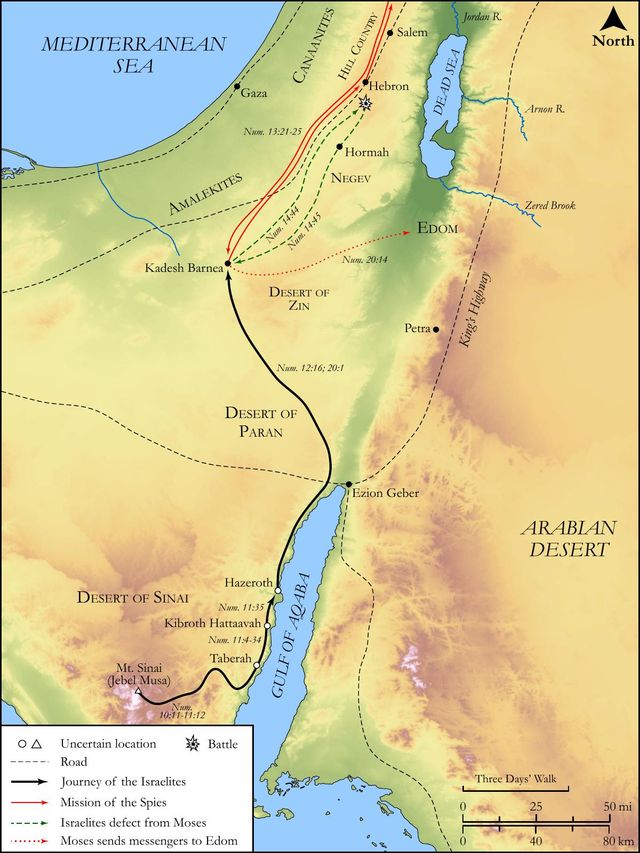
See on the biblical-era map
Study this verse
Public-domain commentary
Matthew Henry
From his Commentary on the Whole Bible. Henry comments on passages, not single verses — this entry covers Numbers 10:1–10.
We have here directions concerning the public notices that were to be given to the people upon several occasions by sound of trumpet. In a thing of this nature, one would think, Moses needed not to have been taught of God: his own reason might teach him the conveniency of trumpets; but the constitution of Israel was to be in every thing divine, and therefore even in this matter, small as it seems. Moses is here directed, 1. About the making of them. They must be made of silver; not cast but of beaten work (as some read it), the matter and shape, no doubt, very fit for the purpose. He was now ordered to make but two, because there were but two priests to use them. But in Solomon's time we read of 120 priests sounding with trumpets, Ch2 5:12. The form of these trumpets is supposed to have been much like ours at this day. 2. Who were to make use of them; not any inferior person, but the priests themselves, the sons of Aaron, Num 10:8. As great as they were, they must not think it a disparagement to them to be trumpeters in the house of God; the meanest office there was honourable. This signified that the Lord's ministers should lift up their voice like a trumpet, to show people their sins (Isa 58:1), to call them to Christ, Isa 27:13. 3. Upon what occasions the trumpets were to be sounded. (1.) For the calling of assemblies, Num 10:2. Thus they are told to blow the trumpet in Zion for the calling of a solemn assembly together, to sanctify a fast, Joe 2:15. Public notice ought to be given of the time and place of religious assemblies; for the invitation to the benefit or ordinances is general: whoever will, let him come. wisdom cries in the chief places of concourse. But, that the trumpet might not give an uncertain sound, they are directed, if only the princes and elders were to meet, to blow but one of the trumpets; less should serve to call them together, who ought to be examples of forwardness in any thing that is good: but, if the body of the people were to be called together, both the trumpets must be sounded, that they might be heard at the greater distance. In allusion to this, they are said to be blessed that hear the joyful sound (Psa 89:15), that is, that are invited and called upon to wait upon God in public ordinances, Psa 122:1. And the general assembly at the great day will be summoned by the sound of the archangel's trumpet, Mat 24:31. (2.) For the journeying of the camps, to give notice when each squadron must move; for no man's voice could reach to give the word of command: soldiers with us that are well disciplined may be exercised by beat of drums. When the trumpets were blown for this purpose, they mustsound an alarm (Num 10:5), a broken, quavering, interrupted sound, which was proper to excite and encourage the minds of people in their marches against their enemies; whereas a continued equal sound was more proper for the calling of the assembly together (Num 10:7): yet when the people were called together to deprecate God's judgments we find an alarm sounded, Joe 2:1. At the first sounding, Judah's squadron marched, at the second Reuben's, at the third Ephraim's, at the fourth Dan's, Num 10:5, Num 10:6. And some think that this was intended to sanctify their marches, for thus were proclaimed by the priests, who were God's mouth to the people, not only the divine orders given them to move, but the divine blessing upon them in all their motions. He that hath ears, let him hear that God is with them of a truth. King Abijah valued himself and his army very much upon this (Ch2 13:12), God himself is with us for our captain and his priests with sounding trumpets. (3.) For the animating and encouraging of their armies, when they went out in battle (Num 10:9): "If you go to war, blow with the trumpets, signifying thereby your appeal to heaven for the decision of the controversy, and your prayer to God to give you victory; and God will own this his own institution, and you shall be remembered before the Lord your God." God will take notice of this sound of the trumpet, and be engaged to fight their battles, and let all the people take notice of it, and be encouraged to fight his, as David, when he heard a sound of a going upon the tops of the mulberry trees. Not that God needed to be awaked by sound of trumpet any more than Christ needed to be awaked by his disciples in the storm, Mat 8:25. But where he intends mercy it is his will that we should solicit it; ministers must stir up the good soldiers of Jesus Christ to fight manfully against sin, the world, and the devil, by assuring them that Christ is the captain of their salvation, and will tread Satan under their feet. (4.) For the solemnizing of their sacred feasts, Mat 8:10. One of their feasts was called a memorial of the blowing of trumpets, Lev 23:23, etc. And it should seem they were thus to grace the solemnity of all their feasts (Psa 81:3), and their sacrifices (Ch2 29:27), to intimate with what joy and delight they performed their duty to God, and to raise the minds of those that attended the services to a holy triumph in the God they worshipped. And then their performances were for a memorial before God; for he takes pleasure in our religious exercises when we take pleasure in them. Holy work should be done with holy joy.
Continue studying Numbers 10:6 across the web’s major study libraries — every link below opens this exact verse, chapter, or book on the destination site.
Read & Compare
 BibleGatewayThis verse in more than 200 translations and 70 languages.
 Bible.comThe YouVersion reader — hundreds of translations, reading plans, and highlights.
 ESV.orgCrossway's official English Standard Version reader.
 NET BibleThe NET translation with 60,000+ translators' notes on every rendering decision.
 STEP BibleTyndale House's free study tool — original text, vocabulary, and scholarly resources.
 BibliaLogos Bible Software's free web reader.
 USCCBThe New American Bible (Revised Edition) with the U.S. bishops' study notes.
Commentaries
 BibleHub CommentariesDozens of classic commentaries on this verse, gathered on one page.
 StudyLightMore than 100 commentary sets — the largest collection on the web.
 BibleRefPlain-English commentary on what this verse means, verse by verse.
 Enduring WordDavid Guzik's free commentary on this chapter, widely used by Bible teachers.
 Bible Study ToolsVerse commentary alongside Greek and Hebrew study aids.
Original Language & Research
- BibleHub InterlinearThe verse word by word — original language, transliteration, and English.
- BibleHub LexiconEvery word's original-language definition and Strong's entry.
 Blue Letter BibleDeep-study tools — Strong's numbers, concordance, and word studies.
 SefariaThe Hebrew text with Rashi and centuries of Jewish commentary.
Sermons, Hymns & Audio


TrulyRandomVerse is not affiliated with these sites and doesn’t control their content. They’re linked because they’re genuinely useful.
Summary
Numbers 10:6 precisely details the second trumpet alarm, a divine signal for the camps positioned on the south side of the Israelite tabernacle to break camp and commence their journey. This specific command highlights God's meticulous provision for order and unified movement among His vast people as they navigated the wilderness, underscoring His sovereign guidance over every aspect of their pilgrimage and teaching them profound lessons in obedience and dependence.
Context
ShowHideLiterary Context
Numbers chapter 10 marks a pivotal transition in the Israelite narrative, signifying their long-awaited departure from Mount Sinai, where they had encamped for nearly a year, receiving the Law and establishing the Tabernacle worship. The preceding verses (Numbers 10:1-8) meticulously outline the divine instructions for crafting and employing two silver trumpets. These trumpets were not mere instruments but sacred tools for communication, used to assemble the congregation, summon leaders, and, most pertinent to this verse, orchestrate the movement of the various tribal camps. The specific command in Numbers 10:6 for the "second alarm" follows the signal given in Numbers 10:5 for the camps on the east side to move out, establishing a divinely ordained, sequential, and orderly departure for the entire nation, emphasizing God's precise control over their pilgrimage.
Historical & Cultural Context
The Israelites' journey through the wilderness was an immense undertaking, involving an estimated two to three million people, along with their livestock and possessions. Such a vast population required an unparalleled degree of organization and clear communication to prevent chaos and ensure survival in a harsh, unpredictable environment. The detailed instructions for the trumpet signals underscore God's provision for this logistical challenge, transforming a potentially chaotic exodus into an orderly procession. The camps were arranged around the central Tabernacle in a specific formation, as described in Numbers 2, with designated tribes on each side. The trumpets, blown by the priests, served as the audible manifestation of God's direct command, requiring immediate and unified obedience from every family and tribe. This system ensured that the entire community, from the leaders to the common Israelite, moved as one body, utterly dependent on divine direction for their safety and progress, mirroring the divine guidance seen in the pillar of cloud and fire (Exodus 13:21).
Key Themes
ShowHideNumbers 10:6 contributes significantly to several key themes within the book of Numbers and the broader Pentateuch. Foremost is the theme of Divine Guidance and Sovereignty, demonstrating God's active and meticulous leadership over His people's journey. Every movement was initiated by His command, communicated through the trumpets, emphasizing Israel's complete reliance on Him. Another crucial theme is Order and Discipline, as the specific, sequential signals prevented chaos and ensured a structured progression for the immense community. This divine order was foundational to their identity as God's chosen people. Furthermore, the passage highlights Obedience and Unity, as the success of the system depended on the immediate and collective response of all the tribes. Their willingness to move at the precise divine signal underscored their corporate submission to God's will, forging a unified identity as they journeyed toward the Promised Land, a journey marked by both divine provision and human challenge, as seen in passages like Numbers 14.
Exposition and Analysis
ShowHideKey Word Analysis
ShowHideThis word (H8643) denotes a loud, often urgent sound – a clamor, a battle-cry, or, as here, a trumpet blast. It signifies a distinct, attention-grabbing signal designed to elicit an immediate and decisive response. Unlike a gentle call, tᵉrûwʻâh implies a forceful, declarative sound, leaving no ambiguity about the command to act. In this context, it was the unmistakable signal for breaking camp and commencing a journey, demanding swift and unified action.
The Hebrew term (H4550) refers to a departure, a march, or a journey. It implies not merely a random movement but a purposeful, directed progression from one place to another, often involving the striking of tents. In Numbers, maççaʻ is frequently used to describe the various stages of Israel's wilderness wanderings, each initiated by a divine signal, emphasizing that their entire pilgrimage was under God's precise direction and not a haphazard wandering.
Verse Breakdown
ShowHide"When ye blow an alarm the second time"
This clause emphasizes the precise timing and sequence of the divine command. The "second time" indicates a pre-established order of movement, following the first alarm for the eastern camps (Numbers 10:5). This specificity ensured that the immense Israelite community moved in a disciplined, staggered fashion, preventing congestion and maintaining order among the millions.
"then the camps that lie on the south side shall take their journey"
This identifies the specific group designated to move at this particular signal. According to the camp arrangement in Numbers 2, the tribes of Reuben, Simeon, and Gad were positioned on the south side. This highlights God's meticulous organization, assigning each tribal division its distinct role and timing within the larger corporate movement, ensuring efficiency and preventing chaos.
"they shall blow an alarm for their journeys"
This reiterates the purpose of the trumpet blast – it was specifically a signal for movement, a call to action for the journey. The repetition underscores the clarity and singular focus of the command. It also implies that the Levites, who were responsible for the Tabernacle's dismantling and transport and whose encampment was also on the south side (between the Tabernacle and the southern tribes), would also respond to this signal, as their readiness was crucial for the sacred objects' safe transport.
Literary Devices
ShowHideThe verse employs several literary devices to convey its message of divine order and precise instruction. Repetition is prominent, particularly with the word "alarm" (tᵉrûwʻâh) and the concept of "journeys," reinforcing the singular purpose and clarity of the command. This repetition serves to emphasize the critical nature of the signal and its direct connection to the act of movement. Specificity is also a key device, as the verse precisely identifies "the second time" and "the camps that lie on the south side," leaving no room for misinterpretation. This precision underscores the meticulous nature of God's guidance and His attention to detail in orchestrating the vast movement of His people. Furthermore, the trumpets themselves function as Symbolism, representing divine communication and the audible manifestation of God's will. Their sound was not merely noise but a sacred signal, symbolizing God's active presence, leadership, and the necessity of immediate obedience in the midst of His people.
Theological and Thematic Connections
ShowHideNumbers 10:6 profoundly illustrates God's character as a God of order, precision, and sovereign guidance. His meticulous instructions for the trumpet signals reveal His desire for His people to live and move in a structured, unified, and obedient manner. This divine orchestration was not merely for logistical efficiency but also for the spiritual formation of Israel, teaching them absolute dependence on His voice and timing. The passage emphasizes that God's people are called to move in concert with His commands, trusting His perfect plan even when the path ahead is uncertain. It underscores the truth that true freedom and progress are found not in chaotic independence but in disciplined submission to divine leadership.
Reflection and Application
ShowHideWhile we no longer hear literal trumpet alarms signaling our physical movements, Numbers 10:6 offers timeless principles for believers navigating their spiritual journeys today. God remains a God of order and desires to guide His people with clarity and precision. Our spiritual readiness involves cultivating a posture of attentiveness to His "signals"—whether through the clear teaching of His Word, the promptings of the Holy Spirit, the wise counsel of the believing community, or the providential opening and closing of doors. This verse calls us to embrace divine timing, understanding that God orchestrates our transitions and movements for our good and His glory. It encourages us to be prepared to break camp from old habits, comfortable routines, or even seemingly good endeavors when God calls us to a new phase, trusting that His leadership will prevent chaos and lead us safely. Embracing God's order in our personal lives, our families, and our churches fosters unity, efficiency, and a deeper reliance on His sovereign hand, ensuring that our collective journey is purposeful and aligned with His will.
Questions for Reflection
ShowHideFAQ
ShowHideWhy were there different signals for different camps?
ShowHideThe different signals for various camps were a logistical necessity and a profound demonstration of divine order. With an estimated two to three million people, along with their livestock and possessions, the Israelite camp was immense. A single, undifferentiated signal for everyone to move simultaneously would have resulted in immediate chaos, congestion, and potential injury. By providing specific signals for different tribal divisions (first the eastern camps in Numbers 10:5, then the southern camps in Numbers 10:6, and so on), God ensured an orderly, sequential departure. This system allowed each segment of the vast population to break camp, pack, and begin their journey in a disciplined manner, maintaining the integrity of the camp's formation and preventing bottlenecks. It underscored God's meticulous planning for His people's well-being and demonstrated His ability to bring order out of potential confusion, ensuring their safety and progress through the vast wilderness.
What was the significance of the "second time" for the alarm?
ShowHideThe phrase "the second time" in Numbers 10:6 indicates a specific, pre-ordained sequence for the Israelite encampments to move. The first trumpet alarm, detailed in Numbers 10:5, was the signal for the camps on the east side (Judah, Issachar, Zebulun) to set out. The "second time" was then the cue for the camps on the south side (Reuben, Simeon, Gad) to begin their journey. This sequential signaling was crucial for maintaining order and preventing the entire massive camp from attempting to move at once. It ensured that the journey was not a chaotic rush but a well-orchestrated procession, reflecting God's nature as a God of order and precision. Each alarm served as a clear, unmistakable command for a specific group, ensuring smooth transitions and efficient movement during their arduous wilderness pilgrimage.
Christ-Centered Fulfillment
ShowHideThe precise trumpet alarms in Numbers 10:6, guiding Israel's physical journey, find their ultimate fulfillment in Jesus Christ, who is the divine signal and ultimate guide for His people's spiritual pilgrimage. Just as the sound of the trumpet called Israel to unified movement, the voice of Christ calls His Church to follow Him on the path of discipleship. He is the Good Shepherd who leads His sheep, and they "hear his voice" and "follow him" (John 10:27). The orderly progression of the camps foreshadows the Church's mission, which is to advance the Kingdom of God in a unified and purposeful manner, not in disarray but under the clear direction of its Head. Christ provides the perfect timing and direction for our spiritual "journeys," equipping us with His Spirit to discern His will and obey His commands. Our ultimate destination is the heavenly Canaan, and Christ Himself is the way, the truth, and the life (John 14:6), leading us through the wilderness of this world. He is the true "alarm" that awakens us to salvation and mobilizes us for His global mission, empowering us to "go therefore and make disciples of all nations" (Matthew 28:19-20), trusting in His abiding presence and perfect guidance until the journey's end.