


Joshua 6:3
Bible text: King James Version (1769 Blayney text) · Public domain
Bible text: Berean Standard Bible · Public domain
Bible text: American Standard Version (1901) · Public domain
Bible text: World English Bible, Messianic edition · Public domain
Bible text: Geneva Bible (1599) · Public domain
Bible text: Young's Literal Translation · Public domain
- וְסַבֹּתֶםve·sa·bo·Temand you will go aroundH5437Conj-w ¦ V-Qal-ConsecPerf-2mpVerb Qal Consecutive Perfect 2nd Plural Masculineוְandסַבֹּתֶםyou will go around
- אֶת'et<obj.>H853DirObjMParticle Object Indicator
- הָעִירha·'Irthe cityH5892Art ¦ N-fsNoun Singular Feminine Absoluteהָtheעִירcity
- כֹּלkolallH3605N-mscNoun Singular Masculine Construct
- אַנְשֵׁי'an·Shei[the] men ofH582N-mpcNoun Plural Masculine Construct
- הַמִּלְחָמָהha·mil·cha·Mah<the> warH4421Art ¦ N-fsNoun Singular Feminine Absoluteהַ<the>מִּלְחָמָהwar
- הַקֵּיףha·Keifyou will encircleH5362V-Hiphil-InfAbsVerb Hiphil Infinitive Absolute
- אֶת'et<obj.>H853DirObjMParticle Object Indicator
- הָעִירha·'Irthe cityH5892Art ¦ N-fsNoun Singular Feminine Absoluteהָtheעִירcity
- פַּעַםPa·'ama timeH6471N-fscNoun Singular Feminine Construct
- אֶחָת'e·ChatoneH259Adj-fsAdjective Numerical Singular Feminine Absolute
- כֹּהkohthusH3541AdvAdverb
- תַעֲשֶׂהta·'a·Sehyou will doH6213V-Qal-Imperf-2msVerb Qal Imperfect 2nd Singular Masculine
- שֵׁשֶׁתShe·shetsixH8337Adj-cscAdjective Numerical Singular common gender Construct
- יָמִיםya·MimdaysH3117N-mpNoun Plural Masculine Absolute
English is a literal word-by-word gloss of the Hebrew, not the KJV's wording. Why?
This is the original text the KJV's translators worked from — each Hebrew word with its own literal English meaning in this verse, prepared by scholars at Tyndale House, Cambridge. The KJV translates whole sentences, not word by word, so its wording differs: one Hebrew word can become several English words, and the KJV may choose “the LORD” where the gloss reads “Yahweh”. Both are faithful — they answer different questions. For the KJV's own rendering, switch to the KJV text.
Details
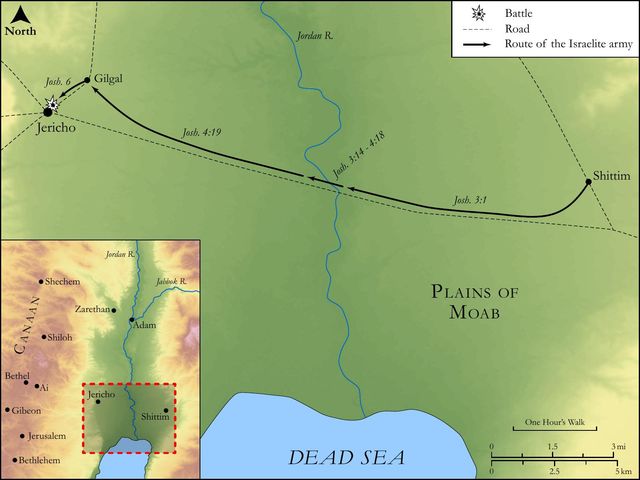
See on the biblical-era map
Study this verse
Public-domain commentary
Matthew Henry
From his Commentary on the Whole Bible. Henry comments on passages, not single verses — this entry covers Joshua 6:1–5. His three-level outline is real structure in the source text, so it is rendered as structure.
We have here a contest between God and the men of Jericho, and their different resolutions, upon which it is easy to say whose word shall prevail.
I.Jericho resolves Israel shall not be its master, Jos 6:1.
It was straitly shut up, because of the children of Israel. It did shut up, and it was shut up (so it is in the margin); it did shut up itself, being strongly fortified both by art and nature, and it was shut up by the obstinacy and resolution of the inhabitants, who agreed never to surrender nor so much as sound a parley; none went out as deserters or to treat of peace, nor were any admitted in to offer peace. Thus were they infatuated, and their hearts hardened to their own destruction - the miserable case and character of all those that strengthen themselves against the Almighty, Job 15:25.
II.God resolves Israel shall be its master, and that quickly, The captain of the Lord's host, here called Jehovah, taking notice how strongly Jericho was fortified and how strictly guarded, and knowing Joshua's thoughts and cares about reducing it, and perhaps his fears of a disgrace there and of stumbling at the threshold, gave him here all the assurance he could desire of success (Jos 6:2): See, I have given into thy hand Jericho. Not, "I will do it, but, I have done it; it is all thy own, as sure as if it were already in thy possession." It was designed that this city, being the first-fruits of Canaan, should be entirely devoted to God, and that neither Joshua nor Israel should ever be one mite the richer for it, and yet it is here said to be given into their hand; for we must reckon that most our own which we have an opportunity of honouring God with and employing in his service. Now.
1.The captain of the Lord's host gives directions how the city should be besieged. No trenches are to be opened, no batteries erected, nor battering rams drawn up, nor any military preparations made; but the ark of God must be carried by the priests round the city once a day for six days together, and seven times the seventh day, attended by the men of war in silence, the priests all the while blowing with trumpets of rams' horns, Jos 6:3, Jos 6:4. This was all they were to do.
2.He assures them that on the seventh day before night they should, without fail, be masters of the town. Upon a signal given, they must all shout, and immediately the wall should fall down, which would not only expose the inhabitants, but so dispirit them that they would not be able to make any resistance, Jos 6:5. God appointed this way,
(1.)To magnify his own power, that he might be exalted in his own strength (Psa 21:13), not in the strength of instruments. God would hereby yet further make bare his own almighty arm for the encouragement of Israel and the terror and confusion of the Canaanites.
(2.)To put an honour upon his ark, the instituted token of his presence, and to give a reason for the laws by which the people were obliged to look upon it with the most profound veneration and respect. When, long after this, the ark was brought into the camp without orders from God, it was looked upon as a profanation of it, and the people paid dearly for their presumption, Sa1 4:3, etc. but now that it was done by the divine appointment it was an honour to the ark of God, and a great encouragement to the faith of Israel.
(3.)It was likewise to put honour upon the priests, who were appointed upon this occasion to carry the ark and sound the trumpets. Ordinarily the priests were excused from war, but that this privilege, with other honours and powers that the law had given them, might not be grudged them, in this service they are principally employed, and so the people are made sensible what blessings they were to the public and how well worthy of all the advantages conferred upon them.
(4.)It was to try the faith, obedience, and patience, of the people, to try whether they would observe a precept which to human policy seemed foolish to obey and believe a promise which in human probability seemed impossible to be performed. They were also proved whether they could patiently bear the reproaches of their enemies and patiently wait for the salvation of the Lord. Thus by faith, not by force, the walls of Jericho fell down.
(5.)It was to encourage the hope of Israel with reference to the remaining difficulties that were before them. That suggestion of the evil spies that Canaan could never be conquered because the cities were walled up to heaven (Deu 1:28) would by this be for ever silenced. The strongest and highest walls cannot hold out against Omnipotence; they needed not to fight, and therefore needed not to fear, because God fought for them.
Historical interpretation
Two Centuries of Reception
3 surviving comments on this verse. Each one is dated, so this reads as a timeline rather than a list.
Select a marker to jump to its quote. Markers stagger vertically where authors wrote within a few decades of each other.
But the Jews are sure to say that ever since this precept was given through Moses, the observance has been binding. But it is clear according to the text that the precept was not eternal or spiritual but temporary, which would one day cease. In short, so true is it that it is not in the exemption from work of the sabbath—that is, of the seventh day—that the celebration of this solemnity is to consist, that Joshua the son of Nun, at the time that he was reducing the city Jericho by war, stated that he had received from God a precept to order the people that priests should carry the ark of the testament of God seven days, making the circuit of the city; and thus, when the seventh day’s circuit had been performed, the walls of the city would spontaneously fall. This was done. When the space of the seventh day was finished, just as was predicted, down fell the walls of the city. [By this] it is manifestly shown that in the number of the seven days there intervened a Sabbath day. For seven days, whenever they may have commenced, must necessarily include within them a Sabbath day; on which day not only must the priests have worked, but the city must have been made a prey by the edge of the sword by all the people of Israel.
Though we appear unarmed in body, we nonetheless are bearing arms with which even in time of sunny peace we grapple in spirit against the unsubstantial foe. Now we need God to help us, and him only we must fear; without him our armor falls from us, but with him our armor gains strength. He will be your tower within the walls; he will be your wall where there are no walls.Let us hereafter recall the deeds of our ancestors recorded in the consecrated books. Observe who had the better protection—those enclosed in a city girded by great walls but without God, or those defended by God’s strength and friendly support but without city walls. I refer to the city destroyed by the eager Joshua, whose own name was changed to delineate his power. He did not subdue it in the usual military way, by conducting the regular long and weary blockade. No, through God’s help his army in sacred symbolism performed a lustration, brandishing its weapons without using them. It withdrew its violence; its arms were silent. For seven days they made seven repeated circuits round the walls. By the strength of this powerful number and by the fearful din of the priests’ trumpets, which aped the flashing thunder of divine wrath, they laid hold of the enemy trapped within. Then that people which trusted in its wealth and city perished, and their graves were mingled with their houses.
The walls of Jericho fell down on account of the priestly trumpets because they contained within themselves a sinful people. A battering ram did not strike it, nor did a machine of war storm it, but—what is remarkable—the terror of the priestly sound brought it down. The walls that had stood impervious to iron collapsed at the sacred voice of the trumpets. Who would not be amazed that when the sound had been made, stones were broken to pieces, foundations were shattered by the noise, and everything collapsed in such a way that, although the conquerors did not injure their own forces, nonetheless among the enemy nothing remained standing? But although no one touched those walls, still they were taken from without at the sound of the righteous while sinners dwelled within. For this reason, then, they gave way, lest they offer resistance to the ones or somehow protect the others. To the righteous they opened a path and to the faithless they denied protection. Therefore, brothers, if the sound of the priestly voice was so powerful at that time, such that its blast in the air announced a certain confusion, how much more do we believe that that priestly voice is living now, which shows forth something magnificent when it speaks Christ in words!… Or how could feeling creatures resist when even unfeeling ones were unable to endure the sacred dread? For we believe that hearts can more easily be softened than rocks at the words of the priests and that sins can be forgiven in a shorter time than those stones were split asunder. For the voice of the Spirit, when it comes, destroys the stain of sin more easily than it breaks apart a tangible fortification of rock.
Continue studying Joshua 6:3 across the web’s major study libraries — every link below opens this exact verse, chapter, or book on the destination site.
Read & Compare
 BibleGatewayThis verse in more than 200 translations and 70 languages.
 Bible.comThe YouVersion reader — hundreds of translations, reading plans, and highlights.
 ESV.orgCrossway's official English Standard Version reader.
 NET BibleThe NET translation with 60,000+ translators' notes on every rendering decision.
 STEP BibleTyndale House's free study tool — original text, vocabulary, and scholarly resources.
 BibliaLogos Bible Software's free web reader.
 USCCBThe New American Bible (Revised Edition) with the U.S. bishops' study notes.
Commentaries
 BibleHub CommentariesDozens of classic commentaries on this verse, gathered on one page.
 StudyLightMore than 100 commentary sets — the largest collection on the web.
 BibleRefPlain-English commentary on what this verse means, verse by verse.
 Enduring WordDavid Guzik's free commentary on this chapter, widely used by Bible teachers.
 Bible Study ToolsVerse commentary alongside Greek and Hebrew study aids.
Original Language & Research
- BibleHub InterlinearThe verse word by word — original language, transliteration, and English.
- BibleHub LexiconEvery word's original-language definition and Strong's entry.
 Blue Letter BibleDeep-study tools — Strong's numbers, concordance, and word studies.
 SefariaThe Hebrew text with Rashi and centuries of Jewish commentary.
Sermons, Hymns & Audio


TrulyRandomVerse is not affiliated with these sites and doesn’t control their content. They’re linked because they’re genuinely useful.
Summary
Joshua 6:3 presents God's precise and seemingly counter-intuitive instructions to Joshua for the conquest of Jericho, commanding the Israelite men of war to encircle the city once daily for six days. This divine directive establishes the foundational principle that the impending victory would be secured not through conventional military might or human strategic brilliance, but solely through unwavering obedience to God's unconventional plan, thereby powerfully highlighting His sovereign power and Israel's dependent faith.
Context
ShowHideLiterary Context
Joshua 6:3 is a pivotal component of God's direct revelation to Joshua regarding the fall of Jericho, immediately following the miraculous crossing of the Jordan River, which is recounted in Joshua 3, and the crucial spiritual preparations undertaken at Gilgal, including the mass circumcision and the celebration of Passover, detailed in Joshua 5. This verse initiates the specific, detailed instructions for the unique "siege" of Jericho, setting the stage for the dramatic and miraculous climax described in Joshua 6:20. It underscores the transition of Israel from a nomadic people to a settled nation, with God actively leading their military campaigns in the Promised Land. The preceding encounter with the Commander of the Lord's Army in Joshua 5:13-15 further solidifies the divine authority behind the entire campaign, making the instructions in 6:3 a direct and non-negotiable mandate from God Himself.
Historical & Cultural Context
Jericho was an ancient and formidable city, often regarded as one of the oldest continuously inhabited cities globally, renowned for its exceptionally strong fortifications. The city was "straitly shut up because of the children of Israel," making it an imposing military challenge for any invading force. The Israelites, despite their numbers, were not a professional, trained army equipped with the sophisticated siege engines or advanced military tactics common among the nations of that day. Their recent history involved forty years of wilderness wandering, which did not include extensive military training in conventional warfare. God's command in Joshua 6:3 deliberately eschewed typical siege warfare, which usually involved prolonged blockades, undermining walls, or direct assaults. This unconventional approach would have been baffling to any contemporary military strategist, serving to highlight that the impending victory would be a supernatural act, not a human achievement. This divine intervention was crucial for establishing God's authority and power in the eyes of both Israel and the Canaanite nations as Israel commenced its conquest of the land promised to their ancestors.
Key Themes
ShowHideJoshua 6:3 contributes profoundly to several overarching themes woven throughout the book of Joshua and the broader Old Testament narrative. Firstly, it powerfully illustrates Divine Strategy and Absolute Obedience. The command to march around the city, seemingly illogical from a human perspective, demands unquestioning faith and precise adherence to God's instructions, no matter how unconventional. Secondly, it champions Faith Over Military Might. The prescribed method of conquest explicitly removes any possibility of Israel boasting in its own strength or tactical brilliance, ensuring that the victory is undeniably God's. This aligns with the enduring biblical principle articulated later in Zechariah 4:6 that "not by might, nor by power, but by my spirit, saith the LORD of hosts." Lastly, the instruction "Thus shalt thou do six days" introduces the theme of Patience and Persistence. The repeated, daily act of obedience, without immediate visible results, built anticipation and rigorously tested the Israelites' endurance and sustained trust in God's timing and ultimate plan, culminating in the dramatic and miraculous events of the seventh day as described in Joshua 6:15-20.
Exposition and Analysis
ShowHideKey Word Analysis
ShowHideThis primitive root means to revolve, surround, or border, used in various literal and figurative applications such as to bring around, cast, fetch, lead, or make to walk around. In this context, its repetition ("compass the city... go round about the city") emphasizes the methodical, deliberate, and ritualistic nature of the action. It signifies not a casual stroll but a commanded encirclement, representing a claim of possession and a preparatory act for divine judgment. The act of "going around" or "circling" often carries spiritual significance in the Bible, sometimes related to worship or a demonstration of God's presence and power, particularly when the Ark of the Covenant is involved.
The phrase combines ʼĕnôwsh (H582), meaning a mortal or man in general, and milchâmâh (H4421), meaning a battle or war. This designation highlights the participants: those equipped and expected to engage in battle. The profound irony, however, is that their "warfare" here involves no direct combat, no siege engines, and no conventional military maneuvers for six days. Their primary weapon is obedience, and their strength is their unwavering faith in God's unconventional strategy, thereby subverting typical expectations of what "men of war" are meant to do.
This specific duration combines shêsh (H8337), meaning six, and yôwm (H3117), meaning a day or a defined space of time. The number six, preceding the climactic seventh day, often symbolizes human effort, labor, or incompleteness in biblical numerology. Here, it represents a period of sustained, patient obedience and a rigorous test of faith before the divine intervention. It also masterfully builds dramatic tension, emphasizing that God's timing is precise and His plan unfolds progressively, not always instantaneously, requiring diligent adherence over time.
Verse Breakdown
ShowHide"And ye shall compass the city"
This is the foundational command, establishing the core action required of the Israelites. It is a direct, imperative instruction from God, indicating a non-negotiable task. The act of encompassing suggests a complete encirclement, a symbolic claiming of the territory, and a preparatory step for its capture.
"all [ye] men of war, [and] go round about the city once"
This clause specifies both the participants and the frequency of the action. "All ye men of war" indicates that the entire fighting force was to be involved, not merely a select few, emphasizing corporate obedience and participation. "Go round about the city once" sets the precise daily rhythm, ensuring a consistent, disciplined, and repetitive action, which would have been physically demanding and mentally challenging given the lack of immediate visible results.
"Thus shalt thou do six days"
This final clause defines the exact duration of this unique "siege." The six-day period establishes a time of patient endurance and sustained faith. It serves as a profound test of their commitment to God's unconventional method, building intense anticipation for the seventh day, when the culmination of God's plan would be dramatically revealed and enacted. The repetition over six days underscores the methodical, deliberate, and divinely ordained nature of God's strategy, which operates on a different timeline and logic than human warfare.
Literary Devices
ShowHideThe passage powerfully employs Repetition, particularly with the command to "compass the city" and "go round about the city once," reinforced by the daily execution over "six days." This repetition emphasizes the methodical and ritualistic nature of the divine command, highlighting the paramount importance of sustained, consistent obedience. There is also significant Irony present; the "men of war" are commanded to perform an act that is not conventional warfare, subverting all expectations of military engagement. Their strength is not to be found in their weapons or tactics, but in their disciplined adherence to an unconventional divine strategy. Furthermore, the entire scenario is rich in Symbolism. The daily march around the city symbolizes Israel's unwavering faith in God's power, their patient endurance, and God's sovereign claim over Jericho. The Ark of the Covenant, carried prominently in the procession, symbolizes God's active presence and direct leadership in the conquest, transforming a military maneuver into a profound sacred procession.
Theological and Thematic Connections
ShowHideJoshua 6:3 serves as a profound theological statement on God's absolute sovereignty, the true nature of faith, and the transformative power of obedience. It unequivocally demonstrates that God's methods often defy human logic and conventional wisdom, yet they are always perfect and meticulously designed to bring Him the most glory. The seemingly absurd command to march around a heavily fortified city highlights that true victory comes not from human strength or ingenuity, but from divine intervention activated by obedient faith. This passage teaches that God delights in demonstrating His immense power through weakness and unconventional means, ensuring that His people rely entirely on Him. It underscores that God is not limited by human limitations or fortified walls, and His plans, though sometimes requiring patient endurance, will ultimately and triumphantly prevail.
Reflection and Application
ShowHideJoshua 6:3 offers timeless and profound principles for navigating the "walled cities" in our own lives—those seemingly insurmountable obstacles, challenges, or deeply entrenched problems that defy conventional solutions. This passage calls us to courageously surrender our human strategies and embrace God's often unconventional, counter-intuitive methods. It reminds us that true breakthrough often requires not just a single act of faith, but a consistent, patient, and disciplined obedience over time, even when immediate results are not visibly apparent. The daily march around Jericho was a rigorous test of endurance and trust, building character and deepening Israel's reliance on God. When faced with situations that seem overwhelmingly too big for us, this verse powerfully encourages us to step out in audacious faith, follow God's specific instructions, and trust that His power will accomplish what ours cannot, thereby demonstrating His glory through our humble yet resolute obedience.
Questions for Reflection
ShowHideFAQ
ShowHideWhy did God command such a strange method for taking Jericho?
ShowHideGod commanded this unconventional method for several profound and strategic reasons. Primarily, it was to demonstrate unequivocally that the victory belonged to Him alone, not as a result of Israel's military prowess or tactical genius. Jericho's formidable walls would have made a conventional siege extremely difficult for the Israelites, who were not a professional, trained army. By having them simply march, God removed any possibility of human boasting, ensuring that He received all the glory for the conquest. This method also served as a powerful test of Israel's faith and obedience, teaching them to rely entirely on Him. Furthermore, it was a visible sign to the surrounding Canaanite nations that the God of Israel was unique and all-powerful, striking fear into their hearts and preparing the way for Israel's subsequent conquest of the land. This divine strategy underscored that God's ways are often infinitely higher than human ways, as articulated in Isaiah 55:8-9.
Christ-Centered Fulfillment
ShowHideThe narrative of Jericho's fall, initiated by the unconventional command in Joshua 6:3, finds profound Christ-centered fulfillment. Just as God's strategy for Jericho defied human logic and military convention, so too did God's ultimate plan for humanity's salvation. The "men of war" were called to an act of seemingly foolish obedience, foreshadowing the "foolishness" of the cross through which God achieved His greatest victory over sin and death (1 Corinthians 1:18). Jesus, the ultimate Commander of the Lord's Army, did not conquer sin and death through conventional power, military might, or earthly tactics, but through humble obedience and sacrificial self-giving. His "march" to the cross, culminating in His death and glorious resurrection, was the ultimate act of divine strategy, dismantling the "walls" of sin, death, and spiritual principalities that separated humanity from God (Colossians 2:15). Like the Israelites, who had to patiently obey for six days before the walls fell, believers are called to daily, persistent obedience and unwavering faith in Christ, even when His commands seem counter-cultural or the promised spiritual victory appears delayed. Our victory over the strongholds of sin and the world is achieved not by our strength, but by the transformative power of Christ's finished work and our faithful submission to Him (Philippians 2:8). He is the true Joshua, leading His people to conquer insurmountable spiritual obstacles and inherit the promised eternal rest and abundant life.