


Joshua 6:24
- וְהָעִירve·ha·'Irand the cityH5892Conj-w ¦ Art ¦ N-fsNoun Singular Feminine Absoluteוְandהָtheעִירcity
- שָׂרְפוּsa·re·Futhey burnedH8313V-Qal-Perf-3cpVerb Qal Perfect 3rd Plural common gender
- בָאֵשׁva·'Eshwith <the> fireH784Prep-b ¦ N-csNoun Singular common gender Absoluteבָwith <the>אֵשׁfire
- וְכָלve·kholand allH3605Conj-w ¦ N-msNoun Singular Masculine Absoluteוְandכָלall
- אֲשֶׁר'a·SherthatH834RelParticle Relative
- בָּהּBah[was] in <the> itPrep-b ¦ 3fsSuffix Personal 3rd Singular Feminineבָּ[was] in <the>הּit
- רַקrakonlyH7535AdvAdverb
- הַכֶּסֶףha·Ke·sefthe silverH3701Art ¦ N-msNoun Singular Masculine Absoluteהַtheכֶּסֶףsilver
- וְהַזָּהָבve·ha·za·Havand the goldH2091Conj-w ¦ Art ¦ N-msNoun Singular Masculine Absoluteוְandהַtheזָּהָבgold
- וּכְלֵיu·khe·Leiand [the] articles ofH3627Conj-w ¦ N-mpcNoun Plural Masculine Constructוּandכְלֵי[the] articles of
- הַנְּחֹשֶׁתha·ne·Cho·shet<the> bronzeH5178Art ¦ N-fsNoun Singular Feminine Absoluteהַ<the>נְּחֹשֶׁתbronze
- וְהַבַּרְזֶלve·ha·bar·Zeland <the> ironH1270Conj-w ¦ Art ¦ N-msNoun Singular Masculine Absoluteוְandהַ<the>בַּרְזֶלiron
- נָתְנוּna·te·Nuthey putH5414V-Qal-Perf-3cpVerb Qal Perfect 3rd Plural common gender
- אוֹצַר'o·Tzar[the] treasury ofH214N-mscNoun Singular Masculine Construct
- בֵּיתbeit[the] house ofH1004N-mscNoun Singular Masculine Construct
- יְהוָהYah·wehYahwehH3068N-properNoun Proper Title
English is a literal word-by-word gloss of the Hebrew, not the KJV's wording. Why?
This is the original text the KJV's translators worked from — each Hebrew word with its own literal English meaning in this verse, prepared by scholars at Tyndale House, Cambridge. The KJV translates whole sentences, not word by word, so its wording differs: one Hebrew word can become several English words, and the KJV may choose “the LORD” where the gloss reads “Yahweh”. Both are faithful — they answer different questions. For the KJV's own rendering, switch to the KJV text.
Details
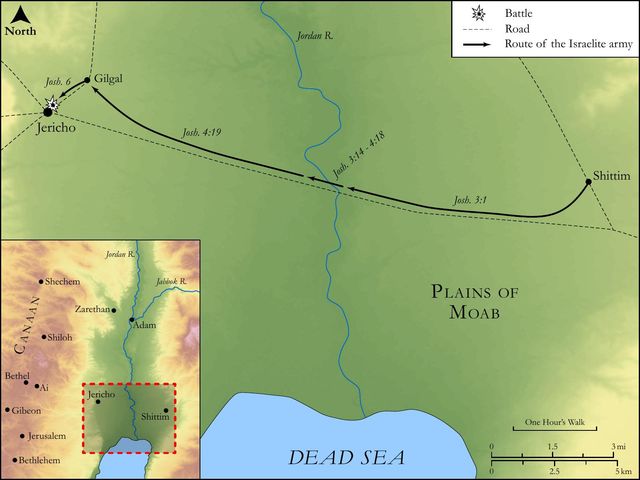
See on the biblical-era map
Study this verse
Public-domain commentary
Matthew Henry
From his Commentary on the Whole Bible. Henry comments on passages, not single verses — this entry covers Joshua 6:17–27. His two-level outline is real structure in the source text, so it is rendered as structure.
The people had religiously observed the orders given them concerning the besieging of Jericho, and now at length Joshua had told them (Jos 6:16), "The Lord hath given you the city, enter and take possession." Accordingly in these verses we have,
I.The rules they were to observe in taking possession.
God gives it to them, and therefore may direct it to what uses and intents, and clog it with what provisos and limitations he thinks fit. It is given to them to be devoted to God, as the first and perhaps the worst of all the cities of Canaan.
1.The city must be burnt, and all the lives in it sacrificed without mercy to the justice of God. All this they knew was included in those words, Jos 6:17. The city shall be a cherem, a devoted thing, at and all therein, to the Lord. No life in it might be ransomed upon any terms; they must all be surely put to death, Lev 27:29. So he appoints from whom as creatures they had received their lives, and to whom as sinners they had forfeited them; and who may dispute his sentence? Is God unrighteous, who thus taketh vengeance? God forbid we should entertain such a thought! There was more of God seen in the taking of Jericho than of any other of the cities of Canaan, and therefore that must be more than any other devoted to him. And the severe usage of this city would strike a terror upon all the rest and melt their hearts yet more before Israel. Only, when this severity is ordered, Rahab and her family are excepted: She shall live and all that are with her. She had distinguished herself from her neighbours by the kindness she showed to Israel, and therefore shall be distinguished from them by the speedy return of that kindness.
2.All the treasure of it, the money and plate and valuable goods, must be consecrated to the service of the tabernacle, and brought into the stock of dedicated things, the Jews say because the city was taken on the sabbath day. Thus God would be honoured by the beautifying and enriching of his tabernacle; thus preparation was made for the extraordinary expenses of his service; and thus the Israelites were taught not to set their hearts upon worldly wealth nor to aim at heaping up abundance of it for themselves. God had promised them a land flowing with milk and honey, not a land abounding with silver and gold; for he would have them live comfortably in it, that they might serve him cheerfully, but not covet either to trade with distant countries or to hoard for after times. He would likewise have them to reckon themselves enriched in the enriching of the tabernacle, and to think that which was laid up in God's house as truly their honour and wealth as if it had been laid up in their own.
3.A particular caution is given them to take heed of meddling with the forbidden spoil; for what was devoted to God, if they offered to appropriate it to their own use, would prove accursed to them; therefore (Jos 6:18) "In any wise keep yourselves from the accursed thing; you will find yourselves inclined to reach towards it, but check yourselves, and frighten yourselves from having any thing to do with it." He speaks as if he foresaw the sin of Achan, which we have an account of in the next chapter, when he gives this reason for the caution, lest you make the camp of Israel a curse and trouble it, as it proved that Achan did.
II.The entrance that was opened to them into the city by the sudden fall of the walls, or at least that part of the wall over against which they then were when they gave the shout (Jos 6:20): The wall fell down flat, and probably killed abundance of people, the guards that stood sentinel upon it, or others that crowded about it, to look at the Israelites that were walking round. We read of thousands killed by the fall of a wall, Kg1 20:30. that which they trusted to for defence proved their destruction. The sudden fall of the wall, no doubt, put the inhabitants into such a consternation that they had no strength nor spirit to make any resistance, but they became an easy prey to the sword of Israel, and saw to how little purpose it was to shut their gates against a people that had the Lord on the head of them, Mic 2:13. Note, The God of heaven easily can, and certainly will, break down all the opposing power of his and his church's enemies. Gates of brass and bars of iron are, before him, but as straw and rotten wood, Isa 45:1, Isa 45:2. Who will bring me into the strong city? Wilt not thou, O God? Psa 60:9, Psa 60:10. Thus shall Satan's kingdom fall, nor shall any prosper that harden themselves against God.
III.The execution of the orders given concerning this devoted city.
All that breathed were put to the sword; not only the men that were found in arms, but the women, and children, and old people. Though they cried for quarter, and begged ever so earnestly for their lives, there was no room for compassion, pity must be forgotten: they utterly destroyed all, Jos 6:21. If they had not had a divine warrant under the seal of miracles for this execution, it could not have been justified, nor can it justify the like now, when we are sure no such warrant can be produced. But, being appointed by the righteous Judge of heaven and earth to do it, who is not unrighteous in taking vengeance, they are to be applauded in doing it as the faithful ministers of his justice. Work for God was then bloody work; and cursed was he that did it deceitfully, keeping back his sword from blood, Jer 48:10. But the spirit of the gospel is very different, for Christ came not to destroy men's lives but to save them, Luk 9:56. Christ's victories were of another nature. The cattle were put to death with the owners, as additional sacrifices to the divine justice. The cattle of the Israelites, when slain at the altar, were accepted as sacrifices for them, but the cattle of these Canaanites were required to be slain as sacrifices with them, for their iniquity was not to be purged with sacrifice and offering: both were for the glory of God. 2. The city was burnt with fire, and all that was in it, Jos 6:24. The Israelites, perhaps, when they had taken Jericho, a large and well-built city, hoped they should have that for their head-quarters; but God will have them yet to dwell in tents, and therefore fires this nest, lest they should nestle in it. 3. All the silver and gold, and all those vessels which were capable of being purified by fire, were brought into the treasury of the house of the Lord; not that he needed it but that he would be honoured by it, as the Lord of hosts, of their hosts in particular, the God that gave the victory and therefore might demand the spoil, either the whole, as here, or, as sometimes, a tenth, Heb 7:4.
IV.The preservation of Rahab the harlot, or inn-keeper, who perished not with those that believed not, Heb 11:31.
The public faith was engaged for her safety by the two spies, who acted therein as public persons; and therefore, though the hurry they were in at the taking of the town was no doubt very great, yet Joshua took effectual care for her preservation. The same persons that she had secured were employed to secure her, Jos 6:22, Jos 6:23. They were best able to do it who knew her and her house, and they were fittest to do it, that it might appear it was for the sake of her kindness to them that she was thus distinguished and had her life given her for a prey. All her kindred were saved with her; like Noah she believed to the saving of her house; and thus faith in Christ brings salvation to the house, Act 16:31. Some ask how her house, which is said to have been upon the wall (Jos 2:15), escaped falling with the wall; we are sure it did escape, for she and her relations were safe in it, either though it joined so near to the wall as to be said to be upon it, yet it was so far off as not to fall either with the wall or under it; or, rather, that part of the wall on which her house stood fell not. Now being preserved alive,
1.She was left for some time without the camp to be purified from the Gentile superstition, which she was to renounce, and to be prepared for her admission as a proselyte.
2.She was in due time incorporated with the church of Israel, and she and her posterity dwelt in Israel, and her family was remarkable long after. We find her the wife of Salmon, prince of Judah, mother of Boaz, and named among the ancestors of our Saviour, Mat 1:5. Having received Israelites in the name of Israelites, she had an Israelite's reward. Bishop Pierson observes that Joshua's saving Rahab the harlot, and admitting her into Israel, were a figure of Christ's receiving into his kingdom, and entertaining there, the publicans and the harlots, Mat 21:31. Or it may be applied to the conversion of the Gentiles.
V.Jericho is condemned to a perpetual desolation, and a curse pronounced upon the man that at any time hereafter should offer to rebuild it (Jos 6:26): Joshua adjured them, that is, the elders and people of Israel, not only by their own consent, obliging themselves and their posterity never to rebuild this city, but by the divine appointment, God himself having forbidden it under the sever penalty here annexed.
1.God would hereby show the weight of a divine curse; where it rests there is no contending with it nor getting from under it; it brings ruin without remedy or repair.
2.He would have it to remain in its ruins a standing monument of his wrath against the Canaanites when the measure of their iniquity was full, and of his mercy to his people when the time had come for their settlement in Canaan. The desolations of their enemies were witnesses of his favour to them, and would upbraid them with their ingratitude to that God who had done so much for them. The situation of the city was very pleasant, and probably its nearness to Jordan was an advantage to it, which would tempt men to build upon the same spot; but they are here told it is at their peril if they do it. Men build for their posterity, but he that builds Jericho shall have no posterity to enjoy what he builds; his eldest son shall die when he begins the work, and if he take not warning by that stroke to desist, but will go on presumptuously, the finishing of his work shall be attended with the funeral of his youngest, and we must suppose all the rest cut off between. This curse, not being a curse causeless, did come upon that man who long after rebuilded Jericho (Kg1 16:34), but we are not to think it made the place ever the worse when it was built, or brought any hurt to those that inhabited it. We find Jericho afterwards graced with the presence, not only of those two great prophets Elijah and Elisha, but of our blessed Saviour himself, Luk 18:35; Luk 19:1; Mat 20:29. Note, It is a dangerous thing to attempt the building up of that which God will have to be destroyed. See Mal 1:4.
Lastly, All this magnified Joshua and raised his reputation (Jos 6:27); it made him not only acceptable to Israel, but formidable to the Canaanites, because it appeared that God was with him of a truth: the Word of the Lord was with him, so the Chaldee, even Christ himself, the same that was with Moses. Nothing can more raise a man's reputation, nor make him appear more truly great, than to have the evidences of God's presence with him.
Historical interpretation
Historical reception
1 surviving comment on this verse from the historical church.
Let us prepare ourselves for the sacrifice of the lamb.… Nor let us be under the impression that this yearling lamb can be eaten anywhere. The precept bids us to partake of it in one house only, lest we think that the lamb may be immolated outside the church. From this, it is evident that the Jews and heretics, and all assemblies of perverted doctrine, because they do not eat the lamb in the church, do not eat the flesh of the lamb but the flesh of the dragon, which, as the psalmist tells us, was given as food to the Ethiopians. Just as in the flood no one was saved who was not in the ark of Noah, and in the fall of Jericho, only the house of the harlot Rahab—which signifies the faithful church of the Gentiles—was spared, so is it true that in the sacrifice of the lamb, the lamb is slain only when it is sacrificed in the one house.
Continue studying Joshua 6:24 across the web’s major study libraries — every link below opens this exact verse, chapter, or book on the destination site.
Read & Compare
 BibleGatewayThis verse in more than 200 translations and 70 languages.
 Bible.comThe YouVersion reader — hundreds of translations, reading plans, and highlights.
 ESV.orgCrossway's official English Standard Version reader.
 NET BibleThe NET translation with 60,000+ translators' notes on every rendering decision.
 STEP BibleTyndale House's free study tool — original text, vocabulary, and scholarly resources.
 BibliaLogos Bible Software's free web reader.
 USCCBThe New American Bible (Revised Edition) with the U.S. bishops' study notes.
Commentaries
 BibleHub CommentariesDozens of classic commentaries on this verse, gathered on one page.
 StudyLightMore than 100 commentary sets — the largest collection on the web.
 BibleRefPlain-English commentary on what this verse means, verse by verse.
 Enduring WordDavid Guzik's free commentary on this chapter, widely used by Bible teachers.
 Bible Study ToolsVerse commentary alongside Greek and Hebrew study aids.
Original Language & Research
- BibleHub InterlinearThe verse word by word — original language, transliteration, and English.
- BibleHub LexiconEvery word's original-language definition and Strong's entry.
 Blue Letter BibleDeep-study tools — Strong's numbers, concordance, and word studies.
 SefariaThe Hebrew text with Rashi and centuries of Jewish commentary.
Sermons, Hymns & Audio


TrulyRandomVerse is not affiliated with these sites and doesn’t control their content. They’re linked because they’re genuinely useful.
Summary
Joshua 6:24 meticulously details the culmination of God's judgment upon Jericho: the city, along with all its contents, was utterly consumed by fire, a direct fulfillment of the cherem (devotion to destruction) command. This act served as a powerful demonstration of divine wrath against Canaanite wickedness and Israel's unwavering obedience. Crucially, the silver, gold, brass, and iron vessels were consecrated and deposited into the treasury of the Tabernacle, signifying God's ultimate sovereignty over the spoils of this miraculous victory and His exclusive claim to the "firstfruits" of the conquest.
Context
ShowHideLiterary Context
Joshua 6:24 marks the decisive conclusion of the Jericho campaign, the inaugural victory in Israel's conquest of Canaan. The preceding narrative in Joshua 6 meticulously outlines God's unique and seemingly unconventional strategy for its capture: a seven-day ritualistic march around the city, culminating in a great shout and the miraculous collapse of its formidable walls (Joshua 6:20). This verse specifically executes the cherem command, a divine injunction given by God through Joshua in Joshua 6:17-19, which mandated the complete destruction of the city and its inhabitants, with the notable exception of Rahab and her household (Joshua 6:22-23). The meticulous preservation and dedication of specific metals for God's treasury stand in stark contrast to the general devastation, setting a critical precedent that is tragically violated by Achan's disobedience in Joshua 7, highlighting the severe consequences of failing to adhere to God's precise instructions regarding the cherem.
Historical & Cultural Context
The conquest of Canaan, as depicted in the book of Joshua, was not merely a territorial expansion but a divinely ordained "holy war" (or herem warfare) against the morally corrupt Canaanite nations. Their pervasive idolatry, cultic prostitution, child sacrifice, and other abominable practices had filled the measure of their iniquity, prompting God's righteous judgment (Deuteronomy 9:4-5). The cherem (חֵרֶם), often translated as "devotion to destruction" or "the ban," was a theological principle whereby certain entities or objects were irrevocably set apart for God, typically for destruction, to prevent Israel's contamination by pagan influences and to demonstrate God's absolute sovereignty. Jericho, strategically located at the gateway to Canaan, served as the "firstfruits" of the conquest, symbolizing God's ownership of the entire land and the initial spoils of victory. Its capture was thus a crucial symbolic and practical victory, establishing Israel's foothold and demonstrating Yahweh's power.
Key Themes
ShowHideJoshua 6:24 profoundly articulates several foundational themes within the book of Joshua and the broader biblical narrative. Firstly, it powerfully underscores Divine Judgment and Holiness, revealing God's absolute intolerance for sin and His righteous wrath against the egregious wickedness of the Canaanites. The cherem principle establishes a clear boundary, separating God's holy people from the corrupting influences of the surrounding nations. Secondly, the verse highlights Absolute Obedience to God's Commands. The Israelites' meticulous adherence to God's specific, seemingly irrational instructions for Jericho's fall, and the subsequent execution of the cherem, emphasizes the paramount importance of trusting and obeying God without reservation. This theme is consistently reinforced throughout the book, particularly in stark contrast to later failures, such as Achan's disobedience in Joshua 7:1. Finally, the dedication of the precious metals to "the treasury of the house of the LORD" powerfully illustrates God's Sovereignty and Ownership. It asserts that all victory, and indeed all possessions, ultimately belong to God, and that the spoils of war, especially the "firstfruits," were to be consecrated to Him, not plundered for personal gain. This act consecrated the initial spoils of the conquest to God, setting a precedent for future victories and acknowledging His provision and authority over all things.
Exposition and Analysis
ShowHideKey Word Analysis
ShowHideThis Hebrew verb (H8313) signifies "to be (causatively, set) on fire," or "to consume with fire." In this context, it denotes a complete and destructive conflagration, emphasizing the totality of the judgment enacted upon Jericho. Fire often symbolizes divine judgment, purification, and the obliteration of that which is deemed unholy or devoted to destruction in biblical narratives.
This noun (H214) refers to a "depository," "storehouse," or "treasury." In the context of the "house of the LORD," it designates the sacred storage area within the Tabernacle complex where valuable items dedicated to God were kept. These items, often spoils of war or freewill offerings, were consecrated for the maintenance of the sanctuary and the support of its services, signifying their sacred status and God's exclusive claim over them.
This phrase combines the noun "house" (H1004, bayith) and the proper noun "LORD" (H3068, Yehovah). It refers to the Tabernacle, the portable sanctuary where God's presence dwelt among Israel. It was the central place of worship, sacrifice, and communion with God. Placing the consecrated metals into its treasury underscored that these items were not merely spoils of war but sacred offerings, devoted entirely to God's service and glory, acknowledging His dwelling among His people and His role as the source of their victory.
Verse Breakdown
ShowHide"And they burnt the city with fire, and all that [was] therein:"
This clause describes the comprehensive execution of the cherem command. The phrase "all that was therein" emphasizes the totality of the destruction, encompassing structures, possessions, and inhabitants (with the specific exception of Rahab and her family). This was not a partial conquest but a complete obliteration, a visible manifestation of God's righteous judgment against the entrenched wickedness of Jericho and a stark warning against idolatry. The use of fire signifies a purifying and final act of devotion to destruction, leaving nothing to be plundered for personal gain by the Israelites.
"only the silver, and the gold, and the vessels of brass and of iron, they put into the treasury of the house of the LORD."
This second clause highlights the specific exception to the general destruction. These precious and durable metals were spared from the fire because they could be purified and consecrated for sacred use. Their dedication to the "treasury of the house of the LORD" (the Tabernacle) underscores God's ultimate ownership of all things, even the spoils of war. As the "firstfruits" of the conquest, these items were set apart as holy to God, acknowledging His power in granting the victory and His right to receive the best of the spoils. This act also served to prevent Israel from being tempted by the riches of the conquered city and to reinforce their dependence on God alone.
Literary Devices
ShowHideJoshua 6:24 employs several significant literary devices that amplify its theological and narrative impact. Hyperbole is evident in the phrase "all that was therein," which, while indicating comprehensive destruction, serves to emphasize the totality of the cherem rather than a literal atom-by-atom annihilation, particularly given the specific exception of the metals. This rhetorical exaggeration underscores the completeness of God's judgment. Symbolism is profoundly present throughout the verse: the act of burning the city with fire symbolizes divine judgment, purification, and the eradication of sin and idolatry. Fire, in this context, functions as an agent of God's wrath and a means of consecration through destruction. The precious metals themselves carry significant symbolic weight, representing the "firstfruits" of the conquest and God's ultimate ownership over all wealth and victory. Their placement in the Tabernacle's treasury further symbolizes their consecration and dedication to God's service. Finally, there is a powerful contrast between the complete destruction of the city and its inhabitants, and the careful preservation and dedication of specific valuable items. This contrast highlights God's meticulous instructions and His distinct purposes for different aspects of the spoils, demonstrating His sovereignty even over the minutiae of the conquest.
Theological and Thematic Connections
ShowHideJoshua 6:24 is a profound theological statement on God's holiness, justice, and sovereignty. The cherem principle, executed here, reveals a God who is utterly separate from sin and will not tolerate the pervasive wickedness that characterized the Canaanite nations. This act of judgment was not arbitrary but a righteous response to centuries of moral depravity, serving as a stark warning against idolatry and rebellion. Simultaneously, the dedication of the precious metals to God's treasury underscores His ultimate ownership of all things and His right to receive the "firstfruits" of all blessings and victories. It teaches Israel, and us, that true prosperity and security come from acknowledging God's provision and consecrating our resources to His purposes, rather than accumulating them for selfish gain. This passage thus balances the severity of divine judgment with the gracious provision and sovereign claim of a holy God, inviting us to consider the implications of His absolute authority and our call to radical obedience.
Reflection and Application
ShowHideJoshua 6:24 calls believers to a radical understanding of God's holiness and a profound commitment to obedience. Just as Israel was commanded to utterly separate from the corrupting influences of Canaan, we are called to identify and eradicate "Jerichos" in our own lives—those areas, habits, or desires that stand in opposition to God's will and threaten to defile our walk with Him. This requires a willingness to submit to God's specific commands, even when they seem counter-intuitive or demand significant sacrifice. The dedication of the precious metals to the Lord's treasury also serves as a powerful reminder of God's ultimate ownership over all we possess. It challenges us to consider what "firstfruits" or "treasures" we are holding back from Him, whether it be our time, talents, or material resources. Our lives, like the consecrated metals, are to be set apart for God's glory, acknowledging His sovereignty and trusting that true provision and blessing flow from honoring Him first. This passage encourages us to live lives of complete consecration, recognizing that everything we have is a gift from Him, to be used for His kingdom purposes, fostering a spirit of gratitude and faithful stewardship.
Questions for Reflection
ShowHideFAQ
ShowHideWhy did God command such total destruction (cherem) at Jericho?
ShowHideGod commanded the cherem at Jericho primarily as an act of divine judgment against the extreme wickedness and moral depravity of the Canaanite peoples. Their practices, including pervasive idolatry, child sacrifice, and sexual immorality, had reached a point where God's patience was exhausted, and their land was said to "vomit out" its inhabitants (Leviticus 18:24-28). The cherem also served a crucial protective function for Israel; by utterly destroying the Canaanite cities and their contents, God sought to prevent His people from adopting the pagan practices that had corrupted the previous inhabitants (Deuteronomy 7:1-6). Furthermore, it was a powerful demonstration of God's sovereignty, power, and faithfulness to His covenant promises, establishing His authority over the land and its inhabitants.
What was the "treasury of the house of the LORD"?
ShowHideThe "treasury of the house of the LORD" refers to the designated storage areas within the Tabernacle complex (and later the Temple) where valuable items consecrated to God were kept. These items included precious metals, vessels, and other offerings that were set apart for sacred use. They were not for personal gain or common use but were dedicated to the maintenance, adornment, and service of the sanctuary. This treasury symbolized God's ownership of all wealth and His provision for the needs of His worship. The inclusion of Jericho's precious metals in this treasury underscored that even the spoils of war were ultimately God's property and were to be used for His glory and the support of His dwelling place among His people, reinforcing the principle of firstfruits and divine proprietorship.
Christ-Centered Fulfillment
ShowHideJoshua 6:24, with its depiction of divine judgment, total destruction, and the consecration of precious items, finds its ultimate fulfillment in Jesus Christ. The cherem principle, which pronounced utter destruction upon that which was devoted to God's judgment, foreshadows the radical judgment against sin that was fully poured out on Christ Himself. On the cross, Jesus became the ultimate "devoted thing," bearing the full wrath of God against humanity's sin, so that those who believe in Him might be spared from eternal destruction (2 Corinthians 5:21). Through His sacrifice, Christ decisively destroyed the power of sin and death, conquering the spiritual "Jericho" that held humanity captive and disarming the spiritual rulers and authorities (Colossians 2:15). Furthermore, just as the precious metals were set apart for the "treasury of the house of the LORD" as holy offerings, believers in Christ are now set apart and consecrated to God, purchased by His precious blood, not with perishable things like silver or gold (1 Peter 1:18-19). Our lives, once devoted to sin, are now "living sacrifices," holy and acceptable to God, offered into His spiritual "treasury" for the advancement of His kingdom (Romans 12:1). Thus, Jericho's fall points to Christ's decisive victory over evil and His redemptive work of making us holy possessions for God's eternal glory, demonstrating His ultimate authority and our consecrated purpose in Him.