


Joshua 6:25
Bible text: King James Version (1769 Blayney text) · Public domain
Bible text: King James Version with Strong's numbers · Public domain
Bible text: Berean Standard Bible · Public domain
Bible text: American Standard Version (1901) · Public domain
Bible text: World English Bible, Messianic edition · Public domain
Bible text: Geneva Bible (1599) · Public domain
Bible text: Young's Literal Translation · Public domain
- וְאֶתve·'Etand <obj.>H853Conj-w ¦ DirObjMParticle Object Indicatorוְandאֶת<obj.>
- רָחָבra·ChavRahabH7343N-proper-fNoun Proper Feminine
- הַזּוֹנָהHa·zo·nahthe prostituteH2181Art ¦ V-Qal-Prtcpl-fsVerb Qal Participle Singular Feminine Absoluteהַtheזּוֹנָהprostitute
- וְאֶתve·'Etand <obj.>H853Conj-w ¦ DirObjMParticle Object Indicatorוְandאֶת<obj.>
- בֵּיתbeit[the] household ofH1004N-mscNoun Singular Masculine Construct
- אָבִיהָ'a·Vi·haher fatherH1N-msc ¦ 3fsNoun Singular Masculine Constructאָבִיfatherהָher
- וְאֶתve·'Etand <obj.>H853Conj-w ¦ DirObjMParticle Object Indicatorוְandאֶת<obj.>
- כָּלkoleveryH3605N-msNoun Singular Masculine Absolute
- אֲשֶׁר'a·Sher[one] whoH834RelParticle Relative
- לָהּlah[belonged] to <the> herPrep-l ¦ 3fsSuffix Personal 3rd Singular Feminineלָ[belonged] to <the>הּher
- הֶחֱיָהhe·che·Yahhe let liveH2421V-Hiphil-Perf-3msVerb Hiphil Perfect 3rd Singular Masculine
- יְהוֹשֻׁעַye·ho·Shu·a'JoshuaH3091N-proper-mNoun Proper Masculine
- וַתֵּשֶׁבva·Te·shevand she has dweltH3427Conj-w ¦ V-Qal-ConsecImperf-3fsVerb Qal Consecutive Imperfect 3rd Singular Feminineוַandתֵּשֶׁבshe has dwelt
- בְּקֶרֶבbe·Ke·revin [the] midst ofH7130Prep-b ¦ N-mscNoun Singular Masculine Constructבְּinקֶרֶב[the] midst of
- יִשְׂרָאֵלYis·ra·'ElIsraelH3478N-properNoun Proper Location
- עַד'aduntilH5704PrepPreposition
- הַיּוֹםhai·Yomthe dayH3117Art ¦ N-msNoun Singular Masculine Absoluteהַtheיּוֹםday
- הַזֶּהha·Zeh<the> thisH2088Art ¦ PrtParticle Demonstrativeהַ<the>זֶּהthis
- כִּיkiforH3588PrtParticle Conditional
- הֶחְבִּיאָהhech·Bi·'ahshe hidH2244V-Hiphil-Perf-3fsVerb Hiphil Perfect 3rd Singular Feminine
- אֶת'et<obj.>H853DirObjMParticle Object Indicator
- הַמַּלְאָכִיםha·mal·'a·Khimthe messengersH4397Art ¦ N-mpNoun Plural Masculine Absoluteהַtheמַּלְאָכִיםmessengers
- אֲשֶׁר'a·SherwhomH834RelParticle Relative
- שָׁלַחsha·Lachhe had sentH7971V-Qal-Perf-3msVerb Qal Perfect 3rd Singular Masculine
- יְהוֹשֻׁעַye·ho·Shu·a'JoshuaH3091N-proper-mNoun Proper Masculine
- לְרַגֵּלle·ra·Gelto spy outH7270Prep-l ¦ V-Piel-InfVerb Piel Infinitive Constructלְtoרַגֵּלspy out
- אֶת'et<obj.>H853DirObjMParticle Object Indicator
- יְרִיחוֹye·ri·ChoJerichoH3405N-properNoun Proper Location
English is a literal word-by-word gloss of the Hebrew, not the KJV's wording. Why?
This is the original text the KJV's translators worked from — each Hebrew word with its own literal English meaning in this verse, prepared by scholars at Tyndale House, Cambridge. The KJV translates whole sentences, not word by word, so its wording differs: one Hebrew word can become several English words, and the KJV may choose “the LORD” where the gloss reads “Yahweh”. Both are faithful — they answer different questions. For the KJV's own rendering, switch to the KJV text.
Details
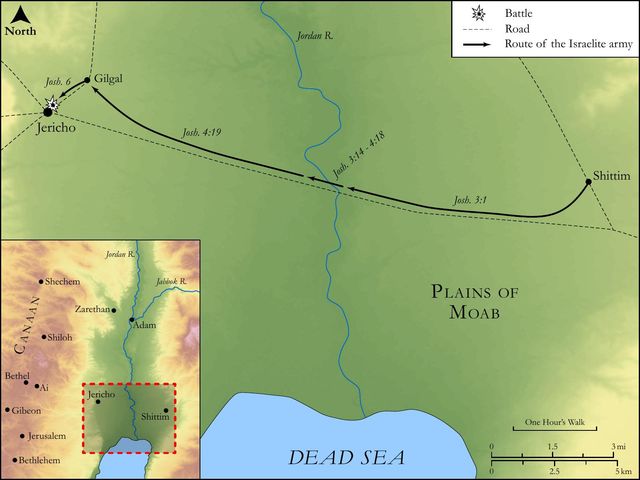
See on the biblical-era map
Study this verse
Public-domain commentary
Matthew Henry
From his Commentary on the Whole Bible. Henry comments on passages, not single verses — this entry covers Joshua 6:17–27. His two-level outline is real structure in the source text, so it is rendered as structure.
The people had religiously observed the orders given them concerning the besieging of Jericho, and now at length Joshua had told them (Jos 6:16), "The Lord hath given you the city, enter and take possession." Accordingly in these verses we have,
I.The rules they were to observe in taking possession.
God gives it to them, and therefore may direct it to what uses and intents, and clog it with what provisos and limitations he thinks fit. It is given to them to be devoted to God, as the first and perhaps the worst of all the cities of Canaan.
1.The city must be burnt, and all the lives in it sacrificed without mercy to the justice of God. All this they knew was included in those words, Jos 6:17. The city shall be a cherem, a devoted thing, at and all therein, to the Lord. No life in it might be ransomed upon any terms; they must all be surely put to death, Lev 27:29. So he appoints from whom as creatures they had received their lives, and to whom as sinners they had forfeited them; and who may dispute his sentence? Is God unrighteous, who thus taketh vengeance? God forbid we should entertain such a thought! There was more of God seen in the taking of Jericho than of any other of the cities of Canaan, and therefore that must be more than any other devoted to him. And the severe usage of this city would strike a terror upon all the rest and melt their hearts yet more before Israel. Only, when this severity is ordered, Rahab and her family are excepted: She shall live and all that are with her. She had distinguished herself from her neighbours by the kindness she showed to Israel, and therefore shall be distinguished from them by the speedy return of that kindness.
2.All the treasure of it, the money and plate and valuable goods, must be consecrated to the service of the tabernacle, and brought into the stock of dedicated things, the Jews say because the city was taken on the sabbath day. Thus God would be honoured by the beautifying and enriching of his tabernacle; thus preparation was made for the extraordinary expenses of his service; and thus the Israelites were taught not to set their hearts upon worldly wealth nor to aim at heaping up abundance of it for themselves. God had promised them a land flowing with milk and honey, not a land abounding with silver and gold; for he would have them live comfortably in it, that they might serve him cheerfully, but not covet either to trade with distant countries or to hoard for after times. He would likewise have them to reckon themselves enriched in the enriching of the tabernacle, and to think that which was laid up in God's house as truly their honour and wealth as if it had been laid up in their own.
3.A particular caution is given them to take heed of meddling with the forbidden spoil; for what was devoted to God, if they offered to appropriate it to their own use, would prove accursed to them; therefore (Jos 6:18) "In any wise keep yourselves from the accursed thing; you will find yourselves inclined to reach towards it, but check yourselves, and frighten yourselves from having any thing to do with it." He speaks as if he foresaw the sin of Achan, which we have an account of in the next chapter, when he gives this reason for the caution, lest you make the camp of Israel a curse and trouble it, as it proved that Achan did.
II.The entrance that was opened to them into the city by the sudden fall of the walls, or at least that part of the wall over against which they then were when they gave the shout (Jos 6:20): The wall fell down flat, and probably killed abundance of people, the guards that stood sentinel upon it, or others that crowded about it, to look at the Israelites that were walking round. We read of thousands killed by the fall of a wall, Kg1 20:30. that which they trusted to for defence proved their destruction. The sudden fall of the wall, no doubt, put the inhabitants into such a consternation that they had no strength nor spirit to make any resistance, but they became an easy prey to the sword of Israel, and saw to how little purpose it was to shut their gates against a people that had the Lord on the head of them, Mic 2:13. Note, The God of heaven easily can, and certainly will, break down all the opposing power of his and his church's enemies. Gates of brass and bars of iron are, before him, but as straw and rotten wood, Isa 45:1, Isa 45:2. Who will bring me into the strong city? Wilt not thou, O God? Psa 60:9, Psa 60:10. Thus shall Satan's kingdom fall, nor shall any prosper that harden themselves against God.
III.The execution of the orders given concerning this devoted city.
All that breathed were put to the sword; not only the men that were found in arms, but the women, and children, and old people. Though they cried for quarter, and begged ever so earnestly for their lives, there was no room for compassion, pity must be forgotten: they utterly destroyed all, Jos 6:21. If they had not had a divine warrant under the seal of miracles for this execution, it could not have been justified, nor can it justify the like now, when we are sure no such warrant can be produced. But, being appointed by the righteous Judge of heaven and earth to do it, who is not unrighteous in taking vengeance, they are to be applauded in doing it as the faithful ministers of his justice. Work for God was then bloody work; and cursed was he that did it deceitfully, keeping back his sword from blood, Jer 48:10. But the spirit of the gospel is very different, for Christ came not to destroy men's lives but to save them, Luk 9:56. Christ's victories were of another nature. The cattle were put to death with the owners, as additional sacrifices to the divine justice. The cattle of the Israelites, when slain at the altar, were accepted as sacrifices for them, but the cattle of these Canaanites were required to be slain as sacrifices with them, for their iniquity was not to be purged with sacrifice and offering: both were for the glory of God. 2. The city was burnt with fire, and all that was in it, Jos 6:24. The Israelites, perhaps, when they had taken Jericho, a large and well-built city, hoped they should have that for their head-quarters; but God will have them yet to dwell in tents, and therefore fires this nest, lest they should nestle in it. 3. All the silver and gold, and all those vessels which were capable of being purified by fire, were brought into the treasury of the house of the Lord; not that he needed it but that he would be honoured by it, as the Lord of hosts, of their hosts in particular, the God that gave the victory and therefore might demand the spoil, either the whole, as here, or, as sometimes, a tenth, Heb 7:4.
IV.The preservation of Rahab the harlot, or inn-keeper, who perished not with those that believed not, Heb 11:31.
The public faith was engaged for her safety by the two spies, who acted therein as public persons; and therefore, though the hurry they were in at the taking of the town was no doubt very great, yet Joshua took effectual care for her preservation. The same persons that she had secured were employed to secure her, Jos 6:22, Jos 6:23. They were best able to do it who knew her and her house, and they were fittest to do it, that it might appear it was for the sake of her kindness to them that she was thus distinguished and had her life given her for a prey. All her kindred were saved with her; like Noah she believed to the saving of her house; and thus faith in Christ brings salvation to the house, Act 16:31. Some ask how her house, which is said to have been upon the wall (Jos 2:15), escaped falling with the wall; we are sure it did escape, for she and her relations were safe in it, either though it joined so near to the wall as to be said to be upon it, yet it was so far off as not to fall either with the wall or under it; or, rather, that part of the wall on which her house stood fell not. Now being preserved alive,
1.She was left for some time without the camp to be purified from the Gentile superstition, which she was to renounce, and to be prepared for her admission as a proselyte.
2.She was in due time incorporated with the church of Israel, and she and her posterity dwelt in Israel, and her family was remarkable long after. We find her the wife of Salmon, prince of Judah, mother of Boaz, and named among the ancestors of our Saviour, Mat 1:5. Having received Israelites in the name of Israelites, she had an Israelite's reward. Bishop Pierson observes that Joshua's saving Rahab the harlot, and admitting her into Israel, were a figure of Christ's receiving into his kingdom, and entertaining there, the publicans and the harlots, Mat 21:31. Or it may be applied to the conversion of the Gentiles.
V.Jericho is condemned to a perpetual desolation, and a curse pronounced upon the man that at any time hereafter should offer to rebuild it (Jos 6:26): Joshua adjured them, that is, the elders and people of Israel, not only by their own consent, obliging themselves and their posterity never to rebuild this city, but by the divine appointment, God himself having forbidden it under the sever penalty here annexed.
1.God would hereby show the weight of a divine curse; where it rests there is no contending with it nor getting from under it; it brings ruin without remedy or repair.
2.He would have it to remain in its ruins a standing monument of his wrath against the Canaanites when the measure of their iniquity was full, and of his mercy to his people when the time had come for their settlement in Canaan. The desolations of their enemies were witnesses of his favour to them, and would upbraid them with their ingratitude to that God who had done so much for them. The situation of the city was very pleasant, and probably its nearness to Jordan was an advantage to it, which would tempt men to build upon the same spot; but they are here told it is at their peril if they do it. Men build for their posterity, but he that builds Jericho shall have no posterity to enjoy what he builds; his eldest son shall die when he begins the work, and if he take not warning by that stroke to desist, but will go on presumptuously, the finishing of his work shall be attended with the funeral of his youngest, and we must suppose all the rest cut off between. This curse, not being a curse causeless, did come upon that man who long after rebuilded Jericho (Kg1 16:34), but we are not to think it made the place ever the worse when it was built, or brought any hurt to those that inhabited it. We find Jericho afterwards graced with the presence, not only of those two great prophets Elijah and Elisha, but of our blessed Saviour himself, Luk 18:35; Luk 19:1; Mat 20:29. Note, It is a dangerous thing to attempt the building up of that which God will have to be destroyed. See Mal 1:4.
Lastly, All this magnified Joshua and raised his reputation (Jos 6:27); it made him not only acceptable to Israel, but formidable to the Canaanites, because it appeared that God was with him of a truth: the Word of the Lord was with him, so the Chaldee, even Christ himself, the same that was with Moses. Nothing can more raise a man's reputation, nor make him appear more truly great, than to have the evidences of God's presence with him.
Historical interpretation
Two Centuries of Reception
3 surviving comments on this verse. Each one is dated, so this reads as a timeline rather than a list.
Select a marker to jump to its quote. Markers stagger vertically where authors wrote within a few decades of each other.
Therefore, our Lord Jesus will come, and he will come with the sound of trumpets. But just now let us pray that he may come and destroy "the world that lay in wickedness" and all things that are in the world, because "everything that is in the world is the lust of the flesh and the lust of the eyes." May he destroy that, may he dissolve it again and again, and save only this one who received his spies and who placed his apostles, received with faith and obedience, in the high places. And may he join and unite this prostitute with the house of Israel.But now let us neither recall nor impute to her the old fault. Once she was a prostitute, but now "a pure virgin, to one man" she has been united, "to Christ." Hear the apostle speaking of her: "But I have determined this itself, to present you to Christ, a pure virgin to one husband." It was also surely of her that someone said, "For once we ourselves were also foolish, unbelieving, wandering, serving desires and various forms of pleasures." Do you still wish to learn more about how the prostitute is no longer a prostitute? Hear Paul saying in addition, "And this surely you have been; but you have been washed, you have been sanctified in the name of our Lord Jesus Christ, and in the Spirit of our God."
But the woman Rahab, how is she said to be joined to the house of Israel up to this very day? Is a succession of posterity on her mother's side ascribed so that she is considered to be preserved in a renewal of offspring? Or rather must it be understood that she has really been bound and united to Israel up to this very day? If you want to see more plainly how Rahab is bound to Israel, consider how "the branch of the wild olive tree is implanted in the root of a good olive tree." Then you will understand how those who have been implanted in the faith of Abraham and Isaac and Jacob are rightly called attached and "joined to Israel up to this very day." For we have been attached up to this very day in the root of those former ones, we, the branches of the wild olive taken up from the nations, who at one time were dealing with harlots and worshiping wood and stone instead of the true God.
Let us prepare ourselves for the sacrifice of the lamb.… Nor let us be under the impression that this yearling lamb can be eaten anywhere. The precept bids us to partake of it in one house only, lest we think that the lamb may be immolated outside the church. From this, it is evident that the Jews and heretics, and all assemblies of perverted doctrine, because they do not eat the lamb in the church, do not eat the flesh of the lamb but the flesh of the dragon, which, as the psalmist tells us, was given as food to the Ethiopians. Just as in the flood no one was saved who was not in the ark of Noah, and in the fall of Jericho, only the house of the harlot Rahab—which signifies the faithful church of the Gentiles—was spared, so is it true that in the sacrifice of the lamb, the lamb is slain only when it is sacrificed in the one house.
Continue studying Joshua 6:25 across the web’s major study libraries — every link below opens this exact verse, chapter, or book on the destination site.
Read & Compare
 BibleGatewayThis verse in more than 200 translations and 70 languages.
 Bible.comThe YouVersion reader — hundreds of translations, reading plans, and highlights.
 ESV.orgCrossway's official English Standard Version reader.
 NET BibleThe NET translation with 60,000+ translators' notes on every rendering decision.
 STEP BibleTyndale House's free study tool — original text, vocabulary, and scholarly resources.
 BibliaLogos Bible Software's free web reader.
 USCCBThe New American Bible (Revised Edition) with the U.S. bishops' study notes.
Commentaries
 BibleHub CommentariesDozens of classic commentaries on this verse, gathered on one page.
 StudyLightMore than 100 commentary sets — the largest collection on the web.
 BibleRefPlain-English commentary on what this verse means, verse by verse.
 Enduring WordDavid Guzik's free commentary on this chapter, widely used by Bible teachers.
 Bible Study ToolsVerse commentary alongside Greek and Hebrew study aids.
Original Language & Research
- BibleHub InterlinearThe verse word by word — original language, transliteration, and English.
- BibleHub LexiconEvery word's original-language definition and Strong's entry.
 Blue Letter BibleDeep-study tools — Strong's numbers, concordance, and word studies.
 SefariaThe Hebrew text with Rashi and centuries of Jewish commentary.
Sermons, Hymns & Audio


TrulyRandomVerse is not affiliated with these sites and doesn’t control their content. They’re linked because they’re genuinely useful.
Summary
Joshua 6:25 stands as a powerful testament to divine mercy and the transformative power of faith, chronicling the remarkable fulfillment of God's promise to Rahab, a Canaanite woman of Jericho. This verse confirms her salvation, the preservation of her entire household, and her permanent integration into the Israelite community, a direct consequence of her courageous act of faith in hiding the Israelite spies. Her story serves as an enduring witness to God's inclusive grace, extending salvation beyond ethnic and social boundaries to all who believe and act upon that belief.
Context
ShowHideLiterary Context
Joshua 6:25 serves as the climactic epilogue to the dramatic account of Jericho's fall, representing the first major victory in Israel's conquest of Canaan. The preceding verses detail the divinely orchestrated siege strategy, culminating in the miraculous collapse of the city walls and the subsequent destruction of its inhabitants, adhering to the herem (devotion to destruction) principle. This verse specifically highlights the singular exception to Jericho's complete annihilation, fulfilling the oath sworn by the Israelite spies to Rahab in Joshua 2. Joshua's meticulous adherence to this promise underscores the sanctity of oaths made in the Lord's name and emphasizes God's particular grace amidst widespread judgment. It contrasts Rahab's salvation with the city's destruction, positioning her story as a key narrative element demonstrating God's justice tempered with mercy.
Historical & Cultural Context
Jericho, an ancient and heavily fortified city, held strategic importance as a gateway into central Canaan. Its destruction, as commanded by God, was a judgment against the profound wickedness and idolatry of the Canaanite inhabitants, whose practices were an abomination to the Lord (Deuteronomy 9:4-5). Rahab, identified as a "harlot" (Hebrew: zonah), occupied an overlooked social position within Canaanite society. Her decision to harbor Israelite spies was an act of profound disloyalty to her own people, a radical act of faith that risked her life and livelihood. In a culture where family and tribal loyalties were paramount, her choice to align with the God of Israel, based on her recognition of His power and sovereignty, speaks volumes about her burgeoning faith. Her subsequent integration into Israel was culturally extraordinary, signifying a divinely orchestrated crossing of ethnic and religious boundaries.
Key Themes
ShowHideJoshua 6:25 powerfully encapsulates several foundational themes central to the book of Joshua and the broader biblical narrative. Firstly, it vividly illustrates Divine Faithfulness and Covenant Keeping, as God ensures the promise made to Rahab is honored through Joshua's actions, demonstrating His unwavering commitment to those who turn to Him. Secondly, it highlights Redemption and Inclusion, showcasing God's willingness to extend salvation and full integration into His people, even to those from outside the covenant community and with a morally compromised past. Rahab's story serves as a compelling counterpoint to the judgment on Jericho, emphasizing that salvation is available to all who respond in faith. Thirdly, it underscores Faith Expressed Through Action, as Rahab's salvation is directly attributed to her active faith in hiding the spies, a crucial theme echoed in the New Testament, particularly in Hebrews 11:31 and James 2:25.
Exposition and Analysis
ShowHideKey Word Analysis
ShowHideThis term consistently describes Rahab, acknowledging her profession without judgment from the biblical narrator. Its repeated use emphasizes that God's redemptive power transcends social stigma and past sin, choosing to work through and transform those whom society might deem outcast. It underscores the universal reach of God's salvation, highlighting that her past did not disqualify her from His grace.
This verb means "to live, to be alive, to revive." In this context, it signifies not merely physical survival amidst the destruction of Jericho but also a spiritual and communal preservation, leading to a new life within the covenant community. It contrasts sharply with the widespread death that befell Jericho, emphasizing the specific, deliberate act of divine preservation extended to Rahab and her family.
This verb means "to sit, to dwell, to inhabit, to remain." Its use here indicates a permanent, settled residence and full integration into the Israelite community, not just a temporary refuge. This signifies a complete change of identity and belonging for Rahab, moving from a Canaanite outsider to a full member of God's people, a status confirmed by the phrase "unto this day," implying a long-standing, recognized presence.
Verse Breakdown
ShowHide"And Joshua saved Rahab the harlot alive"
This clause directly attributes the act of salvation to Joshua, who, as Israel's leader, faithfully executes the promise made by the spies. The explicit mention of "Rahab the harlot" immediately highlights the unexpected nature of her salvation, emphasizing God's grace extended to one typically outside the covenant and socially overlooked. This sets the stage for a story of radical redemption.
"and her father's household, and all that she had"
The scope of salvation is expanded beyond Rahab herself to include her entire immediate family and possessions. This demonstrates the corporate nature of salvation in the Old Testament, where the faith of one individual could bring blessing and protection to their entire household, provided they remained within the specified boundary (the house marked by the scarlet cord). It underscores the comprehensive nature of God's preservation.
"and she dwelleth in Israel [even] unto this day"
This phrase provides a historical attestation to Rahab's full and permanent integration into the Israelite community. The expression "unto this day" (עד היום הזה, ‘ad hayyôm hazzeh) is a common Deuteronomistic phrase affirming the lasting impact and verifiable truth of the event for the original readers, indicating that Rahab's descendants continued to live among Israel, a testament to her enduring legacy.
"because she hid the messengers, which Joshua sent to spy out Jericho"
This final clause provides the explicit reason for Rahab's salvation. Her act of hiding the spies, though seemingly a simple deed, was a profound demonstration of faith and allegiance to the God of Israel. It was a courageous choice that risked her life and betrayed her own people, motivated by a divine conviction gleaned from the reports of God's mighty deeds. It was this active, courageous faith that God honored and rewarded.
Literary Devices
ShowHideJoshua 6:25 effectively employs several Literary Devices to convey its profound message. There is a powerful sense of Irony in the narrative: the "harlot" of Jericho, a city condemned for its pervasive wickedness, is the one who demonstrates true faith and is spared, while the city's seemingly righteous inhabitants are destroyed. This highlights God's unexpected ways and His ability to use the lowly for His sovereign purposes. The phrase "unto this day" functions as a Historical Marker or Testimony, lending credibility and enduring significance to Rahab's story for the original Israelite audience, affirming her permanent integration. Her salvation also serves as a potent Foreshadowing of the inclusion of Gentiles into God's covenant people, a theme that becomes central in the New Testament. Finally, the verse presents a stark Contrast between the universal judgment on Jericho and the particular, merciful salvation extended to Rahab and her family, emphasizing God's discernment and justice tempered with boundless grace.
Theological and Thematic Connections
ShowHideJoshua 6:25 is a profound theological statement on God's sovereign grace and His redemptive plan that transcends human categories. It reveals that salvation is not limited by ethnicity, social status, or past sins, but is freely offered to all who respond in faith and obedience. Rahab, a Canaanite and a harlot, becomes a living testament to God's boundless mercy, demonstrating that genuine faith, which inevitably leads to courageous action, is the singular criterion for salvation. Her integration into Israel's community foreshadows the New Testament revelation of a new humanity in Christ, where distinctions of Jew and Gentile are overcome. This narrative powerfully illustrates that God's kingdom is open to unlikely candidates, transforming and integrating them into His family, showcasing His universal reach.
Reflection and Application
ShowHideRahab's story in Joshua 6:25 offers enduring lessons for believers today, reminding us that God's grace is truly inclusive and profoundly transformative. Her past profession did not disqualify her from God's redemptive plan; instead, her story highlights that no one is beyond the reach of divine mercy. This calls us to embrace a radical understanding of grace, extending compassion and welcome to those overlooked by society, just as God did for Rahab. Furthermore, Rahab's faith was not passive intellectual assent but active obedience, leading her to risk her life for God's messengers. This challenges us to consider whether our own faith is merely theoretical or if it manifests in tangible acts of courage, compassion, and obedience, even when it demands personal sacrifice or goes against prevailing societal norms. Her full integration into Israel, and ultimately into the lineage of Christ, underscores God's power to redeem and repurpose even the most broken lives for His glorious purposes, offering profound hope that our past does not dictate our future in Christ.
Questions for Reflection
ShowHideFAQ
ShowHideWhy is Rahab consistently referred to as a "harlot" in the biblical narrative, even after her redemption?
ShowHideThe consistent use of the term "harlot" (Hebrew: zonah) is not meant to condemn Rahab or dwell on her past, but rather to highlight the extraordinary nature of God's grace and redemptive power. By explicitly stating her former profession, the biblical text emphasizes that God's salvation is available to anyone, regardless of their social standing, moral history, or ethnic background. It underscores that God looks beyond human labels and chooses to work through and transform those whom society might deem unworthy. This emphasis magnifies His mercy and the universal reach of His covenant, making her story a powerful testament to His ability to redeem and repurpose any life. Furthermore, her inclusion in the lineage of Jesus (see Matthew 1:5) further underscores this theme of God's unexpected grace.
What is the significance of the phrase "she dwelleth in Israel [even] unto this day"?
ShowHideThis phrase serves multiple significant purposes. Firstly, it provides a historical attestation to the permanence of Rahab's integration into the Israelite community, indicating that her descendants were still living among them when the book of Joshua was written or compiled. This confirms that her salvation was not merely a temporary reprieve but a complete and lasting change of identity and belonging. Secondly, it highlights the fulfillment of God's promise and the faithfulness of Joshua and Israel in honoring their oath. Thirdly, it underscores the theme of inclusion and redemption, showing that a Gentile woman could become a full member of God's people, a status that would later be profoundly significant in the Messianic line (see Matthew 1:5).
How does Rahab's story relate to the broader narrative of the conquest of Canaan and the herem (devotion to destruction)?
ShowHideRahab's story is a crucial counterpoint to the herem command, which dictated the complete destruction of the Canaanite cities and their inhabitants due to their extreme wickedness and idolatry (Deuteronomy 7:1-6). While Jericho was indeed devoted to destruction, Rahab and her household were spared. This demonstrates that God's judgment is precise and just, but also that His mercy is available to those who turn to Him in faith. Rahab's salvation illustrates that the herem was not an indiscriminate act of genocide, but a righteous judgment with exceptions for those who, like Rahab, chose to align themselves with the God of Israel. Her story thus highlights God's sovereignty, His justice, and His boundless grace, showing that even amidst judgment, there is always a path to redemption for those who believe.
Christ-Centered Fulfillment
ShowHideJoshua 6:25, in its account of Rahab's salvation and integration, powerfully foreshadows the expansive and inclusive nature of God's redemptive plan in Jesus Christ. Rahab, a Gentile and a "harlot," is saved by faith and brought into the covenant community, ultimately finding her place in the genealogy of Jesus Christ. This remarkable inclusion prefigures the New Covenant reality where salvation is extended to all nations, breaking down the dividing wall between Jew and Gentile (Ephesians 2:11-22). Her salvation, secured by the scarlet cord, serves as a vivid type of the saving power of Christ's blood, which covers sin and grants new life to all who believe (Hebrews 9:22 and Romans 5:9). Just as Rahab's active faith in hiding the spies led to her deliverance, so too are believers called to respond to Christ with a living faith that results in obedience and transformation (James 2:26). Rahab's story is a beautiful testament to the truth that in Christ, there is no condemnation for those who believe, and that God's grace is sufficient to redeem, restore, and fully integrate anyone, regardless of their past, into His eternal family (Romans 8:1).