


Joshua 8:2
- וְעָשִׂיתָve·'a·Si·taand you will doH6213Conj-w ¦ V-Qal-ConsecPerf-2msVerb Qal Consecutive Perfect 2nd Singular Masculineוְandעָשִׂיתָyou will do
- לָעַיla·'Aito <the> AiH5857Prep-l ¦ N-properNoun Proper Locationלָto <the>עַיAi
- וּלְמַלְכָּהּu·le·mal·Kahand to its kingH4428Conj-w ¦ Prep-l ¦ N-msc ¦ 3fsNoun Singular Masculine Constructוּandלְtoמַלְכָּkingהּits
- כַּאֲשֶׁרka·'a·Sherjust asH834Prep-k ¦ RelParticle Relativeכַּjustאֲשֶׁרas
- עָשִׂיתָ'a·Si·tayou didH6213V-Qal-Perf-2msVerb Qal Perfect 2nd Singular Masculine
- לִירִיחוֹli·ri·Choto JerichoH3405Prep-l ¦ N-properNoun Proper LocationלִtoירִיחוֹJericho
- וּלְמַלְכָּהּu·le·mal·Kahand to its kingH4428Conj-w ¦ Prep-l ¦ N-msc ¦ 3fsNoun Singular Masculine Constructוּandלְtoמַלְכָּkingהּits
- רַקrakonlyH7535AdvAdverb
- שְׁלָלָהּshe·la·Lahits bootyH7998N-msc ¦ 3fsNoun Singular Masculine Constructשְׁלָלָbootyהּits
- וּבְהֶמְתָּהּu·ve·hem·Tahand its livestockH929Conj-w ¦ N-fsc ¦ 3fsNoun Singular Feminine Constructוּandבְהֶמְתָּlivestockהּits
- תָּבֹזּוּta·Vo·zuyou will plunderH962V-Qal-Imperf-2mpVerb Qal Imperfect 2nd Plural Masculine
- לָכֶםla·Khemfor <the> yourselvesPrep-l ¦ 2mpSuffix Personal 2nd Plural Masculineלָfor <the>כֶםyourselves
- שִׂיםsimsetH7760V-Qal-Imp-2msVerb Qal Imperative 2nd Singular Masculine
- לְךָle·Khafor <the> yourselfPrep-l ¦ 2msSuffix Personal 2nd Singular Masculineלְfor <the>ךָyourself
- אֹרֵב'o·Revan ambushH693V-Qal-Prtcpl-msVerb Qal Participle Singular Masculine Absolute
- לָעִירla·'Irfor the cityH5892Prep-l ¦ N-fsNoun Singular Feminine Absoluteלָfor theעִירcity
- מֵאַחֲרֶיהָme·'a·cha·Rei·ha<from> behind itH310Prep-m ¦ Adj-mpc ¦ 3fsAdjective Numerical Plural Masculine Constructמֵ<from>אַחֲרֶיbehindהָit
English is a literal word-by-word gloss of the Hebrew, not the KJV's wording. Why?
This is the original text the KJV's translators worked from — each Hebrew word with its own literal English meaning in this verse, prepared by scholars at Tyndale House, Cambridge. The KJV translates whole sentences, not word by word, so its wording differs: one Hebrew word can become several English words, and the KJV may choose “the LORD” where the gloss reads “Yahweh”. Both are faithful — they answer different questions. For the KJV's own rendering, switch to the KJV text.
Details
See on the biblical-era map
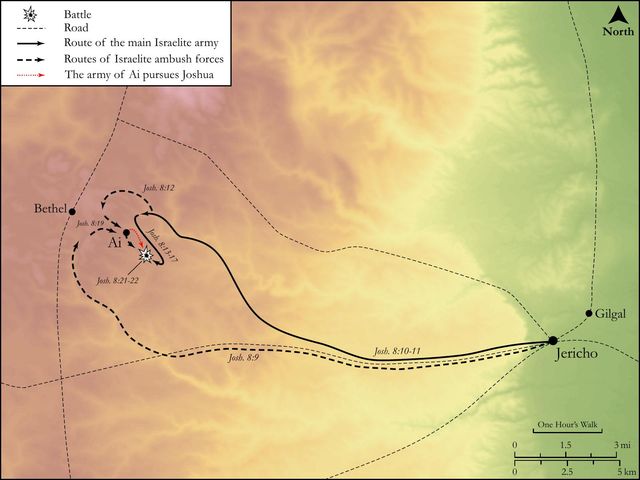
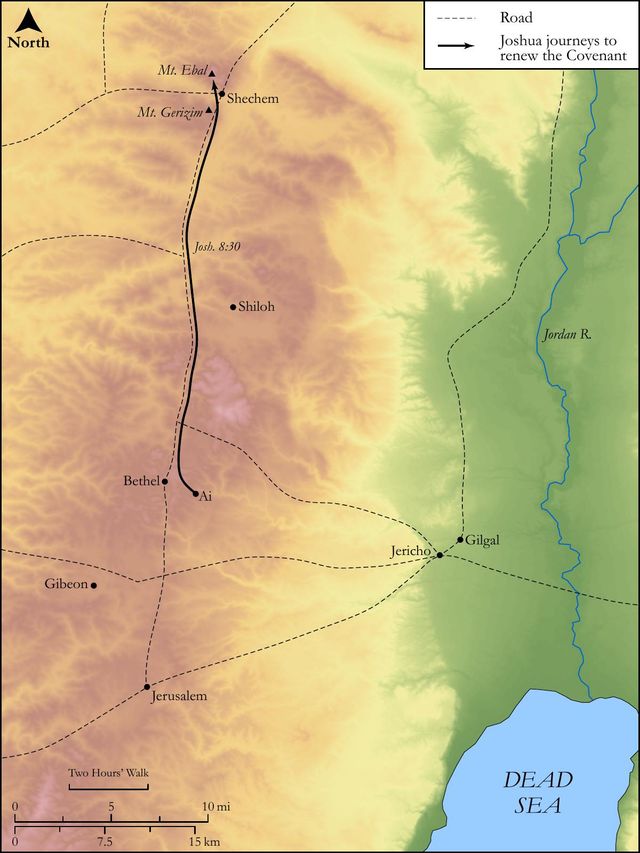
Study this verse
Public-domain commentary
Matthew Henry
From his Commentary on the Whole Bible. Henry comments on passages, not single verses — this entry covers Joshua 8:1–2. His two-level outline is real structure in the source text, so it is rendered as structure.
Israel were very happy in having such a commander as Joshua, but Joshua was more happy in having such a director as God himself; when any difficulty occurred, he needed not to call a council of war who had God so nigh unto him, not only to answer, but even to anticipate, his enquiries. It should seem, Joshua was now at a stand, had scarcely recovered the discomposure he was put into by the trouble Achan gave them, and could not think, without fear and trembling, of pushing forward, lest there should be in the camp another Achan; then God spoke to him, either by vision, as before (Jos 5:1-15), or by the breastplate of judgment. Note, When we have faithfully put away sin, that accursed thing, which separates between us and God, then, and not till then, we may expect to hear from God to our comfort; and God's directing us how to go on in our Christian work and warfare is a good evidence of his being reconciled to us. Observe here,
I.The encouragement God gives to Joshua to proceed:
Fear not, neither be thou dismayed, Jos 8:1. This intimates that the sin of Achan, and the consequences of it, had been a very great discouragement to Joshua, and made his heart almost ready to fail. Corruptions within the church weaken the hands, and damp the spirits, of her guides and helpers, more than oppositions from without; treacherous Israelites are to be dreaded more than malicious Canaanites. But God bids Joshua not be dismayed; the same power that keeps Israel from being ruined by their enemies shall keep them from ruining themselves. To animate him,
1.He assures him of success against Ai, tells him it is all his own; but he must take it as god's gift: I have given it into thy hands, which secured him both title and possession, and obliged him to give God the glory of both, Psa 44:3.
2.He allows the people to take the spoil to themselves. Here the spoil was not consecrated to God as that of Jericho, and therefore there was no danger of the people's committing such a trespass as they had committed there. Observe, How Achan who caught at forbidden spoil lost that, and life, and all, but the rest of the people who had conscientiously refrained from the accursed thing were quickly recompensed for their obedience with the spoil of Ai. the way to have the comfort of what God allows us is to forbear what he forbids us. No man shall lose by his self-denial; let God have his dues first, and then all will be clean to us and sure, Kg1 17:13. God did not bring them to these goodly cities, and houses filled with all good things, to tantalize them with the sight of that which they might not touch; but, having received the first-fruits from Jericho, the spoil of Ai, and of all the cities which thenceforward came into their hands, they might take for a prey to themselves.
II.The direction he gives him in attacking Ai.
It must not be such a work of time as the taking of Jericho was; this would have prolonged the war too much. Those that had patiently waited seven days for Jericho shall have Ai given them in one day. Nor was it, as that, to be taken by miracle, and purely by the act of God, but now their own conduct and courage must be exercised; having seen God work for them, they must now bestir themselves. God directs him, 1. to take all the people, that they might all be spectators of the action and sharers in the spoil. Hereby God gave him a tacit rebuke for sending so small a detachment against Ai in the former attempt upon it, Jos 7:4. 2. To lay an ambush behind the city; this was a method which perhaps Joshua would not have thought of at this time, if God had not directed him to it; and though now we are not to expect direction, as here, by visions, voices, or oracles, yet, whenever those who are entrusted with public councils take prudent measures for the public good, it must be acknowledged that god puts it into their hears; he that teaches the husbandman discretion no doubt teaches statesman and general.
Historical interpretation
Historical reception
1 surviving comment on this verse from the historical church.
Inasmuch as God ordered Joshua to plant an ambush in their rear, that is, to plant warriors in hiding to ambush the enemy, we can learn that such treachery is not unjustly carried out by those who wage a just war. Thus, a just man, if he wishes to undertake a just war, ought to think chiefly in these matters about nothing else than whether it is right for him to do so, for it is not lawful for everyone to wage war. However, once he has undertaken a just war, it makes no difference to the justice of the war whether he wins in open warfare or by treachery. However, those just wars ought to be defined as those which avenge injuries, if the tribe or state which is about to be sought in war, either neglected to punish a crime improperly committed by its own countrymen or neglected to repay what had been lost through those injuries. Moreover, without doubt that type of war is just which God commands, since there is no iniquity in him and he knows what ought to be done to each person. In this type of war the general of the army or the people themselves are not to be deemed so much the instigator of the war as much as its agent.Joshua sent thirty thousand warriors to vanquish Ai.… We must consider whether every attempt at deception ought to be reckoned as a lie and, if so, whether a lie can be just, when someone who should be deceived is deceived. And if not even this kind of a lie is found to be just, we must still relate what transpired with the ambush to the truth with some other meaning.
Continue studying Joshua 8:2 across the web’s major study libraries — every link below opens this exact verse, chapter, or book on the destination site.
Read & Compare
 BibleGatewayThis verse in more than 200 translations and 70 languages.
 Bible.comThe YouVersion reader — hundreds of translations, reading plans, and highlights.
 ESV.orgCrossway's official English Standard Version reader.
 NET BibleThe NET translation with 60,000+ translators' notes on every rendering decision.
 STEP BibleTyndale House's free study tool — original text, vocabulary, and scholarly resources.
 BibliaLogos Bible Software's free web reader.
 USCCBThe New American Bible (Revised Edition) with the U.S. bishops' study notes.
Commentaries
 BibleHub CommentariesDozens of classic commentaries on this verse, gathered on one page.
 StudyLightMore than 100 commentary sets — the largest collection on the web.
 BibleRefPlain-English commentary on what this verse means, verse by verse.
 Enduring WordDavid Guzik's free commentary on this chapter, widely used by Bible teachers.
 Bible Study ToolsVerse commentary alongside Greek and Hebrew study aids.
Original Language & Research
- BibleHub InterlinearThe verse word by word — original language, transliteration, and English.
- BibleHub LexiconEvery word's original-language definition and Strong's entry.
 Blue Letter BibleDeep-study tools — Strong's numbers, concordance, and word studies.
 SefariaThe Hebrew text with Rashi and centuries of Jewish commentary.
Sermons, Hymns & Audio


TrulyRandomVerse is not affiliated with these sites and doesn’t control their content. They’re linked because they’re genuinely useful.
Summary
Joshua 8:2 presents God's precise and adaptive instructions to Joshua for Israel's renewed assault on Ai. Following the nation's humbling defeat due to Achan's sin and subsequent purification, this divine directive outlines a strategic approach that both parallels the complete destruction of Jericho's inhabitants and introduces a significant deviation: the explicit allowance for the Israelites to take the spoil and cattle for themselves. Furthermore, it mandates the tactical deployment of an ambush, showcasing God's sovereign wisdom in employing varied methods—from miraculous intervention to conventional military strategy—to secure victory for His repentant people and provide for their needs.
Context
ShowHideLiterary Context
This verse immediately follows God's renewed command and assurance to Joshua in Joshua 8:1, empowering him to attack Ai a second time. The narrative flow is critical, as it directly addresses the aftermath of Israel's humiliating defeat at Ai (Joshua 7:5), which was not due to military weakness but a direct consequence of Achan's trespass in taking devoted things from Jericho (Joshua 7:1). After Achan and his family were judged and the sin purged from the camp (Joshua 7:24-26), God's favor was unequivocally restored. The detailed instructions in Joshua 8 immediately follow this restoration, signaling God's faithfulness, His readiness to lead His people forward after repentance and purification, and the absolute necessity of obedience for divine blessing and success in the conquest. The stark contrast with the initial failure underscores the profound theological truth that sin breaks fellowship and hinders divine blessing, while repentance reopens the path to victory.
Historical & Cultural Context
The conquest of Canaan was a divinely ordained mission, with specific rules of engagement that varied for different cities. The concept of cherem (Hebrew: חֵרֶם), often translated as "devotion to destruction" or "holy war," was central to this period, as uniquely applied to Jericho. Ai, though smaller, was strategically important due to its location. Militarily, ambushes were a common and effective ancient Near Eastern tactic, demonstrating that God, while capable of miraculous intervention (as at Jericho), also employed and directed conventional military strategies. The allowance of spoil was typical for conquered cities in the ancient world, providing resources for the victorious army and nation. The shift from Jericho's strict cherem (where all spoil was devoted to God or destroyed) to Ai's permitted plunder highlights God's sovereign right to set different terms for His people's provision and the nature of their warfare, adapting to their needs and the specific circumstances of each battle while always maintaining His overarching purposes.
Key Themes
ShowHideJoshua 8:2 contributes significantly to several major themes in the Book of Joshua and the broader Pentateuch. Firstly, it emphasizes Divine Strategy and Adaptation: God does not use a one-size-fits-all approach to warfare or blessing. While Jericho fell through a miraculous, non-conventional siege (Joshua 6), Ai requires a detailed, tactical ambush. This teaches that God's methods can vary, and His people must remain attentive to His specific, present instructions for each situation, rather than relying on past successes or formulas. Secondly, the verse highlights Restoration and Provision: After the purification from sin, God not only grants victory but also allows the Israelites to take the spoil. This contrasts sharply with Jericho, where all spoil was devoted to God or destroyed (Joshua 6:17-19), signifying God's renewed blessing and practical provision for His people after their repentance. Thirdly, it underscores Obedience as a Prerequisite for Success: The previous defeat was a direct consequence of disobedience. The detailed instructions given here emphasize that future success depends on strict adherence to God's precise commands, reinforcing the overarching theme found throughout Deuteronomy and Joshua that faithfulness to the covenant leads to blessing and victory.
Exposition and Analysis
ShowHideKey Word Analysis
ShowHideFrom the root שָׁלַל (shalal), meaning to plunder or take spoil. This term refers to the booty, plunder, or loot taken from a conquered enemy. In this context, the explicit permission to take "the spoil thereof, and the cattle thereof, shall ye take for a prey unto yourselves" marks a significant departure from the cherem (devoted things) applied to Jericho, where all material possessions were either destroyed or consecrated to the Lord's treasury. This allowance for Ai signifies God's renewed favor and provision for Israel, providing tangible resources for the community after the period of judgment and purification following Achan's sin.
From the primitive root אָרַב (arab), meaning to lurk or lie in wait. This term refers to a concealed force lying in wait to make a surprise attack. The instruction to "lay thee an ambush for the city behind it" reveals God's detailed tactical guidance for the battle of Ai. Unlike the miraculous, non-conventional fall of Jericho, God here directs a conventional military maneuver involving deception and strategic positioning. This demonstrates God's willingness to use human strategy and military cunning alongside divine power to achieve His purposes, highlighting His sovereignty over both natural and supernatural means.
Verse Breakdown
ShowHide"And thou shalt do to Ai and her king as thou didst unto Jericho and her king"
This clause establishes a direct parallel between the fate of Ai and Jericho concerning their complete destruction and the defeat of their leadership. It signifies that Ai, like Jericho, would face the total annihilation of its inhabitants and its royal authority. The phrase "as thou didst unto Jericho" refers to the thorough destruction of Jericho's population (Joshua 6:21), indicating that Ai would also be utterly defeated and its people put to the sword as part of the cherem against the Canaanite nations. This emphasizes God's unwavering judgment against the wickedness of the Canaanites.
"only the spoil thereof, and the cattle thereof, shall ye take for a prey unto yourselves"
This is the crucial point of divergence from the Jericho campaign and a significant act of divine grace. While the human inhabitants of Ai were to be utterly destroyed, God explicitly permits the Israelites to take the material wealth and livestock as plunder for themselves. This allowance serves as a practical blessing, providing resources for the Israelite community, and powerfully signifies God's renewed grace and provision after the sin of Achan had been dealt with. It demonstrates God's sovereign right to set different rules for different campaigns, always with His people's ultimate good and His redemptive purposes in view.
"lay thee an ambush for the city behind it."
This final clause provides the specific tactical instruction for the battle of Ai. Unlike the direct assault and miraculous collapse of Jericho's walls, Ai would be conquered through a strategic military maneuver involving a hidden force positioned at the rear of the city (Hebrew: אָחַר, ʼachar' H310, "behind"). This command reveals God's detailed involvement in the military planning and His willingness to use conventional warfare strategies, demonstrating His wisdom in adapting His methods to the specific circumstances of each battle and the needs of His people, rather than relying solely on overt miraculous intervention.
Literary Devices
ShowHideJoshua 8:2 employs several significant literary devices that enrich its meaning. Contrast is paramount, as the verse explicitly compares the conquest of Ai to that of Jericho ("as thou didst unto Jericho") but immediately introduces a stark difference regarding the spoil. This highlights God's adaptable sovereignty and His nuanced approach to the cherem law, demonstrating that His commands are not rigid formulas but expressions of His dynamic will. The phrase "only the spoil thereof..." functions as a qualification or exception, drawing the reader's attention to the specific change in divine instruction and emphasizing its importance. Furthermore, the detailed command to "lay thee an ambush for the city behind it" is an example of divine instruction or command, underscoring God's active involvement in the military strategy and His precise guidance to Joshua. The entire verse serves as a form of divine revelation, communicating God's specific will and plan directly to His chosen leader and, by extension, to His people.
Theological and Thematic Connections
ShowHideJoshua 8:2 powerfully illustrates God's sovereignty, grace, and adaptability in His dealings with His people. While He demands absolute obedience and purges sin from their midst, He also demonstrates profound grace by restoring His favor and providing for Israel's material needs after their repentance. The shift in the spoil rules from Jericho to Ai is a profound theological statement: God is not bound by a single method or rule, but sovereignly determines the terms of engagement and provision, always for His ultimate purposes. He uses both miraculous intervention and human strategy, demonstrating His wisdom and power in diverse ways. This verse underscores that God's plans are perfect, even when they seem to diverge from previous patterns, and His people's success is predicated on listening to and obeying His specific, current instructions. It reminds us that divine victory is not achieved by human might or cleverness alone, but by faithful adherence to God's revealed will.
Reflection and Application
ShowHideJoshua 8:2 offers profound insights for contemporary believers, reminding us that God does not abandon us after failure, especially when we humbly address our sin and repent. Just as He restored Israel's favor and provided a new, detailed plan for victory after Achan's sin was dealt with, so too does God offer redemption and a path forward when we confess and turn from our transgressions. Furthermore, the contrast between Jericho and Ai teaches us that God's methods are not static. We must avoid the temptation to rely solely on past successes or formulas, assuming God will always work in the same way. Instead, we are called to remain flexible, attentive, and obedient to His specific guidance for each unique situation we face. Trusting and obeying God's detailed instructions, even when they involve complex, unconventional, or seemingly contradictory tactics, is key to experiencing His victory and provision in our lives and ministries. Our spiritual battles, like Israel's physical ones, require divine strategy, and our success hinges on our willingness to follow His lead, no matter how different it may be from what we expect, always remembering that His ways are higher than our ways.
Questions for Reflection
ShowHideFAQ
ShowHideWhy did God allow Israel to take spoil from Ai but not from Jericho?
ShowHideThe differing instructions for Jericho and Ai highlight God's sovereign right to set distinct terms for His people's actions and provision, demonstrating His wisdom and adaptability. Jericho was the "firstfruits" of the conquest, and its complete destruction (the cherem, or 'devotion to destruction') and the dedication of its valuable metals to the Lord's treasury (Joshua 6:17-19) symbolized Israel's absolute obedience and God's exclusive claim over the initial victory. It was a test of faith and a demonstration that the victory was entirely His, not for Israel's personal gain. For Ai, however, after the profound lesson of Achan's sin and Israel's subsequent repentance and purification, God graciously allowed them to take the spoil and cattle. This served as practical provision for the community, demonstrating God's restored favor and His willingness to bless His people with tangible resources once their relationship with Him was purified. It shows God's wisdom in adapting His commands to both teach crucial spiritual lessons and meet practical needs, always in accordance with His overarching redemptive plan.
Christ-Centered Fulfillment
ShowHideJoshua 8:2, with its themes of divine strategy, victory after repentance, and the taking of spoil, finds profound Christ-centered fulfillment in the New Testament. The initial defeat at Ai, caused by Achan's sin, mirrors humanity's universal defeat under the power of sin and death (Romans 3:23). Just as God provided a new, detailed plan for victory over Ai after the sin was purged, so too has God provided the ultimate plan for victory over sin and death through the person and work of Jesus Christ. Jesus, the true Joshua, leads His people to victory, not through military ambush, but through His sacrificial death on the cross and His glorious resurrection (Colossians 2:15). He disarmed the spiritual powers and authorities, triumphing over them by His ultimate act of obedience. The "spoil" taken from Ai foreshadows the spiritual riches and abundant blessings that believers receive through Christ's victory—the forgiveness of sins, eternal life, reconciliation with God, and the indwelling of the Holy Spirit (Ephesians 1:3-14). Moreover, God's adaptable strategy for Ai reminds us that Christ's kingdom advances through diverse means, not always through expected or conventional methods, but always according to God's perfect wisdom and power, often through what the world considers foolish (1 Corinthians 1:25). Ultimately, the victory at Ai, secured by divine instruction and human obedience, points to the greater, eternal victory won by Christ, which enables believers to inherit the true promised land—eternal life and rest with God (Hebrews 4:9-11).