


Joshua 8:9
- וַיִּשְׁלָחֵםvai·yish·la·Chemand he sent out themH7971Conj-w ¦ V-Qal-ConsecImperf-3ms ¦ 3mpVerb Qal Consecutive Imperfect 3rd Singular Masculineוַandיִּשְׁלָחֵhe sent outםthem
- יְהוֹשֻׁעַye·ho·Shu·a'JoshuaH3091N-proper-mNoun Proper Masculine
- וַיֵּלְכוּvai·ye·le·Khuand they wentH1980Conj-w ¦ V-Qal-ConsecImperf-3mpVerb Qal Consecutive Imperfect 3rd Plural Masculineוַandיֵּלְכוּthey went
- אֶל'eltoH413PrepPreposition
- הַמַּאְרָבha·ma'·Ravthe ambushH3993Art ¦ N-msNoun Singular Masculine Absoluteהַtheמַּאְרָבambush
- וַיֵּשְׁבוּvai·ye·she·Vuand they remainedH3427Conj-w ¦ V-Qal-ConsecImperf-3mpVerb Qal Consecutive Imperfect 3rd Plural Masculineוַandיֵּשְׁבוּthey remained
- בֵּיןbeinbetweenH996Adj-mscAdjective Numerical Singular Masculine Construct
- בֵּיתbeitBeth-H1008N-properNoun Proper Location
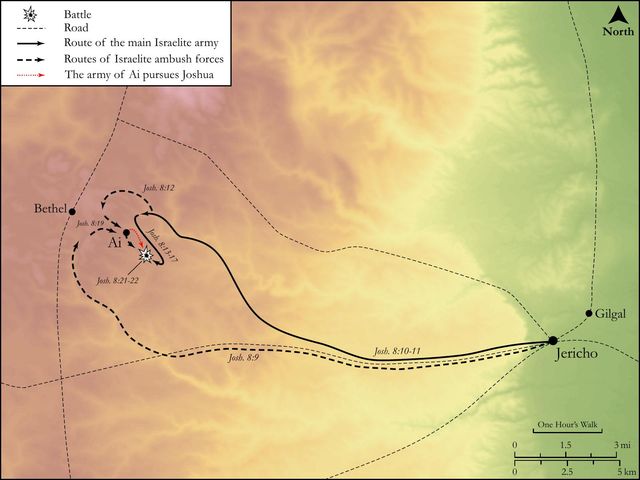
- אֵל'el-elH1008N-properNoun Proper Location
- וּבֵיןu·Veinand betweenH996Conj-w ¦ Adj-mscAdjective Numerical Singular Masculine Constructוּandבֵיןbetween
- הָעַיha·'Ai<the> AiH5857Art ¦ N-properNoun Proper Locationהָ<the>עַיAi
- מִיָּםmi·Yamfrom [the] westH3220Prep-m ¦ N-msNoun Singular Masculine Absoluteמִfromיָּם[the] west
- לָעָיla·'Aiof <the> AiH5857Prep-l ¦ N-properNoun Proper Locationלָof <the>עָיAi
- וַיָּלֶןvai·Ya·lenand he stayedH3885Conj-w ¦ V-Qal-ConsecImperf-3msVerb Qal Consecutive Imperfect 3rd Singular Masculineוַandיָּלֶןhe stayed
- יְהוֹשֻׁעַye·ho·Shu·a'JoshuaH3091N-proper-mNoun Proper Masculine
- בַּלַּיְלָהba·Lay·lahin the nightH3915Prep-b ¦ N-msNoun Singular Masculine Absoluteבַּin theלַּיְלָהnight
- הַהוּאha·Hu'<the> thatH1931Art ¦ Pro-3msPronoun Personal 3rd Singular Masculineהַ<the>הוּאthat
- בְּתוֹךְbe·Tokhin amongH8432Prep-b ¦ N-mscNoun Singular Masculine Constructבְּinתוֹךְamong
- הָעָםha·'Amthe peopleH5971Art ¦ N-msNoun Singular Masculine Absoluteהָtheעָםpeople
English is a literal word-by-word gloss of the Hebrew, not the KJV's wording. Why?
This is the original text the KJV's translators worked from — each Hebrew word with its own literal English meaning in this verse, prepared by scholars at Tyndale House, Cambridge. The KJV translates whole sentences, not word by word, so its wording differs: one Hebrew word can become several English words, and the KJV may choose “the LORD” where the gloss reads “Yahweh”. Both are faithful — they answer different questions. For the KJV's own rendering, switch to the KJV text.
Details
See on the biblical-era maps
Study this verse
Public-domain commentary
Matthew Henry
From his Commentary on the Whole Bible. Henry comments on passages, not single verses — this entry covers Joshua 8:3–22. His three-level outline is real structure in the source text, so it is rendered as structure.
We have here an account of the taking of Ai by stratagem. The stratagem here used, we are sure, was lawful and good; God himself appointed it, and we have no reason to think but that the like is lawful and good in other wars. Here was no league broken, no treaty of peace, that the advantage was gained; no, these are sacred things, and not to be jested with, nor used to serve a turn; truth, when once it is plighted, becomes a debt even to the enemy. But in this stratagem here was no untruth told; nothing was concealed but their own counsels, which no enemy ever pretended a right to be entrusted with; nothing was dissembled, nothing counterfeited but a retreat, which was no natural or necessary indication at all of their inability to maintain their onset, or of any design not to renew it. The enemy ought to have been upon their guard, and to have kept within the defence of their own walls. Common prudence, had they been governed by it, would have directed them not to venture on the pursuit of an army which they saw was so far superior to them in numbers, and leave their city unguarded; but (si populus vult decipi, decipiatur - if the people will be deceived, let them) if the Canaanites will be so easily imposed upon, and in pursuit of God's Israel will break through all the laws of policy and good management, the Israelites are not at all to be blamed for taking advantage of their fury and thoughtlessness; nor is it any way inconsistent with the character God is pleased to give of them, that they are children that will not lie. Now in the account here given of this matter,
I.There is some difficulty in adjusting the numbers that were employed to effect it.
Mention is made (Jos 8:3) of 30,000 that were chosen and sent away by night, to whom the charge was given to surprise the city as soon as ever they perceived it was evacuated, Jos 8:4, Jos 8:7, Jos 8:8. And yet afterwards (Jos 8:12) it is said, Joshua took 5000 men and set them to lie in ambush behind the city, and that ambush entered the city, and set it on fire, Jos 8:19. Now,
1.Some think there were two parties sent out to lie in ambush, 30,000 first, and afterwards 5000 to guard the roads, and to intercept those that were first sent out; and that Joshua made his open attack upon the city with all the thousands of Israel. So the learned bishop Patrick, insisting upon God's command (Jos 8:1) to take all the people of war with him. But,
2.Others think that all the people were taken only to encamp before the city, and that out of them Joshua chose out 30,000 men to be employed in the action, out of which he sent out 5000 to lie in ambush, which were as many as could be supposed to march incognito - without being discovered (more would have been seen, and thus the design would have been broken) and that then with the other 25,000 he made the open attack, as Masius thinks, or with the 30,000, which, as Calvin thinks, he kept entire for that purpose, having, besides them, sent out 5000 for an ambuscade. And those 5000 (they think) must be meant by those (Jos 8:3) whom he sent away by night, with orders to lie in wait behind the city, though the particular number is not specified till Jos 8:12. If we admit such a seeming disturbance in the order of the narrative (of which, perhaps, similar instances might be cited from the other scripture histories), it seems most probable that there was but one ambushment, which consisted only of 5000, enough for such a purpose.
II.Yet the principal parts of the story are plain enough, that a detachment being secretly marched behind the city, on the other side to that on which the main body of the army lay (the situation of the country, it is probable, favouring their concealment), Joshua, and the forces with him, faced the city; the garrison made a vigorous sally out upon them, whereupon they withdrew, gave ground, and retreated in some seeming disorder towards the wilderness, which being perceived by the men of Ai, they drew out all the force they had to pursue them. This gave a fair opportunity for those that lay in ambush to make themselves masters of the city, whereof when they had given notice by a smoke to Joshua, he, with all his force, returned upon the pursuers, who now, when it was too late, were aware of the snare they were drawn into, and, their retreat being intercepted, they were every man of them cut off. The like artifice we find used, Jdg 20:30, etc. Now in this story we may observe,
1.What a brave commander Joshua was. See,
(1.)His conduct and prudence. God gave him the hint (v. 2) that he should lay an ambush behind the city, but left him to himself to order the particulars, which he did admirably well. Doubtless wisdom strengthens the wise more than ten mighty men, Ecc 7:19.
(2.)His care and industry (Jos 8:10): He rose up early in the morning, that he might lose no time, and to show how intent his mind was upon his business. Those that would maintain their spiritual conflicts must not love their ease.
(3.)His courage and resolution; though an army of Israelites had been repulsed before Ai, yet he resolves to lead them on in person the second time, Jos 8:5. Being himself also an elder, he took the elders of Israel with him to make this attack upon the city (Jos 8:10), as if he were going rather to sit in judgment upon them as criminals than to fight them as enemies.
(4.)His caution and consideration (Jos 8:13): He went that night into the midst of the valley, to make the necessary dispositions for an attack, and to see that every thing was in good order. It is the pious conjecture of the learned bishop Patrick that he went into the valley alone, to pray to God for a blessing upon his enterprise, and he did not seek in vain.
(5.)His constancy and perseverance; when he had stretched out his spear towards the city (Jos 8:18, a spear almost as fatal and formidable to the enemies of Israel as the rod of Moses was) he never drew back his hand till the work was done. His hands in fighting, like Moses's in interceding, were steady till the going down of the sun. Those that have stretched out their hands against their spiritual enemies must never draw them back. Lastly, What Joshua did in the stratagem is applicable to our Lord Jesus, of whom he was a type. Joshua conquered by yielding, as if he had himself been conquered; so our Lord Jesus, when he bowed his head and gave up the ghost, seemed as if death and triumphed over him, and as if he and all his interests had been routed and ruined; but in his resurrection he rallied again and gave the powers of darkness a total defeat; he broke the serpent's head, by suffering him to bruise his heel. A glorious stratagem!
2.What an obedient people Israel was. What Joshua commanded them to do, according to the commandment of the Lord (Jos 8:8), they did it without murmuring or disputing. Those that were sent to lie in ambush between Beth-el and Ai (two cities confederate against them) were in a post of danger, and had they been discovered might all have been cut off, and yet they ventured; and, when the body of the army retreated and fled, it was both disgraceful and perilous, and yet, in obedience to Joshua, they did it.
3.What an infatuated enemy the king of Ai was,
(1.)That he did not by his scouts discover those that lay in ambush behind the city, Jos 8:14. Some observe it as a remarkable instance of the power of God in making men blind to their own interest, and the things that belong to their peace, that he wist not that there were liers in wait against him. Those are most in danger who are least aware that they are so.
(2.)That when Israel seemed to fly he drew out all his forces to pursue them, and left none to guard his city and to secure his retreat, Jos 8:17. Thus the church's enemies often run themselves into destruction by their own fury and the violence of their rage against the Israel of God. Pharaoh plunged himself into the Red Sea by the eagerness with which he pursued Israel.
(3.)That from the killing of thirty-six men out of 3000, when Israel made the former attack upon his city, he should infer the total routing of so great an army as now he had to deal with (Jos 8:6): They flee before us as at the first. See how the prosperity of fools destroys them and hardens them to their ruin. God had made use of the men of Ai as a scourge to chastise his people for meddling with the accursed thing, and this had puffed them up with a conceit that they must have the honour of delivering their country from these formidable invaders; but they were soon made to see their mistake, and that when the Israelites had reconciled themselves to their God they could have no power against them. God had made use of them only for the rebuking of Israel, with a purpose, when the correction was over, to throw the rod itself into the fire; howbeit, they meant not so, but it was in their heart to destroy and cut off, Isa 10:5-7.
4.What a complete victory Israel obtained over them by the favour and blessing of God. Each did his part: the divided forces of Israel, by signals agreed on, understood one another, and every thing succeeded according to the project; so that the men of Ai, even when they were most confident of victory, found themselves surrounded, so that they had neither spirit to resist nor room to fly, but were under a fatal necessity of yielding their lives to the destroyers. And now it is hard to say whether the shouts of the men of Israel, or the shrieks of the men of Ai, were the louder, but easy to imagine what terror and confusion they were filled with, when their highest assurances sunk so suddenly into the heaviest despair. Note, The triumphing of the wicked is short, Job 20:5. They are exalted for a little while, that their fall and ruin may be the sorer, Job 24:24. See how easily, how quickly, the scale turns against those that have not God on their side.
Continue studying Joshua 8:9 across the web’s major study libraries — every link below opens this exact verse, chapter, or book on the destination site.
Read & Compare
 BibleGatewayThis verse in more than 200 translations and 70 languages.
 Bible.comThe YouVersion reader — hundreds of translations, reading plans, and highlights.
 ESV.orgCrossway's official English Standard Version reader.
 NET BibleThe NET translation with 60,000+ translators' notes on every rendering decision.
 STEP BibleTyndale House's free study tool — original text, vocabulary, and scholarly resources.
 BibliaLogos Bible Software's free web reader.
 USCCBThe New American Bible (Revised Edition) with the U.S. bishops' study notes.
Commentaries
 BibleHub CommentariesDozens of classic commentaries on this verse, gathered on one page.
 StudyLightMore than 100 commentary sets — the largest collection on the web.
 BibleRefPlain-English commentary on what this verse means, verse by verse.
 Enduring WordDavid Guzik's free commentary on this chapter, widely used by Bible teachers.
 Bible Study ToolsVerse commentary alongside Greek and Hebrew study aids.
Original Language & Research
- BibleHub InterlinearThe verse word by word — original language, transliteration, and English.
- BibleHub LexiconEvery word's original-language definition and Strong's entry.
 Blue Letter BibleDeep-study tools — Strong's numbers, concordance, and word studies.
 SefariaThe Hebrew text with Rashi and centuries of Jewish commentary.
Sermons, Hymns & Audio


TrulyRandomVerse is not affiliated with these sites and doesn’t control their content. They’re linked because they’re genuinely useful.
Summary
Joshua 8:9 meticulously details the execution of God's divinely ordained strategy for the second, successful conquest of Ai, following Israel's previous defeat. It specifically describes Joshua's precise deployment of a significant ambush force to a strategically vital location between Bethel and Ai, on the west side of Ai, setting the critical stage for the deceptive military maneuver. Crucially, the verse also illuminates Joshua's exemplary leadership and profound solidarity with his troops, as he chose to spend that pivotal night lodging directly among the people, demonstrating unwavering commitment and shared resolve.
Context
ShowHideLiterary Context
Joshua 8:9 is situated within the narrative of Israel's renewed campaign against Ai, a pivotal moment that immediately follows the humiliating defeat recounted in Joshua 7. The preceding chapter vividly portrays the disastrous initial assault on Ai, which was a direct consequence of Achan's sin in violating God's command concerning the devoted things. After Achan's judgment and Israel's subsequent purification, God mercifully reinstates His favor and provides a sophisticated, detailed military strategy for taking Ai, as meticulously outlined in Joshua 8:1-8. This divine plan involves a feigned retreat by the main Israelite force to lure the men of Ai out of their city, thereby allowing a hidden ambush force to capture the now-defenseless city. Verse 9 specifically articulates the initial, crucial step of deploying this ambush, underscoring Joshua's immediate, precise, and obedient response to the divine instructions.
Historical & Cultural Context
The conquest of Canaan, as meticulously recorded in the book of Joshua, unfolded within the broader historical and cultural landscape of ancient Near Eastern warfare. Ambushes were a common, highly effective, and widely employed military tactic, fundamentally relying on elements of deception, surprise, and an intimate, detailed knowledge of the local terrain. The specific geographical location mentioned—"between Bethel and Ai, on the west side of Ai"—was not merely descriptive but possessed profound strategic significance. Bethel, a prominent city, lay to the west of Ai, and positioning the ambush force in this area would allow them to remain concealed from Ai's defenders while being close enough to swiftly rush into the city once its inhabitants were drawn out. This particular region, characterized by its undulating hills and valleys, would have provided ample natural cover and vantage points for such a concealed maneuver. The narrative accurately reflects the realities of ancient siege warfare and tactical maneuvers, where intelligence gathering, cunning deception, and disciplined execution were absolutely paramount for achieving success, even when the overall campaign was divinely ordained.
Key Themes
ShowHideThis verse significantly contributes to the development and reinforcement of several overarching themes woven throughout the book of Joshua. Firstly, it powerfully illustrates the theme of Strategic Obedience. In stark contrast to the presumptuous and disobedient attack detailed in Joshua 7, Joshua's meticulous and precise execution of God's specific instructions in Joshua 8:1-8 profoundly highlights the critical importance of precise adherence to divine wisdom, even when significant human effort and ingenuity are required. Secondly, the verse underscores the intricate interplay between Divine Sovereignty and Human Responsibility. While God graciously provides the detailed plan and promises ultimate victory, Israel, under Joshua's capable leadership, is required to actively and intelligently participate in the warfare. The strategic use of an ambush stands as a testament to the essential combination of divine strategy and diligent, disciplined human action. Thirdly, and perhaps most poignantly, the verse showcases Exemplary Leadership. Joshua's deeply significant decision to "lodge that night among the people" powerfully demonstrates his profound solidarity, unwavering commitment, and genuine willingness to share in the discomfort and inherent danger faced by his troops. This act of servant leadership fostered immense morale and trust, standing in stark contrast to the distant or self-serving leadership often observed in ancient warfare. This specific act of solidarity powerfully foreshadows the principles of servant leadership that are more fully articulated later in Scripture, as exemplified by Christ Himself in Mark 10:45.
Exposition and Analysis
ShowHideKey Word Analysis
ShowHideThe Hebrew noun מַאֲרָב (maʼărâb, H3993), translated as "ambush" or "lying in wait," refers to a concealed position or a group of people hidden with the intent to surprise an enemy. It denotes a carefully planned and executed military stratagem involving secrecy and strategic placement to achieve a decisive advantage through surprise. In this context, it emphasizes the calculated and deceptive nature of God's strategy for Ai, meticulously implemented by Joshua, where the element of surprise was absolutely critical for victory.
The Hebrew proper noun בֵּית־אֵל (Bêyth-ʼÊl, H1008), meaning "house of God," identifies a significant ancient city located west of Ai. Its inclusion in the description of the ambush location is crucial not only for geographical precision but also for highlighting the strategic intelligence involved. Positioning the ambush force in relation to such a known landmark underscores the meticulous planning and the intimate knowledge of the terrain necessary for the success of the operation, ensuring the force remained concealed yet strategically poised.
The Hebrew verb לוּן (lûwn, H3885), rendered "lodged," means "to spend the night," "to stay overnight," or "to remain." While seemingly a simple action, its application to Joshua ("but Joshua lodged that night among the people") carries profound significance. It portrays Joshua's active, empathetic presence and solidarity with his main force, rather than his retreating to a place of comfort or safety. This act of "lodging among" signifies his shared commitment, vulnerability, and direct involvement in the challenging, pre-battle circumstances faced by his soldiers, profoundly reinforcing his role as a true leader who leads from the front.
Verse Breakdown
ShowHide"Joshua therefore sent them forth:"
This opening clause immediately establishes Joshua's decisive leadership and prompt action. The conjunction "therefore" explicitly links back to God's detailed instructions provided in Joshua 8:1-8, indicating Joshua's swift and obedient response to the divine command. It marks the precise commencement of the meticulously planned military operation, with Joshua acting as the direct and faithful executor of God's will.
"and they went to lie in ambush, and abode between Bethel and Ai, on the west side of Ai:"
This phrase meticulously describes the specific mission and the precise geographical location of the ambush force. The act of "lying in ambush" highlights the deceptive and strategic nature of the plan, which was ingeniously designed to lure the men of Ai out of their fortified city. The detailed geographical markers—"between Bethel and Ai, on the west side of Ai"—underscore the exceptional strategic precision of the operation. This particular location was absolutely critical for the concealment of a large contingent of soldiers and for the swift, decisive execution of the ambush once the main Israelite force successfully drew Ai's defenders away. It emphasizes the meticulous planning, coordination, and intimate knowledge of the terrain required for the ultimate success of the campaign.
"but Joshua lodged that night among the people."
This final clause provides a crucial and profound insight into Joshua's character and his exemplary leadership style. The adversative conjunction "but" creates a deliberate contrast, shifting the narrative focus from the deployed ambush force to Joshua's personal, significant actions. Instead of returning to a secure and comfortable encampment, Joshua deliberately chose to spend the night with the main body of his troops, who would be directly involved in the perilous feigned retreat. This act powerfully demonstrates his solidarity with his soldiers, his willingness to personally share in their discomfort and potential danger, and his unwavering commitment to being physically present with his forces during a critical and tense phase of the operation. It is a profound act of servant leadership, which would undoubtedly have fostered immense morale, trust, and a deep sense of unity among the people.
Literary Devices
ShowHideJoshua 8:9 effectively employs several literary devices that significantly enrich its meaning and impact. Narrative Contrast is powerfully evident in the stark difference between the events of Joshua 7 and the opening actions of Joshua 8. The preceding chapter portrays Israel's humiliating defeat stemming from disobedience, while this verse marks the commencement of a divinely guided, ultimately successful strategy, highlighting the profound themes of renewed divine favor and the critical importance of obedience. Strategic Foreshadowing is present in the meticulous description of the ambush's deployment. By detailing the precise positioning of the ambush, the text expertly sets the stage for the subsequent unfolding of the battle, creating anticipation and emphasizing how this key element will be instrumental in Ai's downfall. Finally, the verse utilizes Leadership Portrayal through Joshua's specific actions. His decision to "lodge that night among the people" is not merely a factual statement but a deliberate characterization, emphasizing his humility, unwavering commitment, and empathetic leadership, which serves as a compelling model for all those entrusted with the weighty responsibility of guiding others.
Theological and Thematic Connections
ShowHideJoshua 8:9 serves as a powerful and illustrative example of God's redemptive grace and the indispensable necessity of human obedience in the execution of divine strategy. After the devastating defeat at Ai, which resulted directly from Israel's sin, God, in His boundless mercy, graciously provides a new, meticulously detailed plan for victory. This profound act demonstrates that while sin inevitably brings painful consequences, genuine repentance and a renewed commitment to obedience open wide the door for God's continued blessing, guidance, and restorative power. The verse highlights that divine victory often involves a dynamic partnership between God's sovereign plan and diligent human effort. Joshua's precise and faithful execution of the ambush strategy, combined with his empathetic and present leadership, profoundly underscores that spiritual warfare, and indeed all endeavors for God's kingdom, require both divine wisdom and disciplined, intelligent human action. It serves as a potent reminder that even after significant failure, God graciously offers a clear path to restoration and ultimate success when we humbly align ourselves with His perfect will.
Reflection and Application
ShowHideJoshua 8:9 offers profound and enduring lessons for believers navigating the complexities of their faith journey today. Just as Israel was granted a second chance at Ai after humbly acknowledging and dealing with their sin, we too can find immense grace and new opportunities for spiritual victory after moments of failure, disobedience, or discouragement. The fundamental key lies in cultivating humility, embracing genuine repentance, and fostering a renewed, unwavering commitment to God's specific instructions and revealed will. This verse powerfully reminds us that God's plans are often intricate and meticulous, demanding our diligent, strategic participation, rather than merely passive waiting. We are called to be deeply prayerful, yet also proactively intelligent and disciplined in our efforts, trusting wholeheartedly that God will bless our obedient actions. Furthermore, Joshua's exemplary decision to lodge among his people is a powerful and timeless model for leadership in any sphere of influence. True leaders do not distance themselves from the challenges, discomforts, or dangers faced by those they lead; instead, they choose to be present, to genuinely share in their experiences, and to actively foster a spirit of unity and shared purpose. This profound solidarity builds deep trust, inspires unwavering confidence, and significantly strengthens the collective resolve to face even the most daunting tasks.
Questions for Reflection
ShowHideFAQ
ShowHideWhy was it important for Joshua to lodge among the people that night?
ShowHideJoshua's decision to "lodge that night among the people" was profoundly significant for several reasons, highlighting his exemplary leadership. Firstly, it powerfully demonstrated his solidarity and unwavering commitment to his troops. By personally sharing their discomfort and the inherent potential danger of the night before a critical battle, he fostered an invaluable sense of unity and shared purpose, rather than maintaining a distant or detached posture as a commander. This act would have immeasurably boosted morale and trust among the soldiers, especially in the wake of their recent humiliating defeat at Ai. Secondly, it exemplified active and present leadership. Joshua was not merely delegating; he was actively and visibly involved in the critical preparations for the next day's battle. His physical presence would have allowed him to directly supervise, encourage, and perhaps even address any last-minute concerns or fears, thereby ensuring the precise and coordinated execution of God's complex plan. This hands-on, empathetic approach is a hallmark of truly effective leadership, where the leader is visibly and deeply invested in the success and well-being of their team, echoing the New Testament example of Jesus being intimately among His disciples, even humbly washing their feet (John 13:1-17).
What was the strategic importance of the ambush location "between Bethel and Ai, on the west side of Ai"?
ShowHideThe precise geographical location of the ambush force was absolutely critical to the success of God's divinely orchestrated strategy for taking Ai. Placing the ambush "between Bethel and Ai, on the west side of Ai" ensured several vital tactical advantages. Firstly, it provided optimal concealment. The terrain in this specific region was likely rugged, characterized by hills, valleys, and natural depressions, offering ample natural cover for a large contingent of soldiers to remain hidden without being detected by the inhabitants of Ai. Secondly, it allowed for rapid deployment. Once the main Israelite force successfully feigned a retreat and drew the men of Ai out of their city in pursuit, the ambush force needed to quickly and efficiently enter and secure the now-undefended city. Being positioned specifically on the "west side of Ai" placed them perfectly to rush into the city from a direction the Ai defenders would least expect an attack, as their entire focus would be on pursuing the "fleeing" Israelites. This meticulous strategic positioning was an absolutely key element of the deception, ensuring the critical element of surprise that was vital for achieving victory, reflecting the profound wisdom found in Proverbs 24:6.
Christ-Centered Fulfillment
ShowHideJoshua's leadership in Joshua 8:9, marked by his strategic obedience to God's plan and his profound solidarity with his people, profoundly foreshadows the ultimate and perfect leadership of Jesus Christ. Just as Joshua meticulously executed God's plan for the conquest of Ai, Jesus perfectly fulfilled the Father's grand redemptive plan, not through military ambush, but through His sacrificial death and glorious resurrection. Joshua's willingness to "lodge that night among the people" speaks powerfully to the doctrine of the Incarnation, where God Himself "tabernacled among us" (John 1:14), fully identifying with humanity in its weakness, struggles, and fallen condition. Christ, our true Captain of Salvation (Hebrews 2:10), did not merely command from a distant throne but intimately entered into our human condition, sharing in our suffering and ultimately conquering sin and death on our behalf (Hebrews 4:15). The victory at Ai, achieved through a combination of divine strategy and diligent human obedience, points to the infinitely greater victory won by Christ on the cross, where He disarmed the spiritual powers and authorities (Colossians 2:15), securing eternal salvation and triumph for all who trust in Him. Joshua's leadership, therefore, stands as a compelling shadow and type of the perfect, empathetic, and eternally victorious leadership of our Lord Jesus Christ.