


Joshua 8:3
Bible text: King James Version (1769 Blayney text) · Public domain
Bible text: King James Version with Strong's numbers · Public domain
Bible text: Berean Standard Bible · Public domain
Bible text: American Standard Version (1901) · Public domain
Bible text: World English Bible, Messianic edition · Public domain
Bible text: Geneva Bible (1599) · Public domain
Bible text: Young's Literal Translation · Public domain
- וַיָּקָםvai·Ya·komand he aroseH6965Conj-w ¦ V-Qal-ConsecImperf-3msVerb Qal Consecutive Imperfect 3rd Singular Masculineוַandיָּקָםhe arose
- יְהוֹשֻׁעַye·ho·Shu·a'JoshuaH3091N-proper-mNoun Proper Masculine
- וְכָלve·kholand allH3605Conj-w ¦ N-mscNoun Singular Masculine Constructוְandכָלall
- עַם'am[the] people ofH5971N-mscNoun Singular Masculine Construct
- הַמִּלְחָמָהha·mil·cha·Mah<the> warH4421Art ¦ N-fsNoun Singular Feminine Absoluteהַ<the>מִּלְחָמָהwar
- לַעֲלוֹתla·'a·Lotto go upH5927Prep-l ¦ V-Qal-InfVerb Qal Infinitive Constructלַtoעֲלוֹתgo up
- הָעָיha·'Ai<the> AiH5857Art ¦ N-properNoun Proper Locationהָ<the>עָיAi
- וַיִּבְחַרvai·yiv·Charand he choseH977Conj-w ¦ V-Qal-ConsecImperf-3msVerb Qal Consecutive Imperfect 3rd Singular Masculineוַandיִּבְחַרhe chose
- יְהוֹשֻׁעַYe·ho·shu·a'JoshuaH3091N-proper-mNoun Proper Masculine
- שְׁלֹשִׁיםshe·lo·ShimthirtyH7970Adj-mpAdjective Numerical Plural Masculine Absolute
- אֶלֶף'E·lefthousandH505Adj-cscAdjective Numerical Singular common gender Construct
- אִישׁ'ishmanH376N-msNoun Singular Masculine Absolute
- גִּבּוֹרֵיgi·bo·Rei[the] mighty [men] ofH1368N-mpcNoun Plural Masculine Construct
- הַחַיִלha·Cha·yil<the> strengthH2428Art ¦ N-msNoun Singular Masculine Absoluteהַ<the>חַיִלstrength
- וַיִּשְׁלָחֵםvai·yish·la·Chemand he sent out themH7971Conj-w ¦ V-Qal-ConsecImperf-3ms ¦ 3mpVerb Qal Consecutive Imperfect 3rd Singular Masculineוַandיִּשְׁלָחֵhe sent outםthem
- לָיְלָהLa·ye·lahnightH3915N-msNoun Singular Masculine Absolute
English is a literal word-by-word gloss of the Hebrew, not the KJV's wording. Why?
This is the original text the KJV's translators worked from — each Hebrew word with its own literal English meaning in this verse, prepared by scholars at Tyndale House, Cambridge. The KJV translates whole sentences, not word by word, so its wording differs: one Hebrew word can become several English words, and the KJV may choose “the LORD” where the gloss reads “Yahweh”. Both are faithful — they answer different questions. For the KJV's own rendering, switch to the KJV text.
Details
See on the biblical-era maps
Study this verse
Public-domain commentary
Matthew Henry
From his Commentary on the Whole Bible. Henry comments on passages, not single verses — this entry covers Joshua 8:3–22. His three-level outline is real structure in the source text, so it is rendered as structure.
We have here an account of the taking of Ai by stratagem. The stratagem here used, we are sure, was lawful and good; God himself appointed it, and we have no reason to think but that the like is lawful and good in other wars. Here was no league broken, no treaty of peace, that the advantage was gained; no, these are sacred things, and not to be jested with, nor used to serve a turn; truth, when once it is plighted, becomes a debt even to the enemy. But in this stratagem here was no untruth told; nothing was concealed but their own counsels, which no enemy ever pretended a right to be entrusted with; nothing was dissembled, nothing counterfeited but a retreat, which was no natural or necessary indication at all of their inability to maintain their onset, or of any design not to renew it. The enemy ought to have been upon their guard, and to have kept within the defence of their own walls. Common prudence, had they been governed by it, would have directed them not to venture on the pursuit of an army which they saw was so far superior to them in numbers, and leave their city unguarded; but (si populus vult decipi, decipiatur - if the people will be deceived, let them) if the Canaanites will be so easily imposed upon, and in pursuit of God's Israel will break through all the laws of policy and good management, the Israelites are not at all to be blamed for taking advantage of their fury and thoughtlessness; nor is it any way inconsistent with the character God is pleased to give of them, that they are children that will not lie. Now in the account here given of this matter,
I.There is some difficulty in adjusting the numbers that were employed to effect it.
Mention is made (Jos 8:3) of 30,000 that were chosen and sent away by night, to whom the charge was given to surprise the city as soon as ever they perceived it was evacuated, Jos 8:4, Jos 8:7, Jos 8:8. And yet afterwards (Jos 8:12) it is said, Joshua took 5000 men and set them to lie in ambush behind the city, and that ambush entered the city, and set it on fire, Jos 8:19. Now,
1.Some think there were two parties sent out to lie in ambush, 30,000 first, and afterwards 5000 to guard the roads, and to intercept those that were first sent out; and that Joshua made his open attack upon the city with all the thousands of Israel. So the learned bishop Patrick, insisting upon God's command (Jos 8:1) to take all the people of war with him. But,
2.Others think that all the people were taken only to encamp before the city, and that out of them Joshua chose out 30,000 men to be employed in the action, out of which he sent out 5000 to lie in ambush, which were as many as could be supposed to march incognito - without being discovered (more would have been seen, and thus the design would have been broken) and that then with the other 25,000 he made the open attack, as Masius thinks, or with the 30,000, which, as Calvin thinks, he kept entire for that purpose, having, besides them, sent out 5000 for an ambuscade. And those 5000 (they think) must be meant by those (Jos 8:3) whom he sent away by night, with orders to lie in wait behind the city, though the particular number is not specified till Jos 8:12. If we admit such a seeming disturbance in the order of the narrative (of which, perhaps, similar instances might be cited from the other scripture histories), it seems most probable that there was but one ambushment, which consisted only of 5000, enough for such a purpose.
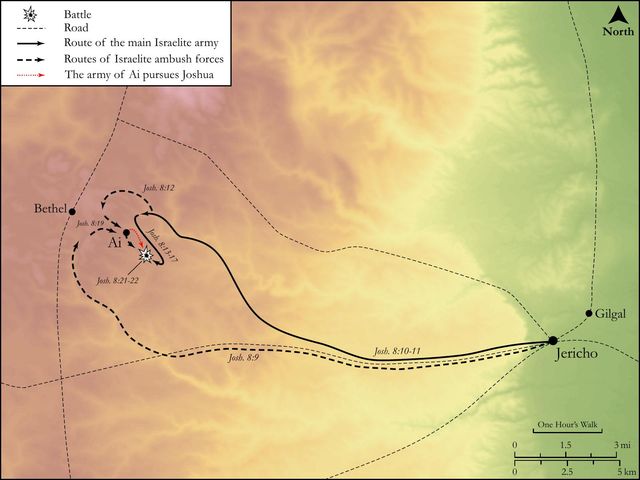
II.Yet the principal parts of the story are plain enough, that a detachment being secretly marched behind the city, on the other side to that on which the main body of the army lay (the situation of the country, it is probable, favouring their concealment), Joshua, and the forces with him, faced the city; the garrison made a vigorous sally out upon them, whereupon they withdrew, gave ground, and retreated in some seeming disorder towards the wilderness, which being perceived by the men of Ai, they drew out all the force they had to pursue them. This gave a fair opportunity for those that lay in ambush to make themselves masters of the city, whereof when they had given notice by a smoke to Joshua, he, with all his force, returned upon the pursuers, who now, when it was too late, were aware of the snare they were drawn into, and, their retreat being intercepted, they were every man of them cut off. The like artifice we find used, Jdg 20:30, etc. Now in this story we may observe,
1.What a brave commander Joshua was. See,
(1.)His conduct and prudence. God gave him the hint (v. 2) that he should lay an ambush behind the city, but left him to himself to order the particulars, which he did admirably well. Doubtless wisdom strengthens the wise more than ten mighty men, Ecc 7:19.
(2.)His care and industry (Jos 8:10): He rose up early in the morning, that he might lose no time, and to show how intent his mind was upon his business. Those that would maintain their spiritual conflicts must not love their ease.
(3.)His courage and resolution; though an army of Israelites had been repulsed before Ai, yet he resolves to lead them on in person the second time, Jos 8:5. Being himself also an elder, he took the elders of Israel with him to make this attack upon the city (Jos 8:10), as if he were going rather to sit in judgment upon them as criminals than to fight them as enemies.
(4.)His caution and consideration (Jos 8:13): He went that night into the midst of the valley, to make the necessary dispositions for an attack, and to see that every thing was in good order. It is the pious conjecture of the learned bishop Patrick that he went into the valley alone, to pray to God for a blessing upon his enterprise, and he did not seek in vain.
(5.)His constancy and perseverance; when he had stretched out his spear towards the city (Jos 8:18, a spear almost as fatal and formidable to the enemies of Israel as the rod of Moses was) he never drew back his hand till the work was done. His hands in fighting, like Moses's in interceding, were steady till the going down of the sun. Those that have stretched out their hands against their spiritual enemies must never draw them back. Lastly, What Joshua did in the stratagem is applicable to our Lord Jesus, of whom he was a type. Joshua conquered by yielding, as if he had himself been conquered; so our Lord Jesus, when he bowed his head and gave up the ghost, seemed as if death and triumphed over him, and as if he and all his interests had been routed and ruined; but in his resurrection he rallied again and gave the powers of darkness a total defeat; he broke the serpent's head, by suffering him to bruise his heel. A glorious stratagem!
2.What an obedient people Israel was. What Joshua commanded them to do, according to the commandment of the Lord (Jos 8:8), they did it without murmuring or disputing. Those that were sent to lie in ambush between Beth-el and Ai (two cities confederate against them) were in a post of danger, and had they been discovered might all have been cut off, and yet they ventured; and, when the body of the army retreated and fled, it was both disgraceful and perilous, and yet, in obedience to Joshua, they did it.
3.What an infatuated enemy the king of Ai was,
(1.)That he did not by his scouts discover those that lay in ambush behind the city, Jos 8:14. Some observe it as a remarkable instance of the power of God in making men blind to their own interest, and the things that belong to their peace, that he wist not that there were liers in wait against him. Those are most in danger who are least aware that they are so.
(2.)That when Israel seemed to fly he drew out all his forces to pursue them, and left none to guard his city and to secure his retreat, Jos 8:17. Thus the church's enemies often run themselves into destruction by their own fury and the violence of their rage against the Israel of God. Pharaoh plunged himself into the Red Sea by the eagerness with which he pursued Israel.
(3.)That from the killing of thirty-six men out of 3000, when Israel made the former attack upon his city, he should infer the total routing of so great an army as now he had to deal with (Jos 8:6): They flee before us as at the first. See how the prosperity of fools destroys them and hardens them to their ruin. God had made use of the men of Ai as a scourge to chastise his people for meddling with the accursed thing, and this had puffed them up with a conceit that they must have the honour of delivering their country from these formidable invaders; but they were soon made to see their mistake, and that when the Israelites had reconciled themselves to their God they could have no power against them. God had made use of them only for the rebuking of Israel, with a purpose, when the correction was over, to throw the rod itself into the fire; howbeit, they meant not so, but it was in their heart to destroy and cut off, Isa 10:5-7.
4.What a complete victory Israel obtained over them by the favour and blessing of God. Each did his part: the divided forces of Israel, by signals agreed on, understood one another, and every thing succeeded according to the project; so that the men of Ai, even when they were most confident of victory, found themselves surrounded, so that they had neither spirit to resist nor room to fly, but were under a fatal necessity of yielding their lives to the destroyers. And now it is hard to say whether the shouts of the men of Israel, or the shrieks of the men of Ai, were the louder, but easy to imagine what terror and confusion they were filled with, when their highest assurances sunk so suddenly into the heaviest despair. Note, The triumphing of the wicked is short, Job 20:5. They are exalted for a little while, that their fall and ruin may be the sorer, Job 24:24. See how easily, how quickly, the scale turns against those that have not God on their side.
Historical interpretation
Historical reception
1 surviving comment on this verse from the historical church.
Inasmuch as God ordered Joshua to plant an ambush in their rear, that is, to plant warriors in hiding to ambush the enemy, we can learn that such treachery is not unjustly carried out by those who wage a just war. Thus, a just man, if he wishes to undertake a just war, ought to think chiefly in these matters about nothing else than whether it is right for him to do so, for it is not lawful for everyone to wage war. However, once he has undertaken a just war, it makes no difference to the justice of the war whether he wins in open warfare or by treachery. However, those just wars ought to be defined as those which avenge injuries, if the tribe or state which is about to be sought in war, either neglected to punish a crime improperly committed by its own countrymen or neglected to repay what had been lost through those injuries. Moreover, without doubt that type of war is just which God commands, since there is no iniquity in him and he knows what ought to be done to each person. In this type of war the general of the army or the people themselves are not to be deemed so much the instigator of the war as much as its agent.Joshua sent thirty thousand warriors to vanquish Ai.… We must consider whether every attempt at deception ought to be reckoned as a lie and, if so, whether a lie can be just, when someone who should be deceived is deceived. And if not even this kind of a lie is found to be just, we must still relate what transpired with the ambush to the truth with some other meaning.
Continue studying Joshua 8:3 across the web’s major study libraries — every link below opens this exact verse, chapter, or book on the destination site.
Read & Compare
 BibleGatewayThis verse in more than 200 translations and 70 languages.
 Bible.comThe YouVersion reader — hundreds of translations, reading plans, and highlights.
 ESV.orgCrossway's official English Standard Version reader.
 NET BibleThe NET translation with 60,000+ translators' notes on every rendering decision.
 STEP BibleTyndale House's free study tool — original text, vocabulary, and scholarly resources.
 BibliaLogos Bible Software's free web reader.
 USCCBThe New American Bible (Revised Edition) with the U.S. bishops' study notes.
Commentaries
 BibleHub CommentariesDozens of classic commentaries on this verse, gathered on one page.
 StudyLightMore than 100 commentary sets — the largest collection on the web.
 BibleRefPlain-English commentary on what this verse means, verse by verse.
 Enduring WordDavid Guzik's free commentary on this chapter, widely used by Bible teachers.
 Bible Study ToolsVerse commentary alongside Greek and Hebrew study aids.
Original Language & Research
- BibleHub InterlinearThe verse word by word — original language, transliteration, and English.
- BibleHub LexiconEvery word's original-language definition and Strong's entry.
 Blue Letter BibleDeep-study tools — Strong's numbers, concordance, and word studies.
 SefariaThe Hebrew text with Rashi and centuries of Jewish commentary.
Sermons, Hymns & Audio


TrulyRandomVerse is not affiliated with these sites and doesn’t control their content. They’re linked because they’re genuinely useful.
Summary
Joshua 8:3 marks the pivotal commencement of Israel's renewed campaign against Ai, showcasing Joshua's immediate and disciplined response to God's specific instructions following the previous defeat. Having addressed the corporate sin of Achan, Joshua meticulously selects a formidable force of thirty thousand elite warriors and dispatches them under the cover of night, thereby laying the strategic groundwork for the divinely orchestrated ambush detailed in the subsequent narrative. This verse underscores a crucial moment of restored leadership, precise military planning, and unwavering pursuit of God's will after a period of national repentance and divine revelation.
Context
ShowHideLiterary Context
Joshua 8:3 immediately follows the resolution of Israel's humiliating defeat at Ai, a narrative meticulously detailed in Joshua 7. The initial failure was not a military miscalculation but a direct consequence of Achan's transgression—taking devoted things from Jericho—which brought divine judgment upon the entire community. After Achan's confession and execution, God mercifully renewed His covenant promises and provided Joshua with a new, detailed strategy for conquering Ai, as explicitly recorded in Joshua 8:1-2. This verse, therefore, signifies the prompt and obedient implementation of God's revised plan, initiating the second, successful military campaign against the city. It stands in stark contrast to the hubris and lack of divine consultation that characterized the first, ill-fated attempt, powerfully underscoring the narrative's central emphasis on absolute obedience to God as the indispensable prerequisite for victory in the conquest of Canaan.
Historical & Cultural Context
The setting for this event is ancient Canaan, a land characterized by numerous fortified city-states. Warfare in this period frequently involved sieges, direct assaults, and, significantly, ambushes—a tactic requiring precision and surprise. The selection of thirty thousand "mighty men of valour" and their deployment "by night" points to a sophisticated military maneuver, characteristic of well-planned tactics designed to achieve overwhelming surprise and strategic advantage. Ai, though smaller than the formidable Jericho, held a crucial strategic location, controlling access to the central highlands. The previous defeat at Ai would have severely impacted Israel's morale and reputation among the Canaanite nations, making this second attempt not merely a military objective but a profound test of their renewed faith and obedience. The concept of herem (devotion to destruction), as outlined in Deuteronomy 7:2-6 and Deuteronomy 20:16-18, was central to Israel's holy war; their failure to adhere to it in Joshua 7 had dire consequences, highlighting the unique, divinely ordained nature of their conquest.
Key Themes
ShowHideThis verse powerfully contributes to several overarching themes woven throughout the book of Joshua. Firstly, it highlights Renewed Obedience and Leadership. Joshua, having diligently addressed the corporate sin, immediately rises to lead, demonstrating a profound commitment to following God's specific, detailed instructions, even after a previous failure. This underscores the vital and unbreakable link between obedience and divine blessing. Secondly, it exemplifies Strategic Warfare guided by God. Unlike the first, ill-fated attack, this assault is meticulously planned, involving a large, elite force and a precise nighttime deployment, foreshadowing the complex ambush strategy detailed throughout Joshua 8. This showcases God's active involvement in providing not just the command but also the tactical wisdom necessary for victory. Thirdly, the verse implicitly speaks to Divine Second Chances and Grace. Despite Israel's previous failure and the severe consequences of Achan's sin, God, in His unwavering faithfulness to His covenant, provides a clear path to victory, emphasizing His willingness to restore and empower His people when they genuinely repent and obey. This theme resonates deeply with God's enduring patience and His steadfast commitment to His promises.
Exposition and Analysis
ShowHideKey Word Analysis
ShowHideThis verb (H6965) signifies more than simply standing up; it denotes a decisive, immediate, and purposeful action. In biblical narrative, "arose" frequently indicates a significant shift in activity, a readiness to embark on a new phase, or an intentional response to a divine command. Here, it profoundly underscores Joshua's prompt and resolute obedience to God's detailed instructions given in Joshua 8:1-2, marking the crucial transition from a period of repentance and strategic planning to the active execution of the military campaign.
This is a significant compound phrase, combining H1368 (gibbôwr) and H2428 (chayil). Gibbôwr denotes a powerful, strong, or valiant person, often specifically a warrior or hero. Chayil can encompass strength, wealth, capability, or an army/force, also implying valor and worthiness. Together, "gibbôwr chayil" describes individuals of proven strength, courage, substance, and exceptional military prowess. It implies not just physical might but also moral fortitude, strategic competence, and a track record of effectiveness. Joshua specifically chose Israel's elite, most capable, and experienced fighters for this critical and complex mission, indicating the seriousness and strategic nature of the second assault on Ai. This term is used elsewhere to describe prominent figures like Gideon (Judges 6:12) and David's elite warriors (2 Samuel 23:8).
The specific mention of the nighttime operation (H3915) is crucial for understanding the tactical genius behind God's plan. Operating under the cover of darkness allowed for absolute secrecy, the element of surprise, and the strategic positioning of the ambush force without detection. This element of stealth was vital for the success of the multi-pronged attack that would unfold, ensuring the element of surprise against the unsuspecting inhabitants of Ai and enabling the intricate maneuver described in the subsequent verses.
Verse Breakdown
ShowHide"So Joshua arose"
This phrase emphatically highlights Joshua's immediate and decisive leadership. Following the spiritual cleansing of Israel and the reception of God's renewed, detailed instructions, Joshua demonstrates no hesitation but promptly takes action, thereby exemplifying his unwavering commitment to God's will and his crucial role as Israel's appointed military commander.
"and all the people of war, to go up against Ai"
This indicates a unified, corporate movement and a renewed determination within the Israelite forces. While Joshua provides the leadership, the entire fighting contingent is united in purpose, prepared to engage in the battle. The phrase "people of war" clearly signifies their readiness for conflict, standing in sharp contrast to their previously demoralized and defeated state.
"and Joshua chose out thirty thousand mighty men of valour"
This clause underscores Joshua's meticulous strategic planning and the exceptional quality of the chosen force. The number thirty thousand is substantial, indicating a significant commitment of military resources and a force large enough to execute a complex ambush effectively. The deliberate selection of "mighty men of valour" emphasizes the paramount importance of skill, courage, and proven experience for this critical and intricate mission.
"and sent them away by night"
This final phrase reveals the tactical brilliance inherent in the operation. The nighttime deployment was absolutely essential for maintaining secrecy and achieving surprise, allowing the main ambush force to position themselves behind Ai undetected. This stealthy maneuver was a crucial component of the strategy detailed in the subsequent verses, speaking to the precision and forethought involved in this divinely guided military campaign.
Literary Devices
ShowHideJoshua 8:3 skillfully employs several literary devices to convey its profound meaning and propel the narrative forward. Narrative Progression is immediately evident as the verse swiftly transitions the story from the resolution of Achan's sin in Joshua 7 to the active execution of the new military campaign. This immediate action creates a palpable sense of renewed momentum and divine purpose. Foreshadowing is subtly woven into the details, particularly the mention of "thirty thousand mighty men of valour" and their deployment "by night." These specific details hint at the complex and large-scale ambush strategy that will meticulously unfold in the remainder of Joshua 8, building anticipation for the reader. There is also an implicit Contrast with the previous, failed attack on Ai, which involved a smaller, overconfident force (Joshua 7:3-5). The meticulous planning, the substantial numbers, and the elite nature of the force in this verse powerfully highlight the lessons learned and Israel's renewed reliance on divine strategy rather than human presumption. Finally, the repeated mention of "Joshua" and his active, decisive role ("Joshua arose," "Joshua chose," "sent them") serves as a clear Emphasis on his leadership and unwavering obedience, positioning him as the central human figure through whom God's will is faithfully executed.
Theological and Thematic Connections
ShowHideJoshua 8:3 stands as a powerful testament to God's redemptive grace and His unwavering commitment to His covenant people, even in the aftermath of their profound failures. It underscores the profound truth that while sin inevitably brings severe consequences, genuine repentance and renewed obedience unfailingly open the door for God's continued blessing and strategic guidance. The meticulous planning and the deliberate selection of "mighty men of valour" demonstrate that divine sovereignty does not negate human responsibility or diligent effort; rather, God often works through and powerfully empowers human agency when it is aligned with His perfect will. This verse illustrates that God is not only the God of overwhelming, miraculous power (as spectacularly seen at Jericho) but also the God of wise, intricate strategy, who provides the perfect plan for every situation, even when it requires complex human execution. It speaks deeply to the importance of learning from past mistakes, humbly seeking God's specific direction, and moving forward in steadfast faith and obedience, trusting implicitly that His presence and wisdom are the true, ultimate keys to enduring victory.
Reflection and Application
ShowHideJoshua 8:3 offers profound and enduring lessons for believers navigating challenges and setbacks in their own lives. Just as Israel learned from the painful and humiliating defeat at Ai, we too are called to critically examine our failures, identify areas of disobedience or unconfessed sin, and turn back to God in genuine repentance. This verse serves as a powerful reminder that God is indeed a God of second chances; He does not abandon us in our failures but graciously provides a clear path forward when we humble ourselves and earnestly seek His divine guidance. Joshua's diligent selection of "mighty men of valour" and his strategic nighttime deployment teach us that while divine power is absolutely paramount, God often calls us to thoughtful planning, meticulous preparation, and diligent effort in pursuing the goals He sets before us. Our faith should never lead to presumption or spiritual laziness, but rather to active, Spirit-led strategy and dedicated hard work. We are called to be both prayerful and practical, trusting God implicitly for the outcome while faithfully stewarding the resources and wisdom He graciously provides. This verse profoundly encourages us to rise up in renewed obedience, even after significant setbacks, confident that God's detailed instructions and empowering presence will ultimately lead us to victory in our spiritual battles and all of life's endeavors.
Questions for Reflection
ShowHideFAQ
ShowHideWhy did Joshua need 30,000 men for Ai, a smaller city, especially after Jericho fell with seemingly less military effort?
ShowHideThe need for 30,000 men for Ai, a city considerably smaller than Jericho, highlights a crucial shift in God's strategy and the profound lessons learned from the previous defeat. Jericho fell by miraculous divine intervention, not conventional military might, emphasizing God's overwhelming power and Israel's absolute obedience to a unique, non-military command (Joshua 6). However, the first attempt on Ai failed due to Achan's sin, not a lack of force, but because God's blessing was withheld and His presence withdrawn (Joshua 7). For the second attempt, God provided a military strategy involving a complex ambush (Joshua 8:1-2). This intricate plan required a substantial force to execute the feigned retreat and the subsequent ambush effectively. The 30,000 men were not intended for a direct, frontal assault but for a sophisticated strategic maneuver, including a large decoy force to draw out the enemy and a hidden ambush party, ensuring overwhelming numerical superiority at the critical moment. This demonstrates God's willingness to utilize conventional military tactics when aligned with His will, requiring significant human effort and strategic planning.
What is the significance of Joshua sending the men "by night"?
ShowHideSending the men "by night" was an absolutely critical tactical element of God's divinely inspired strategy for conquering Ai. This nighttime deployment allowed for paramount secrecy and the crucial element of surprise. The main ambush force could move into position behind the city under the impenetrable cover of darkness, completely undetected by the unsuspecting inhabitants of Ai. This ensured that when the smaller decoy force later drew the men of Ai out of their city, the ambush force was already perfectly positioned to enter the undefended city and set it ablaze (Joshua 8:9-17). The nighttime deployment was therefore essential for the flawless execution of the feigned retreat and the overall ambush plan, powerfully demonstrating the meticulous detail and strategic brilliance of God's guidance.
How does this verse show God's grace or "second chances" for Israel?
ShowHideThis verse powerfully illustrates God's profound grace and His provision of "second chances" for Israel. After the devastating and humiliating defeat at Ai in Joshua 7 due to Achan's sin, the entire nation faced a severe setback in their conquest of Canaan. Yet, immediately after Achan's judgment and Israel's corporate repentance, God did not abandon them in their failure. Instead, He graciously renewed His covenant promises and provided a fresh, detailed strategy for conquering Ai (Joshua 8:1-2). Joshua 8:3 then shows Joshua's immediate and obedient response to this renewed divine command. This sequence powerfully demonstrates God's unwavering faithfulness to His covenant, His boundless willingness to forgive and restore His people, and His steadfast commitment to bringing them into their promised inheritance, even after their failures, provided they return to Him in humble obedience.
Christ-Centered Fulfillment
ShowHideJoshua 8:3, with Joshua's renewed leadership and the strategic deployment of "mighty men of valour" for a decisive victory, powerfully foreshadows the ultimate conquest achieved by Jesus Christ. Joshua, serving as a significant type of Christ, leads his people into the promised land, overcoming formidable obstacles through divine strategy and unwavering obedient action. Just as Joshua rose to lead after Israel's profound failure, so Christ, the greater Joshua (Hebrews 4:8-10), arose victoriously from the grave, having dealt decisively and completely with the sin that plagued all humanity. The battle against Ai, with its meticulous planning and the sending forth of a chosen, elite force, profoundly mirrors Christ's strategic triumph over the spiritual forces of darkness. His ultimate "victory" was not a conventional military one, but a conquest over all things achieved through His perfect obedience, His sacrificial death on the cross, and His glorious resurrection. Through this divine strategy, Christ disarmed principalities and powers, triumphing over them in His cross (Colossians 2:15). He is the ultimate "mighty man of valour" who, by His own inherent strength and divine wisdom, conquered sin, death, and the world itself (John 16:33). Our spiritual victory and eternal inheritance are not achieved by our own strength or cleverness, but by being united with Christ, who has already secured the decisive and eternal triumph, enabling us to be "more than conquerors through him that loved us" (Romans 8:37).