


Old Testament · History · Book 6 of 66
Joshua
Joshua leads Israel over Jordan into the land sworn to their fathers, defeats its kings, divides it among the tribes by lot, and renews the covenant.
- 24 chapters
- 658 verses
- About 86 minutes to read
- Conquest of Canaan, c. 1406–1380 BC
Joshua opens on the death of Moses and a command: “now therefore arise, go over this Jordan” (Joshua 1:2). The land sworn to Abraham, Isaac and Jacob, refused by the generation that came out of Egypt, is now given to their children. Israel crosses on dry ground, Jericho falls at a shout, the kings of the south and north are defeated, and the land is divided by lot. When the dividing is done the book gives its own verdict: “There failed not ought of any good thing which the LORD had spoken unto the house of Israel; all came to pass” (21:45).
The conquest is told as judgment as well as gift. Abram was told his seed would return when “the iniquity of the Amorites” was full (Genesis 15:16), and the judgment that fell on Jericho fell as hard on Achan of Judah (7:1). Rahab of Jericho, who confessed that “the LORD your God, he is God in heaven above, and in earth beneath” (2:11), was spared with her household. The book ends at Shechem with a covenant and a choice: “choose you this day whom ye will serve” (24:15).
There failed not ought of any good thing which the LORD had spoken unto the house of Israel; all came to pass.
Joshua 21:45 KJV
Before you read
- Who wrote it
- Traditionally Joshua. The book records that he “wrote these words in the book of the law of God” at Shechem (Joshua 24:26). The account of his death and burial that follows (24:29–33) was added by another hand.
- When it was written
- Within a lifetime of the events: Rahab “dwelleth in Israel even unto this day” (Joshua 6:25). The Jebusites still dwelt at Jerusalem (15:63), as they did until David took the strong hold of Zion (2 Samuel 5:7).
- When it happens
- From Moses’ death (Joshua 1:1) to Joshua’s, at a hundred and ten (24:29). The wars took “a long time” (11:18): Caleb was forty at Kadeshbarnea and eighty-five when he claimed Hebron (14:7–10), and thirty-eight of those years were spent in the wilderness (Deuteronomy 2:14), leaving about seven.
- Where
- Canaan west of the Jordan, with the land Moses had already given east of it (Joshua 13:8). Israel camped at Gilgal (4:19), set up the tabernacle at Shiloh (18:1), and renewed the covenant at Shechem (24:1).
How Joshua is laid out
8 movements · 102 passages · 658 verses
The charge and the spies
Chapters 1–2 · 42 verses
After Moses’ death the LORD charges Joshua to lead Israel over Jordan, to be strong and of a good courage, and to keep the book of the law day and night. The eastern tribes pledge to cross armed with their brethren. Two spies lodge with Rahab in Jericho. She hides them, confesses the LORD as God of heaven and earth, and binds the scarlet line in her window.
8 passages
- 1:1–9 God Commissions Joshua
- 1:10–11 Joshua Commands Preparation for Crossing
- 1:12–15 Joshua Addresses the Transjordan Tribes
- 1:16–18 The People Pledge Obedience
- 2:1–7 Joshua Sends Spies to Jericho
- 2:8–16 Rahab's Confession and Covenant Request
- 2:17–21 Conditions of the Covenant
- 2:22–24 The Spies Return and Report
Over Jordan to Gilgal
Chapters 3–5 · 56 verses
The priests bear the ark into Jordan at harvest, when it overflows its banks. The waters stand up in a heap and Israel passes over on dry ground. Twelve stones are set up at Gilgal for the children to ask about. The new generation is circumcised and keeps the passover, the manna ceases, and the captain of the LORD’s host meets Joshua.
10 passages
- 3:1–6 Preparation and Logistics at the Jordan
- 3:7–13 God Magnifies Joshua’s Authority
- 3:14–17 Crossing the Jordan
- 4:1–9 The Command to Build a Memorial
- 4:10–14 Completion of the Crossing
- 4:15–18 The Waters Return
- 4:19–24 The Memorial at Gilgal
- 5:1–9 The Kings’ Fear and the Circumcision at Gilgal
- 5:10–12 Passover Observed and Manna Ceases
- 5:13–15 Joshua Meets the Commander of the Lord's Army
Jericho, Achan and Ai
Chapters 6–8 · 88 verses
Israel compasses Jericho seven days, and at the trumpets and the great shout its wall falls flat. The city is devoted to the LORD; Rahab’s household alone is saved. Achan takes of the accursed thing, and Israel flees before Ai until he is taken by lot and stoned. Ai falls to an ambush, and the law is written on stones at mount Ebal and read to all Israel.
13 passages
- 6:1–5 God Commands the Siege of Jericho
- 6:6–14 Obedience and the Daily March
- 6:15–21 The Walls Fall and the City Is Destroyed
- 6:22–25 Rahab and Her Family Are Saved
- 6:26–27 Joshua's Curse and Fame
- 7:1–5 Achan's Sin and Defeat at Ai
- 7:6–9 Joshua's Lament and Intercession
- 7:10–15 God Reveals the Sin and Commands Action
- 7:16–26 The Identification and Confession of Achan
- 8:1–9 God Commands the Strategy for Ai
- 8:10–17 Israel Deploys the Ambush
- 8:18–29 The Defeat and Destruction of Ai
- 8:30–35 Covenant Renewal at Mount Ebal
The kings of the land
Chapters 9–12 · 117 verses
The Gibeonites win a league by deceit, because Israel’s leaders “asked not counsel at the mouth of the LORD,” and are made hewers of wood. Five kings attack Gibeon; the LORD casts down great stones and the sun stands still upon Gibeon. The southern cities fall, then Jabin’s northern league at the waters of Merom. Chapter 12 lists the kings smitten, thirty-one west of Jordan.
17 passages
- 9:1–2 The Kings Unite Against Israel
- 9:3–15 The Gibeonites Seek a Treaty Through Deception
- 9:16–21 The Deception Is Discovered
- 9:22–27 The Gibeonite Servitude
- 10:1–6 Five Kings Attack Gibeon
- 10:7–11 Joshua Marches to Gibeon
- 10:12–15 The Sun Stands Still
- 10:16–27 Execution of the Five Kings
- 10:28–39 Conquest of Southern Cities
- 10:40–43 Summary of the Southern Campaign
- 11:1–5 The Northern Coalition Assembles
- 11:6–9 God Commands the Destruction of War Assets
- 11:10–14 The Destruction of Hazor
- 11:15–20 Summary of Conquest and Obedience
- 11:21–23 The Conquest of the Anakim and Conclusion
- 12:1–6 Kings Defeated East of the Jordan
- 12:7–24 Kings Defeated West of the Jordan
The land divided by lot
Chapters 13–19 · 218 verses
Joshua is old and much land remains, yet he is to divide it all. The eastern tribes’ portions from Moses are recorded, and Caleb at eighty-five claims Hebron. Judah and Joseph receive theirs, though some Canaanites are not driven out. The tabernacle is set up at Shiloh, the last seven tribes receive their lots there, and Joshua takes Timnathserah last.
Refuge and the Levites’ cities
Chapters 20–21 · 54 verses
Six cities of refuge are appointed, three on each side of Jordan, where one who kills unawares may flee and dwell until the death of the high priest. The Levites, who have no inheritance of land, receive forty-eight cities with their suburbs. The section closes on the LORD’s faithfulness: he gave the land, gave rest round about, and not one good thing failed.
10 passages
- 20:1–6 The Command to Establish Cities of Refuge
- 20:7–9 Designation of the Six Cities
- 21:1–3 The Levites Request Their Cities
- 21:4–8 Distribution Summary by Clan
- 21:9–19 Cities for the Priests (Sons of Aaron)
- 21:20–26 Cities for the Remaining Kohathites
- 21:27–33 Cities for the Gershonites
- 21:34–40 Cities for the Merarites
- 21:41–42 Summary of the Levitical Cities
- 21:43–45 Fulfillment of God’s Promises
The altar by Jordan
Chapter 22 · 34 verses
Joshua sends Reuben, Gad and half Manasseh home across Jordan with his blessing. They build a great altar by the river, and the other tribes gather at Shiloh to go to war against them. Phinehas leads ten princes to them; the eastern tribes answer that it is a witness, not an altar for sacrifice, and the matter is settled. They call it Ed.
Choose you this day
Chapters 23–24 · 49 verses
Old and near death, Joshua charges Israel’s leaders to cleave to the LORD and not to mingle with the nations left among them. At Shechem he recounts the LORD’s deeds from Terah and Abraham to the conquest, and calls the people to choose whom they will serve. They choose the LORD; he writes the covenant and sets up a great stone. Joshua, Joseph’s bones and Eleazar are buried.
9 passages
- 23:1–5 Joshua Gathers Israel’s Leaders
- 23:6–10 Exhortation to Complete Obedience
- 23:11–13 Warning Against Apostasy and Intermarriage
- 23:14–16 Joshua’s Final Testimony and Covenant Warning
- 24:1–13 Joshua Assembles Israel at Shechem
- 24:14–18 We Will Serve the Lord
- 24:19–24 The People's Vow and Joshua's Warning
- 24:25–28 The Covenant Is Ratified
- 24:29–33 The Deaths of Joshua and Eleazar
The words Joshua turns on
Pass over fills chapters 3–4, accursed thing 6–7 and fight chapter 10; lot and inheritance run through 13–21, and serve fills chapter 24.
- עָבַר ʻâbarpass over, cross; go through49 verses
- חֵרֶם chêrema thing devoted to the LORD for destruction; accursed thing8 verses
- לָחַם lâchamfight, make war17 verses
- גּוֹרָל gôwrâllot; a portion assigned by lot24 verses
- נַחֲלָה nachălâhinheritance, possession, portion43 verses
- עָבַד ʻâbadserve, worship; work16 verses
What Joshua teaches
nachălâh · inheritance
An inheritance by lot
The land is an inheritance, a gift: Israel “got not the land in possession by their own sword” (Psalm 44:3). The tribes receive their portions by lot, cast “before the LORD” at Shiloh (18:10), so each border is his assignment. Levi receives no land, for “the LORD God of Israel was their inheritance” (13:33). The book says both that “the LORD gave unto Israel all the land which he sware to give unto their fathers” (21:43) and that “there remaineth yet very much land to be possessed” (13:1). Moses had said the nations would be put out “by little and little” (Deuteronomy 7:22). The gift was whole; taking hold of it was Israel’s part, and Joshua asks the tribes that hang back, “How long are ye slack to go to possess the land” (18:3).
chêrem · accursed thing
The accursed thing
Jericho was “accursed, even it, and all that are therein, to the LORD” (6:17): devoted wholly to him, its people to destruction and its silver and gold to his treasury. Moses had told Israel why: “Not for thy righteousness” but “for the wickedness of these nations” (Deuteronomy 9:5), and Israel was warned that the land would spue it out as well if it did the same (Leviticus 18:28). Nor did the judgment spare Israel. When Achan of Judah took of the accursed thing, the LORD said, “Israel hath sinned” (7:11), and Israel fled before Ai until the sin was put away. Rahab, inside the devoted city, believed and was spared, and Gibeon, alone in making peace, was spared too (11:19).
lâcham · fight
The LORD fought for Israel
The book gives one reason for every victory: “the LORD God of Israel fought for Israel” (10:42). The Jordan stood in a heap, Jericho’s wall fell flat, hailstones killed more at Bethhoron than the sword did (10:11), and the sun “hasted not to go down about a whole day” (10:13). Before the first battle, a man with a drawn sword met Joshua by Jericho as “captain of the host of the LORD” (5:14). John Damascene held that Joshua bowed in veneration before an angel of God
. Origen held that Joshua knew him as God, or he would not have worshipped: For who else is chief of the army of the powers of God except our Lord Jesus Christ?
The command to loose his shoe repeats the word to Moses at the bush (5:15; Exodus 3:5).
ʻâbad · serve
Choose you this day
At Shechem Joshua recounts what the LORD has done, from Terah, who “served other gods” beyond the flood (24:2), to cities Israel did not build, and draws the conclusion: “Now therefore fear the LORD, and serve him in sincerity and in truth” (24:14). When the people promise to serve the LORD, he answers, “Ye cannot serve the LORD: for he is an holy God; he is a jealous God” (24:19). He sets the cost before them, and they bind themselves again: “The LORD our God will we serve, and his voice will we obey” (24:24). The book records that “Israel served the LORD all the days of Joshua, and all the days of the elders that overlived Joshua” (24:31). Judges turns to the generation after, “which knew not the LORD” (Judges 2:10).
Christ in Joshua
Moses gave Joshua his name: “Moses called Oshea the son of Nun Jehoshua” (Numbers 13:16), and in Greek that name is Jesus. Stephen says the tabernacle was “brought in with Jesus into the possession of the Gentiles” (Acts 7:45), and Hebrews reasons, “For if Jesus had given them rest, then would he not afterward have spoken of another day” (Hebrews 4:8). Both mean Joshua. The LORD did give Israel rest in his day (Joshua 21:44), but long after, David still said “To day” (Hebrews 4:7), so “There remaineth therefore a rest to the people of God” (4:9). Chrysostom set the two side by side: He brought in the people into the promised land, as Jesus into heaven
, which Moses did not, for The law has not power to bring in, but grace.
Rahab of Jericho is in the line of Christ: “Salmon begat Booz of Rachab” (Matthew 1:5). Hebrews names her faith: she “perished not with them that believed not” (Hebrews 11:31), and James her works, “when she had received the messengers” (James 2:25). A woman of the devoted city was saved and set in the Messiah’s line.
People
By how many verses name them
- JoshuaA son of Nun151
- MosesSon of Amram and Jochebed; a brother of Aaron and Miriam; husband of Zipporah51
- NunA son of Elishama; father of Joshua10
- CalebSon of Jephunneh; a brother of Kenaz; father of Achsah, Iru, Elah, Naam9
- EleazarSon of Aaron and Elisheba; a brother of Nadab, Abihu and Ithamar8
- Sihon7
- AaronSon of Amram and Jochebed; a brother of Moses and Miriam; husband of Elisheba6
- AchanA son of Carmi6
70 more are named.
Places
416 named
- JordanCrossed on dry ground while its waters stood in a heap58
- AiIsrael fled before it for Achan’s sin, then took it by ambush27
- JerichoIts wall fell at the shout; only Rahab’s household was saved26
- HebronCaleb’s inheritance at eighty-five, and a city of refuge15
- Egypt14
- Gilead14
- Bashan13
- GibeonWon a league by deceit; Joshua fought for it against five kings13
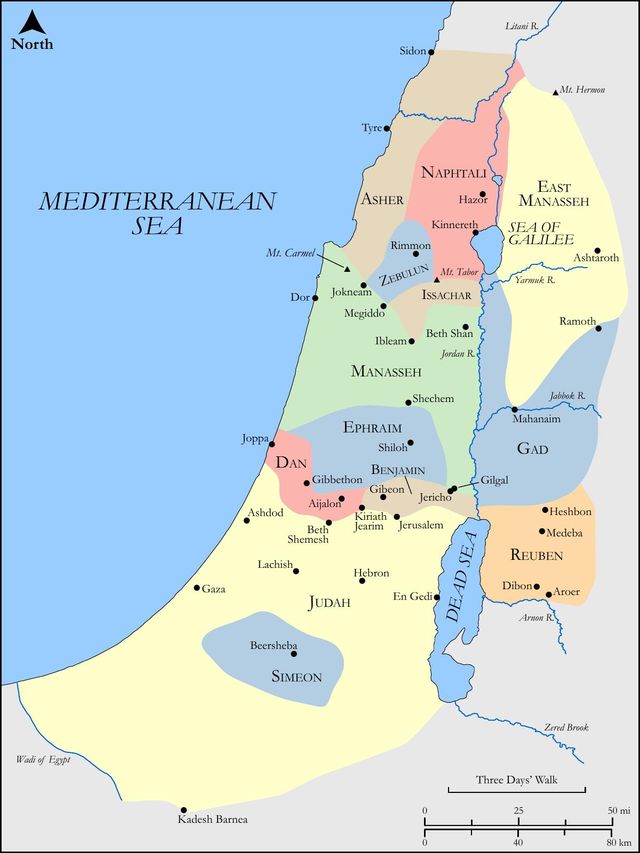
Where Joshua reaches
The passages it leans on, and the ones that lean on it
Deuteronomy 31:6 Joshua 1:5 Hebrews 13:5
“I will not fail thee, nor forsake thee”: Moses’ word to Israel, God’s to Joshua, and Hebrews’ to every believer.
Israel passes through on dry ground twice: the Red sea out of Egypt, the Jordan into the land.
Joshua 2:1 Hebrews 11:31 James 2:25
Rahab receives the spies: Hebrews counts it her faith, James her works.
Joshua’s curse on whoever rebuilt Jericho, fulfilled on Hiel’s two sons “according to the word of the LORD.”
Genesis 13:15 Joshua 21:43–45 1 Kings 8:56
The land promised to Abram is given; at the temple Solomon says again that not one word had failed.
Books Joshua links to most
The Church Fathers on Joshua
235 quotations from 38 writers before AD 800 · the ten most quoted, in date order
- Tertullian220
- Origen253
- Gregory395
- Ambrose397
- Chrysostom407
- Jerome420
- Augustine430
- Paulinus431
- Maximus465
- John Damascene749
Clement of Rome read Rahab’s scarlet thread as prophecy of redemption by the Lord’s blood.
And moreover they gave her a sign, that she should hang out from her house a scarlet thread, thereby showing beforehand that through the blood of the Lord there shall be redemption for all them that believe and hope on God. You see, dearly beloved, not only faith, but prophecy, is found in the woman.
Cyril of Jerusalem traced Joshua as a type of Christ, beginning from the Jordan.
But Jesus [Joshua], son of Nave [Nun], was a type of him in many things; for when he began to rule the people, he began from the Jordan; thence also did Christ begin to preach the gospel after he was baptized.
Augustine took the sun’s standing still as history, and reasoned from it about the nature of time.
Let no one tell me, therefore, that the motions of the heavenly bodies constitute time. For when the sun stood still at the prayer of a certain man in order that he might gain his victory in battle, the sun stood still but time went on. For in as long a span of time as was sufficient the battle was fought and ended.I see, then, that time is a certain kind of extension.
Jerome read the manslayer’s wait for the high priest’s death as a figure of redemption.
… the wood hewer is ordered to flee to a city of refuge and remain in that place until the death of the high priest, that is to say, until he is redeemed by the blood of the Savior …
Keep studying
Articles