


Joshua 11:18
- יָמִיםya·MimdaysH3117N-mpNoun Plural Masculine Absolute
- רַבִּיםra·BimmanyH7227Adj-mpAdjective Plural Masculine Absolute
- עָשָׂה'a·Sahhe didH6213V-Qal-Perf-3msVerb Qal Perfect 3rd Singular Masculine
- יְהוֹשֻׁעַye·ho·Shu·a'JoshuaH3091N-proper-mNoun Proper Masculine
- אֶת'etwithH854PrepPreposition
- כָּלkolallH3605N-mscNoun Singular Masculine Construct
- הַמְּלָכִיםha·me·la·Khimthe kingsH4428Art ¦ N-mpNoun Plural Masculine Absoluteהַtheמְּלָכִיםkings
- הָאֵלֶּהha·'E·leh<the> theseH428Art ¦ PrtParticle Demonstrativeהָ<the>אֵלֶּהthese
- מִלְחָמָהmil·cha·MahbattleH4421N-fsNoun Singular Feminine Absolute
English is a literal word-by-word gloss of the Hebrew, not the KJV's wording. Why?
This is the original text the KJV's translators worked from — each Hebrew word with its own literal English meaning in this verse, prepared by scholars at Tyndale House, Cambridge. The KJV translates whole sentences, not word by word, so its wording differs: one Hebrew word can become several English words, and the KJV may choose “the LORD” where the gloss reads “Yahweh”. Both are faithful — they answer different questions. For the KJV's own rendering, switch to the KJV text.
Details
See on the biblical-era map
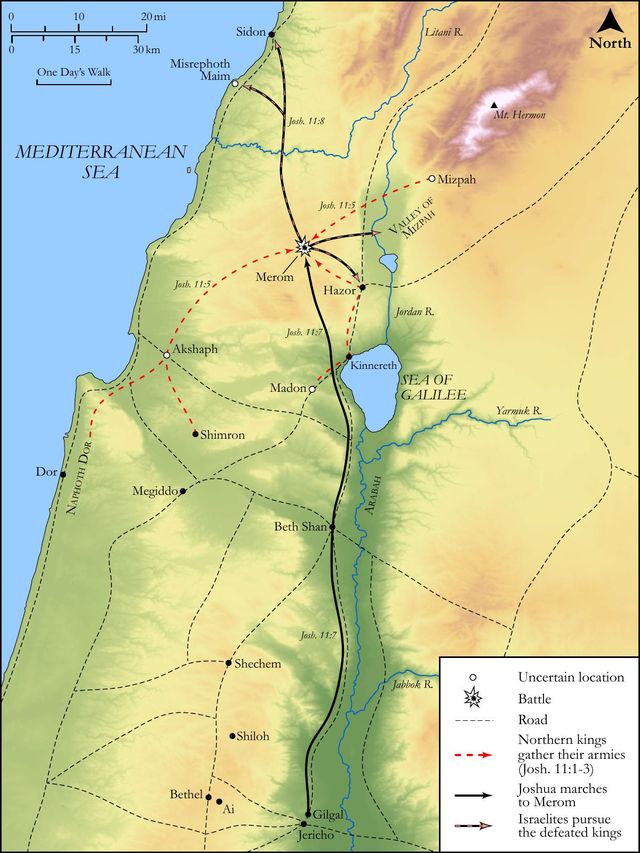
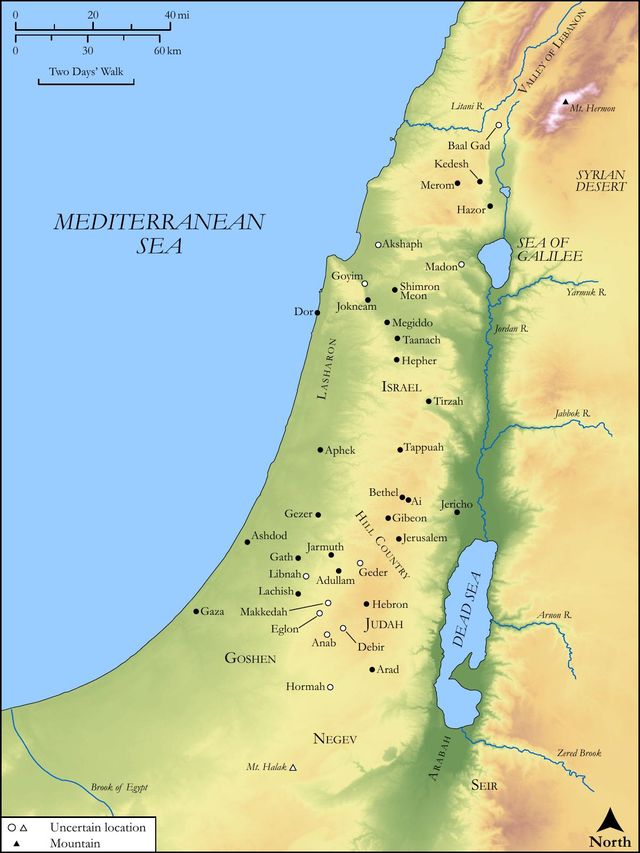
Study this verse
Public-domain commentary
Matthew Henry
From his Commentary on the Whole Bible. Henry comments on passages, not single verses — this entry covers Joshua 11:15–23. His two-level outline is real structure in the source text, so it is rendered as structure.
We have here the conclusion of this whole matter.
I.A short account is here given of what was done in four things:
- 1. The obstinacy of the Canaanites in their opposition to the Israelites. It was strange that though it appeared so manifestly that God fought for Israel, and in every engagement the Canaanites had the worst of it, yet they stood it out to the last; not one city made peace with Israel, but the Gibeonites only, who understood the things that belonged to their peace better than their neighbours, Jos 11:19. It is intimated that other cities might have made as good terms for themselves, without ragged clothes and clouted shoes, if they would have humbled themselves, but they never so much as desired conditions of peace. We here are told whence this unaccountable infatuation came: It was of the Lord to harden their hearts, Jos 11:20. As Pharaoh's heart was hardened by his own pride and wilfulness first, and afterwards by the righteous judgment of God, to his destruction, so were the hearts of these Canaanites. To punish them for all their other follies, God left them to this, to make those their enemies whom they might have made their friends. This was it that ruined them: they came against Israel in battle, and gave the first blow, and therefore might have no favour shown them. Those know not what they do who give the provocation to divine justice, or the authorized instruments of it. Are we stronger than God? Observe here, That hardness of heart is the ruin of sinners. Those that are stupid and secure, and heedless of divine warnings, are already marked for destruction. What hope is there of those concerning whom God has said, Go, make their hearts fat? 2. The constancy of the Israelites in prosecuting this war (Jos 11:18): Joshua made war a long time; some reckon it five years, others seven, that were spent in subduing this land: so long God would train up Israel to war, and give them repeated instances of his power and goodness in every new victory that he gave them. 3. The conquest of the Anakim at last, Jos 11:21, Jos 11:22. Either this was done as they met with them where they were dispersed, as some think, or rather it should seem the Anakim had retired to their fastnesses, and so were hunted out and cut off at last, after all the rest of Israel's enemies. The mountains of Judah and Israel were the habitations of those mountains of men; but not their height, nor the strength of their caves, nor the difficulty of the passes to them, could secure, no, not these mighty men, from the sword of Joshua. The cutting off of the sons of Anak is particularly mentioned because these had been such a terror to the spies forty years before, and their bulk and strength had been thought an insuperable difficulty in the way of the reducing of Canaan, Num 13:28, Num 13:33. Even that opposition which seemed invincible was got over. Never let the sons of Anak be a terror to the Israel of God, for even their day will come to fall. Giants are dwarfs to Omnipotence; yet this struggle with the Anakim was reserved for the latter end of the war, when the Israelites had become more expert in the arts of war, and had had more experience of the power and goodness of God. Note, God sometimes reserves the sharpest trials of his people by affliction and temptation for the latter end of their days. Therefore let not him that girds on the harness boast as he that puts it off. Death, that tremendous son of Anak, is the last enemy that is to be encountered; but it is to be destroyed, Co1 15:26. Thanks be to God, who will give us the victory. 4. The end and issue of this long war. The Canaanites were rooted out, not perfectly (as we shall find after in the book of Judges), but in a good measure; they were not able to make any head either, (1.) So as to keep the Israelites out of possession of the land: Joshua took all that land, Jos 11:16, Jos 11:17. And we may suppose the people dispersed themselves and their families into the countries they had conquered, at least those that lay nearest to the head-quarters at Gilgal, until an orderly distribution should be made by lot, that every man might know his own. Or, (2.) So as to keep them in action, or give them any molestation (Jos 11:23): The land rested from war. It ended not in a peace with the Canaanites (that was forbidden), but in a peace from them. There is a rest, a rest from war, remaining for the people of God, into which they shall enter when their warfare is accomplished.
II.That which was now done is here compared with that which had been said to Moses.
God's word and his works, if viewed and considered together, will mutually illustrate each other. It is here observed in the close,
1.That all the precepts God had given to Moses relating to the conquest of Canaan were obeyed on the people's part, at least while Joshua lived. See how solemnly this is remarked (Jos 11:15): As the Lord commanded Moses his servant, by whose hand the law was given, so did Moses command Joshua, for Moses was faithful, as a law-giver, to him that appointed him; he did his part, and then he died: but were the commands of Moses observed when he was in his grave? Yes, they were: So did Joshua, who was, in his place, as faithful as Moses in his. He left nothing undone (Heb. he removed nothing) of all that the Lord commanded Moses. Those that leave their duty undone do what they can to remove or make void the command of God, by which they are bound to do it; but Joshua, by performing the precept, confirmed it, as the expression is, Deu 27:26. Joshua was himself a great commander, and yet nothing was more his praise than his obedience. Those that rule others at their will must themselves be ruled by the divine will; then their power is indeed their honour, and not otherwise. The pious obedience for which Joshua is here commended respects especially the command to destroy the Canaanites, and to break down their altars and burn their images, Deu 7:2-5; Exo 23:24; Exo 34:13. Joshua, in his zeal for the Lord of hosts, spared neither the idols nor the idolaters. Saul's disobedience, or rather his partial obedience, to the command of God, for the utter destruction of the Amalekites, cost him his kingdom. It should seem Joshua himself gives this account of his most careful and punctual observance of his orders in the execution of his commission, that in all respects he had done as Moses commanded him; and then it intimates that he had more pleasure and satisfaction in reflecting upon his obedience to the commands of God in all this war, and valued himself more upon that, than upon all the gains and triumphs with which he was enriched and advanced.
2.That all the promises God had given to Moses relating to this conquest were accomplished on his part, Jos 11:23. Joshua took the whole land, conquered it, and took possession of it, according to all that the Lord said unto Moses. God had promised to drive out the nations before them (Exo 33:2; Exo 34:11), and to bring them down, Deu 9:3. And now it was done. There failed not one word of the promise. Our successes and enjoyments are then doubly sweet and comfortable to us when we see them flowing to us from the promise (this is according to what the Lord said), as our obedience is then acceptable to God when it has an eye to the precept. And, if we make conscience of our duty, we need not question the performance of the promise.
Historical interpretation
Historical reception
1 surviving comment on this verse from the historical church.
A long time: Seven years, as appears from chap. 14. 10.
Continue studying Joshua 11:18 across the web’s major study libraries — every link below opens this exact verse, chapter, or book on the destination site.
Read & Compare
 BibleGatewayThis verse in more than 200 translations and 70 languages.
 Bible.comThe YouVersion reader — hundreds of translations, reading plans, and highlights.
 ESV.orgCrossway's official English Standard Version reader.
 NET BibleThe NET translation with 60,000+ translators' notes on every rendering decision.
 STEP BibleTyndale House's free study tool — original text, vocabulary, and scholarly resources.
 BibliaLogos Bible Software's free web reader.
 USCCBThe New American Bible (Revised Edition) with the U.S. bishops' study notes.
Commentaries
 BibleHub CommentariesDozens of classic commentaries on this verse, gathered on one page.
 StudyLightMore than 100 commentary sets — the largest collection on the web.
 BibleRefPlain-English commentary on what this verse means, verse by verse.
 Enduring WordDavid Guzik's free commentary on this chapter, widely used by Bible teachers.
 Bible Study ToolsVerse commentary alongside Greek and Hebrew study aids.
Original Language & Research
- BibleHub InterlinearThe verse word by word — original language, transliteration, and English.
- BibleHub LexiconEvery word's original-language definition and Strong's entry.
 Blue Letter BibleDeep-study tools — Strong's numbers, concordance, and word studies.
 SefariaThe Hebrew text with Rashi and centuries of Jewish commentary.
Sermons, Hymns & Audio


TrulyRandomVerse is not affiliated with these sites and doesn’t control their content. They’re linked because they’re genuinely useful.
Summary
Joshua 11:18 provides a crucial summary statement, underscoring the arduous and protracted nature of Israel's conquest of the Promised Land under Joshua's divinely appointed leadership. Far from a swift, singular victory, this verse highlights that the process of dispossessing the numerous Canaanite nations and their rulers was a prolonged, demanding campaign, requiring sustained effort and perseverance over an extended period, even amidst the miraculous intervention and unwavering faithfulness of God. It serves as a retrospective observation on the major military phase of the conquest before the narrative shifts to the land's division.
Context
ShowHideLiterary Context
Joshua 11:18 functions as a pivotal concluding statement for the major military campaigns detailed in the first half of the book of Joshua, specifically chapters 1-11. It immediately follows the comprehensive account of the northern campaign, where Joshua decisively defeated a formidable coalition of kings led by Jabin of Hazor, as meticulously described in Joshua 11:1-15. This verse acts as a retrospective summary, providing a broad observation on the entire conquest period before the narrative transitions to the detailed division of the land among the Israelite tribes, beginning in Joshua 13 and extending through Joshua 19. It emphasizes that the complete subjugation of the land, despite initial swift and miraculous victories like the fall of Jericho and Ai, was not an instantaneous event but required significant time and sustained military effort, thereby setting the stage for the subsequent distribution and settlement.
Historical & Cultural Context
The land of Canaan during the Late Bronze Age (roughly 1550-1200 BC), the period of the Israelite conquest, was characterized by a fragmented political landscape. It was not a unified empire but a patchwork of numerous independent city-states, each typically governed by its own "king" (a local ruler), possessing its own army, and often protected by formidable fortifications. These city-states frequently formed temporary coalitions for defense against external threats, as vividly illustrated by the southern kings' alliance in Joshua 10 and the northern kings' coalition in Joshua 11. The "long time" of war mentioned in Joshua 11:18 accurately reflects the historical reality of conquering such a resilient and fragmented region, which necessitated numerous sieges, pitched battles, and the systematic dislodging of entrenched populations over an extended period. The Israelites, though divinely empowered, were engaged in conventional warfare within the geopolitical norms of their era.
Key Themes
ShowHideThis verse profoundly contributes to several overarching themes within the book of Joshua and the broader Pentateuchal narrative. Firstly, it underscores the theme of Divine Faithfulness and Human Perseverance. God had unequivocally promised the land to Abraham's descendants, as articulated in Genesis 15:18-21, but its full inheritance required Israel's active, sustained obedience and engagement in warfare. The "long time" highlights that God's promises often unfold through a process that demands enduring faith and persistent effort from His people. Secondly, it emphasizes the Scope of the Conquest and the Magnitude of Opposition. The phrase "all those kings" vividly portrays the widespread and formidable resistance Israel faced across the entire land, underscoring the immense scale of the task and, by extension, the overwhelming power of God in granting victory despite such odds. Finally, it subtly reinforces the theme of Total Dispossession, a stringent divine command given in Deuteronomy 7:1-5, which necessitated a comprehensive and prolonged military effort to cleanse the land of idolatry and prepare it for Israel's settlement as a holy nation.
Exposition and Analysis
ShowHideKey Word Analysis
ShowHideThis term (מִלְחָמָה, H4421) refers specifically to military conflict, battle, or warfare. Its usage here emphasizes that Joshua's leadership was characterized by active, sustained, and often brutal military engagement, rather than a passive or immediate occupation of the land. It highlights the physical, strategic, and often bloody demands placed upon Israel in fulfilling God's command to conquer Canaan.
The Hebrew word (יוֹם, H3117) fundamentally means "day," but as seen in its broader usage, it can denote a "space of time defined by an associated term," often used adverbially to indicate duration. When combined with the preceding Hebrew word rab (H7227, "abundant" or "long"), the phrase rab yom (rendered "a long time") emphatically conveys an extended duration, signifying that the conquest spanned many days, months, or even years, dispelling any notion of an effortless or immediate victory.
This word (מֶלֶךְ, H4428) refers to a monarch or ruler. The plural form, melachim, points to the numerous independent city-state rulers across Canaan. This plural usage underscores the fragmented political landscape of the land and the widespread, organized opposition Israel encountered, necessitating multiple, distinct campaigns against various sovereign entities rather than a single, unified empire.
Verse Breakdown
ShowHide"Joshua made war"
This clause establishes Joshua's central and active role as the divinely appointed military commander. It indicates that the inheritance of the land was not a passive gift but required Joshua's strategic leadership and the active participation of the Israelite army in direct conflict, fulfilling God's mandate through human agency.
"a long time"
This phrase is a crucial temporal indicator, directly addressing the duration of the conquest. It signifies that the process of dispossessing the Canaanites was not a swift, singular event but a protracted, arduous, and multi-year endeavor. This highlights the immense perseverance and endurance required from both Joshua and the Israelite army throughout the campaign.
"with all those kings"
This final phrase defines the comprehensive nature of the opposition and the scope of the conflict. It indicates that Israel's warfare was not limited to a few major battles or against a single dominant power but involved extensive engagements against numerous independent rulers and their armies throughout the entire land of Canaan, underscoring the vast and challenging scope of the military undertaking.
Literary Devices
ShowHideJoshua 11:18 functions primarily as a Summary Statement, providing a concise and authoritative overview of the protracted period of military conquest that preceded it. It distills a multi-year span of intense campaigns into a single, impactful sentence. The phrase "all those kings" can be interpreted as a form of Generalization or Synecdoche, where "kings" serves to represent the entirety of the opposing forces and their respective city-states, emphasizing the widespread nature of the resistance rather than a literal enumeration of every single monarch. The deliberate inclusion of the phrase "a long time" serves as a powerful Emphasis, underscoring the arduous and protracted nature of the conquest. This emphasis highlights the unwavering perseverance of Joshua and the Israelites, and ultimately, the steadfast faithfulness of God in sustaining them through such an extended and demanding conflict.
Theological and Thematic Connections
ShowHideJoshua 11:18 profoundly illustrates the theological principle that while God's promises are absolutely certain and His power is supreme, their fulfillment often involves a process that requires human participation, sustained effort, and divine endurance. The "long time" of war is a testament to God's faithfulness in sustaining His people through arduous tasks, even when the path to promised blessing is prolonged and challenging. It also highlights the reality of spiritual warfare, where ultimate victory is assured by God but requires active engagement, unwavering faith, and perseverance from believers. The comprehensive nature of the conquest against "all those kings" underscores God's omnipotence and His ability to overcome all opposition, however widespread or formidable, in order to fulfill His covenant purposes and establish His people in their inheritance.
Reflection and Application
ShowHideJoshua 11:18 offers a profound and enduring lesson for contemporary believers: the Christian life, much like the conquest of Canaan, is often a marathon, not a sprint. Spiritual growth, overcoming entrenched sins, cultivating godly character, or seeing God's purposes unfold in our lives and communities rarely happens instantly or without sustained effort. We, too, face "kings"—entrenched habits, spiritual strongholds, societal pressures, personal trials, or pervasive injustices—that require sustained spiritual warfare and unwavering perseverance. This verse reminds us that God is with us through the "long time," equipping us for the battle and empowering us to endure. It encourages us not to be discouraged by the length or difficulty of a challenge but to press on in faith, trusting that God's ultimate victory is assured and that He will complete the good work He began in us. Our faithfulness in the long haul reflects our trust in His perfect timing and omnipotent power, knowing that His strength is made perfect in our weakness.
Questions for Reflection
ShowHideFAQ
ShowHideWhy did the conquest take "a long time" if God was fighting for Israel?
ShowHideWhile God indeed fought miraculously for Israel, as seen in events like the miraculous fall of Jericho in Joshua 6:20 or the divine intervention of hailstones at Gibeon in Joshua 10:11, Israel was still required to actively participate in the conquest as an act of obedience and faith. The "long time" reflects the strategic and practical reality of dispossessing numerous fortified city-states, each with its own army, across a vast geographical area. It also served several divine purposes: to test Israel's obedience and reliance on God, to allow the land to be filled gradually without becoming desolate (as indicated in Exodus 23:29-30), and to demonstrate God's sustained faithfulness through a prolonged period of human effort and dependence.
Does this verse imply a failure on Joshua's part or an incomplete conquest?
ShowHideNo, quite the opposite. Joshua 11:18 highlights the extent and thoroughness of Joshua's leadership in the conquest. It is a testament to his faithfulness, diligence, and perseverance in leading Israel through a comprehensive and arduous campaign, rather than indicating any deficiency. The book of Joshua concludes by explicitly stating that Joshua "took the whole land, according to all that the Lord had said to Moses" in Joshua 11:23. While pockets of resistance and un-conquered territories remained (which the book of Judges later details as a consequence of Israel's subsequent failures), Joshua 11:18 emphasizes that the major military phase against the organized Canaanite kingdoms was completed under Joshua's long and diligent leadership, fulfilling God's initial command for the primary dispossession.
Christ-Centered Fulfillment
ShowHideJoshua's "long war" against "all those kings" finds its ultimate fulfillment and deeper meaning in the person and redemptive work of Jesus Christ, the greater Joshua. While the Old Testament Joshua led a physical conquest of a literal land, Christ came to establish a spiritual kingdom and wage a decisive spiritual war against sin, death, and the forces of darkness. His victory on the cross was a once-for-all, definitive triumph over the "principalities and powers," disarming them and leading them in triumph, as beautifully articulated in Colossians 2:15. This secured eternal salvation for all who believe. However, just as Joshua's war was prolonged and required sustained effort, the Christian life for believers is a "long time" of spiritual warfare and progressive sanctification. We are called to "put on the whole armor of God" to stand against the schemes of the devil, as exhorted in Ephesians 6:11, and to "fight the good fight of faith," laying hold of eternal life, as admonished in 1 Timothy 6:12. Our struggle is not against "flesh and blood, but against the rulers, against the authorities, against the cosmic powers over this present darkness, against the spiritual forces of evil in the heavenly places," as revealed in Ephesians 6:12. Through Christ, we are assured of ultimate victory, for He has already "overcome the the world" (John 16:33). The "long time" of Joshua's war thus points to the enduring nature of our walk with Christ, a journey of sustained obedience, patient endurance, and unwavering reliance on His strength until His glorious return, when all enemies will be finally and completely subdued under His feet (1 Corinthians 15:25).