


Joshua 10:13
Bible text: King James Version (1769 Blayney text) · Public domain
Bible text: King James Version with Strong's numbers · Public domain
Bible text: Berean Standard Bible · Public domain
Bible text: American Standard Version (1901) · Public domain
Bible text: World English Bible, Messianic edition · Public domain
Bible text: Geneva Bible (1599) · Public domain
Bible text: Young's Literal Translation · Public domain
- וַיִּדֹּםvai·yi·Domand it was stillH1826Conj-w ¦ V-Qal-ConsecImperf-3msVerb Qal Consecutive Imperfect 3rd Singular Masculineוַandיִּדֹּםit was still
- הַשֶּׁמֶשׁha·She·meshthe sunH8121Art ¦ N-csNoun Singular common gender Absoluteהַtheשֶּׁמֶשׁsun
- וְיָרֵחַve·ya·Re·achand [the] moonH3394Conj-w ¦ N-msNoun Singular Masculine Absoluteוְandיָרֵחַ[the] moon
- עָמָד'a·Madit stood stillH5975V-Qal-Perf-3msVerb Qal Perfect 3rd Singular Masculine
- עַד'aduntilH5704PrepPreposition
- יִקֹּםyi·Komit avenged itself onH5358V-Qal-Imperf-3msVerb Qal Imperfect 3rd Singular Masculine
- גּוֹיgoy[the] nationH1471N-msNoun Singular Masculine Absolute
- אֹיְבָיו'o·ye·Vavits enemiesH341V-Qal-Prtcpl-mp ¦ 3msVerb Qal Participle Plural Masculine Constructאֹיְבָיenemiesוits
- הֲלֹאha·lo'¿ notH3808Interrog ¦ NegParticle Negativeהֲ¿לֹאnot
- הִיאhi'[is] itH1931Pro-3fsPronoun Personal 3rd Singular Feminine
- כְתוּבָהkhe·tu·VahwrittenH3789V-Qal-PassPrtcpl-fsVerb Qal Participle Passive Singular Feminine Absolute
- עַל'alonH5921PrepPreposition
- סֵפֶרSe·fer[the] scroll ofH5612N-mscNoun Singular Masculine Construct
- הַיָּשָׁרhai·ya·Shar<the> JasharH3477Art ¦ Adj-msAdjective Singular Masculine Absoluteהַ<the>יָּשָׁרJashar
- וַיַּעֲמֹדvai·ya·'a·Modand it stood stillH5975Conj-w ¦ V-Qal-ConsecImperf-3msVerb Qal Consecutive Imperfect 3rd Singular Masculineוַandיַּעֲמֹדit stood still
- הַשֶּׁמֶשׁha·She·meshthe sunH8121Art ¦ N-csNoun Singular common gender Absoluteהַtheשֶּׁמֶשׁsun
- בַּחֲצִיba·cha·Tziin [the] middle ofH2677Prep-b ¦ N-mscNoun Singular Masculine Constructבַּinחֲצִי[the] middle of
- הַשָּׁמַיִםha·sha·Ma·yimthe heavensH8064Art ¦ N-mpNoun Plural Masculine Absoluteהַtheשָּׁמַיִםheavens
- וְלֹאve·lo'and notH3808Conj-w ¦ NegParticle Negativeוְandלֹאnot
- אָץ'atzit hastenedH213V-Qal-Perf-3msVerb Qal Perfect 3rd Singular Masculine
- לָבוֹאla·Vo'to goH935Prep-l ¦ V-Qal-InfVerb Qal Infinitive Constructלָtoבוֹאgo
- כְּיוֹםke·Yomabout a dayH3117Prep-k ¦ N-msNoun Singular Masculine Absoluteכְּaboutיוֹםa day
- תָּמִיםta·MimcompleteH8549Adj-msAdjective Singular Masculine Absolute
English is a literal word-by-word gloss of the Hebrew, not the KJV's wording. Why?
This is the original text the KJV's translators worked from — each Hebrew word with its own literal English meaning in this verse, prepared by scholars at Tyndale House, Cambridge. The KJV translates whole sentences, not word by word, so its wording differs: one Hebrew word can become several English words, and the KJV may choose “the LORD” where the gloss reads “Yahweh”. Both are faithful — they answer different questions. For the KJV's own rendering, switch to the KJV text.
Details
See on the biblical-era maps
Study this verse
Public-domain commentary
Matthew Henry
From his Commentary on the Whole Bible. Henry comments on passages, not single verses — this entry covers Joshua 10:7–14. His four-level outline is real structure in the source text, so it is rendered as structure.
Here, I. Joshua resolves to assist the Gibeonites, and God encourages him in this resolve. 1. He ascended from Gilgal (Jos 10:7), that is, he designed, determined, and prepared for, this expedition to relieve Gibeon, for it is probable it was before he stirred a step that God spoke to him to encourage him. It was generous and just in Joshua to help his new allies, though perhaps the king of Jerusalem, when he attacked them, little thought that Joshua would be so ready to help them, but expected he would abandon them as Canaanites, the rather because they had obtained their league with him by fraud; therefore he speaks with assurance (Jos 10:4) of smiting Gibeon. But Joshua knew that his promise to let them live obliged him, not only not to slay them himself, but not to stand by and see them slain when it was in the power of his hand to prevent it, Pro 24:11, Pro 24:12. He knew that when they embraced the faith and worship of the God of Israel they came to trust under the shadow of his wings (Rut 2:12), and therefore, as his servants, he was bound to protect them. 2. God animated him for his undertaking, (Jos 10:8): Fear not, that is, (1.) "Doubt not of the goodness of thy cause and the clearness of thy call; though it be to assist Gibeonites, thou art in the way of duty, and God is with thee of a truth." (2.) "Dread not the power of the enemy; though so many kings are confederate against thee, and are resolved to make their utmost efforts for the reduction of Gibeon, and it may be will fight desperately in a desperate cause, yet let not this discourage thee, I have delivered them into thy hand;" and those can make neither resistance nor escape whom God has marked for destruction.
II.Joshua applies himself to execute this resolve, and God assists him in the execution. Here we have,
1.The great industry of Joshua, and the power of God working with it for the defeat of the enemy. In this action,
(1.)Joshua showed his good-will in the haste he made for the relief of Gibeon (Jos 10:9): He came unto them suddenly, for the extremity was such as would not admit delay. If one of the tribes of Israel had been in danger, he could not have shown more care or zeal for its relief than here for Gibeon, remembering in this, as in other cases, there must be one law for the stranger that was proselyted and for him that was born in the land. Scarcely had the confederate princes got their forces together, and sat down before Gibeon, when Joshua was upon them, the surprise of which would put them into the greatest confusion. Now that the enemy were actually drawn up into a body, which had all as it were but one neck, despatch was as serviceable to his cause as before delay was, while he waited for this general rendezvous; and now that things were ripe for execution no man more expeditious than Joshua, who before had seemed slow. Now it shall never be said, He left that to be done tomorrow which he could do today. When Joshua found he could not reach Gibeon in a day, lest he should lose any real advantages against the enemy, or so much as seem to come short or to neglect his new allies, he marched all night, resolving not to give sleep to his eyes, nor slumber to his eye-lids, till he had accomplished this enterprise. It was well the forces he took with him were mighty men of valour, not only able-bodied men, but men of spirit and resolution, and hearty in the cause, else they neither could nor would have borne this fatigue, but would have murmured at their leader and would have asked, "Is this the rest we were promised in Canaan?" But they well considered that the present toil was in order to a happy settlement, and therefore were reconciled to it. Let the good soldiers of Jesus Christ learn hence to endure hardness, in following the Lamb whithersoever he goes, and not think themselves undone if their religion lose them now and then a night's sleep; it will be enough to rest when we come to heaven. But why needed Joshua to put himself and his men so much to the stretch? Had not God promised him that without fail he would deliver the enemies into his hand? It is true he had; but God's promises are intended, not to slacken and supersede, but to quicken and encourage our endeavours. He that believeth doth not make haste to anticipate providence, but doth make haste to attend it, with a diligent, not a distrustful, speed.
(2.)God showed his great power in defeating the enemies whom Joshua so vigorously attacked, Jos 10:10, Jos 10:11. Joshua had a very numerous and powerful army with him, hands enough to despatch a dispirited enemy, so that the enemy might have been scattered by the ordinary fate of war; but God himself would appear in this great and decisive battle, and draw up the artillery of heaven against the Canaanites, to demonstrate to this people that they got not this land in possession by their own sword, neither did their own arm save them, but God's right hand and his arm, Psa 44:3. The Lord discomfited them before Israel. Israel did what they could, and yet God did all.
[1.]It must needs be a very great terror and confusion to the enemy to perceive that heaven itself fought against them; for who can contest with, flee from, or fence against, the powers of heaven? They had affronted the true God and robbed him of his honour by worshipping the host of heaven, giving that worship to the creature which is due to the Creator only; and now the host of heaven fights against them, and even that part of the creation which they had idolized is at war with them, and even triumphs in their ruin, Jer 8:2. There is no way of making any creature propitious to us, no, not by sacrifice nor offering, but only by making our peace with God and keeping ourselves in his love. This had been enough to make them an easy prey to the victorious Israelites, yet this was not all.
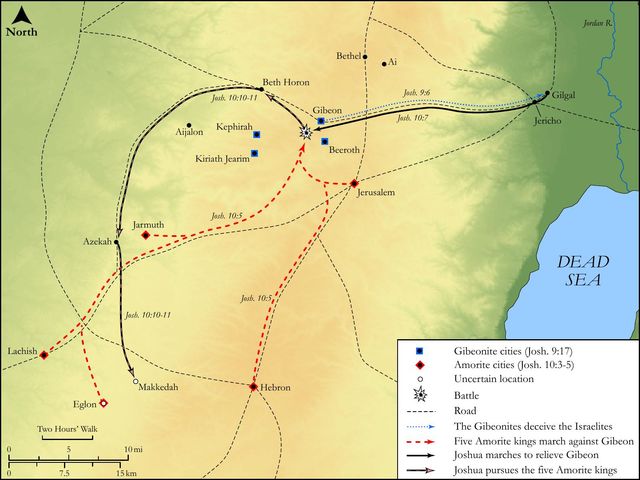
[2.]Besides the terror struck upon them, there was a great slaughter made of them by hail-stones, which were so large, and came down with such a force, that more were killed by the hail-stones than by the sword of the Israelites, though no doubt they were busy. God himself speaks to Job of treasures, or magazines, of snow and hail, which he has reserved for the day of battle and war (Job 38:22, Job 38:23), and here they are made use of to destroy the Canaanites. Here was hail, shot from God's great ordnance, that, against whomsoever it was directed, was sure to hit (and never glanced upon the Israelites mixed with them), and wherever it hit was sure to kill. See here how miserable those are that have God for their enemy, and how sure to perish; it is a fearful thing to fall into his hands, for there is no fleeing out of them. Some observe that Beth-horon lay north of Gibeon, Azekah and Makkedah lay south, so that they fled each way but, which way soever they fled, the hail-stones pursued them, and met them at every turn.
2.The great faith of Joshua, and the power of God crowning it with the miraculous arrest of the sun, that the day of Israel's victories might be prolonged, and so the enemy totally defeated. The hail-stones had their rise no higher than the clouds, but, to show that Israel's help came from above the clouds, the sun itself, who by his constant motion serves the whole earth, by halting when there was occasion served the Israelites, and did them a kindness. The sun and moon stood still in their habitation, at the light of thy arrows which gave the signal, Hab 3:11.
(1.)Here is the prayer of Joshua that the sun might stand still. I call it his prayer, because it is said (Jos 10:12) he spoke to the Lord; as Elijah, though we read (Kg1 17:1) only of his prophesying of the drought, yet is said (Jam 5:17) to pray for it. Observe,
[1.]An instance of Joshua's unwearied activity in the service of God and Israel, that though he had marched all night and fought all day, and, one might expect, would be inclined to repose himself and get a little sleep, and give his army some time to rest - that, like the hireling, he would earnestly desire the shadow, and bid the night welcome, when he had done such a good day's work - yet, instead of this, he wishes for nothing so much as the prolonging of the day. Note, Those that wait on the Lord and work for him shall renew their strength, shall run and not be weary, shall walk and not faint, Isa 40:31.
[2.]An instance of his great faith in the almighty power of God, as above the power of nature, and able to control and alter the usual course of it. No doubt Joshua had an extraordinary impulse or impression upon his spirit, which he knew to be of divine origin, prompting him to desire that this miracle might be wrought upon this occasion, else it would have been presumption in him to desire or expect; the prayer would not have been granted by the divine power, if it had not been dictated by the divine grace. God wrought this faith in him, and then said, "According to thy faith, and thy prayer of faith, be it unto thee." It cannot be imagined, however, that such a thing as this should have entered into his mind if God had not put it there; a man would have had a thousand projects in his head for the completing of the victory before he would have thought of desiring the sun to stand still; but even in the Old Testament saints the Spirit made intercession according to the will of God. What God will give he inclines the hearts of his praying people to ask, and for what he will do he will be enquired of, Eze 36:37. Now, First, It looked great for Joshua to say, Sun, stand thou still. His ancestor Joseph had indeed dreamed that the sun and moon did homage to him; but who would have thought that, after it had been fulfilled in the figure, it should be again fulfilled in the letter to one of his posterity? The prayer is thus expressed with authority, because it was not an ordinary prayer, such as is directed and supported only by God's common providence or promise, but the prayer of a prophet at this time divinely inspired for this purpose; and yet it intimates to us the prevalency of prayer in general, so far as it is regulated by the word of God, and may remind us of that honour put upon prayer (Isa 45:11), Concerning the work of my hands command you me. He bids the sun stand still upon Gibeon, the place of action and the seat of war, intimating that what he designed in this request was the advantage of Israel against their enemies; it is probable that the sun was now declining, and that he did not call for the lengthening out of the day until he observed it hastening towards it period. He does likewise, in the name of the King of kings, arrest the moon, perhaps because it was requisite for the preserving of the harmony and good order of the spheres that the course of the rest of the heavenly bodies should be stayed likewise, otherwise, while the sun shone, he needed not the moon; and here he mentions the valley of Ajalon, which was near to Gibeon, because there he was at that time. Secondly, It was bold indeed to say so before Israel, and argues a very strong assurance of faith. If the event had not answered the demand, nothing could have been a greater slur upon him; the Israelites would have concluded he was certainly going mad, or he would never have talked so extravagantly. But he knew very well God would own and answer a petition which he himself directed to be drawn up and presented, and therefore was not afraid to say before all Israel, calling them to observe this work of wonder, Sun, stand thou still, for he was confident in him whom he had trusted. He believed the almighty power of God, else he could not have expected that the sun, going on in its strength, driving in a full career, and rejoicing as a strong man to run a race, should be stopped in an instant. He believed the sovereignty of God in the kingdom of nature, else he could not have expected that the established law and course of nature should be changed and interrupted, the ordinances of heaven, and the constant usage according to these ordinances, broken in upon. And he believed God's particular favour to Israel above all people under the sun, else he could not have expected that, to favour them upon an emergency with a double day, he should (which must follow of course) amaze and terrify so great a part of the terrestrial globe with a double night at the same time. It is true, he causeth the sun to shine upon the just and the unjust; but for this once the unjust shall wait for it beyond the usual time, while, in favour to righteous Israel, it stands still.
(2.)The wonderful answer to this prayer. No sooner said than done (Jos 10:13): The sun stood still, and the moon staid. Notwithstanding the vast distance between the earth and the sun, at the word of Joshua the sun stopped immediately; for the same God that rules in heaven above rules at the same time on this earth, and, when he pleases, even the heavens shall hear the earth, as here. Concerning this great miracle it is here said,
[1.]That it continued a whole day, that is, the sun continued as long again above the horizon as otherwise it would have done. It is commonly supposed to have been about the middle of summer that this happened, when, in that country, it was about fourteen hours between sun and sun, so that this day was about twenty-eight hours long; yet, if we suppose it to have been at that time of the year when the days are at the shortest, it will be the more probable that Joshua should desire and pray for the prolonging of the day.
[2.]That hereby the people had full time to avenge themselves of their enemies, and to give them a total defeat. We often read in history of battles which the night put an end to, the shadows of which favoured the retreat of the conquered; to prevent this advantage to the enemy in their flight, the day was doubled, that the hand of Israel might find out all their enemies; but the eye and hand of God can find them out without the help of the sun's light, for to him the night shineth as the day, Psa 139:12. Note, Sometimes God completes a great salvation in a little time, and makes but one day's work of it. Perhaps this miracle is alluded to Zac 14:6, Zac 14:7, where the day of God's fighting against the nations is said to be one day, and that at evening time it shall be light, as here. And,
[3.]That there was never any day like it, before or since, in which God put such an honour upon faith and prayer, and upon Israel's cause; never did he so wonderfully comply with the request of a man, nor so wonderfully fight for his people.
[4.]This is said to be written in the book of Jasher, a collection of state-poems, in which the poem made upon this occasion was preserved among the rest; probably the same with that book of the wars of the Lord (Num 21:14), which afterwards was continued and carried on by one Jasher. Those words, Sun, stand thou still upon Gibeon, and thou moon in the valley of Ajalon, sounding metrical, are supposed to be taken from the narrative of this event as it was found in the book of Jasher. Not that the divine testimony of the book of Joshua needed confirmation from the book of Jasher, a human composition; but to those who had that book in their hands it would be of use to compare this history with it, which warrants the appeals the learned make to profane history for corroborating the proofs of the truth of sacred history.
[5.]But surely this stupendous miracle of the standing still of the sun was intended for something more than merely to give Israel so much the more time to find out and kill their enemies, which, without this, might have been done the next day. First, God would hereby magnify Joshua (Jos 3:7), as a particular favourite, and one whom he did delight to honour, being a type of him who has all power both in heaven and in earth and whom the winds and the seas obey. Secondly, He would hereby notify to all the world what he was doing for his people Israel here in Canaan; the sun, the eye of the world, must be fixed for some hours upon Gibeon and the valley of Ajalon, as if to contemplate the great works of God there for Israel, and so to engage the children of men to look that way, and to enquire of this wonder done in the land, Ch2 32:31. Proclamation was hereby made to all the neighbouring nations. Come, behold the works of the Lord (Psa 46:8), and say, What nation is there so great as Israel is, who has God so nigh unto them? One would have supposed that this would bring such real ambassadors as the Gibeonites pretended to be from a very far country, to court the friendship of Israel because of the name of the Lord their God. Thirdly, He would hereby convince and confound those idolaters that worshipped the sun and moon and gave divine honours to them, by demonstrating that they were subject to the command of the God of Israel, and that, as high as they were, he was above them; and thus he would fortify his people against temptations to this idolatry, which he foresaw they would be addicted to (Deu 4:19), and which, notwithstanding this, they afterwards corrupted themselves with. Fourthly, This miracle signified (it is the learned bishop Pierson's notion) that in the latter days, when the light of the world was tending towards a light of darkness, the Sun of righteousness, even our Joshua, should arise (Mal 4:2), give check to the approaching night, and be the true light. To which let me add that when Christ conquered our spiritual enemies upon the cross the miracle wrought on the sun was the reverse of this; it was then darkened as if it had gone down at noon, for Christ needed not the light of the sun to carry on his victories: he then made darkness his pavilion. And, Lastly, The arresting of the sun and moon in this day of battle prefigured the turning of the sun into darkness, and the moon into blood, in the last great and terrible day of the Lord.
Historical interpretation
Fifteen Centuries of Reception
7 surviving comments on this verse. Each one is dated, so this reads as a timeline rather than a list.
Select a marker to jump to its quote. Markers stagger vertically where authors wrote within a few decades of each other.
In this manner, therefore, Jesus [Joshua] with his chiefs and princes comes to those who are attacked for his name by opposing powers, and not only does he furnish assistance in war, but also he extends the length of the day and, prolonging the extent of light, dispels the approaching night.Therefore, if we are able, we want to disclose how our Lord Jesus prolonged the light and made a longer day, both for the salvation of humans and for the destruction of opposing powers.
Immediately after the Savior appeared, it was already the end of the world. Even he himself said, “Repent, for the kingdom of heaven has drawn near.” But he restrained and checked the day of consummation and forbade it to come. For God the Father, seeing that the salvation of the nations can be established only through him, says to him, “Ask from me, and I shall give you the nations for your inheritance and the ends of the earth for your possession.”11
Therefore, until the promise of the Father is fulfilled and the churches spring forth in the various nations and “the whole fullness of the nations” enter so that then “all Israel may be saved,” the day is lengthened and the setting is deferred and the sun never sinks down but always rises as long as “the sun of righteousness” pours the light of truth into the hearts of believers. But when the measure of believers is complete and the already weaker and depraved age of the final generation arrives, when “the love of many persons will grow cold by increasing iniquity” and very few persons remain in whom faith is found, then “the days will be shortened.”15
In the same way, therefore, the Lord knows to extend the day when it is time for salvation and to shorten the day when it is time for tribulation and destruction. We, however, while we have the day and the extent of light is lengthened for us, “let us walk becomingly as in the day” and let us perform the works of light.
Everywhere, therefore, he alone kept close to holy Moses amid all these wondrous works and dread secrets. In this way it happened that the one who had been Moses’ companion in this intercourse with God succeeded to his power. Worthy surely was he to stand forth as a man who might stay the course of the river, and who might say, “Sun, stand still,” and delay the night and lengthen the day, as though to witness his victory. Why?—a blessing denied to Moses—he alone was chosen to lead the people into the promised land. A man he was, great in the wonders he wrought by faith, great in his triumphs. The works of Moses were of a higher type, his brought greater success. Either of these then aided by divine grace rose above all human standing. The one ruled the sea, the other heaven.
But perhaps renown in war keeps some so bound to itself as to make them think that fortitude is to be found in battle alone and that therefore I had gone aside to speak of these things, because that was lacking in us. But how brave was Joshua the son of Nun, who in one battle laid low five kings together with their people! Again, when he fought against the Gibeonites and feared that night might stop him from gaining the victory, he called out with deep faith and high spirit: “Let the sun stand still”; and it stood still until the victory was complete.
Consider how great of value is the righteous man. Joshua the son of Nun said, “Let the sun stand still at Gibeon, the moon at the valley of Elom [Aijalon],” and it was so. Let then the whole world come, or rather two or three, or four, or ten, or twenty worlds, and let them say and do this; yet they shall not be able. But the friend of God commanded the creatures of his friend, or rather he besought his friend, and the servants yielded, and the one below gave command to those above. Do you see that these things are fulfilling their appointed course for service?
Let no one tell me, therefore, that the motions of the heavenly bodies constitute time. For when the sun stood still at the prayer of a certain man in order that he might gain his victory in battle, the sun stood still but time went on. For in as long a span of time as was sufficient the battle was fought and ended.I see, then, that time is a certain kind of extension.
Actually, as we have recorded in our Scriptures, the sun itself stood still when the holy man, Joshua the son of Nun, asked that favor of God, and it remained where it was until a battle, already begun, ended in victory.… Such are the miracles which God grants as favors to his saints; although our adversaries would attribute them—if they believed them—to the arts of magic.…In regard, then, to human knowledge of the natures of things, the unbelievers have no right to becloud the issue by their assumption that nothing, even by the power of God, can happen to a nature beyond what is known already by human experience. And remember, too, that there are qualities and powers in the natures of the commonest things that are nothing less than stupendous and would, in fact, be reckoned portents by anyone who examined them, except that humans have accustomed themselves to have no wonder to spare save for things that are unusual.
The book of the just: In Hebrew Jasher: an ancient book long since lost.
Continue studying Joshua 10:13 across the web’s major study libraries — every link below opens this exact verse, chapter, or book on the destination site.
Read & Compare
 BibleGatewayThis verse in more than 200 translations and 70 languages.
 Bible.comThe YouVersion reader — hundreds of translations, reading plans, and highlights.
 ESV.orgCrossway's official English Standard Version reader.
 NET BibleThe NET translation with 60,000+ translators' notes on every rendering decision.
 STEP BibleTyndale House's free study tool — original text, vocabulary, and scholarly resources.
 BibliaLogos Bible Software's free web reader.
 USCCBThe New American Bible (Revised Edition) with the U.S. bishops' study notes.
Commentaries
 BibleHub CommentariesDozens of classic commentaries on this verse, gathered on one page.
 StudyLightMore than 100 commentary sets — the largest collection on the web.
 BibleRefPlain-English commentary on what this verse means, verse by verse.
 Enduring WordDavid Guzik's free commentary on this chapter, widely used by Bible teachers.
 Bible Study ToolsVerse commentary alongside Greek and Hebrew study aids.
Original Language & Research
- BibleHub InterlinearThe verse word by word — original language, transliteration, and English.
- BibleHub LexiconEvery word's original-language definition and Strong's entry.
 Blue Letter BibleDeep-study tools — Strong's numbers, concordance, and word studies.
 SefariaThe Hebrew text with Rashi and centuries of Jewish commentary.
Sermons, Hymns & Audio


TrulyRandomVerse is not affiliated with these sites and doesn’t control their content. They’re linked because they’re genuinely useful.
Summary
Joshua 10:13 records one of the most astonishing miracles in biblical history: the supernatural suspension of the sun and moon's apparent movement, extending daylight for an entire day. This unparalleled event occurred during Israel's decisive pursuit of the Amorite confederacy in Canaan, serving as irrefutable evidence of Yahweh's direct, omnipotent intervention on behalf of His covenant people to secure a comprehensive and overwhelming victory, demonstrating His absolute sovereignty over creation and His faithfulness to His promises. The verse also references the "book of Jasher," an ancient non-canonical source, lending historical corroboration to this unprecedented divine act.
Context
ShowHideLiterary Context
Joshua 10:13 is deeply embedded within the narrative of Israel's conquest of Canaan, following the miraculous entry into the land and the initial victories at Jericho and Ai. The immediate preceding events involve the cunning deception of the Gibeonites (Joshua 9), who secure a peace treaty with Israel. This alliance provokes a formidable coalition of five Amorite kings—from Jerusalem, Hebron, Jarmuth, Lachish, and Eglon—who unite to attack Gibeon. Gibeon, in turn, urgently appeals to Joshua for military aid. In response, Joshua and the entire Israelite army undertake an arduous, forced march through the night to surprise the enemy at Gibeon. As the battle unfolds, God actively intervenes, not only causing confusion among the enemy but also unleashing a devastating hailstorm that kills more Amorites than the Israelite swords (Joshua 10:11). Recognizing the strategic necessity of extended daylight to complete the rout and prevent the enemy's escape, Joshua, inspired by divine boldness, utters his extraordinary prayer for the sun and moon to stand still (Joshua 10:12). Verse 13 then records the astounding fulfillment of this prayer, highlighting God's direct answer and Israel's subsequent decisive victory, thereby underscoring God's active participation in their conquest.
Historical & Cultural Context
The setting of this event is the days of Joshua, a time characterized by fragmented city-states and frequent warfare in Canaan. Military campaigns were almost exclusively conducted during daylight hours, as nightfall typically brought an end to combat, allowing defeated forces to regroup or escape under the cover of darkness. For Israel to achieve a complete and decisive victory—a "vengeance" or full defeat—against such a formidable coalition of kings, extended daylight was absolutely crucial for the relentless pursuit and annihilation of the fleeing enemy, preventing any future resurgence of threat. Furthermore, the Canaanite peoples whom Israel was dispossessing were deeply polytheistic, often worshipping celestial deities, including the sun and the moon, whose worship Moses had forbidden Israel. God's direct manipulation of these very celestial bodies served as a profound theological and polemical statement. It unequivocally demonstrated Yahweh's absolute sovereignty over all creation, His complete control over the heaven and the earth, and His undeniable superiority over the impotent and false gods of the Canaanites. This spectacular miracle would have had a dual impact: profoundly solidifying the faith and awe of the Israelites, while simultaneously instilling terror and acknowledging the supreme power of Israel's God among the surrounding nations.
Key Themes
ShowHideJoshua 10:13 powerfully encapsulates several foundational themes central to the book of Joshua and the broader biblical narrative. Firstly, it emphatically showcases Divine Intervention and Omnipotence, demonstrating God's absolute control over the natural order. He is not merely a distant observer but an active participant in human history, capable of suspending or altering the very laws of creation to achieve His redemptive purposes. This miracle proves His sovereignty over all things, including the celestial bodies revered by pagan cultures. Secondly, the event underscores God's Faithfulness to His Covenant Promises. This unprecedented divine aid ensures Israel's success in possessing the land promised generations earlier to Abraham, Isaac, and Jacob (Genesis 12:7). God is actively fighting for His people, demonstrating that His word is sure and His promises are unbreakable. Thirdly, the passage highlights Answered Prayer and Human Faith. Joshua's bold, Spirit-inspired prayer in Joshua 10:12 is met with an extraordinary divine response, serving as a powerful encouragement for believers across all generations to pray with audacious faith, trusting in God's boundless ability to do the impossible for His glory and the good of His people.
Exposition and Analysis
ShowHideKey Word Analysis
ShowHideThis verb describes the sun's action. It means "to be dumb," "to cease," "to be motionless," or "to be silent." In this context, it conveys a complete and supernatural cessation of the sun's apparent movement across the sky, emphasizing that it was not merely a slowing down but a complete halt. This underscores God's absolute power to command and suspend the natural order.
This verb describes the moon's action. It means "to stand," "to stand firm," or "to remain in place." While similar to dâmam, ʻâmad often implies a state of being fixed or enduring. Its use alongside dâmam reinforces the miraculous suspension of both celestial bodies, indicating a sustained and deliberate divine act rather than a fleeting phenomenon, demonstrating God's enduring control over all creation.
This noun refers to a "day" as the warm hours from sunrise to sunset, or a period of time. The phrase "about a whole day" (with H8549 tâmîym meaning "entire" or "complete") explicitly states the unprecedented duration of the phenomenon. This indicates that the period of daylight was approximately doubled, allowing for the comprehensive and unhindered pursuit and destruction of the enemy, highlighting the extraordinary length of God's miraculous intervention.
Verse Breakdown
ShowHide"And the sun stood still, and the moon stayed"
This opening clause presents the core miracle, a direct, supernatural intervention by God. It describes the suspension of the natural, apparent movement of the sun and the moon, demonstrating God's absolute sovereignty over the heaven and the earth and His ability to manipulate the universe to serve His redemptive purposes for His people. This is an act of divine power unparalleled in its scope over all creation.
"until the people had avenged themselves upon their enemies."
This crucial clause reveals the divine purpose and strategic necessity behind the miracle. The extended daylight was not merely a display of power but a tactical act designed to ensure Israel's complete and decisive victory. "Avenged themselves" implies a thorough and unsparing defeat of the enemy, ensuring that no combatants escaped and that the existential threat they posed was entirely neutralized, thereby fulfilling God's promise to grant Israel possession of the land.
"[Is] not this written in the book of Jasher?"
This parenthetical question serves as an appeal to an external, well-known ancient source. The "book of Jasher" was a collection of Hebrew poetic or historical records, not part of the canonical Scriptures. Its inclusion here functions as a corroborating witness, affirming the historical veracity and widespread acceptance of this extraordinary event among the Israelites of that time. It lends credibility to the account by referencing a recognized historical record, suggesting the event was widely known and documented.
"So the sun stood still in the midst of heaven, and hasted not to go down about a whole day."
This concluding statement reiterates and amplifies the miracle described at the beginning of the verse. The repetition ("sun stood still") emphasizes the certainty and immense magnitude of the event. The phrase "in the midst of heaven" suggests a high, fixed position, indicating the sun's apparent halt at its zenith or a prominent position. "Hasted not to go down about a whole day" explicitly clarifies the unprecedented duration of the phenomenon, stating that the day was extended by approximately another full day, allowing for the complete and unhindered pursuit and destruction of the enemy.
Literary Devices
ShowHideJoshua 10:13 is rich in literary devices that amplify its impact and convey its profound theological message. The most prominent is Divine Intervention, where God directly acts upon the natural world, suspending its established laws to achieve His specific purposes. This is intrinsically linked to Miracle, an event that transcends natural explanation, serving as an undeniable sign of God's power, presence, and active involvement in human affairs. The Repetition of "the sun stood still" (echoing Joshua 10:12 and within this verse itself) serves to emphasize the certainty, uniqueness, and extraordinary nature of the event, ensuring the reader grasps its profound significance. The phrase "hasted not to go down about a whole day" employs Hyperbole or Exaggeration to convey the immense and unprecedented duration of the extended daylight, making a powerful statement about the scale and completeness of God's intervention. Finally, the Allusion to the "book of Jasher" functions as an external corroboration, adding a layer of historical authenticity and credibility to the narrative by referencing a known ancient source, even if that source is no longer extant or canonical.
Theological and Thematic Connections
ShowHideJoshua 10:13 stands as a monumental testament to God's absolute sovereignty over creation and His unwavering commitment to His covenant people. This miracle transcends mere historical anecdote; it is a profound theological declaration that the God of Israel is not merely a regional deity but the Lord of heaven and earth, capable of altering the very fabric of time and space to accomplish His will. It underscores that God actively fights for His people, not just through natural means but through supernatural intervention, demonstrating that no obstacle is too great for Him to overcome when His purposes are at stake. This event solidifies the understanding that God's promises are guaranteed by His omnipotence, providing both comfort and a call to audacious faith for His followers. It reveals a God who is intimately involved in the details of His people's lives and battles, ensuring their ultimate triumph.
Reflection and Application
ShowHideThe account of the sun and moon standing still in Joshua 10:13 offers profound and enduring lessons for contemporary believers. It is a powerful, awe-inspiring reminder that the God we serve is utterly limitless, unconstrained by natural laws, human logic, or the seeming impossibilities of our circumstances. Just as He intervened dramatically for Joshua and Israel, He remains sovereign over every detail and challenge in our lives today. This passage calls us to cultivate a radical, unwavering trust in God's power, even when our situations appear utterly insurmountable or overwhelming. It encourages us to pray with audacious boldness and specificity, bringing our deepest needs, our most daunting challenges, and our most audacious requests before Him, believing wholeheartedly that He is able to do "exceeding abundantly above all that we ask or think" (Ephesians 3:20). Furthermore, it reassures us that God is not a passive observer but an active, engaged participant in our battles, both spiritual and practical, and that ultimately, the victory belongs to Him. Our sacred role is to be obedient to His call, to step out in faith when He commands, and then to trust Him to fight on our behalf, knowing that His timing and methods are perfect, designed to bring about His ultimate glory and our profound good.
Questions for Reflection
ShowHideFAQ
ShowHideWas this miracle a literal event, or is it symbolic?
ShowHideThe biblical text presents the event in Joshua 10:13 as a literal, historical miracle, a direct and unequivocal supernatural intervention by God. The language used—"the sun stood still, and the moon stayed," "hasted not to go down about a whole day"—strongly suggests a physical phenomenon where the apparent movement of the sun and moon was halted, extending daylight for an unprecedented duration. While modern scientific understanding might struggle to explain such an event within natural laws, the biblical narrative attributes it directly to divine omnipotence, emphasizing God's ability to transcend and manipulate natural processes at will. Attempts to explain it purely as a poetic description, a slowing of the Earth's rotation, or an astronomical alignment often fall short of the text's clear depiction of a miraculous, purposeful intervention. For the biblical authors and their original audience, it was understood as a real, historical act of God, a sign of His unique power and presence.
What is the "book of Jasher"?
ShowHideThe "book of Jasher" (also mentioned in 2 Samuel 1:18) was an ancient, non-canonical Hebrew text. It is generally understood to have been a collection of national songs, poems, or historical records celebrating heroic deeds and significant events in Israel's history, likely a compilation of heroic ballads. It was evidently a well-known and respected source in ancient Israel, cited here in Joshua 10:13 as a corroborating witness to the extraordinary miracle of the sun and moon standing still. Its mention indicates that the event was not only part of oral tradition but also recorded in other historical accounts of the time, lending further weight to its historical veracity. However, it is important to note that the "book of Jasher" is not part of the inspired biblical canon, and its exact content or fate is unknown today. Its purpose in the biblical text is to provide external verification for a remarkable event, not to serve as a source of divine revelation itself.
Christ-Centered Fulfillment
ShowHideJoshua 10:13, with its depiction of God's miraculous intervention to secure a decisive victory for His people, finds its ultimate and most profound fulfillment in Jesus Christ. Joshua, whose very name means "Yahweh is salvation" and is the Hebrew equivalent of Jesus, serves as a powerful type or foreshadowing of Christ, leading God's people into their promised inheritance and securing triumph over their enemies. While Joshua's triumph was earthly and temporal, Christ's victory is spiritual and eternal, and extends over all creation. Just as God the Father demonstrated His absolute power over creation by commanding the sun and moon, Jesus, as the incarnate Son of God, possesses inherent, divine authority over all creation. He demonstrated this by calming raging storms with a mere word (Matthew 8:26-27) and walking on water, proving that the very power that held the sun still resides fully and inherently in Him. Furthermore, the extended day in Joshua lasted "until the people had avenged themselves upon their enemies." Christ, through His sacrificial death on the cross and His glorious resurrection, has achieved the ultimate and decisive victory over humanity's true, spiritual enemies: sin, death, and the devil (Colossians 2:15). He is the true Lamb of God who takes away the sin of the world (John 1:29), and through His finished work, we are granted not merely physical land but an eternal inheritance and spiritual victory over all the forces of darkness. The "whole day" of extended light in Joshua, enabling complete conquest, powerfully foreshadows the eternal light and everlasting rest found in Christ, who is the light of the world (John 8:12) and the one who leads all who believe into their true, everlasting rest and ultimate triumph (Hebrews 4:8-10).