


Old Testament · The Law · Book 4 of 66
Numbers
Israel’s journey from Sinai to the plains of Moab, in which the generation that refused the land dies in the wilderness and their children are numbered to inherit it.
- 36 chapters
- 1,288 verses
- About 2.5 hours to read
- The Wilderness Years, c. 1446–1406 BC
Numbers is named for its two musters of Israel’s fighting men, one in the wilderness of Sinai and one, almost forty years later, on the plains of Moab. Between them a generation dies. The first count is of the men who came out of Egypt, numbered “by their armies” to take Canaan (Numbers 1:3). At Kadesh they refused, crying, “would God we had died in this wilderness!” (14:2), and the LORD answered, “as ye have spoken in mine ears, so will I do to you” (14:28). The second count ends on the outcome: “there was not left a man of them, save Caleb the son of Jephunneh, and Joshua the son of Nun” (26:65).
The LORD’s word holds in mercy as well. He leads the camp by the cloud, feeds it, pardons it at Moses’ plea, and brings the children their fathers feared for to the edge of the land (14:31). When a king hires a prophet to curse them, the prophet can only say, “God is not a man, that he should lie” (23:19). Paul says these things “are written for our admonition” (1 Corinthians 10:11).
God is not a man, that he should lie; neither the son of man, that he should repent: hath he said, and shall he not do it? or hath he spoken, and shall he not make it good?
Numbers 23:19 KJV
Before you read
- Who wrote it
- Moses. The book closes on “the commandments and the judgments, which the LORD commanded by the hand of Moses” (36:13), and records that “Moses wrote their goings out according to their journeys” (33:2). Jesus said of Moses, “he wrote of me” (John 5:46).
- When it happens
- From “the first day of the second month, in the second year after they were come out of the land of Egypt” (1:1) to the fortieth year, in which Aaron died on mount Hor (33:38). Moses later counts the years from Kadesh to the brook Zered as “thirty and eight years” (Deuteronomy 2:14).
How Numbers is laid out
8 movements · 170 passages · 1,288 verses
Numbered by their armies
Chapters 1–4 · 188 verses
In the wilderness of Sinai, in the second year out of Egypt, Moses and Aaron number every man from twenty years old and upward “able to go forth to war”: 603,550 in all. The tribes camp in four companies of three around the tabernacle. The Levites are numbered apart, taken by the LORD instead of Israel’s firstborn, and given the charge of carrying the tabernacle.
23 passages
- 1:1–4 God Commands a Military Census
- 1:5–19 Leaders Appointed for the Census
- 1:20–46 The Census Results by Tribe
- 1:47–54 The Levites Are Set Apart
- 2:1–2 Instructions for Setting the Camp
- 2:3–9 The Camp of Judah (East)
- 2:10–17 The Camp of Reuben (South) and the Tabernacle in the Midst
- 2:18–24 The Camp of Ephraim (West)
- 2:25–31 The Camp of Dan (North)
- 2:32–34 Summary and Obedience
- 3:1–4 The Generations of Aaron and Moses
- 3:5–10 The Levites Assigned to Tabernacle Service
- 3:11–13 The Levites as Substitutes for the Firstborn
- 3:14–20 Census and Duties of the Levite Clans
- 3:21–26 The Duties of the Gershonites
- 3:27–32 The Duties of the Kohathites
- 3:33–39 The Duties of the Merarites
- 3:40–51 Redemption of the Excess Firstborn
- 4:1–16 Duties and Census of the Kohathites
- 4:17–20 Protecting the Kohathites from Death
- 4:21–28 Duties and Census of the Gershonites
- 4:29–33 Duties and Census of the Merarites
- 4:34–49 Summary of the Levitical Census
A holy camp at Sinai
5:1–10:10 · 206 verses
The unclean are put out of the camp, and laws follow for restitution, the jealous husband and the vow of the Nazarite. Aaron and his sons receive the blessing that puts the LORD’s name on Israel. The princes bring their offerings for the altar over twelve days, the Levites are cleansed, and the Passover is kept. The cloud and two silver trumpets will order every march.
From Sinai to Hazeroth
10:11–12:16 · 77 verses
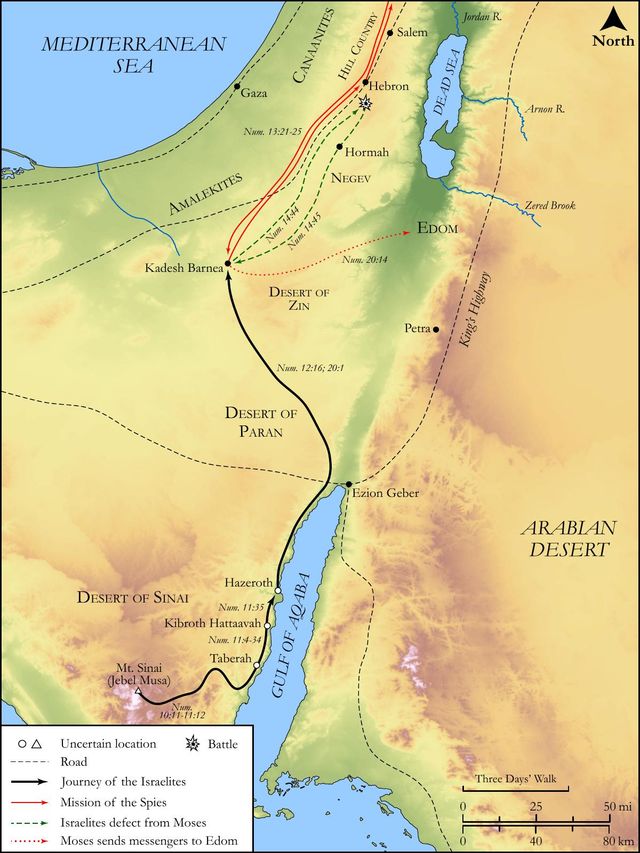
On the twentieth day of the second month the cloud is taken up, and the tribes set out in order behind the ark. Soon the people complain: fire burns at Taberah, and the cry for flesh brings quail and a plague at Kibroth-hattaavah. Seventy elders receive of the spirit that was on Moses. At Hazeroth Miriam and Aaron speak against him, and Miriam is struck with leprosy.
11 passages
- 10:11–28 The Departure from Sinai
- 10:29–32 Moses Entreats Hobab to Serve as Guide
- 10:33–36 The Ark Leads the Journey
- 11:1–3 The Burning at Taberah
- 11:4–15 The Demand for Meat and Moses’ Despair
- 11:16–23 God Appoints Seventy Elders
- 11:24–30 The Spirit Rests on the Elders
- 11:31–35 Quail Sent and Judgment at Kibrothhattaavah
- 12:1–3 Miriam and Aaron Challenge Moses
- 12:4–9 The Lord Defends Moses' Authority
- 12:10–16 Miriam is Judged and Healed
Refusal at Kadesh
Chapters 13–14 · 78 verses
Twelve spies search the land for forty days and bring back a cluster of grapes from Eshcol. Ten say its people are too strong; Caleb says, “we are well able to overcome it.” The congregation weeps and plans to return to Egypt. At Moses’ plea the LORD pardons, but swears that the men of this generation will die in the wilderness. A presumptuous attack ends in defeat.
10 passages
- 13:1–16 The Command to Send Spies
- 13:17–25 Instructions for the Mission
- 13:26–29 The Spies Return to Kadesh
- 13:30–33 The Conflicting Reports
- 14:1–4 Israel Rebels and Despairs
- 14:5–10 Joshua and Caleb Urge Faith
- 14:11–19 God Threatens Destruction
- 14:20–35 The Sentence of Forty Years
- 14:36–39 The Death of the Ten Spies
- 14:40–45 Presumptuous Attack and Defeat
Who may come near
Chapters 15–19 · 158 verses
Laws follow for offerings in the land to come, for sins of ignorance and presumptuous sin, and for fringes on garments. Korah, Dathan and Abiram rise against Moses and Aaron; the earth swallows them, and fire consumes 250 men offering incense. Aaron stands “between the dead and the living.” His rod alone buds. The priests’ portion is set, and the ashes of a red heifer cleanse from the dead.
The way around Edom
Chapters 20–21 · 64 verses
Miriam dies at Kadesh, in the desert of Zin. There Moses strikes the rock twice for water, but he and Aaron are barred from the land. Edom refuses passage, and Aaron dies on mount Hor. When the people loathe the manna, fiery serpents bite them, and Moses sets a serpent of brass on a pole for the bitten to look upon and live. Sihon and Og fall east of Jordan.
8 passages
Balaam and Baal-peor
Chapters 22–25 · 114 verses
Israel camps in the plains of Moab. Balak, king of Moab, sends for Balaam to curse them, and on the road the angel of the LORD stands against Balaam, seen first by his ass. From three high places Balaam blesses Israel instead, and foretells a Star out of Jacob. Then Israel joins itself to Baal-peor through the women of Moab, and Phinehas’ zeal stays the plague.
18 passages
- 22:1–4 Israel Encamped; Moab’s Fear
- 22:5–14 Balak Summons Balaam
- 22:15–21 Balak Sends More Honorable Princes
- 22:22–35 Balaam's Donkey
- 22:36–41 Balaam Arrives in Moab
- 23:1–6 Balaam Prepares the First Altar
- 23:7–12 Balaam’s First Oracle: Israel Blessed
- 23:13–17 The Second Attempt to Curse Israel
- 23:18–26 Balaam’s Second Oracle: God’s Faithfulness
- 23:27–30 Preparation for the Third Oracle
- 24:1–9 Balaam's Third Oracle: Israel's Prosperity
- 24:10–14 Balak's Anger and Balaam's Defense
- 24:15–19 The Fourth Oracle: The Star and the Scepter
- 24:20–25 Oracles Against the Nations
- 25:1–5 The Sin at Baal-peor
- 25:6–9 Phinehas Executes Judgment
- 25:10–15 Phinehas Rewarded with Priesthood
- 25:16–18 Command to Attack Midian
A new generation numbered
Chapters 26–36 · 403 verses
A second census counts 601,730, and not one man of the first numbering is left but Caleb and Joshua. The daughters of Zelophehad receive their father’s inheritance, and Joshua is set before the congregation to succeed Moses. Then come the appointed offerings, vows, the war on Midian, Reuben and Gad’s land east of Jordan, the stages of the journey, the borders of Canaan and the cities of refuge.
11 chapters
- 26 The Second Census Commanded
- 27 The Daughters of Zelophehad Seek Justice
- 28 The Law of Communal Offerings
- 29 Offerings for the Feast of Trumpets
- 30 Introduction to the Law of Vows
- 31 The Lord Commands Vengeance on Midian
- 32 The Request for Land East of Jordan
- 33 The Command to Record the Journeys
- 34 The Borders of Canaan Defined
- 35 The Levites' Cities and Pasturelands
- 36 The Manassehites Raise a Legal Concern
The words Numbers turns on
Number fills the two censuses and set forward the marches; murmur gathers at Kadesh and after Korah, and bless runs from Aaron to Balaam.
What Numbers teaches
pâqad · number
Counted for the land
The first census counts “all that are able to go forth to war in Israel” (1:3), and it comes to 603,550 (1:46). At Kadesh the count becomes the measure of the sentence: “Your carcases shall fall in this wilderness; and all that were numbered of you, according to your whole number, from twenty years old and upward” (14:29). The verb, pâqad, also means to visit, and Moses has just used it in his plea, of the LORD “visiting the iniquity of the fathers upon the children” (14:18). The children bear forty years in the wilderness for their fathers’ sin (14:33), yet they are the ones brought in (14:31). The second census numbers them for their inheritance, “according to the number of names” (26:53), and of the first numbering “there was not a man of them” left (26:64).
ʼâman · believe
Faithful in all mine house
When Miriam and Aaron speak against Moses, the LORD answers, “My servant Moses is not so, who is faithful in all mine house” (12:7). The same verb names the people’s failure two chapters later: “how long will it be ere they believe me, for all the signs which I have shewed among them?” (14:11). Then it is used of Moses himself. Told to speak to the rock, he struck it twice, saying, “must we fetch you water out of this rock?” and the LORD said, “Because ye believed me not, to sanctify me in the eyes of the children of Israel, therefore ye shall not bring this congregation into the land” (20:8–12). Hebrews takes up both. Moses was faithful “as a servant,” Christ “as a son over his own house” (Hebrews 3:5–6), and the fathers “could not enter in because of unbelief” (3:19).
maṭṭeh · rod, tribe
The rod that budded
The Hebrew maṭṭeh is both a rod and a tribe: the staff a prince carried, and the people he led. Korah’s company had said, “Ye take too much upon you, seeing all the congregation are holy” (16:3). The LORD settles who may come near with twelve rods, one for each tribe, laid up before the testimony: “the man’s rod, whom I shall choose, shall blossom” (17:5). Aaron’s rod “was budded, and brought forth buds, and bloomed blossoms, and yielded almonds” (17:8), and it was kept “for a token against the rebels” (17:10). Ambrose read in it that not the will of man but the grace of God should have the chief part in the election of the priest
. Hebrews applies the rule to Christ: “no man taketh this honour unto himself, but he that is called of God, as was Aaron” (Hebrews 5:4).
bârak · bless
Blessed, and not reversed
At Sinai the LORD gives Aaron’s sons the words with which to bless Israel, “The LORD bless thee, and keep thee” (6:24), and adds, “they shall put my name upon the children of Israel; and I will bless them” (6:27). On the plains of Moab a king tries to buy the opposite. Balak trusts Balaam’s word: “he whom thou blessest is blessed, and he whom thou cursest is cursed” (22:6). But God tells Balaam, “thou shalt not curse the people: for they are blessed” (22:12), and from every high place Balaam has to say so: “I have received commandment to bless: and he hath blessed; and I cannot reverse it” (23:20). Balaam himself was not changed. Israel fell at Peor “through the counsel of Balaam” (31:16), and Peter names him as one “who loved the wages of unrighteousness” (2 Peter 2:15).
Christ in Numbers
Jesus took the lifting up of the serpent of brass as a sign of his own: “as Moses lifted up the serpent in the wilderness, even so must the Son of man be lifted up: That whosoever believeth in him should not perish, but have eternal life” (John 3:14–15). The bitten were not healed by any remedy or effort of their own. The LORD’s word was that “every one that is bitten, when he looketh upon it, shall live” (Numbers 21:8).
Paul finds Christ in the wilderness itself. Israel “drank of that spiritual Rock that followed them: and that Rock was Christ” (1 Corinthians 10:4), and those destroyed of serpents had tempted Christ (10:9). Hebrews sets Moses, faithful in God’s house as a servant, beside Christ the Son (Hebrews 3:2–6), and the ashes of the red heifer beside “the blood of Christ, who through the eternal Spirit offered himself without spot to God” (9:13–14). Balaam saw from far off “a Star out of Jacob, and a Sceptre” (Numbers 24:17); Jesus calls himself “the bright and morning star” (Revelation 22:16).
People
By how many verses name them
- MosesSon of Amram and Jochebed; a brother of Aaron and Miriam; husband of Zipporah216
- AaronSon of Amram and Jochebed; a brother of Moses and Miriam; husband of Elisheba97
- BalaamA son of Beor49
- BalakA son of Zippor37
- EleazarSon of Aaron and Elisheba; a brother of Nadab, Abihu and Ithamar34
- KorahSon of Izhar; a brother of Nepheg, Zichri and Shelomith15
- JoshuaA son of Nun12
- MerariSon of Levi; a brother of Gershon, Kohath and Jochebed; father of Mahli, Mushi and Jaaziah12
204 more are named.
Places
133 named
- MoabIts plains are the last camp; its king hires Balaam30
- Egypt27
- Jordan20
- Canaan11
- SinaiWhere the tribes are numbered and the camp is ordered10
- EdomRefuses Israel passage, so the camp goes around its land9
- HorThe mount where Aaron dies and Eleazar receives his garments9
- Jericho9
Where Numbers reaches
The passages it leans on, and the ones that lean on it
Exodus 34:6–7 Numbers 14:17–19
Moses pleads for pardon in the words the LORD proclaimed of himself at Sinai.
Numbers 14:22–23 Hebrews 3:17–19
The men who tempted God “these ten times,” whose failure Hebrews names as unbelief.
The serpent set on a pole for the bitten to look on and live, and the Son of man lifted up.
Balaam, hired to curse, ends his third oracle with the LORD’s promise to Abraham.
Numbers 24:17 Matthew 2:2 Revelation 22:16
The Star out of Jacob; the star of him “that is born King of the Jews”; Jesus, the bright and morning star.
Books Numbers links to most
The Church Fathers on Numbers
184 quotations from 30 writers before AD 800 · the ten most quoted, in date order
- Origen253
- Cyprian258
- Pacian391
- Ambrose397
- Chrysostom407
- Jerome420
- Augustine430
- Procopius528
- Caesarius542
- Paterius606
Origen noticed that Levi is numbered outside the twelve tribes.
We gather from the book of Numbers that there may be something greater than Israel too. For there the whole of Israel is numbered and reckoned in twelve tribes, as under a fixed number. But the tribe of Levi, being of greater eminence than the others, is accounted extra to this number and never thought of as being one of Israel’s number [of twelve].
Cyprian on Korah, Dathan and Abiram, who took the priests’ office to themselves.
Thus Korah, Dathan and Abiram, who tried to assume for themselves in opposition to Moses and Aaron the freedom to sacrifice, immediately paid the penalty for their efforts. … Clearly [this] warned and showed that whatever the wicked attempt by human will to destroy God’s plan is done against God.
Ephrem on the serpent of brass and the Son of Man lifted up on the cross.
The serpent struck Adam in paradise and killed him. [It also struck] Israel in the camp and annihilated them. “Just as Moses lifted up the serpent in the desert, the Son of Man will be lifted up.” Just as those who looked with bodily eyes at the sign which Moses fastened on the cross lived bodily, so too those who look with spiritual eyes at the body of the Messiah nailed and suspended on the cross and believe in him will live [spiritually]. Thus it was revealed through this brazen [serpent], which by nature cannot suffer, that he who was to suffer on the cross is one who by nature cannot die.
Jerome remembers Fabiola asking why Balaam spoke of Christ more plainly than almost any prophet.
One day we had before us the book of Numbers written by Moses, and [Fabiola] modestly questioned me as to the meaning of the great mass of names there to be found. Why was it, she inquired, that single tribes were differently associated in this passage and in that, how came it to be that the soothsayer Balaam, in prophesying of the future mysteries of Christ, spoke more plainly of him than almost any other prophet? I replied as best I could and tried to satisfy her inquiries.
Keep studying
Articles