


Numbers 14:31
Bible text: King James Version (1769 Blayney text) · Public domain
Bible text: Berean Standard Bible · Public domain
Bible text: American Standard Version (1901) · Public domain
Bible text: World English Bible, Messianic edition · Public domain
Bible text: Geneva Bible (1599) · Public domain
Bible text: Young's Literal Translation · Public domain
- וְטַפְּכֶםve·Ta·pe·Khemand your little one[s]H2945Conj-w ¦ N-msc ¦ 2mpNoun Singular Masculine Constructוְandטַפְּlittle one[s]כֶםyour
- אֲשֶׁר'a·SherwhoH834RelParticle Relative
- אֲמַרְתֶּם'a·mar·Temyou saidH559V-Qal-Perf-2mpVerb Qal Perfect 2nd Plural Masculine
- לָבַזla·Vaz<into> plunderH957Prep-l ¦ N-msNoun Singular Masculine Absoluteלָ<into>בַזplunder
- יִהְיֶהyih·Yehhe will becomeH1961V-Qal-Imperf-3msVerb Qal Imperfect 3rd Singular Masculine
- וְהֵבֵיאתִיve·he·vei·Tiand I will bringH935Conj-w ¦ V-Hiphil-ConsecPerf-1csVerb Hiphil Consecutive Perfect 1st Singular common genderוְandהֵבֵיאתִיI will bring
- אֹתָם'o·Tam<obj.> themH853DirObjM ¦ 3mpParticle Object Indicatorאֹתָ<obj.>םthem
- וְיָדְעוּve·ya·de·'Uand they will knowH3045Conj-w ¦ V-Qal-ConsecPerf-3cpVerb Qal Consecutive Perfect 3rd Plural common genderוְandיָדְעוּthey will know
- אֶת'et<obj.>H853DirObjMParticle Object Indicator
- הָאָרֶץha·'A·retzthe landH776Art ¦ N-fsNoun Singular Feminine Absoluteהָtheאָרֶץland
- אֲשֶׁר'a·SherwhichH834RelParticle Relative
- מְאַסְתֶּםme·'as·Temyou have rejectedH3988V-Qal-Perf-2mpVerb Qal Perfect 2nd Plural Masculine
- בָּהּBah<in> <the> itPrep-b ¦ 3fsSuffix Personal 3rd Singular Feminineבָּ<in> <the>הּit
English is a literal word-by-word gloss of the Hebrew, not the KJV's wording. Why?
This is the original text the KJV's translators worked from — each Hebrew word with its own literal English meaning in this verse, prepared by scholars at Tyndale House, Cambridge. The KJV translates whole sentences, not word by word, so its wording differs: one Hebrew word can become several English words, and the KJV may choose “the LORD” where the gloss reads “Yahweh”. Both are faithful — they answer different questions. For the KJV's own rendering, switch to the KJV text.
Details
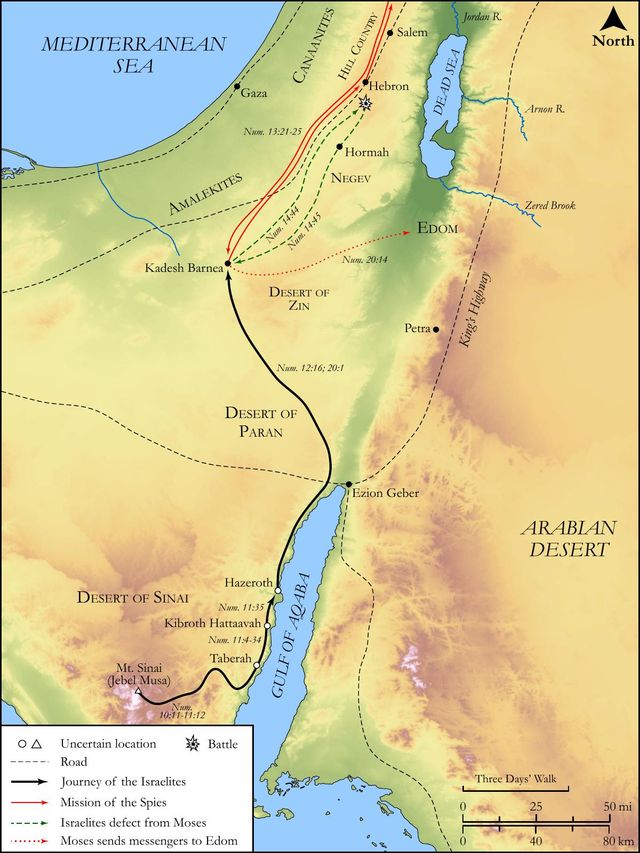
See on the biblical-era map
Study this verse
Public-domain commentary
Matthew Henry
From his Commentary on the Whole Bible. Henry comments on passages, not single verses — this entry covers Numbers 14:20–35. His four-level outline is real structure in the source text, so it is rendered as structure.
We have here God's answer to the prayer of Moses, which sings both of mercy and judgment. It is given privately to Moses (Num 14:20-25), and then directed to be made public to the people, Num 14:26-35. The frequent repetitions of the same things in it speak these resolves to be unalterable. Let us see the particulars.
I.The extremity of the sentence is receded from (Num 14:20):
"I have pardoned, so as not to cut them all off at once, and disinherit them." See the power of prayer, and the delight God takes in putting an honour upon it. He designed a pardon, but Moses shall have the praise of obtaining it by prayer: it shall be done according to thy word; thus, as a prince, he has power with God, and prevails. See what countenance and encouragement God gives to our intercessions for others, that we may be public-spirited in prayer. Here is a whole nation rescued from ruin by the effectual fervent prayer of one righteous man. See how ready God is to forgive sin, and how easy to be entreated: Pardon, says Moses (Num 14:19); I have pardoned, says God, Num 14:20. David found him thus swift to show mercy, Psa 32:5. He deals not with us after our sins, Psa 103:10.
II.The glorifying of God's name is, in the general, resolved upon, Num 14:21.
It is said, it is sworn, All the earth shall be filled with the glory of the Lord. Moses in his prayer had shown a great concern for the glory of God. "Let me alone," says God, "to secure that effectually, and to advance it, by this dispensation." All the world shall see how God hates sin even in his own people, and will reckon for it, and yet how gracious and merciful he is, and how slow to anger. Thus when our Saviour prayed, Father, glorify thy name, he was immediately answered, I have glorified it, and will glorify it yet again, Joh 12:28. Note, Those that sincerely seek God's glory may be sure of what they seek. God having turned this prayer for the glorifying of himself into a promise, we may turn it into praise, in concert with the angels, Isa 6:3, The earth is full of his glory.
III.The sin of this people which provoked God to proceed against them is here aggravated, Num 14:22, Num 14:27.
It is not made worse than really it was, but is shown to be exceedingly sinful. It was an evil congregation, each bad, but altogether in congregation, very bad.
1.They tempted God - tempted his power, whether he could help them in their straits - his goodness, whether he would - and his faithfulness, whether his promise would be performed. They tempted his justice, whether he would resent their provocations and punish them or no. They dared him, and in effect challenged him, as God does the idols (Isa 41:23), to do good, or do evil.
2.They murmured against him. This is much insisted on, Num 14:27. As they questioned what he would do, so they quarrelled with him for every thing he did or had done, continually fretting and finding fault. It does not appear that they murmured at any of the laws or ordinances that God gave them (though they proved a heavy yoke), but they murmured at the conduct they were under, and the provision made for them. Note, It is much easier to bring ourselves to the external services of religion, and observe all the formalities of devotion, than to live a life of dependence upon, and submission to, the divine Providence in the course of our conversation.
3.They did this after they had seen God's miracles in Egypt and in the wilderness, Num 14:2. They would not believe their own eyes, which were witnesses for God that he was in the midst of them of a truth.
4.They had repeated the provocations ten times, that is, very often: the Jewish writers reckon this exactly the tenth time that the body of the congregation had provoked God. First, at the Red Sea, Exo 14:11. In Marah, Exo 15:23, Exo 15:24. In the wilderness of Sin, Exo 16:2. At Rephidim, Exo 17:1, Exo 17:2. The golden calf, Ex. 32. Then at Taberah. Then at Kibroth-Hattaavah, ch. 11. And so this was the tenth. Note, God keeps an account how often we repeat our provocations, and will sooner or later set them in order before us. 5. They had not hearkened to his voice, though he had again and again admonished them of their sin.
IV.The sentence passed upon them for this sin.
1.That they should not see the promised land (Num 14:23), nor come into it, Num 14:30. He swore in his wrath that they should not enter into his rest, Psa 95:11. Note, Disbelief of the promise is a forfeiture of the benefit of it. Those that despise the pleasant land shall be shut out of it. The promise of God should be fulfilled to their posterity, but not to them.
2.That they should immediately turn back into the wilderness, Num 14:25. Their next remove should be a retreat. They must face about, and instead of going forward to Canaan, on the very borders of which they now were, they must withdraw towards the Red Sea again. Tomorrow turn you; that is, "Very shortly you shall be brought back to that vast howling wilderness which you are so weary of. And it is time to shift for your own safety, for the Amalekites lie in wait in the valley, ready to attack you if you march forward." Of them they had been distrustfully afraid (Num 13:29), and now with them God justly frightened them. The fear of the wicked shall come upon him.
3.That all those who had now grown up to men's estate should die in the wilderness, not all at once, but by degrees. They wished that they might die in the wilderness, and God said Amen to their passionate wish, and made their sin their ruin, snared them in the words of their mouth, and caused their own tongue to fall upon them, took them at their word, and determined that their carcases should fall in the wilderness, Num 14:28, Num 14:29, and again, Num 14:32, Num 14:35. See with what contempt they are spoken of, now that they had by their sin made themselves vile; the mighty men of valour were but carcases, when the Spirit of the Lord had departed from them. They were all as dead men. Their fathers had such a value for Canaan that they desired to have their dead bodies carried thither to be buried, in token of their dependence upon God's promise that they should have that land for a possession: but these, having despised that good land and disbelieved the promise of it, shall not have the honour to be buried in it, but shall have their graves in the wilderness.
4.That in pursuance of this sentence they should wander to and fro in the wilderness, like travellers that have lost themselves, for forty years; that is, so long as to make it full forty years from their coming out of Egypt to their entrance into Canaan, Num 14:33, Num 14:34. Thus long they were kept wandering,
(1.)To answer the number of the days in which the spies were searching the land. They were content to wait forty days for the testimony of men, because they could not take God's word; and therefore justly are they kept forty years waiting for the performance of God's promise.
(2.)That hereby they might be brought to repentance, and find mercy with God in the other world, whatever became of them in this. Now they had time to bethink themselves, and to consider their ways; and the inconveniences of the wilderness would help to humble them and prove them, and show them what was in their heart, Deu 8:2. Thus long they bore their iniquities, feeling the weight of God's wrath in the punishment. They were made to groan under the burden of their own sin that brought it upon them, which was too heavy for them to bear.
(3.)That they might sensibly feel what a dangerous thing it is for God's covenant-people to break with him: "You shall know my breach of promise, both the causes of it, that it is procured by your sin" (for God never leaves any till they first leave him), "and the consequences of it, that it will produce your ruin; you are quite undone when you are thrown out of covenant." (4.) That a new generation might in this time be raised up, which could not be done all of a sudden. And the children, being brought up under the tokens of God's displeasure against their fathers, and so bearing their whoredoms (that is, the punishment of their sins, especially their idolatry about the golden calf, which God now remembered against them), might take warning not to tread in the steps of their fathers' disobedience. And their wandering so long in the wilderness would make Canaan at last the more welcome to them. It should seem that upon occasion of this sentence Moses penned the ninetieth Psalm, which is very apposite to the present state of Israel, and wherein they are taught to pray that since this sentence could not be reversed it might be sanctified, and they might learn to apply their hearts unto wisdom.
V.The mercy that was mixed with this severe sentence.
1.Mercy to Caleb and Joshua, that though they should wander with the rest in the wilderness, yet they, and only they of all that were now above twenty years old, should survive the years of banishment, and live to enter Canaan. Caleb only is spoken of (Num 14:24), and a particular mark of honour put upon him, both,
(1.)In the character given of him: he had another spirit, different from the rest of the spies, an after-spirit, which furnished him with second thoughts, and he followed the Lord fully, kept close to his duty, and went through with it, though deserted and threatened; and,
(2.)In the recompence promised to him: Him will I bring in due time into the land whereinto he went. Note,
[1.]It ought to be the great care and endeavour of every one of us to follow the Lord fully. We must, in a course of obedience to God's will and of service to his honour, follow him universally, without dividing, - uprightly, without dissembling, - cheerfully, without disputing, - and constantly, without declining; and this is following him fully.
[2.]Those that would follow God fully must have another spirit, another from the spirit of the world, and another from what their own spirit has been. They must have the spirit of Caleb.
[3.]Those that follow God fully in times of general apostasy God will own and honour by singular preservations in times of general calamity. The heavenly Canaan shall be the everlasting inheritance of those that follow the Lord fully. When Caleb is again mentioned (Num 14:30) Joshua stands with him, compassed with the same favours and crowned with the same honours, having stood with him in the same services.
2.Mercy to the children even of these rebels. They should have a seed preserved, and Canaan secured to that seed: Your little ones, now under twenty years old, which you, in your unbelief, said should be a prey, them will I bring in, Num 14:31. They had invidiously charged God with a design to ruin their children, Num 14:3. But God will let them know that he can put a difference between the guilty and the innocent, and cut them off without touching their children. Thus the promise made to Abraham, though it seemed to fail for a time, was kept from failing for evermore; and, though God chastened their transgressions with a rod, yet his loving kindness he would not utterly take away.
Continue studying Numbers 14:31 across the web’s major study libraries — every link below opens this exact verse, chapter, or book on the destination site.
Read & Compare
 BibleGatewayThis verse in more than 200 translations and 70 languages.
 Bible.comThe YouVersion reader — hundreds of translations, reading plans, and highlights.
 ESV.orgCrossway's official English Standard Version reader.
 NET BibleThe NET translation with 60,000+ translators' notes on every rendering decision.
 STEP BibleTyndale House's free study tool — original text, vocabulary, and scholarly resources.
 BibliaLogos Bible Software's free web reader.
 USCCBThe New American Bible (Revised Edition) with the U.S. bishops' study notes.
Commentaries
 BibleHub CommentariesDozens of classic commentaries on this verse, gathered on one page.
 StudyLightMore than 100 commentary sets — the largest collection on the web.
 BibleRefPlain-English commentary on what this verse means, verse by verse.
 Enduring WordDavid Guzik's free commentary on this chapter, widely used by Bible teachers.
 Bible Study ToolsVerse commentary alongside Greek and Hebrew study aids.
Original Language & Research
- BibleHub InterlinearThe verse word by word — original language, transliteration, and English.
- BibleHub LexiconEvery word's original-language definition and Strong's entry.
 Blue Letter BibleDeep-study tools — Strong's numbers, concordance, and word studies.
 SefariaThe Hebrew text with Rashi and centuries of Jewish commentary.
Sermons, Hymns & Audio


TrulyRandomVerse is not affiliated with these sites and doesn’t control their content. They’re linked because they’re genuinely useful.
Summary
Numbers 14:31 serves as a profound divine declaration, powerfully contrasting God's unwavering faithfulness and covenant commitment with the profound unbelief and rebellious spirit of the Israelites during their wilderness journey. It reveals God's sovereign intent to fulfill His promise of the land, not through the generation that scorned His gift, but through the very children they feared would become prey, thereby reversing their fearful prophecy with a demonstration of His mercy, justice, and ultimate control over His redemptive plan.
Context
ShowHideLiterary Context
This verse is deeply embedded within the immediate aftermath of the twelve spies' reconnaissance mission to Canaan, as meticulously detailed in Numbers 13. Ten of the spies returned with a disheartening report, emphasizing the formidable strength of the land's inhabitants and their fortified cities, which ignited widespread despair and rebellion among the Israelite congregation. Their fear escalated to the point of contemplating a return to Egypt and even seeking new leaders, explicitly voicing concerns that their "little ones" would become "a prey" or plunder for the Canaanites, as articulated in Numbers 14:3. In response to this profound lack of faith and their direct murmuring against the Lord, God declared a severe judgment: the entire generation of adults, twenty years old and upward, would perish in the wilderness and be barred from entering the Promised Land, with the notable exceptions of Caleb and Joshua, as stated in Numbers 14:29-30. Numbers 14:31 then serves as a crucial counterpoint, highlighting God's mercy and justice by revealing the unexpected, redemptive fate of the very children they had feared for, underscoring God's sovereign ability to fulfill His promises despite human failure.
Historical & Cultural Context
The events of Numbers 14:31 unfold during the Israelites' forty-year wilderness wandering, a period immediately following their miraculous exodus from Egyptian bondage. This generation had witnessed God's mighty acts, from the plagues in Egypt to the parting of the Red Sea and the daily provision of manna. Culturally, the concept of "prey" or "spoil" was a grim reality of the warfare of that day, where conquered peoples, especially women and children, could be enslaved, killed, or assimilated. The Israelites' fear reflected a genuine, albeit faithless, concern for their families in a hostile world. Historically, the inheritance of land was central to the Abrahamic covenant, signifying rest, blessing, and the fulfillment of God's promises to His chosen people. The Israelites' rejection of the land, therefore, was not merely a logistical complaint but a profound act of rebellion against the very core of their covenant relationship with Yahweh. Their journey was meant to culminate in settlement, but their unbelief introduced a prolonged period of nomadic existence as divine discipline.
Key Themes
ShowHideNumbers 14:31 powerfully articulates several foundational theological and narrative themes. Firstly, it underscores God's Unwavering Faithfulness despite human failure. Even in the face of the parents' profound rebellion and lack of trust, God remains steadfastly committed to His covenant promises to bring a people into the land. This demonstrates God's sovereignty over human sin and His unyielding commitment to His redemptive plan, even if it requires raising up a new generation. Secondly, the verse vividly illustrates Divine Justice and Mercy. Justice is meted out upon the unbelieving generation who "despised" the land, forfeiting their inheritance, while profound mercy is extended to their innocent children, who become the inheritors of the blessing their parents rejected. This duality highlights the complexity and perfection of God's character. Finally, it emphasizes The Hope of the Next Generation. The children, whom the parents feared would be destroyed, paradoxically become the vessels through whom God's promise is fulfilled. They would "know the land," experiencing its fruitfulness and possessing it, fulfilling God's original intent for His people. This theme speaks to the resilience of God's plan and the potential for a fresh start, even after significant corporate failure, a theme powerfully echoed in Deuteronomy 1:39.
Exposition and Analysis
ShowHideKey Word Analysis
ShowHideThis term literally means 'spoil,' 'plunder,' or 'booty,' referring to goods or persons taken in war. The Israelites' use of this word reveals their deepest fear: that their children would not just die, but be captured and enslaved or killed by the Canaanites, becoming a testament to their own perceived weakness and God's supposed inability to protect them. It highlights their complete lack of faith in God's power to deliver and their projection of human warfare realities onto God's divine protection.
Derived from a primitive root meaning 'to go or come,' this word signifies God's active, intentional, and sovereign intervention. It's not that the children will accidentally stumble into the land, but that God Himself will personally escort them. This emphasizes His direct involvement in fulfilling His promise, contrasting sharply with the parents' inability and unwillingness to enter. It underscores God's initiative and power in accomplishing His purposes.
This is a strong verb meaning 'to spurn,' 'to scorn,' 'to treat with contempt,' or 'to reject with disdain.' It conveys a more severe offense than mere doubt or fear; it implies an active, willful rejection and contempt for God's promised gift—the land flowing with milk and honey. This word underscores the gravity of their rebellion and the profound insult to God's character, generosity, and covenant faithfulness.
Verse Breakdown
ShowHide"But your little ones, which ye said should be a prey"
This clause establishes a direct, divine rebuttal to the Israelites' specific, fear-driven accusation and prediction. Their words revealed their profound unbelief, imagining a horrific fate for their children at the hands of the Canaanites, thereby accusing God of being unable or unwilling to protect them. God's emphatic "But" signals a divine reversal of their faithless prophecy, setting the stage for His sovereign intervention.
"them will I bring in"
This is God's direct, sovereign declaration, asserting His power and intention to personally lead the next generation into the land, despite the parents' failure and their own fears. This demonstrates His unwavering faithfulness to His covenant promises, even when human beings prove unfaithful. It is an act of divine grace and power, ensuring the fulfillment of His word.
"and they shall know the land which ye have despised"
The verb "know" (yada') here implies not merely intellectual awareness, but experiential, intimate knowledge, possession, and enjoyment. The children will fully experience the blessings, fruitfulness, and security of the land that their parents actively scorned and rejected. This highlights the ironic and just outcome: those who feared the land will inherit it, while those who despised it will perish outside its borders, emphasizing the consequences of faith versus unbelief.
Literary Devices
ShowHideNumbers 14:31 is rich with several potent literary devices that amplify its theological weight. The most prominent is Contrast, which is central to the verse's meaning. There is a stark contrast between the parents' fearful, faithless prediction ("should be a prey") and God's redemptive, sovereign promise ("them will I bring in"). This also extends to the profound contrast between the parents' act of "despising" the land and the children's future experience of "knowing" and possessing it. This contrast underscores the chasm between human unbelief and divine faithfulness. Irony is also powerfully at play; the very children for whom the parents feared the worst fate become the inheritors of the promise, while the fearful parents forfeit their own entry. This ironic twist highlights God's ability to turn human failure into an opportunity for His purposes to prevail, demonstrating His unexpected ways. The verse is also a direct Divine Speech, a powerful declaration from God Himself, emphasizing His absolute authority, sovereignty, and the certainty of His word. The use of Repetition of Themes, particularly the "land" and the "generation," reinforces the narrative's central concerns of covenant fulfillment, the consequences of faith or unbelief, and the enduring nature of God's promises across generations.
Theological and Thematic Connections
ShowHideNumbers 14:31 is a profound theological statement on God's character and the nature of His covenant with humanity. It reveals a God who is both just in His judgment of rebellion and merciful in His provision of a way forward. The verse underscores that while human disobedience has severe consequences, it does not ultimately thwart God's sovereign plan or invalidate His promises. His faithfulness is not contingent on human perfection but on His own unchanging character and unwavering commitment to His redemptive purposes. This passage also highlights the intergenerational impact of faith and unbelief, demonstrating that while the sins of one generation can lead to forfeiture, God's grace can still extend to the next, offering a fresh opportunity for covenant relationship and blessing. It serves as a powerful reminder that God's redemptive purposes will prevail, even through unexpected means and through those whom human eyes might dismiss.
Reflection and Application
ShowHideNumbers 14:31 offers a sobering yet profoundly hopeful message for believers today. It starkly reminds us that our choices, particularly those rooted in fear, doubt, and unbelief, can have significant consequences, potentially causing us to miss out on God's promised blessings and even impacting future generations. The Israelites' failure to trust God's power and provision led to a forfeiture of their inheritance, serving as a timeless warning. This prompts us to examine our own lives: are there "promised lands"—God's callings, opportunities, or specific blessings—that we are "despising" or hesitating to enter due to fear, doubt, or a lack of faith in His ability to deliver? Yet, the verse also shines a beacon of incredible hope, demonstrating God's boundless mercy and His unwavering commitment to His ultimate purposes. Even when one generation falters, God's plan endures, often finding a way through the next. This encourages us to live lives of courageous faith, recognizing that our trust in God not only shapes our own destiny but can also pave the way for blessings and spiritual inheritance for those who come after us. It calls us to cultivate a spirit of gratitude for God's gifts and to actively pursue the inheritance He has prepared for us, rather than allowing fear or doubt to dictate our obedience and limit His work in our lives.
Questions for Reflection
ShowHideFAQ
ShowHideWhy did God punish the parents but spare the children?
ShowHideGod's judgment on the adult generation (those 20 years and older, excluding Caleb and Joshua) was a direct consequence of their profound unbelief and rebellion. They had repeatedly witnessed God's miraculous power and provision but still refused to trust Him to deliver on His promise of the land, actively choosing to murmur and even attempt to return to Egypt. This was a corporate act of contempt for God's covenant and His character. The children, however, were considered innocent of this specific act of rebellion, not having participated in the decision to reject the land. God's decision to spare them demonstrates His mercy, His unwavering commitment to His covenant promises, and His justice in holding individuals accountable for their own choices. He would fulfill His word to bring a people into the land, even if it meant raising up a new generation to receive the blessing their parents forfeited. This highlights both God's justice in punishing sin and His grace in preserving His redemptive plan.
What does "know the land" imply for the children?
ShowHide"To know the land" (Hebrew: יָדַע, yada') in this context means far more than simply having intellectual awareness of its existence or geographical features. It signifies an intimate, experiential knowledge, implying that they would possess it, live in it, cultivate it, and enjoy its blessings. It means they would inherit the land as their own, experiencing the rest, fruitfulness, and security that God had promised. This stands in stark contrast to their parents, who, despite being physically present at the border, refused to "know" it in this deeper, possessive sense due to their unbelief, thus forfeiting their entry and experience of its abundance. It speaks to the fulfillment of God's promise through a generation that would embrace His gift and live in covenant fellowship within the promised inheritance.
Is this a lesson about generational sin?
ShowHideWhile the parents' sin of unbelief had profound consequences for their children (prolonged wilderness wandering and the delay of the inheritance), this passage is not primarily about "generational sin" in the sense of children being inherently guilty of their parents' specific transgressions. Instead, it's a powerful lesson about the generational impact of choices and God's redemptive work across generations. The children were spared the judgment of their parents' rebellion and were given a fresh opportunity to enter the covenant promise. It shows that while the actions of one generation can create challenging circumstances for the next, God's mercy and faithfulness can break cycles of failure, offering a new path forward and fulfilling His purposes through those who are willing to trust Him. It emphasizes that God's ultimate plan of redemption will prevail, even if it requires raising up a new generation to carry it forward.
Christ-Centered Fulfillment
ShowHideNumbers 14:31, with its stark portrayal of unbelief's consequences and God's unwavering faithfulness to His promises, finds its ultimate Christ-centered fulfillment in the person and work of Jesus. The wilderness generation's failure to enter the physical promised land due to their unbelief serves as a profound Old Testament type for the spiritual "rest" and heavenly inheritance offered in Christ. Just as the "little ones" were brought into the land their parents despised, so too are those who believe in Jesus brought into a spiritual reality and an eternal inheritance that the world often scorns. The book of Hebrews 3:7-4:11 directly draws this parallel, warning against the same "unbelief" that prevented Israel from entering God's rest, and urging believers to strive to enter God's ultimate rest, which is found in Christ alone. Jesus is the true and greater Joshua, the one who leads His people not into a temporal land, but into the eternal kingdom of God and the new creation, as beautifully described in Revelation 21:1-4. The "prey" that the Israelites feared for their children—death and destruction—was ultimately conquered by the Lamb of God, who takes away the sin of the world through His sacrificial death and glorious resurrection. The "little ones" who entered the land represent all those who, by grace through faith, receive the spiritual blessings and eternal life that the Law and human effort could never secure, as illuminated in Ephesians 2:8-9. In Christ, we truly "know" (experientially possess) a land far greater than Canaan—the kingdom of God and intimate fellowship with the living God, a reality secured by His faithfulness, not our own fleeting trust.