


Numbers 14:32
Bible text: King James Version (1769 Blayney text) · Public domain
Bible text: King James Version with Strong's numbers · Public domain
Bible text: Berean Standard Bible · Public domain
Bible text: American Standard Version (1901) · Public domain
Bible text: World English Bible, Messianic edition · Public domain
Bible text: Geneva Bible (1599) · Public domain
Bible text: Young's Literal Translation · Public domain
- וּפִגְרֵיכֶםu·fig·rei·Khemand your corpsesH6297Conj-w ¦ N-mpc ¦ 2mpNoun Plural Masculine Constructוּandפִגְרֵיcorpsesכֶםyour
- אַתֶּם'a·TemyouH859Pro-2mpPronoun Personal 2nd Plural Masculine
- יִפְּלוּyi·pe·Luthey will fallH5307V-Qal-Imperf-3mpVerb Qal Imperfect 3rd Plural Masculine
- בַּמִּדְבָּרba·mid·Barin the wildernessH4057Prep-b ¦ N-msNoun Singular Masculine Absoluteבַּin theמִּדְבָּרwilderness
- הַזֶּהha·Zeh<the> thisH2088Art ¦ PrtParticle Demonstrativeהַ<the>זֶּהthis
English is a literal word-by-word gloss of the Hebrew, not the KJV's wording. Why?
This is the original text the KJV's translators worked from — each Hebrew word with its own literal English meaning in this verse, prepared by scholars at Tyndale House, Cambridge. The KJV translates whole sentences, not word by word, so its wording differs: one Hebrew word can become several English words, and the KJV may choose “the LORD” where the gloss reads “Yahweh”. Both are faithful — they answer different questions. For the KJV's own rendering, switch to the KJV text.
Details
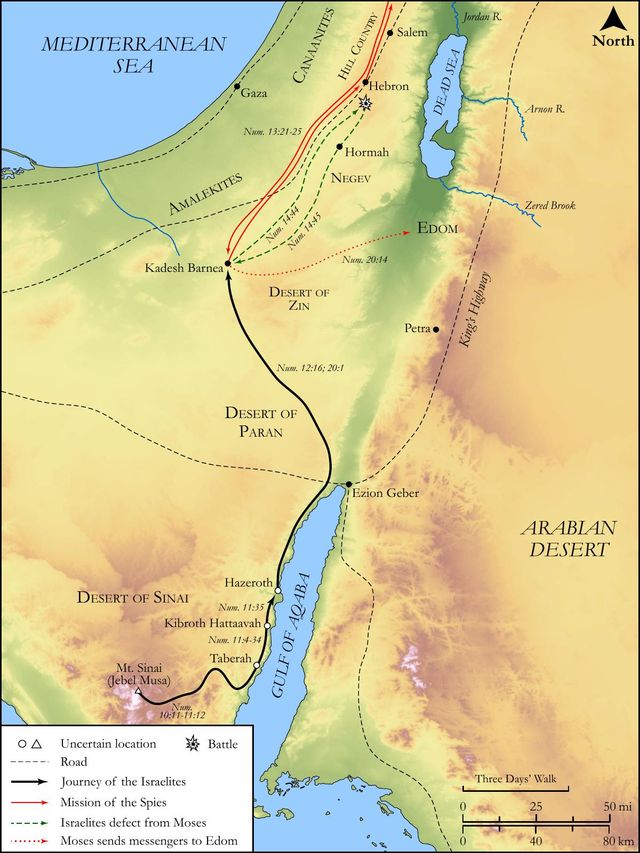
See on the biblical-era map
Study this verse
Public-domain commentary
Matthew Henry
From his Commentary on the Whole Bible. Henry comments on passages, not single verses — this entry covers Numbers 14:20–35. His four-level outline is real structure in the source text, so it is rendered as structure.
We have here God's answer to the prayer of Moses, which sings both of mercy and judgment. It is given privately to Moses (Num 14:20-25), and then directed to be made public to the people, Num 14:26-35. The frequent repetitions of the same things in it speak these resolves to be unalterable. Let us see the particulars.
I.The extremity of the sentence is receded from (Num 14:20):
"I have pardoned, so as not to cut them all off at once, and disinherit them." See the power of prayer, and the delight God takes in putting an honour upon it. He designed a pardon, but Moses shall have the praise of obtaining it by prayer: it shall be done according to thy word; thus, as a prince, he has power with God, and prevails. See what countenance and encouragement God gives to our intercessions for others, that we may be public-spirited in prayer. Here is a whole nation rescued from ruin by the effectual fervent prayer of one righteous man. See how ready God is to forgive sin, and how easy to be entreated: Pardon, says Moses (Num 14:19); I have pardoned, says God, Num 14:20. David found him thus swift to show mercy, Psa 32:5. He deals not with us after our sins, Psa 103:10.
II.The glorifying of God's name is, in the general, resolved upon, Num 14:21.
It is said, it is sworn, All the earth shall be filled with the glory of the Lord. Moses in his prayer had shown a great concern for the glory of God. "Let me alone," says God, "to secure that effectually, and to advance it, by this dispensation." All the world shall see how God hates sin even in his own people, and will reckon for it, and yet how gracious and merciful he is, and how slow to anger. Thus when our Saviour prayed, Father, glorify thy name, he was immediately answered, I have glorified it, and will glorify it yet again, Joh 12:28. Note, Those that sincerely seek God's glory may be sure of what they seek. God having turned this prayer for the glorifying of himself into a promise, we may turn it into praise, in concert with the angels, Isa 6:3, The earth is full of his glory.
III.The sin of this people which provoked God to proceed against them is here aggravated, Num 14:22, Num 14:27.
It is not made worse than really it was, but is shown to be exceedingly sinful. It was an evil congregation, each bad, but altogether in congregation, very bad.
1.They tempted God - tempted his power, whether he could help them in their straits - his goodness, whether he would - and his faithfulness, whether his promise would be performed. They tempted his justice, whether he would resent their provocations and punish them or no. They dared him, and in effect challenged him, as God does the idols (Isa 41:23), to do good, or do evil.
2.They murmured against him. This is much insisted on, Num 14:27. As they questioned what he would do, so they quarrelled with him for every thing he did or had done, continually fretting and finding fault. It does not appear that they murmured at any of the laws or ordinances that God gave them (though they proved a heavy yoke), but they murmured at the conduct they were under, and the provision made for them. Note, It is much easier to bring ourselves to the external services of religion, and observe all the formalities of devotion, than to live a life of dependence upon, and submission to, the divine Providence in the course of our conversation.
3.They did this after they had seen God's miracles in Egypt and in the wilderness, Num 14:2. They would not believe their own eyes, which were witnesses for God that he was in the midst of them of a truth.
4.They had repeated the provocations ten times, that is, very often: the Jewish writers reckon this exactly the tenth time that the body of the congregation had provoked God. First, at the Red Sea, Exo 14:11. In Marah, Exo 15:23, Exo 15:24. In the wilderness of Sin, Exo 16:2. At Rephidim, Exo 17:1, Exo 17:2. The golden calf, Ex. 32. Then at Taberah. Then at Kibroth-Hattaavah, ch. 11. And so this was the tenth. Note, God keeps an account how often we repeat our provocations, and will sooner or later set them in order before us. 5. They had not hearkened to his voice, though he had again and again admonished them of their sin.
IV.The sentence passed upon them for this sin.
1.That they should not see the promised land (Num 14:23), nor come into it, Num 14:30. He swore in his wrath that they should not enter into his rest, Psa 95:11. Note, Disbelief of the promise is a forfeiture of the benefit of it. Those that despise the pleasant land shall be shut out of it. The promise of God should be fulfilled to their posterity, but not to them.
2.That they should immediately turn back into the wilderness, Num 14:25. Their next remove should be a retreat. They must face about, and instead of going forward to Canaan, on the very borders of which they now were, they must withdraw towards the Red Sea again. Tomorrow turn you; that is, "Very shortly you shall be brought back to that vast howling wilderness which you are so weary of. And it is time to shift for your own safety, for the Amalekites lie in wait in the valley, ready to attack you if you march forward." Of them they had been distrustfully afraid (Num 13:29), and now with them God justly frightened them. The fear of the wicked shall come upon him.
3.That all those who had now grown up to men's estate should die in the wilderness, not all at once, but by degrees. They wished that they might die in the wilderness, and God said Amen to their passionate wish, and made their sin their ruin, snared them in the words of their mouth, and caused their own tongue to fall upon them, took them at their word, and determined that their carcases should fall in the wilderness, Num 14:28, Num 14:29, and again, Num 14:32, Num 14:35. See with what contempt they are spoken of, now that they had by their sin made themselves vile; the mighty men of valour were but carcases, when the Spirit of the Lord had departed from them. They were all as dead men. Their fathers had such a value for Canaan that they desired to have their dead bodies carried thither to be buried, in token of their dependence upon God's promise that they should have that land for a possession: but these, having despised that good land and disbelieved the promise of it, shall not have the honour to be buried in it, but shall have their graves in the wilderness.
4.That in pursuance of this sentence they should wander to and fro in the wilderness, like travellers that have lost themselves, for forty years; that is, so long as to make it full forty years from their coming out of Egypt to their entrance into Canaan, Num 14:33, Num 14:34. Thus long they were kept wandering,
(1.)To answer the number of the days in which the spies were searching the land. They were content to wait forty days for the testimony of men, because they could not take God's word; and therefore justly are they kept forty years waiting for the performance of God's promise.
(2.)That hereby they might be brought to repentance, and find mercy with God in the other world, whatever became of them in this. Now they had time to bethink themselves, and to consider their ways; and the inconveniences of the wilderness would help to humble them and prove them, and show them what was in their heart, Deu 8:2. Thus long they bore their iniquities, feeling the weight of God's wrath in the punishment. They were made to groan under the burden of their own sin that brought it upon them, which was too heavy for them to bear.
(3.)That they might sensibly feel what a dangerous thing it is for God's covenant-people to break with him: "You shall know my breach of promise, both the causes of it, that it is procured by your sin" (for God never leaves any till they first leave him), "and the consequences of it, that it will produce your ruin; you are quite undone when you are thrown out of covenant." (4.) That a new generation might in this time be raised up, which could not be done all of a sudden. And the children, being brought up under the tokens of God's displeasure against their fathers, and so bearing their whoredoms (that is, the punishment of their sins, especially their idolatry about the golden calf, which God now remembered against them), might take warning not to tread in the steps of their fathers' disobedience. And their wandering so long in the wilderness would make Canaan at last the more welcome to them. It should seem that upon occasion of this sentence Moses penned the ninetieth Psalm, which is very apposite to the present state of Israel, and wherein they are taught to pray that since this sentence could not be reversed it might be sanctified, and they might learn to apply their hearts unto wisdom.
V.The mercy that was mixed with this severe sentence.
1.Mercy to Caleb and Joshua, that though they should wander with the rest in the wilderness, yet they, and only they of all that were now above twenty years old, should survive the years of banishment, and live to enter Canaan. Caleb only is spoken of (Num 14:24), and a particular mark of honour put upon him, both,
(1.)In the character given of him: he had another spirit, different from the rest of the spies, an after-spirit, which furnished him with second thoughts, and he followed the Lord fully, kept close to his duty, and went through with it, though deserted and threatened; and,
(2.)In the recompence promised to him: Him will I bring in due time into the land whereinto he went. Note,
[1.]It ought to be the great care and endeavour of every one of us to follow the Lord fully. We must, in a course of obedience to God's will and of service to his honour, follow him universally, without dividing, - uprightly, without dissembling, - cheerfully, without disputing, - and constantly, without declining; and this is following him fully.
[2.]Those that would follow God fully must have another spirit, another from the spirit of the world, and another from what their own spirit has been. They must have the spirit of Caleb.
[3.]Those that follow God fully in times of general apostasy God will own and honour by singular preservations in times of general calamity. The heavenly Canaan shall be the everlasting inheritance of those that follow the Lord fully. When Caleb is again mentioned (Num 14:30) Joshua stands with him, compassed with the same favours and crowned with the same honours, having stood with him in the same services.
2.Mercy to the children even of these rebels. They should have a seed preserved, and Canaan secured to that seed: Your little ones, now under twenty years old, which you, in your unbelief, said should be a prey, them will I bring in, Num 14:31. They had invidiously charged God with a design to ruin their children, Num 14:3. But God will let them know that he can put a difference between the guilty and the innocent, and cut them off without touching their children. Thus the promise made to Abraham, though it seemed to fail for a time, was kept from failing for evermore; and, though God chastened their transgressions with a rod, yet his loving kindness he would not utterly take away.
Continue studying Numbers 14:32 across the web’s major study libraries — every link below opens this exact verse, chapter, or book on the destination site.
Read & Compare
 BibleGatewayThis verse in more than 200 translations and 70 languages.
 Bible.comThe YouVersion reader — hundreds of translations, reading plans, and highlights.
 ESV.orgCrossway's official English Standard Version reader.
 NET BibleThe NET translation with 60,000+ translators' notes on every rendering decision.
 STEP BibleTyndale House's free study tool — original text, vocabulary, and scholarly resources.
 BibliaLogos Bible Software's free web reader.
 USCCBThe New American Bible (Revised Edition) with the U.S. bishops' study notes.
Commentaries
 BibleHub CommentariesDozens of classic commentaries on this verse, gathered on one page.
 StudyLightMore than 100 commentary sets — the largest collection on the web.
 BibleRefPlain-English commentary on what this verse means, verse by verse.
 Enduring WordDavid Guzik's free commentary on this chapter, widely used by Bible teachers.
 Bible Study ToolsVerse commentary alongside Greek and Hebrew study aids.
Original Language & Research
- BibleHub InterlinearThe verse word by word — original language, transliteration, and English.
- BibleHub LexiconEvery word's original-language definition and Strong's entry.
 Blue Letter BibleDeep-study tools — Strong's numbers, concordance, and word studies.
 SefariaThe Hebrew text with Rashi and centuries of Jewish commentary.
Sermons, Hymns & Audio


TrulyRandomVerse is not affiliated with these sites and doesn’t control their content. They’re linked because they’re genuinely useful.
Summary
Numbers 14:32 delivers a severe and irreversible divine judgment upon the generation of Israelites who, after hearing the fearful report of the spies, rebelled against God's command to enter the Promised Land. This pronouncement declares that due to their profound unbelief, grumbling, and desire to return to Egypt, their bodies would not inherit the land flowing with milk and honey but would instead perish and be left in the wilderness, a stark consequence of their defiance.
Context
ShowHideLiterary Context
This verse is a direct consequence of the pivotal events described in Numbers 13 and 14. After reaching Kadesh-Barnea, Moses sent twelve spies into Canaan (Numbers 13:1-2). Ten returned with a discouraging report, exaggerating the inhabitants' strength and spreading fear (Numbers 13:31-33), leading the people to weep, grumble, and even propose appointing a new leader to return to Egypt (Numbers 14:1-4). Despite the faithful encouragement of Caleb and Joshua (Numbers 14:6-9), the people threatened to stone them. God's wrath was kindled, and He pronounced a forty-year wandering in the wilderness, during which the entire rebellious generation, aged twenty and above, would perish, with the exceptions of Caleb and Joshua (Numbers 14:26-38). Verse 32 specifically highlights the ignominious end of their physical bodies, emphasizing the finality of their exclusion from the land.
Historical & Cultural Context
The Israelites had been miraculously delivered from slavery in Egypt and sustained by God in the wilderness, a period intended for spiritual formation and preparation for nationhood. The wilderness journey was a critical test of their faith and obedience, a "school of God" where they were to learn to trust His provision and leadership. Kadesh-Barnea was the threshold of the Promised Land, the culmination of their journey from Egypt. For Israel, the Promised Land was not merely a geographical location but the tangible fulfillment of God's covenant promises to Abraham, Isaac, and Jacob (Genesis 12:1-3). To be denied entry was to be cut off from the very essence of their national and spiritual identity, a profound disgrace. The fear of the "giants" (Anakim) and fortified cities, while real, became an excuse for unbelief, demonstrating a lack of trust in the God who had already defeated Pharaoh and parted the Red Sea. Their desire to return to Egypt represented a complete rejection of their divine calling and liberation.
Key Themes
ShowHideThis verse powerfully underscores several foundational themes within the book of Numbers and the broader Pentateuch. Firstly, it highlights the severe Consequences of Disobedience and Unbelief. The Israelites' failure to trust God's power and promises, despite His consistent faithfulness, directly led to their exclusion from the land He had sworn to give them. This serves as a stark warning against a "hardened heart" (Hebrews 3:7-11). Secondly, it vividly displays Divine Judgment, demonstrating God's righteousness and justice in holding His covenant people accountable for their rebellion. While God is merciful, He is also just, and persistent unbelief incurs severe penalties, as seen in the broader narrative of Numbers. Thirdly, the theme of Exclusion from the Promised Land is paramount, symbolizing the forfeiture of divine blessing and covenant fulfillment for an entire generation. What was meant to be their inheritance became their denied destiny, a powerful echo of humanity's expulsion from Eden (Genesis 3:23-24). Finally, the Wilderness as a Place of Perishing signifies a tragic reversal; what was intended as a temporary passage and a place of divine provision became a graveyard for those who refused to walk by faith, transforming a place of testing into a place of judgment.
Exposition and Analysis
ShowHideKey Word Analysis
ShowHideThis term, H6297, specifically refers to a dead body, often one that is unburied or left to rot. Its use here for human remains is particularly stark and ignominious, emphasizing a dishonorable end. It highlights that their bodies, which embodied their physical rebellion and earthly desires, would become mere refuse in the wilderness, denied the honor of burial in the promised land. The word carries a sense of contempt and finality, underscoring the severity of God's judgment.
The verb "fall," H5307, conveys the inevitability, certainty, and completeness of their demise. It is not merely a prediction of death but a divine decree, signifying that their lives would be cut short as a direct consequence of their actions. This word implies a sudden, decisive end, emphasizing the finality of God's judgment and the futility of their rebellion against His will. It speaks to a collapse, a giving way, under the weight of divine wrath.
This term, H4057, refers to an uncultivated, often desolate region, a pasture where cattle are driven, or by implication, a desert. In this context, it signifies the very place where God had miraculously sustained them and revealed His glory. Its transformation into a graveyard for the rebellious generation highlights the tragic irony: the place of divine provision becomes the place of divine judgment, sealing their fate outside the Promised Land.
Verse Breakdown
ShowHide"But [as for] you,"
This phrase marks a sharp distinction and a direct, personal address of judgment. It sets apart the rebellious generation from the faithful exceptions (Caleb and Joshua) and the innocent children, emphasizing that the judgment is specifically targeted at those who demonstrated unbelief and defiance. It highlights the divine specificity and justice in the pronouncement, underscoring that accountability is individual as well as corporate.
"your carcases,"
This noun, as discussed above, emphasizes the physical, ignominious end awaiting them. Their very bodies, which had grumbled and desired to return to Egypt, would be left to perish without honor. It's a visceral image of death and decay, underscoring the severity and finality of their punishment and the complete forfeiture of their earthly hopes and desires.
"they shall fall"
This declarative statement conveys the absolute certainty and inevitability of their demise. It is a divine decree, not a mere prediction. Their death is presented as a direct, unavoidable consequence of their actions and God's righteous judgment, emphasizing the power and faithfulness of God's word, whether in blessing or judgment. The passive voice ("shall fall") implies that this outcome is divinely ordained and inescapable.
"in this wilderness."
The location of their demise is critically significant. The wilderness, the very place where God had miraculously sustained them with manna and water, where He had revealed His glory and given them His law, now becomes their graveyard. This highlights the tragic irony of their rebellion: they rejected the Promised Land and found death in the very place of their testing and divine provision, a stark symbol of unfulfilled promise and divine consequence.
Literary Devices
ShowHideNumbers 14:32 employs several powerful literary devices to convey its message of divine judgment. The most prominent is Divine Pronouncement, as the verse is a direct, authoritative statement from God Himself, emphasizing His sovereignty and the absolute certainty of His word. This direct address underscores the personal nature of God's relationship with His people, both in covenant and in judgment. Symbolism is also heavily at play; the "wilderness" transforms from a place of testing and divine provision into a symbol of judgment, death, and unfulfilled promise for the rebellious generation. Their "carcases" symbolize the ultimate, ignominious consequence of unbelief and rebellion, a physical manifestation of their spiritual failure and separation from God's blessing. Furthermore, there is a profound Irony in the judgment: the Israelites, who longed to return to the perceived security of Egypt rather than face the challenges of the Promised Land, are condemned to perish in the very wilderness they despised, neither reaching the land of promise nor returning to their former bondage. This ironic twist highlights the futility of resisting God's will.
Theological and Thematic Connections
ShowHideNumbers 14:32 serves as a foundational narrative illustrating the profound biblical truth that persistent unbelief and rebellion against God's revealed will carry severe consequences. It underscores God's holiness and justice, demonstrating that while His patience is vast, His covenant relationship demands faith and obedience. This judgment highlights the principle that God's promises are conditional upon a trusting response from humanity. The failure of this generation to enter the Promised Land stands as a perpetual warning throughout Scripture, emphasizing that outward privilege (being God's chosen people, experiencing miracles) does not guarantee salvation or blessing if the heart remains hardened in unbelief. It teaches that true faith is demonstrated by courageous obedience, even in the face of daunting obstacles, and that grumbling and a desire to retreat from God's path ultimately lead to spiritual and physical demise. This passage vividly portrays God's unwavering commitment to His covenant, both in blessing the obedient and judging the rebellious.
Reflection and Application
ShowHideNumbers 14:32 is not merely a historical account of ancient judgment but a timeless warning and a profound call to faith for every generation. It compels us to examine the state of our own hearts, asking whether we truly trust God's promises and power, especially when faced with daunting challenges or "giants" in our lives. When circumstances seem overwhelming, and fear tempts us to doubt God's leading or retreat from His path, this verse reminds us that succumbing to unbelief and grumbling can lead to spiritual stagnation and prevent us from entering into the full blessings and "promised lands" God has for us. It challenges us to cultivate a spirit of courageous faith, perseverance, and obedience, remembering that God's faithfulness is constant, even when our circumstances are difficult. Our journey with God requires active trust, not passive complaint, ensuring that our "wilderness" experiences become opportunities for growth and deeper reliance on Him, rather than places of spiritual demise. This passage encourages us to learn from the mistakes of the past, choosing to walk by faith so that we may fully inherit all that God has promised.
Questions for Reflection
ShowHideFAQ
ShowHideWas God's judgment on the Israelites in Numbers 14:32 too harsh or unfair?
ShowHideFrom a human perspective, the judgment may seem severe, but from a divine perspective, it was a righteous and just consequence for persistent and profound rebellion. God had miraculously delivered Israel from slavery, sustained them in the wilderness, and repeatedly demonstrated His faithfulness. Their rebellion at Kadesh-Barnea was not an isolated incident but the culmination of a pattern of grumbling, unbelief, and a desire to return to Egypt, rejecting God's direct command and His covenant promises. The judgment underscored God's holiness and the seriousness of breaking covenant with Him. It also served as a necessary purification, ensuring that only a generation committed to faith and obedience would enter the Promised Land, thus preserving the integrity of the covenant and the future nation of Israel. It was a demonstration that God cannot be trifled with, and His character demands a response of trust and obedience from His people, as highlighted in Deuteronomy 8:2-3.
Who were the exceptions to this judgment, and why?
ShowHideThe exceptions to this judgment were Caleb, son of Jephunneh, and Joshua, son of Nun. Numbers 14:30 explicitly states that they alone, of that generation aged twenty and above, would enter the Promised Land. Their exception was due to their unwavering faith and "different spirit" (Numbers 14:24) and their "wholehearted following" of the Lord (Numbers 32:11-12). While the other ten spies and the rest of the congregation succumbed to fear and unbelief, Caleb and Joshua urged the people to trust God's power to deliver the land, embodying the very faith that God required. Their lives serve as a testament to the blessings of obedience and trust in God, standing in stark contrast to the faithlessness of their peers.
Christ-Centered Fulfillment
ShowHideNumbers 14:32, with its stark pronouncement of judgment and exclusion from the Promised Land due to unbelief, finds its ultimate Christ-centered fulfillment in several profound ways. The wilderness journey of Israel, marked by testing, rebellion, and the consequence of death, serves as a powerful type and shadow pointing to the greater spiritual journey and the ultimate "rest" offered in Christ. Just as the Israelites failed to enter the earthly Canaan due to their lack of faith, humanity, by nature, is alienated from God's true spiritual rest due to sin and unbelief (Romans 3:23). Jesus Christ, however, is the true and faithful Israelite, who perfectly trusted God even during His own forty-day wilderness temptation, overcoming where Israel failed and demonstrating perfect obedience (Matthew 4:1-11). He is the new and better Moses, leading His people not to an earthly land, but to a heavenly one, to the very presence of God. The "carcases" falling in the wilderness speak to the wages of sin (Romans 6:23), which Christ fully bore on the cross, becoming the ultimate sacrifice that takes away the sin of the world (John 1:29). Our entry into God's true spiritual rest and heavenly inheritance is not by our perfect obedience or lack of grumbling, but by grace through faith in Christ's finished work (Ephesians 2:8-9). He is the "pioneer and perfecter of our faith" (Hebrews 12:2), enabling us to enter the "rest" that the wilderness generation forfeited, a rest found eternally in Him (Hebrews 4:9-10). Through Christ, the judgment of the wilderness is overcome, and the true Promised Land of eternal life is opened to all who believe.