


Numbers 21:8
Bible text: King James Version (1769 Blayney text) · Public domain
Bible text: King James Version with Strong's numbers · Public domain
Bible text: Berean Standard Bible · Public domain
Bible text: American Standard Version (1901) · Public domain
Bible text: World English Bible, Messianic edition · Public domain
Bible text: Geneva Bible (1599) · Public domain
Bible text: Young's Literal Translation · Public domain
- וַיֹּאמֶרvai·Yo·merand he saidH559Conj-w ¦ V-Qal-ConsecImperf-3msVerb Qal Consecutive Imperfect 3rd Singular Masculineוַandיֹּאמֶרhe said
- יְהוָהYah·wehYahwehH3068N-properNoun Proper Title
- אֶל'eltoH413PrepPreposition
- מֹשֶׁהmo·ShehMosesH4872N-proper-mNoun Proper Masculine
- עֲשֵׂה'a·SehmakeH6213V-Qal-Imp-2msVerb Qal Imperative 2nd Singular Masculine
- לְךָle·Khafor <the> yourselfPrep-l ¦ 2msSuffix Personal 2nd Singular Masculineלְfor <the>ךָyourself
- שָׂרָףsa·Rafa saraphH8314N-msNoun Singular Masculine Absolute
- וְשִׂיםve·Simand putH7760Conj-w ¦ V-Qal-Imp-2msVerb Qal Imperative 2nd Singular Masculineוְandשִׂיםput
- אֹתוֹ'o·To<obj.> itH853DirObjM ¦ 3msParticle Object Indicatorאֹת<obj.>וֹit
- עַל'alonH5921PrepPreposition
- נֵסNesa standardH5251N-msNoun Singular Masculine Absolute
- וְהָיָהve·ha·Yahand it will beH1961Conj-w ¦ V-Qal-ConsecPerf-3msVerb Qal Consecutive Perfect 3rd Singular Masculineוְandהָיָהit will be
- כָּלkoleveryH3605N-mscNoun Singular Masculine Construct
- הַנָּשׁוּךְha·na·Shukh<the> [one who] is bittenH5391Art ¦ V-Qal-PassPrtcpl-msVerb Qal Participle Passive Singular Masculine Absoluteהַ<the>נָּשׁוּךְ[one who] is bitten
- וְרָאָהve·ra·'Ahand he will seeH7200Conj-w ¦ V-Qal-ConsecPerf-3msVerb Qal Consecutive Perfect 3rd Singular Masculineוְandרָאָהhe will see
- אֹתוֹ'o·To<obj.> itH853DirObjM ¦ 3msParticle Object Indicatorאֹת<obj.>וֹit
- וָחָיva·Chaiand he will liveH2421Conj-w ¦ V-Qal-ConsecPerf-3msVerb Qal Consecutive Perfect 3rd Singular Masculineוָandחָיhe will live
English is a literal word-by-word gloss of the Hebrew, not the KJV's wording. Why?
This is the original text the KJV's translators worked from — each Hebrew word with its own literal English meaning in this verse, prepared by scholars at Tyndale House, Cambridge. The KJV translates whole sentences, not word by word, so its wording differs: one Hebrew word can become several English words, and the KJV may choose “the LORD” where the gloss reads “Yahweh”. Both are faithful — they answer different questions. For the KJV's own rendering, switch to the KJV text.
Details
See on the biblical-era maps
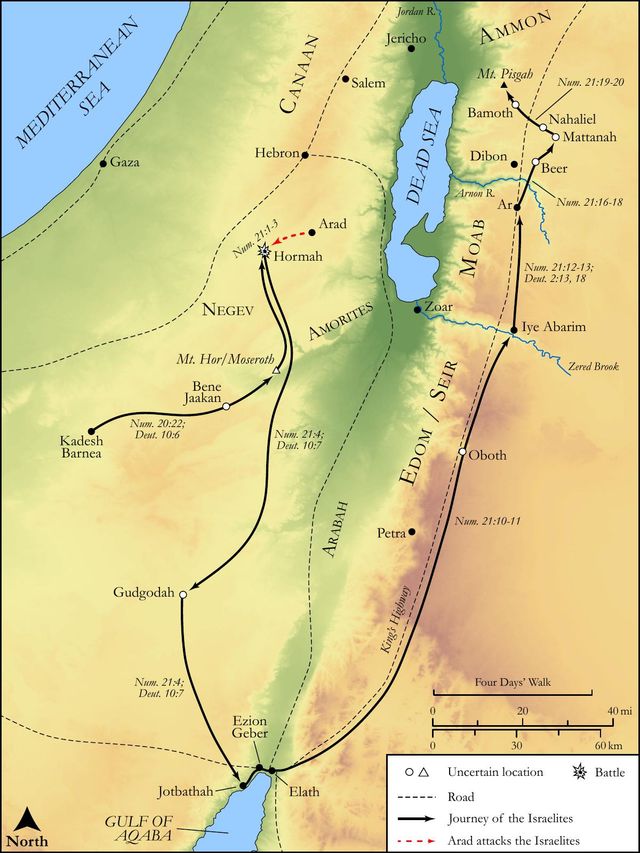
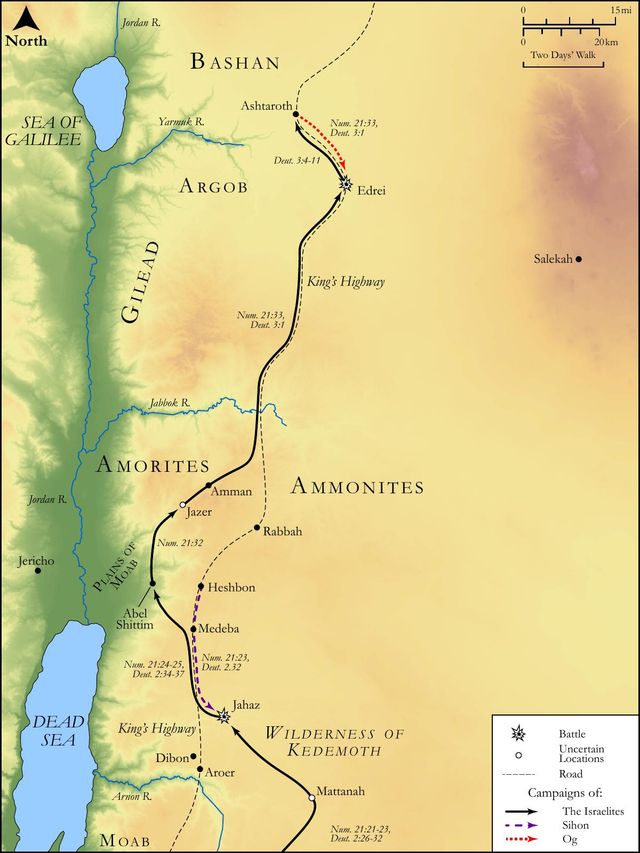
Study this verse
Public-domain commentary
Matthew Henry
From his Commentary on the Whole Bible. Henry comments on passages, not single verses — this entry covers Numbers 21:4–9. His three-level outline is real structure in the source text, so it is rendered as structure.
Here is, I. The fatigue of Israel by a long march round the land of Edom, because they could not obtain passage through it the nearest way: The soul of the people was much discouraged because of the way, Num 21:4. Perhaps the way was rough and uneven, or foul and dirty; or it fretted them to go far about, and that they were not permitted to force their passage through the Edomites' country. Those that are of a fretful discontented spirit will always find something or other to make them uneasy.
II.Their unbelief and murmuring upon this occasion, Num 21:5.
Though they had just now obtained a glorious victory over the Canaanites, and were going on conquering and to conquer, yet they speak very discontentedly of what God had done for them and distrustfully of what he would do, vexed that they were brought out of Egypt, that they had not bread and water as other people had by their own care and industry, but by miracle, they knew not how. They have bread enough and to spare; and yet they complain there is no bread, because, though they eat angels' food, yet they are weary of it; manna itself is loathed, and called light bread, fit for children, not for men and soldiers. What will those be pleased with whom manna will not please? Those that are disposed to quarrel will find fault where there is no fault to be found. Thus those who have long enjoyed the means of grace are apt to surfeit even on the heavenly manna, and to call it light bread. But let not the contempt which some cast upon the word of God cause us to value it the less: it is the bread of life, substantial bread, and will nourish those who by faith feed upon it to eternal life, whoever calls it light bread.
III.The righteous judgment which God brought upon them for their murmuring, Num 21:6.
He sent fiery serpents among them, which bit or stung many of them to death. The wilderness through which they had passed was all along infested with those fiery serpents, as appears, Deu 8:15. but hitherto God had wonderfully preserved his people from receiving hurt by them, till now that they murmured, to chastise them for which these animals, which hitherto had shunned their camp, now invade it. Justly are those made to feel God's judgments that are not thankful for his mercies. These serpents are called fiery, from their colour, or from their rage, or from the effects of their bitings, inflaming the body, putting it immediately into a high fever, scorching it with an insatiable thirst. They had unjustly complained for want of water (Num 21:5), to chastise them for which God sends upon them this thirst, which no water would quench. Those that cry without cause have justly cause given them to cry out. They distrustfully concluded that they must die in the wilderness, and God took them at their word, chose their delusions, and brought their unbelieving fears upon them; many of them did die. They had impudently flown in the face of God himself, and the poison of asps was under their lips, and now these fiery serpents (which, it should seem, were flying serpents, Isa 14:29) flew in their faces and poisoned them. They in their pride had lifted themselves up against God and Moses, and now God humbled and mortified them, by making these despicable animals a plague to them. That artillery is now turned against them which had formerly been made use of in their defence against the Egyptians. He that brought quails to feast them let them know that he could bring serpents to bite them; the whole creation is at war with those that are in arms against God.
IV.Their repentance and supplication to God under this judgment, Num 21:7.
They confess their fault: We have sinned. They are particular in their confession: We have spoken against the Lord, and against thee. It is to be feared that they would not have owned the sin if they had not felt the smart; but they relent under the rod; when he slew them, then they sought him. They beg the prayers of Moses for them, as conscious to themselves of their own unworthiness to be heard, and convinced of the great interest which Moses had in heaven. How soon is their tone altered! Those who had just before quarrelled with him as their worst enemy now make their court to him as their best friend, and choose him for their advocate with God. Afflictions often change men's sentiments concerning God's people, and teach them to value those prayers which, at a former period, they had scorned. Moses, to show that he had heartily forgiven them, blesses those who had cursed him, and prays for those who had despitefully used him Herein he was a type of Christ, who interceded for his persecutors, and a pattern to us to go and do likewise, and thus to show that we love our enemies.
V.The wonderful provision which God made for their relief.
He did not employ Moses in summoning the judgment, but, that he might recommend him to the good affection of the people, he made him instrumental in their relief, Num 21:8, Num 21:9. God ordered Moses to make the representation of a fiery serpent, which he did, in brass, and set it up on a very long pole, so that it might be seen from all parts of the camp, and every one that was stung with a fiery serpent was healed by looking up to this serpent of brass. The people prayed that God would take away the serpents from them (Num 21:7), but God saw fit not to do this: for he gives effectual relief in the best way, though not in our way. Thus those who did not die for their murmuring were yet made to smart for it, that they might the more feelingly repent and humble themselves for it; they were likewise made to receive their cure from God, by the hand of Moses, that they might be taught, if possible, never again to speak against God and Moses. This method of cure was altogether miraculous, and the more wonderful if what some naturalists say be true, that looking upon bright and burnished brass is hurtful to those that are stung with fiery serpents. God can bring about his purposes by contrary means. The Jews themselves say that it was not the sight of the brazen serpent that cured them, but, in looking up to it, they looked up to God as the Lord that healed them. But there was much of gospel in this appointment. Our Saviour has told us so (Joh 3:14, Joh 3:15), that as Moses lifted up the serpent in the wilderness so the Son of man must be lifted up, that whosoever believeth in him should not perish. Observe then a resemblance,
1.Between their disease and ours. The devil is the old serpent, a fiery serpent, hence he appears (Rev 12:3) as a great red dragon. Sin is the biting of this fiery serpent; it is painful to the startled conscience, and poisonous to the seared conscience. Satan's temptations are called his fiery darts, Eph 6:16. Lust and passion inflame the soul, so do the terrors of the Almighty, when they set themselves in array. At the last, sin bites like a serpent and stings like an adder; and even its sweets are turned into the gall of asps.
2.Between their remedy and ours.
(1.)It was God himself that devised and prescribed this antidote against the fiery serpents; so our salvation by Christ was the contrivance of Infinite Wisdom; God himself has found the ransom.
(2.)It was a very unlikely method of cure; so our salvation by the death of Christ is to the Jews a stumbling-block and to the Greeks foolishness. It was Moses that lifted up the serpent in the wilderness, so the law is a schoolmaster to bring us to Christ, and Moses wrote of him, Joh 3:14-16. Christ was lifted up by the rulers of the Jews, who were the successors of Moses.
(3.)That which cured was shaped in the likeness of that which wounded. So Christ, though perfectly free from sin himself, yet was made in the likeness of sinful flesh (Rom 8:3), so like that it was taken for granted that this man was a sinner, Joh 9:24.
(4.)The brazen serpent was lifted up; so was Christ. He was lifted up upon the cross (Joh 12:33, Joh 12:34), for his was made a spectacle to the world. He was lifted up by the preaching of the gospel. The word here used for a pole signifies a banner, or ensign, for Christ crucified stands for an ensign of the people, Isa 11:10. Some make the lifting up of the serpent to be a figure of Christ's triumphing over Satan, the old serpent, whose head he bruised, when in his cross he made an open show of the principalities and powers which he had spoiled and destroyed, Col 2:15.
3.Between the application of their remedy and ours. They looked and lived, and we, if we believe, shall not perish; it is by faith that we look unto Jesus, Heb 12:2. Look unto me, and be you saved, Isa 45:22. We must be sensible of our wound and of our danger by it, receive the record which God has given concerning his Son, and rely upon the assurance he has given us that we shall be healed and saved by him if we resign ourselves to his direction. The brazen serpent's being lifted up would not cure if it was not looked upon. If any pored on their wound, and would not look up to the brazen serpent, they inevitably died. If they slighted this method of cure, and had recourse to natural medicines, and trusted to them, they justly perished; so if sinners either despise Christ's righteousness or despair of benefit by it their wound will, without doubt, be fatal. But whoever looked up to this healing sign, though from the outmost part of the camp, though with a weak and weeping eye, was certainly healed; so whosoever believes in Christ, though as yet but weak in faith, shall not perish. There are weak brethren for whom Christ died. Perhaps for some time after the serpent was set up the camp of Israel was molested by the fiery serpents; and it is the probable conjecture of some that they carried this brazen serpent along with them through the rest of their journey, and set it up wherever they encamped, and, when they settled in Canaan, fixed it somewhere within the borders of the land; for it is not likely that the children of Israel went so far off as this was into the wilderness to burn incense to it, as we find they did, Kg2 18:4. Even those that are delivered from the eternal death which is the wages of sin must expect to feel the pain and smart of it as long as they are here in this world; but, if it be not our own fault, we may have the brazen serpent to accompany us, to be still looked up to upon all occasions, by bearing about with us continually the dying of the Lord Jesus.
Historical interpretation
Historical reception
1 surviving comment on this verse from the historical church.
Many things were done in figure which were done in former times. For when he said that the fathers who were bitten by serpents in the desert could not be healed in any other way except that Moses hung up a brazen serpent, and when this was seen, those deadly bites and injurious effects of the poison were cured, he added: But these things were done in figure to instruct us (1 Corinthians 10:6). In the image, a bronze serpent was placed on a cross; because the true one to be crucified was announced to the human race, who would empty the venom of the devilish serpent, cursed in its image, but in truth, would erase all curses of the world.
Continue studying Numbers 21:8 across the web’s major study libraries — every link below opens this exact verse, chapter, or book on the destination site.
Read & Compare
 BibleGatewayThis verse in more than 200 translations and 70 languages.
 Bible.comThe YouVersion reader — hundreds of translations, reading plans, and highlights.
 ESV.orgCrossway's official English Standard Version reader.
 NET BibleThe NET translation with 60,000+ translators' notes on every rendering decision.
 STEP BibleTyndale House's free study tool — original text, vocabulary, and scholarly resources.
 BibliaLogos Bible Software's free web reader.
 USCCBThe New American Bible (Revised Edition) with the U.S. bishops' study notes.
Commentaries
 BibleHub CommentariesDozens of classic commentaries on this verse, gathered on one page.
 StudyLightMore than 100 commentary sets — the largest collection on the web.
 BibleRefPlain-English commentary on what this verse means, verse by verse.
 Enduring WordDavid Guzik's free commentary on this chapter, widely used by Bible teachers.
 Bible Study ToolsVerse commentary alongside Greek and Hebrew study aids.
Original Language & Research
- BibleHub InterlinearThe verse word by word — original language, transliteration, and English.
- BibleHub LexiconEvery word's original-language definition and Strong's entry.
 Blue Letter BibleDeep-study tools — Strong's numbers, concordance, and word studies.
 SefariaThe Hebrew text with Rashi and centuries of Jewish commentary.
Sermons, Hymns & Audio


TrulyRandomVerse is not affiliated with these sites and doesn’t control their content. They’re linked because they’re genuinely useful.
Summary
Numbers 21:8 records a pivotal divine instruction given to Moses during the Israelites' wilderness wanderings, offering a unique and symbolic means of salvation from a plague of venomous serpents. Following the people's grumbling and God's subsequent judgment, this verse details the LORD's merciful provision: the construction of a bronze serpent on a pole, through which anyone bitten could look and live, thereby illustrating God's sovereign power to heal and His unexpected pathways to redemption for a repentant people.
Context
ShowHideLiterary Context
Numbers 21:8 is situated within a critical narrative segment (Numbers 21:4-9) that immediately follows the Israelites' departure from Mount Hor and the death of Aaron. The people, growing impatient and weary from the difficult journey around Edom, once again succumb to their habitual grumbling, speaking against God and Moses. Their complaints specifically target the lack of water and the "worthless food" (manna) provided by God, revealing a deep-seated ingratitude and lack of trust. In response to this rebellion, the LORD sends "fiery serpents" (Numbers 21:6) among them, whose venomous bites cause widespread suffering and death. This severe judgment prompts the people to confess their sin and appeal to Moses for intercession. Verse 8, therefore, represents God's gracious, though profoundly symbolic, response to their repentance, offering a path to physical healing and life amidst the deadly consequences of their sin.
Historical & Cultural Context
The wilderness journey of the Israelites was a period of divine testing and formation, designed to refine their faith and prepare them for entry into the Promised Land. The setting is the arid desert region, where encounters with snakes and scorpions were common dangers. The "fiery serpents" (Hebrew: nehashim seraphim) were likely highly venomous snakes whose bites caused intense burning pain, leading to inflammation and death. The act of setting an object on a pole or standard (Hebrew: nes) was a common practice, often used for military banners or signals, as in the name Jehovah-nissi that Moses gave the altar at Rephidim. While some pagan cultures used serpent imagery for healing deities (e.g., Asclepius), God's command here is distinct. It is not an endorsement of idolatry but a divinely ordained, counter-intuitive act of faith, demanding trust in His specific, revealed method of salvation, rather than a magical charm or a pagan ritual.
Key Themes
ShowHideThis passage powerfully underscores several core themes prevalent throughout the book of Numbers and the Pentateuch. Firstly, it highlights the recurring cycle of Israel's rebellion and God's judgment, a pattern seen from the golden calf incident in Exodus 32 to the various complaints in the wilderness. Secondly, it demonstrates God's persistent grace and mercy even in the midst of righteous judgment; His desire is not merely to punish but to provide a way back to life for those who repent and obey. The provision of the bronze serpent serves as a potent illustration of salvation through faith and obedience, where a simple act of "looking" becomes the conduit for divine healing. This event also serves as a profound foreshadowing of Christ, a theme explicitly drawn out in the New Testament, where Jesus Himself connects the lifting up of the serpent to His own crucifixion and the offer of eternal life to those who believe in Him (see John 3:14-15). The narrative emphasizes that God's solutions are often counter-intuitive and require absolute trust in His revealed will, regardless of human logic.
Exposition and Analysis
ShowHideKey Word Analysis
ShowHideThe Hebrew term שָׂרָף (sârâph, H8314) literally means "burning one." It refers to the type of serpent whose bite caused a burning sensation, inflammation, and fever, ultimately leading to death. This same root is used to describe the angelic beings, the seraphim, in Isaiah 6:2, perhaps alluding to their radiant, fiery appearance or their role as "burning" with divine zeal. In the context of Numbers 21, it emphasizes the intense, painful, and deadly nature of the judgment.
The Hebrew word נֵס (nêç, H5251) refers to a standard, banner, or signal pole. It was a high, visible object used for rallying troops, marking a place, or signaling. By placing the serpent on a nêç, God ensured it would be conspicuously displayed, accessible to all who needed to see it from a distance. This term highlights the public and visible nature of God's provision for salvation, making it clear that healing was available to anyone who would look.
The Hebrew verb חָיָה (châyay, H2425) means "to live" or, causatively, "to revive." In this context, it signifies not merely survival but a restoration to health and vitality from the brink of death. It underscores the miraculous nature of God's intervention, transforming a fatal condition into life through a simple act of faith-filled obedience.
Verse Breakdown
ShowHide"And the LORD said unto Moses, Make thee a fiery serpent"
This opening clause establishes the divine origin of the command, emphasizing that this unusual solution is God's direct instruction, not a human invention or a magical remedy. Moses is merely the instrument through whom God's will is enacted. The specific instruction to make a "fiery serpent" (likely a bronze or copper effigy, as implied by later tradition) is deliberately paradoxical, as the very image of the instrument of judgment becomes the means of salvation.
"and set it upon a pole"
This command specifies the method of display. The serpent was to be elevated on a nes, a standard or pole, ensuring its visibility to all the afflicted Israelites. This public display underscores the universal availability of God's grace to all who would look, regardless of their position in the camp, and highlights the need for a clear, focal point for faith.
"and it shall come to pass, that every one that is bitten, when he looketh upon it, shall live"
This final clause articulates the miraculous outcome and the condition for healing. The healing is not automatic; it is contingent upon a deliberate act of "looking" (Hebrew: nabat - to gaze, to behold attentively) toward the elevated serpent. This act of looking is not merely visual but signifies an act of faith, trust, and obedience in God's counter-intuitive method of salvation. It is a simple, yet profound, act of reliance on God's word, demonstrating that salvation is by grace through faith.
Literary Devices
ShowHideThe passage in Numbers 21:8 employs several significant literary devices. Most prominently, it uses Symbolism, where the bronze serpent on the pole serves as a powerful symbol. It is a paradoxical symbol, as the very image of the instrument of death becomes the means of life, foreshadowing the profound mystery of Christ's crucifixion. The act of "looking" also functions as Metonymy or Synecdoche, where a physical action (looking) stands for a deeper spiritual reality (faith, trust, obedience). Furthermore, the entire narrative functions as a Type, an Old Testament event or person that prefigures a New Testament reality. The bronze serpent is a clear type of Jesus Christ, whose "lifting up" on the cross provides spiritual salvation to all who look to Him in faith. The narrative also exhibits Divine Irony, as God uses the very image of the "fiery serpent" – the instrument of judgment – as the vehicle for His mercy and healing, subverting human expectations and highlighting His sovereign power over sin and death.
Theological and Thematic Connections
ShowHideNumbers 21:8 is a profound theological statement on God's nature and the pathway to salvation. It reveals that God, while just in His judgment against sin, is also boundless in His mercy and always provides a way for repentance and life. The seemingly absurd command to look at a bronze serpent for healing underscores that God's ways are higher than human ways, and salvation is often found through unexpected, divinely appointed means that demand simple faith rather than complex rituals or human effort. This event serves as a foundational Old Testament illustration of salvation by grace through faith, pointing forward to the ultimate provision in Christ.
Reflection and Application
ShowHideThe account of the bronze serpent in Numbers 21:8 offers timeless lessons for believers today, reminding us that the human condition, marked by rebellion and sin, always stands in need of divine intervention. Just as the Israelites faced the deadly consequences of their grumbling, we too face the spiritual death that sin brings. Yet, God's response is not solely judgment but also an outstretched hand of mercy. Our healing, both spiritual and sometimes physical, comes not through our own merit or effort, but through a simple, obedient act of faith in God's provided solution. This passage challenges us to examine where we are placing our trust: in our own abilities, in worldly solutions, or in the unique and often counter-intuitive wisdom of God. It calls us to humble ourselves, confess our sins, and "look" to the One whom God has lifted up for our salvation, trusting fully in His power to deliver us from death to life.
Questions for Reflection
ShowHideFAQ
ShowHideWhy did God use a serpent, the symbol of evil and the instrument of their judgment, as the means of their salvation?
ShowHideThis is a profound example of God's divine wisdom and irony. By commanding Moses to make a "fiery serpent" and lift it up, God used the very image of the instrument of judgment and death as the means of salvation. This was not an endorsement of idolatry or serpent worship, but a deliberate paradox designed to highlight that healing and life come only from God, often through unexpected and counter-intuitive means. It required a radical act of faith to look at the very thing that caused their suffering as the source of their cure. Theologically, it foreshadows how God would use the "curse" of the cross, where Jesus was "made sin" for us (2 Corinthians 5:21), to bring about the ultimate salvation for humanity. It demonstrates God's sovereignty over evil and His ability to redeem even the most dire situations.
Christ-Centered Fulfillment
ShowHideThe narrative of the bronze serpent in Numbers 21:8 finds its ultimate and most profound fulfillment in Jesus Christ. Just as the serpent was "lifted up" in the wilderness so that those who looked upon it might live physically, so too was Jesus "lifted up" on the cross, not as a symbol of judgment, but as the Lamb of God who takes away the sin of the world, offering eternal life to all who believe. Jesus Himself draws this explicit parallel in John 3:14-15, stating, "And as Moses lifted up the serpent in the wilderness, even so must the Son of Man be lifted up, that whoever believes in Him should not perish but have eternal life." The physical act of "looking" in Numbers prefigures the spiritual act of "believing" in Christ. The venom of the serpents brought physical death, mirroring the spiritual death that sin brings to all humanity (see Romans 6:23). Christ's sacrifice on the cross became the divine antidote, the sovereign remedy for the universal plague of sin, inviting all to look to Him in faith and receive not just physical healing, but eternal life and reconciliation with God (see 2 Corinthians 5:21). The bronze serpent was a temporary provision for a specific physical ailment; Jesus Christ is the eternal, complete, and final provision for the spiritual ailment of sin, offering salvation that transcends time and circumstance to all who fix their gaze upon Him (see Hebrews 12:2).