


Joshua 24:14
- וְעַתָּהve·'a·Tahand thereforeH6258Conj-w ¦ AdvAdverbוְandעַתָּהtherefore
- יְראוּye·R·'ufearH3372V-Qal-Imp-2mpVerb Qal Imperative 2nd Plural Masculine
- אֶת'et<obj.>H853DirObjMParticle Object Indicator
- יְהוָהYah·wehYahwehH3068N-properNoun Proper Title
- וְעִבְדוּve·'iv·Duand serveH5647Conj-w ¦ V-Qal-Imp-2mpVerb Qal Imperative 2nd Plural Masculineוְandעִבְדוּserve
- אֹתוֹ'o·To<obj.> himH853DirObjM ¦ 3msParticle Object Indicatorאֹת<obj.>וֹhim
- בְּתָמִיםbe·ta·Mimin integrityH8549Prep-b ¦ Adj-msAdjective Singular Masculine Absoluteבְּinתָמִיםintegrity
- וּבֶאֱמֶתu·ve·'e·Metand in faithfulnessH571Conj-w ¦ Prep-b ¦ N-fsNoun Singular Feminine Absoluteוּandבֶinאֱמֶתfaithfulness
- וְהָסִירוּve·ha·Si·ruand removeH5493Conj-w ¦ V-Hiphil-Imp-2mpVerb Hiphil Imperative 2nd Plural Masculineוְandהָסִירוּremove
- אֶת'et<obj.>H853DirObjMParticle Object Indicator
- אֱלֹהִים'E·lo·Him[the] godsH430N-mpNoun Plural Masculine Absolute
- אֲשֶׁר'a·SherwhichH834RelParticle Relative
- עָבְדוּ'a·ve·Duthey servedH5647V-Qal-Perf-3cpVerb Qal Perfect 3rd Plural common gender
- אֲבוֹתֵיכֶם'a·vo·tei·Khemyour ancestorsH1N-fpc ¦ 2mpNoun Plural Feminine Constructאֲבוֹתֵיancestorsכֶםyour
- בְּעֵבֶרbe·'E·veron [the] other side ofH5676Prep-b ¦ N-mscNoun Singular Masculine Constructבְּonעֵבֶר[the] other side of
- הַנָּהָרha·na·Harthe riverH5104Art ¦ N-msNoun Singular Masculine Absoluteהַtheנָּהָרriver
- וּבְמִצְרַיִםu·ve·mitz·Ra·yimand in EgyptH4714Conj-w ¦ Prep-b ¦ N-properNoun Proper LocationוּandבְinמִצְרַיִםEgypt
- וְעִבְדוּve·'iv·Duand serveH5647Conj-w ¦ V-Qal-Imp-2mpVerb Qal Imperative 2nd Plural Masculineוְandעִבְדוּserve
- אֶת'et<obj.>H853DirObjMParticle Object Indicator
- יְהוָהYah·wehYahwehH3068N-properNoun Proper Title
English is a literal word-by-word gloss of the Hebrew, not the KJV's wording. Why?
This is the original text the KJV's translators worked from — each Hebrew word with its own literal English meaning in this verse, prepared by scholars at Tyndale House, Cambridge. The KJV translates whole sentences, not word by word, so its wording differs: one Hebrew word can become several English words, and the KJV may choose “the LORD” where the gloss reads “Yahweh”. Both are faithful — they answer different questions. For the KJV's own rendering, switch to the KJV text.
Details
See on the biblical-era map
Study this verse
Public-domain commentary
Matthew Henry
From his Commentary on the Whole Bible. Henry comments on passages, not single verses — this entry covers Joshua 24:1–14. His three-level outline is real structure in the source text, so it is rendered as structure.
Joshua thought he had taken his last farewell of Israel in the solemn charge he gave them in the foregoing chapter, when he said, I go the way of all the earth; but God graciously continuing his life longer than expected, and renewing his strength, he was desirous to improve it for the good of Israel. He did not say, "I have taken my leave of them once, and let that serve;" but, having yet a longer space given him, he summons them together again, that he might try what more he could do to engage them for God. Note, We must never think our work for God done till our life is done; and, if he lengthen out our days beyond what we thought, we must conclude it is because he has some further service for us to do.
The assembly is the same with that in the foregoing chapter, the elders, heads, judges, and officers of Israel, Jos 24:1. But it is here made somewhat more solemn than it was there.
I.The place appointed for their meeting is Shechem, not only because that lay nearer to Joshua than Shiloh, and therefore more convenient now that he was infirm and unfit for travelling, but because it was the place where Abraham, the first trustee of God's covenant with this people, settled at his coming to Canaan, and where God appeared to him (Gen 12:6, Gen 12:7), and near which stood mounts Gerizim and Ebal, where the people had renewed their covenant with God at their first coming into Canaan, Jos 8:30. Of the promises God had made to their fathers, and of the promises they themselves had made to God, this place might serve to put them in mind.
II.They presented themselves not only before Joshua, but before God, in this assembly, that is, they came together in a solemn religious manner, as into the special presence of God, and with an eye to his speaking to them by Joshua; and it is probable the service began with prayer. It is the conjecture of interpreters that upon this great occasion Joshua ordered the ark of God to be brought by the priests to Shechem, which, they say, was about ten miles from Shiloh, and to be set down in the place of their meeting, which is therefore called (Jos 24:26) the sanctuary of the Lord, the presence of the ark making it so at that time; and this was done to grace the solemnity, and to strike an awe upon the people that attended. We have not now any such sensible tokens of the divine presence, but are to believe that where two or three are gathered together in Christ's name he is as really in the midst of them as God was where the ark was, and they are indeed presenting themselves before him.
III.Joshua spoke to them in God's name, and as from him, in the language of a prophet (Jos 24:2):
"Thus saith the Lord, Jehovah, the great God, and the God of Israel, your God in covenant, whom therefore you are bound to hear and give heed to." Note, The word of God is to be received by us as his, whoever is the messenger that brings it, whose greatness cannot add to it, nor his meanness diminish from it. His sermon consists of doctrine and application.
1.The doctrinal part is a history of the great things God had done for his people, and for their fathers before them. God by Joshua recounts the marvels of old: "I did so and so." They must know and consider, not only that such and such things were done, but that God did them. It is a series of wonders that is here recorded, and perhaps many more were mentioned by Joshua, which for brevity's sake are here omitted. See what God had wrought.
(1.)He brought Abraham out of Ur of the Chaldees, Jos 24:2, Jos 24:3. He and his ancestors had served other gods there, for it was the country in which, though celebrated for learning, idolatry, as some think, had its rise; there the world by wisdom knew not God. Abraham, who afterwards was the friend of God and the great favourite of heaven, was bred up in idolatry, and lived long in it, till God by his grace snatched him as a brand out of that burning. Let them remember that rock out of which they were hewn, and not relapse into that sin from which their fathers by a miracle of free grace were delivered. "I took him," says God, "else he had never come out of that sinful state." Hence Abraham's justification is made by the apostle an instance of God's justifying the ungodly, Rom 4:5.
(2.)He brought him to Canaan, and built up his family, led him through the land to Shechem, where they now were, multiplied his seed by Ishmael, who begat twelve princes, but at last gave him Isaac the promised son, and in him multiplied his seed. When Isaac had two sons, Jacob and Esau, God provided an inheritance for Esau elsewhere in Mount Seir, that the land of Canaan might be reserved entire for the seed of Jacob, and the posterity of Esau might not pretend to a share in it.
(3.)He delivered the seed of Jacob out of Egypt with a high hand (Jos 24:5, Jos 24:6), and rescued them out of the hands of Pharaoh and his host at the Red Sea, Jos 24:6, Jos 24:7. The same waters were the Israelites' guard and the Egyptians' grave, and this in answer to prayer; for, though we find in the story that they in that distress murmured against God (Exo 14:11, Exo 14:12), notice is here taken of their crying to God; he graciously accepted those that prayed to him, and overlooked the folly of those that quarrelled with him.
(4.)He protected them in the wilderness, where they are here said, not to wander, but to dwell for a long season, Jos 24:7. So wisely were all their motions directed, and so safely were they kept, that even there they had as certain a dwelling-place as if they had been in a walled city.
(5.)He gave them the land of the Amorites, on the other side Jordan (Jos 24:8), and there defeated the plot of Balak and Balaam against them, so that Balaam could not curse them as he desired, and therefore Balak durst not fight them as he designed, and as, because he designed it, he is here said to have done it. The turning of Balaam's tongue to bless Israel, when he intended to curse them, is often mentioned as an instance of the divine power put forth in Israel's favour as remarkable as any, because in it God proved (and does still, more than we are aware of) his dominion over the powers of darkness, and over the spirits of men.
(6.)He brought them safely and triumphantly into Canaan, delivered the Canaanites into their hand (Jos 24:11), sent hornets before them, when they were actually engaged in battle with the enemy, which with their stings tormented them and with their noise terrified them, so that they became a very easy prey to Israel. These dreadful swarms first appeared in their war with Sihon and Og, the two kings of the Amorites, and afterwards in their other battles, Jos 24:12. God had promised to do this for them, Exo 23:27, Exo 23:28. And here Joshua takes notice of the fulfilling of that promise. See Exo 23:27, Exo 23:28; Deu 7:20. These hornets, it should seem, annoyed the enemy more than the artillery of Israel, and therefore he adds, not with thy sword nor bow. It was purely the Lord's doing. Lastly, They were now in the peaceable possession of a good land, and lived comfortably upon the fruit of other people's labours, Jos 24:13.
2.The application of this history of God's mercies to them is by way of exhortation to fear and serve God, in gratitude for his favour, and that it might be continued to them, Jos 24:14. Now therefore, in consideration of all this, (1.) "Fear the Lord, the Lord and his goodness, Hos 3:5. Reverence a God of such infinite power, fear to offend him and to forfeit his goodness, keep up an awe of his majesty, a deference to his authority, a dread of his displeasure, and a continual regard to his all-seeing eye upon you." (2.) "Let your practice be consonant to this principle, and serve him both by the outward acts of religious worship and every instance of obedience in your whole conversation, and this in sincerity and truth, with a single eye and an upright heart, and inward impressions answerable to outward expressions." This is the truth in the inward part, which God requires, Psa 51:6. For what good will it do us to dissemble with a God that searches the heart? (3.) Put away the strange gods, both Chaldean and Egyptian idols, for those they were most in danger of revolting to. It should seem by this charge, which is repeated (Jos 24:23), that there were some among them that privately kept in their closets the images or pictures of these dunghill-deities, which came to their hands from their ancestors, as heir-looms of their families, though, it may be, they did not worship them; these Joshua earnestly urges them to throw away: "Deface them, destroy them, lest you be tempted to serve them." Jacob pressed his household to do this, and at this very place; for, when they gave him up the little images they had, he buried them under the oak which was by Shechem, Gen 35:2, Gen 35:4. Perhaps the oak mentioned here (Jos 24:26) was the same oak, or another in the same place, which might be well called the oak of reformation, as there were idolatrous oaks.
Historical interpretation
Historical reception
1 surviving comment on this verse from the historical church.
Therefore, what Joshua said to the people when he settled them in the holy land, the Scripture might also say now to us. The text reads as follows, “Now fear the Lord and worship him in sincerity and righteousness.” And it will tell us, if we are being misled to worship idols, what follows, “Destroy the foreign gods which your fathers worshiped beyond the River and in Egypt, and worship the Lord.”Then in the beginning when you were going to be instructed, it would have been rightly said to you, “And if you be unwilling to worship the Lord, choose this day whom you will worship, whether the gods your fathers worshiped in the region beyond the River, or the gods of the Amorites among whom you dwell on the land.” And the catechist might have said to you, “But as for me and my house, we will worship the Lord because he is holy.” He does not have any reason to say this to you now; for then you said, “Far be it from us that we should forsake the Lord, to serve other gods. For the Lord our God, he is God, who brought us and our fathers out of Egypt … and preserved us in all the way that we went.” Moreover, in the agreements about religion long ago you gave your catechist this answer, “We also will worship the Lord, for he is our God.” If, therefore, the one who breaks agreements with men is outside any truce and alien to safety, what must be said of those who by denying make null and void the agreements they made with God, and who run back to Satan, whom they renounced when they were baptized? Such a person must be told the words spoken by Eli to his sons, “If a man sins against a man, then they will pray for him; but if he sins against the Lord, who will pray for him?”
Continue studying Joshua 24:14 across the web’s major study libraries — every link below opens this exact verse, chapter, or book on the destination site.
Read & Compare
 BibleGatewayThis verse in more than 200 translations and 70 languages.
 Bible.comThe YouVersion reader — hundreds of translations, reading plans, and highlights.
 ESV.orgCrossway's official English Standard Version reader.
 NET BibleThe NET translation with 60,000+ translators' notes on every rendering decision.
 STEP BibleTyndale House's free study tool — original text, vocabulary, and scholarly resources.
 BibliaLogos Bible Software's free web reader.
 USCCBThe New American Bible (Revised Edition) with the U.S. bishops' study notes.
Commentaries
 BibleHub CommentariesDozens of classic commentaries on this verse, gathered on one page.
 StudyLightMore than 100 commentary sets — the largest collection on the web.
 BibleRefPlain-English commentary on what this verse means, verse by verse.
 Enduring WordDavid Guzik's free commentary on this chapter, widely used by Bible teachers.
 Bible Study ToolsVerse commentary alongside Greek and Hebrew study aids.
Original Language & Research
- BibleHub InterlinearThe verse word by word — original language, transliteration, and English.
- BibleHub LexiconEvery word's original-language definition and Strong's entry.
 Blue Letter BibleDeep-study tools — Strong's numbers, concordance, and word studies.
 SefariaThe Hebrew text with Rashi and centuries of Jewish commentary.
Sermons, Hymns & Audio


TrulyRandomVerse is not affiliated with these sites and doesn’t control their content. They’re linked because they’re genuinely useful.
Summary
Joshua 24:14 serves as the climactic and urgent command within Joshua's farewell address to the assembled tribes of Israel at Shechem. Following a profound recounting of the LORD's faithful and mighty acts of deliverance and provision, this verse issues a direct and non-negotiable exhortation for the Israelites to respond with exclusive loyalty and wholehearted devotion to God, demanding a decisive break from any lingering idolatrous practices inherited from their past or present surroundings. It encapsulates the essence of their covenant relationship, calling for a radical and singular commitment to serve the LORD alone with integrity and faithfulness.
Context
ShowHideLiterary Context
This verse is strategically placed at the apex of Joshua's final, emotionally charged address to the people of Israel at Shechem, a historically significant site for covenant renewal. Having meticulously detailed the LORD's unwavering commitment and miraculous deeds—from the call of Abraham through the Exodus, the wilderness wanderings, and the successful conquest and settlement of Canaan (as recounted in Joshua 24:2-13)—Joshua sets the stage for a stark, non-negotiable choice. This verse directly precedes Joshua's iconic declaration in Joshua 24:15, where he states his own unwavering commitment, thereby intensifying the challenge for the people to make their own decision. The entire chapter functions as a solemn covenant ceremony, powerfully echoing the foundational covenant established at Mount Sinai.
Historical & Cultural Context
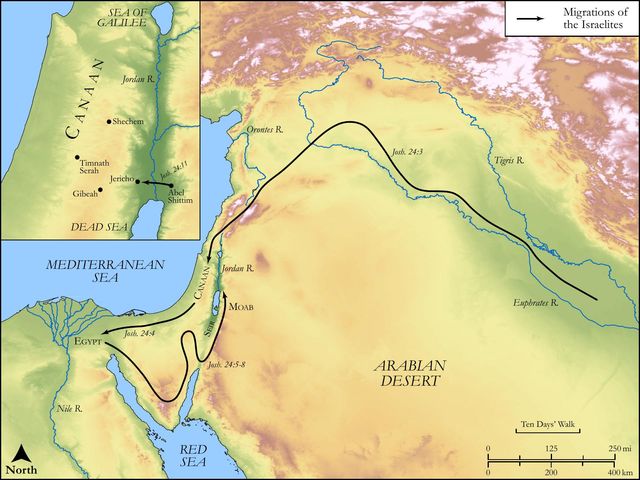
By this point, the Israelites had largely settled in the Promised Land, yet they were perpetually surrounded by Canaanite cultures deeply entrenched in polytheism and idolatry. The command to "put away the gods which your fathers served on the other side of the flood, and in Egypt" reveals that ancestral pagan practices, originating from Mesopotamia (specifically Ur of the Chaldees, beyond the Euphrates River, hence "the flood") and the vivid memory of Egyptian deities, still posed a significant threat to Israel's distinct monotheistic identity. The covenant established at Mount Sinai explicitly forbade idolatry, making this command a crucial reiteration and enforcement of the foundational principles of their national and spiritual identity. Shechem itself held profound historical significance as a place where Abraham built an altar (as seen in Genesis 12:6-7) and where Jacob purified his household of idols (as recorded in Genesis 35:2-4), making it an exceptionally fitting location for this renewed covenant commitment.
Key Themes
ShowHideJoshua 24:14 powerfully articulates several core themes central to the book of Joshua and the broader Old Testament narrative. Foremost is the theme of covenant faithfulness, emphasizing that God's unwavering loyalty demands an equally unwavering response from His people. The imperative "fear the LORD" introduces the theme of reverence and obedience, not as terror, but as a profound awe that leads to humble submission to God's will, a concept foundational to wisdom (as seen in Proverbs 1:7). The call to "serve him in sincerity and in truth" highlights the theme of wholehearted devotion and integrity, demanding worship that is genuine and free from hypocrisy or divided loyalties, echoing the command to love God with all one's being (e.g., Deuteronomy 6:5). Finally, the explicit command to "put away the gods" underscores the crucial theme of exclusive worship and the rejection of idolatry, asserting God's sole claim to Israel's allegiance and warning against the pervasive danger of syncretism.
Exposition and Analysis
ShowHideKey Word Analysis
ShowHideThis word, often translated as "fear," carries a much richer meaning than mere terror. As defined by Strong's H3372, it signifies a profound reverence, awe, and respect for God's power, holiness, and covenant faithfulness. This "fear" is the appropriate response to God's majesty and grace, leading to humble submission, obedience, and worship rather than cowering dread. It implies acknowledging God's absolute sovereignty and authority over one's life, leading to a desire to please Him.
Derived from a root meaning "complete" or "whole," Strong's H8549 defines tâmîym as conveying the idea of integrity, blamelessness, and wholeness of heart. When applied to serving God, it denotes a devotion that is undivided, genuine, and free from hypocrisy or duplicity. It speaks to an inner purity of motive and an unreserved commitment, not merely outward conformity to religious rituals, ensuring that one's service is truly "without blemish" and "upright."
This term, as per Strong's H571, signifies stability, certainty, faithfulness, reliability, and trustworthiness. Serving God "in truth" means doing so with unwavering loyalty, consistency, and adherence to His revealed will. It implies a relationship built on trust and authenticity, where one's actions align with one's stated commitment to God. Together with "sincerity," it describes a worship that is both internally pure and externally consistent, demonstrating "verity" and steadfastness.
Verse Breakdown
ShowHide"Now therefore fear the LORD,"
This phrase serves as a logical conclusion ("Now therefore") to Joshua's preceding historical recount of God's mighty acts on behalf of Israel. The imperative "fear the LORD" is the foundational command, calling for a response of profound reverence and awe towards the God who has proven Himself utterly faithful and powerful. This fear is the wellspring of true obedience and worship, recognizing His supreme authority and worthiness.
"and serve him in sincerity and in truth:"
This clause specifies the manner in which the LORD is to be served. It demands a service that is not superficial or external, but deeply rooted in the heart ("sincerity," meaning wholeness and integrity) and consistently demonstrated through faithful actions and unwavering loyalty ("truth," meaning reliability and authenticity). It is a call for genuine, wholehearted devotion, free from any pretense or divided allegiance, reflecting an inner purity of motive.
"and put away the gods which your fathers served on the other side of the flood, and in Egypt;"
This is a direct negative command, requiring the radical renunciation of all forms of idolatry. "The other side of the flood" refers to Mesopotamia (specifically Ur of the Chaldees, from which Abraham originated), indicating the ancestral paganism that Israel's forefathers practiced. "And in Egypt" points to the polytheistic worship of the Egyptian pantheon, which the Israelites had been exposed to during their long bondage. This command is a radical call to purification and a complete break from all past and present pagan influences.
"and serve ye the LORD."
This concluding imperative repeats and reinforces the central command of the verse, providing a clear, concise summary of the demand. It emphasizes the absolute exclusivity of Israel's devotion: they are to serve the LORD and no other god. This repetition underscores the critical importance of monotheism and undivided loyalty for the covenant people, leaving no room for ambiguity.
Literary Devices
ShowHideJoshua 24:14 employs several potent literary devices to convey its urgent message and impress upon the Israelites the gravity of their choice. The most prominent is the Imperative Mood, evident in the series of direct commands: "fear," "serve," "put away," and "serve." This creates a sense of immediate obligation and underscores the non-negotiable nature of the choice presented to Israel, demanding an active response. Repetition is also key, particularly the emphatic reiteration of "serve ye the LORD" at both the beginning and the end of the positive commands. This chiastic structure (A-B-C-B'-A') highlights the core demand for exclusive allegiance and reinforces its centrality to Israel's covenant identity, creating a powerful rhetorical bookend. A clear Contrast is drawn between serving the one true God ("the LORD") and serving "the gods which your fathers served," sharply delineating the two mutually exclusive paths available to the people. This stark juxtaposition forces a decisive choice. Furthermore, the verse functions as a powerful Rhetorical Appeal, building on Joshua's preceding historical recount of God's faithfulness (as detailed in Joshua 24:2-13) to elicit a grateful and obedient response from the people. The historical narrative provides the compelling reason and moral imperative for the commands that follow.
Theological and Thematic Connections
ShowHideJoshua 24:14 encapsulates a foundational theological truth: God's nature as a jealous God who demands exclusive worship and undivided loyalty from His people. Having delivered Israel from bondage and established them in the Promised Land, the LORD rightfully expects a response of wholehearted devotion. This verse highlights the bilateral nature of the covenant—God's faithfulness requires human faithfulness in return. It underscores the perpetual struggle against idolatry, both overt (worshipping other deities) and subtle (allowing anything else to take God's rightful place in one's heart). The call to "sincerity and truth" emphasizes that true worship is not merely external ritual but an internal disposition of integrity and genuine commitment, reflecting the very character of God Himself, who is faithful and true. This passage serves as a timeless reminder that authentic faith necessitates a radical break from all competing allegiances.
Reflection and Application
ShowHideJoshua 24:14 remains profoundly relevant for believers today, serving as a timeless call to radical, exclusive devotion to God. In a world saturated with competing loyalties and myriad distractions, we are continually challenged to "put away" the "gods" that vie for our ultimate attention and affection. These modern idols may not be physical statues, but rather insidious forms of materialism, career success, social media validation, comfort, self-reliance, or even seemingly good causes that subtly displace God from the absolute center of our lives. The command to "fear the LORD" calls us to cultivate a reverent awe for God's holiness and sovereignty, which naturally leads to humble obedience and a fervent desire to please Him above all else. Serving Him "in sincerity and in truth" means living a life of integrity, where our faith is not merely a Sunday morning ritual but permeates every thought, word, and deed. It demands an honest self-assessment of our priorities and a willingness to surrender anything that compromises our undivided allegiance to Christ. This verse reminds us that genuine faith is not passive but an active, ongoing choice to honor and serve God alone, in every sphere of our existence, reflecting a wholehearted commitment.
Questions for Reflection
ShowHideFAQ
ShowHideWhat does "the other side of the flood" mean?
ShowHide"The other side of the flood" refers to the region beyond the Euphrates River, specifically Mesopotamia. This is the area from which Abraham's family originated, particularly Ur of the Chaldees (as mentioned in Genesis 11:31). Before God called Abraham, his ancestors, like many in that region, worshipped various pagan deities. Joshua is reminding the Israelites of their ancestral idolatry, alongside the more recent exposure to Egyptian gods, as practices they must definitively abandon to fully commit to the LORD.
Is "fear the LORD" about being scared of God?
ShowHideWhile the Hebrew word yare' can imply terror, in the context of "fear the LORD," it primarily signifies a profound sense of awe, reverence, and respect for God's majesty, power, holiness, and covenant faithfulness. It is an attitude of humble submission and adoration that leads to obedience and worship, rather than a cowering dread. This reverential fear is seen as the beginning of wisdom and knowledge (e.g., Proverbs 9:10). It acknowledges God's supreme authority and worthiness of our complete devotion, motivating us to honor Him in all we do.
Why is "sincerity and truth" emphasized when serving God?
ShowHideThe emphasis on "sincerity and truth" (Hebrew: tamim and 'emeth') is crucial because it addresses the quality and authenticity of one's worship and service. "Sincerity" calls for wholeness and integrity of heart, meaning that one's devotion should be undivided and genuine, free from hypocrisy or hidden motives. "Truth" calls for faithfulness and reliability, implying that one's actions and life should consistently reflect their stated commitment to God. Together, these terms demand a worship that is not merely external ritual or lip service, but a deep, internal, and consistent commitment that pervades all aspects of life. It distinguishes true devotion from superficial or convenient religiosity, requiring an honest and complete surrender to God.
Christ-Centered Fulfillment
ShowHideJoshua 24:14, with its urgent call for exclusive loyalty and wholehearted service to the LORD, finds its ultimate fulfillment and deepest meaning in Jesus Christ. While Joshua challenged Israel to put away idols and serve God under the Old Covenant, Jesus, as the perfect embodiment of God's will, perfectly "feared the LORD" in His earthly life, demonstrating ultimate reverence and obedience to the Father (e.g., Hebrews 5:7-8). He is the one who perfectly served God "in sincerity and in truth," living a life utterly devoid of hypocrisy or divided allegiance, fulfilling the very standard Joshua set. Indeed, Jesus Himself declared the impossibility of serving two masters, asserting that one cannot serve both God and money (or any other idol) (e.g., Matthew 6:24), thereby extending the command against idolatry to the heart's affections. Through His atoning sacrifice, Christ not only cleanses us from the sin of idolatry but also empowers us by the Holy Spirit to genuinely "put away the gods" of our own hearts and serve the living God. The New Covenant, inaugurated by Christ's blood, is characterized by an inward transformation where God's law is written on our hearts (e.g., Jeremiah 31:33), enabling us to offer the spiritual worship "in spirit and truth" that the Father seeks (e.g., John 4:23-24). Thus, Joshua's ancient command becomes a present reality for those who are in Christ, empowering them to live lives of undivided devotion to the One who is the Way, the Truth, and the Life (e.g., John 14:6), making Him the sole object of their fear and service.