


Joshua 21:43
Bible text: King James Version (1769 Blayney text) · Public domain
Bible text: Berean Standard Bible · Public domain
Bible text: American Standard Version (1901) · Public domain
Bible text: World English Bible, Messianic edition · Public domain
Bible text: Geneva Bible (1599) · Public domain
Bible text: Young's Literal Translation · Public domain
- וַיִּתֵּןvai·yi·Tenand he gaveH5414Conj-w ¦ V-Qal-ConsecImperf-3msVerb Qal Consecutive Imperfect 3rd Singular Masculineוַandיִּתֵּןhe gave
- יְהוָהYah·wehYahwehH3068N-properNoun Proper Title
- לְיִשְׂרָאֵלle·Yis·ra·'Elto IsraelH3478Prep-l ¦ N-properNoun Proper LocationלְtoיִשְׂרָאֵלIsrael
- אֶת'et<obj.>H853DirObjMParticle Object Indicator
- כָּלkolallH3605N-mscNoun Singular Masculine Construct
- הָאָרֶץha·'A·retzthe landH776Art ¦ N-fsNoun Singular Feminine Absoluteהָtheאָרֶץland
- אֲשֶׁר'a·SherwhichH834RelParticle Relative
- נִשְׁבַּעnish·Ba'he had swornH7650V-Niphal-Perf-3msVerb Niphal Perfect 3rd Singular Masculine
- לָתֵתla·Tetto giveH5414Prep-l ¦ V-Qal-InfVerb Qal Infinitive Constructלָtoתֵתgive
- לַאֲבוֹתָםla·'a·vo·Tamto their ancestorsH1Prep-l ¦ N-fpc ¦ 3mpNoun Plural Feminine Constructלַtoאֲבוֹתָancestorsםtheir
- וַיִּרָשׁוּהָvai·yi·ra·Shu·haand they took possession of itH3423Conj-w ¦ V-Qal-ConsecImperf-3mp ¦ 3fsVerb Qal Consecutive Imperfect 3rd Plural Masculineוַandיִּרָשׁוּthey took possession ofהָit
- וַיֵּשְׁבוּvai·Ye·she·vuand they dweltH3427Conj-w ¦ V-Qal-ConsecImperf-3mpVerb Qal Consecutive Imperfect 3rd Plural Masculineוַandיֵּשְׁבוּthey dwelt
- בָהּVahin <the> itPrep-b ¦ 3fsSuffix Personal 3rd Singular Feminineבָin <the>הּit
English is a literal word-by-word gloss of the Hebrew, not the KJV's wording. Why?
This is the original text the KJV's translators worked from — each Hebrew word with its own literal English meaning in this verse, prepared by scholars at Tyndale House, Cambridge. The KJV translates whole sentences, not word by word, so its wording differs: one Hebrew word can become several English words, and the KJV may choose “the LORD” where the gloss reads “Yahweh”. Both are faithful — they answer different questions. For the KJV's own rendering, switch to the KJV text.
Details
See on the biblical-era maps
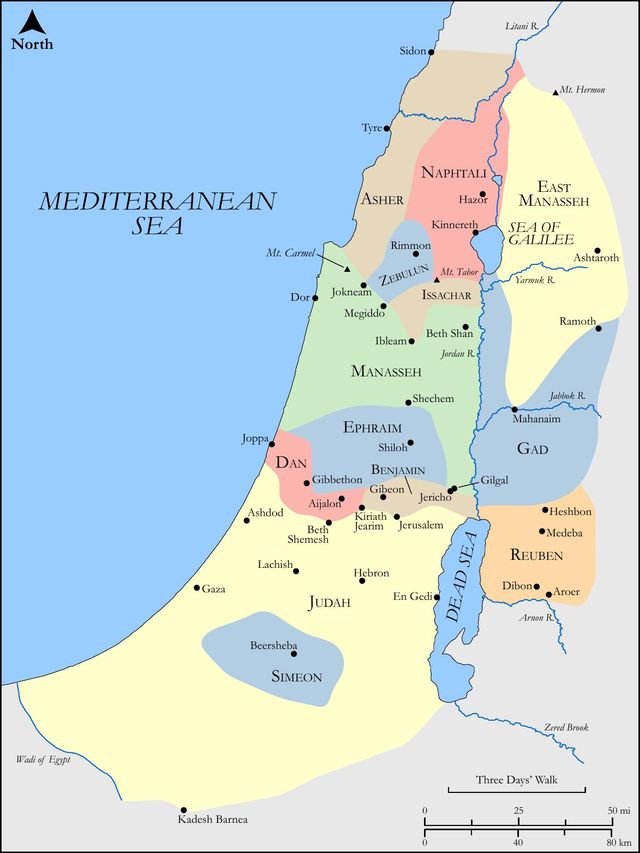
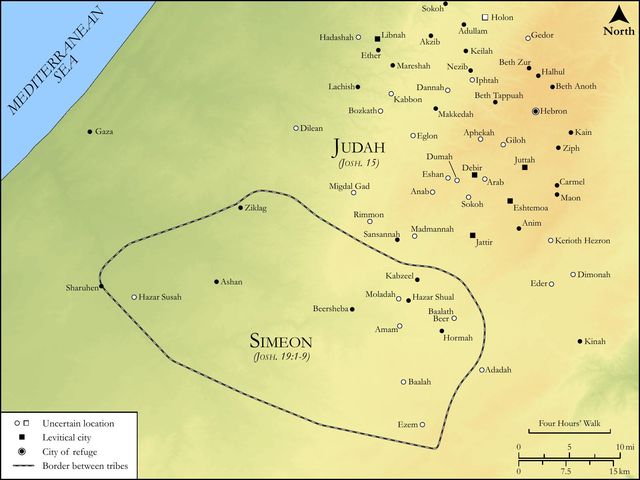
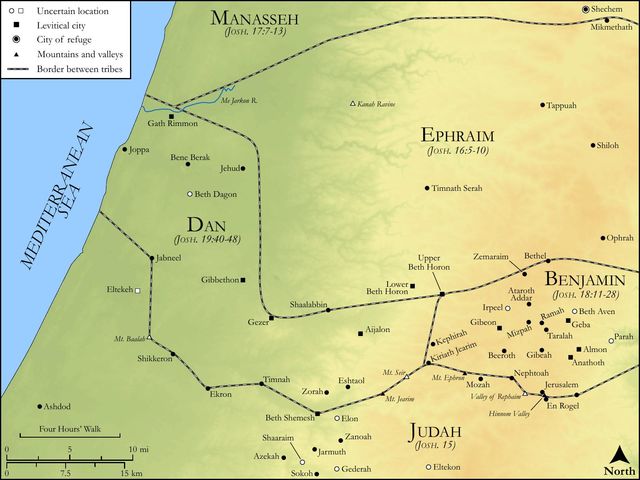
Study this verse
Public-domain commentary
Matthew Henry
From his Commentary on the Whole Bible. Henry comments on passages, not single verses — this entry covers Joshua 21:43–45. His two-level outline is real structure in the source text, so it is rendered as structure.
We have here the conclusion of this whole matter, the foregoing history summed up, and, to make it appear the more bright, compared with the promise of which it was the full accomplishment. God's word and his works mutually illustrate each other. The performance makes the promise appear very true and the promise makes the performance appear very kind.
I.God had promised to give the seed of Abraham the land of Canaan for a possession, and now at last he performed this promise (Jos 21:43):
They possessed it, and dwelt therein. Though they had often forfeited the benefit of that promise, and God had long delayed the performance of it, yet at last all difficulties were conquered, and Canaan was their own. And the promise of the heavenly Canaan is as sure to all God's spiritual Israel, for it is the promise of him that cannot lie.
II.God had promised to give them rest in that land, and now they had rest round about, rest from the fatigues of their travel through the wilderness (which tedious march, perhaps, was long in their bones), rest from their wars in Canaan, and the insults which their enemies there had at first offered them. They now dwelt, not only in habitations of their own, but those quiet and peaceable ones; though there were Canaanites that remained, yet none that had either strength or spirit to attack them, nor so much as give them an alarm. This rest continued till they by their own sin and folly put thorns into their own beds and their own eyes.
III.God had promised to give them victory and success in their wars, and this promise likewise was fulfilled:
There stood not a man before them, Jos 21:44. They had the better in every battle, and which way soever they turned their forces they prospered. It is true there were Canaanites now remaining in many parts of the land, and such as afterwards made head against them, and became very formidable. But,
1.As to the present remains of the Canaanites, they were no contradiction to the promise, for God had said he would not drive them out all at once, but by little and little, Exo 23:30. They had now as much in their full possession as they had occasion for and as they had hands to manage, so that the Canaanites only kept possession of some of the less cultivated parts of the country against the beasts of the field, till Israel, in process of time, should become numerous enough to replenish them.
2.As to the after prevalency of the Canaanites, that was purely the effect of Israel's cowardice and slothfulness, and the punishment of their sinful inclination to the idolatries and other abominations of the heathen, whom the Lord would have cast out before them but that they harboured and indulged them. So that the foundation of God stands sure. Israel's experience of God's fidelity is here upon record, and is an acquittance under their hands to the honour of God, the vindication of his promise which had been so often distrusted, and the encouragement of all believers to the end of the world: There failed not any good thing, no, nor aught of any good thing (so full is it expressed), which the Lord had spoken unto the house of Israel, but in due time all came to pass, Jos 21:45. Such an acknowledgment as this, here subscribed by Joshua in the name of all Israel, we afterwards find made by Solomon, and all Israel did in effect say Amen to it, Kg1 8:56. The inviolable truth of God's promise, and the performance of it to the utmost, are what all the saints have been ready to bear their testimony to; and, if in any thing the performance has seemed to come short, they have been as ready to own that they themselves must bear all the blame.
Continue studying Joshua 21:43 across the web’s major study libraries — every link below opens this exact verse, chapter, or book on the destination site.
Read & Compare
 BibleGatewayThis verse in more than 200 translations and 70 languages.
 Bible.comThe YouVersion reader — hundreds of translations, reading plans, and highlights.
 ESV.orgCrossway's official English Standard Version reader.
 NET BibleThe NET translation with 60,000+ translators' notes on every rendering decision.
 STEP BibleTyndale House's free study tool — original text, vocabulary, and scholarly resources.
 BibliaLogos Bible Software's free web reader.
 USCCBThe New American Bible (Revised Edition) with the U.S. bishops' study notes.
Commentaries
 BibleHub CommentariesDozens of classic commentaries on this verse, gathered on one page.
 StudyLightMore than 100 commentary sets — the largest collection on the web.
 BibleRefPlain-English commentary on what this verse means, verse by verse.
 Enduring WordDavid Guzik's free commentary on this chapter, widely used by Bible teachers.
 Bible Study ToolsVerse commentary alongside Greek and Hebrew study aids.
Original Language & Research
- BibleHub InterlinearThe verse word by word — original language, transliteration, and English.
- BibleHub LexiconEvery word's original-language definition and Strong's entry.
 Blue Letter BibleDeep-study tools — Strong's numbers, concordance, and word studies.
 SefariaThe Hebrew text with Rashi and centuries of Jewish commentary.
Sermons, Hymns & Audio


TrulyRandomVerse is not affiliated with these sites and doesn’t control their content. They’re linked because they’re genuinely useful.
Summary
Joshua 21:43 serves as a powerful and climactic declaration of God's unwavering faithfulness, marking the triumphant culmination of centuries of divine promise. This verse succinctly summarizes the complete fulfillment of the Abrahamic Covenant concerning the land, affirming that the Lord had indeed given Israel all the territory He had sworn to their forefathers, enabling them to possess it fully and dwell securely within its borders. It stands as a profound testament to God's reliability, sovereign provision, and meticulous adherence to His covenant word in the history of His chosen people.
Context
ShowHideLiterary Context
Joshua 21:43 is strategically placed at a pivotal point in the book of Joshua, functioning as a grand theological summary statement. It immediately follows the exhaustive and meticulous accounts of the land's division among the twelve tribes of Israel (chapters 13-19) and the specific allocation of cities for the Levites and the establishment of cities of refuge (chapters 20-21). This verse, along with the subsequent verses (Joshua 21:44-45), provides a definitive and emphatic declaration that God's promises regarding the land have been fully realized, effectively concluding the conquest and settlement phase. It sets the stage for Joshua's final exhortations and farewell addresses in chapters 22-24, transitioning from the narrative of divine fulfillment to the call for covenant obedience.
Historical & Cultural Context
The historical backdrop of Joshua 21:43 is the conclusion of the Israelite conquest of Canaan, a period spanning several decades after their exodus from Egypt. This verse reflects the successful military campaigns led by Joshua, which, while not achieving total eradication of all Canaanite inhabitants, decisively broke their power and secured the central and strategic regions, allowing for Israelite settlement. Culturally, land ownership in Israel was foundational to identity, security, and economic stability. For Israel, however, the land was far more than mere territory; it was the tangible manifestation of God's covenant faithfulness, a sacred space where they were to live in covenant relationship with Him, establish His law, and embody His kingdom. The "fathers" referenced—Abraham, Isaac, and Jacob—underscore the intergenerational nature of God's covenant, highlighting promises made centuries prior that now find their glorious fulfillment.
Key Themes
ShowHideThe most prominent theme in Joshua 21:43 is the Unwavering Faithfulness of God. The declaration that "the LORD gave unto Israel all the land which he sware to give unto their fathers" underscores the absolute reliability of God's word and His unwavering commitment to His covenant promises, spanning generations. This verse also powerfully highlights Divine Sovereignty and Provision, emphasizing that the possession of the land was not primarily a result of Israel's military might or strategic genius, but was fundamentally a gracious gift from God, who orchestrated their victories and provided their inheritance. Furthermore, it signifies the Fulfillment of Covenant, specifically the land aspect of the Abrahamic Covenant, which promised Abraham and his descendants a vast territory (see Genesis 12:7). The concluding phrase, "and they possessed it, and dwelt therein," speaks to a state of secure ownership and a measure of "rest" from their enemies, a theme explicitly affirmed and expanded upon in Joshua 21:44.
Exposition and Analysis
ShowHideKey Word Analysis
ShowHideThis verb, meaning "to give, place, set," emphasizes that the land was a direct bestowal from God, a divine gift rather than something Israel earned or conquered solely by their own strength. It highlights God's initiative, generosity, and sovereign action in fulfilling His promise, underscoring that their possession was an act of grace.
Derived from the root meaning "to swear an oath" (often implying a seven-fold declaration, signifying completeness and certainty), this word signifies a binding, solemn promise made under oath. It underscores the immutable and unchangeable nature of God's commitment to His covenant with the patriarchs, reinforcing the absolute certainty and reliability of His word.
This verb means "to inherit, take possession of, dispossess." It conveys the idea of taking hold of an inheritance, often by displacing previous occupants. Here, it signifies Israel's legal and actual occupation of the land, affirming their rightful claim and secure establishment, not merely passing through but settling permanently.
Verse Breakdown
ShowHide"And the LORD gave unto Israel"
This opening clause immediately establishes God (Yahweh, H3068) as the primary actor and benefactor. The possession of the land is attributed directly to His sovereign will and generous hand, not to Israel's military prowess or strategic planning alone. It underscores the divine initiative behind the entire conquest and settlement, setting the tone for the declaration of fulfillment.
"all the land which he sware to give unto their fathers"
This crucial phrase explicitly links the present reality of Israel's possession to the ancient, binding covenant promises made to Abraham, Isaac, and Jacob centuries earlier (e.g., Genesis 15:18). The emphasis on "sware" highlights the solemn, unbreakable nature of God's oath, demonstrating His historical continuity, meticulous faithfulness, and the ultimate triumph of His word across generations.
"and they possessed it, and dwelt therein"
This concluding phrase confirms the practical and tangible outcome of God's promise. "Possessed it" signifies that Israel had taken effective control, ownership, and inheritance of the land. "Dwelt therein" indicates a state of settled habitation, security, and peace, implying that they were able to live in the land without constant threat, enjoying the fruits of their inheritance and experiencing the promised "rest."
Literary Devices
ShowHideJoshua 21:43 functions primarily as a Summary Statement, providing a concise and definitive theological conclusion to the preceding detailed narrative of conquest and land distribution. The verse employs powerful Fulfillment Language, explicitly connecting the present reality ("the LORD gave... and they possessed it") to past divine promises ("which he sware to give unto their fathers"), thereby emphasizing the complete and faithful execution of God's word. This creates a strong sense of Dramatic Irony for the original audience, who knew the long history of wandering and struggle, now culminating in this declaration of rest. The structure of the verse, moving from God's action ("gave") to Israel's response and settled state ("possessed it, and dwelt therein"), creates a clear Cause and Effect relationship, highlighting the direct result of divine faithfulness. The consistent use of the past tense throughout reinforces the accomplished and irreversible nature of the promise.
Theological and Thematic Connections
ShowHideJoshua 21:43 is a cornerstone verse for understanding God's character and the nature of His covenant promises. It profoundly affirms God's absolute fidelity: what He promises, He performs. The centuries-long gap between the initial oath to the patriarchs and its fulfillment in Joshua's day underscores God's patience, steadfastness, and sovereign control over history. This verse teaches that God's word is not subject to human limitations, delays, or even failures; His purposes will ultimately prevail. It also highlights the concept of divine rest, as Israel finally enters a period of settled security after generations of wandering and warfare, a foretaste of the ultimate rest God provides for His people. This historical fulfillment serves as a powerful theological anchor for all future generations of believers.
Reflection and Application
ShowHideJoshua 21:43 offers immense encouragement for believers today, serving as a powerful anchor for our faith in God's promises. Just as God meticulously fulfilled His ancient covenant with Israel regarding the land, so too can we trust Him to fulfill every promise He has made to us, whether concerning our salvation, provision, peace, or eternal hope. This verse invites us to reflect on God's past faithfulness in our own lives, recognizing the myriad ways He has already demonstrated His reliability, and to allow that history to build our confidence for the future. In a world fraught with uncertainty, where promises are often broken and hopes deferred, Joshua 21:43 calls us to rest in God's unchanging character, knowing that His plans for us are good and will ultimately come to pass, even if the path to fulfillment seems long or arduous. It challenges us to patiently wait on the Lord, knowing that His timing is perfect and His word is true, providing a foundation for enduring hope and steadfast trust.
Questions for Reflection
ShowHideFAQ
ShowHideDoes "all the land" in Joshua 21:43 imply that every single square inch of Canaan was conquered and settled by Israel at this point?
ShowHideNo, "all the land" in this context is a theological and rhetorical statement affirming the substantial and decisive fulfillment of God's promise, rather than a precise geographical survey of every border or unconquered pocket. While Israel had broken the back of Canaanite resistance and secured the strategic centers, allowing them to possess and settle the land, there were still pockets of unconquered territory and cities that remained under enemy control (e.g., Joshua 13:1). The phrase emphasizes that God had given them sufficient land for their inheritance and had enabled them to establish themselves securely, fulfilling the essence of His covenant pledge. It signifies that the major obstacles were removed, and the land was effectively theirs to inhabit and from which to expand.
What is the significance of the phrase "which he sware to give unto their fathers"?
ShowHideThis phrase is profoundly significant because it explicitly links the present reality of Israel's possession of the land to the ancient, binding covenant promises God made to Abraham, Isaac, and Jacob centuries earlier (e.g., Genesis 15:18). The word "sware" (Hebrew: shâbaʻ') denotes a solemn, unchangeable oath, highlighting the absolute reliability and immutability of God's word. It underscores that God's faithfulness spans generations, demonstrating that He remembers His covenants and brings them to fruition in His perfect timing, regardless of the challenges or the passage of time. It reinforces the idea that the land was not a reward for Israel's merit but a gracious fulfillment of a divine commitment, rooted in God's unchanging character.
Christ-Centered Fulfillment
ShowHideJoshua 21:43, with its resounding declaration of God's fulfilled promises regarding the earthly land and the "rest" Israel found therein, powerfully foreshadows the far greater and eternal fulfillment found in Jesus Christ. The "rest" that Israel experienced in the Promised Land, though significant and divinely given, was ultimately temporary, conditional, and incomplete, pointing to a deeper, spiritual rest yet to come. In Christ, believers find the ultimate "land" of spiritual blessing and eternal inheritance, not through physical conquest but through His atoning sacrifice and resurrection. Just as God "gave" Israel the land, so too has He "given" us every spiritual blessing in the heavenly places in Christ (Ephesians 1:3). Jesus is the faithful one in whom "all the promises of God find their 'Yes'" (2 Corinthians 1:20). He is our true inheritance, the one who leads us into the promised rest that remains for the people of God, a rest from works and a secure dwelling in Him (Hebrews 4:1-11). The secure dwelling in the land prefigures our secure dwelling in Christ, who is our peace and our hope, and ultimately, our eternal home in the new heavens and new earth, where God Himself will dwell with His people forever (Revelation 21:1-4).