


Deuteronomy 3:2
Bible text: King James Version (1769 Blayney text) · Public domain
Bible text: King James Version with Strong's numbers · Public domain
Bible text: Berean Standard Bible · Public domain
Bible text: American Standard Version (1901) · Public domain
Bible text: World English Bible, Messianic edition · Public domain
Bible text: Geneva Bible (1599) · Public domain
Bible text: Young's Literal Translation · Public domain
- וַיֹּאמֶרvai·Yo·merand he saidH559Conj-w ¦ V-Qal-ConsecImperf-3msVerb Qal Consecutive Imperfect 3rd Singular Masculineוַandיֹּאמֶרhe said
- יְהוָהYah·wehYahwehH3068N-properNoun Proper Title
- אֵלַי'e·Laito meH413Prep ¦ 1csPrepositionאֵלַtoיme
- אַל'almay notH408NegParticle Negative
- תִּירָאti·Ra'you fearH3372V-Qal-Imperf-2msVerb Qal Imperfect 2nd Singular Masculine
- אֹתוֹ'o·To<obj.> himH853DirObjM ¦ 3msParticle Object Indicatorאֹת<obj.>וֹhim
- כִּיkiforH3588PrtParticle Conditional
- בְיָדְךָve·ya·de·Khain your handH3027Prep-b ¦ N-csc ¦ 2msNoun Singular common gender Constructבְinיָדְhandךָyour
- נָתַתִּיna·Ta·tiI giveH5414V-Qal-Perf-1csVerb Qal Perfect 1st Singular common gender
- אֹתוֹ'o·To<obj.> himH853DirObjM ¦ 3msParticle Object Indicatorאֹת<obj.>וֹhim
- וְאֶתve·'Etand <obj.>H853Conj-w ¦ DirObjMParticle Object Indicatorוְandאֶת<obj.>
- כָּלkolallH3605N-mscNoun Singular Masculine Construct
- עַמּוֹa·Mohis peopleH5971N-msc ¦ 3msNoun Singular Masculine Constructעַמּpeopleוֹhis
- וְאֶתve·'Etand <obj.>H853Conj-w ¦ DirObjMParticle Object Indicatorוְandאֶת<obj.>
- אַרְצוֹ'ar·Tzohis landH776N-fsc ¦ 3msNoun Singular Feminine Constructאַרְצlandוֹhis
- וְעָשִׂיתָve·'a·Si·taand you will doH6213Conj-w ¦ V-Qal-ConsecPerf-2msVerb Qal Consecutive Perfect 2nd Singular Masculineוְandעָשִׂיתָyou will do
- לּוֹloto himPrep-l ¦ 3msSuffix Personal 3rd Singular Masculineלּtoוֹhim
- כַּאֲשֶׁרka·'a·Sherjust asH834Prep-k ¦ RelParticle Relativeכַּjustאֲשֶׁרas
- עָשִׂיתָ'a·Si·tayou didH6213V-Qal-Perf-2msVerb Qal Perfect 2nd Singular Masculine
- לְסִיחֹןle·si·Chonto SihonH5511Prep-l ¦ N-proper-mNoun Proper MasculineלְtoסִיחֹןSihon
- מֶלֶךְMe·lekh[the] king ofH4428N-mscNoun Singular Masculine Construct
- הָאֱמֹרִיha·'e·mo·Rithe Amorite[s]H567Art ¦ N-msNoun Gentilic Singular Masculine AbsoluteהָtheאֱמֹרִיAmorite[s]
- אֲשֶׁר'a·SherwhoH834RelParticle Relative
- יוֹשֵׁבyo·Shev[was] dwellingH3427V-Qal-Prtcpl-msVerb Qal Participle Singular Masculine Absolute
- בְּחֶשְׁבּוֹןbe·chesh·Bonin HeshbonH2809Prep-b ¦ N-properNoun Proper LocationבְּinחֶשְׁבּוֹןHeshbon
English is a literal word-by-word gloss of the Hebrew, not the KJV's wording. Why?
This is the original text the KJV's translators worked from — each Hebrew word with its own literal English meaning in this verse, prepared by scholars at Tyndale House, Cambridge. The KJV translates whole sentences, not word by word, so its wording differs: one Hebrew word can become several English words, and the KJV may choose “the LORD” where the gloss reads “Yahweh”. Both are faithful — they answer different questions. For the KJV's own rendering, switch to the KJV text.
Details
See on the biblical-era maps
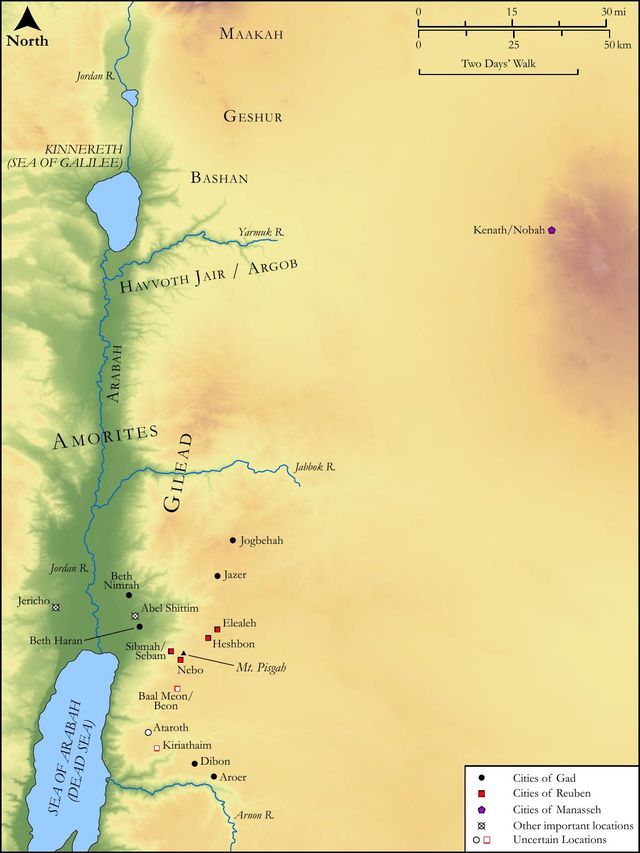
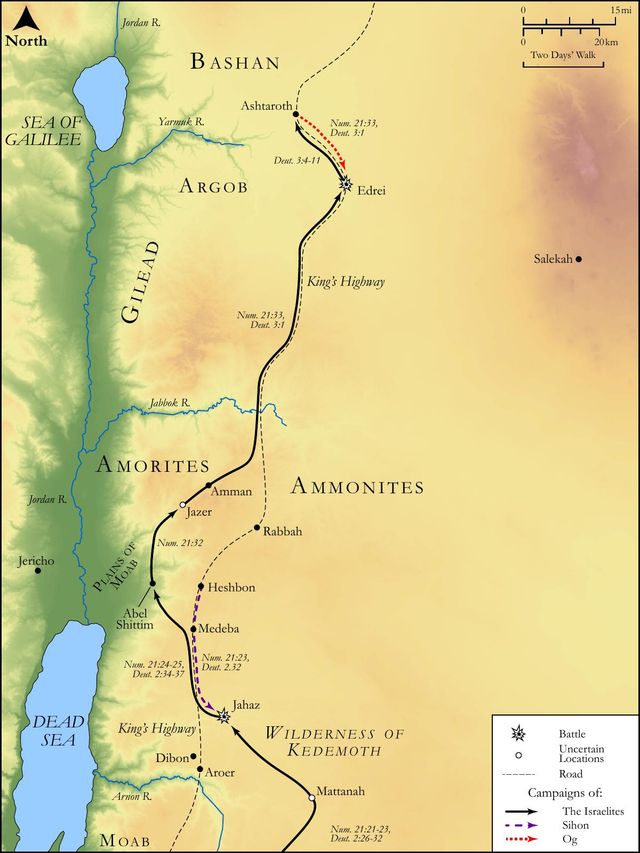
Study this verse
Public-domain commentary
Matthew Henry
From his Commentary on the Whole Bible. Henry comments on passages, not single verses — this entry covers Deuteronomy 3:1–11. His two-level outline is real structure in the source text, so it is rendered as structure.
We have here another brave country delivered into the hand of Israel, that of Bashan; the conquest of Sihon is often mentioned together with that of Og, to the praise of God, the rather because in these Israel's triumphs began, Psa 135:11; Psa 136:19, Psa 136:20. See,
I.How they got the mastery of Og, a very formidable prince,
1.Very strong, for he was of the remnant of the giants (Deu 3:11); his personal strength was extraordinary, a monument of which was preserved by the Ammonites in his bedstead, which was shown as a rarity in their chief city. You might guess at his weight by the materials of his bedstead; it was iron, as if a bedstead of wood were too weak for him to trust to: and you might guess at his stature by the dimensions of it; it was nine cubits long and four cubits broad, which, supposing a cubit to be but half a yard (and some learned men have made it appear to be somewhat more), was four yards and a half long, and two yards broad; and if we allow his bedstead to be two cubits longer than himself, and that is as much as we need allow, he was three yards and a half high, double the stature of an ordinary man, and every way proportionable, yet they smote him, Deu 3:3. Note, when God pleads his people's cause he can deal with giants as with grasshoppers. No man's might can secure him against the Almighty. The army of Og was very powerful, for he had the command of sixty fortified cities, besides the unwalled towns, Deu 3:5. Yet all this was nothing before God's Israel, when they came with commission to destroy him.
2.He was very bold and daring: He came out against Israel to battle, Deu 3:1. It was wonderful that he did not take warning by the ruin of Sihon, and send to desire conditions of peace; but he trusted to his own strength, and so was hardened to his destruction. Note, Those that are not awakened by the judgments of God upon others, but persist in their defiance of heaven, are ripening apace for the like judgments upon themselves, Jer 3:8. God bade Moses not fear him, Deu 3:2. If Moses himself was so strong in faith as not to need the caution, yet it is probable that the people needed it, and for them these fresh assurances are designed; "I will deliver him into thy hand; not only deliver thee out of his hand, that he shall not be thy ruin, but deliver him into thy hand, that thou shalt be his ruin, and make him pay dearly for his attempt." He adds, Thou shalt do to him as thou didst to Sihon, intimating that they ought to be encouraged by their former victory to trust in God for another victory, for he is God, and changeth not.
II.How they got possession of Bashan, a very desirable country.
They took all the cities (Deu 3:4), and all the spoil of them, Deu 3:7. They made them all their own, Deu 3:10. So that now they had in their hands all that fruitful country which lay east of Jordan, from the river Arnon unto Hermon, Deu 3:8. Their conquering and possessing these countries was intended, not only for the encouragement of Israel in the wars of Canaan, but for the satisfaction of Moses before his death. Since he must not live to see the completing of their victory and settlement, God thus gives him a specimen of it. Thus the Spirit is given to those that believe as the earnest of their inheritance, until the redemption of the purchased possession.
Continue studying Deuteronomy 3:2 across the web’s major study libraries — every link below opens this exact verse, chapter, or book on the destination site.
Read & Compare
 BibleGatewayThis verse in more than 200 translations and 70 languages.
 Bible.comThe YouVersion reader — hundreds of translations, reading plans, and highlights.
 ESV.orgCrossway's official English Standard Version reader.
 NET BibleThe NET translation with 60,000+ translators' notes on every rendering decision.
 STEP BibleTyndale House's free study tool — original text, vocabulary, and scholarly resources.
 BibliaLogos Bible Software's free web reader.
 USCCBThe New American Bible (Revised Edition) with the U.S. bishops' study notes.
Commentaries
 BibleHub CommentariesDozens of classic commentaries on this verse, gathered on one page.
 StudyLightMore than 100 commentary sets — the largest collection on the web.
 BibleRefPlain-English commentary on what this verse means, verse by verse.
 Enduring WordDavid Guzik's free commentary on this chapter, widely used by Bible teachers.
 Bible Study ToolsVerse commentary alongside Greek and Hebrew study aids.
Original Language & Research
- BibleHub InterlinearThe verse word by word — original language, transliteration, and English.
- BibleHub LexiconEvery word's original-language definition and Strong's entry.
 Blue Letter BibleDeep-study tools — Strong's numbers, concordance, and word studies.
 SefariaThe Hebrew text with Rashi and centuries of Jewish commentary.
Sermons, Hymns & Audio


TrulyRandomVerse is not affiliated with these sites and doesn’t control their content. They’re linked because they’re genuinely useful.
Summary
Deuteronomy 3:2 records a pivotal divine assurance given by the LORD to Moses, empowering him and the Israelites for the imminent conquest of Bashan. This verse directly addresses any potential fear concerning the formidable King Og, commanding Moses not to dread, as God Himself promises to deliver Og, his people, and his land completely into Israel's hand. It explicitly references the recent, decisive victory over Sihon, King of the Amorites, as a powerful precedent and guarantee of future success, underscoring God's unwavering faithfulness, sovereign power, and active involvement in fulfilling His covenant promises to His people.
Context
ShowHideLiterary Context
Deuteronomy 3:2 is situated within Moses' second major discourse to the Israelites, delivered on the plains of Moab, east of the Jordan River, just before they are to enter the Promised Land. This section (Deuteronomy 2:26-3:11) serves as a historical recap, recounting the recent, significant victories over Sihon, king of Heshbon, and Og, king of Bashan. These narratives are not merely historical accounts but powerful didactic tools, designed to strengthen Israel's faith, remind them of God's unwavering faithfulness, and prepare them for the challenges of conquering Canaan. The verse immediately follows the introduction of King Og in Deuteronomy 3:1, setting the stage for God's direct command and promise of victory, thereby reinforcing the themes of divine guidance and the imminent fulfillment of the Abrahamic covenant as Israel stands on the cusp of their inheritance.
Historical & Cultural Context
The events described in Deuteronomy 3:2 take place around 1406 BC, marking the culmination of the forty years of wilderness wandering. The Israelites are now poised to enter the Promised Land, but formidable enemies stand in their path. King Og of Bashan was particularly notorious, known for his immense stature as one of the last of the Rephaim, a race of giants (Deuteronomy 3:11). Bashan itself was a fertile, strategically vital region east of the Jordan, characterized by its strong, fortified cities. The preceding defeat of Sihon, king of the Amorites, recounted in Deuteronomy 2:26-37, was a monumental victory, demonstrating God's power against seemingly insurmountable adversaries. The explicit reference to Sihon in Deuteronomy 3:2 serves as a crucial cultural and military precedent, reminding the Israelites that God had already proven His ability to overcome powerful foes, thereby bolstering their confidence for the equally daunting battle against Og.
Key Themes
ShowHideDeuteronomy 3:2 encapsulates several foundational themes central to the book of Deuteronomy and the broader Old Testament narrative. Foremost is Divine Assurance and the Conquest of Fear. The LORD's direct command, "Fear him not," directly confronts any apprehension Moses or the people might have felt facing a giant king, emphasizing that true courage is found in trusting God's presence and power, not in human might (Joshua 1:9). This ties into the theme of God's Sovereignty and Deliverance, as the LORD explicitly states, "for I will deliver him... into thy hand." This highlights God's active, decisive role as the ultimate strategist and executor of Israel's victories, underscoring that the land is a divine gift, not merely a human conquest (Deuteronomy 9:4-5). The Remembered Victories as Encouragement theme is powerfully evident in the explicit reference to Sihon, which serves as a potent reminder of God's past faithfulness and a guarantee of future success (Psalm 77:11). Finally, the verse contributes to the overarching theme of Covenant Fulfillment, as the conquest of these lands brings Israel closer to possessing the inheritance promised to Abraham (Genesis 12:7).
Exposition and Analysis
ShowHideKey Word Analysis
ShowHideFrom the primitive root H3372, this word primarily means "to fear," but also encompasses "to revere" or "to be afraid." In the negative imperative "Fear him not" (אַל־תִּירָא, al-tira'), it specifically commands the cessation of dread, terror, or apprehension in the face of a perceived threat. It is a divine injunction against allowing fear to paralyze or undermine faith, rooted in the absolute assurance of God's presence and power. This is not a call to recklessness but to courageous trust in divine sovereignty over human might.
From the primitive root H5414, this verb literally means "to give," "to place," or "to put into." In this context, "I will deliver him... into thy hand" signifies a complete act of divine transfer, where God Himself actively hands over the enemy to Israel. This emphasizes that the victory is not earned by Israel's strength or military prowess, but is a sovereign gift from God. It highlights God's initiative and absolute control over the outcome of the battle, making the conquest a divine act rather than merely a human one.
From the primitive word H3027, this term refers to the physical hand, but it is frequently used idiomatically in Hebrew to denote power, authority, control, or possession. When God promises to deliver Og into Moses' "hand," it signifies granting Moses (and by extension, Israel) full power and control over Og, leading to his defeat and the taking of his territory. It implies a complete subjugation and victory, where the enemy is utterly at the mercy of the victor, demonstrating God's comprehensive transfer of authority.
Verse Breakdown
ShowHide"And the LORD said unto me, Fear him not:"
This opening clause establishes the divine origin and authority of the command, emphasizing that it is a direct word from Yahweh (H3068, Yᵉhôvâh) to Moses. The imperative "Fear him not" (H3372, yârêʼ') is a powerful divine injunction, directly addressing any potential human apprehension or intimidation felt by Moses and the Israelites concerning Og, a formidable giant. It serves as an immediate antidote to fear, grounded in the absolute authority and trustworthy character of the divine speaker.
"for I will deliver him, and all his people, and his land, into thy hand;"
This clause provides the divine rationale and unwavering assurance for the command not to fear. The conjunction "for" (כִּי, ki) introduces the reason: God Himself guarantees the victory. The comprehensive nature of the promised deliverance ("him," referring to Og; "all his people," H5971, ʻam; and "his land," H776, ʼerets) signifies a total and decisive victory, encompassing the king, his military, and his entire territory. The phrase "into thy hand" (H3027, yâd') signifies that the complete power and control over the enemy will be granted to Moses, acting as God's instrument, reinforcing God's sovereignty as the true agent of conquest.
"and thou shalt do unto him as thou didst unto Sihon king of the Amorites, which dwelt at Heshbon."
This final clause provides a concrete, recent, and powerful precedent for the promised victory. By referencing the defeat of Sihon (H5511, Çîychôwn), king (H4428, melek) of the Amorites (H567, ʼĔmôrîy), who dwelt (H3427, yâshab) at Heshbon (H2809, Cheshbôwn), God reminds Moses and Israel of His proven faithfulness and power. The past victory over Sihon (recounted in Deuteronomy 2:26-37) serves as a tangible example that the seemingly impossible is indeed possible with God. This analogy is designed to instill confidence and eliminate doubt, assuring them that the same divine power that delivered Sihon will undoubtedly deliver Og.
Literary Devices
ShowHideDeuteronomy 3:2 masterfully employs several literary devices to convey its powerful message of divine assurance and impending victory. The most prominent is Divine Mandate, where God directly issues a command and a promise to Moses, underscoring His absolute authority and active involvement in Israel's history. This is immediately followed by Exhortation and Assurance, as the imperative "Fear him not" is coupled with the explicit promise of deliverance, designed to embolden the recipient and dispel any apprehension. The verse also features a strong Historical Allusion by referencing the recent victory over Sihon. This serves as a Precedent, drawing a direct parallel between a past triumph and a future one, thereby validating God's promise and building confidence in His unfailing power. Furthermore, the comprehensive nature of the promised deliverance ("him, and all his people, and his land") demonstrates Merism, a literary device where two contrasting or comprehensive parts represent the whole, signifying a complete and utter victory. The logical progression of the verse, moving from command to promise to historical proof, creates a powerful rhetorical appeal, reinforcing faith and obedience in the face of daunting challenges.
Theological and Thematic Connections
ShowHideDeuteronomy 3:2 is a profound theological statement on God's active involvement in the lives of His people and the unwavering fulfillment of His covenant promises. It underscores that the conquest of the Promised Land was fundamentally a divine enterprise, not merely a human military campaign. God's command to "fear not" is consistently linked to His sovereign power to deliver, demonstrating that true courage flows from trust in God's character and His unfailing word. The reference to Sihon highlights the principle of divine faithfulness: God's past actions serve as an undeniable guarantee for His future intentions. This verse teaches that God not only gives the command but also provides the means and the assurance for its fulfillment, reminding Israel (and us) that His plans will always prevail, often by overcoming seemingly insurmountable obstacles. It is a testament to God's unwavering commitment to His covenant people and His determination to bring His redemptive purposes to fruition.
Reflection and Application
ShowHideDeuteronomy 3:2 offers timeless encouragement and profound practical application for believers navigating the challenges of life. Just as Moses and Israel faced a formidable giant in Og, we too encounter "giants" in our lives—whether they are overwhelming circumstances, persistent fears, seemingly impossible tasks, or spiritual battles. This verse reminds us that the command "Fear him not" is not a call to self-reliance or naive optimism, but a summons to place our trust entirely in the sovereign power of God. Our past experiences of God's faithfulness, like Israel's victory over Sihon, should serve as powerful anchors for our faith, reminding us that the God who delivered us before is the same God who will deliver us again. When God gives a command or reveals a path, He simultaneously provides the assurance and the means for its fulfillment. Our role is to obey in faith, knowing that the battle truly belongs to the Lord, and He will indeed deliver. This verse encourages us to confront our fears with divine promises, leaning not on our own strength but on the unfailing power of the One who has already secured our victory, enabling us to walk forward with courage and confidence in His unfailing plan.
Questions for Reflection
ShowHideFAQ
ShowHideWho was King Og, and why was he so formidable?
ShowHideKing Og was the Amorite king of Bashan, a fertile and strategically important region east of the Jordan River. He was particularly formidable because he was one of the last of the Rephaim, a race of giants. Deuteronomy 3:11 describes his iron bedstead as over 13 feet long, strongly suggesting his immense stature. His physical size, combined with the strength of his sixty fortified cities, made him a terrifying opponent and a significant obstacle to Israel's entry into the Promised Land. God's explicit command not to fear him underscores the magnitude of the threat he posed.
Why did God specifically mention Sihon, King of the Amorites, in this verse?
ShowHideGod mentioned Sihon as a powerful and recent precedent to bolster Israel's faith and courage. The Israelites had just decisively defeated Sihon, who also reigned over a strong kingdom in Heshbon, immediately south of Bashan (recounted in Deuteronomy 2:26-37). By referencing this fresh victory, God provided a tangible, recent, and undeniable example of His power to deliver seemingly unconquerable enemies. It served as a powerful reminder to Moses and the people that the same divine power and faithfulness that secured the victory over Sihon would also secure the victory over Og, thus eliminating any doubt and instilling confidence for the upcoming battle.
Does "Fear him not" mean we should never feel fear?
ShowHideThe command "Fear him not" (אַל־תִּירָא, al-tira') is not an admonition against the natural human emotion of fear itself, but rather a prohibition against allowing that fear to dominate, paralyze, or cause a lack of trust in God. It's a call to courage rooted in divine assurance. God understands human weakness and the natural response to danger, but He commands us not to allow fear to dictate our actions or undermine our faith when He has given a promise or a command. It's about trusting in God's presence and power to overcome the object of fear, rather than succumbing to it. This command encourages reliance on God's strength over one's own perceived inadequacy.
Christ-Centered Fulfillment
ShowHideDeuteronomy 3:2, with its powerful declaration of divine deliverance and the conquest of a formidable enemy, finds its ultimate and most profound fulfillment in Jesus Christ. Just as God delivered Og and his land into Israel's hand, Christ, the greater Moses and the ultimate Warrior, has delivered us from far more imposing adversaries: sin, death, and the dominion of Satan. The command "Fear him not" echoes throughout the New Testament in Christ's own words, assuring His disciples not to fear the storms of life or the powers of darkness, for He has overcome the world (John 16:33). The victory over Og, a physical giant, powerfully foreshadows Christ's spiritual triumph over the "prince of this world" (John 12:31) and the forces of evil. Through His sacrificial death and glorious resurrection, Christ disarmed principalities and powers, making a public spectacle of them, triumphing over them in the cross (Colossians 2:15). The inheritance of the Promised Land, secured by God's deliverance, points to the greater spiritual inheritance believers receive in Christ—eternal life, reconciliation with God, and a place in His eternal kingdom (Ephesians 1:11). Thus, Deuteronomy 3:2 is not merely a historical account of a past victory, but a prophetic whisper of the ultimate, decisive victory achieved by the Lamb of God, who takes away the sin of the world (John 1:29), enabling us to "fear not" because our greatest enemies have been conquered and our ultimate victory is assured in Him.